
How Synopsys Is Bringing Agentic AI to the Chip Design Lifecycle

At AI Infra Summit 2026, Synopsys Vice President of AI and Machine Learning Thomas Andersen described a future in which chip design engineers define what they want to build while AI agents execute the complex workflows required to bring those designs to life.
"The silos will go away. There will just be a chip design engineer," Andersen told Brendan Burke and Matt Kimball during a Six Five On The Road conversation.
His vision extends beyond AI-assisted engineering. Today's electronic design automation (EDA) tools would increasingly serve as trusted execution engines, with autonomous agents launching workflows, addressing timing constraints, and coordinating verification processes. Engineers would remain responsible for defining objectives, making architectural decisions, and validating results.
Just weeks later, Synopsys announced several developments that provide additional context for that vision: the launch of its AgentEngineer solutions and the Synopsys Autopilot Platform, a partnership with OpenAI to develop GPT-Synopsys, and a more than $1 billion agreement with Amazon that expands Synopsys’ application-optimized IP business and the companies’ work in AI-powered engineering.
Individually, these announcements represent advances in engineering automation, specialized AI models, and silicon IP. Viewed together, the announcements illustrate how Synopsys is expanding its role across domain-specific engineering intelligence, autonomous workflows, and application-optimized silicon IP.
For semiconductor companies facing increasingly complex designs, growing verification requirements, and pressure to accelerate development cycles, the implications extend well beyond engineering productivity.
From AI-Assisted Design to Autonomous Engineering
AI has been part of semiconductor design for years. Synopsys' DSO.ai, for example, demonstrated how reinforcement learning could optimize implementation parameters and improve power, performance, and area (PPA) outcomes.
The next stage extends that approach.
Traditional AI-assisted workflows automate or accelerate specific tasks, while agentic systems are designed to pursue broader objectives, plan multistep workflows, evaluate results, and adapt their approach as conditions change.
On September 28, 2026, Synopsys announced AgentEngineer, a portfolio of domain-specific, long-horizon agents spanning verification, system validation, implementation, analog and mixed-signal design, manufacturing, and simulation and analysis.
These agents operate on the new Synopsys Autopilot Platform, which provides orchestration, persistent memory, context intelligence, reusable skills, telemetry, and governance. The platform also supports Synopsys, partner, and third-party models and infrastructure, allowing customers to integrate agentic capabilities into different engineering environments.
The distinction is significant: rather than automating isolated activities, AgentEngineer solutions are designed to coordinate complex workflows through long-horizon reasoning and the orchestration of specialized task agents and engineering tools.
For example, the Implementation AgentEngineer can work from RTL, technology files, design constraints, and PPA objectives to address congestion, design rule violations, IR-drop challenges, and engineering change orders through sign-off.
Futurum's Brendan Burke, who leads the firm's Semiconductors, Supply Chain, and Emerging Tech practice, identified this as an important step toward lifecycle-spanning autonomy. The key advancement is removing the human trigger between individual workflow stages, enabling agents to pursue engineering objectives across hundreds or thousands of reasoning steps.
Early Results Point to Meaningful Productivity Gains
Synopsys has reported results from early engagements that include:
- Up to 50x faster verification closure
- 20% higher verification coverage
- A 30% productivity improvement
- 2x better token efficiency
The company reported more than 50 engagements underway, with general availability planned for the end of 2026.
Customer examples provide additional context. Fujitsu cited productivity improvements of 10% to 30% in RTL code generation, while AheadComputing described reductions in manual engineering effort across implementation, engineering change orders, and sign-off.
These are early, company- and customer-reported results rather than broadly established production benchmarks. They nevertheless provide initial evidence of the potential for agentic workflows to reduce manual effort and accelerate complex design processes.
The implications are especially relevant as multi-die architectures, advanced packaging, and 3D-stacked designs introduce additional thermal, electrical, mechanical, and verification requirements.
As Thomas Andersen explained, addressing this complexity through traditional workflows alone could require substantial increases in engineering resources.
Agentic AI offers a different approach by helping engineering teams manage growing complexity while reducing the amount of manual coordination and execution required across workflows.
The Importance of Domain Knowledge and Engineering Context
Autonomy alone is not enough to make AI effective in semiconductor engineering.
Chip design requires specialized knowledge, precise constraints, and reliable validation. General-purpose AI models can reason across many domains, but semiconductor workflows demand a deeper understanding of engineering tools, design dependencies, and the consequences of individual decisions.
During his interview with Six Five Media at AI Infra Summit, Andersen emphasized that expertise held by EDA vendors, semiconductor manufacturers, and foundries must be incorporated into AI systems before they can consistently perform expert-level engineering tasks.
This helps explain the Autopilot Platform's strategic importance.
Autopilot provides the context and orchestration layer through which agents access engineering knowledge, coordinate workflows, and interact with trusted EDA and simulation and analysis engines.
That relationship between AI and the underlying engineering tools was also central to Synopsys’ Investor Day message. The company expects agentic workflows to expand the use of its EDA and simulation and analysis engines as agents perform more design iterations and execute more engineering work.
Synopsys' privileged APIs also provide a more efficient connection between agents and underlying tools, helping reduce latency and token consumption.
From an industry perspective, the differentiation is increasingly shifting beyond the reasoning model itself toward the engineering context and execution capabilities surrounding it.
For customers, this creates several potential benefits: more consistent workflow execution, better reuse of institutional knowledge, improved engineering productivity, and greater flexibility in how AI capabilities are deployed.
It also draws an important distinction between what autonomous agents can technically do and how much autonomy organizations are willing to grant them.
Burke describes one useful measure as checkpoint density: how frequently engineering teams pause an agent to inspect its work, validate results, or redirect execution.
As confidence in agentic workflows grows, checkpoint density could become an important indicator of operational maturity.
Burke suggests that verification could support greater autonomy relatively early because established verification tools can evaluate intermediate results. Other domains may retain denser human checkpoints depending on the cost and detectability of errors.
The longer-term opportunity is not simply to automate more tasks, but to develop engineering systems that can execute increasingly complex workflows within trusted technical and governance boundaries.
GPT-Synopsys: Bringing Frontier Intelligence Into EDA
Two days after the AgentEngineer announcement, Synopsys and OpenAI introduced GPT-Synopsys, a specialized frontier AI model intended to become an expert user of Synopsys EDA tools.
The multiyear partnership includes joint research and development, go-to-market collaboration, and a revenue-sharing framework.
It also represents an evolution in how AI models interact with semiconductor engineering environments.
Today's agentic approaches generally connect existing language models to EDA tools through external orchestration systems. GPT-Synopsys aims to move more of the engineering expertise into the model layer, enabling it to use Synopsys tools, interpret their outputs, and iteratively optimize designs.
GPT-Synopsys is planned to integrate with Synopsys.ai and the Autopilot Platform, while supporting interoperability with customer agent environments.
Synopsys has also stated that customer design data will not be used to train GPT-Synopsys.
Why the Model Layer Matters
The relationship between GPT-Synopsys and Autopilot is particularly important.
Autopilot provides a model-flexible platform for orchestrating engineering workflows. GPT-Synopsys adds a specialized frontier-model option intended to bring deeper native understanding of EDA tools and processes.
Together, they offer customers different approaches to deploying agentic engineering:
- Use Synopsys' Autopilot Platform and AgentEngineer solutions as an integrated environment.
- Incorporate Synopsys agents and engineering capabilities into internally developed AI platforms.
- Use specialized frontier models such as GPT-Synopsys to execute engineering workflows.
This flexibility matters because semiconductor organizations differ significantly in their internal AI capabilities, infrastructure requirements, and engineering practices.
Some may prefer an integrated platform, while others will want to combine vendor-provided engineering intelligence with proprietary agent frameworks.
The OpenAI partnership also introduces new commercial possibilities.
Burke's analysis identifies a model that combines tool subscriptions, AI consumption, and potentially outcome-based revenue sharing tied to improvements in PPA results.
Although the commercial model remains in its early stages, it illustrates how specialized engineering AI could create value through measurable design outcomes rather than software access alone.
The next important milestone will be demonstrating these capabilities across a broader range of customers and production engineering environments.
Amazon Extends the Strategy Into Custom Silicon
Synopsys' third major announcement connects its agentic engineering strategy with the expanding market for custom silicon.
On September 30, Synopsys and Amazon announced a multiyear agreement valued at more than $1 billion, covering application-optimized silicon IP for Amazon's Graviton, Trainium, and Nitro chip families.
The agreement establishes Amazon as a lead customer for Synopsys' application-optimized IP business and introduces a license-plus-royalty commercial structure.
Under the arrangement, the announced $1 billion-plus value covers licensing, with customization fees and per-unit royalties providing additional potential revenue as designs reach production.
The agreement also expands Amazon's use of Synopsys EDA, simulation, and agentic AI technologies.
The companies plan to develop custom agentic capabilities that help Amazon's engineering teams design, analyze, optimize, and validate chips and systems.
In parallel, Synopsys will expand its use of Amazon EC2 and Amazon Bedrock and optimize its software for Amazon's Trainium and Graviton processors.
Connecting AI Infrastructure Demand With Chip Design
The significance of the Amazon agreement extends beyond its financial value.
As hyperscalers develop increasingly specialized processors for AI training, inference, networking, and other workloads, the demand for customized silicon continues to grow.
These designs require sophisticated IP, advanced interfaces, and increasingly complex engineering workflows.
Synopsys' agreement with Amazon brings several elements together: application-optimized IP, autonomous engineering capabilities, simulation technologies, and cloud-based AI infrastructure.
It also strengthens the connection between semiconductor design technology and the production volumes of the chips it helps enable.
The license-plus-royalty structure creates an opportunity for Synopsys to participate more directly in the commercial success of custom silicon designs, complementing its established EDA licensing business.
At Investor Day, Synopsys said its long-term growth objectives include approximately $1 billion from application-optimized IP by fiscal 2030, with royalty revenue expected to build over time.
For the broader semiconductor industry, the agreement demonstrates how engineering automation and specialized IP can become increasingly interconnected as custom silicon development scales.
A Unified Strategy: Engineering Context, Frontier Models, and Silicon IP
Taken together, the three announcements outline a connected strategy for the next phase of semiconductor engineering.
Each initiative addresses a different part of the design process, but their combined impact is potentially greater than any individual announcement.
Autopilot provides the environment in which agents can execute workflows. GPT-Synopsys aims to improve the intelligence directing those workflows. Application-optimized IP connects those capabilities with the silicon products that ultimately reach production.
The broader opportunity is a semiconductor design process that becomes more automated, more adaptable, and better equipped to support increasingly specialized chips.
This also reinforces a point Andersen raised: agentic engineering could make custom silicon development accessible to smaller teams by reducing the manual effort required to move from specification to implementation.
If that vision materializes, the industry could see more design starts, faster development cycles, and a wider range of processors optimized for specific applications.
What This Means for the EDA Industry
Synopsys is not alone in advancing agentic semiconductor engineering.
Cadence has expanded its own portfolio of AI-driven design capabilities, including ChipStack AI Super Agent and an RTL Generation Agent. The competition increasingly centers on the breadth of supported workflows, the quality of engineering context, and the ability to deliver reliable results across design domains.
The emergence of specialized frontier models adds another dimension to that competition.
EDA vendors must determine how best to combine proprietary engineering expertise with rapidly advancing AI models, while customers evaluate the trade-offs between integrated platforms and internally developed agent environments.
For semiconductor companies, several considerations will influence adoption:
- Engineering productivity: Whether agents can consistently reduce manual effort and accelerate design closure.
- Technical reliability: Whether autonomous workflows deliver validated results across increasingly complex designs.
- Operational flexibility: How effectively agentic capabilities integrate with existing tools, infrastructure, and engineering practices.
- Trust and governance: How organizations establish appropriate oversight for consequential engineering decisions.
- Economic value: Whether productivity, design quality, and time-to-market improvements justify deployment costs.
The competitive advantage will likely depend not only on how capable individual agents become, but also on how effectively those agents operate within trusted engineering environments.
What to Watch Next
Several milestones will help determine how quickly Synopsys' strategy translates into broader industry adoption.
AgentEngineer availability and deployment: Synopsys is targeting general availability by the end of 2026. Customer adoption, production use cases, and independently validated productivity improvements will provide important evidence of its impact.
Operational autonomy: As engineering teams gain experience with long-horizon agents, reductions in checkpoint density could indicate growing confidence in autonomous execution.
GPT-Synopsys commercialization: Expansion beyond early OpenAI-driven programs will help establish the value of specialized frontier models across a wider range of semiconductor design environments.
Amazon production milestones: The emergence of royalty revenue as new custom silicon generations enter production will demonstrate how the application-optimized IP strategy develops commercially.
Competitive developments: Additional agentic capabilities, frontier-model partnerships, and new engineering workflows from other EDA providers will help shape the market.
The Bigger Picture: From Engineering Tools to Autonomous Engines
The semiconductor industry is entering a period in which the complexity of designing advanced chips is increasing alongside demand for more specialized computing architectures.
AI accelerators, custom processors, advanced packaging, and multi-die systems are expanding what engineering teams must design, validate, and optimize.
At the same time, the AI models driving this demand are evolving far more quickly than traditional semiconductor development cycles.
Agentic engineering presents an opportunity to narrow that gap.
Synopsys' latest announcements suggest a future in which engineers spend less time coordinating individual tools and more time defining architectures, evaluating trade-offs, and directing intelligent systems toward desired outcomes.
The transition will not happen immediately. Andersen acknowledged that largely automated specification-to-product workflows remain beyond the next six to twelve months, and significant work remains in reliability, validation, and production deployment.
But the direction is becoming clearer.
The next stage of semiconductor design may be defined less by how engineers operate individual tools and more by how effectively they direct autonomous engineering systems.
With AgentEngineer, GPT-Synopsys, and its expanded relationship with Amazon, Synopsys is positioning itself to help shape that transition.
Further Viewing and Reading
- Six Five On The Road: What Happens When AI Starts Designing the Chips That Power It — Thomas Andersen, Brendan Burke, and Matt Kimball at AI Infra Summit 2026
- Futurum: Synopsys Autopilot Aims to Consolidate Chip Design Around One Stack — Brendan Burke
- Futurum: Synopsys Investor Day 2026 Turns EDA Into a Royalty and AI Model Revenue Share Business — Brendan Burke
- Synopsys: Synopsys Powers Autonomous Engineering with a Broad Portfolio of Long-Horizon Agents and Autopilot Platform
- Synopsys: OpenAI and Synopsys Announce GPT-Synopsys
- Synopsys: Synopsys and Amazon Announce Strategic, Multi-year IP Agreement for Custom Silicon
Disclosure: Six Five Media operates as part of Futurum, a research and advisory firm that engages or has engaged in research, analysis, and advisory services with many technology companies, including those mentioned in this article. Analysis and opinions are based on available announcements, company disclosures, and industry research.
AUTHOR

SHARE


Related Content
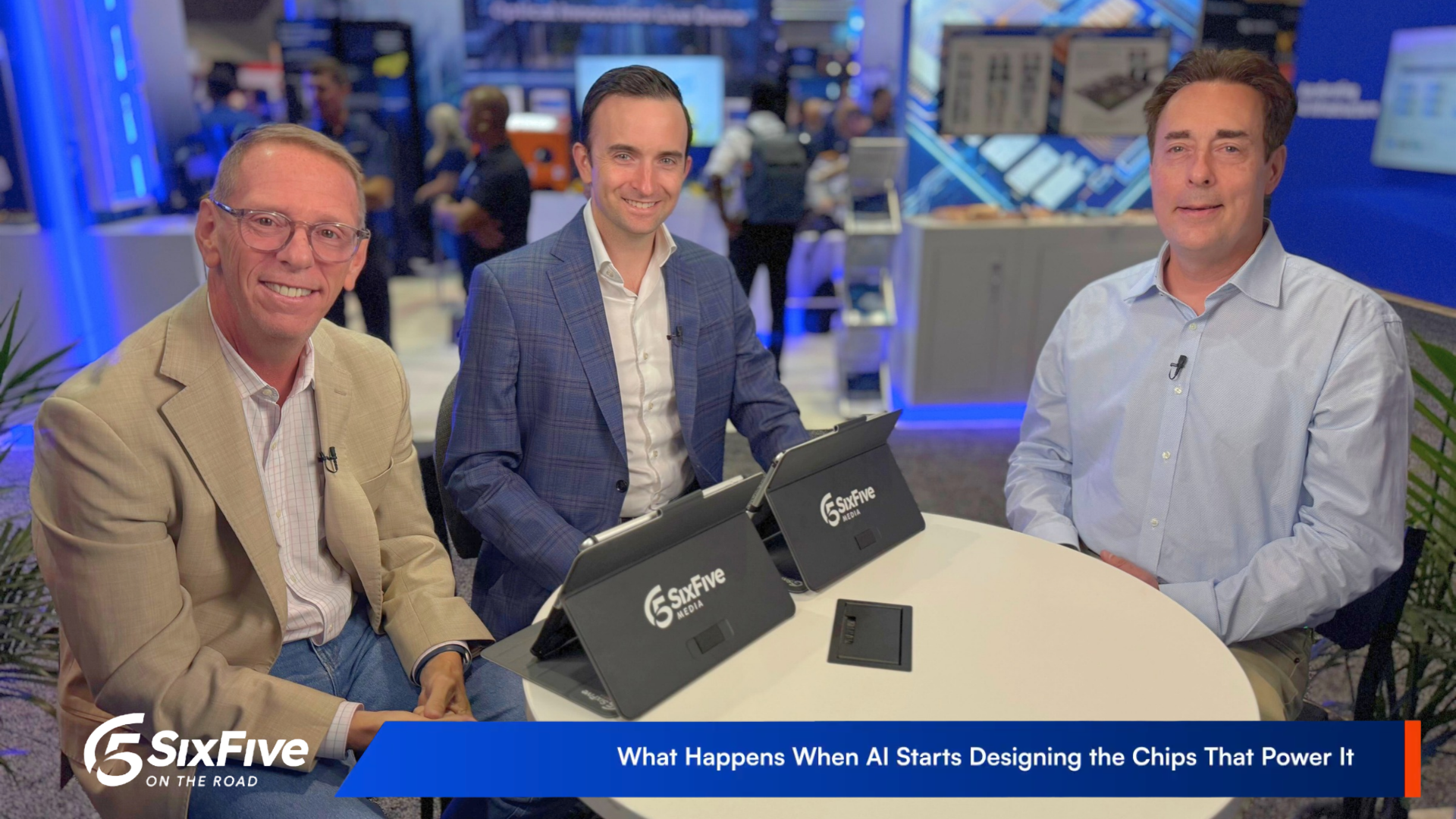
What Happens When AI Starts Designing the Chips That Power It | Synopsys at AI Infra Summit
At AI Infra Summit 2026, Synopsys' Thomas Andersen joins Brendan Burke and Matt Kimball to explain how chip design is moving from AI copilots that suggest to agentic systems that execute tool orchestration, timing fixes, and verification from a written spec. For enterprises, that shift compresses spec-to-tapeout timelines and lowers the resource barrier to custom silicon.


Further Reading
Get insider access to Six Five Media's analyst coverage, major tech events, and executive interviews
