
On-Premise AI for Enterprise: Strategy, Costs, and Vendor Selection in 2026
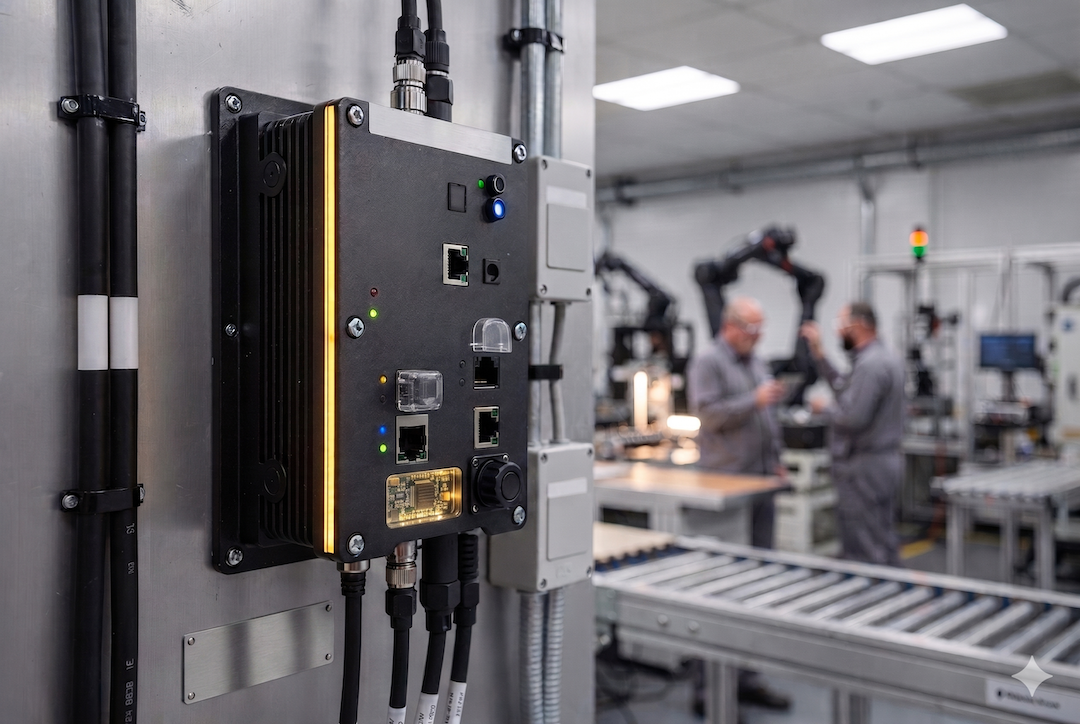
Cloud AI is fast to start. That is not the same as right to scale. Enterprise IT leaders have moved past the procurement question into something harder: a multi-year portfolio decision about where value gets created, where risk sits, and how much operational leverage to build internally versus rent. The frame is no longer "cloud or on-prem" but "which workloads belong where, under what operating model, and on what economics."
TL;DR
Enterprise AI is now core infrastructure spend. Futurum forecasts the data intelligence, analytics, and infrastructure market at $541.1 billion in 2026, growing to over $1.2 trillion by 2031. According to the IDC CIO Playbook 2026 commissioned by Lenovo, 84% of organizations expect to run AI across on-premises or edge environments alongside cloud. Utilization is the single most important TCO variable: below sustained 70%, cloud usually wins; above 80%, owned infrastructure becomes increasingly attractive over three years. Dell reports up to 2.6x first-year ROI for early AI Factory adopters in an Enterprise Strategy Group analysis. Lenovo reports up to 8x lower cost per token versus comparable cloud IaaS. Programs fail on operating model, not hardware.
The Strategic Backdrop
Enterprise AI has crossed from line-of-business experimentation into core infrastructure spend. Futurum's forecast puts the DIAI market at $541.1 billion in 2026, growing at a 17% CAGR through 2028 and exceeding $1.2 trillion by 2031. A separate Futurum survey of 820 global AI decision-makers found that the dividing line between AI leaders and laggards is organizational, not technical. Leaders have a Chief AI Officer, agentic orchestration in production, and metric discipline. Enterprises now run an average of 3.8 models simultaneously, so the infrastructure conversation is no longer about a single model in a single environment.
The data foundation is where most programs still stumble. Futurum analyst work surveying more than 800 senior data and analytics leaders identifies data quality, trust, and governance as the leading cause of AI project failure. Hardware decisions made without a credible data plan will underperform regardless of how well the silicon is specified.
When Does On-Premise AI Make Sense?
On-premise AI makes strategic sense when inference volume is high and predictable, workloads touch sensitive data, latency requirements are tight, regulatory obligations are material, or the workload is core to a differentiated product. Dell's two-year update on the AI Factory with NVIDIA frames the shift in a single sentence: "As AI code assistants and agentic workflows drastically lower the cost and time to build custom applications, CIOs are increasingly choosing to develop AI capabilities in-house, on-premises, driving the need for owned infrastructure."
Low-volume or highly variable inference is almost always better served by cloud APIs. Once traffic is steady and predictable, the case for owned infrastructure becomes worth modeling carefully. Start with a full TCO analysis, not a vendor pitch.
Total Cost of Ownership
A defensible TCO model has to treat compute, storage, and networking as a single system, not three separate procurements. Facilities cost for power and cooling, software licensing, staffing, refresh cycles, and procurement lead times all belong in the model from day one.
Utilization is what makes or breaks the math. Below sustained 70%, cloud almost always wins. Above 80%, owned infrastructure becomes increasingly attractive over three years.
On the financing side, buying outright delivers the best long-term economics at high utilization but concentrates risk on a single capacity bet. Consumption-based models shift cost to OpEx and reduce commitment risk. HPE was named a Leader in the inaugural 2025 Gartner Magic Quadrant for Infrastructure Platform Consumption Services, positioned highest in execution and furthest in vision, and GreenLake is the most mature consumption option on the market.
Planning teams consistently underestimate facility upgrades, data migration, security documentation, backup and disaster recovery, and ongoing model lifecycle management. These are far more expensive after the fact.
Why Programs Fail
Moor Insights & Strategy's research on the architectural shift driving AI infrastructure puts it directly: "AI is primarily constrained not by algorithms or software innovation but by system design. Power availability, efficiency, latency, scalability, and deployability across heterogeneous environments now define what is practical."
In a Six Five On The Road conversation at SC25, Lenovo described how nearly every customer conversation now starts with three questions before any GPU spec gets discussed: how much power is coming into the data center, what the cooling infrastructure looks like, and what the networking and storage requirements will be. Infrastructure complexity regularly outruns facility readiness. The operating model lags the hardware. Security and governance get deferred. Data readiness is underestimated. Talent is overstated.
Who Are the Top Vendors in 2026?
No single vendor covers the full stack, yet. Treating this as a single-vendor decision is one of the more expensive mistakes an enterprise can make. The leading players include Dell Technologies, NVIDIA, Cisco, HPE, Lenovo, Supermicro, Pure Storage, Broadcom (VMware), and IBM.
Dell Technologies is the most common starting point for enterprises standardizing on established data center platforms. Moor Insights & Strategy's research on the Dell AI Factory reinforces what Dell itself reports: an end-to-end path across data platform, infrastructure, and services. Dell's 2026 portfolio update runs from desktop AI development hardware through flagship liquid-cooled servers like the PowerEdge XE9812 on NVIDIA Vera Rubin NVL72, with over 4,000 customers and 2.6x first-year ROI per the ESG-commissioned analysis.
NVIDIA is the central layer in nearly every serious enterprise AI stack. The strategic question is rarely whether to use NVIDIA, but how deeply to commit to its software platform. NVIDIA AI Enterprise, NIM inference microservices, and the broader CUDA ecosystem cut engineering effort substantially, at the cost of architectural specificity. For most enterprises running large models, the software stack is harder to avoid than the silicon itself.
Cisco owns networking, security, and observability in the AI stack. Moor Insights & Strategy notes in its coverage of Cisco's enterprise AI platform strategy that the company is leveraging platform advantages across networking, security, observability, compute, and silicon to support agentic AI workloads. Cisco's Secure AI Factory with NVIDIA packages UCS compute, Nexus networking fabric, AI Defense, and Splunk-based monitoring into a validated reference architecture focused on security at the data layer. For organizations where security and observability are the gating factor, Cisco's role is more strategic than it appears on a hardware bill of materials.
HPE is built around consumption flexibility and hybrid operations. Moor Insights & Strategy's analysis of HPE Private Cloud AI highlights frictionless deployment, built-in NVIDIA Blueprints including AI-Q for agentic AI, and self-service environment provisioning, and describes HPE GreenLake Intelligence as the first articulation of the autonomous datacenter from any vendor. HPE's recent expansion of its private cloud and data platform portfolio adds unified data access for AI readiness.
Lenovo is positioned explicitly on hybrid by design. In a Six Five On The Road conversation at SC25, Lenovo executives walked through how the company guides customers from workload definition through deployment decisions based on latency, sovereignty, or cost. The portfolio runs from edge AI for retail customers like Kroger doing machine vision for theft detection up to 150kW eight-way racks for full AI factories. At GTC, Lenovo introduced Hybrid AI Advantage with NVIDIA and the AI Cloud gigafactory built on NVIDIA Vera Rubin NVL72.
Supermicro plays a distinct role at the rack-scale and turnkey AI factory layer. Supermicro's AI factory cluster solutions ship pre-integrated and L12 cluster-tested, with NVIDIA AI Enterprise and Spectrum-X Ethernet networking, in 4-node to 32-node configurations. In a Six Five Media discussion at NVIDIA GTC, Supermicro positioned its Data Center Building Block Solutions around flexibility for diverse workloads, packaged for enterprises retrofitting existing facilities or building greenfield.
Everpure (formerly Pure Storage) has repositioned from storage vendor to data platform provider for AI. In a Six Five Media conversation at Pure//Accelerate, CEO Charles Giancarlo described the Enterprise Data Cloud strategy as networking all of a customer's arrays to appear as a single cloud of storage, making enterprise data directly accessible to AI workloads without replication. Pure's Q3 results showed 16% revenue growth, well above the broader storage market. For organizations where data validation, governance, and quality are the gating issues for AI, Pure deserves serious evaluation alongside any compute decision.
Broadcom (VMware) has made AI a native capability of the private cloud platform rather than a separate stack. At VMware Explore 2025, Broadcom announced that VMware Private AI Services would become a standard component of VMware Cloud Foundation 9.0, adding built-in GPU Monitoring, Model Store, Model Runtime, Agent Builder, Vector Database, and Data Indexing and Retrieval services. The Multi-accelerator Model Runtime is worth flagging specifically: it lets organizations deploy AI models across AMD and NVIDIA GPUs without refactoring applications. In a Six Five conversation following the acquisition close, VMware's Krish Prasad framed the private AI strategy plainly: private means the privacy of the data, keeping it close to where it is generated. A recent Broadcom and NVIDIA webinar walked through the full capabilities packaged on top of VCF and NVIDIA AI Enterprise. For enterprises already on the VMware path, Private AI Foundation with NVIDIA is the path of least resistance to a governed, secure AI environment.
IBM has spent two years building a hybrid AI operating model spanning models, data, orchestration, and sovereign infrastructure. At Think 2026, IBM unveiled the Blueprint for the AI Operating Model, built on four integrated systems covering agents, data, automation, and a hybrid foundation. IBM Sovereign Core is the most distinctive piece for IT leaders thinking about data residency. Moor Insights & Strategy's research note on Sovereign Core describes a customer-operated control plane on Red Hat OpenShift that ships with more than 160 preloaded regulatory frameworks, continuous runtime compliance checking, and AI governance extending to which models run, where they run, and how decisions get logged. In a Six Five Media conversation, IBM SVP and Chief Commercial Officer Rob Thomas framed the hybrid AI thesis plainly: AI will run on-premises, in the cloud, at the edge, and in sovereign environments, and the differentiator is the orchestration engine deciding which model runs where. The Granite 4.1 family gives enterprises an open-weights, Apache 2.0-licensed option in 3B, 8B, and 30B sizes with context windows up to 512,000 tokens. The 8B model runs on a single H100 or A100, putting on-premise self-hosting within reach of mid-sized organizations.
Questions to Answer Before Investing
Before any infrastructure decision, get clear written answers to six questions. Which workloads are production-ready versus experimental? What data must stay under your control? What are the latency, availability, and reliability requirements? Who operates and governs the environment, and what is the RACI across IT, security, data science, and the business? What is the expected utilization rate, and what is the fallback if it lands 30% below plan? How will you measure success?
Follow A Three-Phase Implementation Roadmap
Phase 1: Discovery and Readiness
Define business goals and select a specific, bounded use case. Assess data readiness, current infrastructure, security requirements, and internal skills honestly. The output is a clear picture of what you have, what you need, and which gaps have to close before production.
Phase 2: Pilot Deployment
Deploy a minimum viable environment for the bounded use case. Measure latency, accuracy, utilization, and unit economics against real usage data. The purpose of the pilot is to surface surprises before production-scale commitment.
Phase 3: Production Scaling
Moving from pilot to enterprise service is a step change. It requires high availability and disaster recovery, observability, access control and governance automation, model versioning and lifecycle management, and chargeback or showback models for internal consumers. Scale only after the pilot has demonstrated measurable business value.
Build the Operating Model Before You Buy the Hardware
Successful on-premise AI is an alignment problem. Infrastructure, data, governance, cost, and operating model all have to point in the same direction. Hardware is the most visible part of the equation and the part vendors will help with most aggressively. It is rarely where programs fail. Programs fail because of data readiness issues, skills gaps, unclear ownership, and underestimated operational complexity.
Start with use cases and a readiness assessment. Evaluate hybrid and local options against business outcomes, not vendor narratives. Engage IT, security, data science, and business stakeholders early. The decisions made in the first few months shape everything that follows, and they are far harder to reverse than they look at the time.
AUTHOR

SHARE


Related Content
%20thumb.png)
Get insider access to Six Five Media's analyst coverage, major tech events, and executive interviews
