
AI-Native, Autonomous, Everywhere: Unpacking the HPE Discover Keynote - Six Five On The Road
SHARE


Ryan Shrout, President & GM at Signal65, joins hosts David Nicholson and Will Townsend to share insights on HPE’s AI-native networking strategy, self-driving networks, and how unified observability is reshaping enterprise AI and security.
How is advanced networking enabling enterprises to unlock the full potential of distributed AI workloads?
From HPE Discover Barcelona 2025, Six Five Media analysts David Nicholson, Will Townsend, and Ryan Shrout share insights on the latest in HPE’s AI-native networking strategy. They explore how new advancements—like self-driving network operations, Private 5G, Wi-Fi 7, and unified edge-to-cloud observability—position HPE to support distributed artificial intelligence, strengthen enterprise security, and address compliance in global operations.
Key Takeaways Include:
🔹AI-Native Networking as the “Enterprise Nervous System”: HPE’s approach repositions the network as the foundational real-time fabric essential for deploying and scaling AI workloads across data centers, the edge, and campus environments.
🔹Advances in Automation and Self-Driving Networks: The integration of AIOps-driven automation and Aruba’s leadership in autonomous networking are moving enterprises closer to fully autonomous, self-optimizing systems.
🔹Edge as Strategic AI Infrastructure: The convergence of Wi-Fi 7, LAN/WAN, and Private 5G transforms the edge into a critical AI infrastructure layer, not merely a connectivity point.
🔹Unified Observability Enhances Security and Performance: Real-time edge-to-cloud network visibility and control are becoming vital for operating and securing distributed AI applications.
🔹Addressing Sovereignty, Compliance & Regional Needs: HPE’s networking strategy actively tackles sovereignty and compliance for European customers, enabling greater data path control and regional autonomy.
Learn more at HPE.
Watch the full video at sixfivemedia.com, and be sure to subscribe to our YouTube channel, so you never miss an episode.
Or listen to the audio here:
Disclaimer: Six Five On The Road is for information and entertainment purposes only. Over the course of this webcast, we may talk about companies that are publicly traded, and we may even reference that fact and their equity share price, but please do not take anything that we say as a recommendation about what you should do with your investment dollars. We are not investment advisors, and we ask that you do not treat us as such.
David Nicholson:
Welcome to Six Five On The Road. We're here at HPE Discover Barcelona 2025. I'm Dave Nicholson with the Futurum Group, and sometimes I get to experience something truly joyful, and that is the opportunity to talk to really, really smart people about stuff they know things about. And I have one of those people with me right here, friend and colleague, Will Townsend, for more insights. He is Vice President and Principal Analyst, specifically focusing, not just on these things, but specifically on networking and security. So, when you want to talk to someone about networking, he's the guy, and I've got him right here. Let me tee this up for you, Will.
Will Townsend:
Okay, Dave. By the way, that was a great introduction.
David Nicholson:
We're here at HPE Discover. Barcelona. And they've been talking about the network as sort of the central nervous system in the AI native enterprise moving forward. What's your take on that? Do you think that that is... a good place to start the conversation about networking in 2025.
Will Townsend:
Dave, I love that analogy. I mean, think about it. I'm not a doctor, but I like to play one on TV sometimes. The nervous system in our body controls so many functions, right? And when you think about networking and the need to move data, to train large language models hosted in clouds, smaller language models at network edges and within enterprises. I think it's a great analogy.
David Nicholson:
When we talk about networking, just give us sort of a primer on the protocols that we're talking about here because people will talk about open versus closed, but what are the primary networking methodologies that we're talking about?
Will Townsend:
Well, I mean, you've got two camps, right? So you have Ethernet. That is a standard that continues to mature through the Ethernet consortium. And with respect to AI, you've got NVIDIA with InfiniBand. InfiniBand was an acquisition that they made at Mellanox many years ago. But what I'm quickly seeing is that Ethernet, through its evolution, is able to support what's needed from an AI workload and application perspective. I don't think InfiniBand is going to go away anytime soon, but I do think, for example, with the AMD HPE Helios announcement for RackScale infrastructure, AI infrastructure, and for a switch that supports that infrastructure, it just demonstrates the value of OpenEthernet.
David Nicholson:
And now NVIDIA has come down on the side of, we love Ethernet also, because they're not trying to crowd everybody out with InfiniBand, NVLink, etc. InfiniBand's not going anywhere, as you say. What about wireless technology? Does that fit into what we're hearing here?
Will Townsend:
Well, there hasn't been a lot of talk on day one about what HPE is doing specifically with private 5G, but certainly cellular is growing in adoption. When you look at OT environments, manufacturing automation, a whole host of use cases, transportation and logistics. I think it becomes an important part of the overall scheme. And then, you know, Wi-Fi. I mean, again, Wi-Fi is not going away. You know, early on when 5G was launched, I was always asked, hey, you know, is 5G going to replace Wi-Fi? It's not the case. They're better together. There's going to be a blend. And in fact, there's an announcement this week around the support for a Wi-Fi 7 access point. that can run both Aruba Central and Juniper Mist. So we're already seeing the integration of both companies come together just in a matter of months.
David Nicholson:
I want to talk about security in a second, but when we talk about AI and networking, You can sort of draw a line down a sheet of paper, and on one side you can put AI enabling the management of networking versus networking that is designed for AI workloads in particular. Can you kind of explain the difference between those two things? Because people get confused about, when they hear AI and networking,
Will Townsend:
Yeah.
David Nicholson:
Sometimes they forget about one or the other.
Will Townsend:
Yeah, they get interchanged. So AI for networking, think about tools, capabilities that ease the whole notion of deploying networking. So think about generative AI and co-pilots and that sort of thing that helps streamline the operational management of sort of networking operations and security operations. And now we're going to talk about security because HPE is very focused on integrating the two together. And then when you think about networking for AI, it's ensuring that you have the right plumbing, right? To be able to move these huge volumes of data around that are needed to train all of these models, to take full advantage of the business outcomes that result from modern AI. So I did that intentionally, by the way.
David Nicholson:
I was trying to trip you up because I know that you... I almost, because I'm jet lagged right now. Yeah, your brain automatically integrates security and networking as they should be. When I said we'll talk about it later, I saw a grimace on your face. Assuming for a moment that security needs to be baked into that networking layer constantly, what are some of the important takeaways so far? out of HPE Discover on that subject?
Will Townsend:
Well, nothing earth shattering. I mean, there was a lot of announcements related to that subject at Discover Las Vegas. But what I'm seeing is sort of a progression of the integration between Juniper, again, and Aruba. Both companies bring very strong AI ops to bear. Another aspect that's important to note is that during the keynote, Rami Rahim spoke to the cross-pollinization of features from Aruba in the Mist and Mist in Aruba. He also talked about Apstra and HPE OpsRamp coming together. Why that's important is that you need observability, especially in most enterprise environments that are multi-vendor, to be able to monitor the entire state of infrastructure. And the value for networking is that with that improved visibility, you drive a higher network assurance. And that also helps identify gaps that can create opportunities for bad actors to enter a network and move laterally and that sort of thing. So it's a win-win. So when you look at the two companies coming together, what they're bringing from an AIOps perspective, but also from an observability perspective, I think it's a force multiplier, Dan.
David Nicholson:
So you think this is an example of the kind of marriage made in heaven, as opposed to the collision of two dump trucks, the two rocks going for a swim, the beginning of an integration story.
Will Townsend:
Yeah, you know, I love that analogy, two dump trucks hitting each other. There were a lot of doubters, right? And the acquisition was longer than I think everyone expected. I'm not going to quote any of my analyst peers out there. I have a lot of respect for everyone that I spend time with. But there were some that were just kind of pointing to this as a share consolidation. There was too much overlap, but what they didn't understand were the true synergies. And one of the things that I learned very quickly was that from a customer standpoint, there wasn't a whole lot of overlap between Juniper and Aruba coming together. And Antonio made that quite clear when the announcement was made. I remember hearing about it on a Sunday and being briefed by Antonio and Rami on a Monday. That, I think, is huge. And then, as you look at the portfolio, yes, there's been some overlap. There's been some rationalization. There were some DOJ stipulations that they had to divest on certain things. But when you kind of break it down and look at the core of it, very, very highly complementary. Juniper brings, for example, a very strong service provider. capabilities that complements what HPE is doing from a private 5G perspective. And then again, when you look at Juniper's penetration into the data center, Aruba's was relatively weak, although you could argue with the launch of the AMD Pensando top of rack switch, the CX 10,000, that was sort of the tip of the spear for Aruba to enter the data center. But when you kind of weigh all that, Dave, it's a highly complementary portfolio.
David Nicholson:
So at this stage of the game, you would rate the acquisition of Juniper as a net positive for HPE and its customers, no question?
Will Townsend:
No question. Net positive. I think, you know, Rami, Rahim coming in to lead the HPE networking portfolio combined is huge. He's a technical person with 30 plus years of experience in the industry. He's a visionary. I mean, Rami, I'm not just saying this to compliment you, but he's sort of like, from my perspective, Steve Jobs, the networking whisperer in the industry that a lot of people maybe didn't realize because he was working for a smaller organization, less prominent than HPE. But I believe he's going to bring innovation. He brings passion. Every time I have an opportunity to speak with him, he's just, I believe, going to be a fantastic catalyst to move the networking business further. And hey, I think at the end of the day, the industry is going to benefit from having a stronger second choice when it comes to networking infrastructure.
David Nicholson:
Yeah, that's a great point. It's always good to have a choice. We are going to choose to sign off here. Thank you, Will Townsend. Thank you, Dave. For Six Five On The Road and for Will Townsend, I'm Dave Nicholson. Thanks for tuning in here at HPE Discover Barcelona 2025. Stay tuned for more interesting content.
MORE VIDEOS
Industry Veteran and Google’s Satish Thomas on Replacing One-Size-Fits-All Enterprise AI With Industry-Specific Agents
Google is moving enterprise AI beyond general-purpose tools and into industry-specific workflows built for regulated sectors such as legal and financial services. Satish Thomas, Vice President, Business and Industry Solutions at Google, joins Six Five to explain how Gemini Enterprise for Industries combines purpose-built skills, ready-to-deploy agents, model choice, and an open partner ecosystem to bring AI into the workflows enterprises already run.


AMD Instinct MI355X vs NVIDIA HGX B200 GPU platforms AMD vs NVIDIA: A Three-Level Inference Infrastructure Evaluation
Signal65 President Ryan Shrout and Senior Performance Analyst Mitch Lewis review a new three-level inference infrastructure evaluation of AMD's Instinct MI355X against NVIDIA's HGX B200 with AMD's Andrew Dieckmann and Anush Elangovan. The MI355X's memory bandwidth advantage compounds as context and concurrency scale, delivering up to 2.25x throughput gains and roughly 40 percent lower cost per GPU hour.
.png)
Anthropic’s AI Slowdown, OpenAI’s $1.2T Valuation & Salesforce’s AI Bet
Anthropic's "Pace the Frontier" essay set off a week in which nearly every major AI leader, and two heads of state, weighed in on whether the frontier should slow down. Patrick Moorhead and Daniel Newman read the incident as something larger than a safety debate. Whoever sets the pace of the frontier also sets the pace for open-weight models, enterprise custom models, and the trillion-dollar valuations riding on top of them. That contest, not the essay itself, is the through-line of Episode 320 of The Six Five Pod.
Other Categories
CYBERSECURITY
Threat Intelligence: Insights on Cybersecurity from Secureworks
Alex Rose from Secureworks joins Shira Rubinoff on the Cybersphere to share his insights on the critical role of threat intelligence in modern cybersecurity efforts, underscoring the importance of proactive, intelligence-driven defense mechanisms.

HP Launches World’s First Business PCs to Protect Against Quantum Hacks - The Six Five On the Road
On this episode of the Six Five - On the Road, hosts Patrick Moorhead and Daniel Newman are joined by HP's Ian Pratt, Global Head of Security for Personal Systems.
What is Autonomous Endpoint Management?
Autonomous Endpoint Management is a framework designed to unify IT operations and security teams on a single platform through real-time control and visibility.
QUANTUM
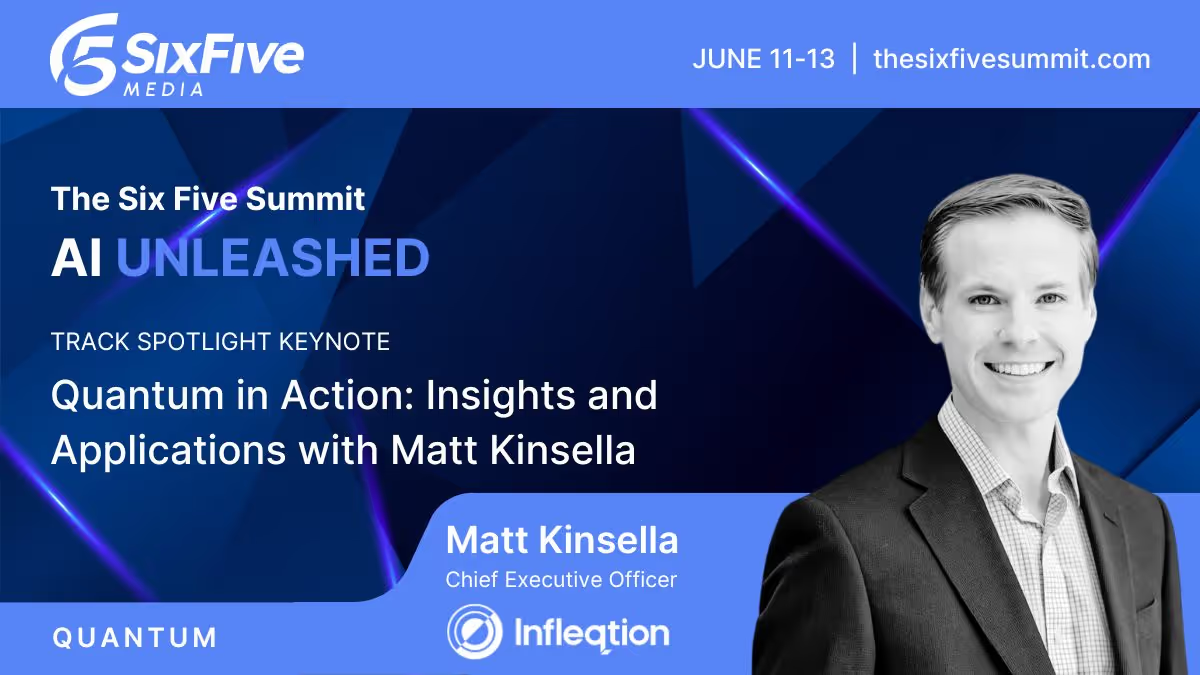
Quantum in Action: Insights and Applications with Matt Kinsella
Quantum is no longer a technology of the future; the quantum opportunity is here now. During this keynote conversation, Infleqtion CEO, Matt Kinsella will explore the latest quantum developments and how organizations can best leverage quantum to their advantage.
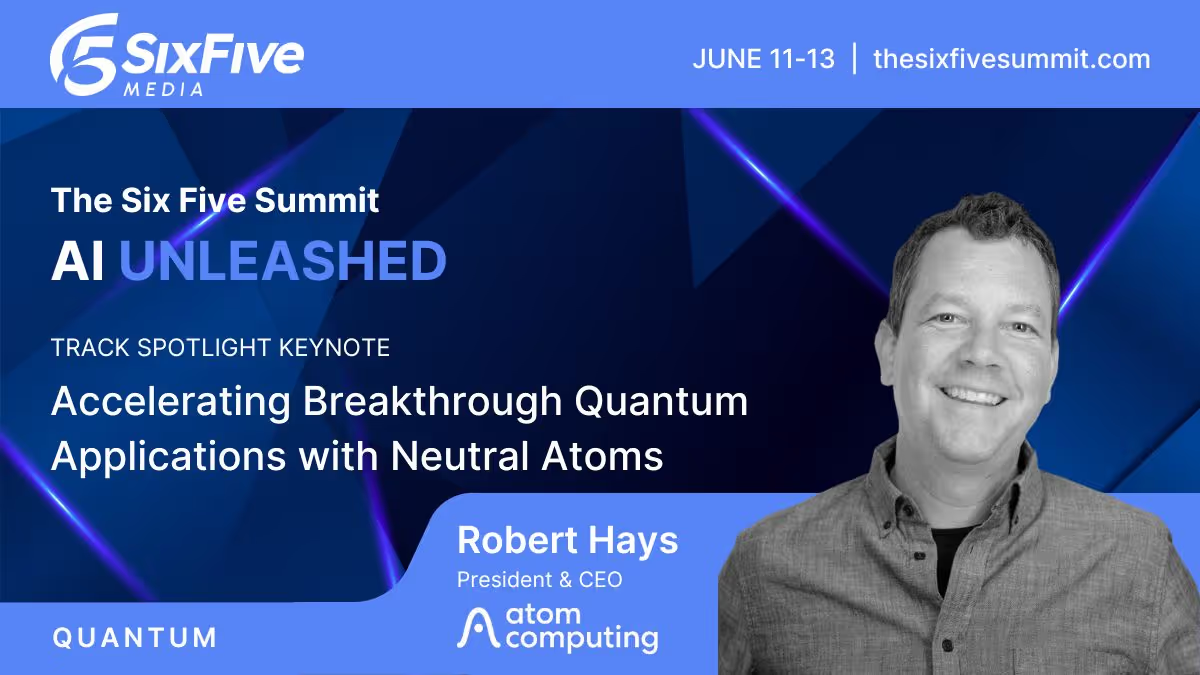
Accelerating Breakthrough Quantum Applications with Neutral Atoms
Our planet needs major breakthroughs for a more sustainable future and quantum computing promises to provide a path to new solutions in a variety of industry segments. This talk will explore what it takes for quantum computers to be able to solve these significant computational challenges, and will show that the timeline to addressing valuable applications may be sooner than previously thought.