
AI, Security, and the End of Traditional Distribution - Six Five On The Road
SHARE


Distribution has moved well past fulfillment, and Eric Kohl, VP of Global Vendor Engagement at Ingram Micro, makes the case that complexity itself has become the distributor's value proposition. Kohl joins Six Five at HPE Discover 2026 to break down how Ingram Micro is helping channel partners build credible practices across networking, security, and AI, and why identity is the next adjacency partners cannot afford to ignore.
Distribution used to mean one thing: take products from one company, send them to another, collect a few profit margin points along the way. That model is gone. The partner ecosystem now includes ISVs, MSPs, and a tangle of specialized players all trying to navigate networking, security, and AI convergence at once. The distributors who can't keep up with that complexity are becoming irrelevant to it.
At HPE Discover 2026 in Las Vegas, David Nicholson and Tom Hollingsworth sat down with Eric Kohl, VP of Global Vendor Engagement at Ingram Micro, to discuss what distribution looks like now that fulfillment is the smallest part of the job. Kohl frames the shift around three priorities: speed, scale, and service, and backs each one with specifics, from automating RFI response times that used to outpace a SpaceX round trip to the moon to onboarding Juniper's partner network into HPE following the networking and security combination.
Why does Kohl call this complexity job security for Ingram Micro? What does it actually take to help a reseller behave like a top-tier cybersecurity provider instead of someone who just sold a firewall and called it a practice? And as AI becomes the next category every IT provider has to credibly serve, what is Ingram Micro doing differently to keep partners from getting handed an AI product and left to figure out deployment alone? Kohl closes with a direct answer on where channel partners need to focus over the next 12 to 18 months, and identity sits right at the center of it.
Key Takeaways:
🔹 Distribution has moved from warehouse-and-fulfillment to strategic enablement, and the change happened because the ecosystem itself got more complex. ISVs, MSPs, and a growing list of specialized partner types now require a distributor that can help them navigate access, not just shipment.
🔹 Speed is no longer optional in partner enablement. Kohl points to RFI response times as a concrete failure point, and Ingram Micro has automated quoting processes specifically because losing deals to slow turnaround is an avoidable problem, not a cost of doing business.
🔹 Networking and security convergence demands more than combined product lines. With HPE's Juniper integration underway, Ingram Micro is actively onboarding Juniper's partner network and building enablement and education around it, treating the technical convergence and the partner convergence as two halves of the same job.
🔹 Selling a firewall does not make a partner a security practitioner. Ingram Micro's cybersecurity strategy walks partners through the full sales cycle, from pre-sales enablement to post-sale time-to-value to SOC-as-a-service, specifically so resellers can credibly sell comprehensive security rather than point products.
🔹 AI today resembles cybersecurity two decades ago: every IT provider will eventually need a credible practice or lose ground to a competitor who built one first.
🔹 Identity is the next adjacency partners cannot afford to ignore. With autonomous agents multiplying across enterprise environments, Kohl frames identity as the new perimeter, and Ingram Micro is investing in that practice ahead of the demand curve rather than reacting to it.
🔹 Partner success increasingly depends on leveraging distributors as strategic advisors rather than transactional logistics providers.
Watch the full video at sixfivemedia.com, and be sure to subscribe to our YouTube channel so you never miss an episode.
Disclaimer: Six Five Media is for information and entertainment purposes only. Over the course of this webcast, we may talk about companies that are publicly traded, and we may even reference that fact and their equity share price, but please do not take anything that we say as a recommendation about what you should do with your investment dollars. We are not investment advisors, and we ask that you do not treat us as such.
DAVE NICHOLSON:
Welcome to SIx Five On The Road. I'm Dave Nicholson and we're here at HPE Discover in Las Vegas, Nevada. And we're about to have a great conversation about partner ecosystems and distribution and how that's changing, especially in the world of AI. We've got a great guest, Eric Cole, Vice President, Global Vendor Engagement of Ingram Micro. Welcome to the show.
ERIC KHOL:
Thank you very much. Excited to be here.
DAVE NICHOLSON:
So when I think of distribution, I think of a company that takes products from one company and sends them to another company. Is it a little more complicated than that these days? Is it more strategic?
ERIC KHOL:
It's way more strategic and certainly way more complicated. As you can tell, I've been in this for a very long time. And I think when I started, it was pretty much that. Hey, you're a warehouse and a fulfillment center. And obviously, the ecosystem has changed so dramatically. It's expanding at the speed of light. And so when you think about all these types of partners that are in the ecosystem today, there's ISVs and MSPs and all these things. And so you've got to have the right strategy to be able to kind of help our partners navigate through that ecosystem and gain access to it.
DAVE NICHOLSON:
So if you think about that in terms of kind of the old model of just fulfillment, Right. Right. You take two points of margin and you make sure that the OEM's products get… On a good day. On a good day. On a good day. I was being generous. You move from fulfillment to enablement. What are the kinds of things that Ingram Micro is doing in partnership with HPE?
ERIC KHOL:
So for me, it's about speed, scale, and service. When I talk about speed, I was at an event a couple weeks ago, and there was a business partner that stood up there and said they didn't have enough time to respond to all of their RFIs because getting quotes together took too long. And that shouldn't happen. And so we've done a lot of work with HPE and other business partners to automate as much of that as we can so that they can respond to market demands faster than ever. You know, if it takes SpaceX to go to the moon and back seven days, it shouldn't take that long to get a quote, right, to service your customer. And then scale is just about, for partners like HPE, you know, we amplify their brand and we help to enable the massive partner community. And then from a service perspective, to me, it's about the people. And we've got amazing talent. So many of them showed up here, our massive leadership team from Ingram Micro here to support our partners at this great event.
TOM HOLLINGSWORTH:
One of the themes that we're hearing here at HPE Discover is that a lot of the networking and security that we've done over the years is kind of integrating and it's becoming a kind of an underlay technology. And a lot of organizations are being asked to deliver broader solutions instead of the point products that we were so used to seeing out of those groups. But I also know from my own experience that a lot of companies need a lot of help figuring out how all of those pieces fit together. And I know that that's something that Ingram Micro is really good at. How are you helping with those partnerships to deliver an integrated solution from the beginning, where we're kind of figuring out what we need all the way through the process when it's being delivered to the customer side?
ERIC KHOL:
Yeah, I mean, look, security and networking have been converged for a long time. And when you think about the massive tidal wave of opportunity from AI, you've got to make sure that your network is modernized. So I'm super excited to see this portfolio come together. You know, from a networking and security and the strength from Juniper, we've had a long-term, tenured partnership, and seeing that combined with new and innovative product offerings is super exciting. But again, it's about enablement and education. And we've got Juniper Partners as an example that we're working to onboard into HPE, because above and beyond security and networking, you've also got to capture the tidal wave of AI. And so these are all the things that we're doing, and again, we've got from technical, all these types of resources are really basically acting as an extension of the HPE channel and sellers to go help our business partners drive profitable growth in this category.
TOM HOLLINGSWORTH:
So in a way, it sounds like not only are you helping HPE customers transition with all of these things, you're in a way helping transition between these kind of disparate systems. that existed before this acquisition of HPE buying Juniper to kind of smooth that process along as well.
ERIC KHOL:
When you think about that complexity, I always say complexity is job security for Ingram Micro. And so we've got a lot of work ahead of us. We're excited that HPE trusts us enough to name us as a global distribution partner. So we'll have full access to the brands around the globe. And so we're super excited about that opportunity. And that's just what we have to do is to help bring these technologies and the partner community and the whole ecosystem together.
DAVE NICHOLSON:
So talking about the convergence of networking and security, it's pretty broadly accepted that that's a massive opportunity to set up a business unit. in kind of the broad partner ecosystem. But what is Ingram Micro's view on that? A lot of other folks are having trouble assembling the teams to be able to deliver that to customers.
ERIC KHOL:
I've been at Ingram for a long time, and we've had a foundational cybersecurity strategy to serve our partners. You know, I've always said selling a firewall does not make you a security practitioner. And so our role has really been to help any number of the thousands of partners that work with Ingram Micro to have them show up like a top-tier cybersecurity provider. And we do that by going through the entire sales cycle to think about, hey, how can we help you from pre-sales enablement? After you've sold the deal, how do we help you to get time to value faster? And then ultimately to wrap it up with 24 by 7 SOC as a service solutions or something, so that they're selling more of a comprehensive cybersecurity solution. And so much is shifting to SaaS and software now, too. And so there's a major role that we're playing in and helping partners on this journey, you know, cross-sell, up-sell, and you've got Zero Trust and, you know, SASE and all these things that are putting software layer well above the hardware layer, and you've got to really bring that together. And the more that we can help them to do it, again, they'll be more profitable, highly trusted security advisors.
DAVE NICHOLSON:
So if I'm a regional value-added reseller, as we used to call them, and I want to do right by my clients, a good idea to have a practice and to leverage Ingram to help us go to market with that convergence of security and networking?
ERIC KHOL:
Yeah, 100%. It's billed by our partner. And we're here to partner. You know, there was a great example yesterday with one of our good partners, Myriad 360, on stage, and they talked about how they made an acquisition of Advisex, right? Because they wanted to make sure that they had the server, the storage, the compute, as their core expertise was in networking. And so, not every company is going to go make an acquisition like that, but they can lean on Ingram Micro and our teams to help them to uncover and unlock those opportunities.
TOM HOLLINGSWORTH:
,We've heard a lot about AI. Everyone seems to be talking about it, especiallyas it comes into the network and security convergence. And a lot of companies are unsure of how they want to proceed with it. And if I'm an organizational executive, my biggest worry is that I picked the wrong partner who's just going to kind of push some AI off on me. and then run away when the choices get hard about how to implement it. What is it that Ingram Micro is doing to help deliver a complete solution that makes their customers happy and helps them with satisfaction, as opposed to just kind of pushing something out the door and saying, well, it's your problem now.
ERIC KHOL:
Yeah, well, so a couple things. First, I think I view the AI market today kind of where cybersecurity was 20 years ago. And, you know, a lot of specialists came out and things like that. But nowadays, everybody that's an IT provider has to have a cybersecurity practice, or you're going to let your competitor in the door. And I think that's where AI is today and still developing all these right use cases. But yeah, to your point, you have to move beyond just selling a point solution and a product. And so a lot of the big companies like HPE, I'll give you an example, we do a lot of work to recruit new vendors into our ecosystem. And the technology has to be good, that's one thing, but they also have to have the right commitment to the channel. And you want to make sure that they're committed to success and that they'll all work together. But it's super important to be able to define those outcomes, figure out niches where you want to play, invest in those areas, and take it to market.
DAVE NICHOLSON:
So we've talked about some of this already, but if you were to sort of sum up the answer to the question, hey, I'm a channel partner. What should I be focusing on over the next 12 to 18 months to give my business a competitive advantage? What are the things that if I miss the trends, I'm in big trouble?
ERIC KHOL:
Give us a roadmap. Yeah, I think focus is the keyword there, right? I love the story about Willie Sutton, famous bank robber in the 30s. Hey Willie, why do you rob banks? Because that's where the money is, right? We can see the tidal wave that's happening with AI, but there's certain adjacencies that you have to be thinking about, right? So for us, identity. Right? Identity is the new perimeter. So we want to make sure that we're investing kind of ahead of that curve. I mean, think about the billions of agents that are going to be running around. They have to be secured. And so we've got a lot of work to do with our identity practice and helping the partners to look at these adjacent types of markets so that they're prepared to tackle that opportunity. And the second thing we kind of talked about a little bit, but hey, lean into Ingram Micro. I've been here a long time. The number one thing that I hear over and over again is, I didn't know you did that. And so rather than me saying the nine million things we can do to help our business partners grow their business, I'll just say, hey, if you have a problem and you don't know how to solve it, give us a call, and we can go build by our partner to do it together.
DAVE NICHOLSON:
It keeps us all young, doesn't it? It sure does. Relatively young anyway.
TOM HOLLINGSWORTH:
Yes. Eric, this has been a great conversation. I'm curious, from your perspective, what are the three biggest important qualities that you should look for in that partnership?
ERIC KHOL:
Look, I'll just go back to the beginning. We're here to help our business partners be more profitable, and we're going to do that with speed, scale, and service. And our teams are here to help tackle this exciting opportunity that's here ahead of us with HPE.
TOM HOLLINGSWORTH:
Thank you very much for tuning in to Six Five on the Road at HPE Discover. Make sure that you subscribe, follow us on socials, and check out all of our coverage at SixFiveMedia.com. We'll see you next time.
MORE VIDEOS
.png)
AI Safety Alarms, China's Distillation Reckoning, and Qualcomm's AWS Breakthrough: A Pivotal Week for Enterprise AI
A viral AI extinction claim, a federal advisory naming six Chinese AI labs for industrial-scale distillation, and a $60 billion Qualcomm-AWS silicon pact define a week when enterprise AI risk and opportunity collided head-on. Patrick Moorhead and Daniel Newman weigh in on what's signal and what's noise across AI safety, chip supply deals, and a market rally still betting big on compute.


The 15-Cent AI Query: Broadcom's Paul Turner on Rebuilding Enterprise AI Economics
A Six Five study found an eight-to-one cost gap between running an AI agent through a leading frontier model and running it on modest on-prem hardware. Paul Turner, Chief Product Officer of the VMware Cloud Foundation Division at Broadcom, joins Daniel Newman and Patrick Moorhead at VMware Explore 2026 to explain how VMware's AI Factory turns GPU provisioning, model management, and security into a repeatable path from infrastructure to production AI.
VMware Explore 2026 Wrap-Up: What’s Next for Private Cloud and Enterprise AI
What infrastructure model makes the most sense when AI workloads move from experimentation into production?
In this analyst recap of VMware Explore 2026, Patrick Moorhead and Daniel Newman examine this central question facing enterprise technology leaders and how Broadcom and VMware are positioning private cloud as a critical foundation for bringing enterprise AI into production.
Other Categories
CYBERSECURITY
Threat Intelligence: Insights on Cybersecurity from Secureworks
Alex Rose from Secureworks joins Shira Rubinoff on the Cybersphere to share his insights on the critical role of threat intelligence in modern cybersecurity efforts, underscoring the importance of proactive, intelligence-driven defense mechanisms.

HP Launches World’s First Business PCs to Protect Against Quantum Hacks - The Six Five On the Road
On this episode of the Six Five - On the Road, hosts Patrick Moorhead and Daniel Newman are joined by HP's Ian Pratt, Global Head of Security for Personal Systems.
What is Autonomous Endpoint Management?
Autonomous Endpoint Management is a framework designed to unify IT operations and security teams on a single platform through real-time control and visibility.
QUANTUM
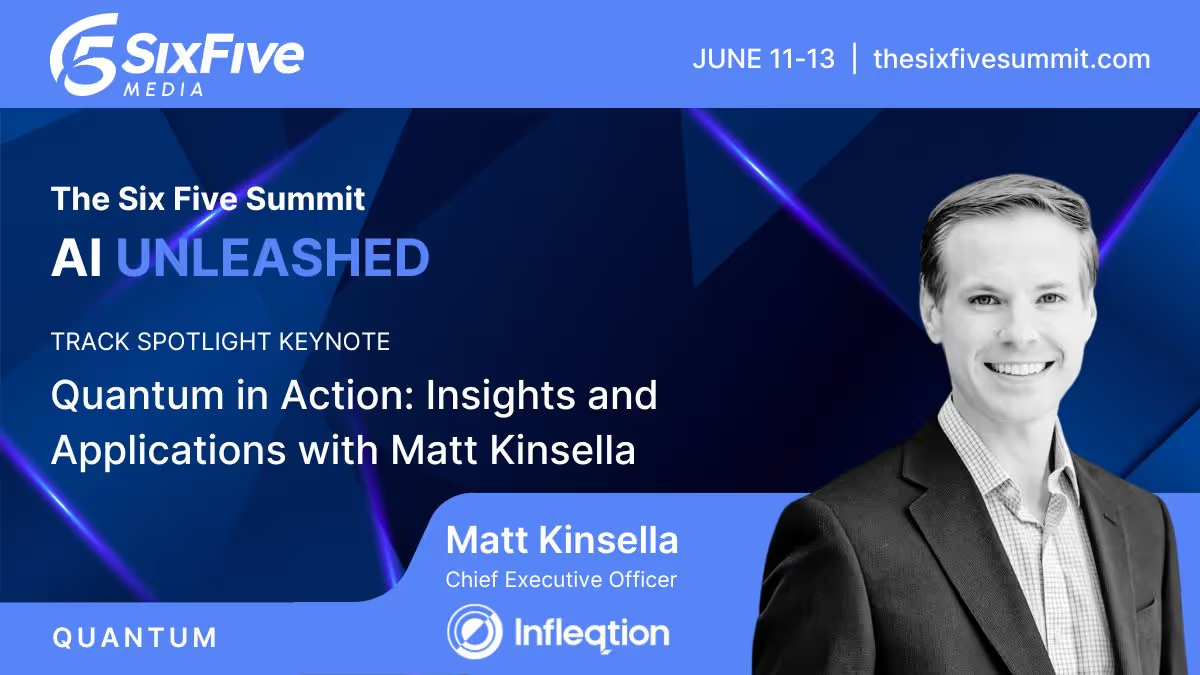
Quantum in Action: Insights and Applications with Matt Kinsella
Quantum is no longer a technology of the future; the quantum opportunity is here now. During this keynote conversation, Infleqtion CEO, Matt Kinsella will explore the latest quantum developments and how organizations can best leverage quantum to their advantage.
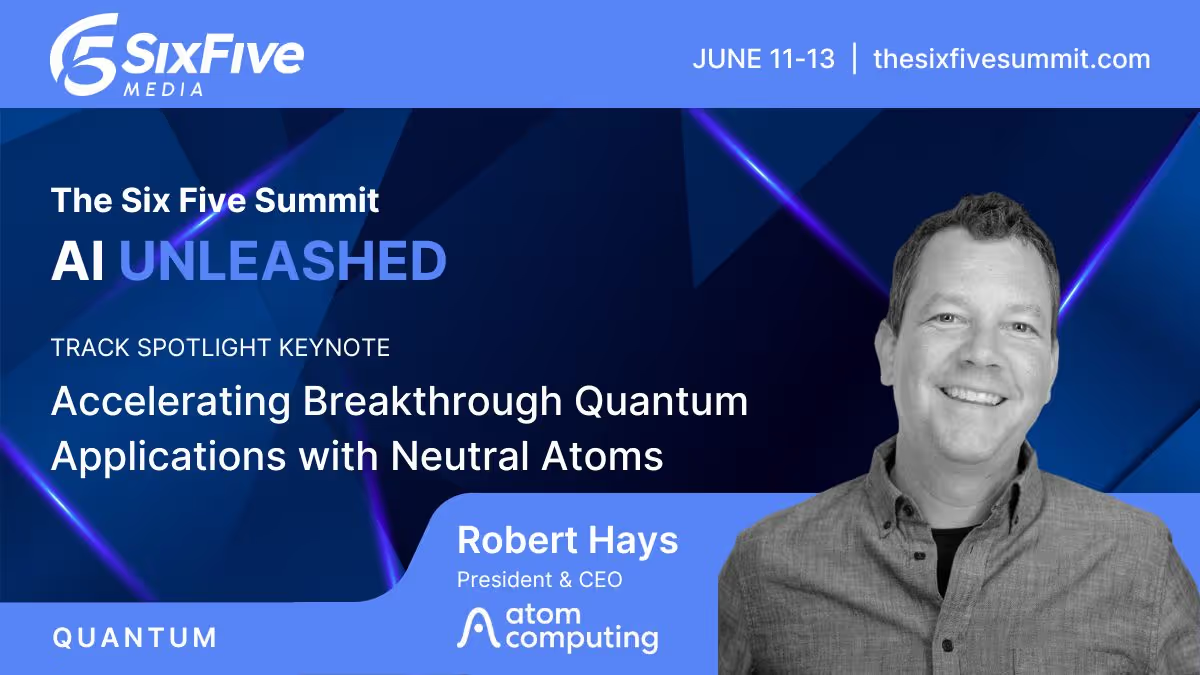
Accelerating Breakthrough Quantum Applications with Neutral Atoms
Our planet needs major breakthroughs for a more sustainable future and quantum computing promises to provide a path to new solutions in a variety of industry segments. This talk will explore what it takes for quantum computers to be able to solve these significant computational challenges, and will show that the timeline to addressing valuable applications may be sooner than previously thought.