
From AI Ambition to AI Outcomes: Building the Infrastructure Foundation for Enterprise AI
SHARE


The bottleneck slowing enterprise AI is not the model or the compute. It is the memory and storage architecture feeding the compute. In this Six Five On The Road conversation at Dell Technologies World 2026, Alan Walker of Samsung Semiconductor and Ben Burgess of Dell Technologies join Matt Kimball to examine stranded GPU economics, co-engineered infrastructure, and what the shift to agentic AI demands from an enterprise stack that was built for a different operating model.
The biggest constraint on enterprise AI right now isn’t just the model or the amount of compute available. It’s the infrastructure feeding those systems. GPUs sitting idle while waiting on memory bandwidth, siloed data slowing real-time inference, and environments built for periodic training now being pushed to support always-on agentic workloads. That’s the real divide between AI pilots and AI systems that can operate reliably at scale in 2026.
At Dell Technologies World 2026 in Las Vegas, Matt Kimball speaks with Alan Walker, Senior Director of Sales at Samsung Semiconductor, Kris Williams, Senior Director of Customer Engineering at Samsung Semiconductor, and Ben Burgess, Chief Product Owner of PowerStore at Dell Technologies, about the infrastructure demands emerging underneath enterprise AI and why tighter co-engineering between storage, memory, and compute vendors is becoming critical for long-term performance.
The conversation digs into the storage and memory limitations many organizations still underestimate, how the Dell and Samsung relationship extends beyond a traditional partnership into deep product integration, and why the rise of agentic AI is forcing enterprises to rethink infrastructure originally designed around training cycles and batch inference.
Key Takeaways:
🔹 Stranded GPUs are one of the costliest problems in enterprise AI. When memory and storage can’t keep pace, utilization drops and expensive compute sits idle.
🔹 Data silos and infrastructure bottlenecks are what keep AI stuck in pilot mode. Enterprises that prioritized models before fixing data, storage, and networking are now hitting operational limits.
🔹 Dell & Samsung’s co-engineering goes far beyond marketing. They are validating memory, storage, and workload performance together at the architecture level before customers deploy the stack.
🔹 Agentic AI changes the infrastructure equation. Continuous agents demand real-time access to memory, storage, and dynamic data environments — not systems designed for batch workloads.
🔹 AI infrastructure decisions made today will shape enterprise capabilities for years. The organizations building for long-term scalability now will be the ones positioned to support agentic AI at production scale.
🔹 The gap between AI ambition and AI outcomes will come down to infrastructure. The winners will treat it as a strategic advantage, not a procurement exercise.
Watch the full video at sixfivemedia.com, and be sure to subscribe to our YouTube channel so you never miss an episode.
IMPORTANT — Note to Uploader: VIDEO EMBED – added by uploader.
Disclaimer: Six Five Media is for information and entertainment purposes only. Over the course of this webcast, we may talk about companies that are publicly traded, and we may even reference that fact and their equity share price, but please do not take anything that we say as a recommendation about what you should do with your investment dollars. We are not investment advisors, and we ask that you do not treat us as such.
MORE VIDEOS
The Major Decision Hiding Behind Every Hypervisor Renewal
HPE's Varma Kunaparaju talks with Patrick Moorhead and Daniel Newman about why virtualization licensing changes are forcing enterprises to confront a bigger decision than which hypervisor to choose next: what operating model sits underneath their private cloud and AI factory. He outlines how CxOs can sequence modernization in phases, extend governance across open and frontier models, and decide where automation should replace human approval in IT operations.


Bridging the Capacity Gap: Why Enterprises Are Investing in Agentic Digital Workers
IFS Loops CEO Somya Kapoor joins Keith Kirkpatrick to explain why agentic digital workers stall between pilot and production, and why governance, escalation design, and change management now shape adoption more than building agents does. Drawing on new Futurum research, she shows how enterprises can start with imperfect data and redirect reclaimed capacity toward growth.

Meta's Muse Moment, AMD's Trillion-Dollar Milestone, and the Agent-Driven CPU Rally
Meta's Muse launch turned a consumer AI agent into a CPU demand story, a new round of frontier model releases sharpened the fight over token economics, and AMD crossed the trillion-dollar mark on the same compute thesis. Patrick Moorhead and Daniel Newman break down Meta Connect, Qualcomm's agentic-device push, the AI policy debate, and whether Meta has finally cracked mainstream AI wearables.
Other Categories
CYBERSECURITY
Threat Intelligence: Insights on Cybersecurity from Secureworks
Alex Rose from Secureworks joins Shira Rubinoff on the Cybersphere to share his insights on the critical role of threat intelligence in modern cybersecurity efforts, underscoring the importance of proactive, intelligence-driven defense mechanisms.

HP Launches World’s First Business PCs to Protect Against Quantum Hacks - The Six Five On the Road
On this episode of the Six Five - On the Road, hosts Patrick Moorhead and Daniel Newman are joined by HP's Ian Pratt, Global Head of Security for Personal Systems.
What is Autonomous Endpoint Management?
Autonomous Endpoint Management is a framework designed to unify IT operations and security teams on a single platform through real-time control and visibility.
QUANTUM
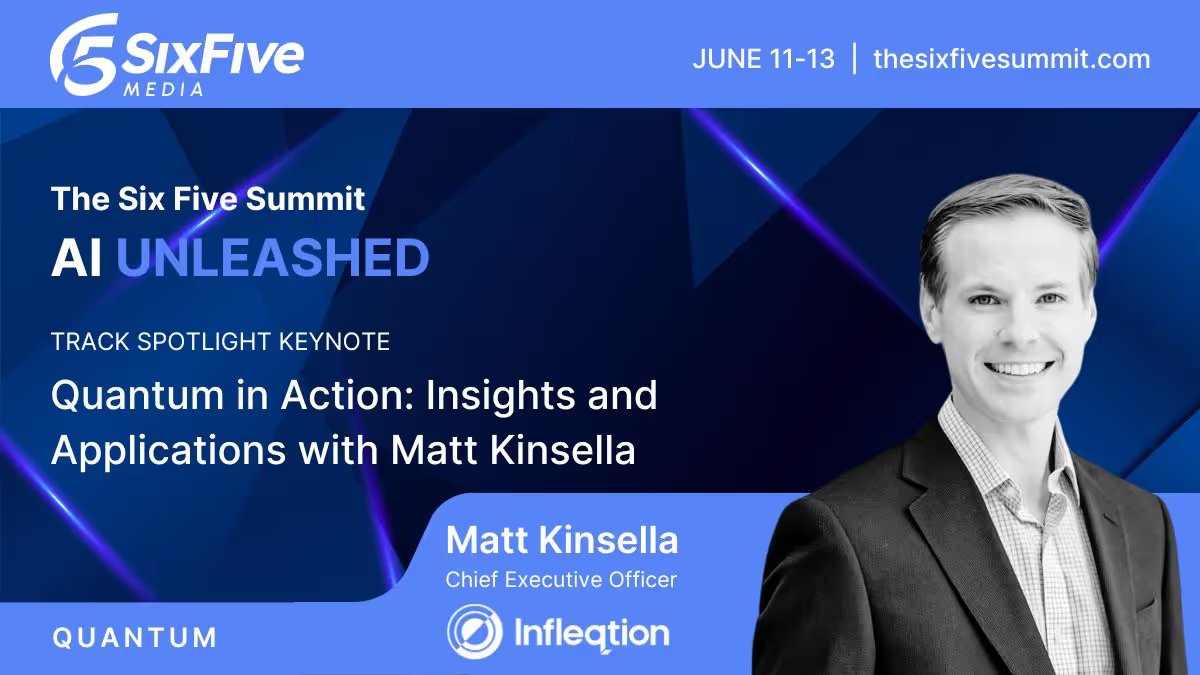
Quantum in Action: Insights and Applications with Matt Kinsella
Quantum is no longer a technology of the future; the quantum opportunity is here now. During this keynote conversation, Infleqtion CEO, Matt Kinsella will explore the latest quantum developments and how organizations can best leverage quantum to their advantage.
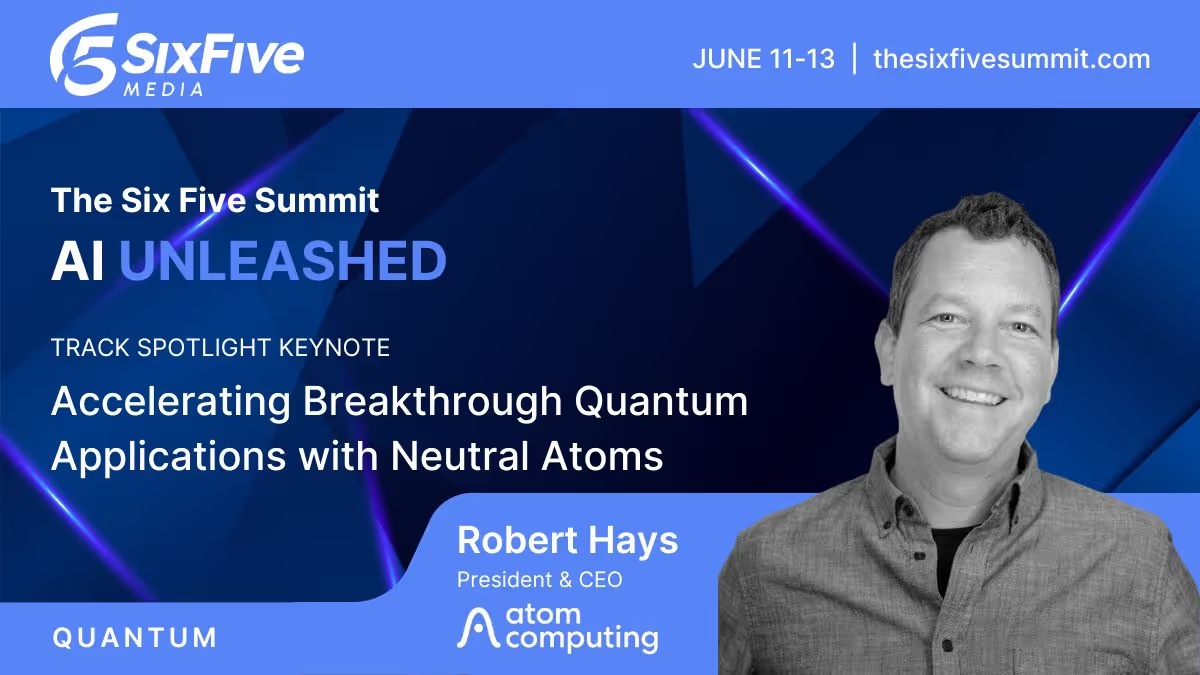
Accelerating Breakthrough Quantum Applications with Neutral Atoms
Our planet needs major breakthroughs for a more sustainable future and quantum computing promises to provide a path to new solutions in a variety of industry segments. This talk will explore what it takes for quantum computers to be able to solve these significant computational challenges, and will show that the timeline to addressing valuable applications may be sooner than previously thought.