Home

From Reactive IT to Autonomous Operations: How Accenture, Dynatrace, and ServiceNow Close the Gap Between Detection and Resolution
From Reactive IT to Autonomous Operations: How Accenture, Dynatrace, and ServiceNow Close the Gap Between Detection and Resolution
SHARE


Accenture, Dynatrace, and ServiceNow have built a closed-loop IT operations architecture that detects, diagnoses, remediates, and closes incidents before the business is impacted, eliminating the reactive firefighting model that has defined enterprise IT for decades. Tom Bruss, Managing Director at Accenture, and Jay Snyder, SVP of Partners and Alliances at Dynatrace, break down how Davis AI, SmartScape, and ServiceNow workflows combine to shift IT from a cost center to a proactive operational foundation, and why process reinvention has to come before automation for any of it to produce lasting results.
Every IT team knows the dreaded “priority-one bridge call,” dozens of the organization’s most expensive people pulled into a room or onto a call for hours while executives demand updates and critical work grinds to a halt. It’s more than frustrating. It’s a sign that the traditional reactive IT operating model has reached its limit.
At ServiceNow Knowledge 2026, Melody Brue spoke with Tom Bruss, Lead - Accenture ServiceNow Business Group & Reinventing #ITOperations, Global, at Accenture, and Jay Snyder, SVP of Partners and Alliances at Dynatrace, about how observability, workflow automation, and AI are converging to close the gap between detecting an issue and resolving it before the business is even impacted.
The closed-loop system built by Dynatrace and ServiceNow is designed to manage the entire incident lifecycle with minimal human intervention: detect, diagnose, remediate, validate, and close. Davis AI identifies anomalies, bidirectional APIs automatically trigger ServiceNow workflows, and enriched incident tickets are generated with root cause analysis, impact assessments, and remediation steps already in place. Dynatrace then validates the outcome and closes the ticket. Ideally, the priority-one bridge call never happens because the issue is resolved before anyone needs to escalate it.
#Accenture is where that architecture meets enterprise reality. The technology alone does not change how work gets done. Process reinvention drives the change, and that is what Bruss makes clear: applying AI to an inefficient process automates the inefficiency. The power of three works because Dynatrace brings causal AI observability, #ServiceNow brings the system of action, and Accenture brings the industry expertise to connect them inside environments that have years of complexity baked in.
Key Takeaways:
🔹 The closed-loop integration between Dynatrace and ServiceNow resolves incidents before humans get involved. Davis AI detects, diagnoses, and triggers remediation through ServiceNow workflows automatically, with a complete audit trail and Dynatrace validation closing every ticket.
🔹 #Dynatrace's SmartScape continuously enriches the ServiceNow CMDB with real-time topology across every service and dependency. Without that context layer, AI agents are guessing. Accurate decision-making requires an accurate baseline.
🔹 Accenture has nearly 49,000 ServiceNow certifications and is scaling Dynatrace talent globally ahead of client demand. Reference architectures built from real enterprise deployments, not theoretical playbooks, are what make outcomes stick.
🔹 #AutonomousIT is not a headcount reduction play. The operating model shifts from tiered service desk structures to human-plus-AI roles, with people managing agents, measuring performance, and focusing on the innovation work that reactive IT never left time for.
🔹 The window to lead rather than catch up is open now. Organizations that unify observability, workflow automation, and AI today build the compounding operational advantage that becomes structurally difficult to replicate in 18 to 24 months.
Disclaimer: Six Five Media is for information and entertainment purposes only. Over the course of this webcast, we may talk about companies that are publicly traded, and we may even reference that fact and their equity share price, but please do not take anything that we say as a recommendation about what you should do with your investment dollars. We are not investment advisors, and we ask that you do not treat us as such.
TOM BRUSS:
One, it's about getting people comfortable with the technology. And then two, it needs to be an opportunity to just think differently in the age of AI. Not just let's buy AI to automate IT, but how can we rethink the way operations work? Today, it's the bridge. Tomorrow, it happens in seconds.
MELODY BRUE:
Hi and welcome to Six Five On The Road. I'm Melody Brue. Today we're going to be digging into how IT is going from reactive to predictive and autonomous. Today I am joined by Jay Snyder from Dynatrace and Tom Bruss from Accenture. Welcome.
JAY SNYDER:
It's great to be here. Thanks so much for having us.
MELODY BRUE:
Yeah, thanks for joining me. So we're just going to dig right in. So Jay, question for you. Modern cloud ecosystems are becoming more dynamic and complex. What does that complexity actually look like at enterprise scale?
JAY SNYDER:
It's a great question. In fact, I would say it's been getting more complex for the last decade. What's happened over the last few years is the pace has accelerated to levels like we've never seen before. So the opportunity to make mistakes is greatly enhanced. So what it looks like is you need to have an environment and a platform that's able to work in a data center across multiple data centers and across multiple clouds with traditional applications and applications built in the agentic age running agents. That's easy to say, possibly, but not easy to do, which is why observability connected to ServiceNow brings all those things together. It allows you to keep current. One of the most important things in your environment, which is your CMDB, leveraging SmartScape within Dynatrace, and being able to track any change at any time within that environment, anywhere across all those multi-cloud environments or multiple data centers. So it starts there with having an understanding, because if your baseline isn't good, then all your decisioning isn't great.
MELODY BRUE:
Now, Tom, you talk about the power of three with Accenture, ServiceNow, and Dynatrace. Talk a little bit about the power of that, how that came about, and where those three fit in together really seamlessly to complement each other.
TOM BRUSS:
Well, it all started last fall. I think it was October when ServiceNow and Dynatrace announced their partnership. And their partnership to help bring this vision of autonomous IT to customers faster. So seamlessly integrating from observability to event management and applied intelligence down to a system of action like ServiceNow to make this a lot more out of box. Right. And Accenture is there. We have the industry expertise, the real world, like on the ground, you know, hands dirty knowledge of what it takes to install these systems. You know, what is the process reinvention that you're going to need to do on top of all this? So it's not just always about AI and autonomous. If you're just applying AI to and inefficient process, you're just automating inefficiency, right? So this is about us coming in with the process and industry expertise, Dynatrace coming in with a market-leading observability platform, and ServiceNow being the market-leading system of action.
JAY SNYDER:
Can I add to that? I would just say what I love about Accenture and what they bring to the table is that they sit at the intersection of technology and industry. And what that means to this is we're able to focus on those issues in the environment by using the technology to pinpoint it that have the greatest business impact. Our platform is business unaware, if you will, right? And the integration is even business unaware, but Accenture isn't. And what Tom was talking about by understanding and deconstructing that business process, you may have a large lasso and that's impacting all kinds of things in a very small event occurring somewhere else. That single event could be the one that disrupts the business most greatly, right? Brings down systems, takes down money from being able to be transact or whatever it might be. And understanding that business process at a business impact level, really creates the differentiation. That's why the power of three is incredibly useful and meaningful if I'm a CIO or CTO looking at this combination.
MELODY BRUE:
And you both mentioned something about how it affects people. So when you hear autonomous, people tend to think, does that mean this is all going to be without humans in the loop? And in contrast, it's actually humans in the lead, both from kind of the consultative perspective, but also it's helping people to do their jobs. So, what are you hearing from customers who really—they want that kind of assurance that this is, that there's that observability layer, but it's controllable and there it is a human that's leading?
JAY SNYDER:
Yeah, I think the first thing I would say is we look at agentic and AI in two different lenses. One, what's inside our platform, and the great news is, for the last decade, we've been building that intelligence already into the platform, so it's not new. The second is, how do you use the platform to manage and understand and monitor those AI workloads and those agents with the environment, so they aren't running rogue, right? You know exactly where they are and what they're doing. We believe that what we're doing is actually freeing up the strategic thinking and the capability of the people in the environment to focus on things that they haven't traditionally had time to do because they need to focus on those mundane tasks that take too much of their day-to-day time. I mean, you can talk to anybody in any account and they'll say, I'm spending too much time on the non-value things because I have to, not because I want to. And we do believe collectively that we're going to unlock that capability, free up that time from the focus on those things, and let the agents and let the automation take care of those day-to-day mundane tasks with the supervision of the observability.
TOM BRUSS:
I think that's exactly right. We talk to lots of clients. I don't think I've ever talked to an IT shop that says they have all the people they need to do to meet the demands of their business. And IT shops are being asked to do more with less, and business demand, those expectations, especially in the age of AI, are sky high. And IT shops are spending too much time doing simple things and not enough time focused on that innovation. And so I think that with this, you know, the autonomous help desk, the autonomous system of action, you know, the whole operating model is going to change. Now, there's going to be new types of roles at the service desk, right? There's going to be different roles. There's going to be people that were resetting passwords that can now move on to focusing on innovation and building. I know I could use 20 more ServiceNow developers on what we're doing at Accenture. But there's going to be new roles. There's going to be the human in the lead roles. Who's going to manage all these agents? Who's going to figure out which agents are performing well, which are never used, which are consuming assists inefficiently, consuming too many tokens, you know. And then that control tower base becomes your guardrails that you can install, right, so that you don't have a process running rogue. consuming to, you know, running up a big token bill. But it's going to be humans that need to figure out how to work with these agents. So I think it starts with that kind of operating model change. And there is plenty of work to do to go around. It's automating work that, you know, people who work at a service, that's how I got a start in my career. These are technologists that like solving problems. They have good tech skills. They don't want to fill out ticket details. It's serviced out as a result. A lot of our ticketing data isn't great, you know, and they don't want to resolve, you know, reset a password all day long. So, you know, once people get that sort of aha moment, they're like, oh, this is just taking care of the stuff I don't want to do in the first place. Yeah, that's when AI goes from this nebulous kind of scary thing to a co-worker. Like, okay, I've got a junior co-worker that can just take care of some of the stuff that I don't want to do. And that's, that's, that's when the switch flips.
JAY SNYDER:
Yeah. Yeah. I'm gonna add one final quick thought there, just because we haven't talked about, and it's not often spoken about, but think about how many companies and businesses want to focus on something completely innovative that may be revenue generating that they don't have the resource time to do because they're constrained. I see this as an unlock for them to be able to actually bring new products to market, bring whole new lines of business to market, right? Which can be incredible. And guess what? They're going to need people to work in those new opportunities to be able to stand them up. So, you know, I know there's risk with anything, but I think there's a tremendous amount of upside to it.
MELODY BRUE:
Yeah, it's not just about productivity anymore. It's about amplifying what the human can do and the things that companies haven't even had the ability to scale yet.
JAY SNYDER:
Exactly. It is an amplification. And if you're always constrained by having to just, quote unquote, do your day job and your day job takes all your time, you don't have the time for that strategic thinking to break into those new lines of business.
MELODY BRUE:
So you described Dynatrace and ServiceNow as a closed loop system. What does that look like in practice?
JAY SNYDER:
That's using the AI technology, Dynatrace Intelligence, to detect, diagnose, remediate, validate, and close any issues before a human actually has to get involved in the process, which is incredible when you think about it. It is a little scary based on what we just talked about. Is that not eliminating someone's job? But what it really is, is getting to the root cause very quickly. It's not about correlation. It's about identification of what actually just happened, being able to prosecute it from start to finish, and closing that loop through the integration and service now. So you're issuing that change management tickets, the service tickets, and everything that needs to happen. So that event will never occur again. And that's without any human in the loop. Now, will there be some further validation after the fact? Quite possibly. But again, this is a massive time saving. If you think about the time it could and has traditionally taken to do a root cause analysis to determine where an event occurred. We started this conversation talking about thousands of applications across three different clouds, across multiple data centers. That's a lot of infrastructure and applications to try to diagnose. If you can do that before anyone even gets involved, or I wake up in the morning, that's quite powerful. That's allowing you to keep digital businesses running 100% of the time, which is really critical. So you're minimizing business impact, you are minimizing brand impact, and you're allowing your company, again, to focus on other things. That's how I would define it, but I'm, yeah.
TOM BRUSS:
No, you're exactly right in bringing it back to what's in it for me. As a technologist, it's automated with things we don't want to do. One of the things we hate doing, we've all probably been on a priority one grid when something goes down and you're stuck on it for hours. What happens today is people might see an alert And then, okay, there's a lawyer, we gotta go investigate this. So they bring in the application owner. Maybe they bring in a couple architects. They bring in the software vendor. Before you know it, you have 30 people on a priority one bridge line, right? Likely your 30 most talented people who, because it's such an emergency, and they're about to get pulled away from the real- Expensive phone calls. Expensive, expensive phone calls, yeah. And you think about all the people, stuff that they could be working on. And these bridges, if you're lucky, You happen to, by magic, get all the right people in the room and it's solved in an hour. More often than not, it goes into the wee hours of the night. And oh, by the way, while you're doing that, every senior executive you know is hanging you, and not in a pleasant tone. So it is not a fun place to be. We can catch the issues, you know, we can detect some of the underlying, you know, failure patterns, degradation that might be happening in the system, translate that into action and act on it in minutes before everyone starts calling your service desk and before you get pulled away from what you should be doing.
MELODY BRUE:
—which should then minimize the damage that could have been done in that time.
TOM BRUSS:
Zero business impacts. That's what we're going for.
MELODY BRUE:
Yeah. Beyond what we talked about, kind of the human factor for CIOs and CISOs as they start to look towards an autonomous operation, what shouldn't they be thinking about and how should they prepare for this kind of inevitable change and something that's going to really improve their operation?
TOM BRUSS:
I'll start with that. I mean, I think one, it's your practitioners are going to need to learn to use this, you know, and it's a new tool. It's a very powerful tool. And so just not just training, but just like having it more ingrained in the way that you work and, and not removing barriers from people using it. I know cost is a concern and all that, but we're kind of, at Accenture, we're ranking some bets on some of these tools, just putting them in the hands of our people. And we've got a few things that have started to go viral, as somebody figured out how to automate their time report. And everyone's like, yeah, show me how to do that. So it's sort of, you got to have those aha moments. And it's going to happen for everybody, regardless of what you do. There is some use case, they used to call it a killer app. Well, there's going to be a killer process that somebody figures out that everyone's like, oh, this, this is exactly what I want to do. So, so one, it's about getting people comfortable with the technology. And then two, it's, it really is, it needs to be an opportunity to just think differently in the age of AI. So not just let's buy AI to automate IT, but like, how can we rethink the way operations works? You know, like some of what we're describing, you know, today, it's the bridge, tomorrow, it happens in seconds, like, And the service desk itself, the whole operating model needs to change from that traditional tiered model that we've all had for 40 years to a human plus AI operating model with different roles. As I've been saying, you know, it needs to be a rethink on how things get done to better adapt.
MELODY BRUE:
I mean, that's really a blueprint for all enterprises beyond IT. It's a reorganizing around value, around people's time.
JAY SNYDER:
Yeah, I mean, Tom said it really well. I don't have much to add. I'm just going to reinforce the last point he made. We see a lot of companies starting to think about this as a silver bullet, right? I can use agentic and AI to just automate everything that we currently do. The key is what you currently do may not be right. It may have been necessity. So, it's stepping back and understanding the business first, then the business process, and then building the automation. Because, yes, you can get efficiencies by automating what you do today, but think about what you can get if you take the time to re-architect what the business outcome could be, if you could have. And these things are enabling things that never existed previously. So you really do have to blank sheet this and step back and say, what if we could, because we might be able to. And that's the power of what we're seeing right now, which I think is really incredible, which is why the partnership with Accenture means so much, because again, that's their bread and butter.
MELODY BRUE:
Yeah, I think that's very well put. Well, this was great. Anything you guys want to add before we wrap this up?
JAY SNYDER:
You know, I say it all the time when I do keynotes that I never thought the pace of change in the industry could change like it had, and this was five years ago. I don't know what to say anymore. It's scary, right, to think a year from now what we're going to be seeing and doing, but it's also incredibly exciting. So I'm really excited to be able to do it with the world's best partners, and I kind of feel like the sky's the limit right now.
TOM BRUSS:
I would agree with that. It is a really exciting time to be in technology. I know there could be consternation about what AI is going to do or not do, but you don't see inflection points like this very often. I try to go back. I've been doing IT for about 30 years. I try to go back and equate it to what it was, maybe the internet when I came out or maybe Maybe the most reasonable thing I could think of is maybe office. You know, if you think about what life was like before you had office, I always wonder, like, how would you get a meeting together? I'll pick on, like, my dad sometimes, like, how did you get anything done in, like, the 70s and 80s before there was internet, computers, and Microsoft Office? So I think that is, you know, we're at a step change like that, and it's really exciting to get to be a part of that. And, you know, for people working, You know, in this industry, we do have the opportunity to reinvent and reset the way your organization is going to work for the next several decades. So it doesn't come around very often. It's a really exciting thing to be a part of.
MELODY BRUE:
It is a time of a lot of change now, like you said, and we've all seen it. We've gone through, you know, mobile and cloud and AI is all of that time is infinite, right?
JAY SNYDER:
It's amazing.
MELODY BRUE:
Well, this was really great. Thank you so much for joining me.
JAY SNYDER:
Thank you.
MELODY BRUE:
And thank you for tuning in to this episode of Six Five On The Road. I'm Melody Brue. Please like, subscribe and check out SixFive .com for more of these episodes. Thank you for being here.
MORE VIDEOS
The Major Decision Hiding Behind Every Hypervisor Renewal
HPE's Varma Kunaparaju talks with Patrick Moorhead and Daniel Newman about why virtualization licensing changes are forcing enterprises to confront a bigger decision than which hypervisor to choose next: what operating model sits underneath their private cloud and AI factory. He outlines how CxOs can sequence modernization in phases, extend governance across open and frontier models, and decide where automation should replace human approval in IT operations.


Bridging the Capacity Gap: Why Enterprises Are Investing in Agentic Digital Workers
IFS Loops CEO Somya Kapoor joins Keith Kirkpatrick to explain why agentic digital workers stall between pilot and production, and why governance, escalation design, and change management now shape adoption more than building agents does. Drawing on new Futurum research, she shows how enterprises can start with imperfect data and redirect reclaimed capacity toward growth.
Meta's Muse Moment, AMD's Trillion-Dollar Milestone, and the Agent-Driven CPU Rally
Meta's Muse launch turned a consumer AI agent into a CPU demand story, a new round of frontier model releases sharpened the fight over token economics, and AMD crossed the trillion-dollar mark on the same compute thesis. Patrick Moorhead and Daniel Newman break down Meta Connect, Qualcomm's agentic-device push, the AI policy debate, and whether Meta has finally cracked mainstream AI wearables.
Other Categories
CYBERSECURITY
Threat Intelligence: Insights on Cybersecurity from Secureworks
Alex Rose from Secureworks joins Shira Rubinoff on the Cybersphere to share his insights on the critical role of threat intelligence in modern cybersecurity efforts, underscoring the importance of proactive, intelligence-driven defense mechanisms.

HP Launches World’s First Business PCs to Protect Against Quantum Hacks - The Six Five On the Road
On this episode of the Six Five - On the Road, hosts Patrick Moorhead and Daniel Newman are joined by HP's Ian Pratt, Global Head of Security for Personal Systems.
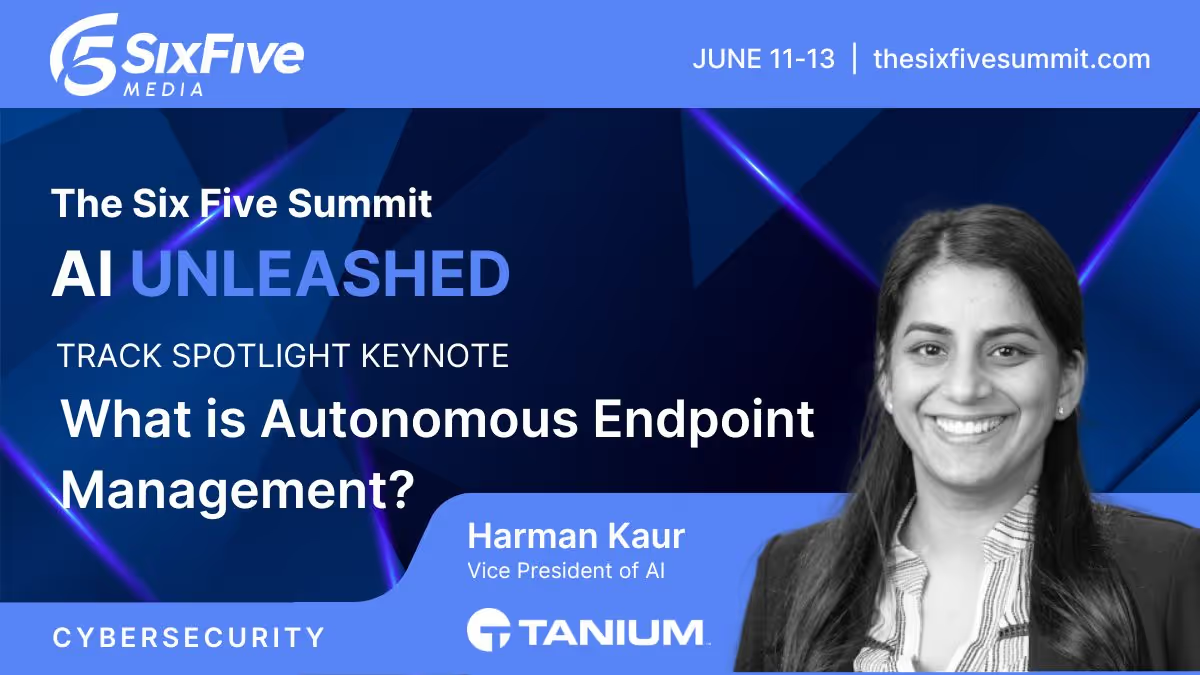
What is Autonomous Endpoint Management?
Autonomous Endpoint Management is a framework designed to unify IT operations and security teams on a single platform through real-time control and visibility.
QUANTUM
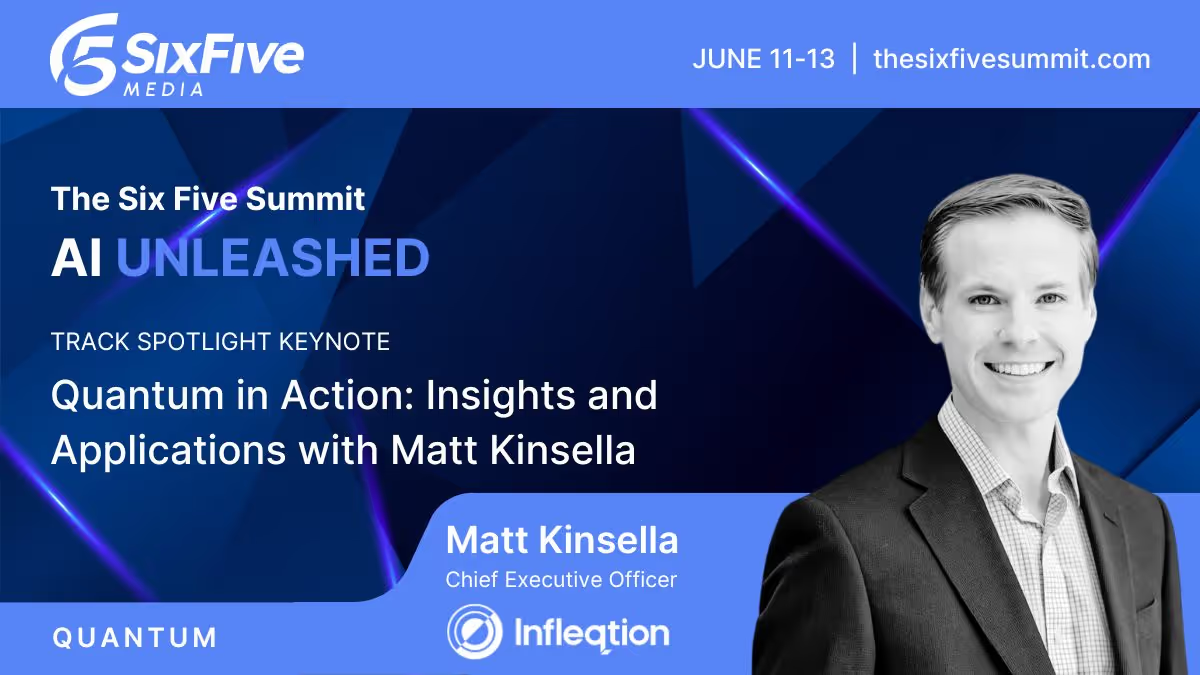
Quantum in Action: Insights and Applications with Matt Kinsella
Quantum is no longer a technology of the future; the quantum opportunity is here now. During this keynote conversation, Infleqtion CEO, Matt Kinsella will explore the latest quantum developments and how organizations can best leverage quantum to their advantage.
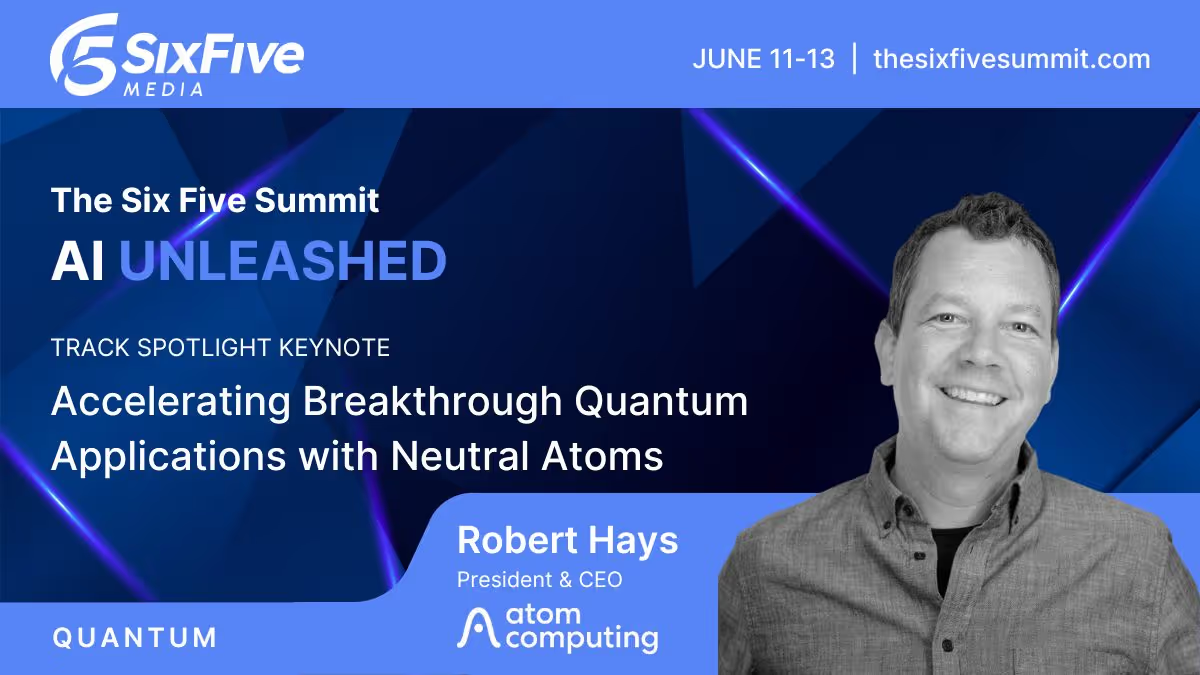
Accelerating Breakthrough Quantum Applications with Neutral Atoms
Our planet needs major breakthroughs for a more sustainable future and quantum computing promises to provide a path to new solutions in a variety of industry segments. This talk will explore what it takes for quantum computers to be able to solve these significant computational challenges, and will show that the timeline to addressing valuable applications may be sooner than previously thought.