
Gaining a Competitive Edge in Today’s IT Job Market - The Main Scoop Episode 37
SHARE


Enzo Damato, President of Rice Telecom, joins hosts to discuss bridging generational gaps in IT, his journey from mainframe hobbyist to AI innovator, and how future technologists can succeed in a rapidly evolving landscape.
Procrastination is career kryptonite. In an IT landscape revolutionized by generative AI, how do you get ahead?
This episode of The Main Scoop explores how generational perspectives are shaping the adoption of generative AI and IT career paths for new technologists. Hosts Daniel Newman and Greg Lotko are joined by Rice University's Enzo Damato, President of Rice Telecom, for a conversation on making mainframes more accessible to new technologists and bridging the generational divide on emerging IT trends.
Key Takeaways Include:
🔹Navigating Generational Divides in IT: A look at how seasoned and newer technologists view the integration of generative AI, mainframes, and IT infrastructure differently, exploring how these perspectives shape learning and adoption in the modern workplace.
🔹Charting a Course for New Technologists: Enzo Damato shares firsthand challenges and valuable resources that have defined his unique journey, offering actionable advice for newcomers and providing a roadmap for successful early career paths.
🔹Practical Applications for AI in Action: An exploration of real-world applications of AI, including Enzo's groundbreaking work in building a facilities-based CLEC and developing AI-powered spam mitigation systems, highlighting where AI excels and where human input remains essential.
🔹Reshaping Education for Tomorrow's IT: Insights into how emerging technologies are actively reshaping education and skills development, providing a critical look at what is needed to prepare the next generation of IT professionals for the future.
Watch the full video at sixfivemedia.com, and be sure to subscribe to our YouTube channel, so you never miss an episode.
Or listen to the audio here:
Disclaimer: The Main Scoop is for information and entertainment purposes only. Over the course of this webcast, we may talk about companies that are publicly traded, and we may even reference that fact and their equity share price, but please do not take anything that we say as a recommendation about what you should do with your investment dollars. We are not investment advisors, and we ask that you do not treat us as such.
Greg Lotko: Hey, folks, welcome back to the next episode of The Main Scoop. Got a fabulous conversation to get in today. All about the different perspectives of people that are working in this ecosystem. Those have been here for a while and those that are new to the mainframe space. And I know people at Times start to think about that as generational, but the reality is we have people coming in, sure, that are the new generation and are younger, but also coming in from other disciplines or other areas of it or outside it. And as always, I'm joined here with my co host, Daniel Newman. Pleasure to see you. And we're live and in person.
Daniel Newman: It is, it's good to be here with you, Greg.
Greg Lotko: And we're gonna do the high foot.
Daniel Newman: You've been rocking on stage or something. What's going on? You're sounding a little gravelly over there.
Greg Lotko: Yeah, I mean, you guys can look this up. I know my voice is a little gravelly today. I was on stage at the Rock and Roll hall of Fame here in Cleveland last night.
Daniel Newman: Well, you know, people don't know that much about us in terms of the background. I mean, now that we're in 30 episodes probably of this show. But you and I like to sing. Sometimes when we're kind of waiting to go on camera, we start singing over each other and. But Greg actually is pretty talented. And so, you know, because this episode's a talent focused episode, it's talking about human development. And, you know, if this whole mainframe thing didn't work out, I just want you to know that I would come to your concerts.
Greg Lotko: I appreciate that.
Greg Lotko: You know, I think we were past the point where we could form a boy band. We might have to call it a man band.
Daniel Newman: Yeah, Old man band.
Greg Lotko: Yeah. I was worried you were gonna go there.
Daniel Newman: There's nothing wrong with that. After 40, everything gets better. Telling you, telling you. But maybe this younger generation coming up, they have a good argument here. There's a lot going on. And, you know, going back to the kind of the plot here, you know, we are in this really interesting inflection right now of where talent's going to come from, of what companies and businesses are going to look like in the future. You have children that are, you know, grown now or close to grown now. Right. And you know, I have one that's finishing her graduate program. I have one that's finishing in my second year or third year of undergrad now. And as I'm going through it with them, even just since my oldest one started six years ago, what job prospects looked like and what technology looks like and the utilization. My oldest one went to school and didn't have LLMs, and didn't use that kind of technology. My younger one doesn't do anything for her program at Baylor without LLMs. And so we are at this really exciting point where we have to sort of merge the kind of the technology that's brought us here with the new technologies that are coming up. And it's going to create a very bold and new group of talent that's going to, in my opinion, those that can really leverage and utilize this technology are going to be rainmakers. They're going to completely change the dynamics.
Greg Lotko: Yeah, I think it's interesting for us to recognize that the perspective is changing on the value and interaction with different technologies and how you combine them with others. And we can kind of talk about that from our perspective, recognizing perspectives are changing. But we could also bring in somebody to join the conversation. So I'd like to introduce and welcome Enzo Damato, definitely the next generation. So why don't you introduce yourself a little bit?
Enzo Damato: So, hi, my name is Enzo. I'm very happy to be here. And I have been interested in computers for about as long as I can remember. I got my first x86 Linux server when I was in the fourth grade, quickly turned that into an entire rack of them, and then got a mainframe when I was in high school. I tracked down a z114 off of eBay, had it shipped to my house and set it up. And the rest, they say, is history.
Greg Lotko: So who knew that, that you'd be buying a mainframe on ebay? And my understanding is there wasn't just the challenge of finding one. You had the challenge of fitting one. Right? You were trying to put it in the garage.
Enzo Damato: We had to take a Sawzall to bits of the garage door to get it in.
Greg Lotko: And that's much better than adjusting the frame because that would avoid the warranty.
Enzo Damato: We tried that first. We tried to do that on the truck, but the driver was getting angry at us. So we just got the saw.
Greg Lotko: And that must have been pretty heavy to deal with too. Did you have to have a forklift on site or did they have one of those ramps to lock?
Enzo Damato: We had one of the ramps.
Greg Lotko: Very cool.
Daniel Newman: So what made you. Because I get the interest in compute. I mean, pretty normal these days, but mainframe, it's not super typical that I would say someone that's young coming up says, I really want a mainframe. I mean, what drove that issue? What did you do with it beyond what you were doing with the x86 Linux server?
Enzo Damato: Well, sort of the thing for me is that I always like to try and mount new challenges. And I think with x86 and Linux there was always new stuff to do in terms of development and whatnot. But I had seen pictures of mainframes online. I'd read about mainframes and they sort of seemed like the Alpha and the Omega. The ultimate computer that you could possibly get if you wanted to build a lab. There will never be a more unique, powerful piece of equipment to put in a home lab compared to a mainframe unless you manage to track down like a Cray-2 or something from, you know, very long ago.
Greg Lotko: And I like that you say the ultimate. So we know in the mainframe space that that platform for transaction processing and throughput is unparalleled. But to have somebody who is that youthful looking into computer technology and realize there's something out there. You talked about the idea of putting it in a home, it setup or in a garage. And I don't remember exactly how you said it. They're not that common. I don't know of anybody else who has done that. And so folks are aware you're now a junior at Rice. So if we're talking about the next generation, you absolutely are the next generation. So when you think about, you know, putting these technologies together or even just your thoughts about having compared and contrasts, what was the most kind of interesting or surprising thing you discovered on this journey into interacting with the mainframe?
Enzo Damato: Most interesting thing, I would probably have to say how much more a single mainframe does compared to an x86 system. Because you have to think a Linux box or even a Windows server is designed to be maintained, installed and basically from creation and destruction by a single person. I don't really think there are any production mainframes that are maintained by a single person. So there is so much more going on on the system. And it necessitates an entirely different mindset to how you're going to manage a single box as a mainframe. Can't really be, almost can't even be conceptualized as a single system like a Linux VM is. It's almost its own data center in a rack, right?
Greg Lotko: It's a virtualized world. I mean, that was a big innovation, right? The virtualization as well as the ability to bring programs forward from generation to generation. And actually an interesting connection point. I was leading the z114 offering management team when that was introduced. It was the first generation of the mainframe that I was involved in the zEnterprise System, z196 and z114. So going into the hardware space, we have that commonality. I was a bit older than you at the time.
Enzo Damato: What happened to zBX?
Greg Lotko: So the zBX was an Interesting and innovative technology that said, hey, not only were we going to allow you to interact and connect with distributed computer x86 servers as well as power, but the entire concept was to put it in a rack co located with the mainframe and have a high speed direct interconnect. So the technology for those systems to talk to each other already existed. But the paradigm shift was to put it all under the enterprise control of the mainframe.
Daniel Newman: So you've had a pretty interesting journey though. I mean beyond the garage. It sounds like you were teaching AP courses in high school and now you've gone off and you know, you're a third year student at Rice Computer science. I mean, where does this lead for you? And by the way, I'm sure you're following all the trends, right? I'm sure as you've been watching the influence of machine learning, the influence of AI. How are you thinking about your path from here as you finish at Rice and probably want to go on and do something out there, right?
Enzo Damato: Yeah, of course. So my plan was to do a five year program at Rice. So I'm going to finish my undergrad, then do a master's in CS and eventually head out into the workforce, which I'm really looking forward to. But sort of once I get out there, I want to specialize in sort of bridging the new and the old. I understand both sets of technologies fairly well in terms of legacy systems in the mainframe and other more niche pieces of equipment and technologies. But I also understand machine learning and AI and Linux and open systems. And I think there are a dearth of people who understand both and can sort of unite those two skill sets.
Greg Lotko: And I mean you ask about where he wants to go and what you want to do. I'm curious, I know you've already started your own business. When you think about your future, are you thinking you will continue that or are you looking to go into the corporate world or you're undecided? Maybe tell us a little bit about this business you're already running.
Enzo Damato: So, yeah, obviously it's a bit of both in terms of what I want to do and it's going to depend on where I am. But in terms of what I'm doing right now, I am actually a phone company in a few states. And what I'm doing with that is I am working on using AI and machine learning to detect and prevent robocallers in real time. I am basically using a large set of phone numbers like a honeypot to collect as many robocalls as possible. I'm using machine learning to decode, talk to the robocallers and categorize them in real time. And then I'm feeding that into a big analysis engine and I'm hoping to identify a robocall with as little as five seconds of audio.
Greg Lotko: So are you selling that service to private people or to commercial phone systems or lines for corporations?
Enzo Damato: Once it's done, I want to sell it to both. Obviously. I'm still developing it right now.
Greg Lotko: I've dabbled a little bit in this space, but I know you're going to say this is very lightweight. Just last night I got one of those spam, you know, robo texts that, you know, somebody was trying to engage with me and get me over to WhatsApp. I think they were going to end up asking me for money. And as I kind of was getting bored with the exchange of toying with them, another one came in. So I told both of them I was happy to connect and I would give them my private number and. And I gave each of them the number of the other robo. I have no idea if they connected with each other and they may still be chatting today.
Enzo Damato: That's pretty funny.
Greg Lotko: It's actually a nice concept. Right? Let's pit them against and at each other.
Daniel Newman: You were really bored last night.
Greg Lotko: I was. I got off stage and I had nothing better to do.
Enzo Damato: Reminds me of the 10,000 person conference call I put together once I had a bunch of spare phone numbers. So I decided, well, I'm working on setting up the systems that those are eventually going to connect into. I'll drop them all into one giant conference call and just watch the chaos.
Greg Lotko: I like it. I like it. And how did that work out?
Enzo Damato: It was pretty funny.
Greg Lotko: For them or just for you?
Enzo Damato: For everyone involved. Because people would drop in, have no idea what it is, and then realize that they were talking to another wrong number caller in real time. They'd chat a little bit and then disconnect. It was the ultimate incarnation of the party lines from, you know.
Greg Lotko: I was thinking like party lines, but the other thing is that it was old school.
Daniel Newman: No, I mean, look, the ability for this particular podcast to run down an interesting avenue is actually part of the podcast. I mean him building a honey pot and you screwing with spam callers all night is a perfect, perfect marriage of content right here. I do want to kind of talk about how this all plays out though, like education itself. Right. People like you that had the ambition to get a mainframe, however you work that out, I mean, you must have really supportive parents too that helped you make all this happen.
Enzo Damato: Yeah, I paid for it myself, but they provided the power.
Daniel Newman: So what are you doing at that age that you could afford to buy mainframe?
Enzo Damato: It's a lot cheaper than you think.
Daniel Newman: Okay. I mean, hardware does depreciate quickly.
But where I was kind of trying to head with this too though is like you've been self teaching a lot.
Enzo Damato: Along the way, which I think is the only way.
Daniel Newman: But you're at Rice and you're planning to not only get your bachelor's, you're master’s.
Greg Lotko: So double click on that. So it's an interesting contrast. I know that's where you're going. So the idea that you're very largely self taught, but you have been within the context of institutions and you're going to Rice and maybe there's a theme there of, well, I need that real world stamp of approval. But you're also educating high school students and teaching at Rice. So how do you see the balance between self and organized?
Enzo Damato: The way I would say it is that organized education is necessary if you want to work in the real world because organized education teaches you how it's supposed to be done and saves you enormous amounts of time in acquiring the basics you need to operate a platform. Sort of. If tomorrow you sat down a new hire in front of a green screen and told them to have fun, they would probably get very annoyed with you. But the thing is, what makes someone an amazing software developer, not just a passable developer, but someone who is truly good at it and who wants to make it a career and is going to be successful at it in the long term, is that they have the ability to solve their own problems. You can't really teach that. I mean, in my courses I try. I have open ended problems and the entire course culminates in one large project that they work on for an entire semester, which I hope builds problem solving skills and builds that creativity. But there's no way to force someone to be creative. They have to be passionate enough about the mainframe or about whatever technology they want to learn that they're going to be self driven to learn how to figure it out and overcome those obstacles and really get working on it. And the way, you know, you've identified someone like that is that the more obstacles you put in their way, the more aggressively they're going to try and solve them and figure it out.
Greg Lotko: So you openly talk about this as you're teaching. You basically say you shouldn't need me to inspire or provoke you. If you have this passion in you, if you have this interest in you, you're likely to be successful. If you're waiting for me to tell you, you may do it, but yep, yeah, okay.
Enzo Damato: As I sort of would say, as Oppenheimer said, theory can only take you so far. At a certain point you have to get out of the classroom and get your hands dirty and it's not going to be pretty. I've melted down my z/OS dozen times, but I just put it back together again and that's why I have my own machine. So I don't care. I melted it down with some homemade ransomware and put it back together again. It's all part of the learning experience.
Greg Lotko: And as Oppenheimer knew, the explosion could be huge and way beyond what you expected.
Daniel Newman: Part of where I wanted to go and culminating all this is, you've accomplished so much at such a young age, mostly through self learning, implementation. Of course, you talk about the institution, the formality, right. And as we sort of see the proliferation of next generation technology, a lot of it's about AI, but there's quantum, there's other technologies coming down the pipe…the learning will change. Like in Austin we have a school, it's called Alpha School. And nowadays it's two hours a day and every student individually is interacting just with AI. The rest of the day is spent.
Greg Lotko: I went to school for about two hours a day.
Daniel Newman: And the other part of school is actually getting people connected to taking them out in the real world. And the point is in two hours they're saying students are learning more than eight hours in college right now is another one. Our university is one of those things that's also very structured. You got to get this many hours, you take this many classes. We want to give you this much balance. You go live there. And what I'm saying is, do you think this because you're sort of in this conflicted where you've grown sort of through the freedom of having your own sandbox and then you kind of go back into the sandbox and with as fast as things are moving, does the institutions and the education and the way people succeed in the world look the same in five or 10 years in your opinion? Or how do you see that changing?
Enzo Damato: Yeah, I see education becoming a lot more freeform because I believe that the greatest upshot of AI is that it's going to be the grim reaper of people whose only job is googling and regurgitating information that someone else has made. If you're not creative, AI will come for you.
Greg Lotko: It's the word I thought you were going for. It'll highlight creativity and the inventors, the creators, not the repetitious rote redoers.
Enzo Damato: Because if you look at what I think the father of modern software development, software engineering theory, Frederick Brooks of Mythical Man Month, wrote, I hope I got that author correct, otherwise it's going to be really embarrassing. But if you look at Mythical Man Month, a really great text on software engineering, he said there is no silver bullet. The people flipped out when compilers were invented. There was originally an occupation called a coder who would take a written piece of code and turn it into hex and load it into a system. And compilers got rid of that, but in exchange they meant that actual programmers could do way more. And I think we're going to see the same thing. I think we're going to see the level of skill and creativity required to be a programmer and work in technology go up and up and up as AI makes book knowledge and memorization a lot less relevant.
Daniel Newman: But you don't see, do you see an impact from the Cursors and the Lovables and the Claude Codes? I mean, I built a website this week and it was incredible. I played in Lovable for like an hour.
Greg Lotko: Yeah. But I think I'm going to use a physical analogy. I think what I heard you say, and you can tell me if I get it wrong, it's the concept of all boats rise or float in a rising tide. So these tools, just like you drew the analogy to compilers, didn't do away with the effort of people. They raised the foundation of what they were building upon. So. So I know there's those who think AI will take the higher level tasks and that that will create a gap. Now the reality is if, if it plays out the way he's saying, which is honestly the theory I want to like, what is referred to as a lower level task is rising because you have yet another tool of AI helping you do these things for you. So I assume that's what you're saying. Your theory is that those who can learn the skills and work on that foundation will move to the higher level work. Those who don't get it and are only stuck in understanding the fundamental level of those jobs.
Enzo Damato: Right now, I would just say if your job is writing CSS code for static websites, you're in trouble because a computer can do that.
Greg Lotko: You don't have to hire anybody.
Enzo Damato: And sort of what you were saying with Cursor is that you have a program that allows you to build a website. I don't want to make assumptions, but I would assume that website is fairly simple. It doesn't have domain specific knowledge in it. It's not large.
Enzo Damato: I think that's where AI starts to really fall apart because they were talking about. Someone had a really cool demo. I just saw about a program that would allow for automated mainframe code translation that would move an entire COBOL base up to Java. That's fantastic because that's not really particularly hard in terms of translating code sheet by sheet. But where the difficulty comes in is when you're running that for three months and all of a sudden you're detecting a 1% rounding error in all your transactions on the aggregate. And now you have to pick apart 100 million lines of Java code to find where that glitch is. That's immensely more difficult than translating a Java file to a COBOL file to a Java file. And I think that that's where we're really going to see software development moving towards sort of minding the automated systems and tying together those outputs to build large complex apps as opposed to developing small functions one at a time.
Greg Lotko: I'm also curious as you think about this, I mean, I've been listening to stats about AI. I believe AI has made huge leaps and bounds being able to generate business logic or application logic, middleware or lower level systems.
Functionality is an entirely different state. But the feedback I get is that AI is fabulous across all those layers at doing a prototype, a proof of concept of getting it up. But if you actually try to use it to get all the way to the final conclusion of what you're attempting to do, it either falls apart or maybe it is like 30% or 40% of the functionality and then you still need the expertise of understanding to go in there and fine tune it. Is that what you're saying?
Enzo Damato: That's basically what I'm saying. And I would say the prototypical example of this was the TAPP breach that happened recently. That app had a tremendous data breach because the security was turned off on the Google Cloud or the Azure storage bucket that that data was being kept in. The thing is, that's just inexcusable for a developer. Every developer knows you have to turn the security on in order for it to help you. But if you're someone who has no idea what's going on and you're just using the app to spit stuff out and put it together, you're not going to realize that. And I think that that's where our developers will still play a major role sort of in reviewing the AI output and, and scaffolding and putting together the systems that it makes in order to turn it into a first draft or proof of concept, an enterprise ready application that you would trust your credit card details to.
Greg Lotko: So it's the next generation of uber productivity tools.
Daniel Newman: Yes, it's going to be an interesting one. I mean, all this has happened inside of 24 months. And so one of the assumptions that I hear a lot of people make is sort of suggesting that where we are today is the best this will ever work. But what I'm saying is to make kind of suggestions, you can get 30% there, 40% there. All I've seen over two years is things that didn't work that well work exponentially better today. And things that work today, maybe only at 30% will be exponentially better in the next two years. And obviously we as humans continue to rise. And I get that. I just mean it's been less evident to me than ever before when you have a technology that's coming at both physical labor and knowledge work at the same time with so much veracity of exactly how. Because again, I get it. The creatives. And by the way, one of the things about creatives that's so interesting is those of us that have 30 years or 20 years of real experience that have either been coding and working and building apps, lawyers that have been in court and done 20 years of law, doctors that have been in hospitals, but they had 20 years of grinding it out. They were first years, they were interns.
Greg Lotko: You can accelerate that, right?
Daniel Newman: You can combine, accelerate it. But where does that experience come from? Meaning, like how many of you know how many Enzos are out there that are actually grinding through this stuff versus kids that are. There's only one school right now that is taking their tests with chat. GPT kids are passing medical school using Claude. And so it's a really interesting inflection.
Enzo Damato: I have to say. And this is where I think a lot of people really mess up their lives. The worst words ever created in the English language, the four words that have caused the most destruction are I'll do it later. There is no excuse if you are following along at home to not be learning, creating, doing, improving yourself right now, because I guarantee someone else is. If you're taking your test with Claude and you're not using the time you've saved to, you know, take apart the Linux kernel instead, you know, you are not helping yourself and you're going to be competing against people who did and AI systems at all.
Greg Lotko: So let me, let me leave you. With a great message to wrap up. I agree and I'll give you one more thought and then you can bring us home. So we're talking about whether or not the 30% or the 40% is it, whether or not it evolves. One of the things I always, I don't think it's, but one of the things that I think we have to look, look back on and realize is, you know, the mainframe is now providing 99 and 7 nines reliability, right? And you kind of say, oh my God, how much better can we get? Well, eight nines, nine nines, ten nines, you can get to infinite nodes, but nobody ever thinks we're going to get to 100%. And when you look at that relative to AI or autonomous driving or processing your financial investments, you know, if you're trading millions of dollars, do you want to lose thousands every once in a while? Because it's 99 and 4 9. So the reality is that space where humans are interacting and focusing on is that refining and that perfection and moving up. So I don't believe we're going to have anything of any technology that is ever really 100%. Humans aren't 100%, the technology isn't 100%. And the reality is Enzo is a perfect example. You know, at some point our parents, our predecessors, thought they had it right as how they were teaching us. We thought we learned and got it and learned new ways and new things and we got wow. We know what it is. We'll pass it on to the next generation. But every next generation finds a way to be more successful, more creative, more imaginative than us. And that's what gives me faith in the future. So bring us home.
Daniel Newman: Absolutely. Enzo, I want to thank you so much. Very inspiring. Thank you. The continued self investment and like I said, whether institution and institutional knowledge continues to be the way and corporations are all one person, billion dollar unicorns are the future. It seems you've set yourself up pretty well to play in any of those spaces, Greg, though for this episode of the main scoop, I think it's time that we say goodbye. We want to thank everybody so much. This was such a great conversation. It was a lot of fun to talk to Enzo Damato. Building mainframes in his garage and now basically delivering the lecture of the future to those of you that want to succeed. It's all about more creativity, more self-starting.
Greg Lotko: By the way, I agree with all that. I do.
Daniel Newman: Hit subscribe. Join us for all of our episodes of the main scoop. We appreciate you being part of our community, but for now we got to say goodbye. See you all later.
MORE VIDEOS
.png)
Anthropic’s AI Slowdown, OpenAI’s $1.2T Valuation & Salesforce’s AI Bet
Anthropic's "Pace the Frontier" essay set off a week in which nearly every major AI leader, and two heads of state, weighed in on whether the frontier should slow down. Patrick Moorhead and Daniel Newman read the incident as something larger than a safety debate. Whoever sets the pace of the frontier also sets the pace for open-weight models, enterprise custom models, and the trillion-dollar valuations riding on top of them. That contest, not the essay itself, is the through-line of Episode 320 of The Six Five Pod.


WD's Tim Rausch: AI Storage Demand Compounds With Every GPU Cycle
Western Digital's Tim Rausch argues that AI's compounding data growth, more than GPU capacity, sets the real ceiling on infrastructure scaling. He joins Matt Kimball at AI InfraSummit 2026 to walk through how total cost of ownership, archived data reuse, and WD's capacity roadmap are reshaping enterprise plans to scale AI over the next several years.
.png)
The Main Scoop Ep. 45: Attackers Only Need to Be Right Once. AI Just Made That Easier.
Chad Rikansrud, R&D Software Security Engineer at Broadcom, explains how frontier AI models are finding decades-old mainframe vulnerabilities in seconds, collapsing the complexity advantage that once protected legacy platforms. He outlines why enterprises need faster Security Intelligence (SECINT) ingestion and disciplined human oversight to keep pace with adversaries wielding the same tools.
Other Categories
CYBERSECURITY
Threat Intelligence: Insights on Cybersecurity from Secureworks
Alex Rose from Secureworks joins Shira Rubinoff on the Cybersphere to share his insights on the critical role of threat intelligence in modern cybersecurity efforts, underscoring the importance of proactive, intelligence-driven defense mechanisms.

HP Launches World’s First Business PCs to Protect Against Quantum Hacks - The Six Five On the Road
On this episode of the Six Five - On the Road, hosts Patrick Moorhead and Daniel Newman are joined by HP's Ian Pratt, Global Head of Security for Personal Systems.
What is Autonomous Endpoint Management?
Autonomous Endpoint Management is a framework designed to unify IT operations and security teams on a single platform through real-time control and visibility.
QUANTUM
Quantum in Action: Insights and Applications with Matt Kinsella
Quantum is no longer a technology of the future; the quantum opportunity is here now. During this keynote conversation, Infleqtion CEO, Matt Kinsella will explore the latest quantum developments and how organizations can best leverage quantum to their advantage.
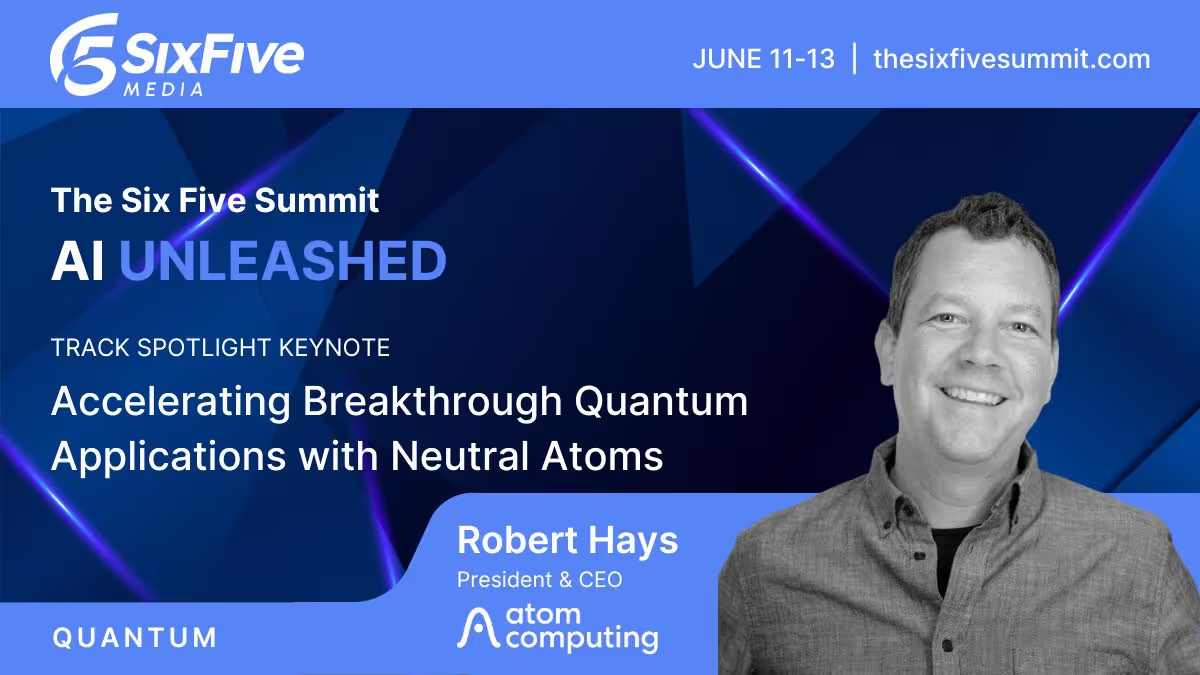
Accelerating Breakthrough Quantum Applications with Neutral Atoms
Our planet needs major breakthroughs for a more sustainable future and quantum computing promises to provide a path to new solutions in a variety of industry segments. This talk will explore what it takes for quantum computers to be able to solve these significant computational challenges, and will show that the timeline to addressing valuable applications may be sooner than previously thought.