Home

How is Software Rewriting Automotive Engineering? A Conversation with Synopsys CEO Sassine Ghazi - Six Five On The Road
How is Software Rewriting Automotive Engineering? A Conversation with Synopsys CEO Sassine Ghazi - Six Five On The Road
SHARE


Sassine Ghazi, CEO of Synopsys, joins Patrick Moorhead and Daniel Newman at CES to discuss how software-defined vehicles are reshaping automotive engineering, and why designing software, electronics, physics, and AI together is becoming critical to speed, cost, and safety.
Six Five is at CES in Las Vegas, inside the Automotive Hall, where the shift is unmistakable. Cars are no longer engineered as machines. They’re being built as complex computing systems.
Patrick Moorhead and Daniel Newman sit down with Sassine Ghazi, CEO of Synopsys, to unpack how automotive engineering is being reshaped as software, electronics, physics, and AI converge. For many automakers, the challenge is no longer packing in horsepower or sculpting sheet metal. It’s how to design, validate, and ship millions of lines of code safely, efficiently, and on schedule.
The conversation looks at why modern vehicles increasingly behave like rolling computers and where things tend to break down as cars become more software-defined. Sassine explains why designing software, silicon, and physical systems in isolation no longer works, and how aligning these pieces early can improve timelines, cost, and safety. The lesson is straightforward. The future of automotive innovation will be written in software, and the winners will be the companies that learn to design it all together from the start.
Key Takeaways:
🔷 Cars are becoming software-defined systems: Modern vehicles are increasingly governed by software, turning automotive engineering into a complex systems problem rather than a purely mechanical one.
🔷 Siloed design does not scale: Designing software, silicon, and physical systems separately creates downstream risk, delays, and cost overruns once vehicles move toward production.
🔷 AI is changing engineering workflows right now: Accelerated computing and AI-driven tools are already reshaping how vehicles are designed, tested, and validated through virtual prototyping and deeper ecosystem collaboration.
🔷 Virtual-first development is getting real: Automakers are shifting away from expensive physical prototypes toward software-driven simulation and validation, enabling faster iteration, fewer surprises, a clearer path from concept to production, and better overall outcomes.
Learn more at Synopsys.
Watch the full video at sixfivemedia.com, and be sure to subscribe to our YouTube channel, so you never miss an episode.
Listen to the audio here:
Disclaimer: Six Five On The Road is for information and entertainment purposes only. Over the course of this webcast, we may talk about companies that are publicly traded, and we may even reference that fact and their equity share price, but please do not take anything that we say as a recommendation about what you should do with your investment dollars. We are not investment advisors, and we ask that you do not treat us as such.
Patrick Moorhead:
The Six Five is On The Road here in Las Vegas, Nevada. We are at the Consumer Electronics Show, and we are in the Synopsys booth here. Look at these. Actually, don't look at the incredible cars yet, but this is pretty awesome. Dale, it's been a great CES so far, hasn't it?
Daniel Newman:
Yeah, it has. You know, there's so much going on in the world right now. We've got robots, we've got AI, we've got the automotive hall. We're driving rapidly, pun intended, towards autonomy. And we're, of course, seeing this whole silicon to systems innovation happening at just breakneck pace. I mean, since we've been here Monday, Pat, you know, there's new chip announcements, new driver lists and L4 and L5. And we see robots walking around this place. You can't come here for a minute and think, man, the innovation that's happening isn't just incredible right now.
Patrick Moorhead: Yeah, you know, it's interesting. CES used to be literally the consumer electronics show. But about 10 years ago, automotive used to get got pulled into the conversation. Why? Because cars became more electrified, they became more intelligent. And here we have ADAS, we have full self driving, and new generative AI algorithms to be put in there that make this as complex as probably a hyperscaler rack to put together these days.
Daniel Newman:
And you know, it's really interesting. I've had a few great conversations here, and we're starting to ask the question about the C. It says it's C for consumer electronics, but should it be C for cars? Should it be Cs for chips? Because it seems like this show is so much more than consumers, and it's really awesome to see all this happening here.
Patrick Moorhead:
It is one company that's absolutely crushing it and imperative is Synopsys. As these designs get more complex, it's not just chips and it's not just a physical design, it's everything together, Synopsys leading it hard. And therefore, we have the CEO of Synopsys, Sassine. Welcome back to The Six Five.
Sassine Ghazi:
Thank you. Great to be here. Yes, I would just love the hardware here. I know, don't you love it?
Patrick Moorhead:
Yeah.
Sassine Ghazi:
There's a Porsche and Synopsys logo right next to it. That's very cool. It's beautiful.
Patrick Moorhead:
Yeah, I didn't expect it.
Daniel Newman:
It makes my eyes water.
Sassine Ghazi:
Cars.
Daniel Newman:
You want to drive it? Is that an offer? No. OK. Well, someday, right? Someday we'll get out there and do that. But I do like to put my foot on the floor every once in a while. But speaking of putting your foot to the floor, back here in the automotive section here, there's a lot going on. Synopsys doesn't necessarily always, you know, people don't always synonymously think about it with automotive. But what are the big changes that are going on in the automotive industry that makes this such an important moment and such It creates such a big role for synopsis to play here.
Sassine Ghazi:
Yeah, actually, if you go back about five, six years ago, CES was all about smart devices, a smart car, a smart phone, smart home, et cetera. As that world started shifting from smart to intelligent, where you have AIs driving the device in terms of how it learns, interacts, adapt, reason, the complexity of building these devices is exponential. And it requires multiple levels of optimization across engineering. All these devices have a tremendous number of silicon. You have the actual physical device that you need, the sophistication of the mechanical, of the structure, of the fluid, etc. So as we saw the world moving from smart to become more intelligent, we made a very strategic move, which is the acquisition of ANSYS. ANSYS is the leader in physics simulation. So almost 90% of the companies you see on that floor, about 100 of the top automotive OEMs are an ANSYS customer. To that extreme, how pervasive is our technology in designing and verifying these systems? And it only does not apply to automotive, because what is an automotive today is a software-defined system. A robot, software-defined robot, et cetera. So the same technology required that sophistication from a silicon all the way up to system. So we're thrilled about the opportunity that is expanding for Synopsys with the acquisition of Ansys.
Patrick Moorhead:
Yeah, the opportunity is increasing the complexity is as well and 10 years ago, Google put a supercomputer in the trunk that barely did self driving. And now we're to the point where you know even in my hometown and I think yours. We have self driving cars that okay they have a few sensors here. a few sensors, but they have very extreme electronics inside as well. So with this said, what are your customers sharing with you about some of the biggest challenges that they have to overcome for the cars of the future?
Sassine Ghazi:
Actually, that's a great example. When you look at the Google example you just mentioned, you had to validate the autonomy of the car by driving hundreds and thousands of miles in order to validate all the various use cases. Imagine a world where you can virtualize the car itself and the environment and do a lot of that development and validation virtually through a digital twin. Now, Digital Twin would not have been practical five, six, seven years ago because you cannot simulate it. The simulation will just simply take too long. Now, there's a big effort on how to accelerate the simulation without losing the fidelity and the accuracy of the simulation. We have recently announced with NVIDIA an acceleration using GPU. So that's another level where you can achieve 30, 40, 50X simulation, but you still need to virtualize and create a digital environment of the world around that system. Be it, again, a car or a robot or on an industrial floor, that representation is a huge opportunity for Synopsys.
Daniel Newman:
But it's really interesting, Sassine, because you're really trying to get three things right at once. You've got the software, a lot of heritage with Synopsys, new capabilities with Ansys, you've got the electronics, right? And then of course you've got physics. And so as we think about this, you know, and by the way, I was at the demo over at NVIDIA the other day and they kind of showed, they were showing a robot and it was basically showing physics on, physics off, how it learns and it walks through a space and you have physics on and you know, it'll bump into something. and it learns from it. Then you turn the physics off and it just blows past everything. You're walking down a hill. You put an obstacle in the way. Exactly. It walks down the obstacle, you know, because you can train it in perfect conditions. And this is really the hard problem with so much of physical AI is that physics is very inconsistent, whereas a language model or video creation model has as much more consistency. How are you, what are you learning about how those things all interact together? And what is it going to take to get that part right? Because that's the, that's the holy grail.
Sassine Ghazi:
Yeah, that example you just mentioned, you cannot do it just by validating it through a physical prototype. It's too expensive, it takes forever, and you're going to miss many use cases that you did not take into account. So you start at the application level, envisioning the use case in a real world environment, and how do you create models for it? But that's not sufficient, because then you need to take into account the cost of developing that system. How are you taking into account the manufacturing of that system? Because you cannot have a robot or a car that's going to cost a few million dollars and assume it's going to be deployed at scale. So today, the way these systems are built, you build a lot of margins. between the software layer, the various physics, the mechanical, the structure, if it's a device that will heat, the thermal, what kind of silicon do you need so you have an overkill from a silicon point of view. So how do you take into account the application in a virtual world without having a need to do physical prototyping and optimizing and reducing the margins across every engineering discipline? That's where we're seeing the opportunity. But you cannot build it as synopsis alone. We have to work with an ecosystem to build it. And we have a rich ecosystem partnership across the silicon, all the way up to the system, in order to make it practical. Now, is it happening right now, today, that you can point to a company that's doing it at that level? No. But do I believe two, three years from now, in that direction, whichever company is racing to build it is going to be the companies able to take it at scale.
Daniel Newman:
But like, you look at like NVIDIA's next generation Vera Rubin systems announced here, A lot of things can be done in simulation. Just take thermals, for instance. There's so much focus right now on heat dissipation. Great application for what you do. In the physical world, though, much less predictable. Is there a curve of where, can we solve all the problems? Can autonomy ever be near perfect? Because I think of every instance of physical AI, the variability, is so much higher than, say, anything that's fixed, say, in a data center. But yeah, we're going to try to solve all of them, aren't we?
Sassine Ghazi:
No, I'm glad you brought up the silicon as a system. Because if you look at these AI chips, Vera Rubin is a good example. Those are multiple chips. jammed in a package where you have to cover all kind of workload, software workload. So the verification of that system is a massive challenge for chip design. With a high level confidence, then when you go and manufacture it, it's going to come back and it works. Because there, if you manufacture it, it's not working. You just wasted $300, $400 million product development cycle. then if it's functional correctly, you need to take into account the stress of that chip is going to overheat based on massive workload you're running. How do you make sure when you're managing the thermal of that system? Now that's at the chip level. The exact same thing applies when you zoom out and you think of the car as a system. How much did you cover in terms of the verification of the environment? And again, you cannot do it through a physical prototype and just drive the car thousands of miles. You need to have a virtual representation and optimization across all these physics in order to do it.
Patrick Moorhead:
So Sassine, when you get this all aligned, you get the physics aligned, you get the software aligned, you get the physical, you actually get the software aligned. Help us take this from kind of abstract to abstract division, I guess. What are some hard numbers? Do you double time to market? Do you, you know, what are, what is the goal here? What is the end goal once these three get aligned?
Sassine Ghazi:
I was meeting with a customer earlier and they were so excited about physical AI. And I was just trying to see from their perspective, why is it practical to do it now versus two years ago, you could not imagine doing it and building a product. It's multiple layers of optimization. Simulation has always been a desire to simulate systems, but it was not practical in many cases. It just takes too long. How can you accelerate simulation? Multiple way to accelerate it. We recently announced the GPU acceleration with NVIDIA. You can speed up simulation 50, 60, 80X. So that made it more practical to say, I can simulate right now at a broader scale in order to check the fidelity of what I'm building. The next level up, can you leverage AI in not wasting cycles of computes and using many techniques? We have a number of techniques using reinforcement learning, for example, that you reach a certain coverage of verification and say, if I continue on running further verification, I'm not improving the coverage. So how do you improve the efficiency of that verification? So to your question, with the improvement on the compute layer, that gave an opportunity to accelerate and then there's an opportunity to intelligently be specific on every workload to design the full stack, so you're not wasting across the stack over designing. So that's where we see the opportunity. The role we're playing, Synopsys, is the silicon to system engineering solution for the various R&D, regardless if you care about the thermal, about the stress or the structure, about the silicon, how can you look at the system and reduce the waste, improve the time to market, and build a product that is affordable, that you can take to market?
Patrick Moorhead:
Yeah, so in the future, you can have a thousand different elements from either chip to car, chip to rack, chip to robot, chip to industrial edge, that you can make a change over here and you really understand what the impact is going to be over here. Alternatively, you improve all the systems over here, it can maybe give you some relief over here.
Sassine Ghazi:
Exactly. The chip to rack is a very good representation in data center. Data center has existed for a long time, but as the workload got more complicated and expensive, you could not just use the same technique. Say this is the same rack, I'm going to use it for all the various applications of workload. It'll be too expensive. It's not energy efficient. So how do you optimize again at the system level? And as you said, make a change at the software and see how is the performance of the chip to ensure that you don't have an overkill at the chip level or vice versa.
Patrick Moorhead:
I like that world. And I think you do too, and your customers should too.
Sassine Ghazi:
I love it.
Daniel Newman:
The opportunity is beautiful. So you've mentioned a few times the possibility of getting away from physical prototypes. Now we know that a lot of work is already being done that way. We know, you know, a great example is how Elon Musk has been able to take the Tesla fleet and all the cars. And basically, every day, they are just creating this infinite, not actually, but this mountain of data that is able to use to continue to optimize. And every year, we get closer and closer to full autonomy. But this could be everything. You talked about robots. You talked about building data centers. It could be engineering buildings, facilities, designing drug discovery in health care. There's so many places where this simulation, you know, in our conversation about fitness and wellness, we talked about, could we build the digital twin of our human anatomy and test, you know, uh, instead of using humans for trials, could we go further with testing or even animals? We could test on a 3d twin. I mean, how close, like give us the timeline of how close are we to some of these, uh, simulations really beginning to replace this physical manifestations that we've been, you know, dependent on for so long.
Sassine Ghazi:
I'm a strong believer innovation is driven by constraints and complexity. The more you constrain, the more complex the problem is and that's where innovation shines. Because of our root synopsis is in silicon. I believe silicon is one of the most complex engineering feat, period. When you have billions, trillions of transistors jammed in a small silicon area and it just works. It's magic. It's like science fiction that is working. That was driven by complexity and that complexity and constraints of physics to manufacture that silicon driven by Moore's law enabled the innovation machine to run at a very fast pace. You look at automotive, what is driving that inflection point and constraint? Electrification, autonomy. AI driven, that engineering complexity, you cannot just engineering the way it was engineered before. So given these constraints, from a time frame point of view, everything we just talked about is being done at the silicon level. You're taking into account the thermal, the structure, the cooling off of that silicon is happening. So the technology is there. How do you take it now to a much bigger system, but that system is running in the physical world, right? Because it's going to have the real world condition that are changing. How do you take that into account? That's why everything needs to be virtualized, create a digital twin for it, because you cannot afford it. Otherwise, it takes too long. There are companies today, you mentioned Tesla, they're collecting data from every car. They're testing that environment and the driving conditions for every accident, for every interaction, et cetera, to train the digital twin representation. So you have, instead of an 80% coverage and 90% coverage and 95% coverage, et cetera.
Daniel Newman:
So what you're hearing then is we're going to get nuclear fusion pretty quickly because we have a serious energy constraint. Right. So we're going to simulate to three billion Kelvin and we're going to be able to use boron to.
Sassine Ghazi:
Again, the constraints keeps on expanding. And when they expand, that's the opportunity to innovate. No question about it.
Daniel Newman:
It is really exciting. We are in exponential times, for sure.
Sassine Ghazi:
It's very exciting times.
Daniel Newman:
And we're going to be in touch because Pat and I are going to want a Six Five car simulated for us. And you can go and deliver it to Austin, Texas. It's lovely down there.
Sassine Ghazi:
We can have fun with that, yes.
Daniel Newman:
Well, Sassine, I want to thank you so much for taking the time here with us at CES. It's always great to sit down. It's just such exciting times. Congratulations on all the progress that you've made. Thank you. We look forward to continuing to follow your journey. Thank you. Thank you. I appreciate it. Thank you. And thank you, everybody, for being part of this Six Five. We are on the road here at CES 2026 in Las Vegas, Nevada. Great conversation. Hit subscribe. Be part of our community. We love all you for joining us. We got to go for now. See you all later.
MORE VIDEOS
.png)
Anthropic’s AI Slowdown, OpenAI’s $1.2T Valuation & Salesforce’s AI Bet
Anthropic's "Pace the Frontier" essay set off a week in which nearly every major AI leader, and two heads of state, weighed in on whether the frontier should slow down. Patrick Moorhead and Daniel Newman read the incident as something larger than a safety debate. Whoever sets the pace of the frontier also sets the pace for open-weight models, enterprise custom models, and the trillion-dollar valuations riding on top of them. That contest, not the essay itself, is the through-line of Episode 320 of The Six Five Pod.


WD's Tim Rausch: AI Storage Demand Compounds With Every GPU Cycle
Western Digital's Tim Rausch argues that AI's compounding data growth, more than GPU capacity, sets the real ceiling on infrastructure scaling. He joins Matt Kimball at AI InfraSummit 2026 to walk through how total cost of ownership, archived data reuse, and WD's capacity roadmap are reshaping enterprise plans to scale AI over the next several years.
.png)
The Main Scoop Ep. 45: Attackers Only Need to Be Right Once. AI Just Made That Easier.
Chad Rikansrud, R&D Software Security Engineer at Broadcom, explains how frontier AI models are finding decades-old mainframe vulnerabilities in seconds, collapsing the complexity advantage that once protected legacy platforms. He outlines why enterprises need faster Security Intelligence (SECINT) ingestion and disciplined human oversight to keep pace with adversaries wielding the same tools.
Other Categories
CYBERSECURITY
Threat Intelligence: Insights on Cybersecurity from Secureworks
Alex Rose from Secureworks joins Shira Rubinoff on the Cybersphere to share his insights on the critical role of threat intelligence in modern cybersecurity efforts, underscoring the importance of proactive, intelligence-driven defense mechanisms.

HP Launches World’s First Business PCs to Protect Against Quantum Hacks - The Six Five On the Road
On this episode of the Six Five - On the Road, hosts Patrick Moorhead and Daniel Newman are joined by HP's Ian Pratt, Global Head of Security for Personal Systems.
What is Autonomous Endpoint Management?
Autonomous Endpoint Management is a framework designed to unify IT operations and security teams on a single platform through real-time control and visibility.
QUANTUM
Quantum in Action: Insights and Applications with Matt Kinsella
Quantum is no longer a technology of the future; the quantum opportunity is here now. During this keynote conversation, Infleqtion CEO, Matt Kinsella will explore the latest quantum developments and how organizations can best leverage quantum to their advantage.
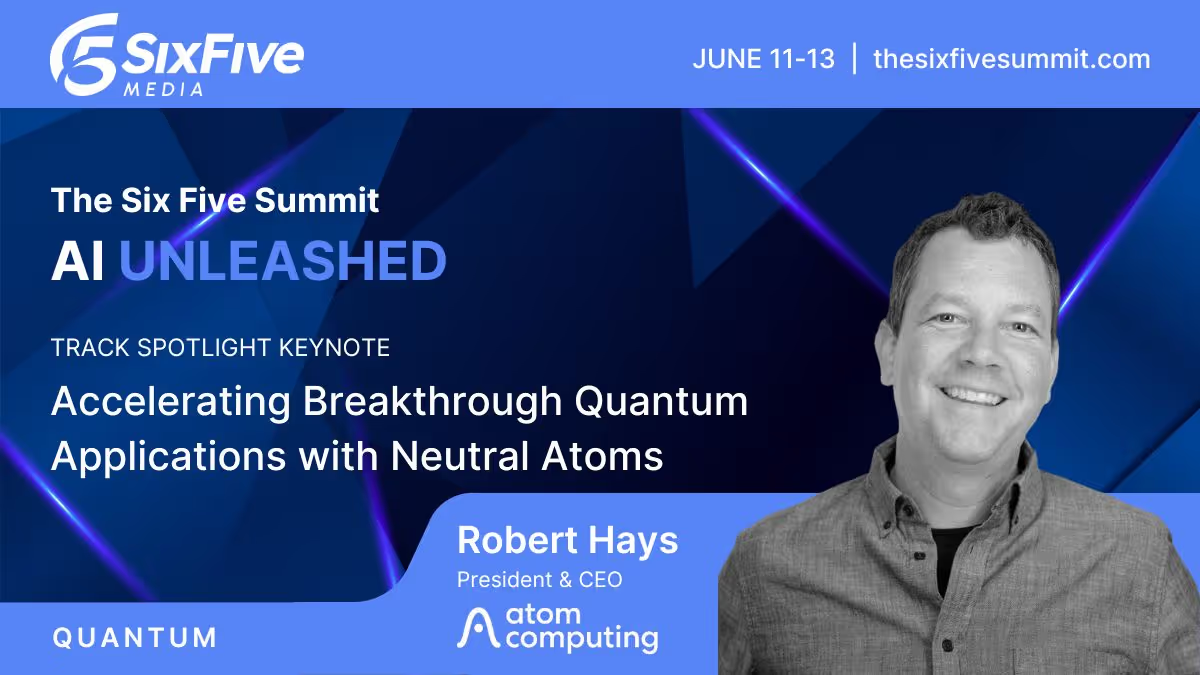
Accelerating Breakthrough Quantum Applications with Neutral Atoms
Our planet needs major breakthroughs for a more sustainable future and quantum computing promises to provide a path to new solutions in a variety of industry segments. This talk will explore what it takes for quantum computers to be able to solve these significant computational challenges, and will show that the timeline to addressing valuable applications may be sooner than previously thought.