
HPC 2.0: How CIQ Is Simplifying Supercomputing for the AI Era – Take :05
SHARE


CIQ’s David Dickerson and David Godlove join host David Nicholson to explore how container-native workflows, security, and hybrid models are making HPC more accessible and effective for AI in today’s supercomputing landscape.
How are container-native workflows and security-focused strategies reshaping high-performance computing for AI workloads?
From Supercomputing 2025, host David Nicholson, Global Technology Advisor at The Futurum Group, is joined by CIQ’s David Dickerson (Senior Director of Business Development) and David Godlove (Senior HPC Engineer) for a conversation on how HPC 2.0 is simplifying supercomputing for the AI era. Guests share how CIQ is making high-performance computing more accessible through streamlined container-native workflows, enhanced security and compliance, and hybrid environments—all key elements in supporting the next wave of AI workloads.
Key Takeaways Include:
🔹HPC 2.0 explained: Modernization of supercomputing infrastructure prioritizing simplicity, scalability, and adaptability for AI-driven workloads.
🔹Container-native workflows: How containerization accelerates deployment, improves reproducibility, and reduces administrative complexity in HPC environments.
🔹Security and compliance: CIQ’s strategies for addressing new security challenges and compliance demands as HPC environments grow more distributed and hybrid.
🔹Hybrid and cloud-native models: Why blending on-premises and cloud resources offers flexibility and optimal performance for evolving use cases.
Learn more at CIQ.
Watch the full video at sixfivemedia.com, and be sure to subscribe to our YouTube channel, so you never miss an episode.
Listen to the audio here:
Disclaimer: Six Five Take :05 is for information and entertainment purposes only. Over the course of this webcast, we may talk about companies that are publicly traded, and we may even reference that fact and their equity share price, but please do not take anything that we say as a recommendation about what you should do with your investment dollars. We are not investment advisors, and we ask that you do not treat us as such.
David Nicholson:
This is a Take Five with Six Five Media. I'm Dave Nicholson and we are here at SC25, the ultimate supercomputing conference this year in St. Louis, Missouri. And as I said, I'm Dave Nicholson. I have two distinguished Dave's with me. Dave, you can be number one, I'll be number three. Dave, number one, introduce yourself and tell us what you do here.
David Godlove:
Yeah, sure. I'm Dave Godlove and I used to be a neuroscientist working at the NIH. Currently, I'm a HPC engineer and also a technical product writer working at CIQ. Dave number two.
Dave Dickerson:
And I'm Dave Dickerson. I work on our sales team and our partnership teams here at CIQ. I've been here for a little over three years now.
David Nicholson:
So we're here talking about HPC, high performance computing. Tell us from your perspective, from CIQ's perspective, kind of where we are in HPC right now, as far as you're concerned?
Dave Dickerson:
Yeah, so right now we're definitely in this transition period of what was traditional HPC and that infrastructure now being used for the age of AI. Those applications and those use cases use the same infrastructure that traditional HPC was, but CIQ is taking a different approach of how do we make the future actual future versus just attempting to build on what was there before.
David Nicholson:
So what are you doing in that regard, Dave? How are you helping people move into the future?
David Godlove:
Yeah, so we're really excited about our product, Fuzzball. And so Fuzzball is basically HPC 2.0. It's taking HPC and reinventing it. by allowing it not only to work on-prem, but also to work in the cloud, by being more intelligent about storage, and by just opening it up to anyone, really, who wants to use HPC, not just computer scientists or domain experts, but anybody who needs to.
David Nicholson:
So what is the connection between the world of containers as we think about them and the world of HPC today?
David Godlove:
Yeah, so about 10 years ago, we saw a container revolution within HPC. And we saw that through products like Singularity, which became Aptainer. So these were container platforms which were built specifically for HPC users and HPC needs. Now we're continuing with that trend with Fuzzball, which is a container orchestration platform, which is built specifically for HPC. So it's a way, once you have container orchestration within HPC, once you've got all these containers to run your jobs, you realize that you can run your whole cluster that way.
David Nicholson:
So what does a delighted user of what CIQ offers in the HPC space look like? What were the issues they were having beforehand that you were able to solve for that makes them get the CIQ tattoo?
Dave Dickerson:
I can make it real easy. A delighted user gets to actually do their job. So in the HPC space, like all things, there's management, there's patching, there's building, there's deploying, there's all of this that has to be done. And we have a viewpoint of letting users work, let them do the things that they want to do, and not have to spend their time managing that infrastructure. And that's our approach to the operating system, that's our approach to our cluster manager, and that's our approach to Fuzzball. give the user the ability to do their work.
David Godlove:
Any other thoughts on that? Yeah, absolutely. I mean, in the HPC space, we have, and I say we, like admins and staff scientists within HPC have traditionally thought to ourselves, well, these users, they need to learn more. We need to make these users computer scientists. They need to learn how to use the batch scheduling system and Linux and all this other stuff. And if they don't, well, then that's a shortcoming on their side. I have worked with a team and the CIQ team is a team that says, no, that's wrong. These users, they already know their domains and their domains are complicated and they need to know a lot about their science or their expertise, whatever that is. We don't need to make them computer scientists either. We're failing if we're doing that. What we need to do is we need to let them do their science and just give them the power to do it without having to learn all these new tools.
David Nicholson:
So I'll tell you what I've been impressed by, and it's interesting. Just a moment ago, I met one of the newest members of your team, and I said, what's your background? And he said, well, media, where I've been dealing with the orchestration of these things, working for big television networks, and it just maps directly with everything I've seen with CIQ. People who have actually dealt with the real world problems, and how to address them, are now coming to the other side of the table, if you will, to solve those problems. I mean, does it feel like that to you?
Dave Dickerson:
No, 100%. So, I mean, before this, I was in the storage industry, doing similar things, helping customers solve their media problems, and solving their backup problems. And from the same concept here, it's just a different piece of it. So how do we help them actually take a step beyond either A, giving them a more compliant environment to operate in, especially in the government space? Compliance matters. Security matters. How can we give them a more secure operating system and a secure environment to run inside of? And then finally, performance. And depending on who's doing what and where it matters, those three kind of rotate as to what's most important and what falls second and third on that list.
David Nicholson:
So when I talk to people in the HPC world, they talk about three things. Compliance, security, and performance. Issues they need solved. What do you do to help them with those three things?
Dave Dickerson:
Yeah, so we take the baseline Rocky Linux operating system that CIQ now delivers in a product called Rocky Linux from CIQ. Uh, and we create a variant called hearted, which we refer to as RLCH or Rocky Linux from CIQ hearted. And what comes along with that is first off, we, we pre-hardened everything, meaning that we do code level changes and introduce certain things like the Linux kernel runtime guard, which protects against if somebody gets behind the castle walls, if you will, it limits the blast radius of what type of. destruction that you can create and access to your systems. And then beyond that, we will take Ansible playbooks to make it easier to do compliance deployments. So achieving CAS benchmarks, applying DISA STIG to these environments. And these are really important to our government customers and clearance focused users. And then finally, beyond that, we will do kernel tweaks and user space tweaks that allow for a more performant deployment, depending on where the customer is needing to run their operating system and what the work workload may look like. you
David Godlove:
If I could just add on, I mean, really it's all about just recognizing that customers are different. And some customers, you know, just really want to focus more on stability. And some customers really want to focus more on things like performance. And so you can give the customers, you know, that choice. Some customers might be in a situation in which they have to focus on security. So you give the customers the choice and you, you know, you take them out of the same box and you put them in, you know, in separate places where they can choose.
David Nicholson:
Okay, so lightning round. Take you guys by surprise. You step into an elevator and you have 15 to 30 seconds. You learn that this person is someone in charge of a complex HPC environment and you grab them by the shoulder and you say, dude or dudette, just remember these two or three things. to get them to call CIQ. What are those things that you're going to try to impress upon them?
David Godlove:
Yeah, short elevator ride. That we're going to abstract away, not only from the user's perspective, but also from the admin perspective. A lot of the stuff that you're working on right now, we're going to make things a lot easier for you and for your users that you get fewer tickets as well.
David Nicholson:
Okay, now you get in on a different floor and it's the same person. What else do you tell them?
Dave Dickerson:
Stop worrying about the infrastructure as a whole and let us handle that from top to bottom. Let us make it compliant. Let us make it secure and let your users actually get to work. Wasted time on their part managing the environment is wasted resources and wasted cost. And that's not something that anybody has the ability to withstand.
David Nicholson:
Fantastic. Well, thanks for joining us here at CIQ town in the Dave lounge with the three Daves. This has been a take five from Six Five Media. Thanks for joining us and stay tuned for more interesting content.
MORE VIDEOS

How the Mid-Market Gets Enterprise AI Without a 300-Person IT Org
On this Six Five Virtual Webcast, AWS’s Chris Sullivan explains how partners and AWS Marketplace are helping mid-market companies move agentic AI from proof of concept to production without enterprise-sized IT teams. Starting with a real business problem and the right partner gives these organizations a faster path to measurable results.


Scaling Enterprise AI, Lessons from HPE - Six Five Connected with Diana Blass
On Six Five Connected, Diana Blass explores how HPE is scaling AI across its own business and what agentic AI demands from compute, memory, edge, and networking infrastructure. Enterprises that design infrastructure around their most valuable use cases can turn AI adoption into measurable savings.
Outpacing Threat Actors: Mainframe Security in the Age of AI and Quantum
On The Main Scoop, Vertali's Mark Wilson explains why AI-driven vulnerability discovery and looming post-quantum deadlines are forcing mainframe teams to rebuild their maintenance cycles. Teams that combine AI-assisted vigilance with security fundamentals and early cryptographic inventories will stay ahead of threat actors.
Other Categories
CYBERSECURITY
Threat Intelligence: Insights on Cybersecurity from Secureworks
Alex Rose from Secureworks joins Shira Rubinoff on the Cybersphere to share his insights on the critical role of threat intelligence in modern cybersecurity efforts, underscoring the importance of proactive, intelligence-driven defense mechanisms.

HP Launches World’s First Business PCs to Protect Against Quantum Hacks - The Six Five On the Road
On this episode of the Six Five - On the Road, hosts Patrick Moorhead and Daniel Newman are joined by HP's Ian Pratt, Global Head of Security for Personal Systems.
What is Autonomous Endpoint Management?
Autonomous Endpoint Management is a framework designed to unify IT operations and security teams on a single platform through real-time control and visibility.
QUANTUM
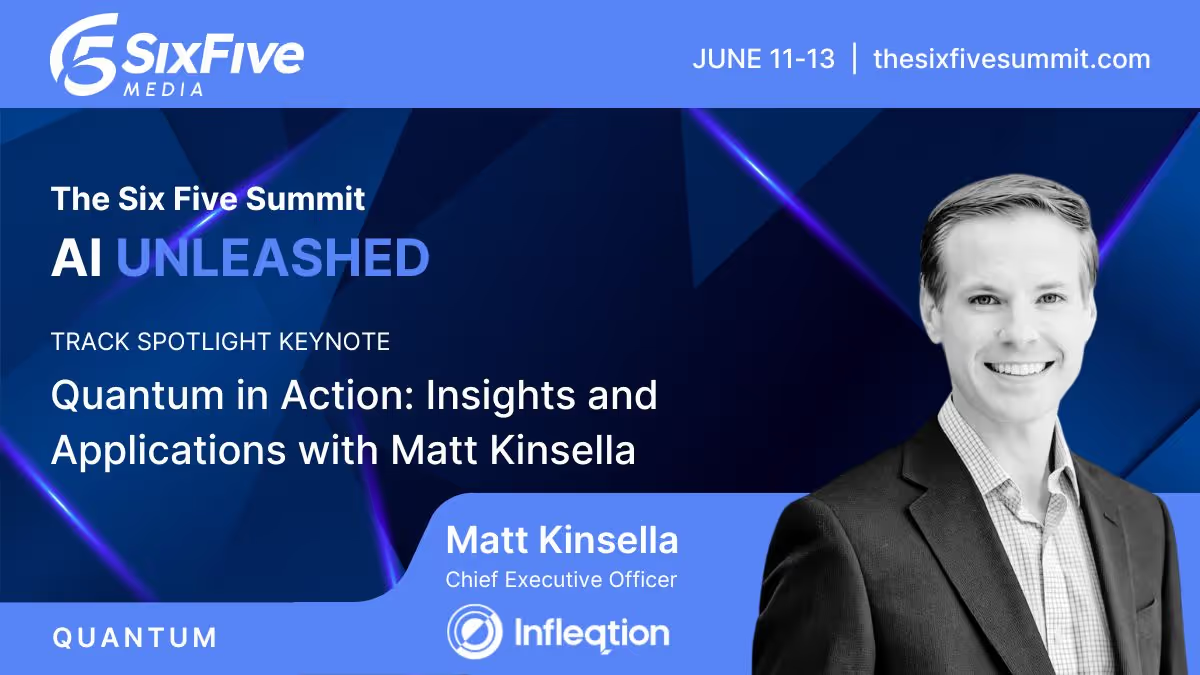
Quantum in Action: Insights and Applications with Matt Kinsella
Quantum is no longer a technology of the future; the quantum opportunity is here now. During this keynote conversation, Infleqtion CEO, Matt Kinsella will explore the latest quantum developments and how organizations can best leverage quantum to their advantage.
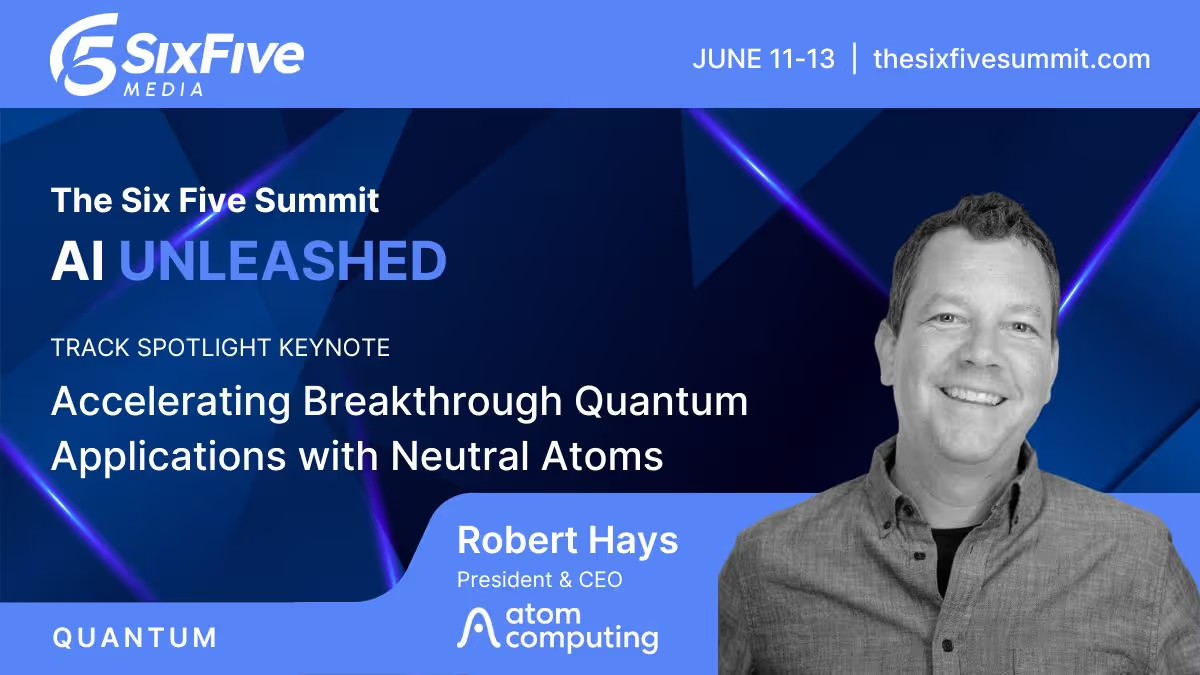
Accelerating Breakthrough Quantum Applications with Neutral Atoms
Our planet needs major breakthroughs for a more sustainable future and quantum computing promises to provide a path to new solutions in a variety of industry segments. This talk will explore what it takes for quantum computers to be able to solve these significant computational challenges, and will show that the timeline to addressing valuable applications may be sooner than previously thought.