
HPE Networking: Delivering Next-Gen AIOps - Six Five In The Booth
SHARE


Miles Davis, VP of Global Solutions at HPE, joins Will Townsend to explore HPE Networking’s evolution, the integration of Juniper, key AIOps innovations, and the path to self-driving networks in real-world scenarios.
As automation becomes essential to modern IT, how is HPE advancing the path toward autonomous networks through next-generation AIOps and recent strategic acquisitions?
From HPE Discover 2025, host Will Townsend is joined by Hewlett Packard Enterprise's Miles Davis, VP of Global Solutions, for a conversation on the evolution of HPE Networking, focusing on delivering next-gen AIOps and the company's journey toward self-driving networks.
Key Takeaways Include:
🔹HPE + Juniper Acquisition Updates: Insights on key milestones and real customer benefits already taking shape.
🔹Comparing HPE’s AIOps Platforms: Key strengths across the company’s two flagship offerings.
🔹Cross-Platform AI Features: The innovations being integrated across platforms and their anticipated release schedules.
🔹Self-Driving Networks: Practical definitions and real-world examples of autonomous network operations in action.
🔹Vision for the Future: HPE’s priorities and directions for advancing networking capabilities over the coming year.
Learn more at HPE.
Watch the full video at sixfivemedia.com, and be sure to subscribe to our YouTube channel, so you never miss an episode.
Or listen to the audio here:
Disclaimer: Six Five In The Booth is for information and entertainment purposes only. Over the course of this webcast, we may talk about companies that are publicly traded, and we may even reference that fact and their equity share price, but please do not take anything that we say as a recommendation about what you should do with your investment dollars. We are not investment advisors, and we ask that you do not treat us as such.
Will Townsend:
This is Six Five Media in the booth. We're at HPE Barcelona 2025. And I'm Will Townsend. Joining me is Miles Davis from HPE. And we're going to talk about one of my favorite subjects, networking.
Miles Davis:
Yeah.
Will Townsend:
Yeah. So Miles, lots of exciting announcements are going on this week. I understand that the event sold out for the first time.
Miles Davis:
That's right. Events sold out. I think all the excitement around Juniper HPE coming together is driving people into the place and making a real kind of buzz about everything that's going on.
Will Townsend:
I can totally feel it myself. So let me ask you that question. How is the HPE Aruba and Juniper integration going?
Miles Davis:
I think it's going really great. The teams have come together in a way in which, through previous transactions like this, we've been able to accelerate things to a level in which I've never really seen play out in the market. And I think it's both because of the way in which we think about the development of the software, it's also about just the nature of the way that we built the platforms and the fact that we both thought about this in a microservices kind of architecture as we build our clouds, allowing us to be able to share some of this intellectual property that we both had before the acquisition closed.
Will Townsend:
And from my perspective, it represents two very, very strong and capable networking solution providers coming together, creating a very viable alternative to other offerings in the market. From your perspective, what do you see as Aruba strengths relative to Juniper strengths?
Miles Davis:
Good question. So when I think about what Juniper Mist came in with is the capabilities around AIOps and being built from cloud kind of ground up. Those benefits in the platform really, really bring these kinds of outcomes to customers that we haven't seen in the market before. On the Aruba side, the strength that we've had is we've got this really strong customer base that understands our portfolio and understands how to build networks at really large scales. And what's exciting about the central platform itself, too, is that we thought about it as the kind of methodology in which we develop to be cloud, as well as VPC, as well as on-prem. So they each bring their kind of unique capabilities to the table in which I think makes for a great overlap or a great overlap as well as a great cross-section maybe is the better word for our customers.
Will Townsend:
I agree and I think just to add to that from my perspective what Juniper brings from a service provider perspective I think is amazing. It strengthens what HPE has been focused on and now HPE extends that into private 5G with the app and that acquisition of what you're doing there. And then I also like Apstra in the integration with OpsRamp over time to drive a stronger observability platform that's going to do amazing things from my perspective for network assurance.
Miles Davis:
Yep.
Will Townsend:
Right?
Miles Davis:
Yeah.
Will Townsend:
I really like the complementary nature of the roadmaps and how they're coming together. And to your point, very early on in Aruba's journey with AIOps, I actually spent time with the team when Kirti was still the CEO. I wrote a paper about the Edge services platform. And that was really Aruba's first sort of toe in the water with AIOps. And then you look at what Juniper's done with Mist, and it's simply amazing. And combining those two, I think it's going to be really, really powerful. And so during the keynote, Rami talked about that cross-pollinization. So I'm hoping, Miles, that we can spend a little bit of time talking about where we should see the fairy dust be sprinkled on Aruba Central and the Aruba Central fairy dust sprinkled on this.
Miles Davis:
Yeah. What's really interesting is that because of the way we've built these platforms in essentially microservices slash just container-based in a very cloud-native kind of way, We've been able to accelerate that process of actually sharing stuff. It's easier to integrate, right? Exactly, exactly. So even as we go into tomorrow's demos and others, what customers are going to see is they're going to see things like the large experience model, which the Mist team built out of saying, hey, let's take all this data that we have around Teams, let's have all this data around Zoom, cross-section that with all the network telemetry we have so that we can predictively determine based on the network telemetry how those collaboration apps might be working. Well, that model that they built and all that telemetry, all we had to do was re-pipe that into what we did in Central and boom, we have that kind of shared. Other areas where we've seen a lot of collaboration is NIST had done their thing around more of a CI and conversational interface.
Will Townsend:
Rami likes to say crushing those treble tickets, right?
Miles Davis:
That's right, exactly. What we launched in Discover Las Vegas and started talking about was our agentic engine under the kind of brand of Copilot. When we came together as a team, we saw an immediate opportunity and we executed on that immediate opportunity to actually bring over some of that agentic capability into the Mist platform, enhancing what they had already been doing with the conversational interface. And those are things in which, from a shipping perspective, customers are seeing today. It's happening today. In production.
Will Townsend:
And that's amazing, given... the acquisition just closed, like how many months ago?
Miles Davis:
Yeah, like three or four months.
Will Townsend:
Yeah.
Miles Davis:
Teams are already working together. Right. And it's not only exciting because we can take what we already had on the truck and be able to, you know, kind of bring them into each other, but also because as we kind of go forward, I mentioned about that culture of cloud native and and thinking about how to develop in a way in which we can easily move things. Sure. We've got this kind of mantra internally now where it's developed once, deployed twice. And between the large experience model, LEM, and our agentic capabilities that we brought over from Central, that's actually the first place in which we took that approach. We adapted our development process to accomplish that. But as we go forward, that's going to be the way in which we continue to make intellectual property and innovation is to develop it in one place with one team, deploy it into two different clouds.
Will Townsend:
Right. I mean, and that's the most efficient way to engage engineering resources and to scale innovation. And all of that effort, from my perspective, is fueling the company's vision for a self-driving network. And there's a lot of buzz, I think, just generally in the industry about this. I think it goes all the way back to intent-based networking. And we never quite got there, from my perspective, because the missing element was AI ops and AI and the maturity of that. So I'm curious, Myles, from your perspective, how do you define a self-driving network and can you provide an example of something that's real today?
Miles Davis:
Yeah. To me, the self-driving network is the type of operational model in which instead of network operators and engineers having to rotely go in and do a bunch of actions in which, you know, we could all just, I guess, do based on reaction. I don't know the best way to say it, but it's so practiced that we just know how to do it. Why are we intelligent humans having to do those things? Why don't we give that over to a network that can self-drive, just like we've done those tasks for cars and planes and everything else?
Will Townsend:
And the value, I think, from that perspective is that it frees up operational teams to provide more value-added support for the lines of business that are supported.
Miles Davis:
That's right. Yeah, and get out of the task of these kinds of rote, you know, repetitive things in which we can take away. The kind of examples that we've actually implemented in the platform, this isn't imaginary, you know, use cases in which customers aren't using. These are active features in the platforms, which are stuck clients, whether they be wired or wireless, from time to time, whether based on the client stack or just the client stack interaction to the network stack interaction, you get these situations where the client isn't transmitting data anymore. Well, based on the telemetry that we have in the network, we can reset PHYs or bounce ports or reset the chipsets and APs. very quickly to be able to react to those situations and then take a task away from a network engineer that has many more important things to go do. So these are like real value adds for customers that need to just get moving on, like you said, line of business tasks or whatever else the case may be, and can put away these tasks that really aren't all that important.
Will Townsend:
Yeah, I mean, from my perspective, it's a game changer. I don't think anyone enjoys mundane, CLI, buried, kind of hunt-and-peck type scenarios, but I'm really blown away by just what the team has accomplished just in a short amount of time. Here's my million-dollar question for you, Miles. What excites you the most? If we look out a year from now, and of course, you can't disclose anything that's under NDA or on the roadmap, but what excites you the most about the combination of Juniper and HPE Aruba?
Miles Davis:
I think what's most exciting about the year forward for us is getting to show customers that we are one team coming together, that this strategy that we're taking up of leveraging the intellectual property across both portfolios and really driving that on both platforms is a reality, right? It's been really exciting to be able to come to bear with the AIOps capabilities that we had on the Aruba side, but to be able to have that plethora of capabilities that the Juniper side brought as well is just mind-boggling and exciting. I'm also really pumped for the type of outcomes that we'll be able to deliver to customers, right? I think we're at a pivotal point in which AI is becoming a non-optional aspect of how the network gets operated. And I've seen it play out just in conversations that we've had with different customers . This used to be something that took me, you know, 12 hours to solve, and now I'm doing this in 30 minutes. Well, what I like to imagine is what can be done with that other 11 and a half hours in our networks with all the different data and telemetry and whatever else. Those customer outcomes are what really, really excites me.
Will Townsend:
Yeah, and at the end of the day, modern AI is only as good as the data that you can move around, whether it's a cloud-hosted large-language model, whether it's a smaller-language model on an AI-enabled device. Network is important, and that's what I really appreciate about Antonio's vision and what the company is executing on. It's making networking sexy again, to quote Justin Timberlake.
Miles Davis:
That has been a really exciting aspect as well. Just thinking from a network engineer's perspective is getting back into a world where it's not about seven layers of the OSI model. You still have to know those things and it's still important. It's really reinvigorated me to be able to come into a kind of landscape of data analysis and other things which wasn't really in our vocabulary 10 years ago as network operators and network engineers.
Will Townsend:
Well, Miles, thanks for taking the time. It's been a great conversation. This is Will Townsend with Six Five Media at HPE Discover Barcelona 2025. Stay tuned for more content coming soon.
MORE VIDEOS
Scaling Enterprise AI, Lessons from HPE - Six Five Connected with Diana Blass
On Six Five Connected, Diana Blass explores how HPE is scaling AI across its own business and what agentic AI demands from compute, memory, edge, and networking infrastructure. Enterprises that design infrastructure around their most valuable use cases can turn AI adoption into measurable savings.


Outpacing Threat Actors: Mainframe Security in the Age of AI and Quantum
On The Main Scoop, Vertali's Mark Wilson explains why AI-driven vulnerability discovery and looming post-quantum deadlines are forcing mainframe teams to rebuild their maintenance cycles. Teams that combine AI-assisted vigilance with security fundamentals and early cryptographic inventories will stay ahead of threat actors.
When Sovereign AI Becomes an Enterprise Problem, Not Just a Policy One
NetApp’s Adam Gale explains why sovereign AI now depends on moving complete services quickly while preserving control and security. For enterprises facing regulatory and geopolitical shifts, portability has to be built into the data platform before a crisis forces the move.
Other Categories
CYBERSECURITY
Threat Intelligence: Insights on Cybersecurity from Secureworks
Alex Rose from Secureworks joins Shira Rubinoff on the Cybersphere to share his insights on the critical role of threat intelligence in modern cybersecurity efforts, underscoring the importance of proactive, intelligence-driven defense mechanisms.

HP Launches World’s First Business PCs to Protect Against Quantum Hacks - The Six Five On the Road
On this episode of the Six Five - On the Road, hosts Patrick Moorhead and Daniel Newman are joined by HP's Ian Pratt, Global Head of Security for Personal Systems.
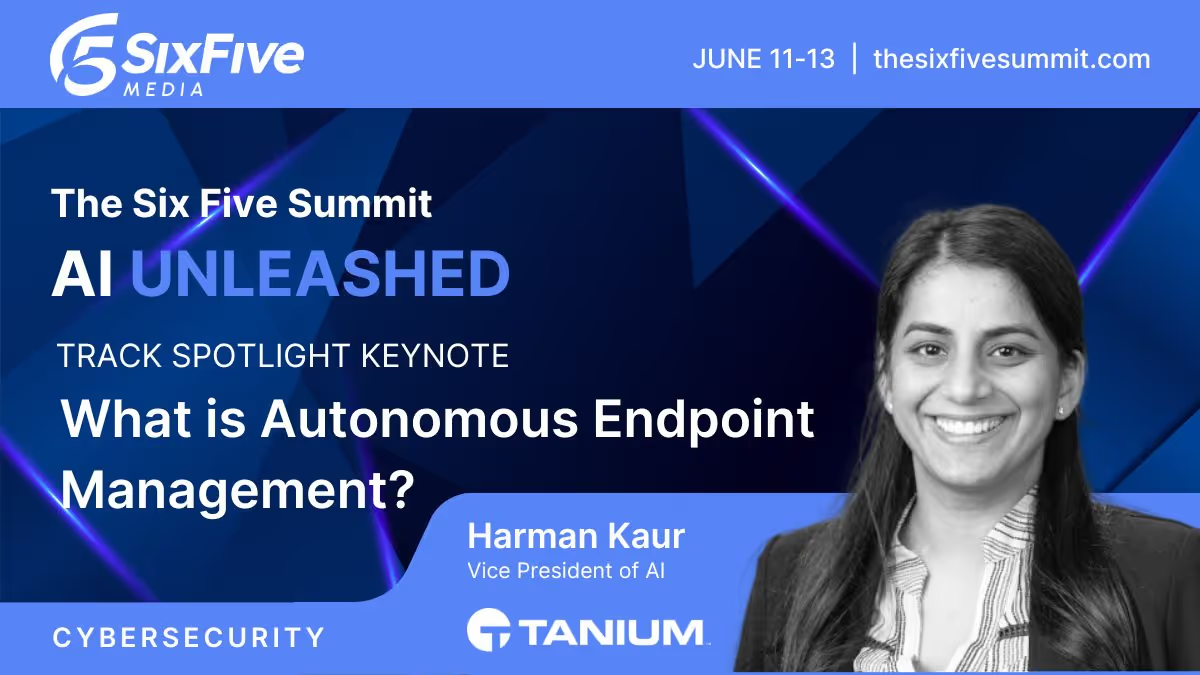
What is Autonomous Endpoint Management?
Autonomous Endpoint Management is a framework designed to unify IT operations and security teams on a single platform through real-time control and visibility.
QUANTUM
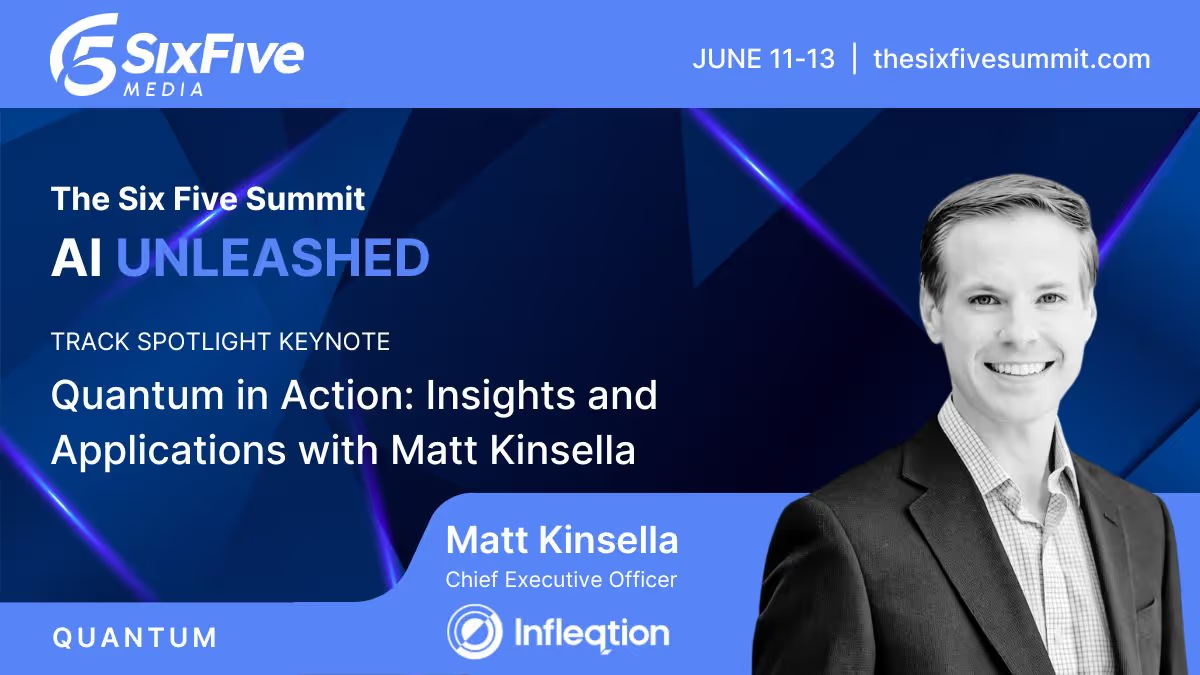
Quantum in Action: Insights and Applications with Matt Kinsella
Quantum is no longer a technology of the future; the quantum opportunity is here now. During this keynote conversation, Infleqtion CEO, Matt Kinsella will explore the latest quantum developments and how organizations can best leverage quantum to their advantage.
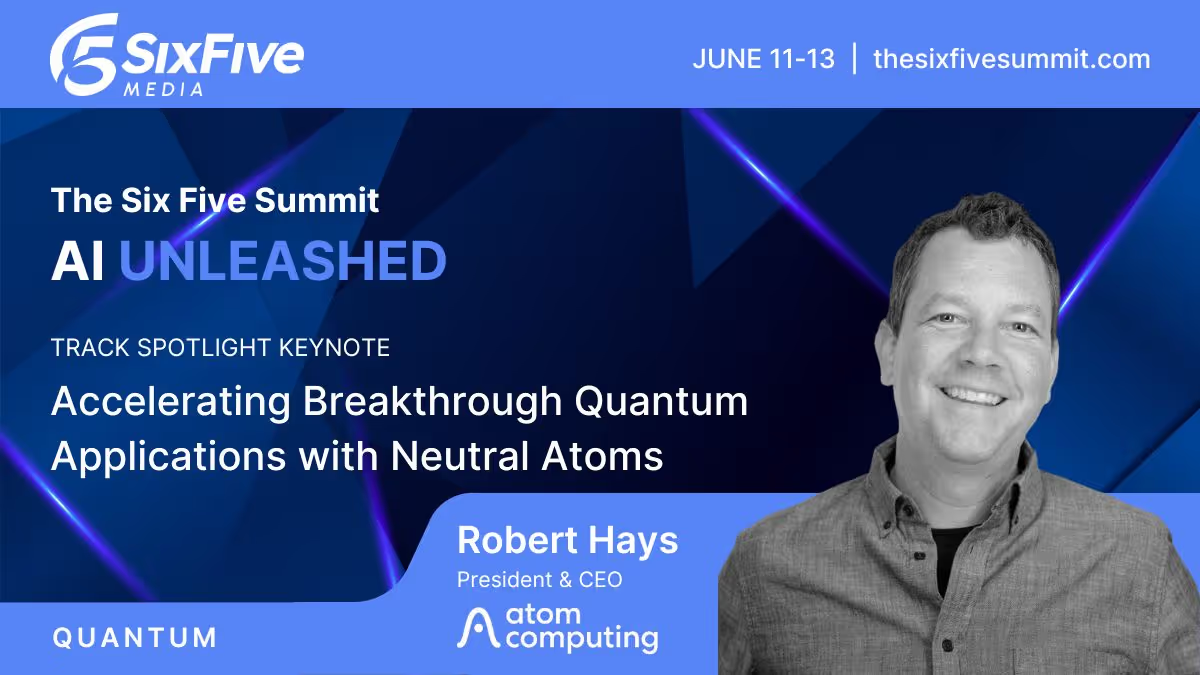
Accelerating Breakthrough Quantum Applications with Neutral Atoms
Our planet needs major breakthroughs for a more sustainable future and quantum computing promises to provide a path to new solutions in a variety of industry segments. This talk will explore what it takes for quantum computers to be able to solve these significant computational challenges, and will show that the timeline to addressing valuable applications may be sooner than previously thought.