
Innovation to Product: How AWS Goes from Science to Service – Six Five On the Road
SHARE


Swami Sivasubramanian, VP, Agentic AI at AWS, joins Patrick Moorhead to discuss how the AWS innovation engine transforms research breakthroughs into real-world cloud services shaping digital transformation.
How does AWS turn groundbreaking scientific research into cutting-edge cloud services powering global businesses?
From AWS re:Invent 2025, host Patrick Moorhead is joined by Amazon Web Services's Swami Sivasubramanian, VP, Agentic AI, for a conversation on the innovation process at AWS. Their discussion provides insight into the “AWS innovation engine” and how AWS transforms research into market-ready services.
Key Takeaways Include:
🔹Concept to Launch: Swami outlines the rapid journey of Amazon Quick Suite from a research idea to a customer-facing service.
🔹Innovation Framework: Learn how AWS evaluates new research and identifies which scientific advances are primed to scale into impactful cloud products.
🔹Customer-centric Development: Insights on balancing bold, long-term innovation against immediate needs and value delivery to AWS’s vast global customer base.
🔹Real-world Impact: Swami reflects on the innovations he’s most proud of, offering his personal perspective on meaningful technological progress.
Learn more at Amazon Web Services.
Subscribe to our YouTube channel, so you never miss an episode.
Listen to the audio:
Disclaimer: Six Five On the Road is for information and entertainment purposes only. Over the course of this webcast, we may talk about companies that are publicly traded, and we may even reference that fact and their equity share price, but please do not take anything that we say as a recommendation about what you should do with your investment dollars. We are not investment advisors, and we ask that you do not treat us as such.
Patrick Moorhead:
The Six Five is On The Road here in Las Vegas, Nevada. We're at AWS re:Invent 2025, and it has been, unsurprisingly, all about agentic AI. And the great part is we are making the turn from, boy, this technology is cool, this is fun, look what it can do, to real outcomes. And there's a lot of science and development obviously that goes into this. But there truly is a different level when it goes into building agentic AI technologies for enterprises. And AWS obviously is a leader in doing this. And the cool part is, like many companies, they create a lot of their own technology internally use it internally before they invoke it on some of their customers. And I have with me Swami from AWS who heads Agentic AI to chat about, and they do this a lot, but one example that they use, which is essentially taking QuickSuite from the, what do I call the science lab? Okay, that sounds very pedestrian and elementary, to hundreds and thousands of users using it inside of Amazon. But anyways, welcome to Six Five.
Swami Sivasubramanian:
Yeah, hey, glad to be here. Thanks for having me.
Patrick Moorhead:
Yeah, you know, in the green room, I talked a little bit about, you know, when they put you in charge of AI, I'm wondering, my gosh, this is a hard job. And how is he going to look in three years? But you look great. You look rested. I'm trying to wonder, like, what's going on here? And you're getting a lot done, too. But anyways, it's great to see you. I've been on different analyst briefings with you, but it's just great that you could come and do this.
Swami Sivasubramanian:
Oh, thank you. It's been actually now like 10 years or so since the days we started on deep learning. So I'm glad to be here.
Patrick Moorhead:
Yeah. You know, that was old AI. That was, you know, we just invented AI like three years. No, we didn't. Okay. Now I know this. I was very tuned into the days of machine learning, but as my programmer son tells me, dad, it's all machine learning. Don't embarrass me. But anyways, it's great to have you. Hey, I want to use QuickSuite as a premier example of how you take something from concept in the lab to production. Can you walk me through kind of the innovation cycle? How does it work at AWS?
Swami Sivasubramanian:
When you think about something like QuickSuite, it came from the premise that, hey, the world of actually how people do work is rapidly changing. And we took a step back. We had actually a bunch of products around things like QuickSight, which is how business users get data from their data warehouses and so forth. And then we had assistants like U-Business and so forth, which are getting data from unstructured data, like documents in MS365, Google Docs, and API, SAS apps, and everything else as well. But then when we observed what we do internally, it didn't make sense, at least in my brain, that, hey, that if I had to answer a question saying, like, hey, I'm about to launch this product or this new capability as part of the service, I'd like to understand how it works against other computing products, if any, out there, how do we stack, and how will, what are the existing set of customers, how will they receive it, all these things. Now, when I ask such a question, Now, you typically need to actually have a BI analyst come up and pull dashboards, and then you need to have a product manager do competitive analysis, and then they actually do a bunch of this work. And I was observing what's happening in the industry last year, let alone when we were building our own models with AI agents, and you saw what we were able to do with Transform, with JDK upgrades, and so forth. And I said, you know what, forget everything what we had. And the entire industry still has the silos I talked about. But I said, what if we didn't have any of these silos? If you come from a purist point of view, it's about you having a unified data lake, so to speak, cross-structured and unstructured data. and you want the ability for agents to get insights, you want the ability to have a research agent, and you want the ability to actually do lightweight automations and heavyweight automations. So this came to the idea of then what does that unified thing look like and that's led to what is then became QuickSuite and this was the fundamental thesis behind the idea. And of course, we had to get a bunch of folks along. And there was a huge amount of innovation that, I make it sound easy, but a bunch of technologies at the time were not invented yet. Such as, how do you build deep research on structured data? Or how do you pull up any kind of terms like agentic or ad did not exist? So when we unpack and work backwards from the customer problem, then we were solving things like, how do you do agentic RAG across structured and unstructured data and third-party SAS APIs? And then, of course, how do you do deep research, where it's not just about the model, but you pull in data. And then we invented things like code agents that dynamically generate code to query all these things. and actually does research and compare and dynamically build stables and stuff. So we started prototyping rapidly. I put together, I call them like a bunch of two pizza ninja teams for each of these things to say, yes, I'd like to see a prototype in the next four weeks for each of these areas.
Patrick Moorhead:
Oh, four weeks.
Swami Sivasubramanian:
Okay.
Patrick Moorhead:
I was going to say like four years or something.
Swami Sivasubramanian:
And then we got going. It was actually as simple as that because the key thing is it forces us also to really think destructively, where you don't feel like, hey, I have to fit it into all the things I'm doing. Then Once we saw the art of possible, then we mapped it to the customer problem and then worked towards actually making it work for all enterprises fitting into their identity stack and fitting into which data connectors needs to be worked through and integration and so forth. So that is where we move from lab to a real product that meets a lot of enterprise needs and startup needs, and then found a quick suite that works across all popular data viruses, not just Redshift or S3 Lake, but Snowflake, Databricks, to everybody else. drugs with more than 40 plus SAS and document connectors, let alone then we started building all these agents with the right identity. So then one of the things unique that I was talking to you offline was This product is something that is very unique to the rest of AWS. AWS historically have been more in, I would say, an API driven business catering to developers, whereas with business users, what they care for is very different. we did something different. We said we're not going to launch it externally until internally the demanding Amazonians are happy. So we rolled it out to 100,000 users internally and we saw how they received it and it took us actually a few weeks before they went from oh this is interesting to I love it I can't live without it.
Patrick Moorhead:
Yeah, so you were very much a behind-the-scenes, but with QuickSuite, you're right there. I mean, it is the front end too. It is the front end.
Swami Sivasubramanian:
And even, that's how actually now if you see how our sales people on the AWS side, that's how now they are getting actually trained on new products. And when they meet a customer, They actually built their own chat agent and they find out, oh, all the things I talked about in the keynote, can you give me a summary of the latest announcements? And all these things are becoming dynamic and they actually build PowerPoint decks on the fly using QuickSuite agents. So it is transforming the way we work. In many ways, this is where I call it as like working backwards from customer meeting science, where you work forward. I kind of now like to make these two, work backwards and work forwards, meet in the middle. And that is exactly where I live. One leg in the future, one leg in the present.
Patrick Moorhead:
That's a great example. And being customer zero gives customers confidence. That's right. Because it's like, hey, well, what do you use? Well, I use what I what I built. So, hey, there's in Gen AI and agentic AI world, there's no shortage of ideas. Everybody's got an idea. Yeah. Okay. And if I look back, I've been in tech for 35 years now, it's like, ideas have never been the issue. It's been, how do you sort the ideas to turn into something that is unique, your customers will pay for, you can make money on? I'm like, I'm just curious, how do you evaluate these research ideas that come across your desk? And you have so many engineers, they have ideas about how they can improve everything as well.
Swami Sivasubramanian:
I know. Actually, I always say this, that innovation looks very rosy in the rear view mirror, but when you go through it, I call it like it's a chaotic process filled with agonizing self-doubt and failures.
Patrick Moorhead:
It's so good. I might lift that for my next podcast.
Swami Sivasubramanian:
But the reason I actually say this, it's because we always remember which ones are success. We don't remember which ones didn't work out. Kind of like kids.
Patrick Moorhead:
You have kids and it's like, hey, I'm ready for another one. I forgot how hard having that last kid was, right? Let's do it again, right? And then you're like, oh my gosh, how did I get here? It was so hard. And then you forget. And then you just go.
Swami Sivasubramanian:
I actually tell you about it. But in a way, but that is exactly like kids because that process is amazingly rewarding and our brain really crazy.
Patrick Moorhead:
And you love all your kids the same, don't you? Just like your products. I get it.
Swami Sivasubramanian:
I include, actually, even my dog in that list. But the thing that I would say is, on your question about innovation, innovation is not just about what ideas I see. It comes in many different ways on where people see the paint on. To me, one of the key things, and this is the genesis of actually the working backwards processes, When people come up with ideas, they end up proposing solutions instead of actually saying, hey, here is the core customer problem I'm trying to solve, and here is why we should solve it. The how part is not important in many ways. To me, it is about what are we solving and why is it important. are the two important questions. How in terms of who should build it and how should we architect it, all those things are important details, but they are next level. So to me, great leaders are typically first A, I want all my directs and leaders, they are trained to say yes more than no. So because you want to be the person not actually stifling innovation, you want them to be enabling innovation. But two, you want to be able to experiment in a lightweight manner. The reason I said I did the stew pizza team to experiment with these ideas is not because it was stingy. It's also because these are risky bets and you can't actually throw in like 300 people to those bets because A, while it may not be a great decision in terms of investment wise, but I also think it simply won't work because organizing 300 people to do anything, something like extremely disruptive, will be disruptive on its own that nothing will get done. So the third thing is, I'm a big believer that also innovation needs to happen. from not just top-down, like me personally having a great idea. It can actually come from even in many cases, like our engineers, especially AWS builds products for developers. So I ask my own developers, why are you not using this? Or why are you not building it? And then they come back with, here are the reasons. So in many cases, I tell them, OK, let's go fix it. Why didn't you start a team to go fix it? And then they actually go and build it in many ways. The KeroSpec was an example of an innovation where we said people actually wear wipe coating, but they hated the notion that there is no way to properly treat all these wipes into something that is durable, that they can actually generate designs and then code and test and so forth. So we had a team of literally six engineers, Claire and a few others actually building it end to end. And then, of course, we made it even bigger as we knew the ideas would work. So to me, it comes in many ways. And as leaders, one of the key things was we had to be staying close to the ground and be accessible so that people walk up to you and say, I have an idea and then tune your ears to listen carefully.
Patrick Moorhead:
Yeah, it's interesting. In a previous life, I was part of many product groups. And, you know, every company says they're customer focused. I mean, who doesn't, right? But one thing that I really appreciated about what AWS did, it seemed to have a very clear articulation of what the customer problem was, what the impact of the problem was, what the new widget is, what it does, how it solves the problem. And I have always appreciated that. And I do actually believe that your customer is centric. Okay, even though a lot of companies say, but not every customer is. We talked about leadership. You talked about leadership and some great leadership education here, by the way, all those who are listening or watching. How do you balance kind of this near term, I can solve this problem very quickly with I'm gonna have to invest a lot of time and money for this bigger problem. How do you balance those two?
Swami Sivasubramanian:
I think, I mean, this is one of the, I mean, constant tussles all leaders face. And the way I tend to view it, which one is a durable problem in the long run? And to me, I view it as in worlds of great change. what things are not changing is going to be a more important question. And then you say, what things are not going to change? Then you ask yourself, that means which are the strategic things we need to build that are always going to be actually the default things that we wish we invested like five years ago, and then look forward from there. So that's how we actually built. And our customers actually wanted in early days of AI that we touched on early on, When we were actually starting, people wanted something called the TensorFlow service. They did not want SageMaker because that was the popular upcoming framework. But then we knew, hey, frameworks are going to come and go and nobody actually now even knows what TensorFlow is anymore. But we knew that what they really wanted was a platform that makes it super easy to build, train, and deploy, because that's never going to change. And then we launched SageMaker. Then, of course, everybody built their own versions of it and whatnot. But the same is true for Bedrock again. And I say, of course, everybody wanted a great model as an API. But what they really wanted was the ability to build model-driven API and apps and so forth. So double-clicking and then making sure, do we have the best platform that will really enable us for, a decade or more to actually thrive innovation, which is how we talked about it. That is one of the ways why we got into building even things like Tranium and whatnot too, because we knew in the world that is going to be so much powered by AI. people are going to want great price performance. And you can't actually just build a chip like in the short run. So making those strategic bets is super important, but they need to be guided by what are the durable things we want for years to come. And that's how we approach it.
Patrick Moorhead:
I appreciate that. A final question before we wrap, you know, we were kind of joking about, you know, products are like your kids, you like all of them equally. But I'm going to put you on the spot here. And if you were explaining to your kids, which one are you most proud of? Yeah. Which one would it be?
Swami Sivasubramanian:
I'd say first, unlike your side, I guess your kid who seems like he's a programmer, my kids are in elementary school, they are 10 and 5, so to me this question is especially harder, but I would say My daughter, she is also an artist and a composer, but also she builds robots. So even though she watches my keynotes, I have no idea how much she understands it, but she knows all the things about Bedrock and others. But she started building on Kira. And her favorite is Kira because she built, I think this was two weekends ago, something called Exploding Unicorn Tic-Tac-Toe Game. She made up the rules on what that tic-tac-toe game should be and I was playing with her that game. She built it in like 30 minutes and it was amazing to see how much creativity that she was able to get done. I think to me Kiro is an example of how we are going to change the game on who is building with agents and how quickly they can build. To me that's what makes agentic AI one of the most transformative technologies since like cloud happen because once we change who is building and are they not constrained by do they know a particular programming language or do they know all the APIs and then how quickly they can build. Now the world is going to change in many profound ways and that's why I'm excited in big ways for this.
Patrick Moorhead:
Yeah, great answer. I wouldn't have guessed that in a million years, the name of the app, which your daughter created, but it's pretty awesome. Yeah, listen, I'm a tech optimist too, and I've seen a lot of waves and, you know, separating from what's a trend and what's a hype, but I do really love the democratization and it, you know, every five or 10 years we get something new, right? It's like no code, even, You know, doing things inside of Excel 20 years ago used to be difficult. So, and here we are building full-up applications just by describing it. That's right. A lot of people can do that, but making them bulletproof for enterprises is a vastly different type of effort. We've all seen the nightmares of vibe coding that can be hacked in about 12 seconds. And we've seen the mistakes that have gone in even to the earlier chatbots, selling airline tickets for $12 and things like that. So a lot more innovation to go and I've been following very closely what you and the team and my team has as well. and I can't wait to see what you work on next and hopefully next year we can sit here and you can tell me about some of the next year's version of QuickSuite.
Swami Sivasubramanian:
I'm excited to share and you're going to see some of the glimpse on the precise problems you talked about on How do you make agents trustworthy and produce the best one? But in my keynote tomorrow as we unpack trust in a big way as well.
Patrick Moorhead:
Well, it's a good start today with what you announced even today. Thanks for coming on the show. Thank you. So this is Patrick Moorhead and Swami from AWS. We are talking agentic AI going from research to deployment, how it happens, how they do it here at AWS. We talked about a few different applications here. Check out all the 6.5 content on our website. Also check out the more insights and strategy content, the research content we have there. Thanks for tuning in. Hit that subscribe button. Take care.
MORE VIDEOS
WD's Tim Rausch: AI Storage Demand Compounds With Every GPU Cycle
Western Digital's Tim Rausch argues that AI's compounding data growth, more than GPU capacity, sets the real ceiling on infrastructure scaling. He joins Matt Kimball at AI InfraSummit 2026 to walk through how total cost of ownership, archived data reuse, and WD's capacity roadmap are reshaping enterprise plans to scale AI over the next several years.


.png)
The Main Scoop Ep. 45: Attackers Only Need to Be Right Once. AI Just Made That Easier.
Chad Rikansrud, R&D Software Security Engineer at Broadcom, explains how frontier AI models are finding decades-old mainframe vulnerabilities in seconds, collapsing the complexity advantage that once protected legacy platforms. He outlines why enterprises need faster Security Intelligence (SECINT) ingestion and disciplined human oversight to keep pace with adversaries wielding the same tools.
Fleet-Scale Deployment Is the Physical AI Benchmark
Physical AI is shifting from lab prototypes to fleets of machines operating reliably in the real world, and Ambarella's Muneyb Minhazuddin joins Six Five On The Road at AI Infra 2026 to explain what that shift demands of silicon, memory and developer workflows. Minhazuddin traces the case back to a 22-year-old chip architecture and forward to a developer cloud built to compress model porting time from months to days, and he identifies enterprise ROI proof points as the biggest hurdle left before physical AI scales into millions of deployed units.
Other Categories
CYBERSECURITY
Threat Intelligence: Insights on Cybersecurity from Secureworks
Alex Rose from Secureworks joins Shira Rubinoff on the Cybersphere to share his insights on the critical role of threat intelligence in modern cybersecurity efforts, underscoring the importance of proactive, intelligence-driven defense mechanisms.

HP Launches World’s First Business PCs to Protect Against Quantum Hacks - The Six Five On the Road
On this episode of the Six Five - On the Road, hosts Patrick Moorhead and Daniel Newman are joined by HP's Ian Pratt, Global Head of Security for Personal Systems.
What is Autonomous Endpoint Management?
Autonomous Endpoint Management is a framework designed to unify IT operations and security teams on a single platform through real-time control and visibility.
QUANTUM
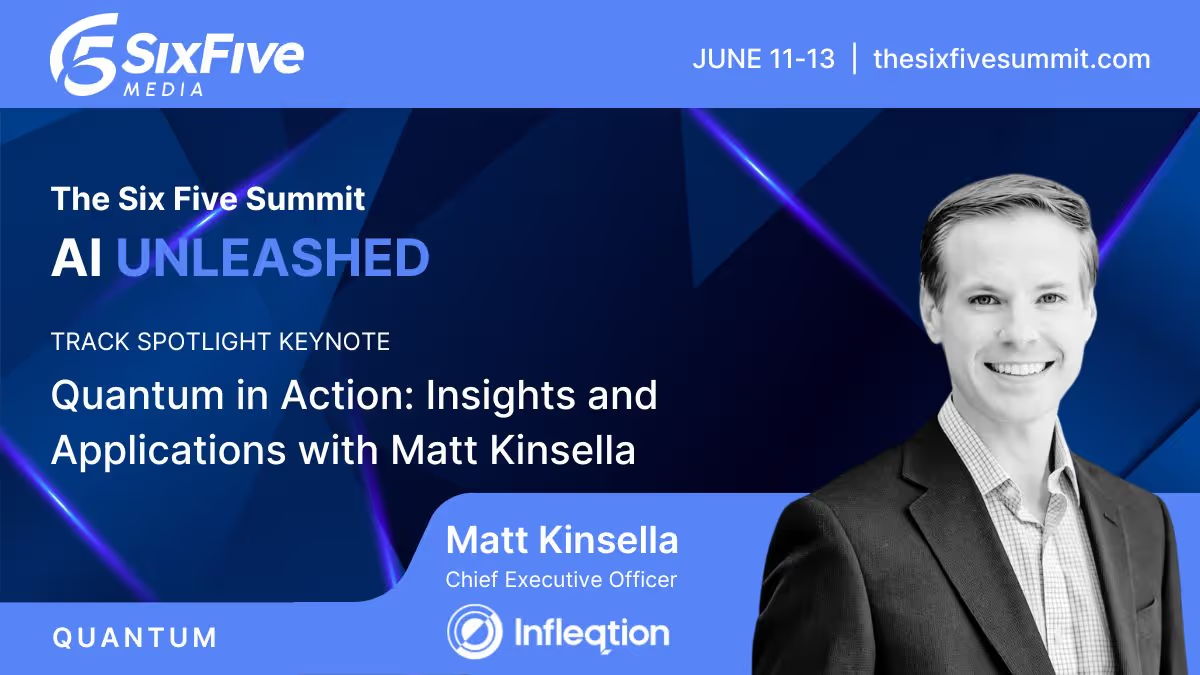
Quantum in Action: Insights and Applications with Matt Kinsella
Quantum is no longer a technology of the future; the quantum opportunity is here now. During this keynote conversation, Infleqtion CEO, Matt Kinsella will explore the latest quantum developments and how organizations can best leverage quantum to their advantage.
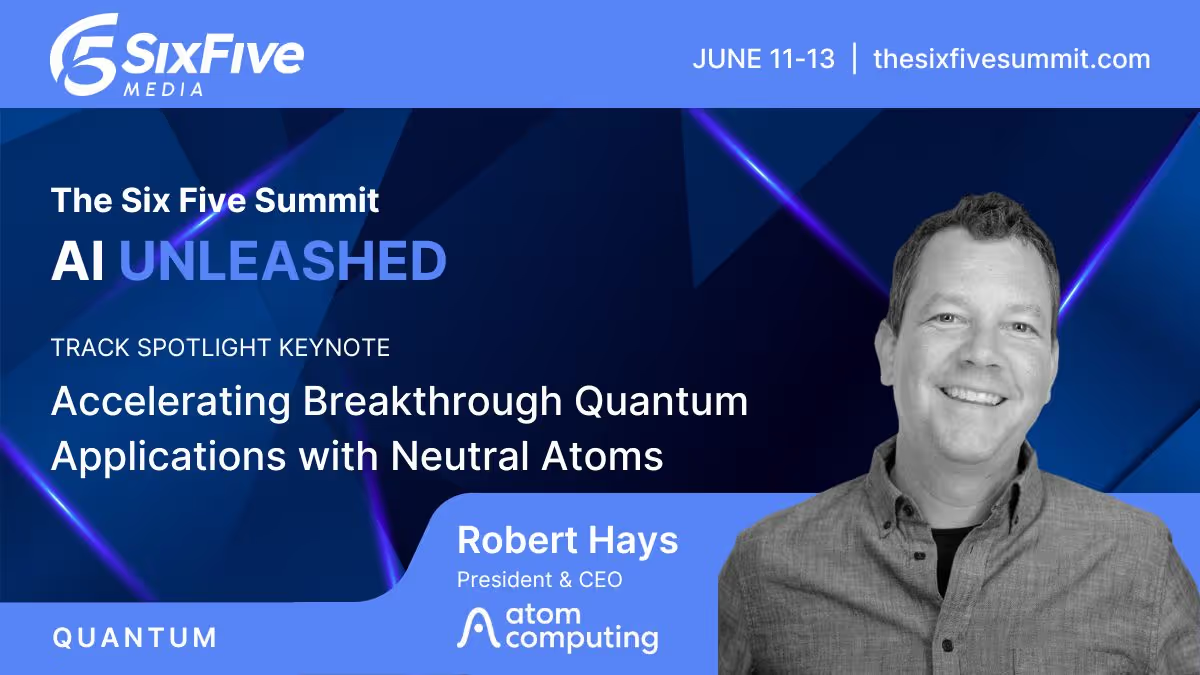
Accelerating Breakthrough Quantum Applications with Neutral Atoms
Our planet needs major breakthroughs for a more sustainable future and quantum computing promises to provide a path to new solutions in a variety of industry segments. This talk will explore what it takes for quantum computers to be able to solve these significant computational challenges, and will show that the timeline to addressing valuable applications may be sooner than previously thought.