
Networking Becomes the Bottleneck: Rami Rahim on Building Infrastructure for AI at Scale
SHARE


As AI deployments move from experimentation into production, networking is emerging as the factor that determines performance, scalability, and operational success at scale. Rami Rahim, EVP, President and GM of Networking at HPE, joins Daniel Newman at HPE Discover 2026 to examine how enterprises are rethinking network architecture, automation, and operations to build the foundation AI infrastructure actually depends on.
Networking has become the infrastructure layer that determines how much value enterprises actually extract from their AI investments. At 10 to 15 percent of total data center spend, the network is a force multiplier — and as AI data center costs approach $50 to $100 billion per gigawatt, the performance of that layer has direct consequences for the returns on everything above it. HPE, following the close of its Juniper Networks acquisition, enters this environment with a substantially expanded capability set across routing, switching, scale-out, scale-up Ethernet fabrics, and a decade of AI-for-networking investment through Marvis.
At HPE Discover 2026 in Las Vegas, Daniel Newman sat down with Rami Rahim, EVP, President and General Manager at HPE, to break down what the Hewlett Packard Enterprise-Juniper combination delivers for enterprise and AI cloud builder customers, how the Marvis AI engine has reached a level of network automation that Rahim believes leads the industry, and what the Helios rack-scale Ethernet fabric signals for the scale-up networking opportunity tied to AMD GPU deployments.
The conversation covers where AI cloud builders are placing networking on the priority list alongside compute, power, and space; how HPE is positioning the Aruba and Mist solutions for AI-managed campus and branch networks; the security integration strategy that makes the case for a self-protecting, self-driving network; and Rahim's forward read on where agentic NetOps takes the industry over the next several years.
Key Takeaways:
🔹 Networking is a force multiplier on compute investment, not a commodity line item. At 10 to 15 percent of AI data center spend, the network determines throughput efficiency across billions of dollars of GPU infrastructure. Running at 50 percent capacity due to blocking or congestion erodes returns on the entire stack.
🔹 The HPE-Juniper integration is ahead of schedule and already producing new product surface area. The close of the acquisition unlocked the Helios rack-scale Ethernet fabric, an open Ethernet solution for scale-up GPU connectivity that Rahim describes as a first-of-its-kind architecture enabled specifically by combining HPE and Juniper capabilities.
🔹 Marvis has a decade of real-world telemetry behind it and currently addresses 70 to 80 percent of network issues through closed-loop automation. Rahim projects that agentic AI advances will bring that to 100 percent within a few years, and HPE intends to reach that threshold before competitors.
🔹 A self-driving network must also be a self-protecting network. HPE's security integration spans firewall, SD-WAN, network access control, and cloud security, converging across the networking stack toward universal zero trust network access, a path every CIO is now actively seeking.
🔹 Customer trust in autonomous network operations is accelerating. Enterprises are moving from requiring approval before remediation to authorizing Marvis to resolve issues without prior notification, a behavioral shift that signals growing confidence in network AI at the operational layer.
The organizations that treat networking as a strategic AI infrastructure decision, rather than a procurement line item, are the ones positioned to get full performance out of the compute they are already building. HPE's combination of Marvis, Helios, and integrated security gives it a claim on that decision at every layer of the stack.
The organizations that treat networking as a strategic AI infrastructure decision, rather than a procurement line item, are the ones positioned to get full performance out of the compute they are already building. HPE's combination of Marvis, Helios, and integrated security gives it a claim on that decision at every layer of the stack.
Watch the full video at sixfivemedia.com, and be sure to subscribe to our YouTube channel so you never miss an episode.
Disclaimer: Six Five Media is for information and entertainment purposes only. Over the course of this webcast, we may talk about companies that are publicly traded, and we may even reference that fact and their equity share price, but please do not take anything that we say as a recommendation about what you should do with your investment dollars. We are not investment advisors, and we ask that you do not treat us as such.
DANIEL NEWMAN:
The Six Five is On The Road here at HPE Discover 2026 in Las Vegas, Nevada. Daniel Newman here, excited for a great conversation that I'm going to have with someone that I've had here on the show before, Rami Rahim. Rami is the EVP President and General Manager at HPE. Rami, welcome back. It's great to be sitting with you. It's great to be here. Thank you so much for having me, Daniel. Yeah, congratulations. It's been a big year, actually. Between last year, at this time, I think I sat at this event with Antonio. And I was talking to Antonio. I kind of took him aside. I said, you're going to get this thing done.
RAMI RAHIM:
Yes, yes.
DANIEL NEWMAN:
And he, you know, at the time, you know, he couldn't say a lot because of everything going on. But anyways, it was very quickly thereafter, Discover, last year, I think, that the news came through that this deal was getting done.
RAMI RAHIM: Literally days after. So we were getting ready to make a big announcement at this show that unfortunately didn't happen in time. So we missed it literally by days. This is my first HP Discover Las Vegas.
DANIEL NEWMAN:
Yeah.
RAMI RAHIM:
Well, there you go. Well, were you here? Were you physically in the building? No, I was not here. I was at HP Discover Barcelona for our European customers. OK.
DANIEL NEWMAN:
OK. Well, look, let's talk networking, right? There's been so much attention over the last year on the infrastructure build out. A lot of focus has been on of course, compute, and compute has been, and this is a big part of HP's portfolio. Having said that, we're starting to see the full stack, right? Whether it's these rack scale systems from partners of HP's like NVIDIA, or it's just the conversation about where are constraints throughout the supply, it's not just compute anymore, it's compute, it's memory, it's networking, it's storage, it's energy, it's everything, but networking is starting to become more and more in focus of how companies are gonna deliver the potential around AI. Even just the HPE Juniper partnership now fully merged, what are you seeing since this deal has been done that is really showing that this was a great deal for both companies and that this combination is going to deliver value faster for your customers?
RAMI RAHIM:
Right, right. It's a great question. For the first part of your question, There is no doubt that there is an immense amount of focus and energy right now on networking. I wouldn't say it's emerging. I mean, we are living it right now. Many of our biggest customers, the AI cloud builders, are really thinking about three things, space, power, and connectivity. And it's interesting because if you take a look at a typical AI data center, Maybe only around 10 to 15% of the total investment in that data center is going to be networking, but it is a true force multiplier. That investment is going to determine how much you're going to get out of your billions of dollars that you put into compute. If you're running your network at 50% capacity, having blocking issues, congestion issues, guess what? That investment in compute is just not going to live up to expectations. So networking has become incredibly important again. It's like essential infrastructure for the AI era. To the second part of your question, Daniel, about the integration, I mean, it's going great, honestly. It's a lot of work. Integrating two large companies is not easy, but we are ahead of schedule. We told ourselves, as we work through this integration process, we are not going to let ourselves get distracted from what's important, which is around innovation, supporting our customers, and we've been doing all of that, the integration work, and you can see the innovation engine since the beginning of this, the close of the acquisition. It's just amazing. It's honestly awesome to see.
DANIEL NEWMAN:
Yeah, it is great. And by the way, when you say that 10 to 15%, it's probably important to also just call out for everyone out there how much the cost per gigawatt, that 10 to 15% is gonna be a bigger and bigger number because every part of that build That number's growing, right? I mean, a few years ago, I think we were looking at something like 5 billion to 10 per gigawatt. And then a year and a half ago, we were talking about maybe 20 to 30. Now the consensus has it at 50. And there's, I think Jensen got on stage and said that this could hit 80 to 100. all those parts, including yours, so the numbers are getting bigger.
RAMI RAHIM:
The numbers are getting bigger, primarily because the demand is getting a lot bigger. I mean, put the supply chain issues aside, the innovation and the process node advancement is allowing us to actually achieve far more bits per second per watt in networking, and that's allowing us to build far bigger data centers today. And of course, we are capitalizing on that right now. Moving more data.
DANIEL NEWMAN:
And let's face it, it's generating more tokens. And that is what, you know, we need to move the data faster and generate those tokens. So we hear a lot about like AI for networks, networks for AI. Where are you sort of seeing demand, because it's everywhere, right? Demand is everywhere, but where are you sort of seeing it in your business? You know, where is it growing the fastest? Where is that innovation being adopted most rapidly?
RAMI RAHIM:
Well, both of those key areas of opportunity are important to us, and both are massive opportunities. Starting with AI for Networks, this is just sort of a new mode of operating networks across every single layer of the network, from the campus and branch to data centers, wide area networking, security, you name it. The old way of operating networks, manual configuration, manual optimization, manual diagnosis of issues when they occur, just doesn't cut it in the AI era. And so we need to leverage artificial intelligence to crush the cost of managing network, to delight the end customer, And I truly believe that we at HP Networking have made the most progress of any other technology company in that space. I mean, our solutions here across Aruba Central and Mist are just awesome. And honestly, like light years ahead of anybody else. The other opportunity that you mentioned is networks for AI. And this just goes back to what we were talking about. I mean, there is a literally insatiable appetite for the production of tokens. And that means you need infrastructure. and networking is such a key piece of this. The one thing that we have the ability to do now in HPE networking is not just the scale across routing solutions or the scale out Ethernet solutions that connect different racks together, but also the scale up solutions that we're developing in partnership with companies like AMD with a product that rack scale solution called Helios. where the network is an open Ethernet fabric, first of its kind, to connect GPUs together. That's a brand new opportunity that has come about because of the combination of Juniper and HPE.
DANIEL NEWMAN:
And by the way, I feel like I got to keep putting these exclamation points at the end of your sentences, but that's a huge, you know, we've got a forecast at Futurum where we're looking at the AMD market share on GPUs. And first of all, we got, I think it was 10 trillion of CapEx. between now and 2030. You've got market share of a more than trillion dollar annual spend on these. rack scale systems coming up and HPE so one of the big differences and of course you have a great partnership with NVIDIA but one of the big differences with Helios is Helios is taking a bit more of a partnership approach and you guys are deep in the guts.
RAMI RAHIM:
Yeah both NVIDIA and AMD are amazing partners of ours very important partners of ours and we're working our solutions with each of these technology providers sort of in different ways With Helios, it is truly unique in that it is now bringing Ethernet and our own Ethernet technology with our software and capabilities, services, into the scale-up solutions for the first time. And, I mean, you might have seen some of these stats, but scale-up, from a capacity standpoint, can be sometimes 10 times the total bandwidth, from a requirement standpoint, as scale-out. It's staggering capacity that's required for that layer of the network.
DANIEL NEWMAN:
Yeah, so for those quants out there that are sort of trying to figure out the spreadsheets and understand the revenue opportunity, this is a really… So when Antonio is pulling forward those bullish forecasts two years into the future in this last earnings, I mean, this is the visibility he has into where HP networking is going to land. So it's… Sure is.
RAMI RAHIM: Yeah, we landed a great Q2 and networking was a big part of the success story there. And yeah, we're optimistic about the future for sure.
DANIEL NEWMAN:
So we've kind of alluded to some of this in the first couple of questions, but The differentiation, right? Because people might look at networking as networking is networking, right? Of course, we've got a lot going on with packaged optics and optical, and then you've got copper, and you've got all the different connectivity. But then, of course, you have what really sets HPE Networking apart? What are the big strategic differentiators in network architecture? Is it specific to sovereign? Is it specific to enterprises? Where are you guys really finding that differentiation being most? you know, well-received.
RAMI RAHIM:
Well, let's start with AI for Networks. We have now, for a decade, been collecting telemetry from real deployments in some of the largest, most complex environments, the largest retailers, largest banks, the largest healthcare systems, and learning from those deployments and teaching our AI engine. It's called Marvis. So Marvis has essentially for the last decade been looking at real world examples of failure modes, learning from them, and that's gone into our algorithms that are now proactively addressing issues before they start to impact customer experience. So that closed loop system that we have now built is, like I said, like way ahead of anything else that exists in the market today. And you can see it in, you know, Analyst reports like the latest Gartner Magic Quadrant for wired wireless infrastructure, where we are farthest ahead in both vision and execution. Then in networks for AI, we build incredible networking infrastructure. A lot of that sort of pedigree comes from Juniper, of course, where we have a history of developing high-performance networking. But I think the real unlock here for us is to combine compute, storage, networking, the virtualization, the automation capabilities across the stack, and that's how I think we achieve a level of differentiation that will be very difficult for the standalone networking companies to take advantage of.
DANIEL NEWMAN:
Yeah, I think there's a word you didn't mention, but I'll complete your sentence, is security. Yes. Right? Because you've got all those other parts, and then, you know, the network, the criticality of making sure the network is secure. Yes. Is going to be such a differentiator, and it's been a bit of, you know, I think I shared something on X yesterday about this, but I said, you know, HPE's made a conscious choice to lead with network and security. And you've always had a very robust compute business, and you're not running away from that, but you're sort of leading with the fact that across sovereign clouds, enterprise clouds, you've kind of said you're not going to chase the low margin, high volume, Neo cloud, some of that stuff, but very conscious to say, hey look, networking's hard, security's hard, we can supply compute, we can string it all together, We can deliver it, and by the way, we can deliver it within our operating model, doing it profitably. And then of course, like I said, and security has been a big part of that as well.
RAMI RAHIM:
I'm glad you brought it up because we firmly believe that a self-driving network must also be a self-protecting network. So security is an integral part of all of our solutions across each of the networking layers. This is where, again, the combination of HP and Juniper is really powerful because we have brought together an amazing set of ingredients. Best efficacy firewall, very high-performance firewalls, network access control that's world-class, the best SD-WAN solution in the market by a lot, a great cloud security solution. And we're bringing them together, embedding them into each of our self-driving networking solutions and working towards what is the future of universal zero trust network access, which really every CIO is wanting a path towards. So security is absolutely integral. We've got amazing gradients, and I think we're also executing rapidly there.
DANIEL NEWMAN:
And I like to point out the IOPS and the automation and self-healing, and I just see that stuff continuing to become exponentially more important. These networks become more critical, more complicated, more at risk of security. The automation and AI at that layer too, because we talk a lot about AI in terms of us consuming it, next generation models and how we use it for consumption and productivity and tokens, but literally inside the infrastructure, it's going to become a massive both requirement and opportunity because we're going to have to keep these networks, keep all this compute up and running, keep it all secure. We're not going to have enough hands on the steering wheels.
RAMI RAHIM:
We need AI to drive this. Yeah, rewind, let's say, five years or so, a lot of the conversations that I was having with customers and prospects was to convince them that they didn't need a lot of on-prem controllers to manage their network. They could go to the cloud, and it would simplify their life significantly. And now, many customers have moved in that direction. It's much less of a convincing job. Today's conversation is about convincing them to do what you just said. take your hands off the wheel, because you cannot keep up. You cannot keep up with the complexity of networking. And I have to say, more and more customers are starting to do that. We're giving them knobs on an individual feature basis, where we say, you know, for this kind of issue, if it occurs, I don't even want to be informed before. Let me know after you've gone and addressed the problem all on your own, Marvis. And it will do just that. So it's amazing to see customers build the trust in the technology and literally take their hands off the wheel.
DANIEL NEWMAN:
Yeah, that's absolutely what we're hearing and seeing, too, in the market. So let's do a little, you know, prognostication. Romney's crystal ball. Again, we're in this era of abundance, and it seems like insatiable, endless demand. I use the phrase, what can be built can be sold, which of course works out great, but it also makes it a little hard for markets to choose the winners and losers. Are you winning because it's best, all the great things that you've said? Is it winning because people just can't get their hands on enough networking? But like, what do you think, how does this evolve over the next several years? Because off camera, you and I both agreed, it's not a demand, the demand curve is not likely to slow down. In fact, I think we've underestimated the demand curve at every stage. So demand soars. Well, what else is going to happen to networking?
RAMI RAHIM:
So in terms of the automation and leveraging of agentic net ops for network operations, while we have made so much progress, there is still a lot more to do. I think we're probably around 70 to 80% of all issues that can occur in a network to be addressed proactively using a closed loop automation system. We are going to get to a hundred percent in the next few years because of the advancements in agentic AI ops. It's truly staggering to see how fast this technology is evolving. And I think we're going to get there first, by the way. Now look at the networks for AI. There is no end in sight to the demand right now for the generation of tokens. What that means for us is we need to continue to push the envelope on silicon systems and software for scale across, scale out, and scale up. You know, we're sort of in this period where if you can demonstrate superiority in performance, power efficiency, you're going to get a big chunk of the pie. And I mean, that's what we're working towards.
DANIEL NEWMAN:
Well, congratulations on all the success. It's been a lot of fun catching up with you, Rami. How was your first discover here in Las Vegas? Overall, good event, good show.
RAMI RAHIM:
Honestly, I'm not just saying it. It has exceeded my expectations. It's just an amazing event. Such a density of customers and partners to talk to. Love doing the keynote address as well. So yeah, I'm looking forward to the next one already.
DANIEL NEWMAN:
I'm definitely looking forward to continuing our conversations here on The Six Five and everywhere else. LinkedIn, everywhere else that we talk, Rami. Thanks so much for joining me here today. My pleasure. Thank you. And thank you so much for joining us here for Six Five. We are on the road here in Las Vegas at Discover 2026. Check out all the coverage here on Six Five at the show. We've got a lot going on. Stay tuned. We'll see you all soon. Back later. Bye bye.
MORE VIDEOS
Fleet-Scale Deployment Is the Physical AI Benchmark
Physical AI is shifting from lab prototypes to fleets of machines operating reliably in the real world, and Ambarella's Muneyb Minhazuddin joins Six Five On The Road at AI Infra 2026 to explain what that shift demands of silicon, memory and developer workflows. Minhazuddin traces the case back to a 22-year-old chip architecture and forward to a developer cloud built to compress model porting time from months to days, and he identifies enterprise ROI proof points as the biggest hurdle left before physical AI scales into millions of deployed units.


.png)
AI Safety Alarms, China's Distillation Reckoning, and Qualcomm's AWS Breakthrough: A Pivotal Week for Enterprise AI
A viral AI extinction claim, a federal advisory naming six Chinese AI labs for industrial-scale distillation, and a $60 billion Qualcomm-AWS silicon pact define a week when enterprise AI risk and opportunity collided head-on. Patrick Moorhead and Daniel Newman weigh in on what's signal and what's noise across AI safety, chip supply deals, and a market rally still betting big on compute.
The 15-Cent AI Query: Broadcom's Paul Turner on Rebuilding Enterprise AI Economics
A Six Five study found an eight-to-one cost gap between running an AI agent through a leading frontier model and running it on modest on-prem hardware. Paul Turner, Chief Product Officer of the VMware Cloud Foundation Division at Broadcom, joins Daniel Newman and Patrick Moorhead at VMware Explore 2026 to explain how VMware's AI Factory turns GPU provisioning, model management, and security into a repeatable path from infrastructure to production AI.
Other Categories
CYBERSECURITY
Threat Intelligence: Insights on Cybersecurity from Secureworks
Alex Rose from Secureworks joins Shira Rubinoff on the Cybersphere to share his insights on the critical role of threat intelligence in modern cybersecurity efforts, underscoring the importance of proactive, intelligence-driven defense mechanisms.

HP Launches World’s First Business PCs to Protect Against Quantum Hacks - The Six Five On the Road
On this episode of the Six Five - On the Road, hosts Patrick Moorhead and Daniel Newman are joined by HP's Ian Pratt, Global Head of Security for Personal Systems.
What is Autonomous Endpoint Management?
Autonomous Endpoint Management is a framework designed to unify IT operations and security teams on a single platform through real-time control and visibility.
QUANTUM
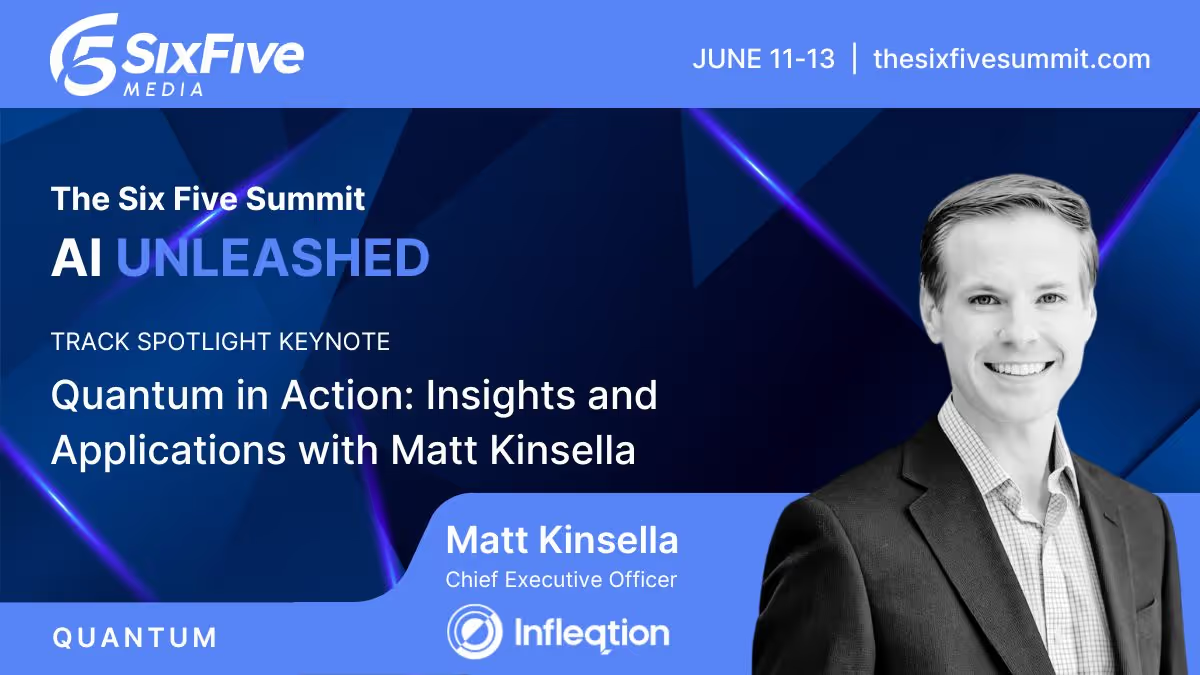
Quantum in Action: Insights and Applications with Matt Kinsella
Quantum is no longer a technology of the future; the quantum opportunity is here now. During this keynote conversation, Infleqtion CEO, Matt Kinsella will explore the latest quantum developments and how organizations can best leverage quantum to their advantage.
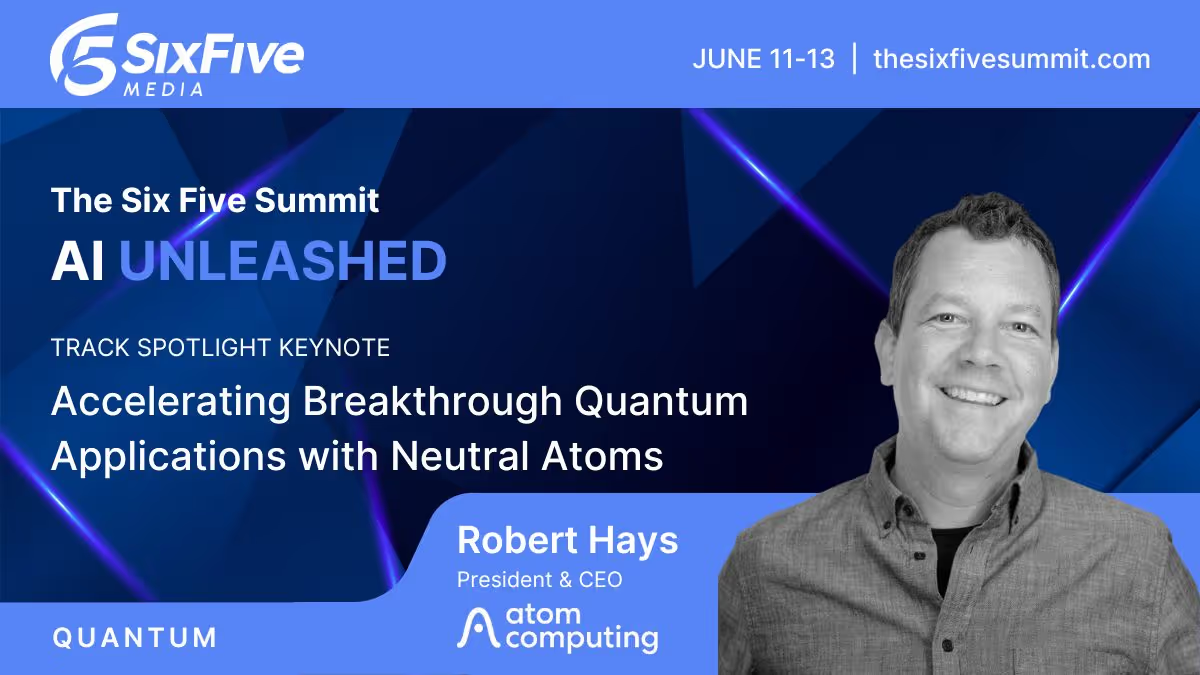
Accelerating Breakthrough Quantum Applications with Neutral Atoms
Our planet needs major breakthroughs for a more sustainable future and quantum computing promises to provide a path to new solutions in a variety of industry segments. This talk will explore what it takes for quantum computers to be able to solve these significant computational challenges, and will show that the timeline to addressing valuable applications may be sooner than previously thought.