
NVIDIA’s $500B AI Bet, Anthropic’s Watermark Gamble & the Edge AI Debate | Ep. 315
SHARE


NVIDIA mobilizes over $500 billion in third-party capital to finance AI infrastructure, Anthropic doubles down on data-center ownership and mandatory content watermarking, and Patrick Moorhead and Daniel Newman debate whether distributed AI at the edge is finally ready to accelerate, all on Ep. 315 of The Six Five Pod.
The handpicked topics for this week are:
- NVIDIA Turns AI Compute Into an Asset Class: NVIDIA signed an MOU with Apollo, BlackRock, Blackstone, Brookfield, Goldman Sachs, and KKR to mobilize over $500 billion in third-party capital for AI compute financing, with NVIDIA backstopping up to 25% of individual deals. Patrick Moorhead called it a mechanism that locks partners into NVIDIA's ecosystem without technically locking them into NVIDIA on paper, while Daniel Newman framed it as smart deployment of NVIDIA's projected trillion dollars in three-year free cash flow. (The Decode)
- Anthropic Doubles Down on Infrastructure Control and Content Authenticity: Anthropic is moving to mandatory invisible watermarking on all Claude-generated text and images worldwide, aligning with the EU's Code of Practice on AI transparency, while also forming a data-center joint venture called Theseus Infrastructure with Macquarie Asset Management and GIC. Moorhead called the watermarking timing risky given Anthropic's ongoing trust concerns, citing data suggesting Claude's Fable 5 model has struggled to gain enterprise traction. Newman raised the "means of creation" IP problem: enterprises building proprietary products on top of Claude could see their own outputs credited to Claude instead of themselves. (The Decode)
- The Frontier Model Landscape Splits: xAI shipped Grok 4.6 at what the hosts characterized as frontier-tier intelligence for more than 60% less cost, while Google's Gemini 3.5 Pro slipped again to August, its third delay from a promised June launch. Moorhead noted open models have compressed the gap with frontier labs from 9-12 months to mere weeks, intensifying the price war, while pushing back on reports of "muted" internal sentiment on Gemini 4 and pointing to Google's track record inventing transformers, TPUs, and PageRank. (The Decode)
- Zuckerberg's "The Future Is for Everyone" Essay: Meta CEO Mark Zuckerberg published a 6,000-word essay using the word "superintelligence" 60 times, arguing for open-weight AI and zero government regulation while explicitly distancing Meta from OpenAI and Anthropic. Patrick read the essay as a positioning document aimed at Washington policymakers, timed to argue against export controls and training-checkpoint restrictions. Daniel pointed to Meta's 3 billion daily users and self-directed compute stack as the company's real advantage, even as its frontier-model leadership remains unproven. (The Decode)
- Intel Prices Largest All-Common-Stock US Follow-On Ever: Intel's stock offering grew from an announced $15 billion to $20 billion and finally $23 billion after the full greenshoe, drawing $100 billion in orders, more than 2,700 times oversubscribed, priced at $95 a share. Moorhead traced the raise back to CEO Lip-Bu Tan's refusal to pre-invest in 14A capacity without a confirmed customer, a stance that drew public criticism before a public reconciliation and a 10% U.S. government investment in Intel. Both hosts read Tan's personal $12 million purchase of shares as a credibility signal. (The Decode)
- The Flip: Will Distributed AI at the Edge Accelerate in the Next 12-18 Months?: Moorhead argued FOR, pointing to the historical pattern of compute migrating toward the point of content creation and citing new device-to-cloud routing technology like NVIDIA Switchyard as removing the sovereignty and latency barriers that kept edge AI stalled. Newman argued AGAINST, pointing to $944 billion that flowed into centralized AI infrastructure in a single week and research showing AI PC adoption is actually decelerating in 2026, with most on-device AI features still routing to cloud models in a browser tab. The Flip assigns Moorhead and Newman opposing sides of a debate, not necessarily their own positions. The exercise tests how far each argument holds up.
(The Flip)
- CoreWeave Posts Strong Beat as Depreciation Debate Intensifies: CoreWeave reported Q2 revenue of $2.58 billion, up 112% year-over-year and above consensus, alongside a smaller-than-expected adjusted loss and a backlog that grew to $104 billion, up 246% year-over-year. Moorhead pointed to contracts running through 2029 on six-year-old A100 chips as evidence a resale market has emerged around aging AI hardware. (Bulls and Bears)
- Nebius Group Posts 454% Revenue Growth: Nebius reported Q2 revenue of $582.3 million, up 454% year-over-year, with adjusted EBITDA turning positive at $236.2 million versus a loss in the prior year. Both hosts flagged energy access, not capital or demand, as the primary constraint facing neoclouds like Nebius. (Bulls and Bears)
- Lenovo Posts Record Revenue and First-Ever Billion-Dollar Profit Quarter: Lenovo reported record revenue of $26.9 billion, up 43% year-over-year, its best quarter in company history, with adjusted net income crossing $1 billion for the first time. Moorhead highlighted the Infrastructure Solutions Group's record 9.1% operating margin and an AI server pipeline that grew 157% quarter-over-quarter. (Bulls and Bears)
- Cisco Delivers Its Best Print in Years, Market Sells Anyway: Cisco reported $17.25 billion in revenue, up 18% year-over-year and beating estimates by $432 million, with product orders up 35% and triple-digit growth in hyperscaler AI infrastructure orders. Moorhead called out enterprise orders up 21% and public sector orders up 30% as early evidence that enterprise AI demand is starting to show up in the numbers.
(Bulls and Bears) - Cerebras Systems Beats on Revenue, Stock Drops 15% on Accounting Confusion: Cerebras posted record core revenue of $209.9 million, up 103% year-over-year, and raised full-year guidance to $880-890 million, but shares fell 15% after-hours as investors struggled to reconcile GAAP and non-GAAP figures around customer warrants. Newman argued the real question is whether Cerebras' inference cloud growth ramp holds up, not near-term accounting noise. (Bulls and Bears)
- Coherent Posts First-Ever $2 Billion Quarter: Coherent reported record revenue of $2.05 billion, up 34% year-over-year, with non-GAAP EPS up 74%. Pat noted 79% of Coherent's business is data center and communications-related, positioning the company as a direct beneficiary of hyperscaler AI capital spending across multiple photonics technologies. (Bulls and Bears)
- Applied Materials Posts Record Quarter, Guides Above Street: Applied Materials reported record revenue of $9.12 billion, up 25% year-over-year, with record non-GAAP EPS of $3.50 and a fourth-quarter guide of $10.25 billion, well above consensus. Moorhead pointed to the company's 13th straight quarter of gross margin expansion and its ability to compete across packaging, advanced logic, and metrology.
(Bulls and Bears)
Watch the full video at sixfivemedia.com, and subscribe to our YouTube channel so you never miss an episode.
Free registration is open for Six Five Summit: AI Unleashed at sixfivemedia.com/summit.
Disclaimer: Six Five Media is for information and entertainment purposes only. Over the course of this video, we may discuss companies that are publicly traded, and we may reference their equity share prices. Nothing discussed during this webcast should be considered investment advice or a recommendation to buy or sell any security. We are not investment advisors, and you should not rely on this content as financial advice. Six Five Media collaborates with technology companies and industry leaders to produce research-driven interviews and multimedia programming for enterprise technology audiences.
Daniel Newman:
What's going on, everyone? How are we doing today? We are back, 6-5. It is maybe Monday for you, because obviously everyone, I don't think people go to work on Monday when they know there's a 6-5 coming up, right? They take the morning off, they wait for it to hit, the alert comes out, they are strapping in, working out, taking a walk. Cause you know, this is the preeminent pod. If you want to know what's going on in tech, but in all serious everybody, welcome back. This is episode 315. Man, what a week, what a week. You and I recording this on a Friday, got back late last night. Some of us were silly enough to think a good idea was to get back super late and then wake up super early to work out. And I bet you, if we actually pulled the crowd right now, a lot of them would say that was me that did that. And it was not me, it was you that was silly enough to get in bed late, get up early. And then by the way, hate yourself so much that you did a leg day. There's a different level of self-hate, like if it was a Friday arm day.
Patrick Moorhead:
I'm happy to report that your facts are straight with the exception of the leg day. I did a back day. Oh, you did a back day?
Daniel Newman:
I thought you did a leg day.
Patrick Moorhead:
No, no, that's tomorrow. I'm doing leg day tomorrow. Dang it. But yeah, it was rough. I'm two pre-workouts in, plus I'm on my second cup of coffee. I should probably add up the amount of caffeine I'm blasting, but I'm mega dosing on creatine, get my brain back. But no, I'm super excited, man, you know, Friday, right. And it's so funny. It's like, that's not even the goal line, right? Because, you know, I'm working on Saturdays, you know, Middle Eastern customers work on Sundays. So this is it, this is the entrepreneurial grind. And if I didn't love it, I wouldn't, I wouldn't do it. But Daniel, I have to ask about the stash. What, tell me what's going on there.
Daniel Newman:
You know, sometimes beauty happens by accident. That's all I can say. It's like, you know, I was kind of doing my typical shavy, shavy. Everyone knows I kind of went from carrying the goat, because we changed the little coin to have a smooth faced Daniel, to having no facial hair and including no eyebrows or very thin eyebrows, I've been told. And, you know, I was, I don't know, Pat, it was like a week I didn't travel, didn't have a ton of media or anything going on where I had to be all fancy. And I didn't shave for like five or six days. And you know how that goes. You don't shave for five or six days and we start to get like a beard. So I was working through, we were getting ready for some recordings for Six Five Summit, which everybody hopefully registered for. 65media.com slash summit. And so I started shaving, you know, I took the first I trim, because you know, you don't want to take the razor too quick. And I started trimming, I just basically I just trimmed everything but the stash. And I got to the end. And I'm like, I think I'm just gonna leave this for today. So I went out and I showed my wife and I thought she'd be horrified. She was not. She actually was like, it's not terrible. She's like, it does not look terrible. And so I said, eh, you know, I'll keep it a few days. The good news for us guys is like, look, I can get rid of it tomorrow. And if I want to do it again, it'll grow back. But yeah, what do you think? I like it, dude. I like it a lot. I appreciate that. Like I said, I have very little contour, no hair on my head, barely have eyebrows, so a little contour. It's going to be the stash at least for today. So anyways, but we had a crazy week. I mean, you and I have ton to cover. You know, we've got NVIDIA's $500 billion Wall Street financing. We have Anthropic, you know, doubling down, watermarking. And by the way, you know, maybe getting a $2 or $3 trillion valuation. you know, more things going on in the Frontier Labs. Cause Pat, what would be another week without another model? God, we have Zuckerberg, you know, being all the big massive empath or a psychopath. I don't know which one with his 6,000 word essay. We'll have to discuss which one that might be. Probably a little bit of both. Intel raised a little money. And then Pat, we're going to get into our flip where I'm going to win a simulated debate. And then we've got a metric shit ton of earnings to talk about today. So I mean, everybody is gonna need to strap in. And by the way, we're not really covering it here on the show, but I just feel like before we get into the decode, the entire last weekend, the market was hyped that memory was gonna go to zero and everything was going to optics. One of the dumbest threads I've seen on FinTwit in a long, long time. And I'm just really glad I was on the right side of that one. Turned up this week, including even Elon Musk came out to reaffirm the fact that memory is still possibly the biggest and most significant wall for scaling AI. I don't know what people were thinking. I'm not saying CPO and NPO and all the things we're doing is not going to create new architectures. And I'm not even saying all the labs and all the chip companies aren't working tirelessly to figure out how to not pay for as much memory. But since we're not talking about it, I just wanted to do that victory lap right there, that once again, held my nose, took people's shit, and once again was right.
Patrick Moorhead:
And I'm pretty awesome for that. And by the way, the question is, did you sell all your assets, including insurance policies, and go in at a forex lover? capitalizing. You know, we'll get there. We'll get there.
Daniel Newman:
I should have done that. You know, I gotta, I gotta, I gotta grow up. You know, the fact is, though, is, is one last point, you know, this whole thing that Ruben was going to use less memory, they're gonna have a new version. And then when people started mapping it out, they realized they'd have to do so many more Ruben chips. And it would actually end up using more memory. Unless when you added up the totals, it would be less across each GPU, but it would be more across total deployment. Anyway, all right, Pat, let me stop my rambling. This is what I do. Sorry. It's going to be an hour and a half. You notice when I host, you get all this excess crap up front. When Pat hosts, we get right down to business. You'll have to decide maybe every other week you just don't want to listen. And I understand. I'm OK with that. And don't tell me which week. But Pat, why don't we start off talking about the other constraint, capital. NVIDIA is turning AI compute into an asset class. How about this new MOU with Apollo, BlackRock, Blackstone, Brookfield, Goldman Sachs, and KKR, 500 billion bucks. What's going on there? Yeah, maybe we should do that. Yeah, I didn't do that part. Okay, do it again. All right, Pat, I've blabbered on enough. There's a lot going on, let's get into the decode. All right, topic one, NVIDIA turns AI compute into an assets class. They have an MOU with Apollo, BlackRock, Blackstone, Brookfield, Goldman Sachs, KKR, 500 billion in third-party capital. framed as demand is real and NVIDIA is gonna backstop 25% of these deals. What's the story?
Patrick Moorhead:
Yeah, so first of all, this is different from NVIDIA just pouring money in, right? The design point, it's institutional credit, right? Insurance money and private capital that are underwriting these GPUs for a myriad of either hyperscalers, colos, neoclouds, sovereign clouds, added even small frontier labs, right? And I think the way to look at this is the only way I think we should look at this is whether your glass is half full about AI and the long term future, or the glass is half empty. Now, I'm a glass half full guy, which is This will be the largest technological shift that we've seen in 50 years. And the economic adders downstream, where you're literally changing everything about everybody's lives and work, transportation, everything has a lot of value. Now, I do recognize that You know, once you start getting into the hundreds of, you know, the trillions, the tea club, it does get a little dicey, particularly when you look at, let's say, the entire GDP of France, right? And that's maybe four to five trillion dollars. Like, how do you justify and like, where is the money coming back? I do want to… I do wanna comment on the brilliance of NVIDIA. You know, it's funny, I took a lot of heat last week from a lot of people. I was essentially saying, listen, I've seen this movie before when I was at AMD and we were starting to really out innovate Intel. Intel would pull in their balance sheet and do some pretty amazing stuff, vertical and horizontal integration to move that up. And I think that, You know, people took that as a, oh, Pat's saying that NVIDIA is doing financial engineering and doesn't innovate. That, you know, I think, again, people play their book big time out there, but that's definitely not what I was saying. But you have to admire NVIDIA for what they're doing to pretty much Even though on paper it's not locking them into NVIDIA, I would say it's locking people into NVIDIA. And this is another $500 billion in sales. And quite frankly, I don't think this is going to be the last one. Right. This is going to be another really interesting way to finance things. I do love the timing. I think it was CoreWeave that said, you know, we're still getting commitments up into 2029 for an A100. That I think is six years old, right, which just shows the downstream demand. But, you know, the negative FCF that people are, you know, even the hyperscalers, the, you know, lack of even profits at the Neo clouds, I do understand why it makes people pause.
Daniel Newman:
Yeah, it's a good read in, you know, you look, you look at the whole story and I've said this many times, you're talking to a company that's got a trillion dollars in projected free cashflow in NVIDIA over the next three years. Why would you not take that free cashflow you're creating and invest it back into the ecosystem to support your major growth? I mean, you know, first of all, just in a very simple math, people go, Oh, you know, they invested 2 million, 2 billion in momentum. And, you know, then momentum is going to pay them $2 billion or whatever, you know, any of these stories that they'll call it, everything's circular. They invested 2 billion in four week. They're going to get 2 billion back. I invested 2 billion in iron. They're going to get to like all these stories about circular, um, investment. And, you know, the bottom line is, is that, they're buying at lower valuations. They're stabilizing and supporting the business ecosystem that's going to grow. Almost all of these investments are sizably larger, meaning that they invested $2 billion. They're worth $8, $10, $12, $20 billion now in terms of the gains. That's just really good corporate venture. It's just really good corporate venture. And so understanding that, you know, investing into the ecosystem that's either going to support the build outs or that's going to create the channel, create the demand. I just don't, I mean, what do you want them to do? Go Apple and just buy stock back? I mean, they could literally buy, you know, 20% of the float back with the cash flow they're creating, but how is that gonna help create innovation? So, you know, people are all hung up on that, but, you know, overall, you know, they're partnering with, you know, the biggest financial engines in the market. And, you know, I think it's, I think it's the right move. You know, I understand that people are concerned about credit risk and people are concerned about cashflow, but I think this is how we get the build out done faster. And, you know, it's our choice. Do we want to move faster? Do we want to move slow? And, you know, only the free cash flow mafia and Bernie Sanders want to go slower.
Patrick Moorhead:
Yeah, man. What a moat for Nvidia. I mean, who else has this?
Daniel Newman:
I mean, like I said, the cash they're creating is just monumental. It's hugely to their advantage to do what they're doing. It just makes them out bigger and bigger and it makes it harder and harder for anyone to chase them. They're so differentiated in their positioning because of how they can liberally deploy cash into whatever they think makes sense. Any supply chain bottleneck, any strategic partnership, any distribution, you know, and they can spread it everywhere. They can put their bets everywhere. And so good on them. Uh, you know, let's hit the next thing. Here's an interesting one. Anthropic basically came out with this watermarking this week. This is interesting. Of course, with Anthropic, there's always a bunch of different things going on. But as far as I know it, what they're basically doing is setting up where the provenance of every cloud output is going to start to be watermarked. And from what I read into that, I think it's a really interesting move. I think Google does something like this, by the way. I don't think OpenAI does yet. But effectively, companies that are building on Anthropic even if they're using their own inputs, putting all their own proprietary data, putting proprietary content and created insights prompts and everything else that now everything that comes out is going to be. notated as created by Claude. This is the big thing. There's a bunch of little things, but this is the big debate, you know, and I don't know that I have a strong opinion on whether or not this, you know, I did say this could be the most consequential mistake that Anthropic makes to do this, because people that are investing bigly to use Anthropic as that sort of output layer, and they're stacking it on top of a bunch of their own proprietary alpha, the goodness, the stuff that Karp always talks about, not doing. And now all of a sudden, everything that your AI is gonna create is going to have a basically built by Claude, sort of like hijacking the means of creation. what I would call it. I thought that was really interesting and I wonder if people that are spending money in building on a cloud this would be a something that would accelerate their consideration of moving to a open source model or moving to open AI if open AI does not in fact do this. But basically, long story short, all cloud-generated content, text, images across every model and product worldwide will now carry invisible watermarks. So people will know nothing that, you know, none of the research, if you were using cloud, that your team use, even if cloud only helped them to modify it, improve it, augment it, would now basically the world will think it was all created and AI generated by cloud. I don't know, I'm gonna pause here because like I said, I think this was driven by the EU and a code of practice with AI that the EU has but like deploying it worldwide. What do you think? Does it push people away?
Patrick Moorhead:
So the timing could be worse with Anthropic Trust going down. And if you look at some of the statements that even Sam at OpenAI made about, we're going to do a percentage of revenue, that's the business model of the outcome. You'd have to watermark your stuff to do that, and Anthropic is just doing everything it can to lower trust for people, whether it's jailbreaking its models, nerfing 4.6 to 4.8, price gouging people. Interesting data point, Fable 5 has not caught on in the enterprise. I thought that was some interesting data that came out. And I think it's going to be really hard. The EU said editing doesn't count, but Anthropic really doesn't have a way to to meter that. And also, what if you had a 100% human written research report and you put it in and asked to do a fact check and then adjust as necessary? That thing is going to be watermarked essentially as AI created. So I think it brings up a lot of issues. Google does it on the image side. I don't know if they do it on the text side necessarily, but You know, you know, we will see even think of a financial analyst, right? You do the cloud plugin on Excel, you have it help create and and fact check. You know, I think this it would be flagged, which which is sad. The other anthropic news I wanted to hit. is announced on August 10th, Macari Asset Management and GIC formed what's called Theseus Infrastructure, essentially putting together a platform to develop and operate and lease data center infrared scale to Anthropic under LTAs. And, you know, I view this as a Essentially margin margin stacking or margin deletion right going more vertically integrated and traffic wants to make its own chips and why not why not have our own infrastructure to take out the profit. um, uh, profit stacking, uh, from Neo clouds or, or the hyperscalers or, or even, even the, uh, even the, even the Colos. So I, um, I think this is, listen, everybody has the visions of grandeur. And if you're going to come out of the hatch with a two or $3 trillion valuation, you need to show not only growth, but also how are we going to manage costs? And pretty much everybody has record earnings. Right. Hyperscalers are making a ton of money on infra. Neo clouds aren't making a ton of money, but they're driving a ton of revenue and growth. Chip makers are making a ton. So this just makes sense. We had covered a related topic on this in a prior episode. But this is the deal. I don't believe that there was a a dollar figure on this deal. But in 2025, Anthropic did commit $50 billion to custom data centers in an announcement it made earlier in 2025. Which, by the way, $50 billion isn't huge, if you think about it, when you're talking about $200B for Google and AWS.
Daniel Newman:
Yeah, I can't tell if things are burning in Anthropic or if it's a $3 trillion IPO that's about to happen in October. Because I'm like kind of hearing both sides, like things are getting really messy. Yeah. I feel like things are just messy and muddled.
Patrick Moorhead:
I mean, messy. I mean, literally the entire senior leadership team, except for the COO, either quit or was fired. Yeah. Now the COO is still there. I thought the CEO left. I thought the CEO was the only one. Well, sorry. They're putting, uh, they're giving, uh, Brockman, uh, more, more responsibilities. So how about this people outside of Sam and Brockman? Right.
Daniel Newman:
Yeah, it's crazy. It's crazy everything that's going on. And I've heard the same thing on Google. I'm not clear 100% on exactly everything where the watermark is. But I just like last thought of this as means of creation, meaning that, you know, like imagine if you use Adobe Photoshop, you know, you pay for it, you use it, and you create an image with it. And somewhere deep inside, it's not created by the agency or the artist. but it's all credited that it's Adobe. And Adobe had like a big sub waterline. It was actually not created by you, it's created by Adobe. People gotta be able to build on these tools or else there is no economy beyond the tool. And that's gonna create a really interesting set of debates. All right, a little more in this model world, Pat. I don't think this one's gonna take as long, but XAI ships a new model. There's some new updated on pricing. You know, as it relates to that, it's cheaper. Google has a new 3.5 or sorry, Google's 3.5 is slipping again. And now there's a world of panic. Is Google falling out of the frontier race? What's going on in model land beyond the two big frontiers?
Patrick Moorhead:
Yeah, that was the big news. I'll add that Google brought out Gemini 3.7 Flash out there as kind of a, you know, essentially the message of we are competitive too. So I think the bigger picture is, it is amazing how it used to be that we were all questioning OpenAI being the runaway, they're gonna run away with everything. Right. And you had some coders that used Anthropic, but, but, you know, not so much, a lot of the coders were on stuff like a cursor. Right. And, and then they came out and 4.6 was, was the big equivalent for a multi-agent. and multi-use case for Anthropic, then it's like, oh my gosh. And then OpenAI went away, and it's like Anthropic's going to run away with the whole thing. Is OpenAI going to go out of business? And then you had the open models that used to be 9, 12 months behind the leading frontier models. Squeeze that to weeks, not months. And then we've got a price war that's going on here as well. Some of these are temporary. Some of these are permanent. I think the biggest biggest thing was you had Grok come out with something that, you know, close to Solmax, but with a significant price cut. And, you know, I didn't know this at the time, but I'm just thinking, You can't just tie a losing core value proposition is tying at the same price unless you can offer something different. And you've got XAI pulling the price lever. Which is pretty cool. And by the way, not to be outdone, Gemini 3.7 flash comes out and takes a huge, it's interesting, it's a temporary low price until the end of the year. Final comment, the delay of 3.5 Pro and then seeing Sundar really lean into 4.0 and the Exodus outside of Google, you do have to wonder what's going on. Two trains of thought. One is very pragmatic, that says, Hey, Google Cloud wants to put all of its infrastructure and sell it to people like Anthropic. And what that does is that potentially starves compute from DeepMind. And the other talk track is about that Google realizes that it can't win the race, but it can win with the right models for its internal workloads and have open models for its own customers. By the way, I don't know I don't have enough data. I haven't had enough conversations with enough people. Semi-analysis basically called Google a loser culture, which I thought was harsh and didn't actually build products. They've built like 30 winning products. They invented transformers. So it's more conversation. And I'm trying to get the inside story at this point. And I don't have it.
Daniel Newman:
Yeah, I don't know, Pat. So first and foremost, you know, I think the world is looking for a U.S. open source or even just price, more price. I don't know if open source is the obsession or just price optimization, meaning I don't know if people are going to be fine to use a frontier open way or not even open of any sort. If it's just U.S. based, it doesn't cost what it costs to run the leading edge. And I think some of the data on 4.6 indicates close to parity. I will say, you know, and our team at Signal 65, I think we're going to build the best benchmarks in the industry for agentic workloads. But like, as a whole, I do think that the benchmarks themselves probably only tell like part of the story in most cases. And why do I say that is because like you, I think you and I agree like anecdotally, we use different models for different things. And we'll see like, oh, on the scoreboard, like Opus 5.0 or Opus, you know, 4.8, where are we at now, 4.8?
undefined: 4.8?
Patrick Moorhead:
I think 4.8, yeah. I don't use Opus, so.
Daniel Newman:
I think there's Opus 5 now, I think there is. I'm just having a total brain fart. But my point is like, between that or Fable and all the different, my point is like, we'll read a benchmark that says X is better than Y, but then you'll use it, you'll be like, I don't know, I think the outputs I get from that model are very good. You know, like your own experience tends to weigh in on that a little bit. I do think, like I said in the end, the token maxing and token efficiency narrative remains. And I think being able to deliver better token economics, high quality, and then, of course, sovereignty and having the model be US-based or Western-based versus Eastern-based does matter. And by the way, just on the Google front, just kind of You know, Google invented PageRank, Transformers, TensorFlow, you know, of course, things that have changed our life like Google Maps, Android. you know, they led translation, you said TPU, you know, they were at the very forefront even of quantum computing, self-driving technologies, I don't know. My point is that's a ridiculously stupid statement to say Google doesn't invent anything. And by the way, it's like creates most profit of any company in the world. I've said it a few times, I think Sunder getting back in the, not Sunder, I think going back into founder mode, you know, I think that's a good thing. And I think having, you know, Sergei and the team step back into leadership in the AI race. I don't know, last thought, I just think ruling any company out because a current model isn't the best, we've seen this through the whole process, is stupid. OpenAI had a huge lead and then Anthropic had a huge lead. Everyone said Grok is dead. Now Grok's not dead anymore. They had a good model. Like this stuff changes fast. I mean, just, My advice, if anyone is willing to listen to me, is don't be stupid. All right, quickly, I want to hit on this Zuckerberg, 6,000 words, great guy that's got $100 billion or more, tells us in an essay that the future is for everyone. Apparently used the word superintelligence 60 times. He argues for, by the way, open weight, not open source, open weight, and zero government regulation. And he said, you know, that they're different than OpenAI and Anthropic. And then on that same day, they released Muse, Glimmer, OpenWait, which I have not used yet, to be clear. I don't know if you have, have you used it?
Patrick Moorhead:
No.
Daniel Newman:
Okay. Yeah. Does anyone use them? I don't know. I'm sure somebody uses them.
Patrick Moorhead:
I haven't even seen very many people talking about it or talking about the benefits unlike XAIs 4.6.
Daniel Newman:
But it seems like the whole thing with Zuck is all about making the world believe that AI is going to change humanity, change our lives. We're all gonna have a, you remember when Steve Jobs said, you know, I'm gonna put a hundred songs in your pocket. Apparently now we're gonna have super intelligence in our pocket. We're gonna have a companion for everything we do, everywhere we go, completely ambient and pervasive. And of course he sees a future where that's gonna be powered by, you know, by meta. I got mixed feelings. Like I said, I always think that companies 3 billion daily eyeballs is a disproportionate amount of attention. And they obviously monetize that incredibly well. I'm just not sure in the AI race where they're leading. The one place I see them leading is they are standing up a shit pile of compute and it is all for their own disposal. They use it for themselves. So anything they want to build with compute is the moat. I continue to think that is an advantage for them. But the last thing about this essay is it seems that he's really trying hard to say we are not anthropic and open air. And that felt like the strongest point he made to me, like that he is open way to support that, you know, that, you know, he, you know, advocates for moving fast, not having regular regulation, you know, create too much friction, slow us down. And then, you know, democratizing access and how, I guess, because they do have their 3 billion users, they can really lead in the democratization.
Patrick Moorhead:
I gotta tell you, man, this was just a mess. Like, first of all, 6500 words. I mean, what are you thinking? And the only thing that I can come up with is this is targeted at the bureaucrats globally, but particularly in Washington DC, because the only people who read 6,500 word essays are think tanks and the junior staff of senators and house members. So, but net, net, I think you nailed it. Primary thing was we are not, Anthropic and an open AI who ship to governments and businesses as if consumer as if they don't have a consumer play. And so it was partially a positioning document that says we're for everybody with all of our users. And oh, by the way, ignore, ignore Google. Okay. That had a billion users. It was funny, I couldn't figure out if it was the actual application on the smartphone or that included AI overviews, but still, there is another sheriff in town there. And part of it, I think, might have been just catch up, which was, you know, you had Jensen come out with a lot of leadership and had all of these people sign on for open models. And, you know, maybe Metta like Metta was a signature, signatory, signatory, and they just felt left, left out. But it's kind of a, you know, finally, the other reason why I think it was targeted Washington is, is, You know, he wasn't saying don't, you know, don't closely manage these. It was, hey, keep the export controls, take the training checkpoints and stop handicapping an American to open source against China. So yeah, that was a mess. Oh, total mess. Other than that, the play was good, Mrs. Lincoln said.
Daniel Newman:
All right. All right. And that was what young man, young man screams. Get off my lawn. Um, I can I can play that too. Yes. So all right. Last thing. Lip boo tan. Raise a little money. What's going on there, Intel?
Patrick Moorhead:
He did. He did. So a little story here, right? Lippu comes in as CEO. He floats the idea that he's not going to build out 14A. Trump calls him out and says he needs to be fired immediately. A week later, they're taking selfies together. A lot of videos, Lutnik and a 10% investment by the USG into Intel. The stock goes a little bit nuts. But Li Pu always said, and part of this what he said is, I am not going to pre-invest CapEx without a customer. And you might think that's super pragmatic, but it did go against the risk-taking that goes into semi-CapEx. Believe it or not, until this crazy time of what seems like unlimited CapEx, it would be a huge decision to invest something that you're not going to see any return on for three or four years. And if you see a return, it's going to be suspect and questionable. And I think TSMC operates still a little bit in that. So Lipu, I also think it was a little bit of Lipu's brilliance in negotiating. He was sending his message to Apple, Nvidia, AMD, Qualcomm, Marvell, and others that, okay, if you don't get on board, I'm going to leave you to Intel. Sorry, leave you to TSMC. And at the time, Samsung was struggling with two nanometers. So, all of this ended up coming together. Long story, this is where the capital is actually the credit or the money to actually deploy the capital to build out 14a. And by the way, I think this is for packaging as well more near term. And I also think it could be a little bit for 18AP that became a note again, right? And this also follows on their earnings report where they clearly said that they were supersizing CapEx for 26, but also for 2027. Net-net, this is an absolute confidence boost, should be a confidence boost. It's one thing to say you're bullish about your PDK and you're having some very constructive conversations when your CEO says, I'm only going to deploy capital when you have a customer, pretty much says, we have a customer. And if you weren't confident enough about that, Lipu put up $12 million of his own money at $95 a share. I wish I could have gotten in on that deal. I'll sign me up for discounted shares, please. I could flip the next day. Just kidding. But that was extra. Lipu putting his own money on the line was kind of like icing on the cake.
Daniel Newman:
Yeah, look. you said all of it, you and I beat the drum, watch the CapEx number, this raise is signal. So I've already in the market that's looking for signal about where Intel is going and people are mad, oh, they're diluting, blah, blah, blah, look. If they get this right, this is a drop in the bucket to the future evaluation of the largest Western leading edge foundry, period. The customers are coming in. I can't validate and verify that because Intel is not, so we can't, but like Lipu is, you know, he is almost as conservative as TSMC. And you've heard me talk about TSMC does not spend CapEx if it does not know for sure that CapEx will return. Lippu is cut from a very similar cloth in terms of how he thinks and how he operates. Again, you want a sign, he's giving you a sign. He's not going to come out with a press release that says AMD and NVIDIA are going to do X amount of wafers on 14A with me. It's not going to happen until much, much closer to when that goes live. And by the way, just one little comment on the 12 million, Pat, because I just think it's fun. You know, I posted something about it. A bunch of people are like, well, he's worth a billion bucks. Like, you know, what's 12 million? And I just laugh. I go, anyone that's ever made any money of any consequence knows that they don't nobody just throws 10 million of their own capital plus into anything if they're not convicted by it. Like he's investing in his own capital. because he's basically signaling to the market how confident he is. Like no one's throwing it away. He's not throwing the money away. So just, just know that like people, you know, wealthy people didn't become wealthy by being idiots. You know? I mean, they're not just running around buying horses. I mean, they're doing smart stuff with their money.
Patrick Moorhead:
Yeah. There is huge difference between cash and cash and value too. Like one person can be, you know, cash poor and only be able to afford, you know, one McLaren and a Ferrari and a Lambo. And, you know, the other guy, you know, all about cash decides to, you know, put 5 million bucks into horses versus the S&P 500 were to be worth 10.
Daniel Newman:
By the way, everybody, there's nothing to read into that. That was all hyperbole for anyone that's concerned. Like I said, I respect LitBoo for what he's doing. And I think Intel's future is looking brighter and brighter with each passing day. All right, Pat, we got through the decode. We did it. And now we're gonna hit the flip and everybody knows this is the part where you and I do a simulated debate on a topic that is of interest. And today we're gonna talk about distributed AI at the edge. We're looking at on-device and on-premises and will it accelerate materially into enterprise deployments over the next 12 to 18 months, forced by escalating token expense, cost controls, sovereignty and compliance, or is it just a rumor and a fad? Let's flip and see who's for this trend.
Daniel Newman:
We're gonna move to the edge. Going on to bonus.
Patrick Moorhead:
How about that? Yeah, I went and did a little, okay, my agent did a little research on this, but yeah, I've been calling this since 2023. And this is an easy one on multiple, on multiple framing. First of all, let's take history, right? History always says, that the compute and data will go as close to the point of content creation as you can possibly get. We saw mainframes to mini computers, mini computers to client server, and the whole PC. revolution, and then tablets and phones. And what happens is the only thing that goes contrary to that argument is if you can't manage the end-to-end ecosystem very well, and concentration is actually a positive from an efficiency standpoint. And one of the reasons that it was so hard to chop up a cloud workload was because of latency. And this whole idea of bursting of the cloud didn't make any sense. But with the new technologies today, whether it's routing like the NVIDIA Switchyard, having the management planes for agents, workloads, and even models that says, hey, you user on the end, your privacy, your sovereignty, and enough performance to complete a workload, an agent in a certain period of time at the right quality level will keep it on that device. If not, it bounces it up to the Cloud unless you don't want to share your IP with Anthropic so they can share your IP with everybody and then build businesses to come and get you. So there's a sovereignty angle that I think people finally get you got a management plane with things like switchyard and also the agenda orchestrators out there and then the fundamental physics. I would say physics advantage, which is says just the amount of distributed compute has always eclipsed the amount of concentrated compute. Yeah, concentrated compute out there. So I think that. You know, people might say, oh, the AI PCs, they never went in there. Just to be blunt, the amount of compute that was in there was insufficient to do what we're doing today. And that call was made about eight years ago to invest in that in the architecture. So I get it. But as we see, you know, like AMD's Gorgon, DGX Station, you know, some very capable systems and including some of the NDA roadmap stuff that you and I have seen together, it's very clear that that capability bar will go up. I think the final thing I'll talk about is, and it's funny, I'm not even talking about the industrial edge and robotics, which is the edge, I'll stick this to devices, is the model capability are just absolutely Insane used to be that leading edge model take two years to go from the data center to the same level of computing with the client now it's more like. 69 months so you know these are no longer these teeny tiny and capable. type of models to get real work done. I've got like 10 more points that I can go down, but I'll just leave the floor to you. I don't want to embarrass anybody.
Daniel Newman:
Oh, Pat, you're so funny and silly when you're wrong. Despite the fact that it's easier to argue, you know, and frankly, I'm not even going to argue against Edge AI. I'm just going to argue against the calendar here so I can be right and I can win. Accelerating material at 12 to 18 months is just It's just wrong. It's not happening. It's not going to happen this quickly. And every piece of evidence we have, including our own research at Futurum, says it's wrong. This is a 29 story being told as a 2027 story. Look, let's look at what's actually happening. This week alone, $944 billion went into centralized AI infrastructure. Okay. Just that alone. You know, capital markets are the world's most expensive prediction market. And this week they bet nearly a trillion dollars that inference stays centralized. You're asking the world to fade that trade by believing this is going to be a 2027 store. Furthermore, you know, If this was 12 to 18 months out, the supply chain would already show it. Where are we going to get enough memory and enough supply to actually build all these devices that you're thinking about at the edge? Because right now, we can't do it. So even if the world wants to do it, we're going to be doing it on underpowered machines and underpowered devices that can't actually handle the kind of models that they're going to need to do this kind of work. Jeff, I want you to sleep. Wake back up. All right, so I'll back this up even further with our own research. You know, we track, and guess what? AI PC adoption is decelerating in 2026 as the Windows 10 sunset tailwind fades. Most AI applications remain browser-based. And the refresh cycle that you call a physical delivery mechanism is a replacement cycle wearing an AI coat, like vast companies that said, we have AI. Not really, the growth has remained the same. And yet, yeah, enterprises are buying the machines, but they're not buying them for on-device AI. They're buying them because their old systems aged out. It was a cycle thing. It was not a technology-driven innovation cycle. And by the way, just to be clear, shipping a device with an NPU is not deploying edge AI. Okay. Attach rate is not utilization right now. Most of the used AI feature on a, sorry, most used AI feature on Copilot PC is a browser tab pointed at a cloud model. Okay. I'm glad we had this talk. And lastly, you know, quality matters. Look, okay. You're right. You know, these one to 15 billion parameter open weight models now match GPT 3.5. Holy crap. What would you actually do on GPT 3.5? What crappy unimportant kinds of work are you going to do on a, what, three-year-old model? You know, we need hard ROI, and that's going to come from the best models. Those models are 200 billion to 800 billion parameter at minimum, and they have 32,000 million context windows, and they're running on B200s and B300s and MI350 clusters, not on a laptop. So anyways, you know, the best argument you made was the sovereignty trap. No doubt about that, but you don't need to do on-device to be sovereign AI. You can do it in the cloud, in the data center. So yes, I concede at some point in the future, more and more we'll move to the edge, but it can't happen now. It's physically impossible. It breaks the investment cycle. You literally can't build these machines. The models aren't good enough and you don't need to go on-device to solve the sovereign problem. Thank you very much for attending this sermon. I hope you enjoyed it.
Patrick Moorhead:
Brilliant move, kind of shifting the plane a little. I've used that against you a few times and I admire it. That was good. And by the way, the decrease in PCs is units, not revenue. We just saw, you know, Lenovo pop off like a 30% increase in revenue. By the way, richer configurations too. You're right. And you know, when you're selling a desk side DGX, DGX box for 100k. Hey, man, I just I hear you're getting one. I want one too. Possibly. That's the rumor. We'll see if it's exactly nice.
Daniel Newman:
You think I can you think I can tap into yours?
Patrick Moorhead:
You know, like, possibly get SSH put up, put up some firewalls. I mean, I mean, tell you I'm gonna do is create PowerPoints with it. No, no. Yeah. Or maybe play some crisis, you know?
Daniel Newman:
Yeah. I'm not gonna do anything important.
Patrick Moorhead:
Right.
Daniel Newman:
Press releases, tweets, all my tweets for sure. All right, dude. We got about 15 minutes before you and I have to spill to another meeting. And at the same time, we've got like 15 earnings to cover. So we're going to hit bulls and bears now. And I'm going to, I'm going to try to be more concise, which I don't know if that's possible. Let's go. By the way, we did acknowledge that I crushed that flip, right? I mean, that was like your subtle way when you said how I turned, okay. Anyways, onward. All right, Pat, busy, busy, busy, busy, busy, busy week of earnings. Let's start with CoreWeave.
Patrick Moorhead:
Triple B. The whole debate on losing a bunch of money and driving a ton of growth is intensifying here. CEO said, we're sold out and we're raising price. That's always a good call. So maybe they can squeeze out some sort of a profit. I think the depreciation comment was the biggest one that's getting a lot of play. A100 brought out in 2020. running contracts through 29, it just shows you don't need the leading edge for everything. And as you have different workflows. So anyways, I think that if I can net this out, I think, you know, the depreciation bears just discovered that AI has a used car market. Right. And I think This 2029 a 100 thing is the business signal, the most interesting signal I thought from the entire earnings.
Daniel Newman:
Yeah, I mean look, you've hit it and we're going to go to nebbiest next but it's going to be the same question with all these, the growth is incredible demand. with all the companies that I'll raise the same red flags about interest rates and depreciate, like these are all real risks, but the growth has diminished the size of the risk materially. You know, the only question is like, you know, really as long as the music keeps playing, as long as the music, like if the demand keeps going and A-100s are gonna be getting increased value spot prices and long-term contracts into the 20, 29, 30 plus range, it's like, these guys can't go wrong. Now, if suddenly the AI demand slips and slows and or the overbill, even if just we overbill, I just keep thinking people keep talking about overbilling. I mean, we're so far from even having enough. It's like, at what point are we gonna even be close to overbilling? That gives a lot of time for these companies to figure out their strategy. Nebbius had, I think it was up like 36%. I mean, just a freaking monster, 454% revenue growth. you know, six month revenue is 500, 529%. You know, Justin, even a positive in the stock market, you know, I mean, it was up, it was up bigly. I mean, I'm sure once it peaked is where you bought, right? I mean, you bought there and Nickelberg is short.
Patrick Moorhead:
Yeah, I'm loading up, loading up on that.
Daniel Newman:
I do the same thing, buy high, sell low. It's a great strategy. Tax loss harvesting. That's what Kathy Wood, Michael Burry, that's what they tell people. We're just trying to not pay as much taxes. But in all serious, just an absolute monster quarter. Not a lot to complain about. for either of these companies. Same issue on net losses. They're not cash flow positive companies, but the demand is huge. Where are the risks in these companies, Pat? The risk, in my opinion, in all of them is energy. Can they actually energize these? They don't control the buildups and construction of their data centers. And so they are dependent on outside being able to get that power and connectivity. But they're all doing partnerships with Fuel Cell. They're partnering with, you know, Obviously, they're buying up on turbines. Some of them have signed deals with potential nuclear SMRs. I mean, they are trying to get ahead of this. I think they're doing it aggressively. But these two companies, I mean, just absolutely crushing growth. It's worth noting, I mean, people complain Corbett's book only grew $4 billion. in the quarter, but they grew their book at twice the rate that they did revenue. So I mean, I'm saying even in a backward, and then I think they announced they had 25 billion already booked in Q3. So they're gonna have a monster bookings growth in Q3. Let's talk about the OEMs. Some of them reported this week too, big, big, big reports. How about Lenovo?
Patrick Moorhead:
Yeah, Lenovo absolutely crushed it. I mean, their stock, I looked at it and I thought, something big must have happened. It was up 20 points. They issue early because they do it out of Hong Kong. But they just absolutely crushed it. Lenovo sits on both sides of the hardware trade. They sell AI servers, hyperscalers, and then you've got PCs and phones, which it's kind of ironic. you know, driving all the memory, you know, increases cost on PCs, but they absolutely crushed it on ISG, which was data center. And they had a record percent Operating margin all-time high you know I mean just it's just absolutely crazy almost a you know three quarters of a billion dollars in in operating profit and you know this has been a a profit challenge for for the company. as well. I mean, PC's up 30% and profitability was stable. I think that's a really good sign for them. And the SSG was up. They had a monster quarter and it wasn't just because of selling more hardware. had a lot of really good 50% growth in certain, certain product lines. And that's non, non-product related, like TruScale, which is their infrastructure as a service. So all in all, market reacted. We may or may not be having lunch with somebody from the company, and he's buying
Daniel Newman:
I mean, how can you not be buying? And by the way, this is a lot more. I mean, they have a big cloud business, but there's a lot of enterprise implication in this. Demand, strength, services, like you talked about. Even PCs, pricing power for these OEMs is immense right now. So they're making money even on lower units, which I don't think is going to go away anytime soon, because I don't know how we're going to fix the memory problem. I think people are going to start buying PCs to power their data centers, stacks of old PCs.
Patrick Moorhead:
I mean, you're seeing weird stuff. You're, you're, you know, you're having people tear apart old servers just for the memory, sell them at above four years later above the price they paid for the original server just for the memory. Yeah, it's like, it's like body parts, you know?
Daniel Newman:
Yeah. Yeah, crazy. Anyway, you know. Yeah, so great stuff. You know, just special call out to the ISG team, just monster growth on the infrastructure side, but that will lead to more service growth. The PCs, I've said my piece there. Cisco had what I believe was the best print I've seen Now, that didn't stop the market from selling it, but it also has risen towards all-time highs. We're seeing some of that great quarters, great performances, and still driving some selling. But, Pat, I mean, 18% growth, 23% EPS growth, product orders, 35% growth, triple-digit growth in hyperscale AI infrastructure orders. guided that AI revenue to seven and a half billion. Look, I mean, there's just another one backing up the thesis of the AI CapEx cycle. But I thought this was an amazingly good print. I really can't figure out why it's selling except for theoretically that sometimes when a stock has had a big gain and I'm trying to pull this up now just to make sure I got my maths right. But I believe Cisco has risen past all-time highs. And let's see over the last… But, you know, I mean, it's up 42% year-to-date. So it's up 42% year-to-date, but it's kind of gone sideways despite its strong performance, you know, this quarter. But, Pat, you know, this is a company that's executing well. And I just… I think it's not gonna be as parabolic as a Nebbius or some of these kinds of companies, but clearly the performance looks very good.
Patrick Moorhead:
Yeah, the company's in all the right places. It used to be dominated by compute, and now it's equally part of the conversation related to networking and security. And those are two businesses that Cisco is doing well in. The irony is that what turned off the street turned me on, which was, I think they were reacting to the percentage of sales to hyperscalers as a percent went down. Enterprise orders were up 21%, folks. That's not a hyperscaler. Public sector was up 30%. And I can't help but wondering, is this the AI rocket ship starting gear, starting to engage for the enterprise where we can just go up? Sometimes we think, oh, look at Dell and all those server sales. That must be a good indicator of enterprise AI. where most of Dell's sales on the server side are to the Neo clouds. I mean, they've got, you know, 5,000 deployments out there in the enterprise, but what's ringing the bell is, so congrats to Cisco.
Daniel Newman:
All right, Pat, Cerebris looks like it crushed it, I think, or whatever, but the market hated it.
Patrick Moorhead:
Well, they hated it because, you know, I like to look at conversations as at least one barometer of what's going on and what people are looking at. Nobody can figure out literally what the fuck was going on with their financials. Like, wait a minute, GAAP versus non-GAAP and EBITDA, reconciliation of customer warrants. It was an absolute mess, I thought, and that's why they got absolute hammered. Now, the freaking run-up. They had a 30% run up before a 15% decline. But the bears are like, gaps to reality, adjustments are inflating the story. The bulls are all like, core core shows the true economics, the deal, plus the shift to this recurring inference cloud and the algorithms missed it. So the conversation needs to get back to what customers, what's the growth, squaring up so the conversation's not freaking accounting.
Daniel Newman:
Yeah, I mean, look, I just think it was people wanted monster guidance. They got a raise, didn't get monster raise. That's it. I think, you know, I do think some of what you said definitely mattered, but I don't think people are judging the company on its near term gap financials. I think people are mostly judging it as do they have this huge growth ramp into the future because they have this amazing high token output, you know, inference engine that's going to get used by anybody and everybody that needs, you know, like what was it, the Opus, or not Opus, Sol 4. Which one is that? Sol, the new one?
undefined: 6?
Daniel Newman:
I get the numbers messed up. It's the new Sol model. Anyways, it's supposed to be like 7,500 tokens per second. Crazy fast. Anyway. All right. Let's talk coherent laser beams. Optical is hot. They have record revenue. They had a first ever $2 billion quarter. They had a 74% beat on non-GAAP EPS. Their margins were up. The street kind of faded it again. A couple of things going on here. One is the memory is dead. Optics are the jam. It's not the real trade. It's just not what's actually happening in the market. There has been some really parabolic moves recently with Coherent. Remember, this company is up 74% year to date. So it's had a huge, huge run up, but it did sell decently on the news. Overall though, Pat, This is a company that has indicated, but not shared huge bookings beats. I think it was something like four times revenue bookings to billings, which is great growth. I do think there's more competition in optics than say memory in Chinese optics. And unless we get like a Western ban of optics from China, that's going to always put some weight on these names for the overall, you know, And then there's just questions on how fast they can ramp, how fast they can scale, how much pricing power they have. I think you called out wisely, if the demand is this pent up, should there be more margin enhancement? Why are we not seeing more of a memory-like impact to margins? So that's all the things. But I mean, overall, it was a good result. And this is a company that keeps ticking with a conservative public sort of approach from CEO Jim Anderson. Is Jim in our summit this year? Is Jim in the 6.5 Summit? He is. Yeah. So by the way, everybody will hear from Jim Anderson, our 6.5 Summit coming up soon.
Patrick Moorhead:
But yeah, I'll let you add anything you have to this one. That was a great breakdown, Daniel. I just want to point out 79% of the company's business is data center and comms, mostly data center. And essentially what that means is, and I said this a while back, that Coherent pretty much grows as hyperscaler AI CapEx grows, right? It's one of the clearest optical beneficiaries of this. Regardless of the three or four flavors of photonics that you want to sign up for, They're every part of that because they're so vertically integrated. The six inch wafer thing related to how fast can you ramp that. The company talked about a doubling of Indian phosphide. I'm interested to see what some of the folks on Substack when they break this down. There's some perma bears out there that I read a lot of, which by the way, those same perma bears got burnt heavily on a couple of hater stocks that ended up ripping.
Daniel Newman:
And there you go. All right. Last but not least, Pat Amat.
Patrick Moorhead:
Yeah. Applied materials. It's interesting. I'm still trying to piece together what the heck happened. It's like the largest quarter on quarter growth in the history on the company and it sells. And you've got, I would call it net ad customers, like an Intel coming online. And then you've got Samsung that's figured out a two nanometer to be able to fill in the gap, bridge the gap between TSMC's conservativeness. So it is a three freaking horse race. And I will add to this that, you know, unlike ASML, you've got applied materials that can win in almost any area. Like, oh, you want packaging? Okay, we do that. You want advanced logic? we can we can help you that beyond the shrink. And as the as the shrinks get harder to get, it just puts applied into such a better a better position. They're also you know, silently crushing it in metrology in areas and this services thing is a gem, right? Hey, are you having issues with your parametric yields? or this metal layer or the ability to optimize some of the special features that our equipment can take advantage of, we'll come in and help you increase your yields, your output, your performance for a very hefty price. So I think the challenge was mostly positioning. 13th straight quarter of gross margin expansion, DRAM mix is inflecting, free cash flow is normalizing, and the guide was $700 million. above the street. So maybe you can help me understand this, Daniel.
Daniel Newman:
Look, it was a great quarter, you know, 15% sequential. I think they said it was the best sequential growth the company's had in its 59 years of history. I'm going to simplify for both the reason that we need to wrap and also because you said a lot of the right things. I think people want a more material growth indicator than just a lot better than the 30%. Because that could mean 35. That could mean 70. That could mean 1000. Like, what does that mean? We have a lot of new fab projects announced. We got a lot of signal coming from Intel. No, there's gonna be some money spent there. You know, people like certainty. So they gave a teaser, people prefer hard numbers, the lack of hard numbers. And I think, you know, I think applied is okay. CEO Gary Dickerson will be on our Six Five Summit. So that too, you got Jim Anderson, you got Gary Dickerson, you're gonna hear from all the good peeps. Mark Benioff, but I mean, yeah, my read is people just, they wanna know exactly what's happening in advance before they take risk. unless it's in Korea, and then they will Forex leverage the concept. But in all serious, great show, Pat. We covered a ton of ground today. Appreciate everybody out there sticking with us. We may or may not have gotten a full night's sleep, but I think we, I was drinking pre-workout and I wasn't even working out. That's how committed I am to all of you. Appreciate you tuning in. Sign up for that Six Five Summit. We want you there. Subscribe, be part of our community. See you all later.
MORE VIDEOS
The Major Decision Hiding Behind Every Hypervisor Renewal
HPE's Varma Kunaparaju talks with Patrick Moorhead and Daniel Newman about why virtualization licensing changes are forcing enterprises to confront a bigger decision than which hypervisor to choose next: what operating model sits underneath their private cloud and AI factory. He outlines how CxOs can sequence modernization in phases, extend governance across open and frontier models, and decide where automation should replace human approval in IT operations.


Bridging the Capacity Gap: Why Enterprises Are Investing in Agentic Digital Workers
IFS Loops CEO Somya Kapoor joins Keith Kirkpatrick to explain why agentic digital workers stall between pilot and production, and why governance, escalation design, and change management now shape adoption more than building agents does. Drawing on new Futurum research, she shows how enterprises can start with imperfect data and redirect reclaimed capacity toward growth.
Meta's Muse Moment, AMD's Trillion-Dollar Milestone, and the Agent-Driven CPU Rally
Meta's Muse launch turned a consumer AI agent into a CPU demand story, a new round of frontier model releases sharpened the fight over token economics, and AMD crossed the trillion-dollar mark on the same compute thesis. Patrick Moorhead and Daniel Newman break down Meta Connect, Qualcomm's agentic-device push, the AI policy debate, and whether Meta has finally cracked mainstream AI wearables.
Other Categories
CYBERSECURITY
Threat Intelligence: Insights on Cybersecurity from Secureworks
Alex Rose from Secureworks joins Shira Rubinoff on the Cybersphere to share his insights on the critical role of threat intelligence in modern cybersecurity efforts, underscoring the importance of proactive, intelligence-driven defense mechanisms.

HP Launches World’s First Business PCs to Protect Against Quantum Hacks - The Six Five On the Road
On this episode of the Six Five - On the Road, hosts Patrick Moorhead and Daniel Newman are joined by HP's Ian Pratt, Global Head of Security for Personal Systems.
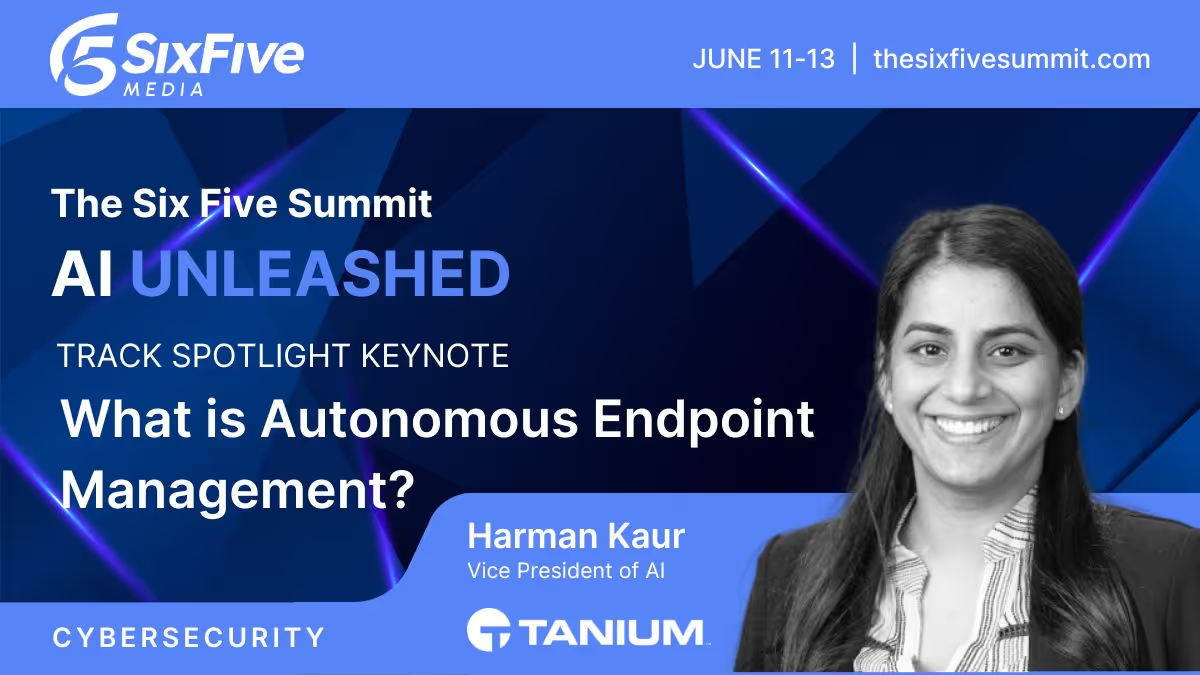
What is Autonomous Endpoint Management?
Autonomous Endpoint Management is a framework designed to unify IT operations and security teams on a single platform through real-time control and visibility.
QUANTUM
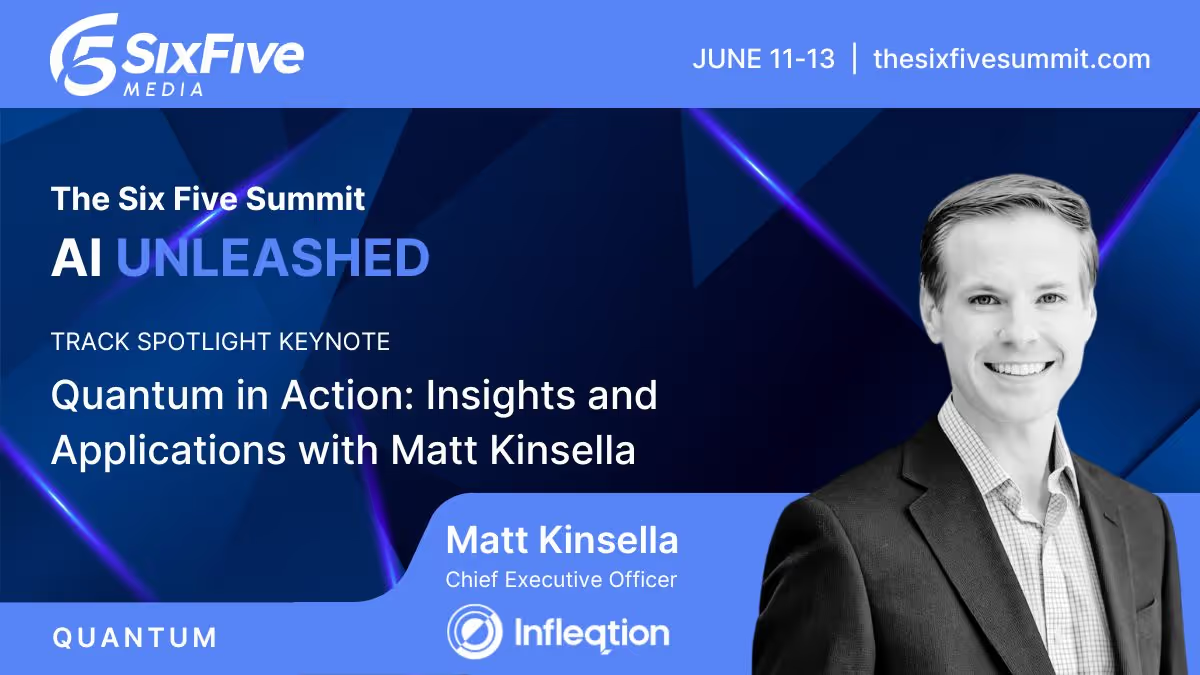
Quantum in Action: Insights and Applications with Matt Kinsella
Quantum is no longer a technology of the future; the quantum opportunity is here now. During this keynote conversation, Infleqtion CEO, Matt Kinsella will explore the latest quantum developments and how organizations can best leverage quantum to their advantage.
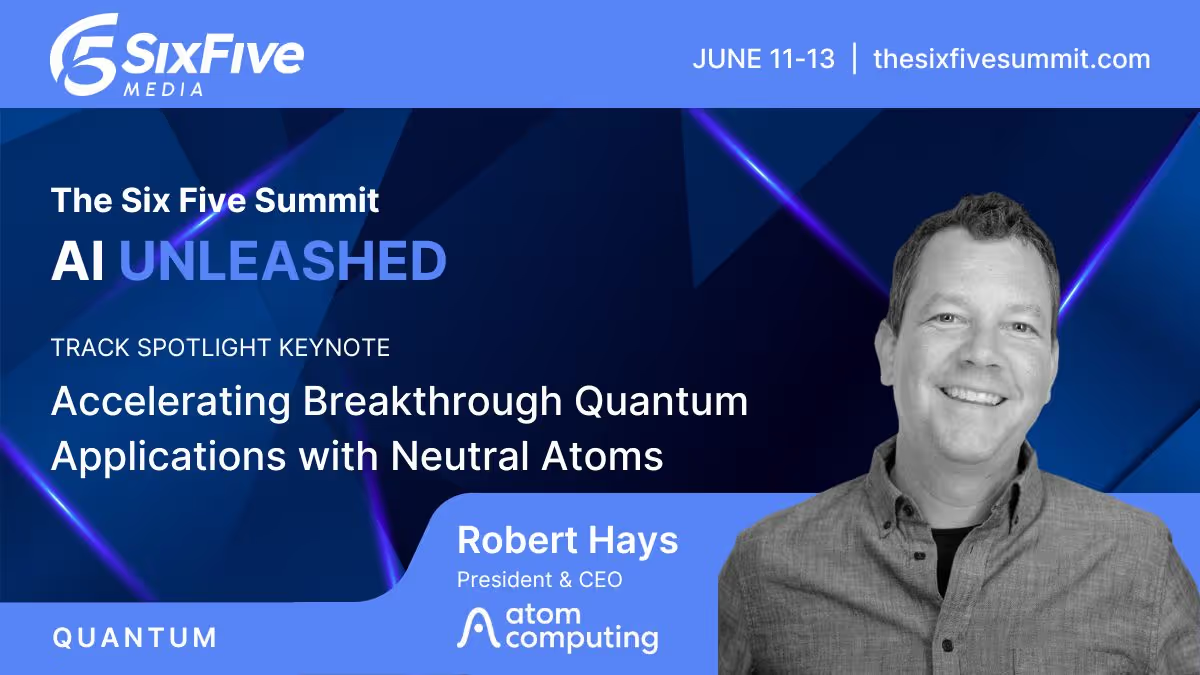
Accelerating Breakthrough Quantum Applications with Neutral Atoms
Our planet needs major breakthroughs for a more sustainable future and quantum computing promises to provide a path to new solutions in a variety of industry segments. This talk will explore what it takes for quantum computers to be able to solve these significant computational challenges, and will show that the timeline to addressing valuable applications may be sooner than previously thought.