Home

Open by Design: Building Scalable AI-Ready Data Architectures Without Lock-In - Six Five On The Road
Open by Design: Building Scalable AI-Ready Data Architectures Without Lock-In - Six Five On The Road
SHARE


Sam Pierson and Brendan Grady of Qlik join Nick Patience to discuss how technology leaders can scale AI while building flexible, trusted data foundations that safeguard against vendor lock-in. Explore strategies for interoperability, open standards, and regulatory agility.
How can technology leaders deliver real-world AI value while maintaining flexibility and avoiding vendor lock-in as data ecosystems rapidly evolve?
From AWS re:Invent 2025, host Nick Patience is joined by Qlik's Sam Pierson, CTO, and Brendan Grady, General Manager, Analytics, for a conversation on building a trusted data foundation without lock-in while scaling AI. They focus on how organizations can achieve flexible, auditable, and reusable data architectures that keep pace with changing AI requirements while preserving strategic options for more agile, open data ecosystems.
Key Takeaways Include:
🔹Vendor Lock-in Concerns: CIOs are increasingly wary of cloud and AI platform lock-in, seeking architectural portability to preserve both resilience and bargaining power as AI adoption accelerates.
🔹Data Portability for Leaders: CDOs are driving toward open standards and data products, with an emphasis on interoperability to prevent dependency on any one platform, ensuring that data assets support multiple analytics and AI tools without costly pipeline rebuilds.
🔹Rising Pressures & Shifting Regulation: They unpack the growing focus on avoiding “cost cages” and adapting to evolving regulatory environments—especially around sovereignty—underscoring the importance of strategic flexibility and the value of sovereign, adaptable tech stacks.
Learn more at Qlik.
Watch the full video at sixfivemedia.com, and be sure to subscribe to our YouTube channel, so you never miss an episode.
Or listen to the audio here:
Disclaimer: Six Five On The Road is for information and entertainment purposes only. Over the course of this webcast, we may talk about companies that are publicly traded, and we may even reference that fact and their equity share price, but please do not take anything that we say as a recommendation about what you should do with your investment dollars. We are not investment advisors, and we ask that you do not treat us as such.
Hi, I'm Nick Patience, the AI Platforms Practice Leader at Futurum, and we're here at AWS reInvent in Las Vegas, and I'm joined by Sam Pierson, CTO of Qlik, and Brendan Grady, the GM of AI and Analytics at Qlik. Welcome. Thank you for having us. Great to be here. So we're going to talk about, obviously, data and CIOs and cost and resiliency and all these kinds of things. But Sam, let's start with you. What are CIOs most concerned with at the moment?
Sam Pierson:
Yeah, I think, look, today there's so much pressure from the AI front. You've got boards, you've got the executive teams who are basically saying, hey, this is something we have to embrace one way or the other. And I think one of the biggest problems is that we've still got all these treasure troves of data that are stored within these enterprises. From extracting that data and getting it ready for AI, not much of that has actually changed, but there's so many additional rules and regulations now. You've got different regulations in the US, you've got regulations all over Europe, talking about residency, the regulation around data, how it can be used and everything. So I think there's a lot of just general change and sort of this fear of getting locked into one pattern when six months from now, it is, of course, going to change. And so I think one of the things that we hear a lot is just like, hey, how do you help me be more flexible in my data strategy, the architectures that we're building out? It's a huge concern for folks.
Nick Patience:
So they're concerned about vendor lock-in, they're concerned about data platforms lock-in. So how does Click kind of help with that situation?
Sam Pierson:
Yeah, well, one of the things that we've done, I guess, from first principles is just try to help our customers get choice, right? So you may have different workloads, you're going to have things that are maybe more operational. As you start to pick up these different AI workloads, you are going to have all sorts of different vendors that you're going to want to work with, right? You might want to put it in Snowflake, you might want to put it in Databricks, you might need to feed it into a model. And one of the things that we have done within our data platform is the ability to basically bring it into this data substrate that can then be reused, right? And like we can very quickly add new targets, we can add different patterns. So that's sort of it in a nutshell. I would also say some of the things that we've seen also around the Open Lakehouse. It's a huge trend this year that we have picked up on. The ability to not just have scale or performance or optimize for cost, but really to be able to manage between all three of those with your variety of workloads. For us to be able to store that data, potentially store it in multiple different places or have different datasets that are stored in different areas, but then still have your engine come in and read those, query those, all of those things are patterns that we've helped our users get set up.
Nick Patience:
Brendan, I'm going to turn to you. Let's think about how organizations need the flexibility to plug in new AI capabilities over and over. As this thing evolves, this is the kind of compression of time we're dealing with now as to how fast innovation is coming. It's just incredible. And so, what Scott was talking about by the data pipelines, what do you see chief data officers maybe and the people who work with them, what do they need to do in order to get that flexibility and portability of data for that kind of ever-changing AI landscape?
Brendan Grady:
That's really, it's a really hugely valuable point right now. I mean, Sam said the word six months came out of his mouth and I sort of chuckled because the reality is you're getting new capabilities coming in every couple of weeks. So the way, what we're hearing out of chief data officers, CIOs, and actually more and more chief risk officers are starting to think about this as well, right, because there's inherent risk. What we're hearing from them is, number one, They need to make sure that their data foundation is in order because the majority of problems that they're starting to see where they're seeing failures in some of their initiatives is because their data quality wasn't where it needed to be. So they need to really think about this trusted data product. So we're hearing some of that. The other thing we're hearing is once you get the trusted data foundation in place, There are so many different models out there and they seem to be changing constantly. So giving our customers the flexibility to evolve with us and bring the types of models they want to work with is another area we really are focusing on. We're also seeing more openness. And one of the things that we're trying to address is to say, look, we want to be an open ecosystem to provide access to some of the core capabilities around trusted data and our analytics engine and AI engine that will really surface context in a trusted intelligence layer. These are some things that are keeping a chief risk officer up at night. So I think you're going to see the chief risk officer and CDO spend a lot more time together, especially with AI.
Nick Patience:
Are you talking about the semantic layer there?
Brendan Grady:
A good point. Semantic layers, that's one piece of the puzzle, right? So when it comes to making sure that you can make the best, most accurate decisions using any type of AI technique, it comes down to having the semantic layer. But more importantly, it comes down to trusted context in all of that. And that is going to require more than just a semantic layer. Yes, semantics You'll also need to make sure that the data products and trusted data that you're bringing in is all of the data you need. And then you'll need to apply techniques to it to make sure that you actually get the context of why an agent may or may not be acting on your behalf. Hugely critical.
Nick Patience:
Well, you mentioned the word agent. It just struck me, obviously, we've gone in the last three years from generative AI to agentic. They're obviously built on top of the other. They're not separate things, but maybe you can talk about the challenges of agentic AI, obviously very early, but the challenges that it looks like it might present to organizations from a data point of view.
Sam Pierson:
Yeah, I think if you look at the way that the foundational models have been built, it's trained on the open internet. These things are absolutely phenomenal for general purpose questions and answers, right? But for the enterprise, the key is how do you get your data into that model or how do you get your proprietary data to sort of get unlocked with a lot of that work that's been done? Some of the things that we're seeing and that we're predicting is actually like, you also go back to the reg architecture, which is also very monolithic, big blocks. I think what we're going to see now is that the agents are actually going to get much, much smaller in the jobs that they are written to do. So think of it as analogous to the microservice, right? So you have these services that are custom for a very small context. You're going to have the exact same thing with the agents. And then you will have corresponding data products that will get mapped into the job that that agent has to do. And when you have it in a data product then that is managed, governed, regulated, you've got an audit trail on who's accessing that or what agent is accessing that. I think that's sort of the pattern that we see. Because also when these things are bounded in context, it's a lot easier to have the evals perform well as you start to benchmark this across different use cases.
Brendan Grady:
Can I actually add something there? Because it reminded me of sort of the first question around the CIOs, what challenges are CIOs facing? They're facing the challenge of the credit card swipe. Anybody can go out and sign up for one of these agentic tools today, right? And are they going to be able to do it in a trusted governed way or is it going to be the wild west? And I think you're, you're starting, you're starting to see this. We're in that classic pendulum of technology right now, which is heavily on IT or heavily on business. You're starting to see that swing back. So the CIO is really going to have to really think about being that business enabler again. 20 years later, I'm saying it again, but that's really what we're starting to see because we look at our own company, right? We've got a bunch of different tools. Some people started on their own, right? We do have a corporate standard, but I think regulating that and then thinking about data sovereignty and data residency, So, that's going to be another key thing that you're going to have to protect your companies and you're going to expose yourself to a lot of risk.
Nick Patience:
Well, let's talk about sovereignty a little bit and residency. How realistic is it for organizations that are multinational, especially ones that obviously have operations in the EU? But really, I've just noticed it's basically every country in the world now. It used to be an EU-specific thing, but it's really everybody. So, how realistic is it for them to achieve, you know, true data sovereignty, you know, and if they're spread, you know, spread around the world?
Brendan Grady:
I think there's a technology play here and there's also sort of a geopolitical play here as well. I think realistically, they're not going to be given a choice, right? I think that's part of some of the challenges that every organization is going to face. Whether it's the EU AI Act, whether it's what we've come out with here in the United States, there will be these acts that are going to come out that are going to mandate where you store your data, period, the end. That's not going to be a choice for a lot of people moving forward. From a technology perspective, you look at Let's take AWS as a great example, and one of the announcements that we just made is we're going to take part in the EU sovereign cloud, right? We feel very, very, very strongly that that is important for our customers in the EU. We, CLIC, obviously are a European company by heritage, right? We started in Sweden, and then obviously through some acquisitions we have Israel, we have France as well. So I think that sovereignty is going to be a mandate. There's also a level of comfort where there's that feeling side that's still going to come into it. People will feel better about it. I mean, Sam, you're seeing some things in your team too.
Sam Pierson:
Yeah, and I think this has also driven a lot of our strategy around where we put our regions. So we're very aware of this from an offering perspective. being able to have regions in all of these major countries, and then not just having a presence there, but also having the certifications and the compliance, the encryption, the monitoring, like bring your own key, all of these different features that we built into our cloud to make sure that customers feel not only comfortable with it, but know that if they get audited or they have to pull the logs, that it's going to be fairly trivial for them to show that they're in compliance.
Nick Patience:
Do you think, is this something, because you're saying it's something they're going to have to do, do you think it's, is this being customer, is this pull or push? The customer's leading this or is this, they need to get prepared for this because it's coming?
Sam Pierson:
No, they absolutely need to be prepared for it. I don't, I mean, I haven't talked to any customers who are like, yeah, let's have more of this. But I think, look, the space has moved so fast that I think a lot of the, you know, a lot of the governing bodies have just felt compelled to do something, right? And whether it's, you know, whether it's right or wrong, like these things are in place and there's more getting written every day.
Brendan Grady:
I mean, AI is the next moonshot, right? It's a race to the moon. AI is going to be a competitive advantage, not just for businesses moving forward. Countries are going to look to AI and the data, as old as this statement is, data is the new oil, data is the new platinum, is what I'm calling it, right? So it really is even more valuable than oil. It's one of those rare earth metals. And so countries are really going to want to do that. And they will drag some of their more open market constituents along with them, maybe kicking and screaming, but they will have to do it.
Nick Patience:
And let's talk about the cost component of all this in terms of avoiding lock-in portability. What are you seeing? Obviously, CIOs are always focused on that. What are they telling you that you as a vendor need to do for them? Yeah.
Sam Pierson:
Well, I think there's a handful of things here. Like we started out, you've got companies that are under enormous pressure to expand margin, be more cost conscious, and be fit financially. and at the same time invest more in AI. And it's like, you're not going to be given a lot of time to do this. It's like, all right, we need to see the results of this now. I think when it comes to the data strategy, the Lakehouse pattern, I think, is one that we've been really excited about. So the idea that you can take all of your data, and again, I think a few years back, right, it was, and you can go all the way back, you know, whether it was Hadoop or Oracle or any of these major vendors that have captured a lot of market share. We were in that position, and I think you're starting to see that, you know, the pendulum swing back to more of a distributed model. And things like Apache Iceberg, where they decouple the storage, the compute and the metadata, really have opened the door. So now things like AWS S3 tables, you can store that data in a very low cost, very commodity storage type of model. But then also it's like, okay, well, I need Snowflake or I need Databricks to read that. Like we're able to integrate with their catalog. They're able to point their engine at that data, do the querying, do the processing. And then other things are just around like optimization, right? So, okay, are we pumping? Do we need to pump this much data in? Do we need to hit the compute bill for these different vendors? Or can we meter that back and still meet the SLA that we have committed to inside the business? So lots of different patterns have emerged around this, but that's one that we see a lot of traction around.
Brendan Grady:
The other interesting thing, Sam, as we think about that, that we're all seeing is some of those things are diametrically opposed. Right? So if you, it's, it's, well, I can't incur too much data costs on this, but I don't have all the data I need to actually have the agents be trained in the right way. The agents will get things wrong. So I think you're starting, the CIOs are going to have to wrestle with that. It is no longer, oh, I just need to stand up a server in my data center. It's all of these geopolitical aspects combined with the technological combined with business and the pressures that a lot of these CIOs feel from their boards. it is a really difficult position to be in. And we at Click feel really strongly that we want to help those CIOs to be able to navigate it, regardless of which other vendors they use. That's what we're really trying to focus on.
Nick Patience:
Great. Well, that's a lot. We've covered a lot of ground. That's all we've got time for today. But thank you for joining us from Six Five On The Road here in Las Vegas. And we'll see you again next time.
MORE VIDEOS
.png)
AI Safety Alarms, China's Distillation Reckoning, and Qualcomm's AWS Breakthrough: A Pivotal Week for Enterprise AI
A viral AI extinction claim, a federal advisory naming six Chinese AI labs for industrial-scale distillation, and a $60 billion Qualcomm-AWS silicon pact define a week when enterprise AI risk and opportunity collided head-on. Patrick Moorhead and Daniel Newman weigh in on what's signal and what's noise across AI safety, chip supply deals, and a market rally still betting big on compute.


The 15-Cent AI Query: Broadcom's Paul Turner on Rebuilding Enterprise AI Economics
A Six Five study found an eight-to-one cost gap between running an AI agent through a leading frontier model and running it on modest on-prem hardware. Paul Turner, Chief Product Officer of the VMware Cloud Foundation Division at Broadcom, joins Daniel Newman and Patrick Moorhead at VMware Explore 2026 to explain how VMware's AI Factory turns GPU provisioning, model management, and security into a repeatable path from infrastructure to production AI.
VMware Explore 2026 Wrap-Up: What’s Next for Private Cloud and Enterprise AI
What infrastructure model makes the most sense when AI workloads move from experimentation into production?
In this analyst recap of VMware Explore 2026, Patrick Moorhead and Daniel Newman examine this central question facing enterprise technology leaders and how Broadcom and VMware are positioning private cloud as a critical foundation for bringing enterprise AI into production.
Other Categories
CYBERSECURITY
Threat Intelligence: Insights on Cybersecurity from Secureworks
Alex Rose from Secureworks joins Shira Rubinoff on the Cybersphere to share his insights on the critical role of threat intelligence in modern cybersecurity efforts, underscoring the importance of proactive, intelligence-driven defense mechanisms.

HP Launches World’s First Business PCs to Protect Against Quantum Hacks - The Six Five On the Road
On this episode of the Six Five - On the Road, hosts Patrick Moorhead and Daniel Newman are joined by HP's Ian Pratt, Global Head of Security for Personal Systems.
What is Autonomous Endpoint Management?
Autonomous Endpoint Management is a framework designed to unify IT operations and security teams on a single platform through real-time control and visibility.
QUANTUM
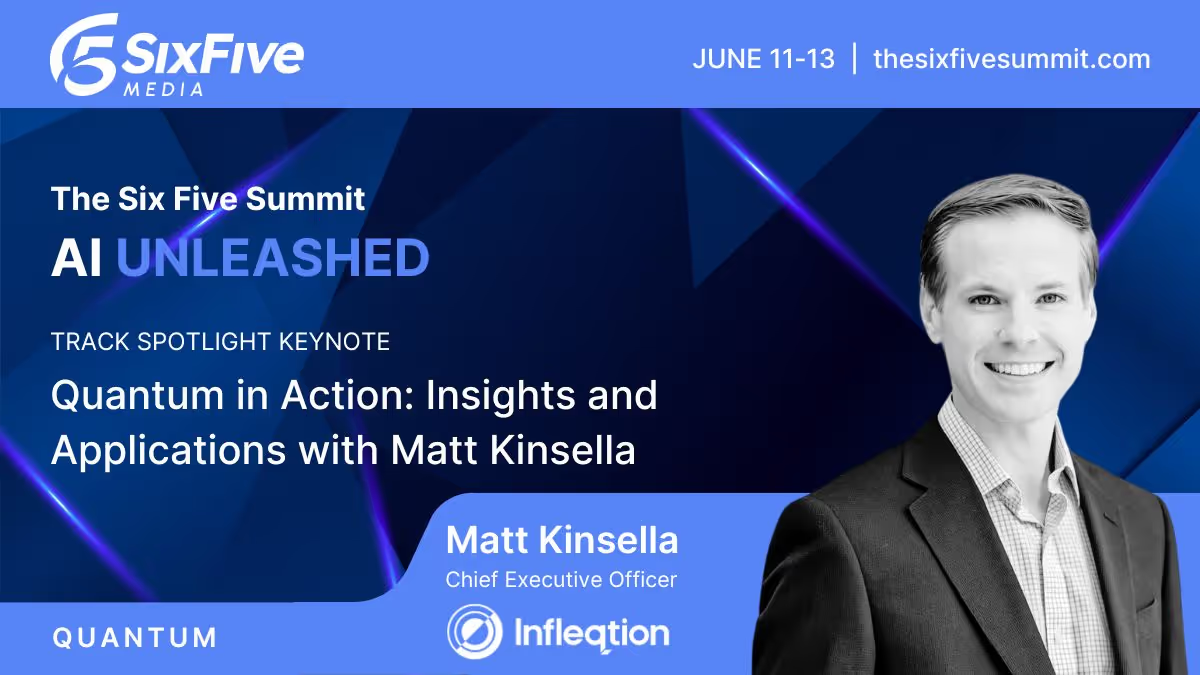
Quantum in Action: Insights and Applications with Matt Kinsella
Quantum is no longer a technology of the future; the quantum opportunity is here now. During this keynote conversation, Infleqtion CEO, Matt Kinsella will explore the latest quantum developments and how organizations can best leverage quantum to their advantage.
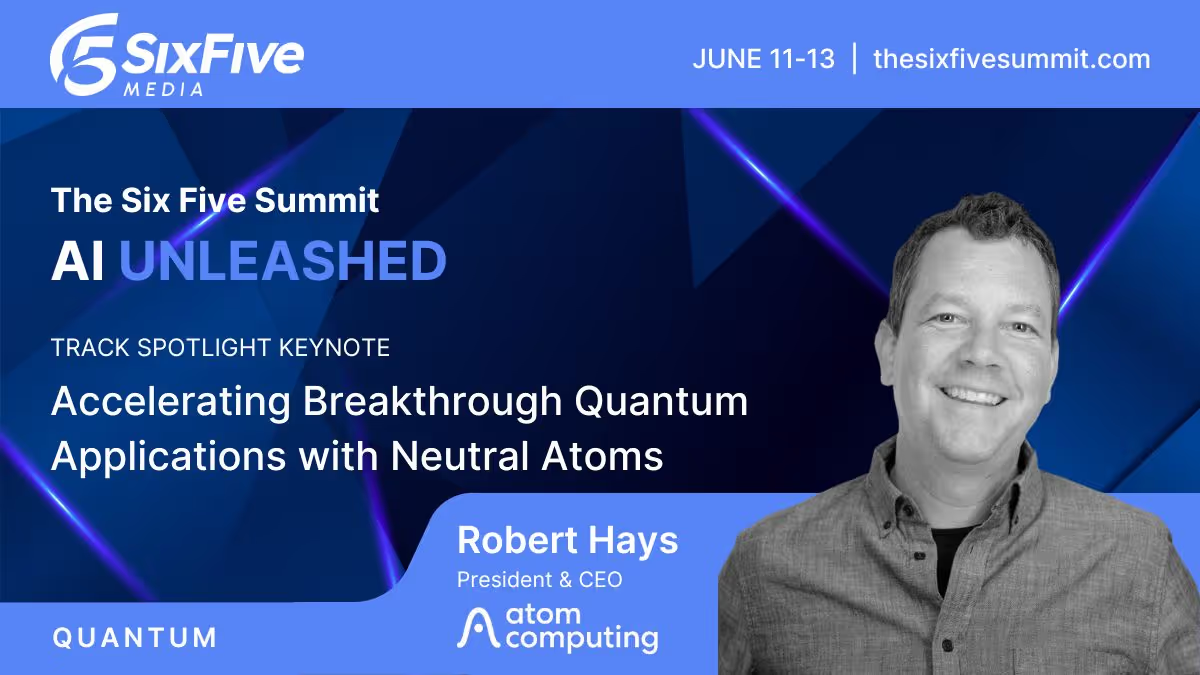
Accelerating Breakthrough Quantum Applications with Neutral Atoms
Our planet needs major breakthroughs for a more sustainable future and quantum computing promises to provide a path to new solutions in a variety of industry segments. This talk will explore what it takes for quantum computers to be able to solve these significant computational challenges, and will show that the timeline to addressing valuable applications may be sooner than previously thought.