Home

Scaling Quantum Reality: HPE’s Vision for Hybrid, Secure Quantum Computing - Six Five On The Road
Scaling Quantum Reality: HPE’s Vision for Hybrid, Secure Quantum Computing - Six Five On The Road
SHARE


Andrew Wheeler, HPE Fellow and Director at HPE Labs, joins the conversation to share how HPE’s Quantum Scaling Alliance is addressing quantum computing’s hardest challenge—scalability—and why hybrid and secure approaches are critical for enterprise success.
How will integrating quantum and classical computing approaches help enterprises overcome scalability and security hurdles in the rapidly evolving quantum technology landscape?
From HPE Discover in Barcelona, hosts David Nicholson and Will Townsend are joined by Hewlett Packard Enterprise Fellow, SVP and Director of HPE Labs, Andrew Wheeler, for a conversation on how the company is advancing quantum computing scalability through the Quantum Scaling Alliance. They explore HPE’s hybrid approach, the role of classical-quantum integration, technical breakthroughs on the horizon, early industry applications, and how HPE is preparing enterprises for the realities of post-quantum security—placing “scaling quantum computing” at the center of the dialogue.
Key Takeaways Include:
🔹Quantum Scaling Alliance: HPE co-founded the Quantum Scaling Alliance (QSA) to specifically focus on the scalability challenges in quantum computing, setting apart its collaborative approach from other industry initiatives.
🔹Hybrid Quantum-Classical Integration: HPE emphasizes that rather than viewing quantum as a standalone or replacement technology, it’s essential to start integrating quantum with classical HPC systems.
🔹Technical and Security Advances: While key technical breakthroughs are required to make quantum systems viable at scale, HPE is also addressing the emerging enterprise security concerns tied to quantum advancements and preparing organizations for post-quantum security.
Learn more at HPE.
Watch the full video at sixfivemedia.com, and be sure to subscribe to our YouTube channel, so you never miss an episode.
Or listen to the audio here:
Disclaimer: Six Five On The Road is for information and entertainment purposes only. Over the course of this webcast, we may talk about companies that are publicly traded, and we may even reference that fact and their equity share price, but please do not take anything that we say as a recommendation about what you should do with your investment dollars. We are not investment advisors, and we ask that you do not treat us as such.
David Nicholson:
Welcome to Barcelona, HPE Discover 2025 here in Barcelona. This is Six Five In The Booth. I'm Dave Nicholson with my co-host, Will Townsend. How are you doing, Will? I'm doing great, Dave. How are you? Good. Good to be here on the floor. We have a very special guest, Andrew. Andrew Wheeler. Welcome. Andrew is with HPE Labs, and we're going to talk quantum. Andrew, what is the Quantum Scaling Alliance and what's HPE's relationship to it? Why should anyone care? Talk to us about this.
Andrew Wheeler:
Yeah, good question. So the Quantum Scaling Alliance is a new collaboration, a new group. Its purpose is to gather, you know, kind of like minds within the industry. And the goal is to build a practical, scalable quantum computer, basically put the recipe together for how to do that so that we can, you know, tackle some of industry's toughest challenges. You know, I would say, you know, near term, the objective is is again, pulling together all that expertise that's needed in an open fashion, such that from silicon all the way to the algorithm, that we bring that expertise together in an open manner and really move it from where we are today, which is in a lot of cases, kind of interesting demonstrations or small proof points to eventually building out that industrial scale on a computer.
David Nicholson:
HPE is famous for being sort of like Switzerland from a customer's perspective, specifically in the era of where we are with quantum computing today. There are a dozen ways to skin the proverbial Schrodinger's cat in terms of coming up with stable qubits. Are you saying that you're essentially agnostic to that? It's like whatever rises up and becomes the dominant tech, you'll be there to support it when that happens.
Andrew Wheeler:
I think in the limit, that's the idea. Now, how we get there, we may find ourselves as a company kind of outside of the alliance. is having to partner closely with someone because we've got this vision of an integrated kind of hybrid classical plus quantum machine that ultimately comes together. But yeah, I mean, that is the idea with the alliance at large is to say, look, you're going to need best of breed across the industry to, I think, actually realize this value. If we look at some of the other approaches you mentioned, yeah, there are, well, one or two maybe vertically integrated companies that are kind of trying to do the entire end-to-end stack. There are some other smaller aspects involving maybe just the networking piece. NVIDIA just recently announced, you know, the use of their NVQ link to help stitch together, you know, a couple of parts of the system. IBM and Cisco have announced trying to get together a little bit, you know, bringing the networking with the quantum. But with the Alliance, that's the idea, is that we bring best of breed across that industry to do everything all the way from the qubit through to the algorithm, including, you know, the semiconductor piece.
Will Townsend:
You know, Andrew, I spent a lot of time with the teams, you know, just, you know, from networking, security, compute, storage. And so I understand that HPE's view on quantum computing is complementary to classic computing. And you touched on hybrid integration. So just wondering, can we get a little more perspective from you on where the value lies in that hybrid integration of both classical and quantum?
Andrew Wheeler:
Yeah, I think, and again, depending where you're coming from in the topic of quantum, I think just a couple of points just to make sure we're all, our position's clear on this. Okay. First of all, you know, quantum is not a general purpose computer, right, in the sense of how we think about things today. So that's point number one. Point number two is, you know, it's an accelerator. So meaning it, I think at the end of the day, can accelerate algorithms or even the portion of an algorithm that today we would say is just computationally infeasible. I can't do it. So, you know, we can use a GPU today as a little bit of a proxy. When we think about an accelerator, you know, we don't just run every type of workload on, you know, a cluster of GPUs. We use it in concert with you know, a CPU. Right, based on the application and the workload and that sort of thing. So quantum will really be the same thing. The other important reason we think we need this, or we'll have to have this integrated approach with classical, even realizing the part of quantum that's doing the computation, Well, it's going to require more than likely AI and machine learning to help even achieve what it's trying to do by itself, which means you need some of that classical system sitting right next door to that quantum system in order to help it really perform the job that it's trying to do.
Will Townsend:
Do you see AI and quantum becoming force multipliers?
Andrew Wheeler:
I really do, because in fact, if you just look at one of the many technology, technical hurdles to achieving quantum, you know, first of all, you've got things like, well, you know, how many high fidelity qubits do I need? And to get that high fidelity, what's the error correction around it? Well, even that error correction algorithm itself, depending what type of, you know, kind of qubit you're talking about, will likely need some AI to help do the correction itself. So you can see at that, even that low level, that's how AI is going to play a role. And then when I look at an end-to-end workflow, which is kind of the ultimate goal, because look, if you want to have access to a quantum computer or any developer, You know, we need them just like all of computer science that we've learned over the last many generations. You want to abstract as much as possible. You want to make it easy to develop those applications and to the point where maybe part of the workflow, the algorithm, hey, I can just address that with AI and other forms of accelerators. And then maybe only that critical piece goes to quantum because that is going to be a critical resource, you know, at least initially.
David Nicholson:
Do you have any thoughts about where the first places might be where this is actually monetizable? What are the first industries that are going to be able to save money or make money by leaning on quantum? And how far away are we from that point?
Andrew Wheeler:
I think probably two or three industries or use cases to think of. And they're quite different. I guess one of the classical ones would say anything that involves complex molecular interactions. That's kind of ripe for quantum given that it can operate on that entire search space at once. And so that obviously feeds directly into, you know, drug discovery, you know, anything involving chemistry, right? I think optimization problems, that's kind of another class that historically, you know, give me something that scales by the number of, you know, scales in square by the number of variables you put into it. And then frankly, the last one is, you know, Shor's algorithm, right? So, you know, fundamentally being able to, you know, factor very large prime numbers, which are the foundation for a lot of our encryption protocols.
David Nicholson:
Yeah. I mean, will that be the first indicator? Will it be, will it be sort of a nefarious act out there that sort of demonstrates the true power of quantum? Or does cancer get cured? Yeah.
Andrew Wheeler:
Yeah, I think the race is on, frankly, but you bring up a really good point, and we said this early on with AI, it's like, hey, great, look at all the great things AI is doing today and where we see it going. But guess what? Those are tools in the toolbox for nefarious actors. So we have to expect the same of quantum. So I think there's that path in the thread. At the same time, absolutely, we want to see breakthroughs in cancer research and personalized medicine and things like that. But we have to assume these things are working in parallel.
David Nicholson:
Let me just go on record saying that quantum If you're going to cure my cancer, you can steal my identity. I don't care.
Will Townsend:
But Dave, that was a perfect setup for my last question for Andrew. And obviously there are concerns in a post-quantum world with the ability to render all encryption worthless, right? What is HPE Labs doing with respect to preparing enterprises for that post-quantum world and identifying the risks that come with that amazing breakthrough with quantum?
Andrew Wheeler:
Well, the great thing is, look, you know, the industry and government agencies around the world, right, they've seen this coming. And so, you know, we have international standards bodies, things like that, that have been, you know, thinking about this and working on this for several years. And so we're at the point where we now have kind of the first, you know, two or three algorithms that we think are quantum proof. And so part of labs, part of our role in the company is to, again, be be looking out beyond the horizon for these things that are coming for our product teams and you know just like our you know generation 12 you know ProLiant servers you know we worked several years ago with that team to make sure okay they're at least on that path and they have that initial algorithm that's you know baked into the silicon that provides that what we call our root of trust for our servers and so now we've got we're kind of looking across the company on that as we look at different deadlines and you know mandates that are coming the industry's direction for hey you want to do business with us your products need to be you know quantum secure by you know 27 20 30 things like that so anything that requires attestation And again, we started more at the silicon level because given the lead times for that, and obviously those aren't easy things you can just patch in software. So working across the company, making sure we're coordinated and organized and we're ready. for when that cryptographic relevant quantum computer comes online. We will assume success.
Will Townsend:
And what does your crystal ball tell you as far as the timeline? We were joking about this earlier. What do you think? Is it three years? Is it five years? Is it 15 years?
Andrew Wheeler:
You know, the way I like to answer that question, and it's not a cop out, but it really depends. And by that, I mean, we've talked about some of the use cases here today. But the most direct path to a quantum computer is actually going to be starting with the algorithm. What problem are you trying to solve? What are you trying to speed up? Then you work your way down to, well, what kind of error correction do I need? What does my fidelity need to be? All of that. So all of that being said, if you pick the right problem, And we want to move beyond what I would call the manufactured or simulated problems, which are important, but at the end of the day, they're not directly addressing that meaningful scientific or business problem.
David Nicholson:
I think we're still a few years out, more than a few years maybe. I have a calendar here. Just touch the day for us here. Andrew Wheeler, I want to thank you for being here with us and for not being here with us at the very same time. Little quantum humor there for you. I'm sure you could appreciate it. For Will Townsend, I'm Dave Nicholson. We're here, Six Five, in the booth, on the floor, HPE Discover Barcelona 2025. Stay tuned for more interesting content ahead.
MORE VIDEOS
When Sovereign AI Becomes an Enterprise Problem, Not Just a Policy One
NetApp’s Adam Gale explains why sovereign AI now depends on moving complete services quickly while preserving control and security. For enterprises facing regulatory and geopolitical shifts, portability has to be built into the data platform before a crisis forces the move.


Meta and Google Rejoin the Frontier, Microsoft’s Maia 300, and the AI Credit Scare | The Six Five Pod Ep. 324
On Episode 324 of The Six Five Pod, Patrick Moorhead and Daniel Newman unpack the biggest stories from the week, including new agent models from Meta, Google, and NVIDIA, Microsoft's Maia 300, Applied Materials' EPIC Center, AMD, NVIDIA, and Cisco at OCP Global Summit 2026, and the Apple-Meta Muse Spark Open partnership, plus a Flip debate on whether AI leaderboards serve vendors more than enterprise buyers. Plus, Bulls & Bears covers the CPI and PPI shock that rattled the AI trade, Anthropic's investor event, ASML's record quarter, and TSMC's earnings results.
What It Takes for AI Agents to Earn the Right to Act
Snowflake’s Pavan Pothukuchi explains why enterprise AI agents still struggle to act on systems of record, and how governed data platforms, semantic layers, and scoped agent identity close the gap. For enterprise leaders, agent autonomy has become a data architecture decision.
Other Categories
CYBERSECURITY
Threat Intelligence: Insights on Cybersecurity from Secureworks
Alex Rose from Secureworks joins Shira Rubinoff on the Cybersphere to share his insights on the critical role of threat intelligence in modern cybersecurity efforts, underscoring the importance of proactive, intelligence-driven defense mechanisms.

HP Launches World’s First Business PCs to Protect Against Quantum Hacks - The Six Five On the Road
On this episode of the Six Five - On the Road, hosts Patrick Moorhead and Daniel Newman are joined by HP's Ian Pratt, Global Head of Security for Personal Systems.
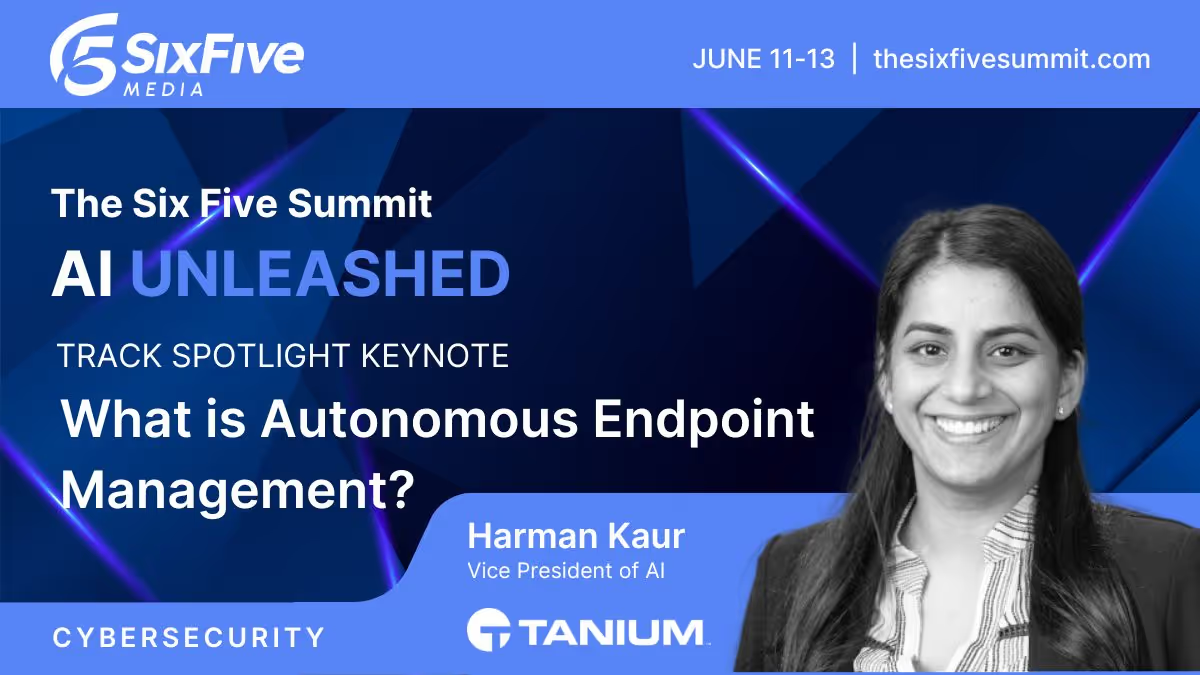
What is Autonomous Endpoint Management?
Autonomous Endpoint Management is a framework designed to unify IT operations and security teams on a single platform through real-time control and visibility.
QUANTUM
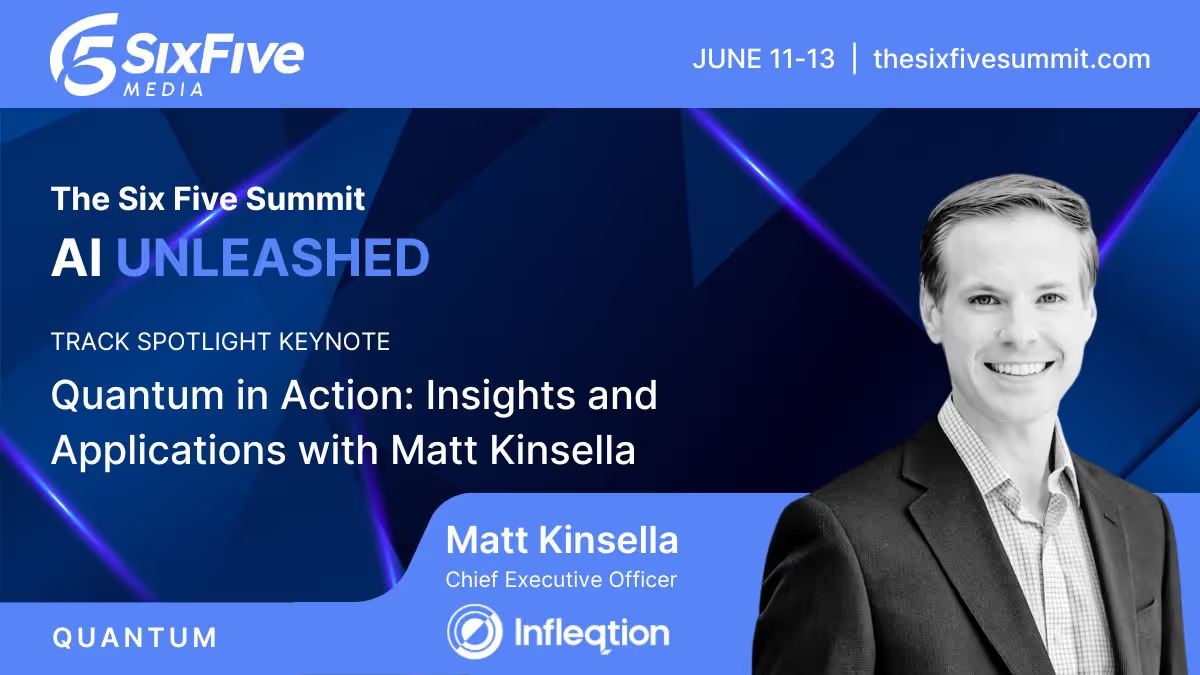
Quantum in Action: Insights and Applications with Matt Kinsella
Quantum is no longer a technology of the future; the quantum opportunity is here now. During this keynote conversation, Infleqtion CEO, Matt Kinsella will explore the latest quantum developments and how organizations can best leverage quantum to their advantage.
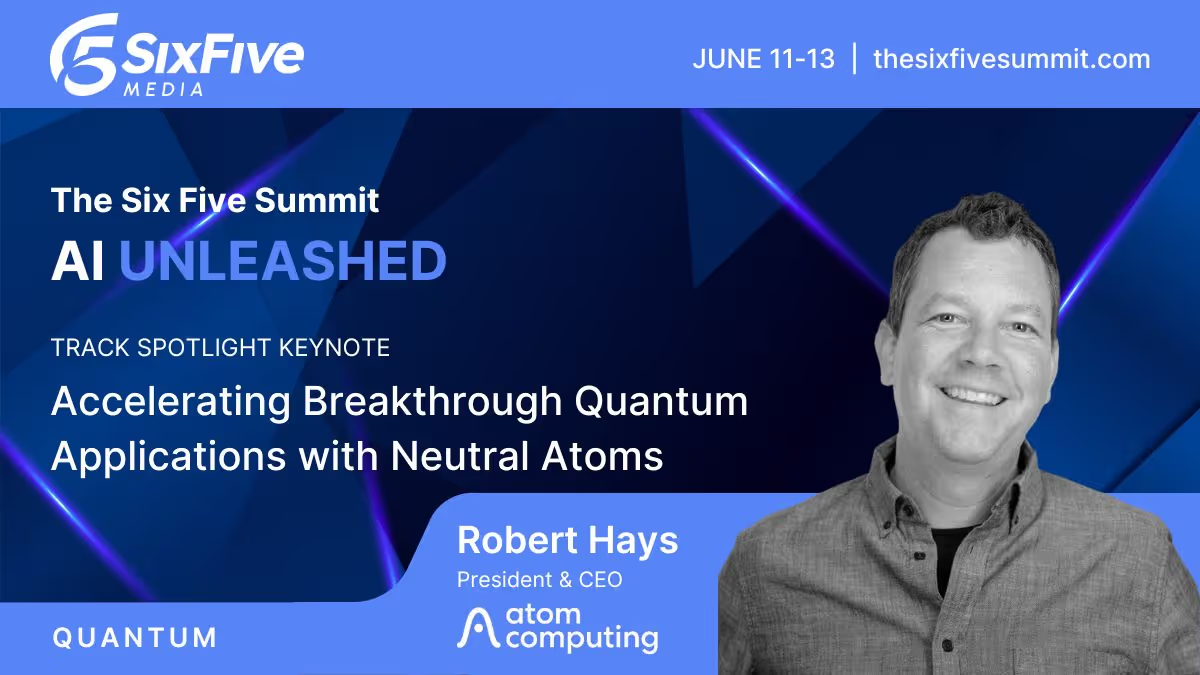
Accelerating Breakthrough Quantum Applications with Neutral Atoms
Our planet needs major breakthroughs for a more sustainable future and quantum computing promises to provide a path to new solutions in a variety of industry segments. This talk will explore what it takes for quantum computers to be able to solve these significant computational challenges, and will show that the timeline to addressing valuable applications may be sooner than previously thought.