Home

The Main Scoop Episode 39: Fostering Learning Agility and Curiosity - How to Empower Today’s Developers
The Main Scoop Episode 39: Fostering Learning Agility and Curiosity - How to Empower Today’s Developers
SHARE


Brent Foster, VP and Engineering Practice Owner at TD Bank, joins The Main Scoop hosts to discuss developer empowerment through generative AI, the modernization of mainframes, and building strong technical career paths in evolving enterprise IT.
How do enterprises responsibly modernize, optimizing developer experience (DevX) with the latest tooling and AI, while maintaining the security and reliability of mission-critical systems?
On this episode of The Main Scoop, hosts Greg Lotko, SVP & GM, Mainframe Software Division, Broadcom, and Daniel Newman, CEO and Chief Analyst, Futurum, are joined by TD Bank Group’s Brent Foster, VP and Engineering Practice Owner, and DevSecOps Executive Product Owner and Technology Lead, to explore how enterprises like TD Bank are empowering developers through modern AI tools, evolving culture, and practical modernization while meeting the security and governance demands of regulated environments. The conversation ties developer experience priorities such as reliability, modernization, and career growth directly to business impact, showing why technology and culture must evolve together in enterprise IT.
Key Takeaways Include:
🔹 Modernizing core systems responsibly
Developers are evolving mission-critical platforms—like the mainframe—while maintaining the security, reliability, and resilience enterprises depend on.
🔹 AI and modern tooling as DevX accelerators
Generative AI and contemporary development tools are enhancing productivity, improving technical depth, and helping teams modernize without sacrificing control.
🔹 Culture, curiosity, and career growth
Fostering learning agility, clear career paths, and a supportive culture is critical to retaining talent and enabling sustained innovation in hybrid enterprise environments.
Subscribe to our YouTube channel, so you never miss an episode.
Listen to the audio here:
Disclaimer: The Main Scoop is for information and entertainment purposes only. Over the course of this webcast, we may talk about companies that are publicly traded, and we may even reference that fact and their equity share price, but please do not take anything that we say as a recommendation about what you should do with your investment dollars. We are not investment advisors, and we ask that you do not treat us as such.]
Greg Lotko:
Welcome back to The Main Scoop. We've got something special for all of you today, some classic Americana. We're coming to you from the mountains of Colorado, the scenery of the West, mountains, snow. You can just picture horses and carriages running through the fields at the Pony Express, you know, bankers, Wells Fargo, all that kind of stuff. It fits right in with the mainframe and part of classic Americana. We have a charger behind us today. You've heard us talk about cars. We figured what better setting. And it really relates to the mainframe. If you think about it, mainframe relative to IT technology, classic Americana mainframe, the foundation of modern servers that allowed people to take programs and workloads and move them from each generation to the next. continue to evolve, continue to innovate, and as modern as all get out today.
Daniel Newman:
Isn't she beautiful?
Greg Lotko:
Yeah, actually I think the Charger is gorgeous and a great backdrop for us.
Daniel Newman:
Yeah, it is. It's a modern classic.
Greg Lotko:
I think it's a classic.
Daniel Newman:
It's a classic classic. It's 1969. Well, there you go.
Daniel Newman:
But to me, there's so much about it, so much about what was built that's become so relevant to what's being built today. And I think sometimes people lose that. They do.
Greg Lotko:
And it's the idea that, you know, people think that only modern cars are fuel efficient. And those of us who are collectors or into cars know that that's not true. It's about keeping them in tune. It's about keeping them operating well. And you can even go beyond that and update them, put in modern fuel injection, you can put in transmissions with overdrive, you can add anti-lock brakes, and that's how the mainframe has evolved, right? It continued to add technology and capability, so it was bigger, stronger, better, faster.
Daniel Newman:
The two things that totally rev you up, too. I mean, you're glowing.
Greg Lotko:
Mainframes and cars. Man. Don't get any better than that.
Daniel Newman:
Well, this is a great setting, Greg. And it's a great setting to continue this conversation. And I think, if I'm not mistaken, we have a really great guest.
Greg Lotko:
We have a fabulous guest with us today. We have Brent Foster. He's a VP at TD Bank. You know, knows all about the idea of applying technology for business purposes, for driving value. And I know a lot about how you help make developers efficient and effective and make the most out of what you have with technology. But let's pull Brent in. Welcome to The Main Scoop.
Brent Foster:
Well, thank you for having me. It's so exciting to be here. And, uh, we're charging ahead just like this charger back here.
Greg Lotko:
Absolutely. We're charging along. So tell our audience here a bit about yourself and what you do at TD. For sure.
Brent Foster:
Well, first off, I'm so excited to be here at TD Bank. I lead our software engineering and DevSecOps, and what an exciting time to be alive. There's so many cool things happening in the world, and there's so many cool things that we can build on, and just so excited to be in this field and being able to be a part of it.
Greg Lotko:
So I know the business has expectations all the time to go faster, but it's also about doing things better. And I know you want to be inclusive and pull developers in on what's going on. Talk a little bit about your focus and how you're accomplishing that at TD.
Brent Foster:
Oh, a hundred percent. So first off, I like to say happy people are productive people. I agree. And if you focus on that developer experience and transitively the customer experience, guess what? You're going to do great things. With a developer, how do I maximize being in a state of flow and minimize context switching? I think that's one of the single most important things for us to focus on. If we actually do focus on being better, faster, and simpler, it's more conducive to us being able to do that. And so when you think of like, well, what tools do I have to use? What am I actually trying to do? How does that ultimately translate to value than I'm delivering? The simpler I can make that, the easier it's going to be to translate to staying in the zone and not having a context switch and just get it done.
Daniel Newman:
And I know we're moving a lot faster now and you've been in the industry for a while. Like, how are you seeing that sort of pace and change and how is that sort of generating more success now in this role? But like any, any past, you know, I love that we got this kind of past, present, future thing going right here. Perfect in this space, but like, you know, but like, how have you kind of, what's, what have you learned from the past? How are you meeting the expectations now? And how are you sort of, you know, driving into the future?
Brent Foster:
Well, for sure. And, you know, I've had the pleasure of working in many different companies, different industries. And what you see, it's kind of like history. It rhymes. And so one of the first things that I notice, and I think is very important, and I think the most successful companies really dial this in, it's focusing on the customer. It's working backwards from the customer. It's making sure that you're actually focused on delivering those customer outcomes. And so, as a technologist, how can we actually enable and catalyze those business outcomes and get that value in the customer's hands as quickly as possible? And I think there's a few simple things I like to focus on. So first off, if you boil it down to just how quickly things change, learning agility and curiosity. So do I have the curiosity to go motivate myself or my teams or the entire company to go check out that new thing? Have you heard of generative AI? Like, he's definitely heard of that. I think so, right? But it's like, so if you can be adept at adapting, you're going to win all day long because whatever comes along, you're going to be able to adapt to it and figure it out.
Greg Lotko:
And there's a lot of things there on a lot of levels. You talked about starting with the customer first. It really is thinking about what you're trying to accomplish in the business, not just technology for technology's sake. You talked about happy people, you know, they get more done, they work faster. You want a team to have as little friction as possible, to have access to the best tools without having to do the contact changing. And if you're providing IT to the developers, I mean, then the developers are your customer as well. So it keeps going up the food chain. It is about making things easier so that they go faster.
Brent Foster:
Absolutely. And one of the ways I like to kind of boil that down, there's really three things that you could manifest almost anything with. Abstractions, compositions, and interfaces. And so if you think about it, like if you actually have the right level of abstraction for something, the easier it is because you're operating at the right level. And this is talking about translating things to business value. A lot of that comes down to, did I abstract it in such a way that I can actually articulate the importance of what this technical capability is in the context of what I'm trying to do? And then if you look at like those three principles, well, how do you manifest those? Well, you've got goals you're trying to drive. You've got models for how you're going to actually envision delivering those outcomes. Then you've got implementations of the models. And so you put all that together, you can make magic happen.
Daniel Newman:
Yeah, for sure. You've got all these things happening at one time. You know, developers have the challenge though right now. You want to go quickly. We talked about that. They're up against modernization. But also part of what makes the mainframe, the mainframe is it's known, it's secure, it's stability, it's reliability, which, right, it's sometimes, you know, in that agile world, it's all about go fast, the leaders are fast fail, that kind of stuff. And you got to be a little bit more careful here, right? So how do you balance that to keep that pace, keep the developers moving, give them the you know, the, the, the room to basically maneuver. But at the same time, these are critical workloads. Oh, it goes down. They have to run, they have to be secure. Like, and then you have to, by the way, I realize I'm rambling, but you've got to let them explore, right? Cause you don't want these developers to feel like they can't use their creative skills and, and build on what all this new available technology offers.
Brent Foster:
Yeah, so there's a lot to unpack there. Yeah, that's how I ask questions. Yeah, I love it. So maybe we'll start with, and I'll go with them, because we've got these awesome cars around us. If you've got a lot of horsepower, you've got to be careful on that gas pedal, because if you just floor it, you're not going to go anywhere. You got to know how to harness that power in the best way. And so I'd like that, if you think of the mainframe, you could do so much transaction processing, things bulletproof. Now, how do you harness that? Well, so I'll go back to what I said with, uh, let's start with interfaces. So if I can wrap a whole ecosystem around that horsepower, I can tap into it in the most capable way. I can do all kinds of things. And you could almost translate that to any context, whether it's a user interface, it's a command line interface, it's something that a customer doesn't even see. It's that interface that's providing that vehicle to tap into those capabilities in the most conducive way for whatever it is you're trying to do. And so if you think about this from a developer perspective, there's really two different ends of the spectrum to look at. There's the inner loop and then there's the outer loop. In the inner loop, this is all the stuff that you're doing day to day. This is you on your local machine or whatever you're tapping into from an interface perspective. You're doing it, you're doing it quickly, you're iterating, you're learning, you're adapting, and you're testing, and you're just repeating that as quickly as possible. Then you kick it out to the outer loop, where this is where you're hitting a shared environment. And so, as long as you have parity between those two things, and you've built all the appropriate guardrails to facilitate and automate all of those wonderful things like security, then you're moving along.
Greg Lotko:
So you want access through interfaces to the right data in the right context, efficiently, with the right tools, without creating a bottleneck or a disruption, with the right level of security, instead of sitting there just spinning your wheels. We've all heard of people, right, that you give them access to the overall database or data store, whatever it is, And rather than writing an efficient query and going after what they really need, they try to boil the ocean. Well, you can do that really fast, but you go through way more data than you need to, right?
Brent Foster:
Absolutely.
Daniel Newman:
So let's talk a little bit about something I like to talk about sometimes. Let's talk about Gen AI. Yeah. So you've got this new tool, this new toy, and it's totally changing the developer experience, right? But at the same time, you know, this is another push and pull balance thing, right? How are you seeing these new tools change the developer? Is it accelerating their work? Are they augmenting well? Are they fighting it? Like, you know, especially inside of, you know, organizations that have, you know, classic IT strategies or classic IT workflows. Where's Gen AI fitting in?
Brent Foster:
Yeah. So one, it's super exciting. Uh, and to all the points you described, it's a little bit of everything. And so, so one, I'll, I'll go back to the abstraction standpoint. So, uh, what do you think of that capability? One of the interesting things is if you look at how things evolve over time, it's a, it's another set of abstractions. And I think what we're moving towards is everything as a prompt. And so if you think about generative AI, it's as if you're going to get as good an output as the input you're feeding it. And so it's all about the prompt.
Greg Lotko:
Frame your question the right way. Be careful what you ask.
Brent Foster:
Exactly. You ask the right question, you're more likely to get the right answer. You ask something that, you know, isn't dialed in.
Greg Lotko:
Isn't well-framed, isn't well-organized, you'll get the wrong solution.
Brent Foster:
Oh, 100%. And so that's one of the things that we're noticing with our engineers at TD is you've got a set of folks who are really dialed in. They're experimenting. They're creating these prompts. We're establishing prompt libraries for all of these basic capabilities. So if you did something once, it worked really well. Guess what? You put that prompt on a shelf. Everyone can now benefit from that. Then you've got the other end of the spectrum where people are almost typing prompts like it's a Google search box. And it's like, do this. And you're not getting a very good output through that. And so there's a lot of maturity and training that we're working with.
Greg Lotko:
But we have to think about, you know, how we're using the tool versus just trying to do the old things with a new tool. Look at what the strengths are of this tool and technology and use it that way. I'm really curious, you know, face it, we talk to a lot of people out in the space that people are doing the heavy lifting, writing the code, running operations. And there's one set of people who recognize AI and generative AI in general as, okay, this is the next tool. This is gonna help me be more productive and more effective. And then there's others that are like, oh my God, this is gonna take my job. And I mean, I think the real trick there is it only takes your job if you're not learning, if you're not advancing, if you're not becoming more effective and efficient using these technologies versus ignoring them. Is that kind of how you're framing it with your people or you seeing them going through the same kind of quandary of what does this mean to me?
Brent Foster:
Oh, absolutely. So I think everyone has their own personal journey with new technology. And so different people are at different stages of their own personal progression. But I definitely like earlier on this, maybe a couple years ago, a lot of fear, a lot of anxiety, people aren't quite sure what to make of it. But I think at this point, people are starting to really embrace it and like, okay, This is cool. This is helpful. I can actually have something kind of take some of that toil off my plate. Some of those things that maybe I'm not excited about doing. Maybe it's adding some additional unit tests. Maybe I just didn't feel like doing those unit tests, but guess what? Now I have a capability that will just do it for me. All I have to do is guide it. Yeah. It's really exciting.
Daniel Newman:
It's interesting too. I've spent a lot of time with developers and there are these kinds of two schools. There's the one school that's like, I am as productive as I've ever been. I am so excited about AI and the future and the impact of my job. And then there's the others that are like, I'm fighting it. Um, I don't want to embrace it. It's never going to work as well. They'll kind of call out the, you know, the hallucinations, the bugs, the inaccuracies, but I think the first camp is going to win.
Greg Lotko:
And I do too. And I think it's up to us as leaders. I think it's the leaders in the organizations. And by that, I don't just mean managers and executives. I mean the leaders who are the technologists to display the right behavior and approach to the rest of the organization to say, no, this is something that can help you, that can make you more capable and more productive and, and show the way, show the light.
Daniel Newman:
And I mean, Brent, are you putting education, programmatic learning in place? Because I love what you said about prompting. This is like the one-on-one thing. And I know a lot of these engineers get really good. We have developers and staff. And I've read these prompts. Some of these are like four or five page long prompts. And what they create is incredible. Like you said, the average person that starts prompting literally says, what happened in yesterday's football game? And they'll ask just a really simple question like they're doing a search. And then they just want the generative text. A good developer is building these prompts that accelerate bug identification to speed up the process, or developer notes and releases. And they figure out how to prompt it to create really valuable release notes for QA teams to be able to review. You know, are you creating that kind of environment for them and what are you doing to make sure they're embracing it, learning, and then using it?
Brent Foster:
Absolutely. So there's a few different parts to it. So one, I think, especially from an engineering and technical perspective, you have to give folks not only the chance to learn something, but to actually go do it. And so the experimentation part is super important. So whether it be trying a different model, trying a different, you know, kind of way of prompting. That's one end of the spectrum. So you've got to enable experimentation. You've got to get folks comfortable with that. And you've got to give them the environment to do so. So that's one. The other is learning. So for instance, this morning, we just did a GitHub copilot training in partnership with GitHub. I think we had 1,400 engineers on the call, and they're asking great questions like, okay, I'm trying to do this. For instance, someone was converting from one API to another. So, okay, so I've got this version of Spring Boot. What would be the best way to prompt it to go do that conversion for me? And so things like that, it gets people thinking like, okay, here's the things I'm trying to do in my daily life. I've got a tool that could probably help me. What is the most effective way for me to leverage that? And so this is what we're seeing in a lot of, we do these, we call them dojos. And so in these dojo sessions, one of the most exciting things for me is just seeing the questions and then having everyone kind of participate. And then when someone asks a really good question, you have everyone else that starts thinking about it as well. They're like, oh, All right, let me think about that. I bet I have a similar sort of situation too. Let me start thinking about that. And then they go off and they try it.
Greg Lotko:
I love that you're multitasking because I know you got here last night. We had the opportunity to have dinner together and you were here by the end of the morning. So you were watching everybody play in that dojo or did you send your AI to that meeting?
Brent Foster:
Oh, you know, you got to have your agents show up everywhere. No, you got to, you got to check out how things are going.
Daniel Newman:
That's really cool. That's great. Greg bot, Dan bot. We'll be doing the podcast in 2027. That'd be a big bot for me. It'd be a really smart bot. Would you say that, by the way, I love the GitHub analogy, the GitHub analogy, because it's like a repository. prompt repositories, right? I mean, when you learn a great prompt, how many teach that to scale, it is the future. I mean, I think you said that earlier. It's like so much about creating something, iterating on it, which is by the way, what coders did forever, right? That's what GitHub was. It was like, hey, I'm going to take this massive code and I'm going to
Greg Lotko:
You know, but even before all that, we're like, you're starting to write code and you're like, I think I did this before. I think I did a sort algorithm. I think I made a call to this database. I think I went through this and you're like, Oh yeah. And you had to look in the code library. Now you can get all that, you know, you got an AI finding it for you, spitting it out and telling you, Hey, if there's nuances in it, how you transform it into a particular context. Absolutely.
Brent Foster:
It's fabulous. Well, and there, there's a plug for like a dev or Bridge for Git. So all of that, the source code that we have just sitting there, well, now we can feed it in, expose it. And then talking about, uh, interfaces, well, now you can wrap, you know, that interface with an MCP, uh, you know, basically the MCP interface. Now I can have, uh, you know, the agentic into the equation where now that's just context I can ingest and operate off of. And that's super exciting.
Greg Lotko:
It is, it's funny, you know, for an industry or a space in the industry that's been around for such a long time and has gone through multiple generations and, you know, passing of the torch, you know, the people I learned from, you really focus on, you can't possibly learn in your five or 10 years everything that somebody knew that was working in the space for 40. But what you can do is learn from them how they think, how they approach a problem, where they look, how they set context, what other things might be related to it. And now having AI and like Bridge for Git and having technologies looking at all that, It's helping the developer, even if that expert isn't there, set the context and look through all that history and explain to them what relates. It's a fabulous time.
Brent Foster:
Absolutely. And it's like the best automation takes that expertise and you've baked it and made it something that everyone else can benefit from.
Greg Lotko:
Absolutely.
Daniel Newman:
So before we wrap up, I just, you've been in the industry a while, you've held roles and led developers and dealt with, you know, development teams. How much faster, like you have any sort of, you know, even if it's just your opinion from your experience, how much faster is it going? Right now, as a result of AI, as a result of just all the, all the technology, all the innovation that you've seen throughout your career and over the last decade or, and then of course, over the, even the last year, like, is it 10%? Is it 50%? Like how much more are you able to get done with the team you have?
Brent Foster:
Yeah, so one, it's super, super exciting. It's definitely going faster. Now, quantifying it to a specific percentage. It's a guess. It varies. I'll say it's a lot faster. Now, here's another way to kind of put that. So if you look at the assistive side or the agentic side, from an assistive side, so if I'm one-to-one, say I'm a developer in my IDE, I'm much more proficient and efficient with what I'm doing if I know what I'm doing to begin with. So if you've got those skills, now you can amplify yourself with these capabilities. Now from an agentic perspective, now guess what? You can multiply yourself. So every engineer can now essentially be an engineering manager of agents. Yeah. And that's, that's super exciting. So I think just scaling yourself and scaling entire teams now, what used to be one-to-one is now one-to-n. And so that just scales really well.
Greg Lotko:
It's remarkable. For years, for decades, we've been talking about the rate and pace of change and how it's unprecedented in these times, how fast it goes. But the reality is, we get these tools, technologies, capabilities that make us more effective and more efficient, and then we combine them and add something else, and we continue to go faster and faster than we ever could. And you can relate that to a car, a car that was built in 1969 that originally had bias ply tires. And not only do you end up getting modern radials that can grip the road better, you get better rubber compounds. On top of that, you get a wider footprint so it can hook up better. You got better oils so that the engine will spin freer. And every time you think you meet the pinnacle, every time you think, oh my gosh, I can't do it any faster or better than this, whether it be vehicularly or technologically, we find a way. There's another thing that comes along and it makes us better than we were before.
Daniel Newman:
Absolutely. It's a very exciting time. And Brent, I want to thank you so much for spending some time here with both Greg and myself here on The Main Scoop.
Brent Foster:
Well, thanks for having me. I had a great time and let's do it.
Daniel Newman:
All right. Bring us home. Well, Greg, you know, just as a, as a point, I've been thinking a lot about this as you build out this team with all your agents, right? Where do they report to? Are they going to report directly to you or to the people? By the way, do you manage them and work with them?
Greg Lotko:
See, I don't think of it as agents on their own. I think about, just like I think about hybrid technology with mainframes and cloud and client-server, I think about these agents working not only with other agents, but with programmers, operators, developers. So, I don't think we're going to have an agent at the top. I think it'll be a human that's going to be the CEO of their company or the VP.
Daniel Newman:
I don't know. Hoctan might create a Greg bot that will be the forever leader of Broadcom mainframe software.
Greg Lotko:
Uh, I'll let you bring that up with him next time he's here.
Daniel Newman:
I will talk to him about it, but seriously, I think it is a very exciting time.
Greg Lotko:
It is.
Daniel Newman:
It was great to kind of go through the eras here, classic to modern. Yeah. And really talk about how all of this innovation is here, but how all this innovation has always been there and how much we are continuing to build on it and how exciting times are today.
Greg Lotko:
Yep. We started with a fire. Somebody decided to make a wheel. We could put our food and our catch in it and bring it and cook it on the fire. And we bring it all the way to cars and technology and computers and AI. Who knows where we're going next?
Daniel Newman:
Heck of a ride. Yeah. Heck of a ride. We appreciate all of you for joining this ride with us. We are the main scoop for this episode, though. Time to say goodbye. Hit subscribe, be part of our community. We appreciate all of you very much. See you next time. Bye-bye.
MORE VIDEOS
Industry Veteran and Google’s Satish Thomas on Replacing One-Size-Fits-All Enterprise AI With Industry-Specific Agents
Google is moving enterprise AI beyond general-purpose tools and into industry-specific workflows built for regulated sectors such as legal and financial services. Satish Thomas, Vice President, Business and Industry Solutions at Google, joins Six Five to explain how Gemini Enterprise for Industries combines purpose-built skills, ready-to-deploy agents, model choice, and an open partner ecosystem to bring AI into the workflows enterprises already run.


AMD Instinct MI355X vs NVIDIA HGX B200 GPU platforms AMD vs NVIDIA: A Three-Level Inference Infrastructure Evaluation
Signal65 President Ryan Shrout and Senior Performance Analyst Mitch Lewis review a new three-level inference infrastructure evaluation of AMD's Instinct MI355X against NVIDIA's HGX B200 with AMD's Andrew Dieckmann and Anush Elangovan. The MI355X's memory bandwidth advantage compounds as context and concurrency scale, delivering up to 2.25x throughput gains and roughly 40 percent lower cost per GPU hour.
.png)
Anthropic’s AI Slowdown, OpenAI’s $1.2T Valuation & Salesforce’s AI Bet
Anthropic's "Pace the Frontier" essay set off a week in which nearly every major AI leader, and two heads of state, weighed in on whether the frontier should slow down. Patrick Moorhead and Daniel Newman read the incident as something larger than a safety debate. Whoever sets the pace of the frontier also sets the pace for open-weight models, enterprise custom models, and the trillion-dollar valuations riding on top of them. That contest, not the essay itself, is the through-line of Episode 320 of The Six Five Pod.
Other Categories
CYBERSECURITY
Threat Intelligence: Insights on Cybersecurity from Secureworks
Alex Rose from Secureworks joins Shira Rubinoff on the Cybersphere to share his insights on the critical role of threat intelligence in modern cybersecurity efforts, underscoring the importance of proactive, intelligence-driven defense mechanisms.

HP Launches World’s First Business PCs to Protect Against Quantum Hacks - The Six Five On the Road
On this episode of the Six Five - On the Road, hosts Patrick Moorhead and Daniel Newman are joined by HP's Ian Pratt, Global Head of Security for Personal Systems.
What is Autonomous Endpoint Management?
Autonomous Endpoint Management is a framework designed to unify IT operations and security teams on a single platform through real-time control and visibility.
QUANTUM
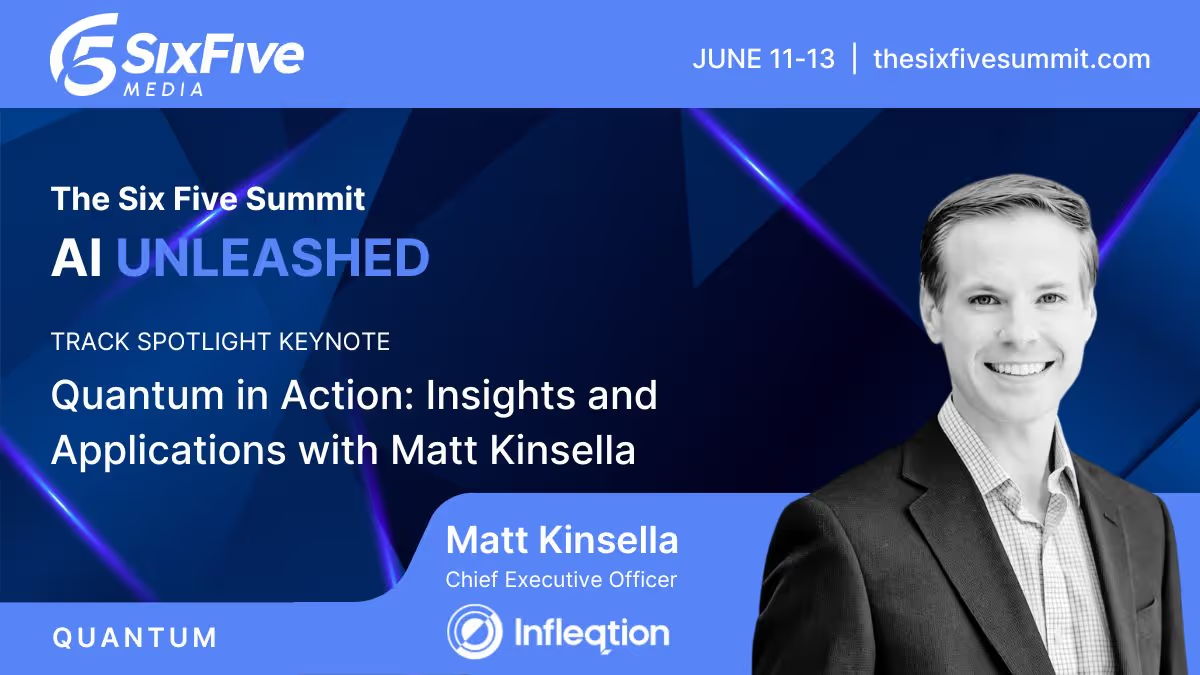
Quantum in Action: Insights and Applications with Matt Kinsella
Quantum is no longer a technology of the future; the quantum opportunity is here now. During this keynote conversation, Infleqtion CEO, Matt Kinsella will explore the latest quantum developments and how organizations can best leverage quantum to their advantage.
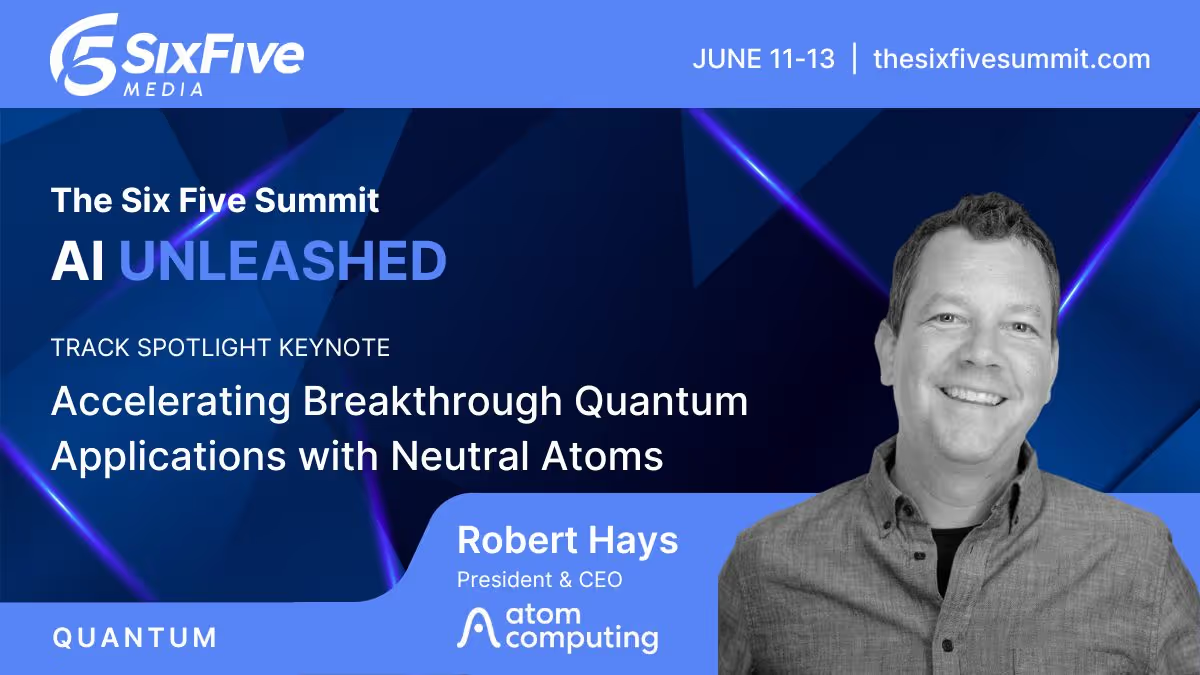
Accelerating Breakthrough Quantum Applications with Neutral Atoms
Our planet needs major breakthroughs for a more sustainable future and quantum computing promises to provide a path to new solutions in a variety of industry segments. This talk will explore what it takes for quantum computers to be able to solve these significant computational challenges, and will show that the timeline to addressing valuable applications may be sooner than previously thought.