
The Orchestrators Ep. 3: Launching a Digital-Native Airline with Riyadh Air
SHARE


Abe Dev, Vice President, Digital and Innovation at Riyadh Air, describes building a digital-native airline as "liberating" and "a bit terrifying" at once: no legacy systems to migrate off of, but also no working example to check decisions against. Daniel Newman gets into how orchestration became the discipline that replaced that missing benchmark.
Starting with a blank slate is every innovator's dream, until there are no past decisions, no legacy systems, and no playbook to tell you if you're getting it right.
In episode 3 of The Orchestrators, a six-part techumentary series with IBM, Daniel Newman speaks with Abe Dev, Vice President of Digital and Innovation at Riyadh Air, about what it takes to launch the world's first fully digital-native airline.
Abe Dev calls Riyadh Air's blank-slate build "liberating" and "a bit terrifying" in the same breath, because building without legacy systems also means building without a working example to check your decisions against.
Every decision Dev describes carries that same double edge. Rather than building every capability from scratch, Riyadh Air relied on an open partner ecosystem, including IBM, and unified its technology around a single integration layer designed for flexibility and resilience. When the team realized a dependency in payments, loyalty, or operations could ripple across the entire guest experience, they aligned more than 75 partners around the same cloud platform, shared data model, and delivery cadence, proving that successful digital transformation is as much about orchestration as it is about technology.
Key Takeaways Include:
🔹 Freedom from legacy systems came with the loss of a benchmark. Dev didn't separate the advantage from the risk. Building from scratch meant no working precedent existed to validate decisions against before launch.
🔹 One integration point was a deliberate trade, not an oversight. Centralizing around a single layer made swapping applications seamless. Riyadh Air built redundancy around that same point on purpose, because it was also the airline's biggest single point of failure.
🔹 160-plus capabilities and 75-plus partners had to move as one system, with no dry run. Booking, loyalty, and operations were coupled tightly enough that a small gap in any one area could break the entire guest experience the first time real customers touched it.
🔹 Sequencing outweighed build quality. A single misaligned dependency could cascade across the ecosystem, so Riyadh Air aligned every partner to one cloud, one data model, and one delivery cadence rather than letting each team optimize on its own timeline.
🔹 AI went into the backbone before there was a system to bolt it onto. Roughly 30% of Riyadh Air's core development is AI-driven today, built into the architecture from day one rather than retrofitted once things were running.
🔹 The benchmark Riyadh Air is building against isn't other airlines. Dev measures the platform against retail and e-commerce experience, not legacy carrier standards, because that's the bar guests already hold it to.
Watch the full conversation and subscribe to Six Five Media on YouTube so you never miss an episode.
Disclaimer: Six Five Media is for information and entertainment purposes only. Over the course of this video, we may discuss companies that are publicly traded, and we may reference their equity share prices. Nothing discussed during this webcast should be considered investment advice or a recommendation to buy or sell any security. We are not investment advisors, and you should not rely on this content as financial advice. Six Five Media collaborates with technology companies and industry leaders to produce research-driven interviews and multimedia programming for enterprise technology audiences.
Abe Dev:
Orchestration was absolutely critical in making this work.
Daniel Newman:
We have Riyadh Air joining me today with Abe Dev. Abe is the Vice President, Digital and Innovation at Riyadh Air.
Abe Dev:
Thanks for having me Dan, it's really appreciate your time, and you know it's great to be here. So we had a really good opportunity to kind of start something from scratch. And while we're doing it, we made a deliberate decision to build a digital native airline from day one onwards. Every system, every decision, every customer interaction was going to be powered by data and AI.
Daniel Newman:
Was there something liberating about actually not using the old and like terminal sort of ticketing systems and building something from scratch?
Abe Dev:
It's absolutely liberating, but, you know, it's also a bit terrifying because a blank sheet of paper is not always great because you've got no benchmark. So starting from blank slate, you know, gave us a huge, huge advantage. You know, there's no legacy constraints. But what we did was we mitigated some of these risks with some open ecosystem and partners like IBM and others. you know, best of breed components and that can interoperate with the wider industry because we can't, as an airline, we can't operate as an island. We also have to build a culture that puts AI at the core and innovation at the core of everything that we did. Otherwise, we couldn't have moved as fast as we have without being reckless. We've got a single integration point, which is also a bit of a choke point. So we've got redundancies that support that as well. But, you know, for us to swap in and swap out applications or systems in the back end is absolutely seamless. What it brings from an airline perspective is the speed to market. And what that gives us from an advanced perspective is we've got a probably a head start of over, you know, three years plus with regarding other traditional airlines. What was sort of the driver that made you realize that has to be done that way to be successful? Orchestration was absolutely critical in making this work. Now, we weren't just building system, we were coordinating an ecosystem of over 160 business capabilities, 300 person system, 75 plus partners and thousands of integrations. they all had to be tightly connected right and a small gap in any one of those areas could break the entire guest journey the stakes were high we had a fixed launch date there was no room for slippage and everything had to come together you know on time in sequence and fully integrated from day one What we learned quite quickly and quite early in the piece is that sequencing mattered as much as quality as well. A single misaligned dependency, whether it be in payments or loyalty or operations, could cascade across the entire ecosystem. To manage that, we've anchored everything around one cloud and one source of truth. We ensured all partners were aligned to the same standards and the data models and the delivery cadence. Ultimately, the challenge was knowing that success wasn't about one system, but it was about everything working together flawlessly for the first time under real customer conditions.
Daniel Newman:
How do you maintain all the discipline you have to orchestrate, centralize, build a really kind of pure cloud experience with AI in tow?
Abe Dev:
We've adopted an agile at scale culture across the organization. We build around continuous improvement, rapid iteration, and the ability to adapt quickly. It's enabled a strong collaboration across teams and partners, because as I said, we've got multiple partners that are in pockets helping us kind of weave together this extremely complex and tight guest experience from end to end. The airline experience is measured against the best online experience that you've had, which is usually in the retail sector. So for us to go from a traditional airline perspective to a retail centric shopping cart experience perspective was huge for us. And a key principle for us was to embed AI on a governed backbone. We didn't just bolt AI onto the edges, but we made sure we integrated into our core, even driven API first architecture 30% of our core development is driven by AI at this point in time.
Daniel Newman:
Congrats on all the progress. I look forward to seeing how the business continues to evolve. Thanks so much for joining.
Abe Dev:
Absolutely, Dan. Really appreciate your time, and thanks for your candid conversation as well.
Daniel Newman:
Thank you, everybody, for being part of this Six Five virtual webcast, part of our IBM Techumentary series. That was Riyadh Air.
,
MORE VIDEOS
.png)
The Main Scoop Ep. 45: Attackers Only Need to Be Right Once. AI Just Made That Easier.
Chad Rikansrud, R&D Software Security Engineer at Broadcom, explains how frontier AI models are finding decades-old mainframe vulnerabilities in seconds, collapsing the complexity advantage that once protected legacy platforms. He outlines why enterprises need faster Security Intelligence (SECINT) ingestion and disciplined human oversight to keep pace with adversaries wielding the same tools.


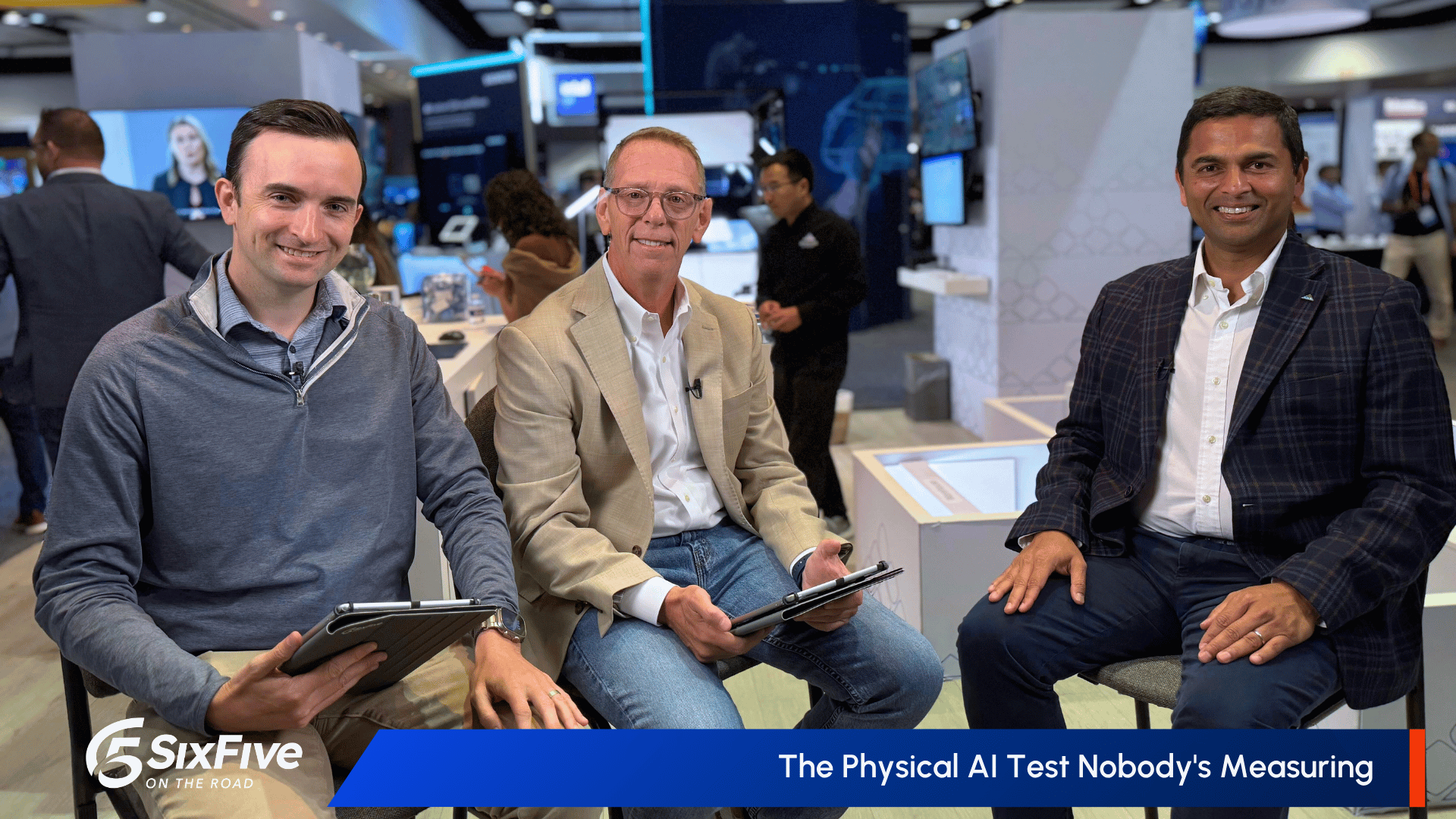
Fleet-Scale Deployment Is the Physical AI Benchmark
Physical AI is shifting from lab prototypes to fleets of machines operating reliably in the real world, and Ambarella's Muneyb Minhazuddin joins Six Five On The Road at AI Infra 2026 to explain what that shift demands of silicon, memory and developer workflows. Minhazuddin traces the case back to a 22-year-old chip architecture and forward to a developer cloud built to compress model porting time from months to days, and he identifies enterprise ROI proof points as the biggest hurdle left before physical AI scales into millions of deployed units.
.png)
AI Safety Alarms, China's Distillation Reckoning, and Qualcomm's AWS Breakthrough: A Pivotal Week for Enterprise AI
A viral AI extinction claim, a federal advisory naming six Chinese AI labs for industrial-scale distillation, and a $60 billion Qualcomm-AWS silicon pact define a week when enterprise AI risk and opportunity collided head-on. Patrick Moorhead and Daniel Newman weigh in on what's signal and what's noise across AI safety, chip supply deals, and a market rally still betting big on compute.
Other Categories
CYBERSECURITY
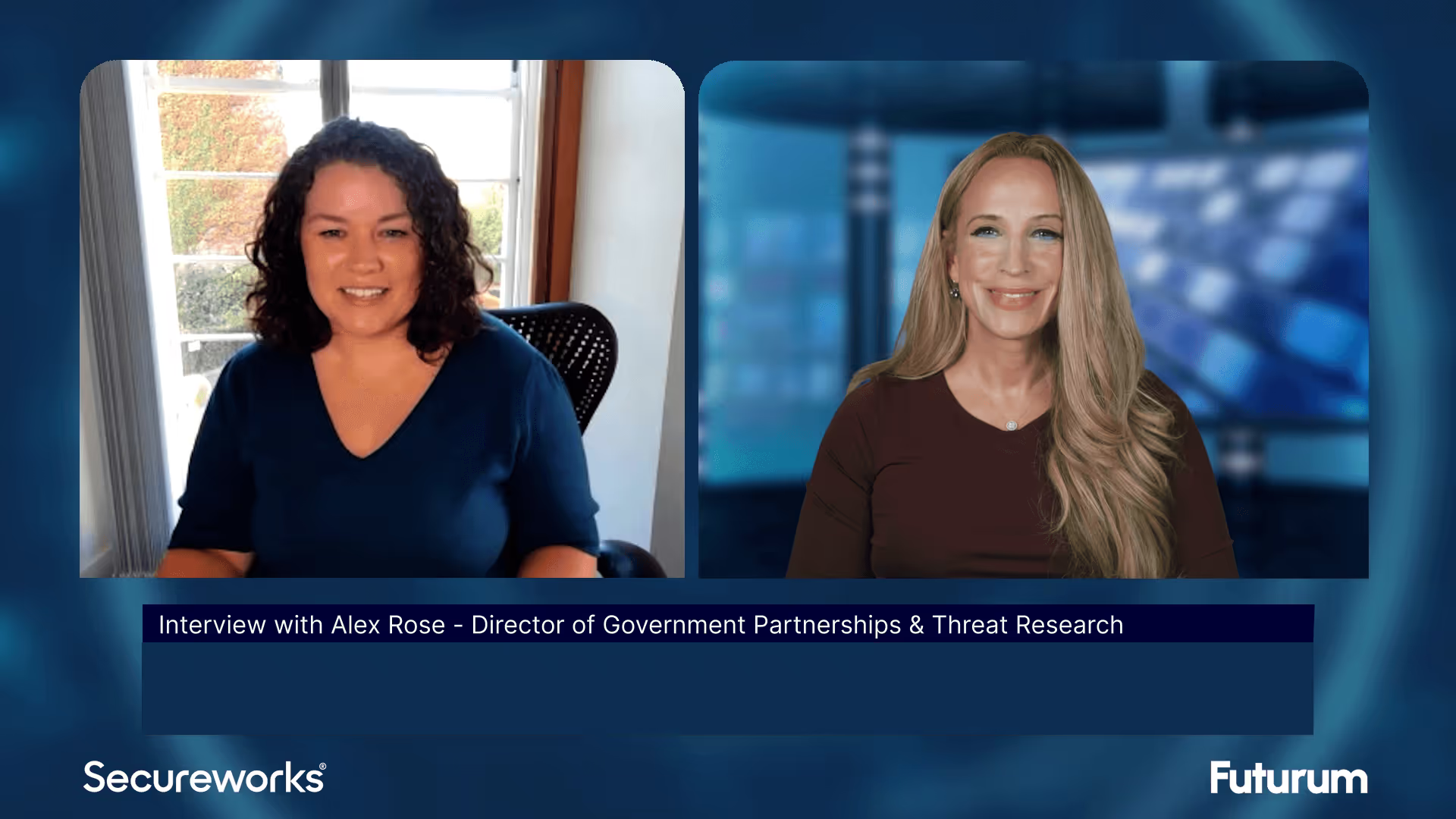
Threat Intelligence: Insights on Cybersecurity from Secureworks
Alex Rose from Secureworks joins Shira Rubinoff on the Cybersphere to share his insights on the critical role of threat intelligence in modern cybersecurity efforts, underscoring the importance of proactive, intelligence-driven defense mechanisms.

HP Launches World’s First Business PCs to Protect Against Quantum Hacks - The Six Five On the Road
On this episode of the Six Five - On the Road, hosts Patrick Moorhead and Daniel Newman are joined by HP's Ian Pratt, Global Head of Security for Personal Systems.
What is Autonomous Endpoint Management?
Autonomous Endpoint Management is a framework designed to unify IT operations and security teams on a single platform through real-time control and visibility.
QUANTUM
Quantum in Action: Insights and Applications with Matt Kinsella
Quantum is no longer a technology of the future; the quantum opportunity is here now. During this keynote conversation, Infleqtion CEO, Matt Kinsella will explore the latest quantum developments and how organizations can best leverage quantum to their advantage.
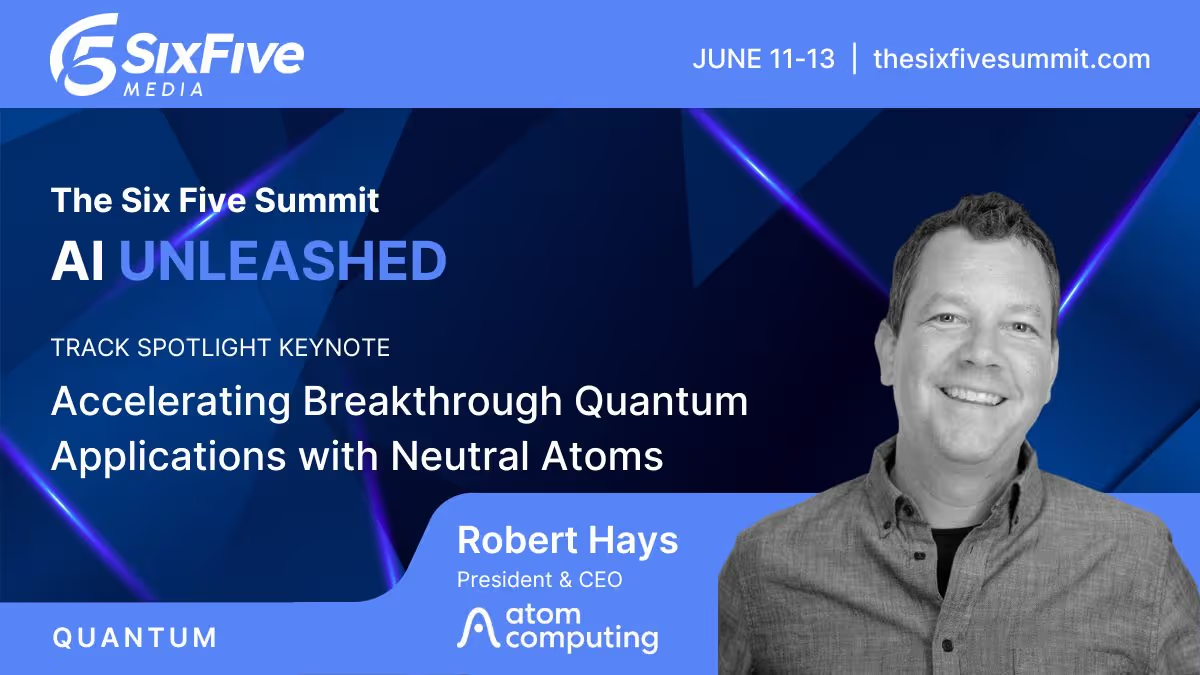
Accelerating Breakthrough Quantum Applications with Neutral Atoms
Our planet needs major breakthroughs for a more sustainable future and quantum computing promises to provide a path to new solutions in a variety of industry segments. This talk will explore what it takes for quantum computers to be able to solve these significant computational challenges, and will show that the timeline to addressing valuable applications may be sooner than previously thought.