
The Orchestrators Ep. 6: How AI Is Reshaping the CEO Agenda
SHARE


79% of executives expect AI to significantly contribute to their revenue by 2030. Only 24% know what those revenue streams will actually be. Salima Lin, Managing Partner at IBM Consulting, and Dalia Tarabay, EVP of Corporate Strategy at IBM, tell Daniel Newman why that gap, not the technology itself, is what's holding most CEOs back from turning AI into real strategic advantage.
79% of executives say AI will significantly contribute to their revenue by 2030. Only 24% know what those revenue streams will actually be. Salima Lin calls that gap the single biggest problem CEOs need to close right now.
At IBM's One Madison headquarters in New York City, Daniel Newman talks with Lin, Managing Partner for Strategy, M&A, Transformation, and Thought Leadership at IBM Consulting, and Dalia Tarabay, Executive Vice President of Corporate Strategy at IBM, as part of The Orchestrators techumentary series, about what's actually separating CEOs who are turning AI into strategic advantage from the ones stacking up pilots.
Lin's numbers come from the IBM Institute for Business Value's Enterprise 2030 report, built on roughly 2,000 executive perspectives and launched at Davos, part of an annual research effort that talks to around 70,000 executives. The report identifies competitive intensity as the force behind a specific behavioral shift: almost two-thirds of CEOs surveyed say they'll take on more risk than their competitors to keep an edge, making bigger bets, sooner, rather than waiting for certainty. Tarabay frames the harder half of that shift as an architectural one, enterprises moving off multi-year transformation plans built around fixed outcomes and toward adaptive platforms that can absorb shifting goals in real time. When Newman asks about the expensive mistakes leadership teams make, Lin points to a specific pair of numbers: 68% of leaders worry their AI efforts will fail because they were never integrated into daily workflows, and 57% expect their current skill sets to be obsolete by the end of the decade. Treating AI as a technology program instead of a people and operating-model transformation is the mistake behind both numbers.
Key Takeaways Include:
🔹 79% expect AI to drive revenue by 2030. Only 24% know how. Salima Lin identifies that 55-point gap between strategic intent and execution clarity as the core problem CEOs need to solve, drawn from the IBV's Enterprise 2030 research.
🔹 Nearly two-thirds of CEOs say they'll take on more risk than competitors. Lin ties this directly to competitive intensity: bigger bets, made more often and sooner, are becoming the norm rather than the exception among the CEOs the IBV surveyed.
🔹 68% worry their AI efforts will fail from lack of integration. 57% expect their skills to be obsolete by 2030. Lin uses these two numbers to make the case that the biggest mistake leadership teams make is treating AI purely as a technology program rather than a workforce transformation.
🔹 Tarabay identifies a shift from multi-year plans to adaptive platforms. Enterprises leaning into this shift are trading rigid, outcome-locked roadmaps for platforms that let decisions adjust as goals move.
🔹 Open, hybrid architecture is what protects a company's ability to move fast. Dalia Tarabay says avoiding lock-in to a single proprietary solution is what gives enterprises the control to redirect execution in real time as disruption hits.
🔹 Point solutions and isolated pilots can't scale, according to Tarabay. She argues orchestration has to run systematically across an organization's workflows, optimizing to outcomes dynamically, rather than sitting as disconnected pilots.
🔹 Both Lin and Tarabay use the same phrase for the companies that win: "master orchestrators.” Tarabay says the enterprises that get this right will be master orchestrators of human and technological intelligence together. The ones that don't will stay stuck in AI pilot mode with rising tech debt and solution sprawl.
Watch the full conversation and subscribe to Six Five Media on YouTube so you never miss an episode.
Disclaimer: Six Five Media is for information and entertainment purposes only. Over the course of this video, we may discuss companies that are publicly traded, and we may reference their equity share prices. Nothing discussed during this webcast should be considered investment advice or a recommendation to buy or sell any security. We are not investment advisors, and you should not rely on this content as financial advice. Six Five Media collaborates with technology companies and industry leaders to produce research-driven interviews and multimedia programming for enterprise technology audiences.
Salima Lin:
That gap between the strategic intent of AI and the ability to execute needs to be closed.
Daniel Newman:
Hello and welcome, everyone, to The Six Five. We are On The Road here as part of our Orchestrator series, an IBM Techumentary. I couldn't be more excited to be here in New York at IBM's One Madison headquarters today. We are going to be talking with Dahlia and Salima, and we're going to be talking a little bit about what's going on in AI in the real world. Salima, Dahlia.
Dalia Tarabay:
Thanks for having us.
Daniel Newman:
You know, a lot of CEOs, they're saying AI is their top priority. They need it for strategic flexibility. They need it to drive their businesses. You know, how are you seeing them make decisions? How are you seeing this AI moment play out for them?
Salima Lin:
That's exactly right, Daniel. So what we're seeing out there is that the most successful CEOs are using AI less like just a technology program and more like an innovation engine that gives them the strategic flexibility, as you called it, that they need to run their businesses. And so the Institute for Business Value, the IBV, it's the thought leadership arm for IBM. We talk to about 70,000 executives every year. We produce a number of reports on topics that our business leaders care about. Enterprise 2030 is our flagship report for this year that we launched at Davos. It's based on perspectives of around 2,000 executives around the globe across industries. 79% of them say that AI will significantly contribute to their revenues by 2030. Only 24% know what those revenue streams will be. And so that gap between the strategic intent of AI and the ability to execute needs to be closed. Today, what we're seeing is that executives are using AI to improve productivity. The more forward-looking CEOs, the smarter enterprises, they are reinvesting that productivity into growth. And so what that means is that AI is not just about reducing costs, but it's about freeing up capital so that it spurs that next wave of innovation, which will drive future revenue growth. And that's the strategic flexibility that CEOs are expecting from AI.
Dalia Tarabay:
That's totally right, Salima. To your point on the gap that you mentioned, we're seeing that it's both a leadership mindset gap and a technological capability gap, an architectural gap. So we're seeing this massive transition from And again, the enterprises that are being smart about it, that are leaning into it, they are transitioning from those long-winded, multi-year transformation plans towards rigid outcomes into the mindset of adaptive, dynamic platforms that give them that flexibility for decision-making on the go as goals shift and will continue to shift.
Daniel Newman:
If you had a billion dollars right now to apply to AI, how would that decision get made? How do they make sure it stays current? And how different is that than, say, how those decisions might have been made even just five years ago?
Salima Lin:
Let's talk about the importance of that billion-dollar bet that you talked about. In Enterprise 2030, we make five predictions. The first one is the fact that there's so much competitive intensity out there that big bets become unavoidable. So if you think about any company going through time, they're going along, they make a bet, it's a good bet, and you get this inflection point of performance, and they go up. And then they plateau again, and then they make another great bet, and you get this inflection point. What AI does is it accelerates the cycle. And so the most successful CEOs use AI to make bets more often and to make them sooner. In fact, almost two thirds of the CEOs that we talked to said that they will take on more risk. than their competitors to keep an edge out there. That doesn't mean being reckless. It means being courageous so that they make those AI first bets.
Dalia Tarabay:
To get that ROI on those bets, it is totally an AI first mentality. We are seeing enterprises, especially the ones that are moving fast, get very comfortable with the idea that this world of rapid innovation change is there to stay. And so they are realizing that to become master orchestrators, they need that to invest in the systems and the solutions that will give them that flexibility across their environments, no matter where they are, that will give them control of their technology and their choices.
Daniel Newman:
What are some of the horror stories that you've heard from working with leadership on expensive mistakes because they didn't get this process right?
Salima Lin:
That's a good question. So first of all, the point you made before about moving so fast and making mistakes, we need to move fast, but we need to be open to making mistakes. and to failure because otherwise you're just stuck where you are and you make smaller, smaller bets. But to get to your question around what's the biggest mistake that they make, and we touched a little bit about this earlier, but the single biggest mistake that a lot of leadership teams make is treating AI just like a technology program instead of a people and our model transformation that it is. I'll share a couple of data points with you. Of course, I'll share data with you. The first is that in our enterprise 2030 study, 68 percent of the leaders say that they worry that their AI efforts will fail because they're not integrated into the fabric of their organizations, into their workflows. And 57% of them say that the skills that they have today to do that will be obsolete by the end of the decade, which means if you're not already thinking about, how do I reskill my people? What are the roles that I need? How do operating models need to change? How do I have AI and people working together in ways that I can't even imagine today? If you're not thinking about that, what will happen is you'll do pilot after pilot and you'll never get to what you called out before, that enterprise value at scale.
Dalia Tarabay:
In the future where the enterprises are looking at humans and agents working side by side, making sure that we are orchestrating at scale and uplifting and rescaling the humans very, very fast is crucial. It's going to be crucial to that evolution. You referenced earlier open hybrid architectures. It's very important at this point we see enterprises lean into not being locked in into a single proprietary solution because automatically it is about your ability to navigate the disruption is about you having control as an enterprise and the choices as an enterprise to be able to move fast and not lock yourself in. What we're seeing especially is that clients and enterprises want to make sure that they are optimizing their execution in real time so that they're able to change goals dynamically to deal with that disruption that is happening. And you cannot achieve that with siloed point solutions that are piloting in the ethos somewhere on their own. From an execution perspective, we're moving towards orchestration of agents, AI, the data that you mentioned even beyond AI, to make sure that you are infusing that within the workflows of an organization at scale. So that move from point solutions or point pilots can never scale. You have to be thinking about it systematically across the workflows in the organization that are optimizing to outcomes in real time and dynamically.
Daniel Newman:
We've never quite dealt with change at this pace. So it's always been about the company that can sort of get the people to change with the tech. And of course, now the driver of that pace is an industry that's literally seeing significant infrastructure and software and capabilities inflections almost weekly. And so that puts a lot of strain on organizations and how they orchestrate this whole thing. So let's, Dahlia, fast forward to the future. In three to five years, what is an organization that got this right, what are some of the characteristics of that organization going to look like?
Salima Lin:
So in three to five years, the companies that will win are those that are going to be making more bets and sooner than their competition. They'll be perfecting this flywheel of innovation where the cost savings are then used to fuel growth. They'll be making technology decisions around complexity sooner. And they'll be reinventing this model of humans and technology working alongside they'll have that perfected in their environments. The outcome, of course, is they'll win with stock price, revenue growth, profit.
Dalia Tarabay:
The enterprises that will be winning will be master orchestrators of intelligence. human and technological intelligence. The ones who get it wrong will be stuck in AI pilot mode. They will be facing increasing costs, increasing tech debt, and increasing solutions sprawl, and the competition would have leapt ahead of them.
Daniel Newman:
Salimah, Dalia, appreciate you both so much.
Dalia Tarabay:
Thank you. Thank you. Thank you, Daniel.
Daniel Newman:
And thank you everybody for being part of this Six Five On The Road. This is the Orchestrator Techumentary series in partnership with IBM. Subscribe, be part of all of the Techumentary episodes. See you all later.
MORE VIDEOS
.png)
The Main Scoop Ep. 45: Attackers Only Need to Be Right Once. AI Just Made That Easier.
Chad Rikansrud, R&D Software Security Engineer at Broadcom, explains how frontier AI models are finding decades-old mainframe vulnerabilities in seconds, collapsing the complexity advantage that once protected legacy platforms. He outlines why enterprises need faster Security Intelligence (SECINT) ingestion and disciplined human oversight to keep pace with adversaries wielding the same tools.


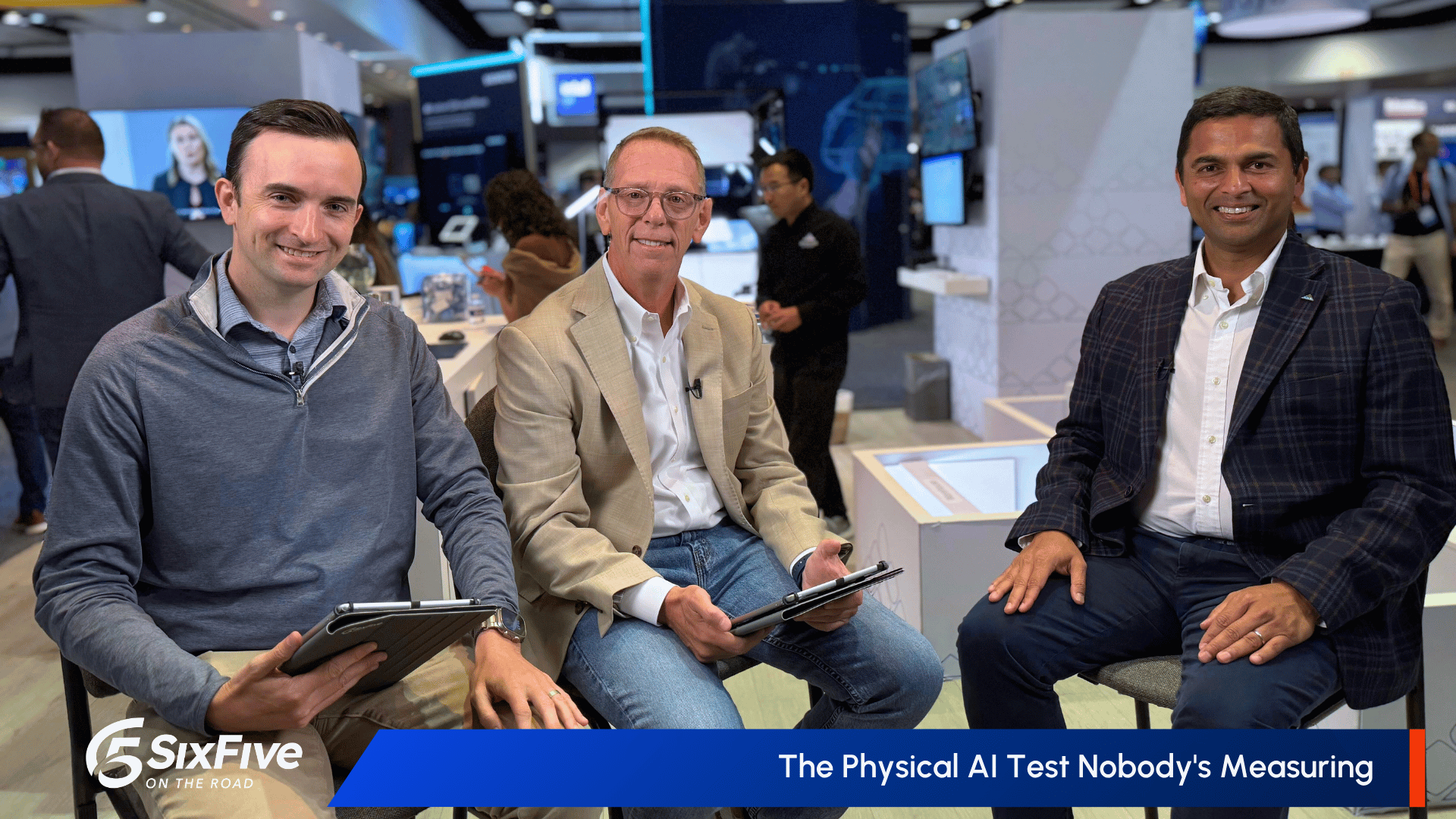
Fleet-Scale Deployment Is the Physical AI Benchmark
Physical AI is shifting from lab prototypes to fleets of machines operating reliably in the real world, and Ambarella's Muneyb Minhazuddin joins Six Five On The Road at AI Infra 2026 to explain what that shift demands of silicon, memory and developer workflows. Minhazuddin traces the case back to a 22-year-old chip architecture and forward to a developer cloud built to compress model porting time from months to days, and he identifies enterprise ROI proof points as the biggest hurdle left before physical AI scales into millions of deployed units.
.png)
AI Safety Alarms, China's Distillation Reckoning, and Qualcomm's AWS Breakthrough: A Pivotal Week for Enterprise AI
A viral AI extinction claim, a federal advisory naming six Chinese AI labs for industrial-scale distillation, and a $60 billion Qualcomm-AWS silicon pact define a week when enterprise AI risk and opportunity collided head-on. Patrick Moorhead and Daniel Newman weigh in on what's signal and what's noise across AI safety, chip supply deals, and a market rally still betting big on compute.
Other Categories
CYBERSECURITY
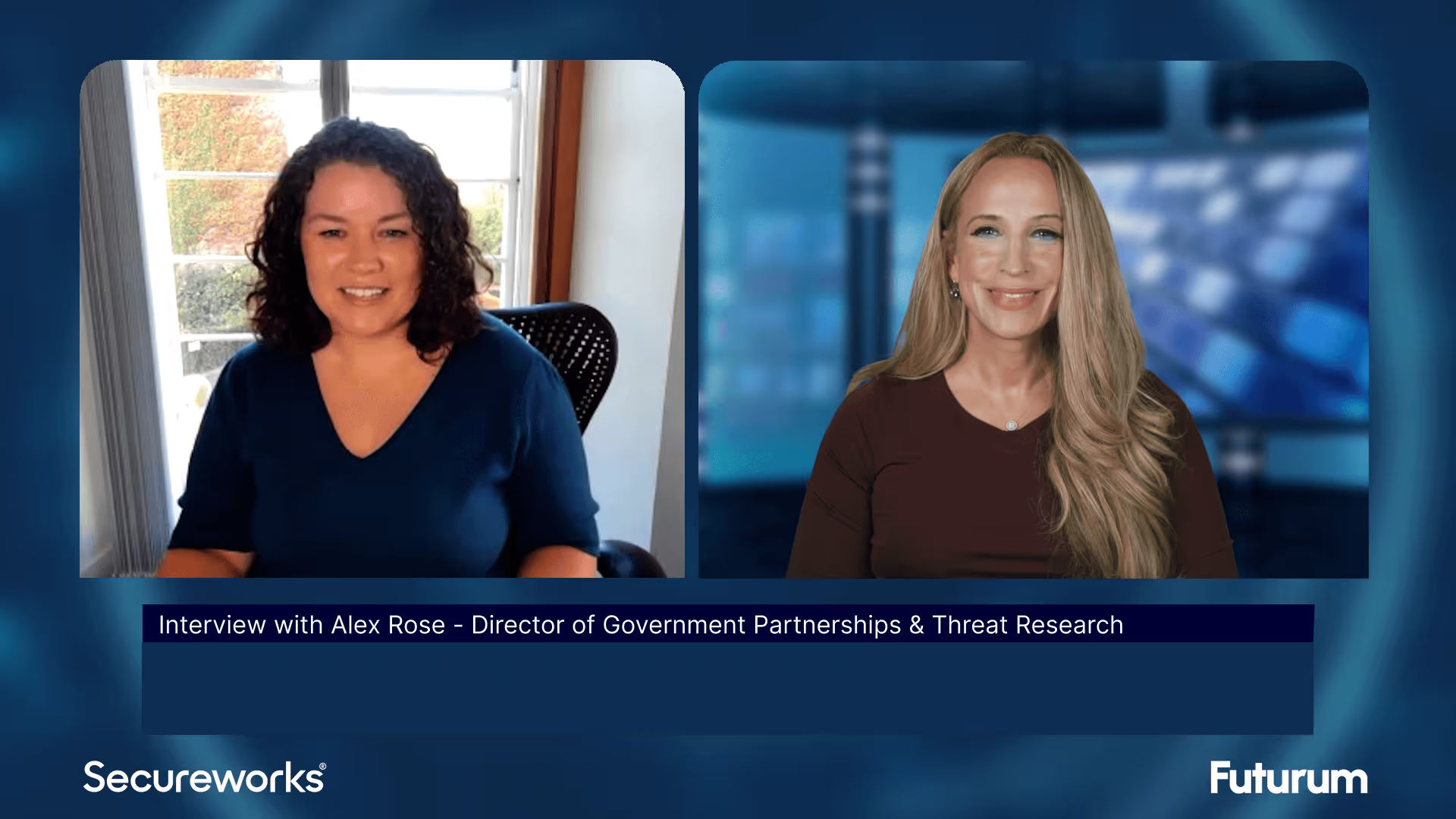
Threat Intelligence: Insights on Cybersecurity from Secureworks
Alex Rose from Secureworks joins Shira Rubinoff on the Cybersphere to share his insights on the critical role of threat intelligence in modern cybersecurity efforts, underscoring the importance of proactive, intelligence-driven defense mechanisms.

HP Launches World’s First Business PCs to Protect Against Quantum Hacks - The Six Five On the Road
On this episode of the Six Five - On the Road, hosts Patrick Moorhead and Daniel Newman are joined by HP's Ian Pratt, Global Head of Security for Personal Systems.
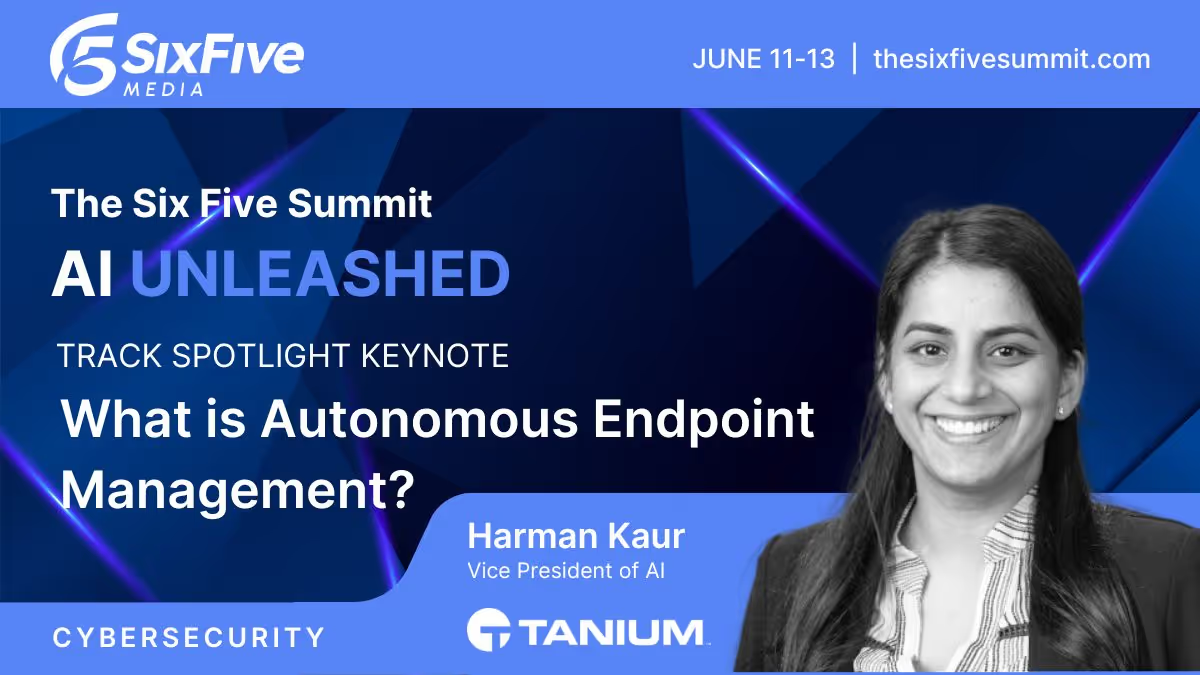
What is Autonomous Endpoint Management?
Autonomous Endpoint Management is a framework designed to unify IT operations and security teams on a single platform through real-time control and visibility.
QUANTUM
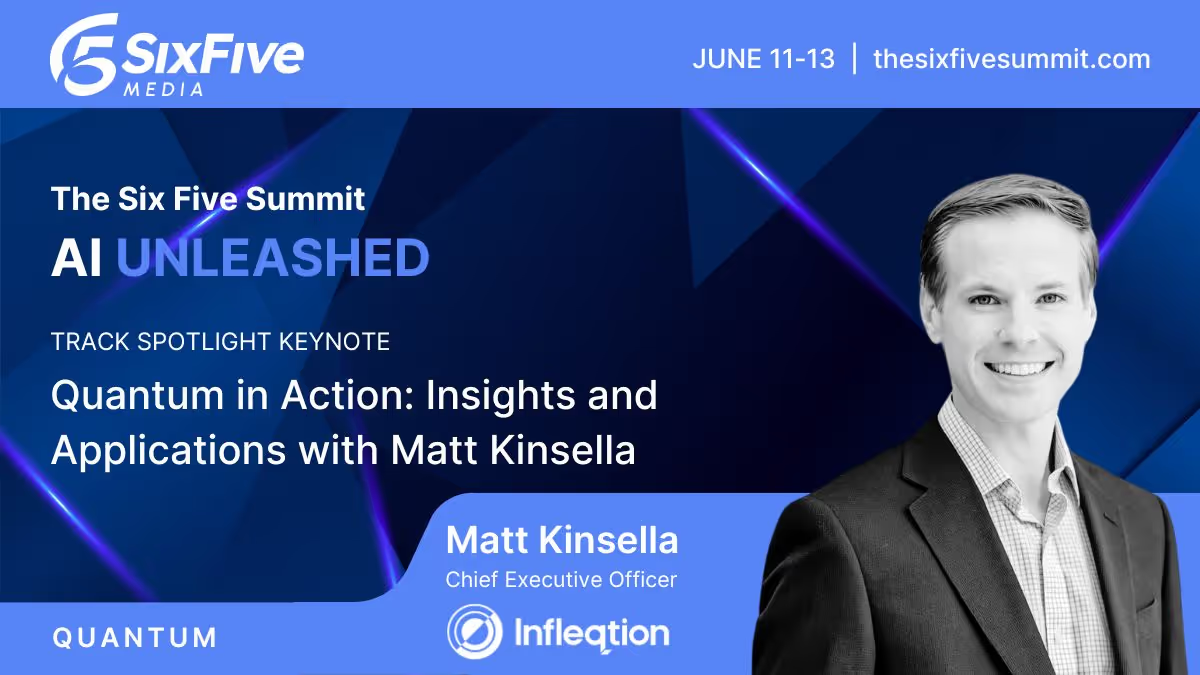
Quantum in Action: Insights and Applications with Matt Kinsella
Quantum is no longer a technology of the future; the quantum opportunity is here now. During this keynote conversation, Infleqtion CEO, Matt Kinsella will explore the latest quantum developments and how organizations can best leverage quantum to their advantage.
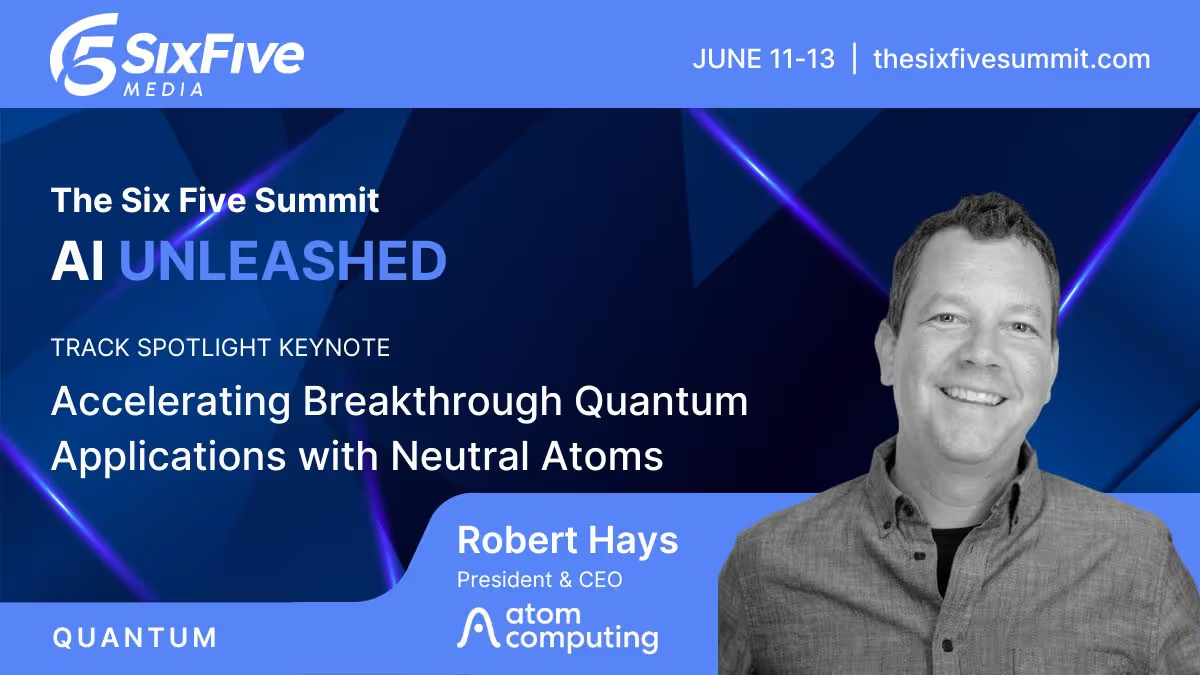
Accelerating Breakthrough Quantum Applications with Neutral Atoms
Our planet needs major breakthroughs for a more sustainable future and quantum computing promises to provide a path to new solutions in a variety of industry segments. This talk will explore what it takes for quantum computers to be able to solve these significant computational challenges, and will show that the timeline to addressing valuable applications may be sooner than previously thought.