
The Six Five Pod | EP 289: Infrastructure, Capital, and the Reality of AI Scale
SHARE


On this episode of The Six Five Pod, Patrick Moorhead and Daniel Newman explore how infrastructure constraints, capital dynamics, software consumption shifts, and regulatory friction are increasingly determining who can scale intelligent systems, featuring an exclusive “Off The Record” conversation with Martin Casado, GM of the Infrastructure fund at a16z (Andreessen Horowitz). On this episode of The Six Five Pod
The handpicked topics for this week are:
- Execution vs. Experimentation in AI
AI adoption is accelerating, but most organizations remain stuck in pilots. The issue isn’t the models, it’s execution. When reliable compute, clean integration, and production discipline are missing, scale breaks. Pat & Dan provide examples from @NVIDIA, @AMD, @Qualcomm, and @Intel at CES – the divide is clear. Treat AI as infrastructure, and you move forward. Treat it as an experiment, and you stall. - Infrastructure as the Real Constraint
AI scale is governed by physical limits. Power, racks, memory, networking, and where infrastructure can be built now determine outcomes. - The Widening Gap Between Investment and Outcomes
AI spending keeps rising, but results remain uneven. Capital is abundant, but infrastructure is lacking. Without production-ready systems, funding alone does not translate into execution. - Changing Software Consumption Models
AI agents are reshaping how software is used. Pat and Dan comment that SaaS was never a technology problem, it was a business process problem. AI changes consumption and access, not the need for structure, compliance, and operational control. - Capital Intensity and Long-Horizon Strategy
The hosts reflect on the market and note that AI infrastructure rewards patience. Multi-year commitments across compute, power, and facilities are creating advantages, while short-term thinking is creating exposure. - Regulation and Permitting as Bottlenecks
Regulation now slows AI scale more than technology. If organizations cannot break ground, they cannot scale, regardless of demand or capital. - Rebuilding the Stack for a New Technology Epoch with Martin Casado of Andreessen Horowitz
Martin Casado of @a16z argues that every major technology shift forces a full-stack rebuild. The industry is supply-constrained, not overbuilt. - Reframing the AI Bubble Debate
The real question is execution. Demand is real. Supply is constrained. The winners are the ones who can deploy durable systems at scale.
For a deeper dive into each topic, please click on the links above. Be sure to subscribe to The Six Five Pod so you never miss an episode.
Listen to the audio here:
Disclaimer: The Six Five Pod is for information and entertainment purposes only. Over the course of this webcast, we may talk about companies that are publicly traded and we may even reference that fact and their equity share price, but please do not take anything that we say as a recommendation about what you should do with your investment dollars. We are not investment advisors and we ask that you do not treat us as such.
Daniel Newman:
Everyone, welcome we are back. We are so back. Episode 289 back and at it here in 2026, Pat gosh, another year just blew by, and you and I lazily skiing away and beaching away, took what, two, three weeks off? Well, the industry didn't take two or three weeks off. There was really no downtime, including a mega deal made right on Christmas Eve, that $20 billion NVIDIA Grok deal. So there's no downtime, but you know what, Pat? Everyone, even us, needs a little bit of a recharge. And so I'll argue, man, you're back. Give me the quick stats, the vitals. You're healthy. You've got any big news in the family you want to break? Did anything interesting happen in the Moorhead clan over the holiday?
Patrick Moorehead:
Maybe. Yeah, my daughter Catherine got engaged and Lauren is already married and I've got a grandson and we have his birthday party coming up in February. And then kind of on the health front, you know, the shoulders doing well, um, and I'm kind of balancing, uh, you know, muscle mass and energy with fat. Uh, I'd like to lose, you know, five pounds of fat, um, to get my, uh, content down, but I don't want to lose energy. So I can't blast it on, uh, on the strength training, uh, workouts have been really, uh, happy, happy about that, but all systems are a go. I mean, shoulder, Uh, you know, hernia repair, dude, I have no excuses at this point, uh, whatsoever.
Daniel Newman:
Yeah. And you're a miserable son of a bitch when you are hurt. So I'm going to keep you healthy this year. Cause you're almost intolerable when you're not like able to, to, to get after it. We're going to work extra hard to keep you healthy and rich this year. Cause that's when Pat's really the best to be around. Um, but yeah, I'm really glad to hear you. Mine, mine was good. I mean, uh, I did survive being stranded in Aruba. There's just no way as a pompous privileged individual to say that and not sound like a total total moron. So let's just say I was in Aruba 20 miles or less from the border of Venezuela the day the airspace got shut down and I was trying to get back. It did actually impact a number of different things but I was trying to get back for CES and it was kind of like a stressful way to end some good downtime just because I had to be at an event because gosh, I mean, why not start the year off with like the first Monday having like one of the largest technology events in the world. But Pat, off we went, we were in, we made it, I made it, we went to Vegas, you and I did the pregame for this mega Lenovo Tech World event where pretty much the keynote had what? And their CEO, Huawei and NVIDIA CEO and it had, AMD CEO, Qualcomm CEO, and you know, just like the who's who of tech was on the stage and you and I were pre-gaming and we did that and we were busting through. So we got in, came in, I think, I don't know, like 16 videos. I think we did 16 videos in less than 24 hours of actual time and we crushed it. So that's good. So we crushed the year, we crushed the first week, we're getting after it and we had a great episode for everybody. So, you know, first of all, great to be back with you all. Thank you all for being part of our community. We we really do love all of you. And, you know, the fact that you spend some time with us each week means a lot. We're going to have a busy few weeks. ahead. We are going off to Davos, Pat. We're going to have, you and I are going to be in a view from Davos. Once again, there'll be a number of conversations, sit down, then just some great meetings that we expect to have while we're there. And there was just a ton of coverage this week because of CES, but not just CES, there's more AI news, unsurprisingly. And by the way, The C in CES maybe should stand for chips now. It's maybe not consumers. It might be the chip show. And there's a lot going on there. And Pat, we're going to have to be a little bit quicker today in our decode and bulls and bears because we have a very exciting guest for our off the record section. We're going to have to be a little cautious about how much we drone, just knowing the time we have to record. You and I got other meetings. I don't know if you guys believe this, but this isn't the only thing we do. I know we're really good at it, but we actually do a whole bunch of other stuff in between. So, I don't know, man. You ready to get after it? You ready to just dive into the week's docket? LFG, Daniel. Let's go to the decode. All right, my man. It was the chip show. Um, let's just do the quick rundown. I mean, I think the big day one day zero was NVIDIA. I mean. There was some other big chip news, and I think we should touch on that too, but like NVIDIA, Jensen, Keynote, Pact Event, Millions of Eyes, what happened there?
Patrick Moorehead:
Yeah, so just to net this out, it was all about Vera Rubin shipping and open sourcing and auto generative AI agentic platform for automotive called Alpamayo. More details about Rubin being in a six-chip platform, which it's funny, it might actually be seven. He mentioned something on Bloomberg about another chip that I thought was interesting. Maybe that was CPX. Vera Rubin had been announced already. There were just more details that went into that. But again, shipping it is, and again, it wasn't shipping it for production. I believe it was first ship of units for people to test, because I don't believe that it's going to be fully online until the second half. of this year. And then the follow on to that is is Rubin Ultra. So, yeah, I mean, it was part of Jensen's rock show. He took it from Washington, D.C. here to Las Vegas. He came out from a timing standpoint second after Qualcomm. But NVIDIA is just being NVIDIA. And they literally sucked a lot of oxygen out of that room.
Daniel Newman:
Yeah, it was. And I think that was a way to take about four days of content, take it into about a minute. I mean, look, I think the full production was the big thing. I think a lot of people expected that moment to maybe come at GTC. not necessarily to happen at CES. It seemed like there was a bit of a tug of war. I think Lisa, Sue, and Andy are running their own race for sure, but they want to make early announcements. And I also think there was, you know, Pat, if I can just say, like, if you do the Chip Enterprise show, because Enterprise was super in focus, and both Enterprise in terms of delivering data centers that that enterprises can touch and get access to. Pat, but also enterprise in terms of special parts for enterprises, like, right? I mean, MI 440X, which is like, you know, we're saying, hey, enterprises might build data centers too. And they're not going to have liquid cooling, and they're not going to be able to bring in gigawatts of power, but they're still going to want to be able to do inference and AI. And so, Pat, I don't know. I think for guys like you and me, though, like, I think it's fun that CES is starting to be tailored more to stuff we care about.
Patrick Moorehead:
Yeah, and it's funny, a lot of debate on that. Obviously, the gaming guys are upset. CES changed its name to CES from the Consumer Electronics Show a couple years ago, and it became the Automotive Show about five years ago. It's really where is all the money and excitement happening show, right? That is what that is what this is about. But listen, I'm here for all forms of news, whether it's robotics, data centers, cool stuff, and automotive, things that move innovation forward and help out consumer businesses.
Daniel Newman:
All right, a bunch more CES related stuff. We'll hit that later down in the docket, Pat. Just a quick note, I don't know if the energizing the data center was a pretty big topic throughout the week. We make jokes about the size of the racks and the amount of gigawatts of power they're going to take. But Meta is now signing some new nuclear deals. So I said 25 was the year of these GPU REITs. You had companies like Iron and Cypher and you had capacity plays like Nebbius and Corweave signing all these deals with hyperscalers because they need more capacity quickly. It seems like now they're looking further into the future because let's face it, most of these nuclear technologies are not shipping at this point. Some of them late into the decade, some of them not. much further. But you know, Meta is basically saying they got what about 6.6 gigawatts of power they need to add by 2035. So they're starting to think ahead of this stuff, Pat, and they're signing deals with Vistra, TerraPower and Oklo to basically help them get the capacity that they're going to need. So we're starting to get this forward pull as forward inertia of, okay, the turbine power is not going to happen fast enough to get us to where we need. We need to start thinking well into the future, Pat, and now nuclear is hot.
Patrick Moorehead:
Yeah, that's right. I mean, it's, you've got power requirements in the front of your face and current course and speed, we run out of power in 2028. And I've been pretty clear, we've got a two-year fuse, unless we have some sort of a Manhattan Project-style launch on nuclear. You're advising some companies, I'm meeting, have had ongoing conversations with Fusion companies. A very renowned investor here at Austin has been in that for three years. And none of this is new. I mean, AWS last year, I think mid-year, in one week, nuclear became okay again. And then AWS talked about what it was doing. Each one of the hyperscalers have outlined a power strategy because they do see that as the gating factor to accomplish what they need to accomplish.
Daniel Newman:
Yeah, absolutely. And I expect this to be the year of hearing more deals by more hyperscalers signed with more prospective nuclear providers, meaning there's still risk here that this stuff ever comes online. I'm pretty sure Oklo hasn't deployed any gigawatts yet. At this point, they have contracts and deals. So these are the very speculative, but the technology is starting to prove out and as it proves out and starts to get deployed. there will be a lot of interest in working with these companies. And I think we're gonna see some interest back, Pat, and remember we heard about, what is it, like Three Mile Island reopening? I think you're gonna see more interest in fission, not just SMR, but fission, like reopening and accessing some of the nuclear capacity that was available that for really no good reason was taken offline when it was politically uh correct to do so um all right so pat we also um need to touch base on amd i know i i teased it a bit you know it's hard to talk about amd without NVIDIA and video without amd but uh what you know you you spend some time with lisa and you know we spend some time with amy like what what was your read on that
Patrick Moorehead:
Yeah, and very similarly to NVIDIA, you had AMD giving more information about its racks and its technologies. There was a little bit of a, you know, of course, there's going to be an MI500 coming out. There was a little bit of discussion about that. Probably one of the biggest breakthroughs or kind of news was that the company was in robotics and in space. Now, apparently they had been in space for a long time, primarily through the Xilinx acquisition. You had NASA, you had a lot of other folks up there, but they did talk about what they're doing next in that area. But it was the robot on stage that I think got everybody excited, because nobody had really heard of AMD in robotics. a pretty cool company that was called Generic Genetic Engineering. I forget the name, to be honest. But I wish that the robot had moved, like walked or something like that to show some reality. But there were some incredible, cool tricks that they did. So one of the things that I thought was really unique about AMD is getting Greg Brockman on stage to talk about why he chose AMD. And I know Brockman gets on a lot of stages, but he literally talked, he showed the slide, uh, which he created in a chat GPT, um, um, on exactly why they did it and whether it was for, um, scale-up domain, decode, and pre-fill, this is why they were going with AMD. It doesn't mean they're not going with NVIDIA, they are, but it was good to see that as a vote of confidence. Because it was one thing, you know, AMD stock skyrocketed when the announcement was made, but to have more details on why they did that. The only thing I'll end with here is, so Lisa has a very high say-do ratio, and she doesn't use biggest, fastest, only, without there being some data there. And she said Helios, the world's best AI rack. And I know the word best can be construed in multiple ways, but I feel that as a sign of confidence that AMD has around Helios. And while they didn't say they were shipping it, like NVIDIA said they were shipping there, that's about as close as you can get to it with the, again, the affirmation from Greg Brockman from OpenAI.
Daniel Newman:
Yeah, we see their Helios business driving somewhere around 8 to 10 times growth in their AI accelerator business over the next couple of years. So it's going to be really big for them. I mean, look, they're always going to be fighting just based on pure size, the NVIDIA Headwind. Probably the biggest questions they still have to answer is ROKM. Can they execute and build that sort of contingent around it? They've made a lot of progress. You know, Pat, we talk about this on the show all the time. The demand for AI is favorable. Lisa has wafers, capacity, customers, and they're going to use AMD. And I think those that want to zero sum this thing are just wrong. They are going to use it. It's going to find its way in with the hyperscalers. There's a lot of Neo clouds building around it. Enterprises will build around it. is going to be a battle to take share, but the market's so big that if it can just have share, the share it has, and grow with market, they will grow very, very large, be very, very successful. even if NVIDIA doesn't trip up. So that's just something important to point out. All right. For a long time, I've been banging the drum like, hey, Qualcomm is going to get into robotics. It just made sense. There's a couple of things favorable, but they're very focused in low power. They're very focused on edge. They've been very focused on autonomy. And they had all the right ingredients for it. they really kind of had their coming out moment here at CES. You know, with the announcement, was it the IQ10? Is that what it is? I'm trying to make sure I got the right name for it. And they are the Dragon Wing platform. But what they're basically doing is taking the, autonomy platform from their ADAS, and they're applying a lot of the work that's been done. And by the way, those of you that are out there, Qualcomm has become a formidable company in automotive. That has been probably their biggest net new diversification success over the past half a decade. And now what they're really doing is saying, look, yeah, there is, there's a, you know, an optimist market for $30,000 per humanoid, but there's a huge market for other smaller, different form factors of humanoid robots. And I thought, Pat, and I think you've mentioned a few by name, but like figure eight, is it, and like a number of other companies that had kind of sounded like they were going to go down the NVIDIA path. have made commitments and came out and made some commitments here at CES, looking like Qualcomm may have their next kind of big market TAM expansion opportunity in this multi-year diversification play that they've had. So I thought this was really, really interesting, Pat. I mean, there was other announcements. They had more automotive announcements. They had more IOT, Dragon Wing related announcements. But I don't know about you, but their kind of full in entered entrance into the robotics race was a real standout moment for me.
Patrick Moorehead:
Yeah. At their last financial analyst day, they had put up some numbers that go into 2029. And I was thinking about robotics. What would it take for people to get the attention in the outside world that Qualcomm would have to do to do this? And their first thing was you have to show up with somebody, a major brand, whether it's Tesla Robotics, KUKA, and even maybe one of NVIDIA's premier partners. And they did all that. KUKA is one of the biggest robotics companies on the planet. And they're in. NVIDIA and Figure AI have a very strategic relationship together, so I was quite shocked. I met their CEO on stage at GTC, and they're using, first of all, DGX on the back end, but things like Jetson and Thor for real-time robotics. I think also, you know, the Isaac platform. So seeing their name up there, what was a surprise? And I started thinking, you know, hey, what happened in the ADAS market and the dashboard market where, you know, NVIDIA was the absolute, you know, the only thing in town for both those markets. Qualcomm came in and really took over the dashboard. And then Qualcomm has been very successful with lining up ADAS. Are we seeing a very similar play here, Daniel, based on two things, which is performance per watt and openness of the software platform? NVIDIA does offer a lot of open source models from an entire stack standpoint in automotive. They brought out Alpimaio, but I'm unaware of NVIDIA's open source software platform for robotics. It doesn't mean it's not there. I'm just unaware of that. Qualcomm's diversification plan is coming together. They've delivered an automotive. They're making a lot of headway in IoT. And then here we have robotics, the next trillion dollar opportunity for Qualcomm.
Daniel Newman:
And there you have it. But there was a lot of benefit gained from the work they've done in autonomy for ADAS. And that is translating really nicely. And those wins were really material. We got one more decode topic. We have about 20 we could do, but just going to have to keep you on schedule, Pat. You're a busy boy. I'm just talking too much, Daniel. You're just a busy boy. But I mean, good. What a week for Intel. Lippu, Lutnick, Trump sending out tweets, or ex-posts, or I don't know what it is. What did you hear and what happened with Intel this week?
Patrick Moorehead:
First off, the tweets by Trump and the video with Lutnick and Lippu, Tan, it was pretty awesome. Intel did do a product launch with Panther Lake, but that's missing the macro point here. That's not why their stock is just exploding right now, because Panther Lake is a proof point around 18a. Intel gets 18A internal write and they prove to people that gives them the right to do 18A and 18AP for foundry customers, which gives them permission to do 14A. So that was pretty amazing. The other thing that I thought was pretty cool is that this new architecture, typically what will happen is Intel will do a waterfall, like premium is the new stuff. and then down the price curve is the older stuff. But it's premium to mainstream laptops. I saw their lower positioned product in the lab actually running. It's not a science project. It looked like a very inexpensive design, which I think to go up against the AMDs of the world and the Qualcomm's of the world, I believe that these guys, Intel is getting ready to compete on price. That lower cost platform is called Wildcat Lake. for all those out there and who are counting. And probably the third thing is, you know, we saw these new Series 3 processors tested and certified for embedded and industrial, which could go into robotics, smart cities, automation, healthcare, and a lot more. So those are really the three standouts for me.
Daniel Newman:
Yeah. So I'm going to just quickly say one is, you know, Great to see 18A on its own, you know, its own products being built and being successful. That will be a watermark, not the only one, but it will be one of the, you know, they've always been able to do the IDM thing, but now they're gonna try to start doing it for others. Pat, I do think there's way for deals in tow. I just do. I got this sense of it. I think that there's a quiet confidence about Lit Boo. He's clearly, and by the way, there's just so much demand. The demand is there, but I don't think it's gonna happen on 18A. The Core Ultra stuff, very, very cool. So that was good. And like I said, it's up 10% today as we're doing this podcast, 10%. 45 bucks a share. Most of the people that have, they're actually, if you had Intel for 10 years, you were maybe getting back to break even now. As crazy as that sounds. It's been a long time coming. That's a great, that's astonishing.
Patrick Moorehead:
Yeah, for the month they're up 12%, six months they're up 93%.
Daniel Newman:
And Pat- And if you own NVIDIA in that same period of time, you were up, sorry, in the 10 years, you were up like 3000%. Yeah. So, you know, they've got a long way to go, but it's good to see we need American foundry. We need more foundry, even if it's not American. We need to just be able to make more than we're making right now. All right, Pat, let's close out the deco. Let's head over and talk a little bulls and bears. All right. You know, the good news, Pat, is it's a quiet, no earnings over the break. So in bulls and bears, we can just talk about a few macro things here. One is jobs reports came in. You know, basically, it was a Goldilocks jobs report. It was a little bit better than expected in terms of the unemployment rate, but the added new jobs was negligible. And in the end, I think we're, I'm just going to say this out loud because I'm a macro economist, self-proclaimed. I do think we do end up with more rate cuts this year. And I think that's going to be important for keeping the growth environment warm. I know Trump this week announced some things with housing. I don't know if you heard about it, like basically saying big corporations. So our friends at Blackstone are going to buy up all the real estate and then overcharge rent for it anymore, potentially. And I know Trump's steadfast about bringing interest rates down because that'll be what ends up stimulating that market. But that stuff all has teardown effects to the broader economy, to growth, to entrepreneurs, to investment. So it's always interesting to just talk about that stuff. There was something that came out this week that said, Pat, I don't know if you saw this. Do you know who the most profitable company was in the world last year? I should know, but it was an oil company, Ramco. No, Google. Google made more money. It's OK. We can delete that out or keep it. I don't care. But the bottom line is Google made the most money. And by the way, not just profit, also cash. In 27, though, Pat, it looks like Google's going to do it again this year, maybe. Although I think NVIDIA might change that trajectory this year. But in 27, it looks like NVIDIA is going to become the company's not only most valued, world's most valuable company, but also the company that creates the most profit in the world. That, of course, is unless there's a bubble and then nobody needs NVIDIA anymore. And we go back to to, you know, doing our workloads. What did we use? Like printing presses and and sewing machines or whatever. So anyway, so that was interesting, Pat. You know, there there. apparently on the route to becoming, it could be a seven, $8 trillion company. So only Elon Musk will be worth more than a video.
Patrick Moorehead:
Yeah, for the record, for all the people that think I'm stupid, in 2024, Saudi Aramco had more net income than Google. I don't know what it was for 2025, but I think for 2025, you're probably right.
Daniel Newman:
I don't think that was a dumb answer. I just think it was, you know, what the hell? I didn't mean to make you look bad, buddy. I won't ever do that again. I'll never ask you a question without a prep again. Everybody out there just know that if I ever ask Pat a question, he gets it wrong. It means I went off script.
Patrick Moorehead:
I got it right for the wrong year. It's okay.
Daniel Newman:
We're getting old.
Patrick Moorehead:
Well, I hope my audience will forgive me.
Daniel Newman:
Let's actually talk. Let's just do quickly, Pat, because I don't think there's a lot of like needing to dive into this. But Google was the most profitable company and guess now it is apparently overtaken. So it went last year for me like fifth most valuable company in the world. When the year started, it was fifth and it climbed past Amazon, it climbed past Meta, it climbed past Microsoft, and now it's climbing past Apple. Alphabet is worth more than Apple.
Patrick Moorehead:
Well, I mean, one reason it's called Gemini 3. Bard 1, disaster. Bard 2, disaster. Gemini 1, uninspiring. Gemini 3, hold on to your seat, folks. From a developer standpoint, from a usability standpoint, I mean, my gosh, I literally spent more time on Notebook LM doing those GIFs and summaries than you can even imagine. We didn't do a prediction show, Daniel, but it is going to be hard to knock off Google at this point without some disaster happening inside Gemini 4 being horrible. And Apple, by the way, Apple with no AI, even the fact that we're having this conversation is an absolute miracle. And it's going to be an interesting year for Apple, Daniel. You're going to see probably a complete revamp of the senior leadership team, or at least announcements. You're going to see a lot of people moving back and forth. Tim Cook, right, it's pretty much the worst rumor ever that he is going to put up somebody to replace him. It's the worst rumor because you don't think it's true? No, sorry, it's the worst kept secret. There are no secrets.
Daniel Newman:
Yeah, I mean, I think his time has come. You know, I had an interesting conversation about that this week. He came in because they'd had a jobs in charge for so long that didn't put the rigor around operations. And then he came in and basically was able to capitalize on jobs ideas and turn it into a machine. But now they haven't had a jobs figure in a very long time, someone that's a big visionary there. And I think, you know, it's maybe time to rotate that back and get back to the visionary side of that business. All right, I got one more, you know, like I said, there's not a lot here, Pat, but like one more just to, I'd like to get your read on, you know. What do you think, like, a lot of people say where the bubble shows up is when earnings start to break down. A lot of companies have closed their books at the end of the year. We're going to have the big wave, Pat, the one where you and I end up on doing all the TV and going, you know, running a million miles an hour in about two weeks, three weeks, talking about this quarter and, you know, like kind of, I'm not asking you for estimates. People can look that crap up. Do you think there's any breakdown? Do you think we're going to like, do you see any path or any likelihood that tech is going to break down over these next couple of quarters? Or do you think we're going to be, you know, sailing smooth coming out of Q1 this year?
Patrick Moorehead:
Listen, infrastructure, infrastructure, I feel pretty good about. Software to me is another and we're going to be talking about Martin Casado from Andreessen Horowitz to get a little bit of his opinion of that. But I still think it's an open throttle, Daniel, on enterprise SaaS. I don't have a good feeling for it. I mean, if there's one, probably a top three theme when I talk to CIOs is their desire to reduce spend with enterprise SaaS. The question is, can they? And when could they do it? And what's the priority? Because right now they're at this impasse between where do I put my investment dollar? Do I put it into horizontal and vertical agents, small language models, an on-prem version of agentic orchestrator, or do I pay the extra money to my enterprise software provider to do this? And a lot of spending is frozen. right, as well. Like if you had to go invest a ton into infrastructure, your budget increased a little. And I think overall, we saw about a 10% increase in AI budgets for 2025 at the CIO level, maybe even more. But that's the one thing that I think could make it crash.
Daniel Newman:
Yeah, I think. we're going to end up stable. I think that the growth is going to be there. I don't see earnings erosion coming this next few quarters. I think there's just too much demand. I think there's too much demand. And if you go down to that enterprise level, I think that there's too much pressure from boards to deliver AI. So I'm not saying all earnings will be good. Tech earnings will be good because people are going to continue to turn to tech for the deflationary and scale and productivity and efficiencies that they expect to be able to get. And they're under pressure to implement AI. And whether or not we believe that, I think this is the year of enterprise AI, and this is the year of agentic AI. And you and I both play with this stuff a lot. We're building stuff in our businesses itself. And we see how much more productive it can make us. So I think it'll be a good year. I'm very optimistic. And I'm kind of a permeable, so I get it. I don't tend to ever see danger. But so far, Pat, I think our batting average is at least good enough to keep us in the major leagues.
Patrick Moorehead:
So danger. Let me ask you this, though. Danger overall or or, you know, what will be pockets? I mean, in aggregate, I do think that, you know, NVIDIA, you know, could be the next, you know, five trillion dollar company or something. But where is that going to pull it from? So in aggregate, I agree. I just don't think it's going to be evenly spread. I was watching a bunch of shows this week about people wanting to load balance on Mag 7 or the Sweet 8 or whatever we're calling it at this point. I just don't think it's going to be uniform.
Daniel Newman:
No, it never really is though. The big companies are your reliables. We've had multiple years in a row of very strong QQQ, the NASDAQ growth, as well as S&P growth. It does. There does tend to be down years at some point. So a down year does need to happen somewhere. This year has gotten off to a fast start. It's been up straight away. Policy has been favorable. The Venezuelan news was favorable. You know, interest rates potentially coming down without huge recession fears and the jobs numbers have been favorable. But we are in the middle of a Trump presidency and you know that he can say whatever he wants, Pat, but I don't think he wakes up in the morning and doesn't look at the stock market. I'm pretty sure every day he's judging his performance against the market's performance. They're trying to create policy for crypto that's favorable, policy for AI that's favorable. You've got Genesis Mission, you've got regulatory red tape being taken out of the picture. I'm still very optimistic. But listen, What goes up must come down at some point. So we're certainly not saying it's a it's a shoe in but here's the kind of recommendation I have for everybody out there before we close up the show is each week ask Patrick if he's put money into the market if He says, yes, that could be a sell cue. That could be a sell signal because Pat will wait until just when the market tops. And that's when he loves to come in. I'm kidding. You know, I love you, man.
Patrick Moorehead:
No, no, no. Actually, you're absolutely correct. I mean, I sat on the sidelines, I put a ton of money in and it dropped like 10%, 10%.
Daniel Newman:
But you waited like a long time. Like you waited like till it had really gotten cooking and you were like, you were like the guy that shows up at the craps table when it's been like a heater and everybody's just cheering and celebrating and you stood there and you kind of watched it and you're looking over and then everyone's cheering and cheering and the money's all pushed into the middle and you just come in with a big wad of cash, throw it down on like, you know, all in on the pass line, crap seven out, first roll and then everybody just
Patrick Moorehead:
Oh man. Don't be mean. But in fairness. This is why we don't even have to do a disclaimer anymore for this bulls and bears show. Because quite frankly, you do what I do, you're going to lose money. Okay?
Daniel Newman:
Yeah. Absolutely. By the way, Pat, you make some other very good investments. So we don't talk about those on the show, but you've nailed some others very, very, very much. All right. There you have it, everyone. That is our bulls and bears. What a week in the markets. Pat, there is always so much to discuss. But hey, let's go off the record. I know we don't do these as often as we probably like, but when we have the opportunity to bring someone in that can really change the trajectory of the conversation here, Pat, or just someone that's got really interesting ideas and things to talk about, I know we love to do that. And we've got one today that you met. When you were doing your professional modeling and hosting, that was fun. It was really fun for me to sit there and watch you, because I saw you working and sweating at GTC for like two days. Let's have you introduce our guest, which I'm super excited to have here today on The Pot.
Patrick Moorehead:
Yeah, it's great. So I am proud to introduce here Martin Casado, general partner at a16z, joining us today. Martin, it's great to see you.
Martin Casado:
Great to be here. Thanks so much for the insight.
Patrick Moorehead:
Yeah, the lights aren't as hot, but the audience is actually bigger than the in-person audience that we had in Washington, D.C. for GTC. I really appreciated it. But hey, why don't we start off just to make sure we know who we're talking to. We know you're famous, but for those who don't know who you are, what do you do and what does your portfolio, what do you focus on?
Martin Casado:
Yeah, so I, I'm a general partner at Andreessen Horowitz. I run the infrastructure fund. So the infrastructure fund, so our definition of infrastructure, this is computer science infrastructure. This is anything with a technical buyer. So think compute, network storage, databases, of course, any of the low-level AI stuff, dev tools, that sort of thing, security. And so I run the team. I've been here for 10 years. And then prior to that, I was actually a portfolio founder for a16z.
Patrick Moorehead:
Now, that's wonderful. And isn't it funny how infrastructure was pretty much left for dead about five years ago? And the meme of hardware was a hardware is an undifferentiated commodity. And look at us now. And I know infrastructure spans not just hardware, but also software.
Martin Casado:
Yeah, yeah, for sure. So listen, it's been it's been an evolving tale. I mean, hardware has historically actually been pretty boring, like networking, silicon, now software infrastructure, especially in data has been pretty exciting things like Snowflake or Databricks. And so like, there has been a lot of exciting, you know, GitHub. But AI has blown everything up. Like, I don't remember the last time you had a lot of excitement around, you know, a silicon chip. And, you know, NVIDIA just bought Grok for, or didn't buy Grok, they hired the Grok team.
Patrick Moorehead:
Exactly.
Martin Casado:
You know, we're seeing that we're seeing networking companies get funded again because AI requires new networking fabrics. And so times are very exciting again, you know, kind of early internet-esque.
Daniel Newman:
And Martin. By the way, just a little props to Pat and maybe myself, but you know, both Pat and I actually did advise Grok. And we decided when we did this back in ‘21, Pat, ‘21-‘22, we decided to take stock from them instead of cash. So we're not like VCs and cool quite like, you know, we're not the cool, cool kids, but we actually saw what was going on. Because Pat and I laughed, like in 2019, we would make this joke, Silicon will eat the world in the next decade. We kept saying Silicon will eat the world, Semiconductor will eat the world. And we had journalists that said, don't write any more op-eds about chips, or we aren't going to cover chips. Exactly. No. Just five years ago.
Martin Casado:
They were like, we don't even want to hear about it. Yeah. I mean, it just turns out every technical epoch requires you to redo the entire stack. And we actually saw this even with like 5G, like a lot of the Intel processors, like the Xeon was like actually used for 5G. We saw this with the data center. This is when you saw a network revolution. So I, you know, I worked in software-defined networking. That was kind of my focus. We redid the network. You saw this, of course, with the internet, which gave rise to Cisco and Juniper. So every time you have a technical epoch, you have to redo everything. And we forget that every time. So when you get to the end of the last epoch, we're like, oh, hardware's dead or whatever. And then the next wave comes, and we've got to kind of get back to building the stack.
Patrick Moorehead:
So I have to ask you, just because, I mean, everything you're saying here, I think I've seen you speak about this a bit, but are we in this AI bubble here, Martin?
Martin Casado:
Well, bubbles are tough. I don't think people even have a common definition of a bubble. Here's what I will say. From a productivity standpoint, demand is real. You have real users paying real money, getting real value, and that's incredibly clear. The data couldn't be more clear. So is there like a demand bubble, meaning like where a demand will come? Do we have a supply overhang where we're building out as hoping it'll come? No, the answer is absolutely not. We do not have a supply overhang. We have a supply underhang. The demand is very real. Now, speculatively, if you look on a deal by deal basis, sure, some deals are overvalued, but some deals are undervalued. So what I've learned in 10 years of investing 30 years in tech, is that markets are actually very rational in the long term and broadly, but it's uneven. Depending on how you look at it and how you squint, you're going to see things that seem overvalued and things seem undervalued. But I would say, if you take it all in, my true belief is it's all undervalued in the long term. This stuff is so, so disruptive. Demand is so real. It's monetizing so well. It's driving so much build out that we should all be incredibly excited for the future. I'm just going to give this guy a high five.
Patrick Moorehead:
Daniel and I are absolutely in there. And Daniel and I do a lot of broadcasts. That's literally the only question we got for months. Daniel, what are your thoughts on that? I know they're very much aligned.
Daniel Newman:
I think I did my 50th TV segment this week where I got asked the question, are we in an AI bubble? And so I think I'm so tired of answering it. My comms guy said to me, you can't laugh at them when they ask you this because you make it look like they're asking a stupid question. I know but like I just keep saying like look we're constrained in every part of the supply chain right now like we have so much more demand than supply. Now there's a monetization question that hasn't been answered yet about the size of the TAM beyond subscriptions to LLMs. Like you know, we'll get into enterprise right now because maybe there's a perfect segue here for you, Martin, like the AI disruption of software. So right now, every SaaS company is adding agents, but at the same time, like I've got five terminals of cloud code open on my desk and I can't program for crap. I'm not a programmer, but I am building stuff and playing inside of, you know, IDEs now and actually seeing what can be done. We're building our own applications that can do things that our CRM used to do and our ERP did and that enables project management. I mean, is software maybe the actual biggest risk here? Is that where the real disruption is happening is now that enterprises can sort of build anything really quickly with a few smart people? Is that maybe where we're going to see the bubble pop?
Martin Casado:
Yeah. So, you know, it's very, it's a very timely conversation. So we actually as a firm and my team in particular did a deep dive on this in the last week. So we actually have a lot of data. Let me just predicate this entire thing by saying it's very early. And so a lot of what I'm going to say is purely speculative, but I do think that, you know, we are a couple of years in, and so you can say a few things. So let me just say a few things on this. So the first one is, it's very clear that coding is pretty much dead, but engineering is very much not. And so you can clearly say the floor has been lowered, so everybody becomes a developer. There is almost no indication that the ceiling has also been lowered. In fact, the companies that are the most aggressively using AI are also hiring the most. And so the question is, how do you reconcile these things? There are many things that even the best version of AI coding can't solve. It's not very good at solving large, complex, stateful software code bases. It doesn't do anything with operations. Let's say, these days, actually writing software is running software. Because it's all SaaS, like the operations is not, it's, it's, it's, it's not a small problem because we haven't controlled, we haven't closed that control of like watching what it does. And then we're fighting based on what it does. And if you actually look dollar weighted, the majority of dollars that are coming in on AI coding are professional coders, not casual coders. And so my belief is this is widening the aperture of the people that can code, which is going to require more code, which means more operations. And so the tent gets a lot bigger. I think the ceiling actually goes up. It doesn't come down because now the problem has become much harder. You're going to have professional developers and engineers, and they're going to be, you know, put to work. And then you're going to have a bunch of new coders that are coming in. There's a separate question, which is, what does this do for SAS? I just want to submit something before the next question, which is, I've been investing in infrastructure and enterprise for 10 years. I will tell you, SAS has never been a technology problem, ever. It's just not hard. If you build a SAS app, it's not hard. It's never been hard, right? And so the question is, why do people buy SAS? And the answer is, you're buying a business process. It's a business process that's been understood by another company that tells you how to run your business. It's never been about the technology or the software, so I don't think it changes that dynamic much either.
Patrick Moorehead:
Yeah, it's really interesting you brought that up. I was sitting in Google Cloud Next probably two and a half years ago, and they put up a slide, agents for marketing. agents for finance, and I was aligning enterprise SaaS companies with these down the line marketing, human resources, and you could see the leaders in these businesses. And what's interesting is we have seen, at least from a markets perspective, I know you deal with a different market, but the public markets, the valuations are not doing well, probably with the exception of folks like ServiceNow, You know, you've seen folks like Salesforce and Workday and folks like that decline here. But talk me through your thesis on, again, you'll never have the perfect data, right? You have to have your data management in place, but I do think AI will help with that. So you have a data fabric that's accessible by the enterprise, and these agents can hit that data fabric with the right security, the right access. Talk to me about your thesis of how this rolls out. We've seen some public battles between Mark Benioff, And Satya Nadella, right, that seemed to go on for a year. So there is tension in the system for sure. And I do a lot of CIO roundtables, and they're literally telling me we are finding a way to get off of this software vendor.
Martin Casado:
Yeah, yeah, yeah. So listen, let me let me just provide kind of maybe like the, the, the historical sober view of this, right? So why are valuations and growth lower from traditional companies is because we're seeing the largest movement in budget we've seen in since the internet. And when budget moves, it goes to new places. you know, are we seeing mass replacements of traditional software? No, we're not. Right. And so, like, historically, software tends to get, it's not zero sub, it tends to get layered, or, you know, budget will move, or it tends to slow down, but you know, it doesn't tend to get replaced. Now, why would you start replacing something like a system of record? Well, the answer is, is it doesn't evolve with the new technology. Meaning there were a number of companies that didn't make the internet transition. And they could have, they just decided not to. So like we as consumers are going to evolve our opinion on what it means to interact with software. Like when I interact with Salesforce, for example, I'm going to want to call it up and talk to it. I'm going to want to have an LLM, but this is a consumption layer change. It's not a fundamental change. The business process is still there. The guarantees are still there. So Salesforce at a hundred percent has the opportunity to evolve the consumption layer to be what the expectations of the user are. So I don't think there's something fundamental end-to-end that's going to disrupt all of SaaS. That said, it's up to the SaaS providers to evolve to meet these moving expectations and this moving budget. So again, I use the internet as my anchor example when thinking through what's going to happen.
Daniel Newman:
Yeah, I think that's really interesting, though, too. I think what you said is the most prescient, which is the experience has to change. And the reason that I think a lot of people, and I can say this as business owners, Pat, you share this probably sentiment with me, is these systems of records are supposed to help you run your business, but they're actually not that easy to use. How many people you have to hire to be like, oh, I want to report on last year's business versus this year's business with this cut and this slice and this angle. And you need like a special person to like come sit at your desk with you, or they can, thanks to SAS, they can do it in another desk. But the point is, and drum up a report. When in reality, what we can do with ChetGBT or with Anthropic now is we just ask it a question the same way I'd ask you a question. And if it can actually go through the APIs and through the traps and find the data, it will spit out. And you can say, I want it in a pie chart. And you tell it, oh, I want it in a bar chart, or I want it in a narrative that sounds like Eric Clapton singing Tears in Heaven. And it can do that for you.
Martin Casado:
Let me just provide the other side of it. I agree with everything you're saying, but let's look at the internet. What did the internet provide? It provided me the ability to connect to software from my house, for example. It provided this fluidity with consumption, with access. What does AI do? It does the same thing. I can talk to it. I can use natural languages. But you still have all of the compliance, you still have all of the integrations, there's formal reporting things, there's also the business process on top, I still need to do pipeline reviews, I still need to do roll ups, like, like, structured data is not going away. And we structure it to limit complexity. And the complexity is driven by the operations. It's not driven by the software. So I think the right way to view this is there's a reason that there is this complexity in the software. It's because we have complex business processes. We've got complex environments that they sit in. We've got a complex regulatory framework. And so you're going to always have that structured data, but it frees the individual from having a new consumption layer to work with. And so the right thing, in my opinion, for these SaaS vendors to do is to evolve with the evolving expectations of the users. But that doesn't mean it obviates all of this work of having to integrate into a complex operational.
Daniel Newman:
I just keep saying that when you have less total human users and you have more agents, they all probably need to refactor their business models to some type of consumption based on tokens and actions and not so much based on seeds.
Martin Casado:
That's a huge topic. And so, I mean, you both probably remember the move from perpetual license on trim to recurring. I mean, that that gave rise to companies killed companies was one of the most disruptive things. Not all companies even there yet. There's still companies today that are talking about this move. Now we're seeing another pricing change, which is from recurring to consumption basis. And that's going to be a whole massive disruption at the same level of that. And we're seeing that right now. Absolutely.
Patrick Moorehead:
Yeah. So, Martin, I want to flip back to infrastructure. I think you talked about an infrastructure inversion driven by AI and cloud. Is there a contrarian view that you have on enterprise infrastructure that the market hasn't fully internalized yet?
Martin Casado:
I mean, I guess my contrarian view is like it really hasn't had an impact in the enterprise yet. I mean, there's very open questions like, for example, I'll tell you like one open question is, What's going to happen to central buyers and platform teams and IT teams if agents are making the decisions, right? So let's say I'm a developer right now. So let's say pre-AI, if I'm a developer and I want to use a database, the IT team provides a set of infrastructure, a set of docs, I get on board and I know about them and I make these technical decisions that are in line with the policies of the organization, right? Today, I code every night and I code every night. It's the most fun thing ever. By the way, the fact that you're coding just shows that this TAM is expanding. We're all coding now and we didn't code before. Who is making a technical decision? If you're using cursor or if you're using Cloud Code, what's making the technical decision of infrastructure to use? The AI is making that decision. And so infrastructure is a multi-trillion dollar business. And you've removed the human by and large from actually making the decision of what to use. We have no idea what that means internally. We have no idea what that means to the industry. And so I think a lot of the real disruptions from AI are still on the come. And we're just seeing very, very early glimpses of that. through secular adoption by individual users.
Daniel Newman:
So we've got only a minute or two, and I really appreciate, Pat, we really appreciate What about the, you're the infra guy and Pat kind of shifted us back here a little bit, but I mean, I just keep hearing everything is constrained. You know, this is, 26 is going to be the year of memory. You know, we're, we're inking nuclear deals for tech that doesn't even technically work yet in most cases, because we're going to need to energize these racks. We've got two ton racks. You know, now being delivered. At least at least one upped it with a 2.6. Right. I mean, I mean, Jensen's breaking physics laws. But like, what is what is your sort of read on compute, capital efficiency, all these different constraints? And like, how is this going to reshape the, you know, kind of the way we're going to scale this whole thing going forward?
Martin Casado:
There's only one constraint. That's regulatory. You know, it's very interesting. So do you guys hear about data centers in space?
Patrick Moorehead:
Oh, yeah, absolutely.
Martin Casado:
It's it's a ridiculous concept. You know, like you have to go all the way to space. It's so stupid. So so it turns out it's not stupid for exactly one reason. Can you guess why that is? Yeah.
Patrick Moorehead:
Regulation. Less rules.
Martin Casado:
So it's 100 percent. By the way, the numbers pencil out just because of regulation. And it's so onerous to break ground in the United States. It makes more sense to send the data center to space. And so listen, we are a very, very innovative species. We're a very mature industry. If we need capacity on bandwidth, on tips, we know how to do it. The issue is getting the bureaucracy out of the way to do it.
Daniel Newman:
That makes sense. That was too fast, though. He doesn't even give me a few good soundbites about like, you know, the fact that we can't build enough. Because your point, though, in the end is like we need to build more fabs. That takes time. You need to build more data center. That takes time. You need to. Right.
Martin Casado:
But the issue really is that they can't listen. If you went to Google today and you're like, you can break ground tomorrow, we would have the capacity we need. We actually have the latent capacity as an industry to do this. The take time is purely a bureaucratic and regulatory morass.
Patrick Moorehead:
Power is very much a challenge, whether it's SNR fusion that doesn't work yet at scale. Daniel, you're involved in a couple of projects as well.
Daniel Newman:
Well, I advised Trump on the TAE deal, but the thing I was going to say is I heard you can open daycares very quickly. So you can't do that. If you can't do a data center thing, guys, there's other ways to make money.
Martin Casado:
You get them funded very quickly.
Daniel Newman:
Exactly. You actually don't need to open them to make money. And that's the beauty. So, Martin, I just want to say thanks. This was a lot of fun. Absolutely. Our off-the-record segment, unfortunately, isn't as long as this conversation really needed to be because I could have drilled in quite a bit longer. So I'll send that note back to the producer that we've got to figure out ways for these longer forums to let us keep going. a lot of fun to chat to you. And by the way, that was the best answer on the regulatory, best answer I've heard on something in a long time, because I've just been thinking about it too much. Because I'm thinking about like, I'm not actually kind of going back with the right message is like, guys, if we just fix regulatory, you can fix everything else.
Martin Casado:
I mean, just, I mean, maybe we're rolling, maybe not. I talk to these people all the time. We have a portfolio. I am telling you the long pole by far by an order of magnitude is breaking ground. That's it. We know how to solve power. We know how to build foundries. We know how to do these things. It's not a technical issue. And the people that are sitting on the top of these big data centers know that. And by the way, is China smarter than us? No. Do they have more production capacity than us? No. Are they ahead of us? Yes. Why? Because it's like full-throated endorsement of building out. And this is what we need to do too.
Daniel Newman:
Is that like a coal-fired plant a week there? Is that what I've heard or something like that that's going on?
Patrick Moorehead:
I started working with the Chinese in the mid-90s and they would show me schematics of where a metal bending factor would be and it'd be a forest and there's no roads. And then a week later, a forest has been cleared, people have been moved and roads were put in. And then a week later, power came in. I mean, it was absolutely, uh, on, uh, unbelievable. So yeah, Martina, I really appreciate you coming on the show. Uh, we'd love to, uh, uh, uh, keep in touch as we, uh, move forward. I don't know if you're sending it contingent to Davos, but a lot of your compatriots are actually.
Martin Casado:
I'll run the other way.
Patrick Moorehead:
No, no, I hear you. It's funny. A lot of your, uh, a lot of your peers are headed there for the first time in years. Uh, and Daniel and I, uh, for the first, you know, we just started going last year when it looked like we were actually going to talk about technology and, uh, yeah. So, yeah. I was thinking about your regulation, uh, your regulation, uh, commentary, but, uh, quite frankly, the, the, the biggest discussion there last year was we over-regulated ourselves. And these were, uh, people from the, uh, uh, from the EU and DJT is going to be there and Vance and, and, and folks.
Martin Casado:
I mean, did you just see like, like Italy just fined Cloudflare what $17 million for like something that they basically couldn't fix and Matt Prince is going to fight. I mean, I just feel like we're in this crazy thing where we're extracting taxation. Taxation, this is what this is.
Daniel Newman:
That's the EU's fundraising mechanism is basically a regular Regulating US companies. And by the way, if you want to go slow, you want to feel like we're going fast. Just look at what Europe does and you'll realize that we're going really fast here in the United States.
Martin Casado:
Every time I feel bad about the United States, I just think about the EU and I feel better.
Daniel Newman:
And that's there. So China makes us feel slow and the EU makes us feel fast. And, you know, we're going to land somewhere in between. That was, by the way, Pat, my worst ever exit of an interview. Like we exited and then we did five more minutes, but it was totally worth it, Martin. Thank you so much for chatting with us. Let's have you back on the show again soon. And there you have it, everyone. That is off the record. All right, man, I got to wrap. I got to go. I got to meetings and stuff to be at. Unfortunately, for all of you that don't care about that, Pat and I love doing this. We wish we could do it more, spend more time with you. Thanks so much for tuning into the show. We appreciate you being part of our 2026 Six Five. It's going to be the best year ever.
Patrick Moorehead:
Yes, it is. See you all later.
MORE VIDEOS
.png)
Anthropic’s AI Slowdown, OpenAI’s $1.2T Valuation & Salesforce’s AI Bet
Anthropic's "Pace the Frontier" essay set off a week in which nearly every major AI leader, and two heads of state, weighed in on whether the frontier should slow down. Patrick Moorhead and Daniel Newman read the incident as something larger than a safety debate. Whoever sets the pace of the frontier also sets the pace for open-weight models, enterprise custom models, and the trillion-dollar valuations riding on top of them. That contest, not the essay itself, is the through-line of Episode 320 of The Six Five Pod.


WD's Tim Rausch: AI Storage Demand Compounds With Every GPU Cycle
Western Digital's Tim Rausch argues that AI's compounding data growth, more than GPU capacity, sets the real ceiling on infrastructure scaling. He joins Matt Kimball at AI InfraSummit 2026 to walk through how total cost of ownership, archived data reuse, and WD's capacity roadmap are reshaping enterprise plans to scale AI over the next several years.
.png)
The Main Scoop Ep. 45: Attackers Only Need to Be Right Once. AI Just Made That Easier.
Chad Rikansrud, R&D Software Security Engineer at Broadcom, explains how frontier AI models are finding decades-old mainframe vulnerabilities in seconds, collapsing the complexity advantage that once protected legacy platforms. He outlines why enterprises need faster Security Intelligence (SECINT) ingestion and disciplined human oversight to keep pace with adversaries wielding the same tools.
Other Categories
CYBERSECURITY
Threat Intelligence: Insights on Cybersecurity from Secureworks
Alex Rose from Secureworks joins Shira Rubinoff on the Cybersphere to share his insights on the critical role of threat intelligence in modern cybersecurity efforts, underscoring the importance of proactive, intelligence-driven defense mechanisms.

HP Launches World’s First Business PCs to Protect Against Quantum Hacks - The Six Five On the Road
On this episode of the Six Five - On the Road, hosts Patrick Moorhead and Daniel Newman are joined by HP's Ian Pratt, Global Head of Security for Personal Systems.
What is Autonomous Endpoint Management?
Autonomous Endpoint Management is a framework designed to unify IT operations and security teams on a single platform through real-time control and visibility.
QUANTUM
Quantum in Action: Insights and Applications with Matt Kinsella
Quantum is no longer a technology of the future; the quantum opportunity is here now. During this keynote conversation, Infleqtion CEO, Matt Kinsella will explore the latest quantum developments and how organizations can best leverage quantum to their advantage.
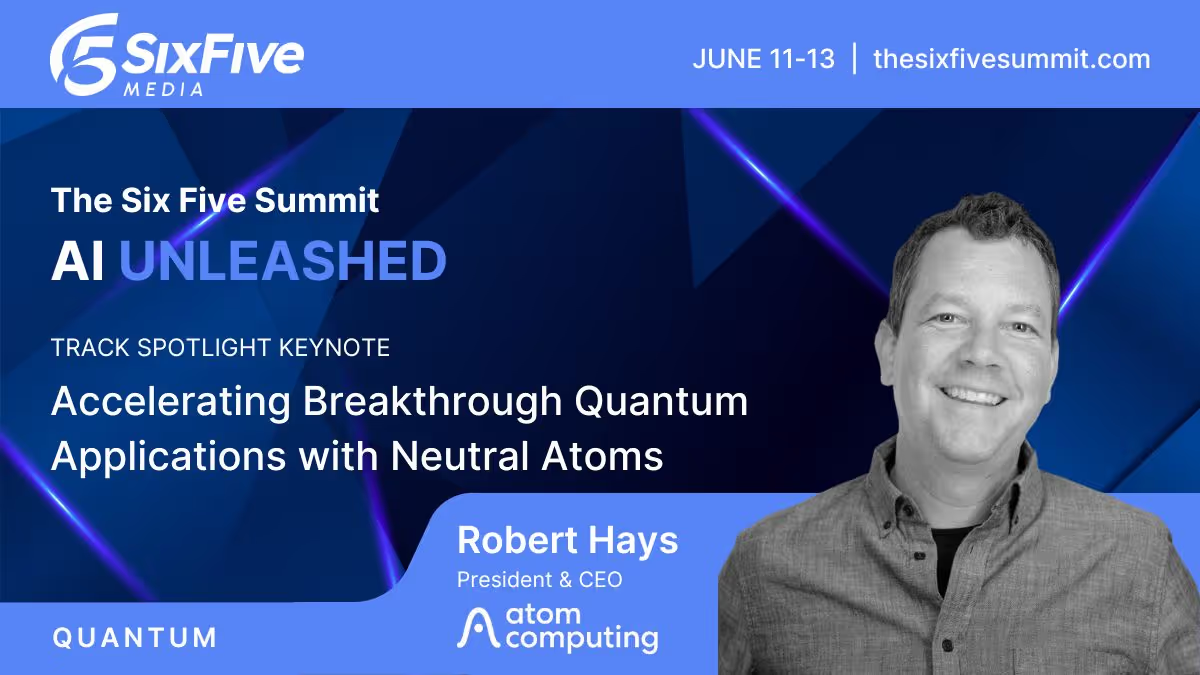
Accelerating Breakthrough Quantum Applications with Neutral Atoms
Our planet needs major breakthroughs for a more sustainable future and quantum computing promises to provide a path to new solutions in a variety of industry segments. This talk will explore what it takes for quantum computers to be able to solve these significant computational challenges, and will show that the timeline to addressing valuable applications may be sooner than previously thought.