
The View From Davos with IBM's Rob Thomas on Turning AI Spend Into Real Enterprise Value
SHARE


Rob Thomas of IBM joins Patrick Moorhead and Daniel Newman from Davos to discuss why enterprise AI success depends less on experimentation and more on execution discipline, operational focus, and cultural readiness.
The AI ROI gap isn’t between ambition and technology. It’s between ambition and execution.
From Davos, Patrick Moorhead and Daniel Newman are with IBM’s Rob Thomas, Senior Vice President, Software and Chief Commercial Officer, to examine the disconnect many enterprises are now facing. AI investment is accelerating, expectations are high, yet measurable business impact remains frustratingly uneven.
Rob shifts the lens away from technology gaps and toward application discipline. The biggest gains, he argues, are rarely headline-grabbing. They show up in operational workflows that reduce friction, compress cycle times, and quietly lower costs. He also points to resilience, not novelty, as the trait that increasingly defines successful enterprise AI, especially as organizations move from experimentation to systems they must rely on every day.
Key Takeaways Include:
🔷 AI ROI is driven by execution, not imagination: Enterprises rarely fail due to a lack of ideas. They struggle to operationalize AI because processes, incentives, and ownership models are not designed for change at scale.
🔷 Boring workflows deliver outsized returns: Repetitive, operational tasks across finance, HR, supply chain, and customer support often provide faster and more defensible ROI than high-visibility, experimental use cases.
🔷 Productivity gains matter more than novelty: Reducing costs and accelerating cycle times are the most reliable early indicators that AI is delivering real business value.
🔷 Culture determines whether AI scales: AI adoption requires top-down commitment and tolerance for disruption. Without leadership-driven change management, even strong technology investments underperform.
🔷 Resilience is returning as a strategic priority: As AI becomes embedded in core systems, reliability, security, and operational stability move from secondary concerns to competitive differentiators.
Listen to the audio:
Disclaimer: Six Five Media’s The View from Davos is for information and entertainment purposes only. Over the course of this webcast, we may talk about companies that are publicly traded and we may even reference that fact and their equity share price, but please do not take anything that we say as a recommendation about what you should do with your investment dollars. We are not investment advisors and we ask that you do not treat us as such.
Patrick Moorhead:
The Six Five is On The Road with a View From Davos. Daniel, it's been a great show so far. You know, the big, I would say, political fireworks haven't hit yet, but I really did appreciate coming in Davos for a second year to get a much better view of what's going on, the intersection between AI, policy, technology, and a whole lot more.
Daniel Newman:
Well, we're seeing the world change right before our eyes. And this is an event where you bring together the business, the economics, the policy leaders. And you're able to have those conversations, so many of them in such a small amount of time. And I don't think there's been a bigger topic. And it doesn't really matter what industry you're in. than what the impact of AI is going to be. So I expect this week to not only talk about some of the regularities, what's going on with energy and AI, and then, of course, the escalating tariff and trade policy issues, but I also expect us to be talking about jobs. What does it mean when you have software that writes itself and completely rewrites industry? So there's a lot going on this week.
Patrick Moorhead:
Yeah, totally. One of the big tech companies that is making major moves, not only in enterprise AI, but also in government, based on its Watson X platform, is IBM. And it's great to welcome Rob Thomas back to the show.
Rob Thomson:
Rob, how are you? Wonderful. Great to be with you both again. Another year in Davos. Exciting?
Patrick Moorhead:
Yeah. What has Davos brought you so far? I know it's early in. What do you want to achieve here?
Rob Thomson:
We're just getting started, obviously, for the week. But I would say the feeling's different this year. As I see, from what I can tell, CEOs around the world have shown up. aggressively and significantly from all over the world. If I look at the meetings I have, heads of state as well. So I feel like Davos is really on the map this year for many of the reasons that Daniel just alluded to. It's kind of the convergent of business and technology and government and everything that's happening in the world. Excellent.
Daniel Newman:
Yeah, this one's going to go really quickly. So one of the things you've been focused on, though, you know, running many parts of IBM, I think you have like three or four different jobs under that job title, you know, but in all seriousness, and you're also writing books about this, though, is, you know, extrapolating, extracting value from AI. You know, we've had these years and look, there's five, 10 companies that AI is their business and they're really making money. And then there's a lot of companies that are trying to make money or figuring out how to make money or trying to figure out where AI drives productivity and efficiency to their P&L. What is, in your mind, working with so many enterprise customers, sort of this gap between companies really getting to value, getting to P&L growth because of AI, and where they're at today?
Rob Thomson:
So maybe back up a little bit, just kind of the macro setting. So S&P 500 in 2019, operating margins were 13%. through 2025, for the most recent quarters reported, which is really calendar Q3, it's 19. That's a pretty significant difference, and maybe another two points to come in 2026. So, technology's having a big impact. To your question, I'm actually not sure that's even AI driven at this point. I think that's technology driven, which is people are bringing technology into their company, figuring out a way to automate processes, figure out a way to become more productive, more efficient. So let's not act like there's not been a ton of progress. There has. You can see the numbers.
Daniel Newman:
Tax-free deflationary.
Rob Thomson:
Absolutely. But for AI, that's a different question. And as I tell most clients I meet with, you are not going to get an ROI. by having AI draft your emails, and then when somebody receives it, having it be summarized by AI. And I think 95% today check the box on that basis. That's not gonna be what this is about.
Patrick Moorhead:
Yeah, it makes sense, and I admit, I might do summaries, but I don't have to write my emails, though. I have not crossed that bridge, and I don't know if I will. I still think the human element matters, but I digress. So when, I do want to drill down in AI for the most part here. When it's not delivering inside of an enterprise, are you seeing it primarily, is it execution, is it technology, or is it a people issue, or something different?
Rob Thomson:
First and foremost, it's culture, more than imagination. Meaning, do we have the mentality to be aggressive, to try things, and to disrupt ourselves? Because done right, AI is going to disrupt how you operate as a business. It will change your processes. It will eliminate processes. Do you have the courage to take that on? That's why I start with culture, because it's going to be a massive change management exercise. A lot of people ask me about this and they say, well, shouldn't our teams be doing this? I think this has to be tops down. in the short term to give people the confidence that we're going to try this. And we know it may not be perfect. I hear a lot of people make the excuse of, well, AI got something wrong or I'm getting the wrong. I'm like, look, the humans get a lot of stuff wrong. I don't know about you guys, but my experience is humans get a lot of stuff wrong. So, so the fact that AI makes a mistake is not a valid excuse. So I think it has to be tops down. taking on the cultural and the change aspects and being willing to change completely how you operate in some cases.
Daniel Newman:
You get a lot of that where people talk about the cars like, oh, the Tesla had an accident. It's like it had an accident. Yes. I'm like, there was like. 50 times more by humans in that given day, but that's like that kind of that analogy, or even worse, or some of the people are like, oh, I use chat GPT and it hallucinated something one time, so you never used it again. I mean, look at like how fast and how exponential this is changing. It's like, look, they get things wrong and then a week later they ship new, you know, they update and it's better. I mean, so if you're a business, right? I mean, or an employee of a business and you're being tasked with this, because I had a different question for you, but I want to just drill into this culture one really quickly is, so how do you get, Because that's a big part of your job, the IBM consulting side of the job, is getting people to change their mind. How are you getting them to change their mind and really drive ROI and drive adoption, drive behaviors that make this work in their business?
Rob Thomson:
I walk in with a point of view, and I say, actually, AI is best used for boring tasks. Because you want to catch people's attention. They're like, well, what does that mean? I'm like, let's not go for, we're going to put people on the moon. Or we're going to fundamentally create a new business. Let's go after the boring, repetitive tasks in the company. And let's say, can AI make you more productive? Can it reduce the amount of repetitive tasks that you have to do? Can it increase your cycle times? Normally that starts with what I would call the back office of an enterprise. It's customer support, it's HR, supply chain, procurement, finance, operations. I think if people are willing to start there and the experience that we've had, you'll find an ROI actually quicker than you think, at least to build some confidence and get going. But if you start with, we're going to use AI to double our revenue, I would say maybe Like there's a lot of different factors that go into that. So control what you can control, which is the operations of the company.
Daniel Newman:
Makes me laugh. You guys seen like on X, those people that will post something like Claude grow me a billion dollar business, make sure that it, you know, makes 90% margins and make no mistakes. Like that's the new like Claude prompt that everybody make no mistakes. Like how quickly people are like thinking that the technology is anything I want 10 times my revenue.
Rob Thomson: And the ideas are good. It's like create a PDF based business. Like that's great, but there needs to be demand for it, which is why I say I would not start with necessarily with the revenue piece, start with the cost piece and kind of back to what I said at the top. If operating margins have improved like that without AI, that's actually a proof point that this is very doable because technology itself has always been able to do this. Now we can take a next step.
Patrick Moorhead:
So Rob, I love boring is beautiful, and back-end probably front-end, more front-end into the future, but maybe not because we're dealing with customers. I've heard that use cases have been hard to define, and I'm curious, related to use case definition and metrics, what are some of the best practices that you're seeing around there? with your clients that are delivering the goods?
Rob Thomson:
So in terms of, I guess I'd call it KPIs, you've got to look at two things. One is, can you reduce the cost of an existing process? That's pretty much all that matters. Secondly, and I would say almost equally important, is can you increase cycle times? Because if you can reduce the time that it takes to deliver something to one of your constituents, supplier, partner, customer, and you can take it down by 100x, that's value. That creates velocity in the business. And efficiency play, then. I would always start with one of those two. Because if you build enough confidence on we can use AI to increase productivity, then that gives you the option to go do anything else. So think about what are the things, as you look at your company, that take entirely too long to do in the year 2026. I think we all have examples of that.
Daniel Newman:
You think there's a new role coming? I know there was a period a few years back in the early moment of CHAT GPT where there's this chief AI officer role. It feels like it died down a little bit. Some places have it still, but do you think there's that role, that person that kind of used to be almost a COO type that goes now and looks at every process inside of a business, starts to figure out where AI can speed it up? Because I don't think I'm seeing that, but it feels like an obvious I'm doing that in my own business. But in big companies… Well, you're the chief AI officer. I'm the chief everything officer. That's the E, by the way. The E is not executive. It's everything. But you work with a lot of these companies that have to look at so many antiquated processes, so many things where I call it people that just move data from one place to another all day long. I mean, this is like the perfect thing for AI to do.
Rob Thomson:
So I'm probably mixed on whether or not there's a new role. It probably goes back to my cultural point. I think for some organizations, that is necessary because that's how the company has always functioned. I think for others, the minute you do that, you take it off everybody else's plate. You say, you guys don't have to worry about it because we've created this new AI officer. So I think this is very company specific as opposed to there's a general correct answer. Oh man, I was hoping you'd just say yes.
Patrick Moorhead:
Yeah, and there's also another conversation going on and this, intersects the cultural thing you talked about, and that was, well, wait a second, is the CIO, if the agents are being created by the CIO, do these agents report to the CIO? And if the agents are doing all this meaningful work, so we're getting into these also, okay, we have built these things that work, now who manages these, and how do they spread across? I think that'll probably play its way out in the next three to five years. IBM, giant company, a lot of history, a lot of technology. You've made some changes with AI. What advice are you giving to other very large companies on where to start? And has that evolved over the last two and a half years?
Rob Thomson:
One thing I would say is maybe the under-talked part of AI is I would call it applied AI. How are you using AI to improve something that's core to your operations. I'll give you an example. We've invested a lot of R&D on how do we use AI to make IT run better, to be able to manage the landscape of a network, to automatically patch vulnerabilities. Most people think of AI as this is a chat interface. kind of doing some of the basic tasks as opposed, this can change how we operate our technology infrastructure, how we become more resilient. If I think about one theme that I see, you know, projecting forward for 2026 and probably beyond, I think it's the return of resilience. So it's something that nobody talks about. Everybody knows they need it when they don't have it. But given everything that's happening in the world, I think we're going to see a big return to a focus on resiliency. And I think AI can play a big role in that.
Daniel Newman:
Makes sense. So we're kind of winding down here. Appreciate all the time, Rob. But I guess, you know, what do you think people are getting wrong? I mean, while we're here in Davos, like what are… What's the big thing about AI that, you know, I mean, there's the bubble talk. There's the, it's going to replace everyone's jobs talk. There's the, it's going to make the economy 20 times larger. I mean, there's a lot of big kind of hyperbolic comments and statements being made, but like you're, you're so close to it with somebody like, what do you think's not being correctly articulated out there in the media or in the, in the market?
Rob Thomson:
I think the most incorrect thing is fear. Because there's an old equation in macroeconomics that says GDP growth comes from population growth plus debt growth plus productivity growth. You look around the world, we're not going to have population growth. Debt growth, I think, is probably uncertain given the way the world's changing. So the only way for the world to continue to grow will be productivity. AI can be the single biggest driver of productivity. So why are we scared of that? Technology has always had a positive impact. in the long run. That doesn't mean there's not disruption in the short term. So I think anybody that's fearful of this, I think that's the biggest mistake I see at the moment.
Daniel Newman:
Well, Rob, I want to thank you so much for spending some time with us here. It was great to talk. We're going to have to come back. We do this a couple of times a year. Always. but it feels like this changes so quick. I mean, you know, I laughingly said, yeah, I laughingly said like a year ago I made some comments. I think you did too, but maybe not. We're like, I'm like, I think it's, I think the developers, we know it is over, you know? And people thought I was crazy. And a lot of the world's best developers said, Oh no, it's never, AI will work with us, but it's never going to. And now you got like Carpathy and Boris from Anthropic, they're like, yeah, it's over. It's over. I mean, engineering, yes, workflows, yes, but coding, what I'm saying is like, so in six months we could get together and like things that we said right now might be harder, it could be done.
Rob Thomson:
I'm still willing to debate that one, by the way. Well, we've seen as we rolled out Bob and IBM, we now have 20,000 users. It actually makes the best developers even better. Yeah. And it raised the bar a little bit. Yeah. But I do think it really gives people superpowers, and I don't really think software development is going away.
Daniel Newman:
Well, in fairness, by the way, these developers aren't saying, they're just basically saying now they have superpowers. But they are basically thinking more as engineers and more as workflow experts and business people, not code writers.
Rob Thomson:
Right, so it evolves how you spend your time day to day, hour to hour. But that's also true if you look at the previous decade. Before there was code repositories or modern ones, there was a lot of manual effort in managing code. So I think the role probably evolved.
Daniel Newman:
Rob, so much fun. Always great to talk to you. We'll have you back again real soon. And have a great Davos. Good to see you guys. Thank you. Thank you everybody for spending a little time with us here with a view from Davos. This is The Six Five. We are on the road. Subscribe, be part of our community. Check out all our great content here in Davos and everywhere else. We gotta go. See you all later.
MORE VIDEOS
Industry Veteran and Google’s Satish Thomas on Replacing One-Size-Fits-All Enterprise AI With Industry-Specific Agents
Google is moving enterprise AI beyond general-purpose tools and into industry-specific workflows built for regulated sectors such as legal and financial services. Satish Thomas, Vice President, Business and Industry Solutions at Google, joins Six Five to explain how Gemini Enterprise for Industries combines purpose-built skills, ready-to-deploy agents, model choice, and an open partner ecosystem to bring AI into the workflows enterprises already run.


AMD Instinct MI355X vs NVIDIA HGX B200 GPU platforms AMD vs NVIDIA: A Three-Level Inference Infrastructure Evaluation
Signal65 President Ryan Shrout and Senior Performance Analyst Mitch Lewis review a new three-level inference infrastructure evaluation of AMD's Instinct MI355X against NVIDIA's HGX B200 with AMD's Andrew Dieckmann and Anush Elangovan. The MI355X's memory bandwidth advantage compounds as context and concurrency scale, delivering up to 2.25x throughput gains and roughly 40 percent lower cost per GPU hour.
.png)
Anthropic’s AI Slowdown, OpenAI’s $1.2T Valuation & Salesforce’s AI Bet
Anthropic's "Pace the Frontier" essay set off a week in which nearly every major AI leader, and two heads of state, weighed in on whether the frontier should slow down. Patrick Moorhead and Daniel Newman read the incident as something larger than a safety debate. Whoever sets the pace of the frontier also sets the pace for open-weight models, enterprise custom models, and the trillion-dollar valuations riding on top of them. That contest, not the essay itself, is the through-line of Episode 320 of The Six Five Pod.
Other Categories
CYBERSECURITY
Threat Intelligence: Insights on Cybersecurity from Secureworks
Alex Rose from Secureworks joins Shira Rubinoff on the Cybersphere to share his insights on the critical role of threat intelligence in modern cybersecurity efforts, underscoring the importance of proactive, intelligence-driven defense mechanisms.

HP Launches World’s First Business PCs to Protect Against Quantum Hacks - The Six Five On the Road
On this episode of the Six Five - On the Road, hosts Patrick Moorhead and Daniel Newman are joined by HP's Ian Pratt, Global Head of Security for Personal Systems.
What is Autonomous Endpoint Management?
Autonomous Endpoint Management is a framework designed to unify IT operations and security teams on a single platform through real-time control and visibility.
QUANTUM
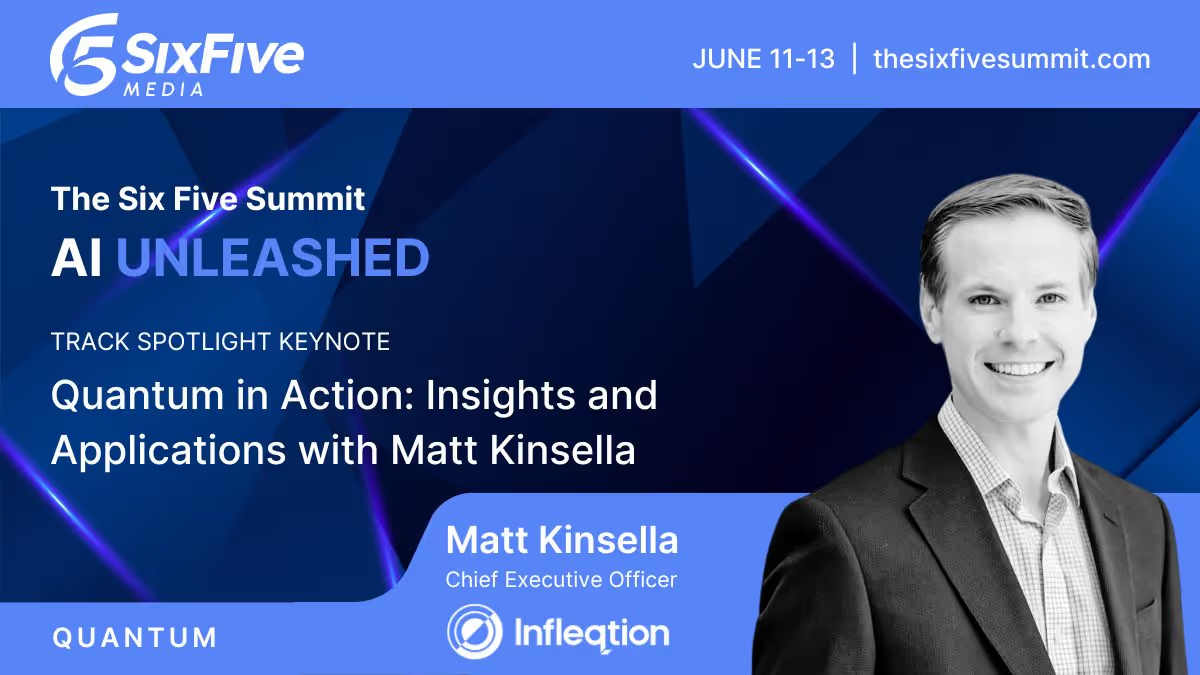
Quantum in Action: Insights and Applications with Matt Kinsella
Quantum is no longer a technology of the future; the quantum opportunity is here now. During this keynote conversation, Infleqtion CEO, Matt Kinsella will explore the latest quantum developments and how organizations can best leverage quantum to their advantage.
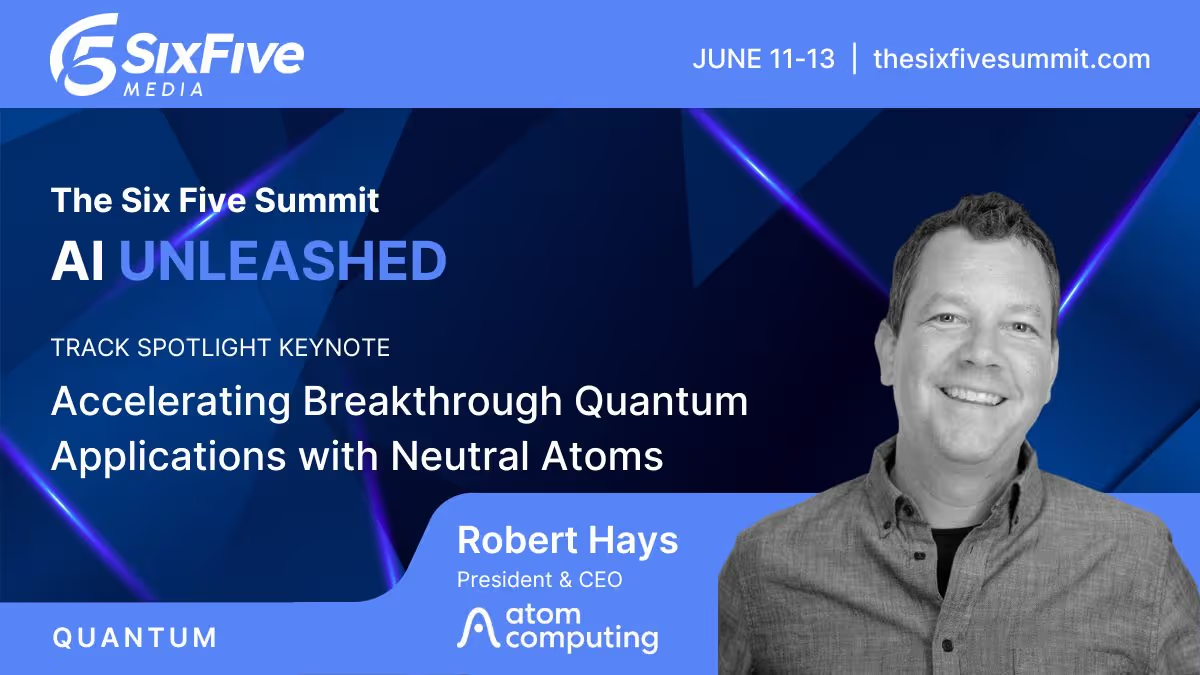
Accelerating Breakthrough Quantum Applications with Neutral Atoms
Our planet needs major breakthroughs for a more sustainable future and quantum computing promises to provide a path to new solutions in a variety of industry segments. This talk will explore what it takes for quantum computers to be able to solve these significant computational challenges, and will show that the timeline to addressing valuable applications may be sooner than previously thought.