
The View from Davos with with Infosys‘s Anand Swaminathan
SHARE


Anand Swaminathan, EVP at Infosys, joins host Patrick Moorhead to break down enterprise insights from Davos—covering evolving AI priorities, investment trends, and how Infosys is helping businesses navigate rapid technological change.
How are global business leaders balancing AI innovation with economic and geopolitical uncertainty in 2026?
From Davos, host Patrick Moorhead is joined by Infosys's Anand Swaminathan, EVP & Global Head - Communications, Media & Technology, for a conversation on Infosys’s perspective from Davos, highlighting cautious optimism in business, the maturing conversation around AI, and the company’s key role in enabling enterprise-scale AI outcomes. The discussion centers on keyphrase focus: AI in the enterprise, shifting technology spending, the impact of agentic and sovereign AI, workforce transformation, and the growing significance of power and energy constraints.
Key Takeaways Include:
🔹 AI Conversation Has Matured From “What Is AI?” to “Where’s the ROI?”: Cautious optimism prevails in Davos, and the focus is on how enterprises and governments can deploy AI at scale with the goal of saving money or generating additional revenue. ROI remains unresolved for many, making execution and absorption of AI the real differentiator.
🔹 Infosys’s Competitive Edge: Success in AI relies on domain expertise and operational rigor, not just technology. Deployment cycles are shrinking dramatically, benefiting customers, but raising execution pressure. Infosys’ value lies in bringing customer context, industry knowledge, and operational rigor to AI deployments.
🔹 Shifting Spend: Traditional IT spending is declining, while AI-driven business outcomes such as supply chain resilience, faster product innovation cycles, and customer retention are driving new investments.
🔹 Enterprise Challenges and Opportunities: As agent ecosystems expand, security, resilience, and governance become critical. Infosys is actively working with cybersecurity partners to ensure responsible, sustainable AI deployment.
🔹 Sovereign AI is Getting Real: There is growing concern over data residency, geopolitical risk, and technology autonomy. Countries want to ensure they are not “unplugged” from critical AI infrastructure and telcos are becoming central players in sovereign AI strategies.
🔹 Social Responsibility and Inclusion Matter: AI has the potential to dramatically expand access to education, healthcare, and opportunity. Examples include medical AI agents delivering expert-level guidance in underserved regions. While the transition will be uneven, the long-term outcome is broad-based uplift, not concentration of advantage.
Subscribe to our YouTube channel so you never miss an episode.
Listen to the audio here:
Disclaimer: Six Five Media’s The View from Davos is for information and entertainment purposes only. Over the course of this webcast, we may talk about companies that are publicly traded, and we may even reference that fact and their equity share price, but please do not take anything that we say as a recommendation about what you should do with your investment dollars. We are not investment advisors, and we ask that you do not treat us as such.
Patrick Moorhead
The Six Five is on the road here with a view from Davos at the World Economic Forum. For those of you who might not be familiar with World Economic Forum, it is the combination of technology, AI policy and we might even see some some tariff talk here as well. Some of the biggest conversations, though, are how as a government or an enterprise, how am I enabling AI?
It's very it's very complex, particularly if you have a lot of technical debt that you have to figure out how to make it work, and then you have a cultural issues and really welcome, really happy to welcome anon with Infosys back to talk about his Davos experience. Great to see you.
Anand Swaminathan
Great to see you Pat. Always a pleasure and a beautiful day here in Davos.
Patrick Moorhead
Yeah they always like to say it's always like this. It's actually not. But just the days that we get together. So there must be some magic when you and I combine here so.
Anand Swaminathan
I can see that.
Patrick Moorhead
Yeah. So hey, let's talk a little bit about your Davos experience. What, uh, what do you like to accomplish here. And maybe what's the difference this year versus last year so far.
Anand Swaminathan
Yeah. The first thing is, you know, to get a quick dipstick of where the business is and you know, how are the different verticals and businesses and partners feeling. And so far it's been quite optimistic. Um, and everyone is looking forward to the year that's coming and hopefully more investments will be made. AI of course, is a big topic. So politics aside, politics aside, I am quite impressed with the sentiment so far. What I would like to accomplish is, apart from getting a sense of where the business is heading towards, to fine tune our own strategies, uh, so that we can be better aligned and be relevant to our customers.
Patrick Moorhead
Now that that just makes a lot of sense. I love the dipstick analogy, kind of kind of see where we are on this map. Oh, so would you say that conversations have evolved in AI maybe two years ago at what is AI to, um, how do we implement it? Maybe those POCs, but now how do we make how do we make money off of this? How do we save money? How do we make more money?
Anand Swaminathan
Yeah, I think it has evolved. I think it's also evidenced by the fact that you see all the companies investing quite heavily in AI. But ROI is still a question, to be candid. And that's going to now come down to how are companies absorbing technology. And that is where we become relevant with our deep domain understanding of different industries and our customer context.
It becomes imperative on companies like Infosys to bring the domain with the intelligence and the engineering power. Right? There are a lot of things are changing in terms of how you develop and deploy. Those cycles are dramatically, you know, coming down and for the benefit of the client, you know, which is a great thing.
We're looking forward to making the leap into the AI world. I think we've got our strategies cut out pretty well. So I'm very excited personally that the conversation has shifted to how do we deploy AI from what is AI and what technologies make AI?
Patrick Moorhead
Yeah, it's good, it's good. You sound optimistic and I'm sure your confidence is increased. You posted really good earnings. Congratulations. So on the whole is tech spending falling. Is it accelerating. Is it around the same. Judging by the judging by your your forecast and your results. I would say yes.
Anand Swaminathan
Yeah. We you know, as you might have noticed, you know, we update our guidance for this year and, you know, this is the time of the year. We are also talking to all the clients to figure out how their budgets are looking for the coming year. Right. I would I would categorize the spend in two buckets. The existing spend.
You should expect that to come down because you don't really need to spend so much to maintain your systems and keep them running. Right. But there is newer spend area that's opening up or new or spend areas that are opening up, which is about how do you deploy AI for the benefit of the business? Right. And that's where we are seeing a lot of conversations and interest.
It could be about customer expansion, retention. It could be about, you know, more resilient supply chains, new product features and introductions. And how do we bring AI. And those conversations are now more than actually the standard, you know, keep the lights on conversation. So I am looking forward to a year.
Hopefully that will that is going to be better than what we have seen.
Patrick Moorhead
No. That's great. And one of the big changes in our conversation is I reviewed the the tapes last year. We were talking about models and llms, and it's really been since then. A lot of talk about a genetic AI. And one of the hottest areas is in in developers, right. And I'm curious, um, what's the reading when you look at the dipstick on on customers, how confident are they to let a genetic AI automate a tasks?
I recently saw an announcement that you did that. They kind of brought this to mind.
Anand Swaminathan
Yeah. No, I think that's the most pressing question now. I think the whole SDLC is changing and changing for the good. There is quite a bit of upside to be had with the coding agents, and we are really looking at a strong set of partnerships and helping our clients to really absorb, you know, the technology.
So that's one part of it. Now around, however, when you take these technologies into an enterprise context in the overall AI discussion. Security and resilience becomes a really important topic. That's right. The more agents you have, you know, we're talking about, you know, the MCP protocols and how agents communicate with each other and so on.
It's really important that you're deploying deploying technology in a very responsible way. So we're also working a lot with the cyber tech companies to make sure that what we whatever we are building is sustainable, and it's actually going to help organizations to absorb technology without risking it, without risking their business.
Patrick Moorhead
Well. And one of the part of risk that leads to what was a smaller conversation last year and that was, uh, sovereign cloud or sovereign AI. You recently made an announcement with Telstra, which was essentially a sovereign AI capabilities in cloud. Are you are you having more of those conversations? There's more interest.
My guess would be, yes. You know, let's geopolitics is a challenge, and I know there are clients who are afraid that they might be unplugged. But to your point about keeping that data inside and internal, the risks are higher. Sure, the ROI is better, but it's even more important that you you keep that not only not only for a country, but for certain businesses as well.
Anand Swaminathan
I think sovereign AI is for real. There is a lot of interest across countries to make sure that they have the data residency and the autonomy over technology, right to be able to provide their citizens what is required and factoring in any risk that may develop on the geopolitical side. Right. And as part of it, the telcos become a big critical factor for these countries to offer their infrastructure and technology.
And given our presence with telcos across the globe. We are in the middle of many discussions with telcos across the globe and helping them on the sovereign AI. We have done some amazing work so far. The JV with Telstra that helps us to actually provide the B2B service to the Australian customers is clearly a big step forward, but we are also having discussions with other telcos.
Patrick Moorhead
I know there's a lot of debate about is there downstream benefits to AI? I think those people who are closer to it, that are seeing it work under the right conditions, or maybe they've experienced themselves. I've seen a lot in the C-suite that are using cloud code to vibe code to show their teams of what can be done now might not be the best code.
It's probably not secure, but it's making believers out of people. And now the conversation seems to be shifting from, okay, I see the opportunity here. I'm still going to debate the CapEx
being invested, but it's also shifting to jobs. And in the future you have a very large workforce. And I'm curious, if you were talking to a university student today. What would you recommend that that they get, they get into with this background? Yeah.
Anand Swaminathan
No. First thing is that I think, you know, science and tech, um, is is definitely going to be a fundamental factor in the evolution of the world. Similarly, in our liberal arts is going to be required a lot to address the ongoing changes as well as to reimagine many of the consumer or client engagement models.
Right. Um, so both are going to be relevant. But I think for a particular individual, whether they are just entering the workforce or they are already in the workforce, the question is, how are they understanding the change that is happening from a non AI world into an AI world? Yes, there are going to be services that will get subsumed by AI, but that also gives rise to a lot of new services.
So we just talked about cybersecurity. Now imagine a company with multiple agents talking to each other and, you know, doing things. Now who is going to observe and govern them. Right. That gives you a new kind of opportunity. This is just one example. So I think it's important at an individual level and at an organization level, to appreciate that current services that you're offering may get outdated, but you have the opportunity to build newer services that are going to be in demand, and that is going to be the opportunity.
Right now. One of the biggest topics of conversations in Davos is power, right? Everyone is saying the biggest limiting factor is going to be power. And the opportunities that are going to emerge in that space is also huge. So personally speaking, I'm quite optimistic about the opportunities, but it is not obvious to the people and the organizations, and that's where the social responsibility comes for organizations like Infosys.
How do we use the Infosys Foundation and our partnerships with clients to really drive the understanding of technology to help people? Who needs to cross the chasm?
Patrick Moorhead
Yeah, I agree, and I think history is on your side. If I look at the Industrial revolution, the electrification and then the computerization, um, we always have created new jobs and new opportunities and quite frankly, doing work that people generally don't like to do. Okay. I do think, uh, where it is different is the curve is steeper and we are going to have some, some rocky roads there.
But, um, I look at the, the opportunity. I mean, there are villages that we like to think that everybody has a smartphone and everybody has access to medical information. The reality is they don't. A lot more people have been connected over the past decade, but imagine having a medical agent that is as good at answering questions as a PhD level doctor with 20 years of experience.
That to me is exciting. And I think what we've seen, we've seen. Education go up, poverty go down, clean, drinking water go up. And I think everybody in the end will be lifted up from this.
Anand Swaminathan
I agree with you, Pat. I think that's a really, um, not just an optimistic view, but that's the vision that every organization has to carry forward and be inclusive in the process. But always a pleasure talking to you, Pat. And, you know, wish you an amazing Davos for the rest of the time, you're going to be here and look forward to being in touch and hopefully catching up in Mobile World Congress.
Patrick Moorhead
So I can't wait. Thanks for coming on the show. Thank you. This is Pat Moorhead in Davos at World Economic Forum talking all things AI with a nod from Infosys. Hit that subscribe button, check all of our content out from Davos. And also more insights and strategy content from Infosys and AI as well. Tune in.
Hit that subscribe button. Take care.
MORE VIDEOS
Industry Veteran and Google’s Satish Thomas on Replacing One-Size-Fits-All Enterprise AI With Industry-Specific Agents
Google is moving enterprise AI beyond general-purpose tools and into industry-specific workflows built for regulated sectors such as legal and financial services. Satish Thomas, Vice President, Business and Industry Solutions at Google, joins Six Five to explain how Gemini Enterprise for Industries combines purpose-built skills, ready-to-deploy agents, model choice, and an open partner ecosystem to bring AI into the workflows enterprises already run.


AMD Instinct MI355X vs NVIDIA HGX B200 GPU platforms AMD vs NVIDIA: A Three-Level Inference Infrastructure Evaluation
Signal65 President Ryan Shrout and Senior Performance Analyst Mitch Lewis review a new three-level inference infrastructure evaluation of AMD's Instinct MI355X against NVIDIA's HGX B200 with AMD's Andrew Dieckmann and Anush Elangovan. The MI355X's memory bandwidth advantage compounds as context and concurrency scale, delivering up to 2.25x throughput gains and roughly 40 percent lower cost per GPU hour.
.png)
Anthropic’s AI Slowdown, OpenAI’s $1.2T Valuation & Salesforce’s AI Bet
Anthropic's "Pace the Frontier" essay set off a week in which nearly every major AI leader, and two heads of state, weighed in on whether the frontier should slow down. Patrick Moorhead and Daniel Newman read the incident as something larger than a safety debate. Whoever sets the pace of the frontier also sets the pace for open-weight models, enterprise custom models, and the trillion-dollar valuations riding on top of them. That contest, not the essay itself, is the through-line of Episode 320 of The Six Five Pod.
Other Categories
CYBERSECURITY
Threat Intelligence: Insights on Cybersecurity from Secureworks
Alex Rose from Secureworks joins Shira Rubinoff on the Cybersphere to share his insights on the critical role of threat intelligence in modern cybersecurity efforts, underscoring the importance of proactive, intelligence-driven defense mechanisms.

HP Launches World’s First Business PCs to Protect Against Quantum Hacks - The Six Five On the Road
On this episode of the Six Five - On the Road, hosts Patrick Moorhead and Daniel Newman are joined by HP's Ian Pratt, Global Head of Security for Personal Systems.
What is Autonomous Endpoint Management?
Autonomous Endpoint Management is a framework designed to unify IT operations and security teams on a single platform through real-time control and visibility.
QUANTUM
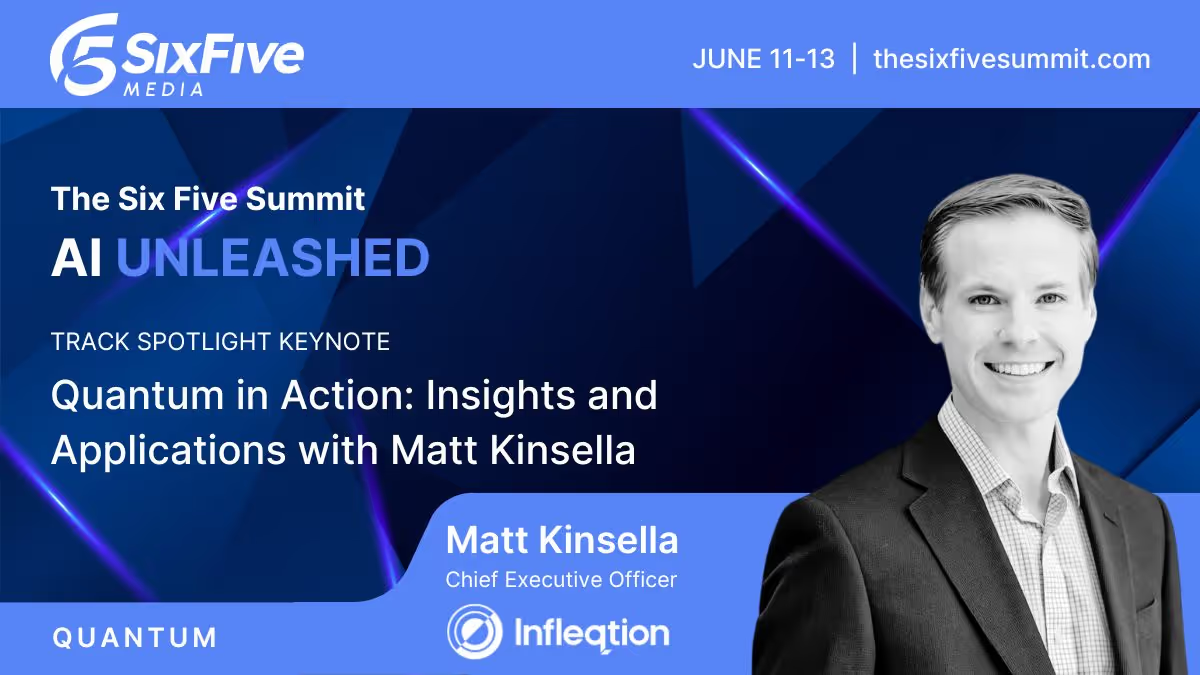
Quantum in Action: Insights and Applications with Matt Kinsella
Quantum is no longer a technology of the future; the quantum opportunity is here now. During this keynote conversation, Infleqtion CEO, Matt Kinsella will explore the latest quantum developments and how organizations can best leverage quantum to their advantage.
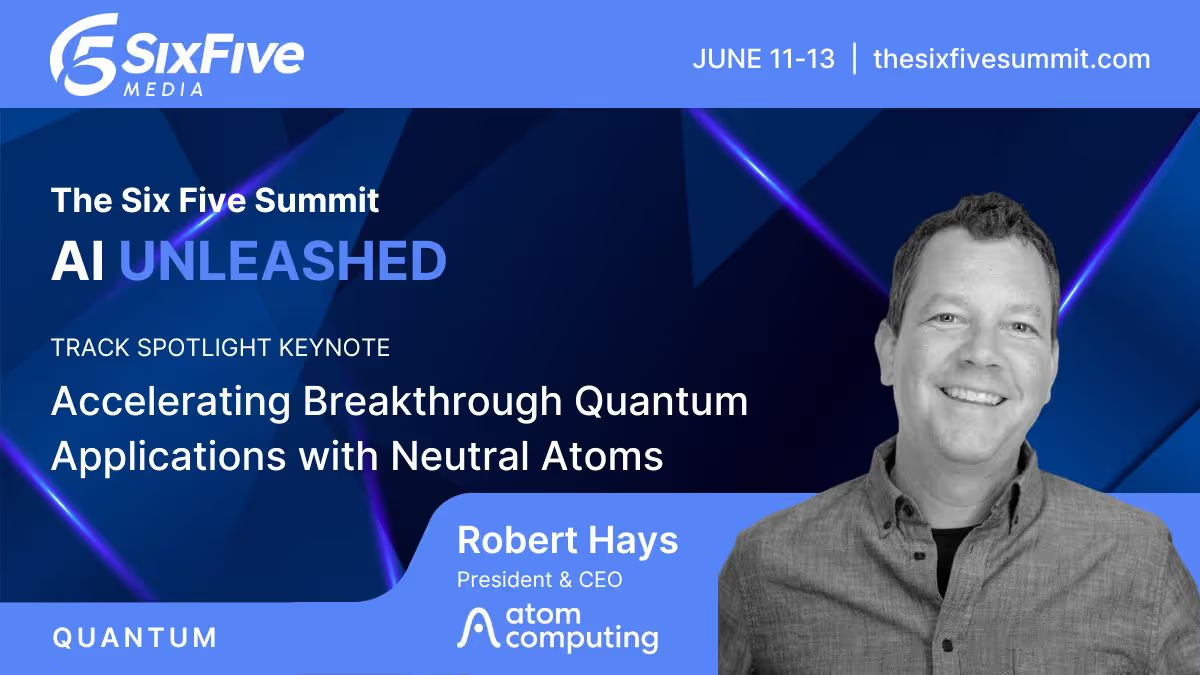
Accelerating Breakthrough Quantum Applications with Neutral Atoms
Our planet needs major breakthroughs for a more sustainable future and quantum computing promises to provide a path to new solutions in a variety of industry segments. This talk will explore what it takes for quantum computers to be able to solve these significant computational challenges, and will show that the timeline to addressing valuable applications may be sooner than previously thought.