
WD's Tim Rausch: AI Storage Demand Compounds With Every GPU Cycle
SHARE


Western Digital's Tim Rausch argues that AI's compounding data growth, more than GPU capacity, sets the real ceiling on infrastructure scaling. He joins Matt Kimball at AI InfraSummit 2026 to walk through how total cost of ownership, archived data reuse, and WD's capacity roadmap are reshaping enterprise plans to scale AI over the next several years.
Compute demand rises and falls with each user session. The data created by those sessions persists and compounds. According to Tim Rausch, SVP of Product Engineering at Western Digital, that accumulating data is what ultimately determines how AI infrastructure must scale.
At AI InfraSummit 2026, Matt Kimball spoke with Rausch about what compounding data growth means for infrastructure leaders moving AI systems from pilot to production at scale.
Rausch illustrated the stakes through storage economics. In a small pilot handling one terabyte across DRAM, flash, and hard-drive tiers, a total-cost model that is off by one cent per gigabyte creates a negligible $10 discrepancy. At 100 exabytes, that same one-cent error becomes a $1 billion miscalculation.
The value of older data is also changing. Western Digital-sponsored research found that 55% of organizations are applying AI to archived data, uncovering patterns in years-old datasets that human analysts missed. That is prompting some companies to move data out of tape archives and back into active hard-drive tiers.
Western Digital’s roadmap offers a glimpse of where storage must go next: capacities increasing from 30–40 terabytes today to 60 terabytes by 2028 and 100 terabytes by 2030, paired with new multi-head read/write technology designed to deliver eight times today’s throughput by the end of the decade.
Key Takeaways:
🔹 Data growth outlasts compute cycles. Each user session ends, but the data it creates remains. As every new interaction builds on what came before, storage demand continues to compound.
🔹 Small TCO errors become billion-dollar problems. A miscalculation of one cent per gigabyte amounts to roughly $10 at pilot scale. At 100 exabytes, that same error reaches $1 billion.
🔹 Archived data is becoming active again. Western Digital-sponsored research found that 55% of organizations are using AI to uncover insights in historical datasets, prompting some to move data from tape archives back into active HDD tiers.
🔹 Long-form AI video will intensify storage demand. Rausch expects AI systems to generate content ranging from 30 minutes to several hours within the next few years—creating another major source of data growth.
🔹 Western Digital’s roadmap is built for that scale. The company is targeting 60-terabyte drives by 2028 and 100-terabyte drives by 2030, along with read/write technology designed to deliver eight times today’s throughput.
As AI moves from pilot to production, storage capacity, throughput, and cost efficiency will increasingly determine whether the underlying infrastructure can scale with it.
Watch the full video at sixfivemedia.com, and subscribe to our YouTube channel so you never miss an episode.
Disclaimer: Six Five Media is for information and entertainment purposes only. Over the course of this video, we may discuss companies that are publicly traded, and we may reference their equity share prices. Nothing discussed during this webcast should be considered investment advice or a recommendation to buy or sell any security. We are not investment advisors, and you should not rely on this content as financial advice. Six Five Media collaborates with technology companies and industry leaders to produce research-driven interviews and multimedia programming for enterprise technology audiences.
Matt Kimball:
Hello and welcome to Six Five On The Road. My name is Matt Kimball and I'm here at AI InfraSummit 2026 and today we're exploring why today's biggest AI challenges and the bottlenecks that are associated with infrastructure might not be that compute platform that you're thinking about, but it's actually the data. It's the data that gets created along the way. And today, I have a very special guest, Tim Rausch, Senior Vice President with WD, to talk about all of this neat stuff. Welcome, Tim. Thanks for having me. Yeah, thanks for being here. Hey, so listen, I'm kind of getting right into it, okay? AI infrastructure conversations seems to always start with GPUs or accelerators. However, we know that the data that gets created and consumed by AI, there's a lot of it. It lasts a really long time. So as you, Representative WD, As you kind of think about this, how should that change the way that infrastructure, like the leaders that design and deploy infrastructure, how does it change how they should think about scaling AI and what it takes to actually scale in a reasonable way?
Tim Rausch:
Yeah, so the way I think about it is that compute cycles with data compounds. Let me tell you what I mean by that. When I go interact with an AI, I'm really talking to a GPU. And together, that GPU, that compute resources, we're creating data. Maybe we're working on an email, a PowerPoint, maybe even a photo. Well, all that is stored on a hard drive eventually, right? But then I move on, and somebody else comes behind me, and they use that exact same GPU resources again. And they create a whole bunch of data, which they add to the data that I created, and then the third person and the fourth person. So what ends up happening is the users are cycled through that compute, but the data keeps compounding and compounding. So when people think about scaling their AI infrastructure, it's like what you said, everyone's focused on the GPU or the compute, right? But you also got to grow that storage. In fact, I was talking to a recent customer and they lamented that they've got idle GPUs because they can't bring hard drives on fast enough. So I think that really just shows that it really is about having enough storage in order to do all that AI magic that people like to do.
Matt Kimball:
It's funny you say that, because that cost of an idle GPU is highly, it's a lot of money, and it really does come down to how quickly you can feed it, and how much infrastructure you have to support all that.
Tim Rausch:
And idling it is just a horrible use of capital.
Matt Kimball:
Yes. Alright, so listen, we're looking at AI kind of going from experiments and pilots into production, right? And you have to balance that performance with power, right, capacity, reliability, total cost of ownership. Where do those trade-offs, where do they become really consequential as we see AI really start to scale?
Tim Rausch:
Yeah, so when I think about the examples that you just gave there, you're always trading performance, capacity, reliability against TCO. So TCO, and by TCO I mean total cost of ownership, right? That's the really big knob, that's what matters most to people. And a lot of people kind of forget that as they scale their system. Nobody ever jumps to a large scale system. Everybody starts with a pilot or a little test system, right? So let's say we built a small AI, just a little company, right? And I'm going to have three storage layers there. I'm going to have the DRAM, I'm going to have SSDs or flash, and then I'm going to have hard drives, which is the most cost-effective storage layer. So in my little system that maybe we spent a million dollars as a test system to develop, If my TCO model is wrong by one cent per gigabyte, just one cent, and I'm moving a terabyte up and down through that storage stack, that's like 10 bucks. Nobody's going to notice that I was inefficient by $10 for this little prototype. But when you scale to a large scale system, and you're moving around 100 exabytes, being wrong by one cent per gigabyte, that's a billion dollars. Everybody notices a billion dollars. So the most important thing is probably keeping your TCO under control, making sure that you have a good TCO model and that you're properly trading against performance and capacity. But then as you scale to make sure that you're always fine tuning because things get really expensive if you don't scale right.
Matt Kimball:
I love how you call that out, and you're right. I mean, having been in IT, I've had that experience where you start small, and as you grow organically, before you know it, maybe, yeah, and those costs that you were measuring initially, you forget to measure them as you grow, and they become a lot bigger. All right, hey, so listen, y'all at WD sponsored some research recently, right? It's actually really interesting around data retention and how much longer companies are retaining data and using that to feed AI, right? And how that gets used as AI scales. So what's changing about the value of that historical data as we try and feed models and kind of scale AI across an organization?
Tim Rausch:
Yeah, it's, I mean, the one people are most familiar with is training AI models, right? So, let me give you an example from WD, right? We're solving a lot of very difficult material science problems. So we have an AI that's helping us with that. Now, it was trained on all the scientific literature that's out there, but we've also added our data to the mix, right? So we have years or even decades of material science, know-how, problem-solving, we fed all that to our AI. And our AI now is helping us solve problems that we're facing today and pointing us in directions that we maybe never would have gotten. And that's allowing us to create higher capacity drives. And one of the interesting things from that report you talked about is that 55% of the respondents, what they said is they're actually using AI to go look at older data. So what they're doing is they're taking old data sets, they're having the AI look at it, and it's finding trends that humans who looked at that data set three or four years ago missed. So they're getting business analytic information, different ways to run their org more efficiently over customer data. They're also saying they're going to keep the data longer for that exact reason. So now they can have the AI look for trends over multiple years. In fact, the report also highlighted that some people are bringing data off of archival like tape, putting it back in the HDD tier so that the AI can just operate it and keep looking for stuff. So the AI are very good at finding trends that as humans it's hard for us to do or that you had to hire some very specialized data scientists to do it. The AI just naturally does that.
Matt Kimball:
Yeah, it's interesting you say that, and you can think even in different industries where that archived data, that historical data is even more and more valuable, right? Maybe it's in case law, maybe it's in just, and it's that, and you think about the amount of data that exists in a lot of these older firms.
Tim Rausch:
Even medical. We talked about it earlier, I got two kids in medical school. They're using AI to help look at x-rays and things like that, and they see some trend, and then they just double check to make sure it was real. Because AI is too hallucinating.
Matt Kimball:
Hey, so listen. AI is becoming embedded in everything we do, right? We're creating videos. We're consuming more content. We're contextualizing and personalizing content. Where do you see the biggest opportunities for AI in that? And what's that going to mean for the amount of data, kind of tied to what we're talking about, the amount of data that we have to store and manage over a lifecycle? Is it exponential? Talk to me about that.
Tim Rausch:
So what I'm most excited about is video. So today, most AIs can make you a video that's a couple seconds long. But in the not-too-distant future, I think AI is going to be able to create half-hour, hour-long, or even multi-hours long. So personally, what I'm most excited about Today, I spend about a half hour figuring out what I want to watch when I get home at night on the multitude of streaming services. In the not too distant future, I'm going to be able to tell the AI, hey, make me a custom half-hour sitcom from my favorite show from the 80s or 90s that hasn't been on the air in 30 or 40 years. And then that got me to thinking, if I'm going to do that, there's all kinds of very creative people who are going to use AI as their own television studios or movie studios and then they're going to be creating all kind of content. So personally I'm excited about that because I'm looking forward to being entertained by all that stuff. But as someone who works at a hard drive company, the thought of an explosion and people creating video, that's just a great story for us.
Matt Kimball:
Oh yeah, I got to tell you, you say half an hour. I'm a little bit different. I will go and watch a show for six minutes, go, that's terrible, start another. So that half hour ends up being two hours before I finally settle on something.
Tim Rausch:
Well, with the AI, you can tell it exactly the plot you want, and you'll get exactly what you're looking for.
Matt Kimball:
All right, hey, all right, we're going to round this out. Last question. So we're talking about data, just volumes are increasing almost exponentially, right? So I'm making investments that have to support requirements, kind of data requirements, well into the future. So you talk about scaling with confidence, right? Great term, but what does that require from an infrastructure strategy, right, that kind of has to evolve over the next couple or two to three years or so?
Tim Rausch:
Yeah, I think if people want to scale with confidence, really what they want to do is have a crystal ball and see the future. But you can't do that. But at WD, we're sort of helping people. We've shared with our customers our long-term roadmap. In fact, we shared it publicly at Innovation Day in New York earlier this year. We have a very exciting roadmap that's going to grow capacity. Today, there's two technologies. EPMR, which stands for Energy Assisted Perpendicular Magnetic Recording. That's the technology that allowed us to deliver storage for the last 20 years. The new technology is HAMR, that's called Heat Assisted Magnetic Recording. That's the technology that'll allow us to deliver drives for the next 20 years. So with WD, we're going to give our customers the opportunity to buy the same capacity drives using either technology. We've also laid out what the capacity roadmap looks like for the next five years. So today, we're shipping drives between 20 and 30, sorry, between 30 and 40 terabytes. We're already sampling 40 terabytes, but we've told our customers to expect 60 terabyte drives in 2028 and incredibly 100 terabytes by 2030. So we're laying this all out for them so that they can go plan their roadmaps. So kind of give them that crystal ball so they can peek into the future.
Matt Kimball:
AI is a great crystal ball too, by the way. Yeah. That's fantastic, that's impressive too. That increase in capacity goes non-linear at some point.
Tim Rausch:
Our customers are also asking for high performance drives, so one of the things we've added to our roadmap are drives that have double the bandwidth. So today when a hard drive only reads with one head at a time or writes with one head at a time, Well, we have an HPD technology that allows you to read with two heads at the same time. That actually doubles the throughput of the drives. We've sampled those drives to five customers and they love it. And they're telling us, we want this sooner, go faster, right? And we see a path to actually read and write with eight heads at the same time, offering an 8x performance throughput by 2030. Oh, wow.
Matt Kimball:
And that feeds directly into the TCO story, the performance story, and it makes that trade-off, that economic trade-off, it changes that equation considerably.
Tim Rausch:
Exactly. AI is changing the way people think about storage, and at WD, we're adapting our roadmap to meet their needs. That's fantastic.
Matt Kimball:
Tim, this is a really fun conversation. Thank you. I would like to keep going. However, we're getting the yank from my producer. So I want to thank you for joining us. Thanks for a really engaging chat. And thank you for tuning in to Six Five On The Road at AI InfraSummit 2026. Please don't forget to hit subscribe, follow us on socials, and check out all of our coverage on sixfivemedia.com.
MORE VIDEOS
.png)
The Main Scoop Ep. 45: Attackers Only Need to Be Right Once. AI Just Made That Easier.
Chad Rikansrud, R&D Software Security Engineer at Broadcom, explains how frontier AI models are finding decades-old mainframe vulnerabilities in seconds, collapsing the complexity advantage that once protected legacy platforms. He outlines why enterprises need faster Security Intelligence (SECINT) ingestion and disciplined human oversight to keep pace with adversaries wielding the same tools.


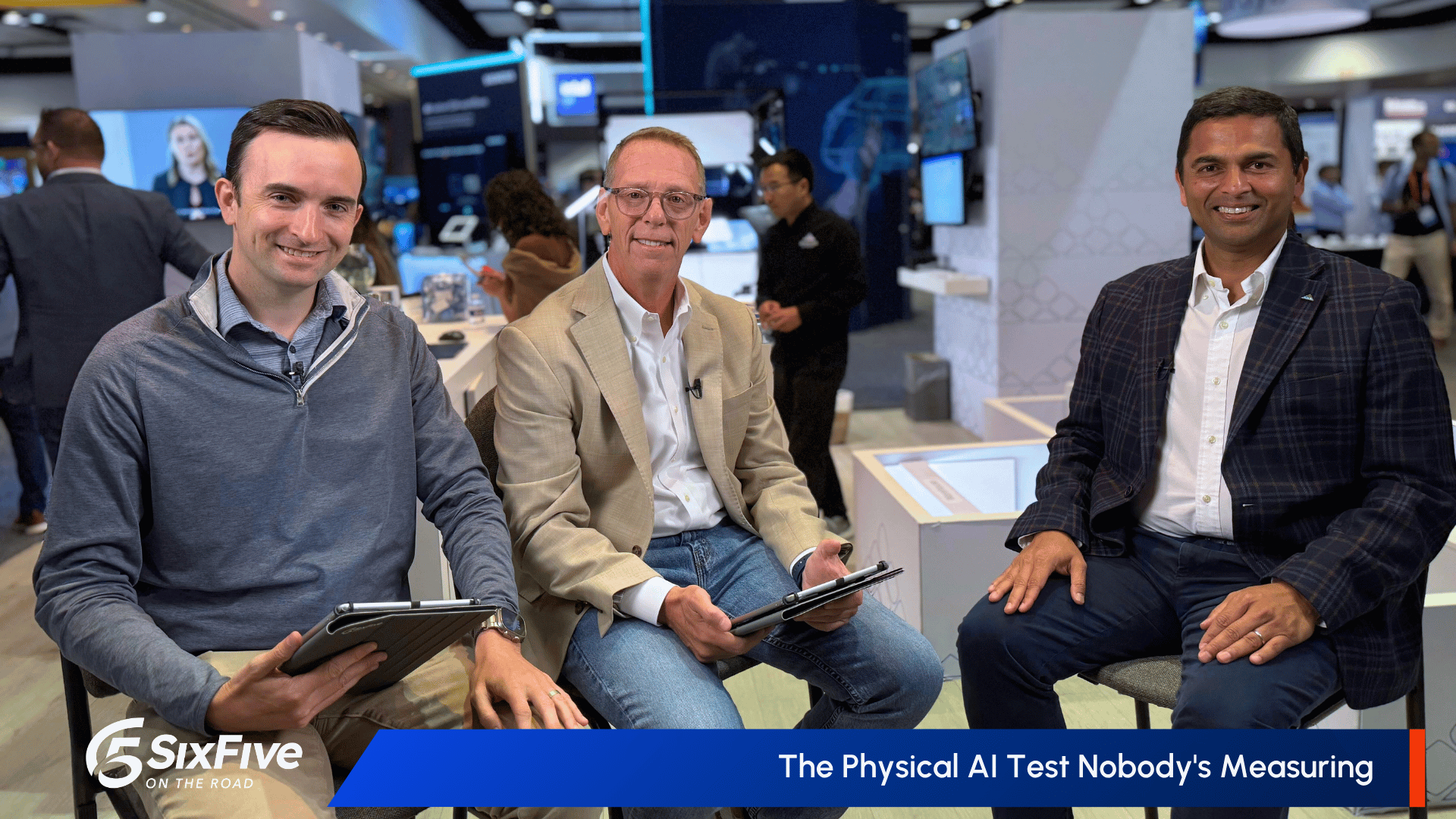
Fleet-Scale Deployment Is the Physical AI Benchmark
Physical AI is shifting from lab prototypes to fleets of machines operating reliably in the real world, and Ambarella's Muneyb Minhazuddin joins Six Five On The Road at AI Infra 2026 to explain what that shift demands of silicon, memory and developer workflows. Minhazuddin traces the case back to a 22-year-old chip architecture and forward to a developer cloud built to compress model porting time from months to days, and he identifies enterprise ROI proof points as the biggest hurdle left before physical AI scales into millions of deployed units.
.png)
AI Safety Alarms, China's Distillation Reckoning, and Qualcomm's AWS Breakthrough: A Pivotal Week for Enterprise AI
A viral AI extinction claim, a federal advisory naming six Chinese AI labs for industrial-scale distillation, and a $60 billion Qualcomm-AWS silicon pact define a week when enterprise AI risk and opportunity collided head-on. Patrick Moorhead and Daniel Newman weigh in on what's signal and what's noise across AI safety, chip supply deals, and a market rally still betting big on compute.
Other Categories
CYBERSECURITY
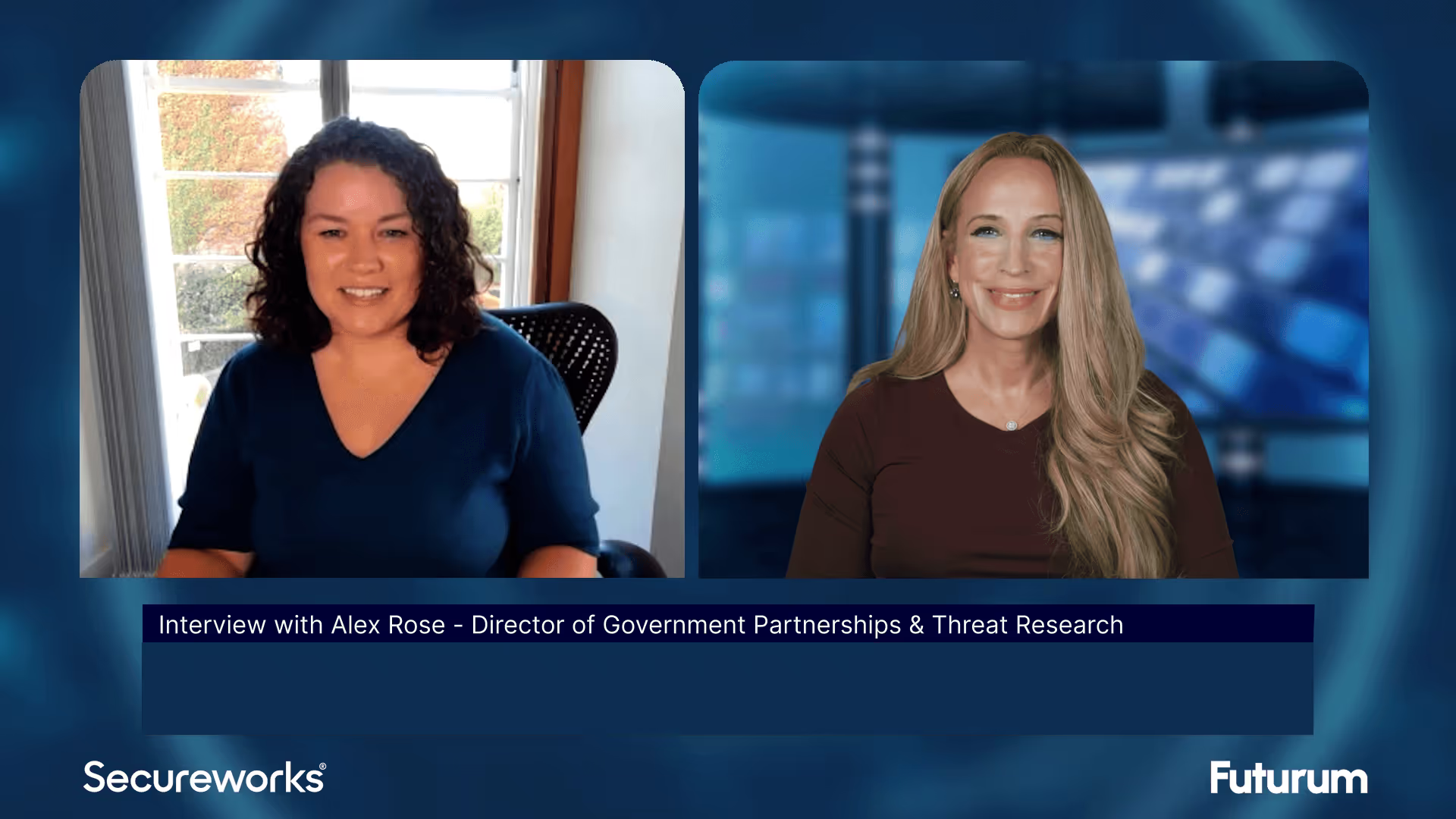
Threat Intelligence: Insights on Cybersecurity from Secureworks
Alex Rose from Secureworks joins Shira Rubinoff on the Cybersphere to share his insights on the critical role of threat intelligence in modern cybersecurity efforts, underscoring the importance of proactive, intelligence-driven defense mechanisms.

HP Launches World’s First Business PCs to Protect Against Quantum Hacks - The Six Five On the Road
On this episode of the Six Five - On the Road, hosts Patrick Moorhead and Daniel Newman are joined by HP's Ian Pratt, Global Head of Security for Personal Systems.
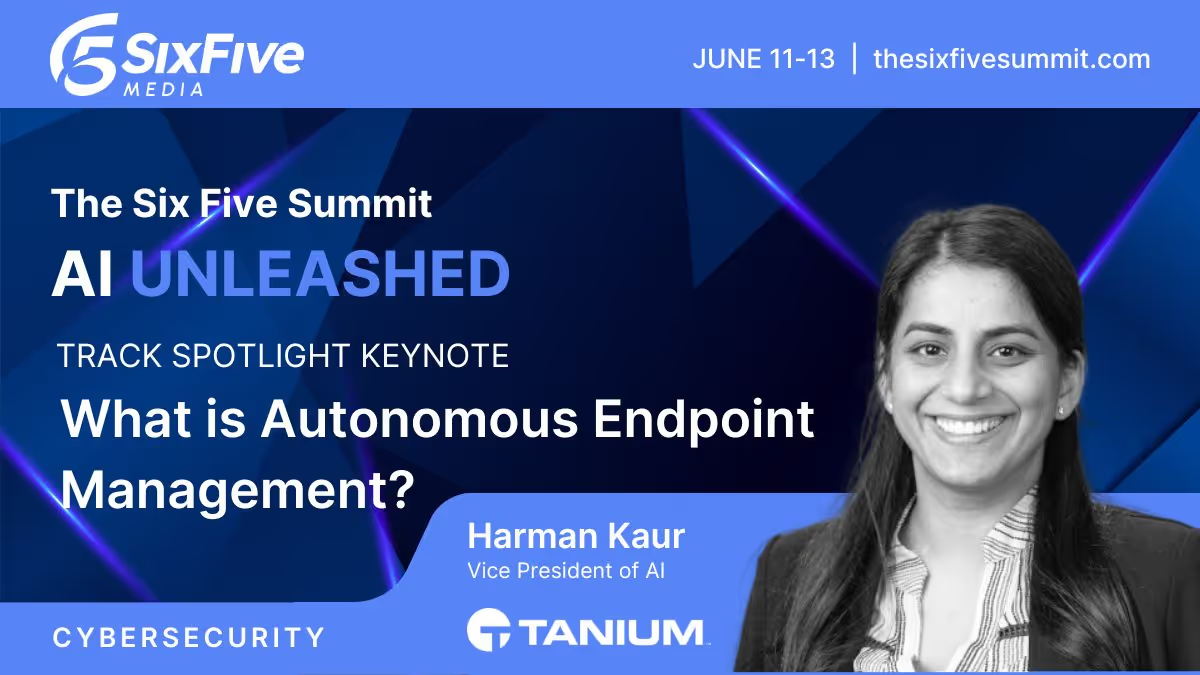
What is Autonomous Endpoint Management?
Autonomous Endpoint Management is a framework designed to unify IT operations and security teams on a single platform through real-time control and visibility.
QUANTUM
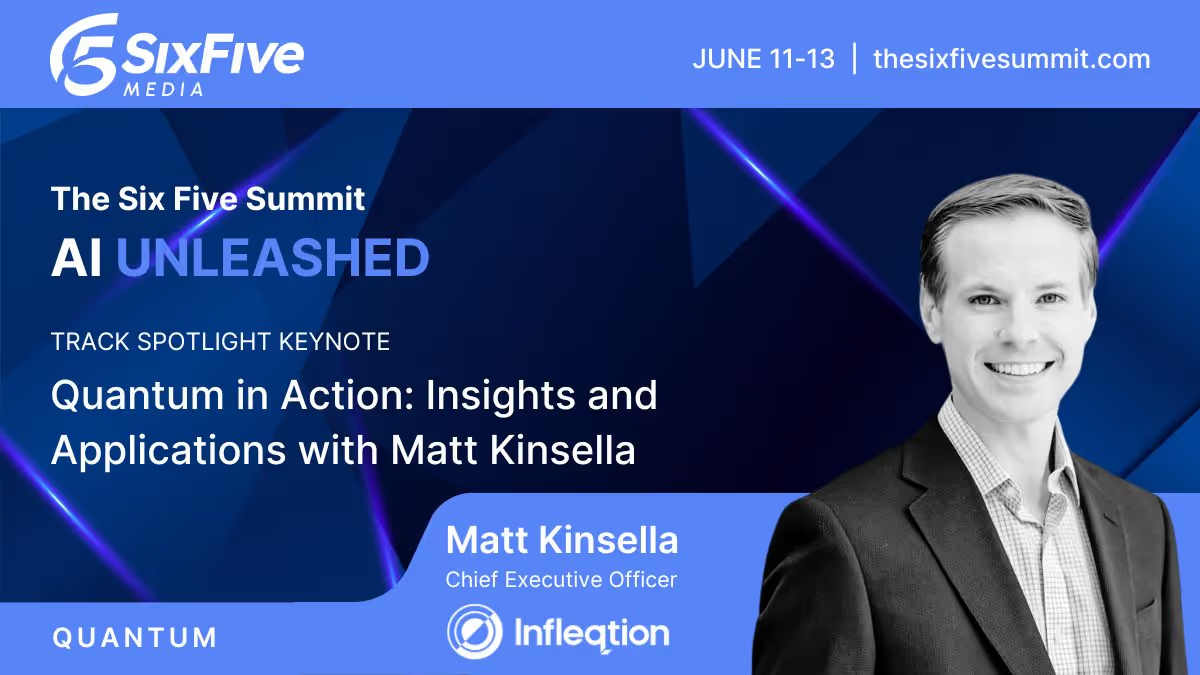
Quantum in Action: Insights and Applications with Matt Kinsella
Quantum is no longer a technology of the future; the quantum opportunity is here now. During this keynote conversation, Infleqtion CEO, Matt Kinsella will explore the latest quantum developments and how organizations can best leverage quantum to their advantage.
Accelerating Breakthrough Quantum Applications with Neutral Atoms
Our planet needs major breakthroughs for a more sustainable future and quantum computing promises to provide a path to new solutions in a variety of industry segments. This talk will explore what it takes for quantum computers to be able to solve these significant computational challenges, and will show that the timeline to addressing valuable applications may be sooner than previously thought.