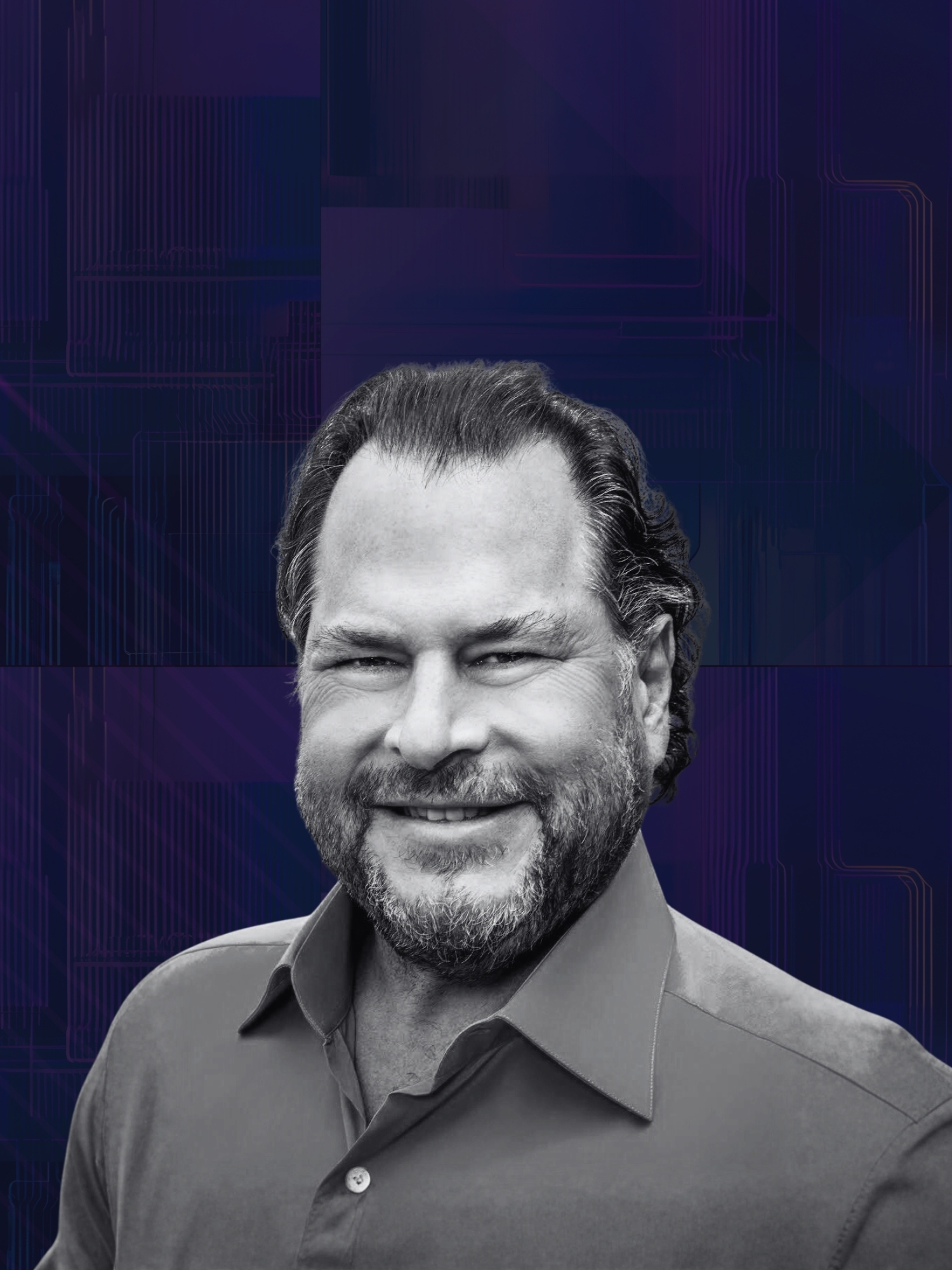
AI Unleashed: Marc Benioff on the Next Era of Enterprise AI
Marc Benioff spent eight weeks meeting more than 200 customers across Europe this summer, and came back with a diagnosis: most large enterprises have barely started their AI transformation, despite the online conversation moving at a blazing pace. He calls it a tale of two cities.
The Six Five Summit: AI Unleashed 2026 opened with Patrick Moorhead and Daniel Newman in conversation with Marc Benioff, Chair and CEO of Salesforce, about where enterprise AI adoption actually stands.
Benioff's central argument is that enterprise AI works by layering probabilistic AI on top of deterministic enterprise systems, preserving the security, governance, and compliance those systems were built for. He frames this as three phases arriving at once: the prompt-and-model era that started with ChatGPT, the agentic phase built around platforms like Agentforce, and now an interface phase where AI renders dynamic, personalized views on top of existing enterprise data inside tools like Anthropic's Cowork. Salesforce's own agents illustrate the shift: The Agentforce Help Agent has resolved 5 million customer service cases on help.salesforce.com, and the company's supply chain product, Regrello, now branded Agentforce Supply Chain, reaches out to 20,000 of one manufacturing customer's suppliers every day to flag risk.
That thesis breaks into four layers: data, application and semantic, agentic, and interface, with all four needing to connect to release the value trapped in decades of enterprise software investment. Salesforce is backing that framework with hiring, bringing new graduates directly into the work of building these systems.
Key Insights:
🔹 Most large enterprises are still early in AI adoption. Despite meeting 200+ customers across Europe, Benioff says the bulk of them have barely started their AI transformation.
🔹 AI is moving through three phases at once: prompt-and-model, agentic, and now a dynamic interface layer rendering enterprise data on top of tools like Cowork.
🔹 Enterprise AI succeeds by layering probabilistic AI on top of deterministic systems, preserving existing security, governance, and compliance investments.
🔹 Benioff frames the opportunity in four layers: data, application/semantic, agentic, and interface, arguing all four have to connect to release trapped enterprise value.
🔹 Salesforce's own agents show the model at work: The Agentforce Help Agent has resolved 5 million customer service cases, and Agentforce Supply Chain contacts 20,000 supplier accounts daily for one manufacturing customer.
Benioff's bet is that the winners in enterprise AI will be the ones who connect new agents and interfaces directly to the systems they've already built.
Watch the full video at sixfivemedia.com, and subscribe to our YouTube channel so you never miss an episode.
Catch the rest of the Six Five Summit: AI Unleashed 2026 opening keynote coverage and all three days of Summit sessions at sixfivemedia.com/summit.
Disclaimer: Six Five Media is for information and entertainment purposes only. Over the course of this video, we may discuss companies that are publicly traded, and we may reference their equity share prices. Nothing discussed during this webcast should be considered investment advice or a recommendation to buy or sell any security. We are not investment advisors, and you should not rely on this content as financial advice. Six Five Media collaborates with technology companies and industry leaders to produce research-driven interviews and multimedia programming for enterprise technology audiences.
Marc Benioff:
You can vibe code all by yourself over here with no controls and no security and no sharing models, or you can vibe code on top of one of these deterministic systems. This is going to be the happy middle where I think the blossom of the lotus is going to happen.
Patrick Moorhead:
Hey, everybody, and welcome to the Six Five Summit 2026. I'm Patrick Moorhead, and I'm joined by Daniel Newman. We are thrilled to have Mark Benioff, Chairman and CEO of Salesforce, joining us for our opening keynote. Mark, it's great to have you on for our seventh summit.
Marc Benioff:
Always great to be with you and great to see you online, though I did prefer to see you in person.
Daniel Newman:
Yeah, we 100% agree with that. Schedules are crazy this time, but I did hear that there was a random running into somewhere in the UK with Patrick and Mark not too long ago. We will meet again in person. It's just this time we're going to make it work. But Mark, I would love to start out talking about just the macro picture of what you are seeing. You know, you've been building Salesforce for multiple decades now. You have hundreds of thousands of customers. You talk across the political regulatory landscape, of course, and CEOs across the world in every industry. I guess just your read on the tech. industry as a whole. This change has gone parabolic. It's never looked like this before. It feels like what you know on Friday can be different by Monday. How are you sort of just seeing the whole tech you know ecosystem right now?
Marc Benioff:
Well it's a tale of two cities and you're right we were over in Wimbledon together and that was part of eight weeks that I just spent in Europe and while I was there I met with probably more than I'd say more than 200 customers one-on-one and I'll tell you that when I say it's a tale of two cities what I mean by that is that On one side, we're all here, we're online, we're listening to the podcast, we're hearing about the change to this model, we're hearing about the singularity, we're hearing about all these things. And then back in reality, we're talking with customers who said, hey, I've got my Salesforce, I have Microsoft, I have SAP, maybe I've got my data lake, I'm using Teams or I'm using Slack and a hyperscaler, and I still haven't really started my AI transformation. And so I think that is the two worlds. It's a world where, yes, all of us are enjoying using consumer-facing AI, which is kind of Reddit with these very cool models on top of them that can do these cool things, draw pictures, answer questions, summarize things, give us advice, do therapy with us. And then on the other side, we keep asking the question, well, how is this going to impact our business? So the vast majority of customers are still at the beginning of their AI journey, not just in Europe, really all over the world. And I think we have to keep this in mind that these are large companies that have enterprise systems with the securities, control, governance, compliance, and trust with their information systems that has to be preserved as we move into this new AI world. And so that's the two worlds. And listen, I think we are moving into an exciting new world. There's no question. I think that for a lot of us, one, we were all there at our chat GPT moment three or four years ago now where we looked at the prompt and we said, wow, I can kind of query this data set and get this amazing answer. And we all know Sam Altman was the CEO of Reddit. And while he was there, he had this revelation that he'd be able to use this huge data set, scoop it up, drop it into these algorithms, known as models, and be able to provide what we call intelligence. And that has gone incredibly well. And we have, of course, now So many amazing new models, all kinds of things from not only the United States, from China, even where I was in Europe, there are French models, Mistral, there's Japanese models, Sakana. It's kind of an amazing moment. Now, Let's also think that we moved pretty fast from kind of AI 1.0, which was the prompt and the model, you know, and the public data set to agents. This idea now we could actually almost program these prompts and give them intelligence to go and do work for us. And Salesforce has AgentForce. There's a lot of companies that have different agent platforms now. It's cool. Even at Salesforce, we have our agent Casey. And Casey has gone out and resolved 5 million customer service issues for us on help.salesforce.com. It's so cool. We have another agent called SlackBot. And SlackBot works with me or with millions, tens of millions of Slack customers who are trying to make sense of all their Slack data and the world around it. And we have Marshall, our supply chain agent that goes out and tries to help us rationalize our relationship with all of our suppliers. So we have lots of new things as we move from AI 1.0 to 2.0. And then when I was in Europe, it just became really clear to me that we are moving rapidly into the third phase already. And that's what's exciting is this is moving fast. So we started in that prompt world that call it the ChatGPT moment. We moved into the second world, which is the agentic enterprise, we call it. But we're moving fast into this third world, which is the interface. And this is where I think enterprises are going to get extremely excited. So a lot of us are using Cowork from Anthropic, or maybe you're using even Slack or some other user interface that now is kind of a dynamic view on your data. And all of a sudden, These systems are corporate systems. They're very deterministic. They know who they are. They're known entities. They're very secure. They're control-oriented. And then you take these probabilistic AI-based systems and you kind of put them on top, and they don't know who they are. They don't have controls, and they don't have the governance. But when you combine them together, a deterministic system and a non-deterministic system, or maybe a probabilistic system like an AI system, and you start to move the interface forward, it's pretty awesome what we're seeing, which is this era of very dynamic user interfaces and releasing all this trapped value in the enterprise where these companies have spent billions, bajillions, not even billions, bajillions, of dollars with vendors, not just Salesforce, but so many. And a lot of data is trapped in there, in the workflow, in the governance, in the user models, in the sharing models, in the data sets. And the AI is able to find it, still preserving all of these security and controls, but delivering these highly customized user interfaces. And for us, it's cool because Salesforce is delivered now as a fully headless system where we have these APIs, but all of the apps that have ever been built in Salesforce, like everything ever built in Lightning, people forget, Lightning is a design environment and a runtime environment. It's all in there. And so then it all gets revealed into the new UI. And this is, I think, the AI transformation customers are really going to groove with and get excited about. And that's why I am pretty jacked after my trip to Europe. I spent eight weeks there. It was exhaustive. But, you know, as we started to show customers what the opportunity is, I think that we saw this is going to be an incredible new moment. And I think we're going to see that really open up over the next 12 to 18 months.
Patrick Moorhead:
Yeah, Mark, the learning curve here is amazing. And I'm so glad we've come a long way. I feel like if we started off as kindergartners doing recipe LLMs and we migrated, I think we're maybe in the second grade at this point. I am glad that we are out of this notion that I'm going to sit in an afternoon in VibeCode and any enterprise app I'm going to stand it up, I'm going to scale it to 50,000 users, governance, data, I'm going to get good answers back, and then I never have to update it. I'm glad we're not having that debate anymore, but maybe there'll be, you know, there are new debates out there.
Marc Benioff:
I think that in some cases you will vibe code your app. And let's just take that apart what you said, because I think it's so important what you said. You know, there's kind of this idea that you either have the vibe coding of the apps over here, or you have the pre-packaged apps over here. And I don't agree with this, that it's kind of either or. I think what you're going to find is the happy middle. And let me explain to you again the happy middle. You have your deterministic systems, call them your core, enterprise core. And then you have these next-gen AIs over here kind of doing their thing. But they've mostly been doing their thing, maybe in coding. And we have these awesome new capabilities in coding. We even have now Slack code. Slack can code. Cloud can code. Repl.it can code. You can do all this coding. We even have our own core Vibe coding products as well. And you can Vibe code. But you can Vibe code in two ways. One, you can vibe code all by yourself over here with no controls, and no security, and no sharing models, and operate it, and manage it, and all that on your own. Or you can vibe code on top of one of these deterministic systems. Again, if you take a non-deterministic system, like these vibe coders, or the models, or whatever, and you apply it over here to the deterministic model, this is going to be the happy middle where I think the blossom you know, of the Lotus is going to happen because that's where customers are going to see for the first time. I'm not going to throw everything away that I have. I'm not throwing away my SAP. I'm not throwing away my Microsoft. I'm not throwing away my Salesforce. I'm not throwing away my data lake. I've made these huge investments, but I'm going to make them better. I'm going to amplify them. I'm going to build new composite interfaces on them. There's going to be a new level of dynamism on top of them. And that is going to be the awesome part of AI over the next, as I said, 12 to 18 months as people see this, I think for the first time. Just six months ago, the AI could not render a dynamic interface. So we were only on the structured interfaces. Now it can. This is the big breakthrough. We are using co-work. We can see it.
Daniel Newman:
Are you saying that the world is guilty of hyperbole and that we are zero summers? I mean, I'm literally listening to you talk, and I started hearing it in Pat, and I started hearing it in you. It's like, so wait, we're going to end up with hybrid? I remember when every infrastructure company that sold infrastructure said we're going on-prem, and every cloud company said every workload's going to the cloud. And then you had Dario, who You know, you're an investor in Anthropic. So like to some extent, that company becomes worth 100 trillion. That's great. I mean, you kind of win. But coming out and saying every industry, every kind of technology was going to just be consumed by Claude. And then you saw the cybersecurity industry got its biggest gains in years. on the back of mythos. You saw, you know, a massive pivot back towards people going, holy crap, we need rules and rails of business. We need our deterministic systems with, you know, so you're basically saying we are just zero-sum, hyperbolistic, press media and sensational fin-axers, and then the reality ends up being somewhere in between.
Marc Benioff:
Here's what I think. We're all at the AI amusement park, okay? And we're all on the roller coaster, and it is one hell of a fucking good ride. And you guys and I, we've been in this industry a long time, and this is a moment of extreme innovation. And we all love it. And we love to reading about it. And a lot of the stuff that we read is so cool. And a lot of it is true. And a lot of it is not true. And that is okay because the history of our industry, as you guys know, we've had the stories, have been about what's true and what's not true. And ultimately what gets true is it's about customer success. Either the customer is successful or they are not. And that's the truth. So that's what I'm really seeing. So when I'm with our super large customers all over the world, or even us, look at us as customer zero. For example, I gave you help.salesforce.com. If you go there right now, you will see this help agent and it will help you and it will resolve your issue and if it can't, it will auto escalate you to our call center. But if you just go to salesforce.com, you'll meet a whole other agent built on the same platform called Piper. And Piper is a little person that comes up and is talking to you and it's an avatar and it's very cool and you can talk to Piper and that's another world. But they're running on top of deterministic systems. That is, you still have to log in to Salesforce support for Casey, the help agent, to work. And when you log in, it gets authenticated through your phone and this and that. Now you're in. And then it's auto escalates you. Well, by the time it gets to a support agent, they can see a whole screen like I have in front of me of everything that's going on with you. This is now where we're getting this amplification through AI of our enterprise systems. Are all enterprise systems going to get replaced? No. Will some get replaced? Yes. And will some get hybrid or amplified? Absolutely. And can that happen maybe faster than we anticipated? without a doubt. Why is it? It's because we're moving into AI 3.0. We're moving into not just the prompt and the model, not just the agent, but in the interface. And if you haven't used Cowork, really, I think everyone should get on Cowork. And look, I was with a very large customer mine in Europe. They're very, very large tire manufacturer, I won't go through their names, you know, because I don't want to embarrass anybody. And they're amazing. And they use us for everything, they're dealers, and we have all their CRM data, and we've got all their competitive data, and their dealer network, okay. And I'm with the CEO and the COO, and they're saying, we're addicted to co-work because every day we're hand feeding in our supply chain information. and we're doing scenario planning, and I'm like, but guys, now through CLI and MCP, that is the computer language interface and basically model context protocols. Look, we had REST protocols, we had XML protocols, we had the SOAP protocols, we had all the different APIs to get into our systems for decades, but now we have the new APIs, fine. Now, if you take that interface and apply it, Wham, all that investment you've made is going to appear right in CoWork. That has never really been true of anything before, you know, where all your metadata and your data and your application data all magically starts to render on the screen. Awesome.
Daniel Newman:
So if I hear you right, though, then, you know, the phrase allergy of headless. I mean, I'm kind of following you here because, you know, you could say that some of your peers across the enterprise software are probably somewhere between where you are, which I would say is progressive. And on the other side of it, in complete denial about the fact that this stuff is going to be disruptive. But if I heard you right here, you're kind of saying that Salesforce is going to show up in Clover, the coworkers, Salesforce is going to show up in Tons of different, basically wherever you work, it could be Slack, it could be Teams.
Marc Benioff:
It is already, it is today. It has to, and we have to do this. Look, we're not going to stop innovation, we're going to amp it. And you have to understand my position is this. One, of course, I'm expanding distribution worldwide because I believe so heavily in this model, number one. Number two, you've seen I've bought some really cool companies like this company Piper. It's a bunch of Salesforce alumni have this company called Qualified that helps you qualify your prospects on your website. We bought it. We built it into our core platform. We bought that company Regrello that became the heart of the supply chain. You know, we built, but we built also some things like AgentForce. We built SlackBot. So we're buying, we're building, but we're going to amplify this movement to kind of take all three phases are happening simultaneously, number one. Number two, the amount of innovation that you can have in your enterprise today is extreme. And you have to preserve, though, security control, governance, and compliance. This is the heart of how enterprise systems run. So this is what is going to happen. And this is the next phase of AI. And this idea of a dynamic UI It's just awesome. And for us, we're excited because we've always been headless. Headless is not something that just happened. There never was a head on Salesforce. All those apps were always being generated dynamically out of our platforms. There was no, it wasn't fixed client server application where we had a fixed client and a fixed server. You know that. And we have this new API, which is, you know, a application API that just renders inside co-work, or other interfaces. So I think co-work is maybe the first and the best right now. But within 12 months, we'll have ours. You'll be able to use Slack. I'm sure there'll be 100 of them. Because there are 100 models now. There's also 100 agent platforms. And there'll be 100 interfaces. And this, then, will sit on top of our core systems, our deterministic systems. And then that is what will create the intelligent enterprise, because the deterministic and non-deterministic systems will merge. And they're going to get married and have a baby. And that is going to be what we're talking about. And we should be getting pretty pumped right now that we're all going to witness this as the next step of enterprise. And we're not going to toss all this stuff away. We're going to use what we have to make it all happen.
Patrick Moorhead:
Yeah, Mark, it is an exciting time. I mean, if the benefits, I think somehow I've seen the conversation move to more negativity in AI. And I understand how we got here, and I think I understand what we have to do to get us out of here. And one of the discussions was this notion that our young people would not be able to get jobs. And you doubled down, right? Hiring a ton of thousands of new grads. What is the vision for your
Marc Benioff:
Oh, God. Well, you know the story. I was sitting there at MIT with 25 kids who are, well, should we change our major? What are you guys doing? Computer science. Isn't it over? I read about it on X. It's over, right? I'm like, no. I'll hire you all right now. And let me explain to you that we need you to put all these things together. Who's going to put this together? And who's going to create these highly governed systems for governments and enterprises? And there's so many exciting pieces to talk about. But who is going to put it all together? Who is going to make all that magic happen? But this idea that, look, number one, what are the four pieces? One, you've got to get your data right, everybody. You've got to get your data right to get your AI right. That's why we bought Informatica to harmonize the data. That's why we bought MuleSoft to integrate the data. That's why we have Data360 to have our own data lake. And we federate and integrate that data. out into every other data lake as well, so you can bring in your Databricks or your Snowflake or your BigQuery or your Redshift or whatever it is. Because phase one, get your damn data right. Phase two is now you take your application and semantic layers, So yes, we have our sales app, and our service app, and our marketing app, and collaboration, and analytics tableau. Well, that's a semantic layer that we badly need to ground this data to create the accuracy in the app. I have a friend of mine who just left. I just had lunch with him. And he has this cloud app. And he's like, oh, this app is great. Look what I built. this number just keeps changing and it's not accurate. I said, because you're trying to run it in the probabilistic system, what you need to do is get that running in a semantic layer, build it on Tableau, and it'll be the same number every single time. And then the third layer is the agentic layer, which we've been talking about building and spawning agents to do work for us. And the fourth layer is this interface on top of all this, kind of building the harness on top of these four layers. And then you really have something. And the funny thing is, I talked about those four layers, you know, data, apps and semantics, Okay, agents and interface. If there was a hardware person here, they'd be talking about, there's the land, then the power, then there's the chip, there's the hardware, then there's the network. I'm like, whoa, I'm from, you know, computer systems past. We don't even think about that. We only think about software, you know, and we're just trying to get this writing in this company. And, you know, I expected, you know, the power and all that to be there. So that's where my mind is. I'm all about the value we're going to create at this application layer broken into these four core pieces. Does this make sense with you guys? Am I being clear? Because this is the first presentation I've done on this since I got back from Europe. So you're hearing it fresh out of my trip where I was like, this is what is happening and what is going to happen.
Patrick Moorhead: Yeah, this definitely echoes the conversations that I've been having as well. I did really appreciate that you summoned the ghost of IT past. That was good. But yeah, no, but Mark, this goes back 35 years. I mean, IT doesn't want to throw all their stuff away. They don't want to be locked into a specific vendor. They want their data to be secure and used in the right way, and they want to get great outcomes. I mean, Mark, these are very fundamental enterprise constructs.
Marc Benioff:
And you're going to get all of those things, and you're going to be able to choose as you build your next generation of IT systems. And there's no question that you're going to deliver value. Let's get back to that key point. We're going to deliver trapped value into actual enterprise value in short order by making this fundamental change to how we actually architect our enterprise IT system. By architecting it at the data, application, semantic, agentic, and then interface layer, we will release the value that has been trapped in all these systems. That is what is going to be so cool.
Daniel Newman:
Also, first of all, you went quickly on the topic, but of hiring the young people, I think this is the era of the intellectually curious. I think those that are really playing with the tools, they're not rigid, they're moving.
Marc Benioff:
Yeah, you're right. Well, I actually hired a bunch of those kids and put them in my office this summer. And they're like, what? I'm like, yeah, I need you to build all this stuff. They built for me, Benny, you know, the agent we use to run our office here. I can talk to Benny. I'm not running it right now, but if I did, I could say, Hey, Benny, would you bring up that chart that I've been working on that chose the four layers? And then in zoom, that would come up. And, uh, that's just an example where I have someone who's kind of someone it's not really long before it's a thing.
Daniel Newman:
And long before this, you, the Einstein thing was always about like the genius in your boardroom sitting next to you. I mean, you were talking about this long before chat GPT, or we're talking about models, you know, and by the way, it's, it's interesting. I'd like to hear your take on this. And this is a totally different direction. I plan to take this, but this is what makes these conversations fun. You know, you're breaking your new go to market talk track. And I'm, you know, is the industrial revolutions of the past historically, the winners The early winners are often the picks and shovels, right? Everyone talks about that, right? You're building out the infrastructure, whether it was the fiber and internet era, going back to the cable telephony, all those things. But then eventually that stuff does get settled. And you kind of said this in your last answer a little bit, right? And trust me, I'm a semi bull. I love what's going on with chips and I'm having a blast. But the winners long-term tend to be those that build on top. And it's just, it's very interesting because you kind of said that. And I was thinking like, how are you sort of thinking about that? Because early on, a lot of people might say you were in the wrong spot in the beginning of this AI revolution. You know, your partners at NVIDIA, they're making all the money. But now it's like, maybe that's about, you know, things could look very different in five or 10 years.
Marc Benioff:
Listen, I don't really know. I could just tell you what my customers want. I've been living with my customers. And in my life, and the way that I work, and my advocacy is, listen, you want to be successful? Connect with your customers in new ways. And yes, through agents, fine. Through systems, through your people, through automation, all of those things are important. And for our customers, and for me personally, if you're not connected with your customer, you're not going to be successful. So I think customer will continue to be one of the first things to transform. Also like supply chain, which is, for many of these companies like that, that auto supplier, they have to go out and reach out to those suppliers every single day to know that they can maintain the integrity of their supply chain. Now we can red, yellow, green them, and Dell runs the supply chain product from us. It's called Regrelo. And we reach out to 20,000 Dell suppliers every day on agents. And we bring them back and we say, red, yellow, green, here are the ones, everything is fine, but here are the ones that there's a problem. And the reason that we know that it's a problem, because we're asking them, and then we'll say, send us a photo of your inventory. Send us a description of everything that's going on with you. Are you in compliance? Are you in governed? Supplier management has been everybody's nightmare. with agents with this model, all of a sudden you can have an app running very fast that is giving you a very fast, high-level, accurate, empowering picture of what's going on with your suppliers. It just wasn't possible even maybe two years ago, but today it is. And it's not about just the chip. The chip isn't going to do that for you. It's not about the data center isn't going to do that for you. Power isn't going to do that for you, but all those things enable us, just like if we were doing this conversation before the pandemic and pre-AI call it. We wouldn't necessarily be hyping up that we're running on Amazon or running on Google or whatever hyperscaler we're on our own first party data center. We're just talking about the value that we're delivering to our customer. It's gonna come back to that. It's gonna come back to what value are you delivering to the customer? You know it, I know it, we've lived it, we've seen the movie before, and we're crossing that bridge together right now. And look, we have, we're gonna do obviously more than 46 billion in revenue this year. We'd already talked about that. Now over the last year in our guidance, 15,000 salespeople, 80 something thousand employees, We have a lot, hundreds of thousands of customers on core, a million on Slack. We're bringing a lot of people along with us. So we have to show them how to go from point A to point B. And as they go from A to B, they're not just going to dump all their stuff off the bridge that they put you know, they're the last decade into, they're going to want to try to bring that along with them as much as possible. And if you can show them that now Tableau and Salesforce and Slack and everything else is now rendering as a composite dynamic app with their personalized information right inside their, you know, browser, that is what's going to be exciting to them.
Daniel Newman:
Well, Mark, there's so much goodness in this. Really appreciate the chance to kind of hear first from you after, what'd you say, 200 customer meetings?
Marc Benioff:
I mean, look, if I heard one more… I couldn't believe how exhausted I was. Pat saw me at the end. We were at Wimbledon. This is the second year I went to Wimbledon. It was awesome. We saw some great tennis, like, incredible.
Patrick Moorhead:
Amazing. I thought you looked relaxed, Mark. You look relaxed.
Marc Benioff:
Oh, you're so sweet, Pat. You know, come on. It was exhausting. And yeah, I was everywhere in Europe. It was awesome. And I just think that, you know, for me, you know, I have to do that. I have to get out with my customers. I have to go talk to them at every level, at the CIO level, at the CEO level, the COO level. I want to meet everybody. I like talking to everybody. I tell everyone, text me, email me, call me, tell me what's going on. And then you're trying to put all these pieces together so that one and one and one make three. Because it is fast moving, but there is a lot of misinformation too. When you're listening to all these podcasts, probably including this one, when you are reading online all the news, you have to remember everybody's trying to make a buck, too. Of course, I'm trying to make a buck, but also there's a lot of investors out there. We're shorting stocks and buying stocks and taking companies public. And they're trying to make a buck. Everybody's trying to make a buck. That's capitalism. And capitalism is great, but misinformation is kind of more part of capitalism today than ever. And we have to keep our eyes and ears open, you know, in the world as we, as we see that all unfold. And then it's going to all get down to, is this working? Is it not working? Is it great? Do the customers love us? This is what it's ultimately all about. And you know that. And that's why you guys call customers all the time and talk to them. That's why they pay attention to these things. And then they realize, take everything with a grain of salt and then try it on your own. And that is… All true, plus we are at a moment, we're at an inflection point for enterprise right now, where we are going to see incredible innovation from AI. Because the vast majority of customers, as I said at the beginning of this, are still at the beginning of their AI journey, and you know that. You're not seeing these full AI transformations, even Salesforce. Yes, we're qualifying all of our customers. We're building pipelines. We're autonomously resolving things in support. We're building marketing. We're doing automated analytics. Still, we're at the beginning of what an automated version of our company looks like.
Daniel Newman:
Three quick things for everyone out there, because we're going to get on to the Six Five Summit here. First of all, thanks to Mark Benioff, CEO of Salesforce, Chairman and CEO of Salesforce, for taking the time with us. Second, it's very early. I said we're in the pregame. I think we've all debated. We're not in the middle of any game, whatever sport you play. Two, I heard Mark say something that's worth it for everyone to hear, which is everybody's talking their book, so do your own homework. And three, get out and talk to your customers. Gosh, what a great reminder, Mark. Thank you so much for joining us here. Three days, it's going to be great.
Speaker
Marc Benioff is Chair, Chief Executive Officer and Co-Founder of Salesforce and a pioneer of cloud computing. Under Benioff's leadership, Salesforce has become the third-largest enterprise software company and the largest enterprise applications company in the world.
Benioff was named “Innovator of the Decade” by Forbes and is recognized as one of the World’s 25 Greatest Leaders by Fortune, one of the 10 Best-Performing CEOs by Harvard Business Review, as the CNN Business CEO of 2020 and Chief Executive Magazine's 2022 CEO of the Year. He was named a “Chevalier de la Légion d’honneur,” one of France's most prestigious awards for an individual, in recognition of Salesforce’s longstanding relationship with France and support to French Polynesia during the pandemic. Benioff received both the Yale Legend in Leadership Award and the Colin Powell Distinguished Leadership Award in 2024. He has been awarded a Society for Progress Medal for courageous leadership in integrating business performance and societal progress. In 2019, Benioff was elected a member of the National Academy of Engineering. For his leadership on equality, Benioff has been honored by GLAAD, the Billie Jean King Leadership Initiative and Variety Magazine with its EmPOWerment Award. In 2020, he and his wife, Lynne, received a George H.W. Bush Points of Light Award for their civic engagement.
Benioff founded Salesforce in 1999, and it is now a Fortune 150 company with 70,000+ employees, guided by five core values — trust, customer success, innovation, equality and sustainability. The company has been recognized as the Most Innovative Company by Forbes, a Best Place to Work by Fortune, and the 10th Most Admired Company in the World by Fortune.