
Hybrid Cloud: The New Baseline for Enterprise AI Infrastructure
Most enterprise AI projects start the same way: a promising pilot, a small team, a contained dataset, and an isolated environment. Then someone asks to scale it. That's where the real work begins.
Scaling AI isn't a model problem or a GPU procurement problem. It's an infrastructure problem. To run AI in production across an enterprise, you need reliable compute, governed data access, security controls, latency management, compliance coverage, and cost flexibility — often across multiple environments simultaneously. That's a different challenge entirely from spinning up a proof of concept.
In a recent conversation with Six Five Media, IBM's Rob Thomas discussed why some companies are surging ahead in AI while others are stuck.
His argument is direct: the organizations pulling ahead aren't deploying more AI, they're redesigning how their business operates. They're connecting AI strategy to data readiness, governance, workflow integration, and scalable infrastructure. That combination is what separates production AI from perpetual pilots.
Hybrid cloud has become the practical foundation for making that happen. Not as a compromise, but as the operating model that fits how enterprise AI actually works.
Why Hybrid Cloud Has Become the Operating Model for AI Infrastructure
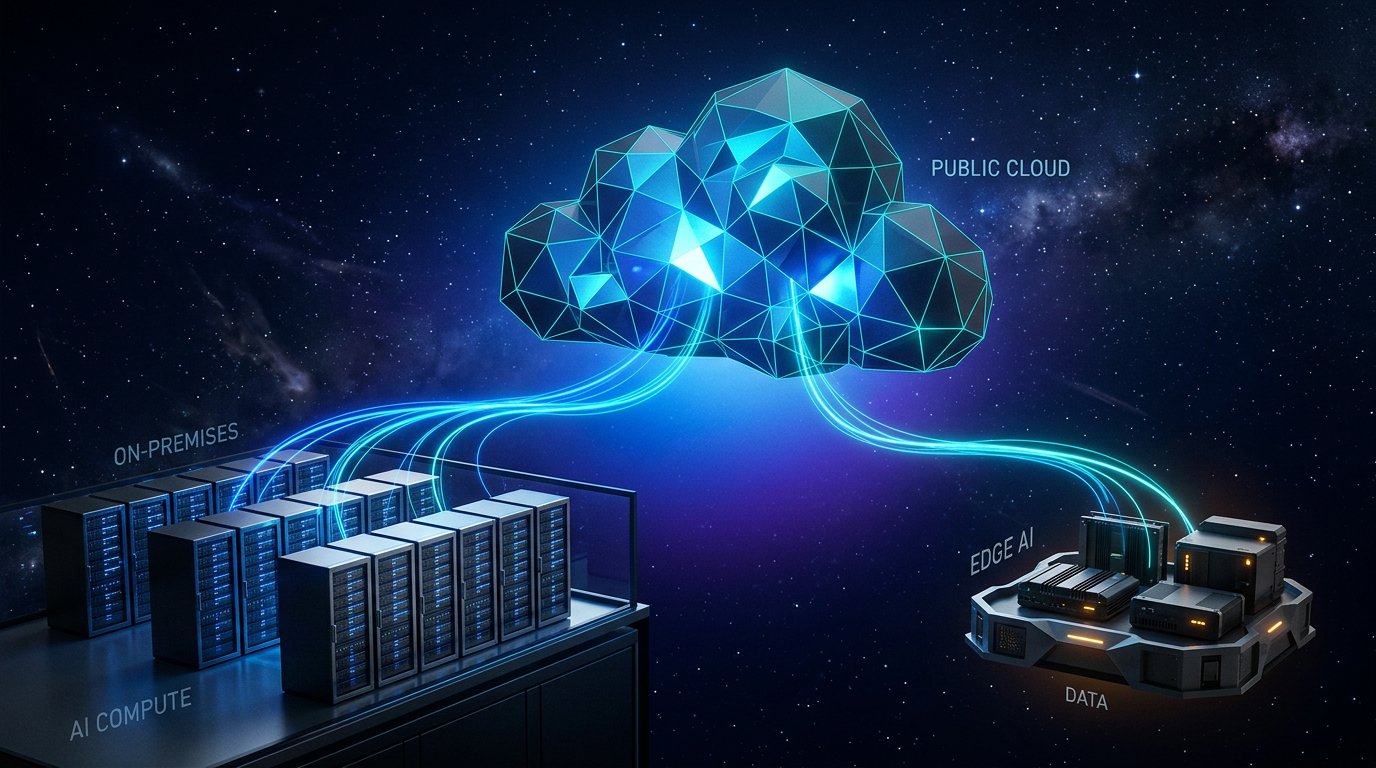
Hybrid cloud in the enterprise AI context means public cloud, private cloud, on-premises systems, edge environments, and managed services working together as a coordinated whole. It's not about hedging bets between cloud providers. It's about recognizing that AI workloads are distributed by nature.
Data lives in different places. Applications run in different environments. Compliance requirements vary by geography, industry, and data type. Users and systems are spread across locations. AI infrastructure has to meet all of that where it already exists, not force everything into a single environment.
According to an IBM Institute for Business Value study highlighted at Think 2026, 70% of executives say a hybrid strategy has helped them optimize costs and performance. But only 8% say their current infrastructure fully meets their AI needs. That gap is where most enterprises are right now.
From AI Experiments to Enterprise-Grade Deployment
A proof of concept runs in a controlled environment with clean data and a narrow scope. Production AI is different. Customer service automation needs to integrate with CRM systems, handle real-time queries, and stay available around the clock. Predictive maintenance needs to ingest sensor data continuously and trigger responses without delay. Financial risk analysis needs audit trails, explainability, and strict access controls. Supply chain optimization needs to pull from multiple data sources across business units.
Each of these requires reliability, security, observability, repeatability, and governance.
Futurum Research has found that 60% of DIY AI initiatives fail to scale past pilot stages due to unclear ROI, and an additional report by Flexential identifies IT infrastructure as the top barrier for 44% of firms. The gap between a working demo and a production system is almost always an infrastructure gap.
The AI Scaling Problem Is Really a Placement Problem
Different AI workloads have different placement needs. Large model training can benefit from the elastic GPU capacity of public cloud. Inference often needs to run close to data or users to meet latency requirements. Regulated data may need to stay on premises or within a defined geographic boundary. Edge AI, such as quality inspection on a factory floor, requires local processing with near-zero latency.
No single environment handles all of this well. Hybrid cloud gives enterprises the workload placement optionality to match each use case to the right infrastructure, rather than forcing every workload into the same environment and accepting the trade-offs that come with it.
The Enterprise Realities That Make Hybrid Cloud Essential
Most large organizations already operate across mixed infrastructure estates. Legacy systems, acquisitions, regulatory requirements, existing cloud contracts, and years of application modernization work have created environments that span data centers, multiple clouds, and SaaS platforms. AI has to fit into that reality.
An "all cloud" or "all on-prem" mandate ignores how enterprises actually function. The question isn't which single environment to choose. It's how to connect them so AI can operate consistently across all of them.
Data Gravity and the Cost of Moving Everything
Data gravity is the tendency of large datasets to attract applications and infrastructure toward them. As data volumes grow, moving that data becomes expensive, slow, and operationally complex. For many organizations, data movement becomes the largest cost driver in AI programs, often exceeding compute and storage costs.
The numbers make this concrete. Moving a GPT-3 scale dataset of roughly 45TB would cost around $3,875 at AWS standard egress rates. At petabyte scale, those costs become prohibitive. And that's before factoring in compliance risk, latency, and operational complexity.
Hybrid cloud lets enterprises process and activate data closer to its source when that makes more sense than centralizing everything. That's not a workaround. It's good architecture.
Security, Sovereignty, and Compliance Requirements
Financial services, healthcare, government, telecom, and manufacturing all operate under regulatory frameworks that constrain where data can go and how AI decisions must be documented. Some workloads require strict data residency, auditability, or isolation that public cloud environments can't always guarantee on their own.
Futurum's Q3 2025 CIO Survey found that 80% of CIOs cite data security, privacy, and information leakage as their top concern — making governance, not ambition, the primary limiting factor for AI expansion. That's a significant exposure for organizations operating in regulated industries.
Hybrid cloud doesn't eliminate compliance complexity, but it gives organizations the architectural control to keep sensitive workloads in appropriate environments while still benefiting from cloud services elsewhere.
Latency and Business-Critical Performance
Some AI use cases can tolerate a round trip to a cloud data center. Others can't. Fraud detection needs a response in milliseconds. Factory-floor automation needs to act on sensor data before a defect becomes a line stoppage. Real-time personalization needs to respond within the user's interaction window.
Hybrid architectures support both centralized model training and distributed inference. You can train a model in the cloud and deploy it at the edge or on premises where it needs to run. That separation of training and inference is one of the most practical advantages of hybrid AI infrastructure.
What the AI Leaders Are Doing Differently
The organizations moving fastest in AI aren't necessarily the ones with the biggest budgets. They're the ones that have connected AI strategy to data readiness, governance, workflow integration, and scalable infrastructure foundations.
Our conversation with IBM's Rob Thomas frames this clearly. The AI divide isn't about who has access to the best models. It's about execution discipline: whether an organization has the processes, incentives, data architecture, and infrastructure to operationalize AI at scale.
Futurum Research has made a similar point consistently, noting that strategic execution, not adoption speed, is the differentiator in enterprise AI — with 89% of CIOs now focused on AI-driven strategic improvement rather than simply expanding deployments.
They Connect AI Strategy to Business Workflows
AI leaders don't scale AI for its own sake. They focus on specific processes where AI can reduce friction, compress cycle times, improve decisions, or lower costs. The infrastructure question follows from the business question: where does this process run, where does the data live, and what does the AI need to do its job reliably?
Hybrid cloud helps embed AI into existing enterprise systems rather than building parallel AI environments that sit alongside the business instead of inside it.
They Treat Governance as an Enabler, Not a Brake
Governance done well means AI models are traceable, access is controlled, decisions are auditable, and policies are enforced consistently. That's not a constraint on AI adoption. It's what makes production AI trustworthy enough to use in consequential decisions.
Consistent governance across hybrid environments reduces risk and increases confidence. Organizations that build governance in from the start move faster in the long run because they're not retrofitting controls onto systems that were never designed for them.
They Modernize Without Abandoning What Works
Most enterprises have mission-critical systems that can't be quickly rewritten or moved to the cloud. ERP platforms, core banking systems, manufacturing execution systems, and clinical data repositories often represent decades of investment and process logic. Hybrid cloud lets organizations connect AI to those systems incrementally, without requiring a full replacement before any value can be extracted.
The Core Building Blocks of a Hybrid Cloud AI Architecture
Scaling AI across hybrid environments requires more than compute. The main building blocks are compute, data platforms, orchestration, model lifecycle management, security, networking, and observability. Each one matters, and gaps in any of them tend to become bottlenecks at scale.
Flexible Compute Across CPUs, GPUs, and Accelerators
Training, fine-tuning, retrieval, inference, and batch processing all have different compute profiles. Large training runs benefit from elastic GPU capacity. Routine inference often runs fine on CPUs. As Moor Insights & Strategy has noted in their research on AI infrastructure, GPUs are invoked selectively for higher-throughput tasks while CPUs and NPUs handle persistent, always-on workloads — not every AI task belongs on a GPU, and building infrastructure as if it does drives avoidable cost and complexity. A recent whitepaper from Intel indicates a trend toward higher CPU:GPU ratios, which are particularly beneficial for multi-agent architectures.
Google has also pushed this conversation forward through its vertically integrated AI stack, where custom Tensor Processing Units (TPUs), networking, orchestration, and AI services are designed together rather than assembled as disconnected layers. Purpose-built for AI workloads, TPUs offer an alternative to traditional CPUs and GPUs for large-scale training and inference. The broader enterprise trend is moving toward heterogeneous compute architectures where CPUs, GPUs, TPUs, and other accelerators each handle different parts of the AI pipeline based on performance, latency, and cost requirements.
Hybrid cloud lets organizations use public cloud GPU capacity when they need it while keeping stable inference workloads on dedicated or on-premises infrastructure where the economics are better.
Unified Data Access Without Uncontrolled Data Sprawl
AI needs access to structured, unstructured, operational, and real-time data. But more data access without governance creates more risk. Data catalogs, access policies, metadata management, and integration layers are what make data accessible without making it ungovernable.
Hybrid cloud should connect data responsibly across environments, not create more silos or duplicate copies that drive up cost and compliance exposure.
Model Lifecycle Management and MLOps
Getting a model into production is one step. Keeping it reliable over time is another. Model drift, versioning, rollback, monitoring, and compliance review are all part of running AI in production. Hybrid cloud architectures need consistent MLOps tooling so models can move from development to production reliably, regardless of which environment they're deployed in.
Security and Identity as a Common Control Plane
Identity and access management, encryption, workload isolation, and policy enforcement need to work consistently across every environment in a hybrid architecture. Inconsistent security controls are one of the most common ways hybrid AI deployments create exposure. Security can't be environment-specific. It has to be a common layer across the whole estate.
Cost Control: The Hidden Reason Hybrid Cloud Matters for Enterprise AI
AI is expensive. High compute demand, data movement fees, storage growth, experimentation waste, and underutilized resources all add up. Hybrid cloud gives enterprises more options for matching workloads to the most economical environment rather than defaulting to the most convenient one.
Not every AI workload needs premium GPU clusters or public cloud elasticity. A company running large model training in the cloud while handling routine inference on private infrastructure is making a sensible cost decision.
Futurum Research's hybrid cloud infrastructure analysis confirms that moving stable, high-utilization workloads from on-demand cloud pricing to reserved or on-premises capacity typically cuts cost by 30 to 40%. That's a meaningful number at enterprise scale.
Balancing Elasticity and Predictability
Public cloud is valuable for bursts, experimentation, and access to services that would be impractical to run privately. Private or on-premises infrastructure is better for stable, predictable workloads where the cost of cloud flexibility isn't justified. Hybrid cloud lets you use both in the right proportions, which is how you build a financially sustainable AI program rather than one that generates impressive demos and uncomfortable invoices.
Common Mistakes Enterprises Make When Scaling AI
Building AI Silos by Business Unit
When different teams build separate tools, data pipelines, models, and governance approaches, the result is fragmentation. Each team solves the same problems independently, and the organization ends up with a collection of AI experiments rather than a scalable AI capability. Hybrid cloud should support shared platforms and standards while still giving business units room to innovate within guardrails.
Focusing on GPUs Before Data and Governance
Compute is necessary but not sufficient.
An IBM CEO Study of 2,000 global CEOs found that only 25% of AI initiatives have delivered on their ROI expectations, and the issue is rarely the model. It's the data quality, access policies, integration work, monitoring, and governance that determine whether AI actually works in production. IBM’s Rob Thomas made this point directly: the gap between AI leaders and laggards is about execution discipline, not hardware.
Assuming One Cloud Strategy Fits Every Workload
Enterprise AI spans many use cases, each with different data requirements, latency tolerances, compliance constraints, and cost profiles. A single-environment strategy forces avoidable trade-offs. The organizations that scale AI most effectively are the ones that match each workload to the right environment rather than forcing everything through the same architecture.
How to Start Building a Hybrid Cloud Strategy for AI
You don't need to solve everything at once. A practical sequence: assess your workloads, map your data requirements, define governance standards, choose platforms, prioritize high-value use cases, and build a scaling roadmap from there.
Assess Workloads by Data, Latency, Risk, and Cost
For each AI workload, ask four questions: Where does the data live? How fast does the response need to be? What compliance rules apply? What's the acceptable cost profile? Those four dimensions will tell you where the workload should run and what infrastructure it needs. That's your placement decision framework.
Create a Common Governance and Operations Model
Shared policies for identity, access, data handling, model approval, monitoring, and incident response are what make hybrid cloud work at scale. Without a common operations model, hybrid becomes a collection of disconnected environments rather than a coherent architecture. Standardize operations first, then scale.
Prioritize Use Cases That Prove the Model
Start with use cases that have clear business value, accessible data, manageable risk, and measurable outcomes. Employee productivity assistants, document processing automation, IT operations support, and customer service augmentation are all good candidates. They're contained enough to deliver results quickly and complex enough to stress-test your infrastructure and governance model before you scale further.
Build for the AI Demands Coming Next
Enterprise AI is getting more distributed, more regulated, more performance-sensitive, and more integrated into core business workflows.
Futurum Research projects that hybrid and edge deployments will capture 43.5% of the total AI platform market by 2030, driven by latency, privacy, and efficiency requirements that centralized cloud can't always meet.
And 98% of IT leaders have already adopted or plan to adopt a hybrid IT model. The direction is clear. The question is whether your current AI infrastructure can support production workloads across clouds, data centers, and edge locations, or whether it's still optimized for pilots.
Hybrid cloud isn't the most exciting part of an AI strategy. But it's the part that determines whether your AI strategy actually works. Get the infrastructure right, and everything else becomes more tractable. For ongoing analysis of enterprise AI trends, coverage from Six Five Media, Futurum Research, and Moor Insights & Strategy is worth following closely.
AUTHOR

SHARE


Related Content
Further Reading



Get insider access to Six Five Media's analyst coverage, major tech events, and executive interviews
