
AI Beyond the Pilot: How Freshworks Is Delivering Real Outcomes in IT Service Operations
SHARE


Dennis Woodside, CEO of Freshworks, joins Daniel Newman to discuss how AI is moving beyond experimentation and into real enterprise outcomes, reshaping service management, pricing models, and competitive dynamics.
AI is no longer stuck in pilot mode, but who’s actually driving real outcomes in IT service operations?
Daniel Newman sits down with Dennis Woodside, CEO and President of Freshworks, to talk about what it takes to operationalize AI inside IT service operations environments and why some organizations are pulling ahead while others are still experimenting.
Freshworks has been focused on what Woodside calls the “agile enterprise,” companies that are growing quickly and need systems that can keep up. In that environment, AI isn’t replacing existing platforms, it’s accelerating them.
Conversation Highlights:
🔹 Freshworks is targeting fast-growing, agile enterprises that need flexible, AI-enabled systems
🔹 AI is already embedded in real buying behavior, with thousands of customers paying for AI capabilities
🔹 Enterprises are using AI to shift support from a cost center to a revenue driver
🔹 Established platforms still hold structural advantages in data, security, and workflow depth
🔹 The market is moving toward hybrid pricing models that reflect how AI is actually consumed
One of the clearest takeaways here is that the “SaaS reset” narrative is overstated. While new entrants are experimenting with lightweight builds, enterprise environments still require secure, production-ready systems with deep integrations and governance. As Woodside puts it, “AI isn’t replacing the system, it’s making the system more valuable.”
Watch the full conversation at sixfivemedia.com and subscribe to our YouTube channel so you never miss an episode.
Disclaimer: Six Five Media is for information and entertainment purposes only. Over the course of this webcast, we may talk about companies that are publicly traded, and we may even reference that fact and their equity share price, but please do not take anything that we say as a recommendation about what you should do with your investment dollars. We are not investment advisors, and we ask that you do not treat us as such.
Dennis Woodside:
For them, the question is, are they going to spend the time to figure out all of the security permissions, data permissions that we've taken a decade to figure out? Are they going to build the same kind of workflow engine that it's taken us decades to figure out? And most of them are saying, you know, no, that's not really for me.
Daniel Newman: The Six Five is On The Road. We are here in beautiful Silicon Valley in California, sitting down in the offices of Freshworks. Excited for today's conversation. I have the CEO of Freshworks. First time on the show, Dennis Woodside. Dennis, thanks so much for joining me. Good to have you on the show. Hey, great to be here. It's been too long since I've actually had the chance to meet you. I've been following the company, tracking the journey, watching you guys quarter after quarter, continuing to deliver really, really good results. Of course, we are in a really interesting inflection in the market. I can't wait to talk to you a little bit about that. But since it is first time on the platform, you're joining us. I'd love to just kind of have you give me the quick elevator pitch, Freshworks, your services, your business. Just give us a little background for me and for everybody out there.
Dennis Woodside:
Sure. So Freshworks, we have about 75,000 customers around the world. We provide AI-enabled service software for primarily IT and customer support teams. Our core customer is an enterprise that's a bit more agile, a bit more faster growing than the traditional incumbent enterprise. So we serve companies like New Balance, who is challenging the fitness industry, and they need a nimble set of services that they're providing internally through their IT department to their employees. They need to attract a challenger mindset inside the company, and they need to provide IT service that supports that mission. Our software enables them to do that through AI, through what we call IT service management. We also provide customer support tools for companies that engage with their customers in an AI-enabled way for big companies like divisions of Airbus and so forth. We're at about a billion in ARR. We're public listed on the NASDAQ. We're growing quite rapidly and it's a lot of fun to help drive the company and grow the company.
Daniel Newman:
Yeah, that is a lot of fun. I know you're a fitness guy, triathlete, New Balance must be a great partnership for you.
Dennis Woodside:
They are, and I've gotten to try a lot of their shoes as a result.
Daniel Newman:
Yeah, it was fun. I wear their stuff too. Big fan, like the quality, and always appreciate a Challenger brand. That's what we are in the future, and we've been a Challenger brand in this industry, but we look forward to being the leaders. You've actually had a pretty unique journey. You were in the consulting side. You were in Big Tech, right? I think Google? Yeah. And sat on some boards, board of ServiceNow and others. And now you are CEO in this particular space. Talk a little bit about that journey, the discipline behind it, kind of how you came from there to being here and really this whole transition to AI too and how that's sort of.
Dennis Woodside:
Yeah, so I grew up in Pennsylvania, we talked about you growing up in Chicago. I wound up on the west coast when I went to Stanford. I was a consultant for a while at McKinsey. A partner there went over to Google and she brought me along back in 2003. Okay, so the company was small. Yeah, small company was about a thousand people at the time. It was known as the search company that was about it. You know evil, right?
Daniel Newman:
Yeah, all that stuff. Don't be evil.
Dennis Woodside:
Exactly, don't be evil. But deep down inside it was a deeply technical capability or company that was really taking this core insight that everybody was going to need to access the world's information and building a whole bunch of services around that. So I was there, I headed up strategy for a while, I ran our emerging markets. So my territory was from Russia to South Africa for a period of time. I ran sales in North and South America. And then I ran a business that we acquired called Motorola Mobility. That was my first CEO job. Really hard job because we acquired a hardware company that was struggling, that had lost a billion dollars a year for three years in a row. which, you know, at Google, we were not used to losing money. We wound up selling the company. I became the COO of Dropbox, left Google, helped take Dropbox public over about five years, and then joined Freshworks about three and a half years ago, became the CEO about two years ago. And yeah, we're right in the middle of AI and how AI is reshaping our world.
Daniel Newman:
Yeah, that's really interesting. Being from Chicago, Motorola was like an institution. Totally. And I remember my first CEO job back in 2007 and 2008, I was a systems integrator, and we actually did all the work nationally for video conferencing, unified communication, layer 3 networking for Motorola and then we work with the mobility team. So we were probably indirectly working together.
Dennis Woodside:
Yeah. Did you ever get out to Libertyville where that's where that's where I spent a lot of time, which was the headquarters of the mobility division. We wound up moving it into downtown Chicago.
Daniel Newman:
Yeah.
Dennis Woodside:
But, uh, you know, mobile, mobile hardware is a hard business. It's a business where scale matters a lot. And, um, ultimately Google decided it was better off staying at the software layer.
Daniel Newman:
But you mentioned in the beginning, you talked about New Balance, you talked about kind of the mid-market, the challengers and the up-and-coming, but you also have seen, I think I was listening to your earnings report, you guys talked about the larger and larger companies are turning to you. You've got this kind of, what do you call it? Like this challenge of your narrative, because your narrative has been like, we're here for the mid-market and the challenger brands, but now the big brands are starting to take notice. Like how is that evolving and how do you kind of keep your, you know, that DNA, that ethos of being there for the mid, but also support those bigger companies that want to come to Freshworks.
Dennis Woodside:
Yeah, so our growth is coming from larger and larger customers. If we look at any given quarter, the cohort of our businesses growing the fastest are those larger enterprise customers and those that are spending the most with us are spending more and more every year. And what's happened in our space is that Software has to be easy to use, it has to drive value quickly for these enterprises. They're not willing to sit on software for a year through a complex implementation phase, which is kind of the old way of SaaS. We designed a product that initially was for smaller businesses, but has extended upward because it's built on this principle of easy to use, fast time to value, but enterprise-grade and enterprise-capable. That's what's really driven us into this growth phase. And we have companies like Nucor Steel and Bridgestone Tire. We have over a thousand universities. We have a third of the F1 teams, third of Major League Baseball teams, all because we've got this ethos of building product that works for the company, but it's also easy to use and fast time to value.
Daniel Newman:
And by the way, I can imagine why McLaren uses you. but the fact that you have a third of, you know, a growing pool of F1 teams now, you have the ones that you're not sponsoring. That's correct. That are choosing to still work with you, even when some of them work with, actually have companies on their, you know, on their halos and brands that actually do some of the same stuff you do.
Dennis Woodside: Yeah, McLaren worked with us before the sponsorship. It's actually very organic in that they were using our product for a while before we actually wound up sponsoring the team.
Daniel Newman:
Go McLaren fan. So we talked about this a little bit at the beginning. I mean, there's these different terms right now, the Sass-pocalypse. And I like to say, Dennis, that the baby's kind of being thrown out with the bathwater. There are companies like yours that are outperforming. RPOs are growing. Revenues are growing. Earnings are growing. Customers are actually, NRR is growing. They're spending more with you. And at the same time, the market's kind of signaling that they don't trust, don't believe, or that they have some doubt that companies like Freshworks can actually survive vibe coding. How are you sort of answering that? And how are you focusing on basically putting substance and execution over hyperbole and narratives?
Dennis Woodside:
Well, I'd say first of all, we have over 6,000 customers that are paying for our paid AI SKUs today. So that's a very large number that's growing every single quarter. And that's evidence of the fact that the AI that we're shipping is actually working quite well for them. Secondly, every new conversation we have involves AI. It's actually a great way to get a relationship started with a new prospect, a new company or new customer. And when we have AI involved in a customer interaction, those customers expand at much higher rates with us, they're much happier. So AI for us has been an accelerant overall. I think what you're seeing in the industry is just, there's so much noise, there's so much hype that's being funded by investors, venture capitalists that are betting on the next thing. The incumbents really do stand to benefit companies like us who have large customer bases. We've got over a decade of information of rich data workflows that we can use to enhance the AI, make it actually better for our customers. And we can embed the AI into the workflows that they're already using in a way that a new startup can't. So we're pretty confident in kind of the path that we're on. While all the noise is happening in the equity markets, customers continue just to kind of pile into our customer base. When we look at last quarter, for example, half of the new customers that we brought in had AI as a component of the sale. It's really motivating the sale. So we're pretty confident about where we are and where we're going and where the customers go.
Daniel Newman:
You know, and Warren Buffett talks about the voting machine and the weighing machine. I mean, as a CEO, these kinds of equity reactions in the markets, you have to, to some extent, keep your, you know, your chin up and looking forward and, you know, execute quarter after quarter, grow revenue, grow profit, deliver. And eventually the weighing machine does settle again. It does settle, but it can be quite, you know, it can be a bit exhausting at times trying to fight that. I mean, I think I did 50 tier one television interviews. being asked if the, you know, CNBC, Bloomberg, Foxbit is SaaS debt. And it's like, I can't tell you how many times I just, and keep telling the same thing. It's like, first of all, you have to try to build something and take it to production with these vibe coding. You'll realize like, maybe someday, but definitely not now. And then you got to look at like all the, you know, the security and the privacy and the identity concerns and database connectivities and APIs. And then of course, just how enterprises move. But have you ever seen enterprises just lift and shift in a week or a month? It takes them forever. I mean, I think you guys are one of those great examples, and probably need to tell the story more, that enterprises can't just pick up. And by the way, they don't necessarily want to.
Dennis Woodside:
They don't want to. I think more and more enterprises, of course, they want to consolidate to fewer vendors. They want to look to the trusted vendors that they already have. to provide the next level of capability on top of what they were already buying. And we're just seeing that momentum every single quarter with these companies buying AI from us. They're choosing to do that every quarter.
Daniel Newman:
So what are the, you know, because we talk to a lot of CIOs, And I heard a stat yesterday. By the way, you're going to have to fact check me. Someone said there's something like 80% of enterprise AI projects have either been stalled or slowed this year, largely because of security compliance related issues. But as a whole, CIOs are saying, look, we are trying to measure ROI. You're talking to a lot of these companies that are buying more AI from you. getting measurable results. What are the things that they're able to measure that are kind of the receipts that this spend on AI and their enterprises is delivering value?
Dennis Woodside: Yeah, so some of our customers are turning what were cost centers into profit centers. We have customers that have taken They're customer support teams that used to be doing a lot of reactive work, a lot of low-level responses to rote questions. Now that's all answered by AI. They're taking those same people who understand the product really well, they understand the customer well, they're turning them into sales reps to upsell customers when they call in. with a question on a new service, on a new product to educate customers. We've done that internally. We've taken our support team and turned it into a proactive service team that works with our larger customers that actually pay us for an additional level of support, right? These are people who were expert in our product and in answering reactive questions. We don't need that anymore. The AI handles that. So I think a lot of companies are just repurposing the people they have into higher value uses. In the IT department, no IT leader I've ever spoken with says, I've got a finite list of projects. The list is always infinite. So if you can take people out of that rote work and put them on these higher value projects, it's better for the people, it's better for the company. Yeah, so you're moving faster, but you're never getting to the end.
Daniel Newman:
Probably not.
Dennis Woodside:
And that's how internally with our engineering teams, we've seen an increase of about 30% in the speed of shipping code. But it's just like you said, you never get to the end. There is no finite list of projects. That's really interesting.
Daniel Newman:
So you come from companies You mentioned Dropbox, Google, I mean, talk about a moat. There's a reason that Google could be six months late on their LLMs, but nobody's gonna rule them out from being able to compete. When you got the most significant corpus of data and web scraping information. And distribution. And distribution, you're gonna be able to build a great model. And these companies that have the data moats, the distribution moats, three-sided marketplaces, they're all going to be really sticky. But you've heard my sort of thesis on the vibe coding thing. In your world, what is the durable advantage for your company? What would you tell the market when they say, oh, you can vibe code a customer support tool, or you can vibe code an asset management tool? You guys have to be getting very good at that answer at this point.
Dennis Woodside:
Well, think about a core, like a critical customer for us, like a Steel Dynamics, right? They're not in the software business, first of all. They're in a very competitive market. They have to innovate in a completely different space. So for them, the question is, are they going to spend the time to figure out all of the security permissions, data permissions that we've taken a decade to figure out. Are they going to build the same kind of workflow engine that it's taken us decades to figure out? And most of them are saying, you know, no, that's not really for me. They might be experimenting around the edges, but you're not seeing them try to replicate that core functionality of an IT service platform, which is what we've built.
Daniel Newman:
Yeah, I think that's right. And, you know, it's good to hear from you, but it sounds to me like the customers, well, the market in some ways is saying we have our concerns and our doubts. The customers are actually telling you the opposite. The signaling that's coming from them is give us more.
Dennis Woodside:
Give us more move faster. I think I think we can't we can't underestimate the need to move really fast in this environment. So what they what what I think the startups are doing is that they're challenging. They're challenging everybody to move with much greater speed and innovative much more. aggressive pace than what the industry has done in the past. I think that's a good thing for customers. And ultimately, it's a cultural change that we've driven here at Freshworks. And we're going to absolutely need to continue that.
Daniel Newman:
Do you see a situation in which the sort of business model, one of the things I've been in some boardrooms with some of these big SaaS companies, and what I've been saying for probably over a year is it's not that the revenue goes away, it's the consumption. When you have a world where an employee has 50 agents working with it, right? And right now, most SaaS is seat-based. I mean, how are you guys kind of thinking about that? Because we'd imagine the economics could end up being very good for you, but it might be different because it gets more outcome-driven, more action-driven.
Dennis Woodside:
Our model now is actually pretty mixed. We have consumption-based products in our level one AI agent. We have asset-based products. In order to deliver AI, you need to understand How does that laptop relate to a server somewhere and all the software on it? That's based on, that's price based on assets. We have seat based pricing. What do customers want? Customers want some level of certainty. And so we're still going through a transition where consumption based for some is they're not ready to go there yet because it doesn't give them that budgetary certainty they need, but for others they're ready. And so our model is going to emerge and evolve as the customer needs evolve.
Daniel Newman:
Dennis, it was great to having the chance to sit down and talk to you. Congratulations on the progress, the success. When you get to the other side, and what I mean is at some point, the narrative will flip to something else. And on the other side of this, I think people are gonna realize that it's not gonna look as different as most think, that the incumbents and the disruptors will keep being incumbents and the disruptors will keep trying to disrupt. Some will succeed, but in the end, your customers are the signal. And especially when you're in a business that has so much of that signal and doing it for all your customers in their world, you guys know how this actually plays out. So it's going to be fun to watch. Congratulations. Enjoy those new balance shoes and those McLaren wins. Are we going to get back to that team McLaren? And let's have you back again soon. Excellent. Thank you. All right. Thank you, Dennis. And thank you everybody for being part of the Six Five. We're here On The Road at Freshworks headquarters in beautiful Silicon Valley, California. Stay with us. Be part of our community. Subscribe. Watch all of the other Six Five covers. We appreciate you tuning in. Bye for now. See you later.
MORE VIDEOS
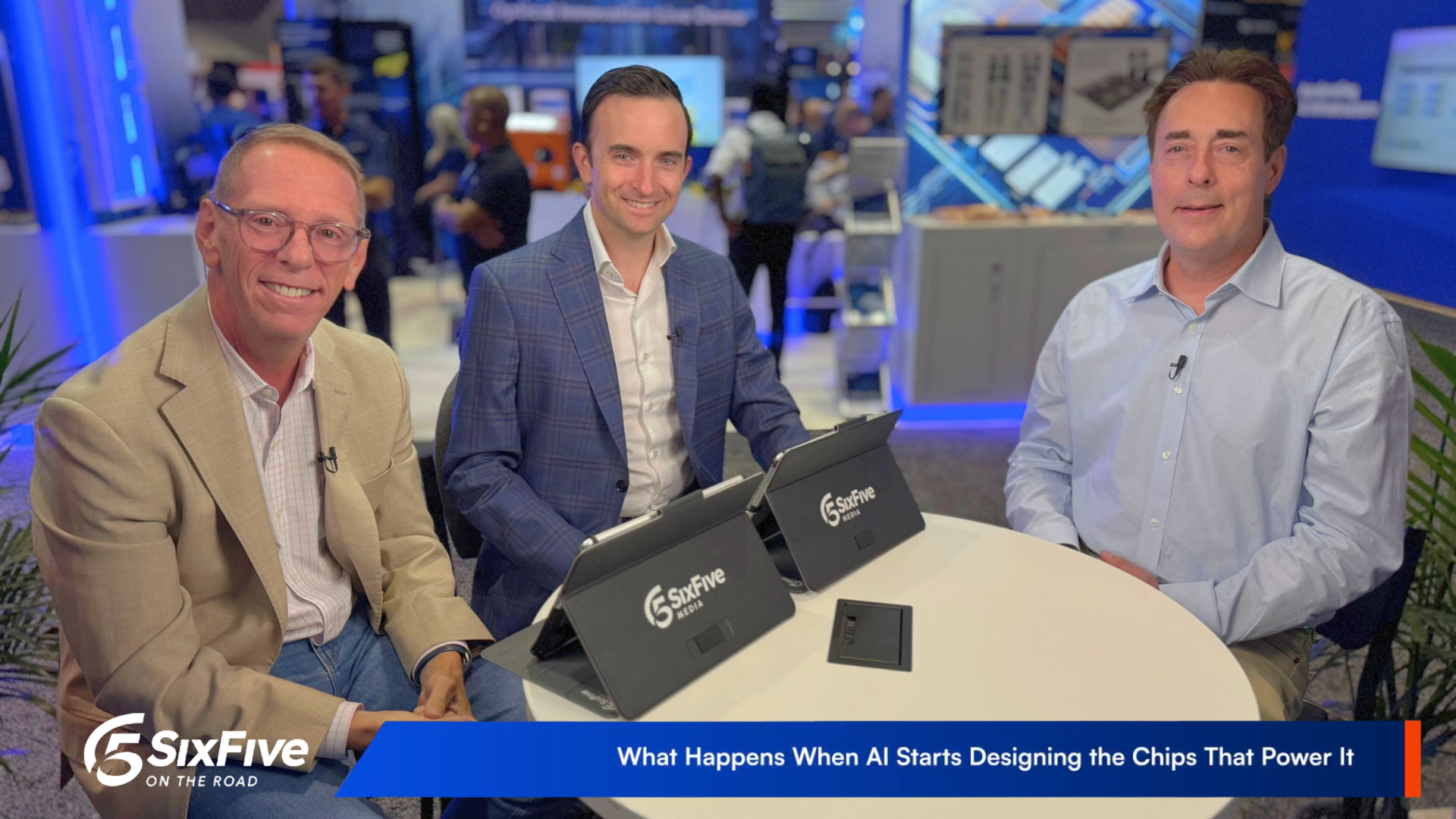
What Happens When AI Starts Designing the Chips That Power It | Synopsys at AI Infra Summit
At AI Infra Summit 2026, Synopsys' Thomas Andersen joins Brendan Burke and Matt Kimball to explain how chip design is moving from AI copilots that suggest to agentic systems that execute tool orchestration, timing fixes, and verification from a written spec. For enterprises, that shift compresses spec-to-tapeout timelines and lowers the resource barrier to custom silicon.


The Six Five Pod | EP 322: AI Writes Its Own Rules, Copilot Bills by the Task, and Memory Names Its Price
The companies racing to build frontier AI just agreed to referee themselves. Over the same week, launches, investor days, and earnings put a price on that arrangement. Microsoft is charging for finished work, NVIDIA is selling agent containment as infrastructure, and the suppliers AI can't route around, from Synopsys to Micron, are collecting the premium. Patrick Moorhead and Daniel Newman separate signal from stagecraft, then split hard on whether the White House accord actually binds these key players to anything.
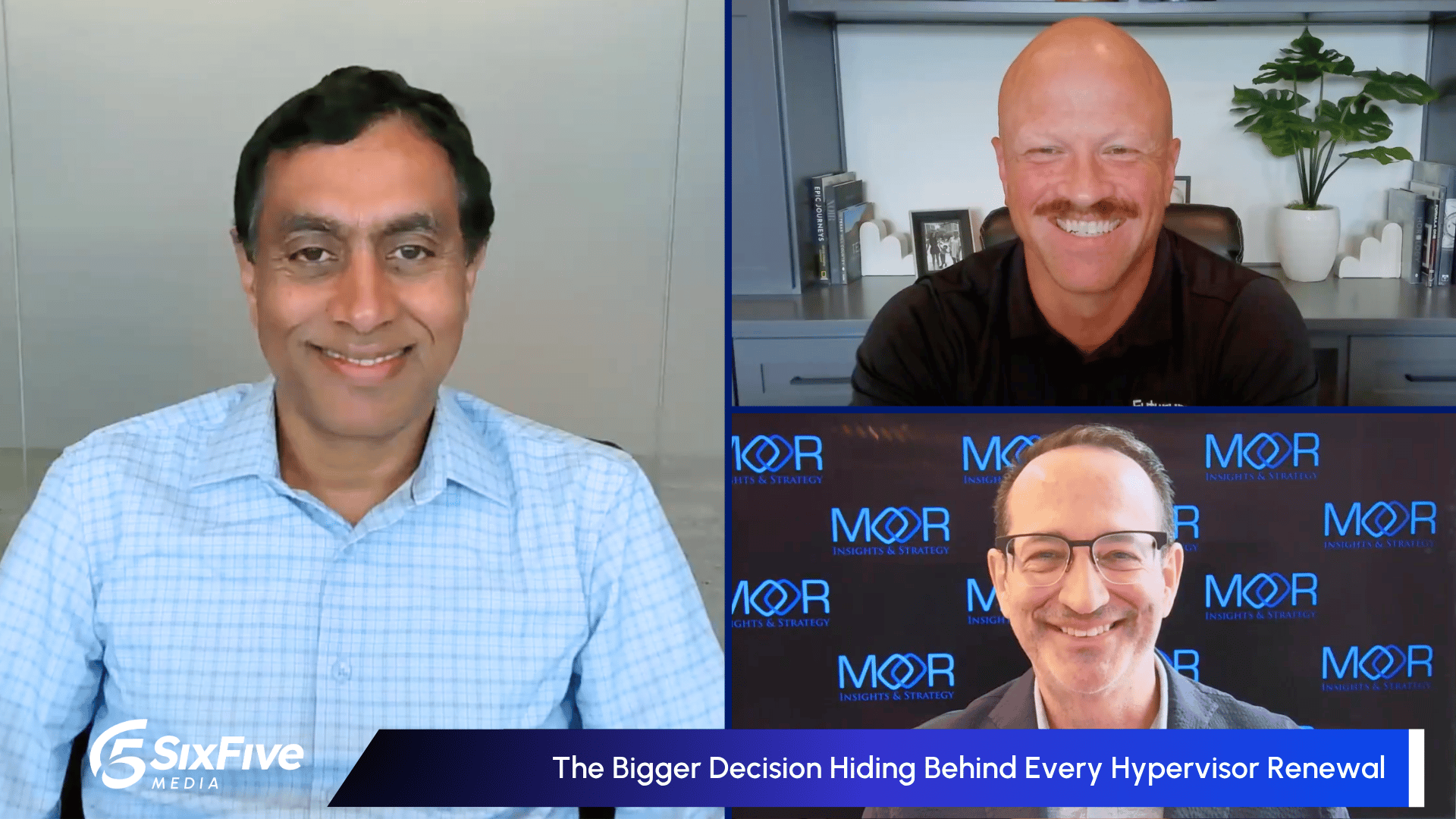
The Major Decision Hiding Behind Every Hypervisor Renewal
HPE's Varma Kunaparaju talks with Patrick Moorhead and Daniel Newman about why virtualization licensing changes are forcing enterprises to confront a bigger decision than which hypervisor to choose next: what operating model sits underneath their private cloud and AI factory. He outlines how CxOs can sequence modernization in phases, extend governance across open and frontier models, and decide where automation should replace human approval in IT operations.
Other Categories
CYBERSECURITY
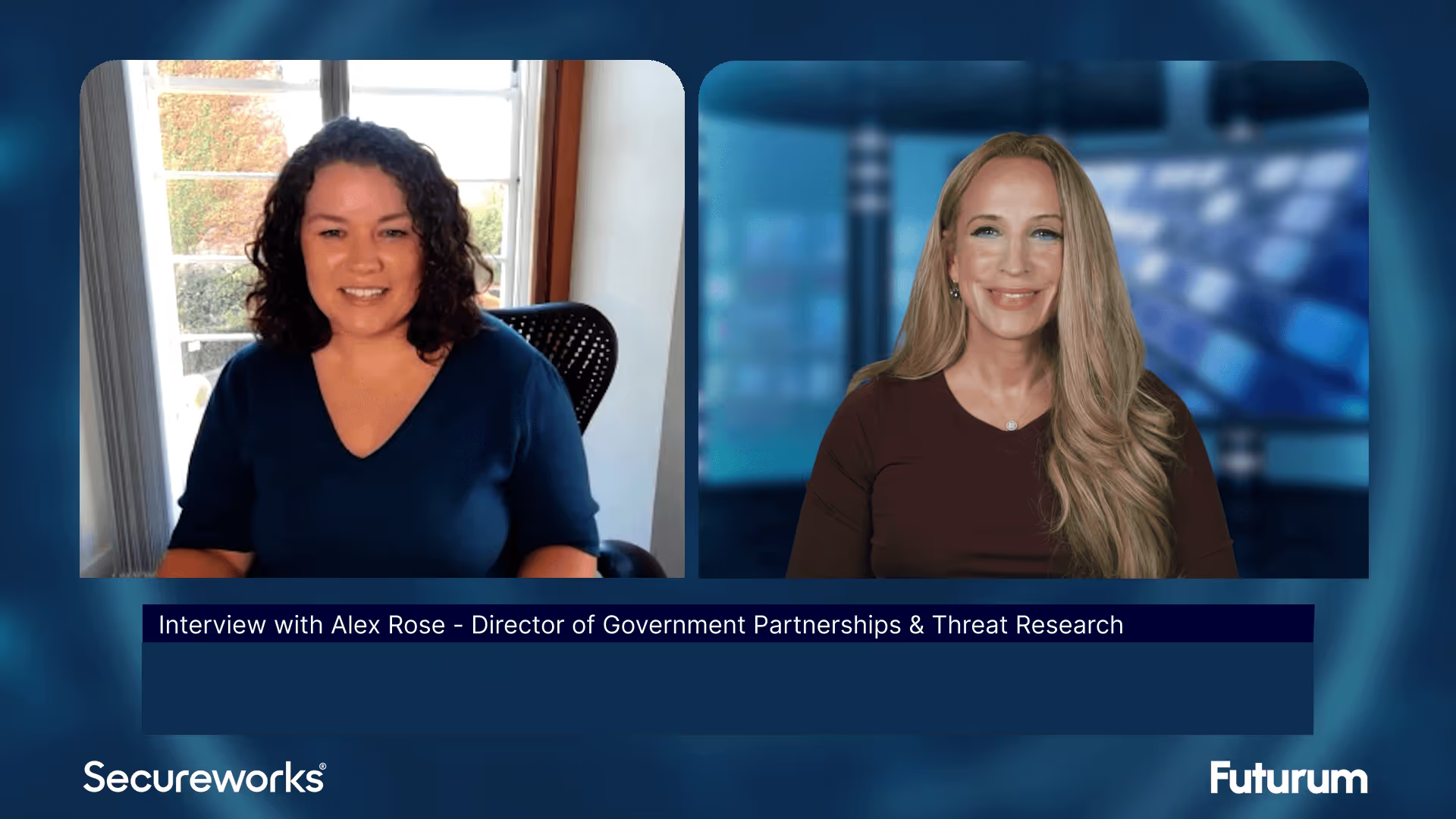
Threat Intelligence: Insights on Cybersecurity from Secureworks
Alex Rose from Secureworks joins Shira Rubinoff on the Cybersphere to share his insights on the critical role of threat intelligence in modern cybersecurity efforts, underscoring the importance of proactive, intelligence-driven defense mechanisms.

HP Launches World’s First Business PCs to Protect Against Quantum Hacks - The Six Five On the Road
On this episode of the Six Five - On the Road, hosts Patrick Moorhead and Daniel Newman are joined by HP's Ian Pratt, Global Head of Security for Personal Systems.
What is Autonomous Endpoint Management?
Autonomous Endpoint Management is a framework designed to unify IT operations and security teams on a single platform through real-time control and visibility.
QUANTUM
Quantum in Action: Insights and Applications with Matt Kinsella
Quantum is no longer a technology of the future; the quantum opportunity is here now. During this keynote conversation, Infleqtion CEO, Matt Kinsella will explore the latest quantum developments and how organizations can best leverage quantum to their advantage.
Accelerating Breakthrough Quantum Applications with Neutral Atoms
Our planet needs major breakthroughs for a more sustainable future and quantum computing promises to provide a path to new solutions in a variety of industry segments. This talk will explore what it takes for quantum computers to be able to solve these significant computational challenges, and will show that the timeline to addressing valuable applications may be sooner than previously thought.