
AI Performance at the Edge with the HPE ProLiant DL145 Gen11
SHARE


Ryan Shrout and Russ Fellows speak with Vincent Sheu of HPE about what edge AI infrastructure actually requires in production environments. The conversation focuses on the HPE ProLiant DL145 Gen11, predictable inference performance, and why thermal behavior, acoustics, and remote operations matter as much as raw compute.
Edge AI is moving out of theory and into places where the environment is the problem.
Signal65’s Ryan Shrout and Russ Fellows sit down with Vincent Sheu, Senior Product Manager at HPE, to talk about what really changes when AI has to run outside the data center in places like retail stores, remote offices, kiosks, and other real-world environments where you don’t control everything.
Edge deployments need something different than a typical rack server. It’s not about top benchmark scores, it’s about whether the system can keep response times consistent, run quietly without overheating in tight spaces, and be easy to manage when there’s no IT team on-site.
Signal65’s testing reveals the HPE ProLiant DL145 Gen11 can maintain stable inference behavior under rising temperatures and in cabinet-style deployment conditions that more closely resemble the edge than a lab.
Key Takeaways Include:
🔹 Why edge locations create thermal, acoustic, and support challenges that standard servers are not built to handle
🔹 How the AMD EPYC 8124P supports power efficiency, thermal balance, and sustained inference performance at the edge
🔹 What predictable latency means for retail, industrial, and computer vision use cases operating in real time
🔹 How the DL145 Gen11 performed in constrained cabinet-style testing designed to simulate edge deployment conditions
🔹 Why remote operations and lifecycle control are becoming critical as edge AI footprints expand
Explore the full Lab Insights report on the unified HPE ProLiant compute infrastructure stack and watch the full conversation for more analysis.
To learn more about the HPE ProLiant DL145 Gen11: https://www.hpe.com/us/en/compute/hpe-proliant-compute/dl145-gen11.html
Read the Signal65 research paper: https://signal65.com/wp-content/uploads/2026/01/Signal65-Insights_Unified-HPE-ProLiant-Compute-Infrastructure-Stack.pdf
Disclaimer: Six Five Media is for information and entertainment purposes only. Over the course of this webcast, we may talk about companies that are publicly traded, and we may even reference that fact and their equity share price, but please do not take anything that we say as a recommendation about what you should do with your investment dollars. We are not investment advisors, and we ask that you do not treat us as such.
Ryan Shrout:
Hey, everybody. Welcome to a Signal 65 video insights. I'm your host, Ryan Schirra. I'm the president at Signal 65, and I'm joined by Russ Fellows, one of our leads in our data center and AI testing segment of the business. Russ, how are you today?
Russ Fellows:
Great. Thanks, Ryan.
Ryan Shrout:
You bet. And we are joined by guest Vincent, who's a senior product manager at HPE. Vincent, thanks for jumping on with us today.
Vincent Sheu:
Hi Ryan, thanks for having me here. Give the viewers a quick overview of kind of what your role is at HPE. What products do you cover and kind of what's your what's your segment?
Russ Fellows:
I'm the Senior Product Manager for DL145 and specifically is the DL145J11 that is the edge optimized platform that significantly helped our customer deploying me in the edge to deal in all the uncontrolled environment.
Ryan Shrout:
Well, thanks for joining us. Really appreciate it. We're here today. We're going to continue talking about, you know, based on a report that Signal 65 published earlier in the year about looking at kind of a unified HPE ProLiant infrastructure stack. And this was inclusive of us doing some performance testing and analysis of the server, specifically the ProLiant DL145 Gen11 server, but also looking at the software stack along with that, the compute ops management, the iLO stack. And we previously talked with Ganesh. another person from HPE that kind of walked us through some of the software side and some of the manageability. And what we wanted to focus on for this video is really diving more into the hardware itself, the infrastructure piece itself, some of the ins and outs of how it was designed and why it was designed, and really get some details from you. on that, Vincent. So I'll kind of just jump in and say, you know, as we, or as you rather as HPE, kind of go talk to customers about deploying these types of AI workloads outside of the data center, right? So, you know, retail stores, factory floors, remote offices, and the like, you know, what are the kind of consistently described operational challenges that they run into in those types of deployments, you know, that are different than just kind of buying a standard rack mount server today.
Russ Fellows:
Yeah, that's very good questions. Each edge location have different challenge and it certainly don't like anything like a data center, right? So you have to deal with the limited physical space, a higher and less predictable temperature, acoustic constraints or very little on-site IT support. You cannot It's bad like each ID support in each retail store, right? So that is in many case, the system is deployed in a small enclosure, bedrooms, storage rooms, or industrial environment where the airflow or cooling and hands-on assets are constrained. And that is why if you put a standard rack server at the edge, is hardly works well. So traditional data centers assume the control environment, right? you have the temperature condition, and you have a professional IT support, can physically access those machine. However, in the edge, what customer need is the predictable performance under the heat stress, the quiet operation, and also the management platform that can handle the security and lifecycle, also the troubleshooting remotely, that is especially crucial for the edge customer.
Ryan Shrout:
Yeah, good. It's interesting to think about. And Russ, I know you have some experience in this. I have a little bit of experience in this. We have, I mean, we are a remote business. You know, we have multiple locations across the country where, you know, not a giant retail establishment, but I often think about when we're, you know, looking to deploy some shared compute resource here for Signal 65, right? Like, where's it going to sit? Is it going to sit in a data center somewhere? Is it going to sit in a closet next to my cubicle, right? And that kind of has a lot of impact on what we, what we look at. Would you agree with that sense in terms of the delta, the difference between how you scope something out for an edge deployment versus a data center deployment?
Vicent Sheu:
So yes, I mean, there's a big difference in a desktop or a tower. and a typical rack mount server. So we have a small data center in our office and most of our gear goes there because it's very loud and noisy and hot and lots of fans blowing and you could by no means put it next to you in the office. I do have a desktop tower system which runs pretty quietly and cool. And from our testing, the DL-145 was pretty much equivalent to that. Very quiet, very cool. Something that you could put next to you and work comfortably if you wanted to, or as we tested it in a cabinet or in a sale kiosk or something like that.
Ryan Shrout:
Now the HPE DL145 Gen11 that we physically tested uses the AMD EPYC 8124P processor in there. So that's kind of my understanding is purpose built for single socket, you know, edge optimized environments. Vincent, could you give me a sense of what specifically in your mind makes that processor well suited for that use case and why it was selected to go into this platform?
Russ Fellows:
That is the real reason to partner up with AMD. This processor, the EPYC 8124P, is designed specifically for edge-optimized deployment. What does that mean? You have to enable the better balance of performance, the power efficiency, as well as the thermal behavior. So in your testing, right, the DO-145 drain even use this processor with the sustained AI inference workloads, and we have the minimum latency impact, even the ambient temperature rising significantly. So that is very important to our customer. So the customer can deploy the meaningful AI workload in the edge without over-provisioning the power or cooling. to worry about and there's something general purpose data center processor cannot optimize for. So that is the unique value on this processor.
Ryan Shrout:
Yeah, I found that interesting in our results to your point, right? We tested different workloads on this particular server and the testing was very linear and consistent. And I think, you know, maybe in some other types of deployments or how people think about edge computing versus data center computing, that that consistency, that predictability of performance is maybe not always the number one priority, but in the edge environment, that does seem to be the case. What does that kind of predictability mean for the customer, right? Why is that valuable to them?
Russ Fellows:
So the edge AI use case, For example, like image inference or industrial quality innovation or retail analytics. All of them depend on constant real-time response. So the system can run well in a control lab or data center. but it will degrade unpredictably in the field. That will jeopardize the business continuity, as well as increase the operational risk. So, your report shows that the DL145 chain even maintains a constant AI inference latency with less than 2%. degradation as temperature increase from 75 Fahrenheit to 105 Fahrenheit. This kind of predictability allow customer to run their business application and with confidence, right? They know the system can behave the same way in the real world edge condition.
Ryan Shrout:
It was interesting, Russ, I know you and the team managed all the testing for this project. And one of the unique scenarios that we put into place was trying to simulate an edge deployment in sense of kind of constrained physical thermal space. Could you describe a little bit about what we actually did for that part of the test?
Vicent Sheu:
So we tried to recreate a point of sale environment, like a kiosk or a checkout register, where somebody would just stick it underneath in a closed space, right? Something you're never supposed to do with a server. There was no ventilation holes anywhere. And quite honestly, I was a little surprised it stayed as quiet and cool as it did. I was expecting temperature rise to get up to 120 degrees or something. and have to crack open the cabinet. But we left it for multiple days running workloads. It never got above 105, even when running the processor full out. So it's a little surprised by that, that it handled it so well.
Ryan Shrout:
And Vincent, when we look at the DL145 Gen11 design, and we mentioned at the beginning how you combine that with the remote management comms layer of things, how does that change you know, what's possible operationally for these types of it teams that are deploying edge systems like this.
Russ Fellows:
So reality of the edge deployment, like the system have to deploy in a location that ID team may never physically visit, right? Like the retail bedrooms, remote telecom site or facility in other countries. So that's where if you combine the DO-145-211 and the HPE ComputeOps management, which is Calm, will foundationally change what's possible operationally. So like remote management is the top requirement for over 60% of enterprise deploying the edge and hyper workloads. So that is the executive what we see from the customer. And with cloud-native management from the Calm, policy-based operation teams can securely manage and update also the troubleshooting assistant without being unsigned. So that instead of the management individual servers, the com can manage the first, which dramatically reduce the operational overhead. Also, the input comes in across the distributed environments.
Ryan Shrout:
that's very important to our customer. Yeah, that's that remote management operational piece of it. We did talk about in the other video, when we talked with Ganesh from HPE as well, if anybody watching this hasn't gone to view that, they definitely should. It's pretty eye opening, I think, even from somebody, you know, Russ is more involved in the day to day management of of the systems themselves from an IT infrastructure standpoint than I am. But seeing some of the changes in how things have evolved over the last several years has been pretty impressive. You know, I always like to kind of end these discussions asking about something looking ahead, right? So the DL145 Gen11 uses the AMD EPYC 8004 series. They represent kind of best in class at a specific point in time for edge AI performance. And we've kind of described some of that here. But as we look forward, AI models get larger. inference demands increase, general-purpose compute command demands continue to evolve and improve. We talk about agents all the time, and all these things are kind of involving. How do you and HPE really think about evolving these types of platforms, either this specific one or, you know, edge compute, generally speaking? What's kind of like the roadmap in your mind?
Russ Fellows:
Yeah, in the edge computing environment, right? So they will become more disputed. The management security and lifecycle consistently become more important and even more important than the computing performance. So that is the why HPE strategy on evolving the unified platform to combine the edge optimized hardware with the cloud native operation. with security and that can secure over time. So as AI models grow and inference demand increases, HPE's role may focus on sustaining predictable performance in real-world conditions while expanding the field-level automation. and security as well as the operational intelligence. And this goal is not just faster edge computing, but edge platform like remain manageable and also the resilient scale as the complexity increase.
Ryan Shrout:
Yeah, it seems like there is a growing demand and Russ, if you have any input on this, let me know. But like the compute demand is growing tremendously, right? And whether or not that's in the data center or how it gets distributed out to the edge. You know, other companies are continuing to talk about how this compute will need to get closer to the end consumer, generally speaking. And so that will put more demands on the edge compute platforms like the one we've described here and kind of the management side of it. Russ, do you think that that's likely to happen in the same way?
Vicent Sheu:
Yeah, definitely. I mean, we see through some of the other work we're doing, testing different models for their agentic capabilities. And even today, even despite, you know, the rise of SLMs as opposed to LLMs, BLMs, whatever, there's a definite correlation between the model size and its agentic capabilities, right? The larger models just do better, right? They get things wrong less often, they're better. So people are naturally going to want to try and deploy those locally. So, you know, as the models continue to improve, maybe their compute requirements diminished slightly, maybe, but people aren't really able to run those larger models locally yet. So with, you know, continued improvement in the platforms, I think there's going to be a proliferation of people being able to deploy these on-premises.
Ryan Shrout:
Yeah, it's going to be interesting to see how the rest of this year and kind of 2027 span out. So quick reminder for everybody who's watched this video, make sure you go to Signal65.com, look up our unified HPE ProLiant compute infrastructure stack paper written by Jonathan, written by Russ on our team, deep dive into the HPE ProLiant DL145 Gen11 server with the Epic processor in it, as well as a whole bunch of discussion around the kind of the manageability side as well. Vincent, I want to thank you for joining us today to talk through some of these results. I appreciate the time. I know it's a different time zone for you, so I appreciate making the window for us.
Russ Fellows: Thank you so much.
Ryan Shrout: Everybody, check out Signal65.com for more of our independent analysis and research coming soon. Thanks, you all. See you next time.
MORE VIDEOS
WD's Tim Rausch: AI Storage Demand Compounds With Every GPU Cycle
Western Digital's Tim Rausch argues that AI's compounding data growth, more than GPU capacity, sets the real ceiling on infrastructure scaling. He joins Matt Kimball at AI InfraSummit 2026 to walk through how total cost of ownership, archived data reuse, and WD's capacity roadmap are reshaping enterprise plans to scale AI over the next several years.


.png)
The Main Scoop Ep. 45: Attackers Only Need to Be Right Once. AI Just Made That Easier.
Chad Rikansrud, R&D Software Security Engineer at Broadcom, explains how frontier AI models are finding decades-old mainframe vulnerabilities in seconds, collapsing the complexity advantage that once protected legacy platforms. He outlines why enterprises need faster Security Intelligence (SECINT) ingestion and disciplined human oversight to keep pace with adversaries wielding the same tools.
Fleet-Scale Deployment Is the Physical AI Benchmark
Physical AI is shifting from lab prototypes to fleets of machines operating reliably in the real world, and Ambarella's Muneyb Minhazuddin joins Six Five On The Road at AI Infra 2026 to explain what that shift demands of silicon, memory and developer workflows. Minhazuddin traces the case back to a 22-year-old chip architecture and forward to a developer cloud built to compress model porting time from months to days, and he identifies enterprise ROI proof points as the biggest hurdle left before physical AI scales into millions of deployed units.
Other Categories
CYBERSECURITY
Threat Intelligence: Insights on Cybersecurity from Secureworks
Alex Rose from Secureworks joins Shira Rubinoff on the Cybersphere to share his insights on the critical role of threat intelligence in modern cybersecurity efforts, underscoring the importance of proactive, intelligence-driven defense mechanisms.

HP Launches World’s First Business PCs to Protect Against Quantum Hacks - The Six Five On the Road
On this episode of the Six Five - On the Road, hosts Patrick Moorhead and Daniel Newman are joined by HP's Ian Pratt, Global Head of Security for Personal Systems.
What is Autonomous Endpoint Management?
Autonomous Endpoint Management is a framework designed to unify IT operations and security teams on a single platform through real-time control and visibility.
QUANTUM
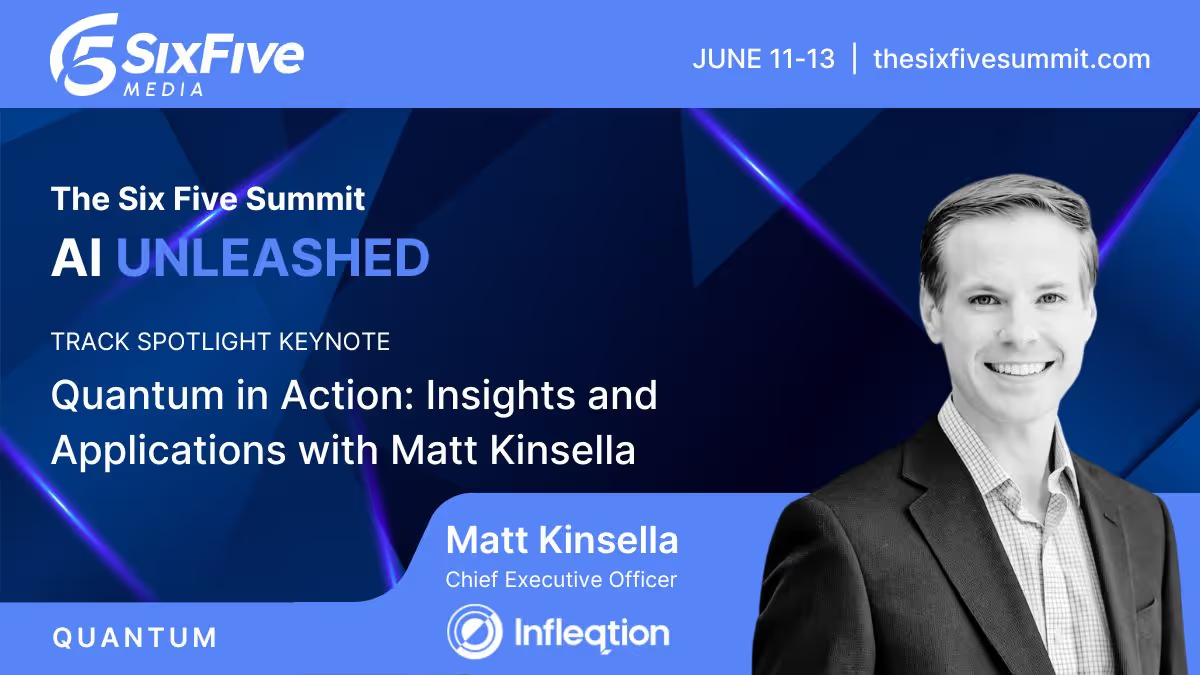
Quantum in Action: Insights and Applications with Matt Kinsella
Quantum is no longer a technology of the future; the quantum opportunity is here now. During this keynote conversation, Infleqtion CEO, Matt Kinsella will explore the latest quantum developments and how organizations can best leverage quantum to their advantage.
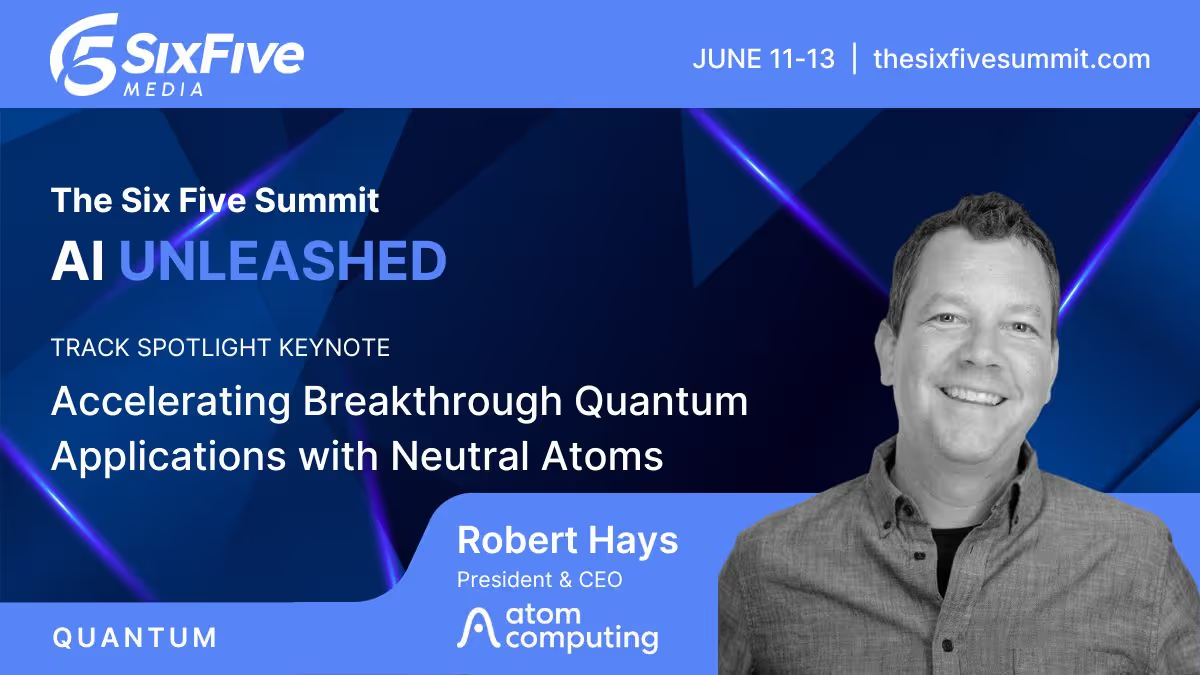
Accelerating Breakthrough Quantum Applications with Neutral Atoms
Our planet needs major breakthroughs for a more sustainable future and quantum computing promises to provide a path to new solutions in a variety of industry segments. This talk will explore what it takes for quantum computers to be able to solve these significant computational challenges, and will show that the timeline to addressing valuable applications may be sooner than previously thought.