Home

From Content Supply Chain to Agentic Operating Layer: Adobe GenStudio and Firefly for Enterprise Scale
From Content Supply Chain to Agentic Operating Layer: Adobe GenStudio and Firefly for Enterprise Scale
SHARE


Varun Parmar, SVP and GM of Adobe GenStudio and Firefly Enterprise, joins Patrick Moorhead and Daniel Newman at Adobe Summit 2026 to discuss how Adobe is transforming the content supply chain into an agentic operating layer. The conversation covers Adobe Brand Intelligence, deterministic Firefly Creative Production workflows, the five-pillar GenStudio architecture, and the Adobe-NVIDIA partnership bringing 3D digital twins into enterprise marketing production.
Content demand is expected to grow 5x over the next two years, but most enterprise workflows aren’t built for that kind of scale. They’re fragmented, heavily manual, and rely on brand guidelines that capture only a fraction of real-world decision-making. That gap makes it hard to keep up.
At Adobe Summit 2026, the focus shifts to what comes next.
Patrick Moorhead, and Daniel Newman sit down with Varun Parmar, SVP and GM of Adobe GenStudio and Firefly Enterprise, to unpack how Adobe is rethinking the content supply chain to move toward a more adaptive, agent-driven system that still keeps humans in control.
Key Takeaways Include:
🔹 Adobe Brand Intelligence tackles the “uncaptured majority” problem. Traditional guidelines and templates only cover about 20% of what a brand really is. Brand Intelligence pulls in the rest: creative judgment, past decisions, approvals, and context from tools like Workfront and Frame, enabling agents to operate with the same understanding as a human marketer.
🔹 GenStudio organizes the content supply chain into five core stages. Planning, creation, activation, insights, and asset management stay intact—but now agents are introduced across each step to support and scale the process, not replace it.
🔹 Firefly Creative Production focuses on consistency at scale. Generative outputs can vary wildly based on prompts or seeds. By building deterministic workflows, Adobe gives enterprises predictable, repeatable results that meet the standards required for global brand execution.
🔹 The Adobe–NVIDIA partnership brings 3D into the core workflow. Industries that depend on precise product representation like automotive, luxury, and manufacturing, can now turn CAD models into real-time 3D assets using NVIDIA Omniverse Cloud, and plug them directly into production. That removes both the 3D bottleneck and the risk of inaccurate AI-generated visuals.
🔹 GenStudio expands into content and performance marketing workflows. A new Content Marketing module helps B2B teams turn long-form assets into multi-channel derivatives, while the OpenAI partnership brings ChatGPT Ads into GenStudio for Performance Marketing, extending the platform from content creation into activation and campaign execution.
Watch now and subscribe to Six Five Media for analyst-led coverage from Adobe Summit 2026.
Disclaimer: Six Five Media is a media and analyst firm. All statements, views, and opinions expressed in this program are those of the hosts and guests and do not represent the views of any companies discussed. This content is for informational purposes only and should not be construed as investment advice.
VARUN PARMAR:
Our view is that for agents to be really productive, they need the same context that your marketing professionals have. That's when they have the grounding of your enterprise, the decisions that you're making, the differentiation that you offer, your positioning, your brand identity. You need to make sure that their entire enterprise context is made available to the agents. And that is where Adobe Brand Intelligence comes in.
PATRICK MOORHEAD:
The SIx Five is On The Road here at Adobe Summit 2026 in Las Vegas. Daniel, it's been a great show so far. We're two keynotes in, and unsurprisingly, a lot of discussion about agents. And it's not only agents inside the enterprise with workflows, but also the connection of agentic services between the brands and the consumers themselves.
DANIEL NEWMAN:
Yeah, the last few years, things have been moving very, very quickly. You remember just a couple years back, Firefly, generative AI, really Adobe focusing on putting the governance around all this generative content. And now we're starting to see, as agents get put into the flow, the exponential productivity opportunities. But enterprises, there's so much complexity. And I think a lot of the focus here is on how those enterprises can demystify and take out this complexity and actually start to generate all the productivity gains that we expect AI to deliver. It's not that simple. And I think there's a lot here that explains how enterprises can get the most out of that.
PATRICK MOORHEAD:
It is. And hot off the keynote stage, I'm going to introduce Varun. Great to see you. I would say welcome to The Six Five. But you've actually been on The Six Five before. Yes, that's right. Melody interviewed you last time. But congratulations on a great keynote. Welcome.
DANIEL NEWMAN:
Thank you so much. Excited to be here. Yeah, you, your bots, and your agents did great. Exactly. I congratulate you. Well, you heard us kind of in the preamble, Varun. I mean, content is exponential right now, right? I mean, we had before generative AI, we were already, you know, kind of dealing with, I think I'd heard the term content shock in the past. And now you add generative AI that basically at everyone's fingertips, they can start the process of becoming designers, building, whether that's web, whether that's written word, whether that's advertising, and you guys do the whole thing. But as content continues to be exponential, right, and the expectations are more and faster, kind of how are you seeing that work? I mean, is it fundamentally in a good place? Are there parts of this that are broken? And what needs to be rethought by enterprises that want to really get the most out of the opportunity that AI is presenting?
VARUN PARMAR:
Yeah, yeah, no, actually, great question. Like, you know, we have a stat, which is the demand for content is going up by 5x over the next two years. Just think about it, five times the content in just the next 24 months. And, you know, the old operating model, doing things manually, you know, having a fragmented content supply chain is just not going to cut it. And so this is where, to your point, the agentic content supply chain comes in, where you need to make sure that these agents are trained on what your brand voice is, what your brand identity is, and then orchestrate what we call as the creative production workflows in order to then take what comes as campaign brief or creative brief and then start to scale all of these variants and do it in certain channels in real time, right? We all know that a lot of the cultural moments are actually getting amplified in real time across some of these social platforms. And so in order to make sure that your brand is represented and you're actually in the discussion that's happening, you need to actually not just create all of this content at scale, you need to also make sure that it's done in real time. And that requires every brand, every enterprise to relook what they already have. That's where Adobe Gen Studio comes in, and we are reimagining the entire content supply chain. And our vision here is that it is human-led and agent-accelerated, and we believe that's very unique. Our view is that humans and agents are going to collaborate with one another, and there are certain activities that the marketing professionals are doing that tend to be more repetitive, more mundane. that they can now delegate over to the agent. Sometimes we find that, you know, there's like silos that get created across the entire content supply chain all the way from folks who are strategists down to folks who are actually activating. We also see a role for agents out there where they're trying to streamline this workflow so that, you know, folks can get on the same page and you can really drive not just the content volume, but also the velocity in which you need to operate.
PATRICK MOORHEAD:
Yeah, there have been a lot of discussions about, you know, two discussions. One of them is we're just not going to need enough humans. But what's happening, what's replaying itself is with better technology, we just want more. I think, I don't know, maybe it was Shantanu or I think he's talked about, you know, people don't just want one campaign, they want 10. And maybe it's micro-targeting at this point to make. Or, hey, I never was able to do verticals, to market to verticals that I could before, but now I can. Oh my gosh, I can't have any type of creative for certain countries because I just couldn't afford it. And this technology allows you to do that. The other part that I think gets too much skepticism is when it comes to anything creative or people buying things from other, it's still humans buying from humans. And when we do get to the point of agents buying from agents, then I think we'll have another conversations, or maybe that's for the ERP folks, right? So you made a ton of announcements on stage. May have been 13, may have been 14. I lost count. But let's drill in Gen Studio and Firefly Enterprise. The essence of, very similar to what we've been talking about, is being creative, using AI technologies, having a human in the loop, and staying within the brand and the brand guidelines and the brand guardrails. Can you talk about how companies are actually, I'll call it having their cake and eat it too?
VARUN PARMAR:
No, so actually, if you look at every single AI brand system that exists out there, you know, they are all trained at, you know, what we call as the codified guidelines, right? So these are, you know, your brand kits, your brand guidelines, you know, your brand templates. And what we've realized, working with all of the major brands and enterprises, is that that represents only 20% of what your brand stands for. I mean, just think about it, right? When a creative is making a decision on placing an object in an image that's actually going to get activated on one of their email campaigns, they're making a lot of decisions. It's not a templated approach that they're taking. How that image operates with the background, and where would the call to action show up? Where would the text show up? What's the foreground coloring, the background coloring? What would happen if you start to reflow this stuff? there is a lot of human judgment, taste, that actually comes in. And what we find is that most AI systems today, while they can actually generate a bunch of things, they are missing this context. We call this the uncodified majority. All of this is captured in all of the feedback that's happening across the content supply chain, in your marketing system of record, which tends to be work front for many of the enterprises, in frame where some of the reviews and approvals are happening, and what we are doing with Adobe Brand Intelligence, which is a new platform that we are actually launching, that we have launched today, is that we're actually codifying not just the written guidelines, but also the tribal knowledge, the tacit knowledge that's there. And by doing that, you can now truly start to give the context to the agents to help the humans in a way that they are productive. Our view is that for agents to be really productive, they need the same context that your marketing professionals have. That's when they have the grounding of your enterprise, the decisions that you're making, the differentiation that you offer, your positioning, your brand identity. You need to make sure that their entire enterprise context is made available to the agents. And that is where Adobe Brand Intelligence comes in. It converts this raw context into something that these agents can understand so that they can truly start to drive some of these business outcomes that we are discussing.
PATRICK MOORHEAD:
In context and personalized.
DANIEL NEWMAN:
Yes, what I say, hyper-personalized, contextually aware. That's what I always like to say. It's interesting too, I was reading one of the lead designers for McKinsey actually talked about how these things might be able to build the deck, but they really can't build like, you know, and I mean, obviously, maybe they're defending their existence, but maybe they're not. I mean, the point is, is like, I've seen a lot of slop get created. And I think what you're kind of talking about is the fact that You can tell it to create something, and it'll create it. And it might even look good to the naked eye. But someone that really knows realizes that not only is that 20% not fully there, there's a whole bunch more that really needs to be there. And so you really position GenStudio, though, as much more than a tool. So you're focused on it becoming an operating layer for planning, for creative, for actually measurement and the analytics side of things. How is that changing how teams work and how is that truly differentiated as you see it right now from what's in the market?
VARUN PARMAR:
Yeah, so Adobe GenStudio is Adobe's solution for the content supply chain. And what we are just discussing right now is that that content supply chain needs to evolve to become an agentic content supply chain, which means that Adobe GenStudio solution needs to also become agentic. So if you take a step back, for us, there are five different pillars of the content supply chain. It actually starts off with workflow and planning. That's where campaign briefs, campaign strategies become really, really important. Then it goes to creation and production, which is the vast majority of what we've been discussing. How do you scale all of this content across all of the channels? But then it goes to delivery and activation. And then there is reporting and insights. And at the heart of this is asset management, the digital asset management that actually storing all of the metadata and all of the content. So we believe that there is going to be a fundamental transformation that's going to happen across these brands. They will have to rethink what the workflow is when agents are being introduced as part of this end-to-end workflow. From Adobe's perspective, this is where all of our rich heritage and experience of understanding what the supply chain is and how it can be optimized. We are going to bring these best practices over to these brands in order to embrace or actually embark on this journey to actually transform themselves. And what we are doing is that we are bringing some new components as part of the overall content supply chain. So we talked about brand intelligence, which is going to establish not just the brand guardrails, it's also going to predict what the engagement of this asset is going to be. While on-brand content is amazing, what's even better is on-brand and performant content. So we are bringing things like synthetic audiences for your target personas for the campaigns that you're running, and we will be able to predict the engagement of the creative, the offer that you have in the creative, along with the positioning that you have. in order to make sure that it drives the business outcomes, the ROI that you're expecting when you go and activate these campaigns. And then we are bringing in the Firefly Creative Production, which essentially allows you to have a deterministic workflow. So one of the things that we've seen is that while there's all of this amazing AI tooling available, just a slight change in terms of the seed value or the prompt can dramatically change the output that comes across from these models. So our vision is that folks like creative technologists or creative developers will build these workflows. And once they're built, you can deploy it to everyone in your organization. So then you have the peace of mind that you actually have something that is validated and verified in terms of the output quality. And then you can democratize marketers and other personas out in the field, in geographies where, you know, things like you wanted to run these personalized campaigns out in different markets, but you know, you didn't have the budget or, you know, you didn't have the available resources to do that, and with this, you can actually start to do that.
PATRICK MOORHEAD:
You know, it's interesting, as Varun was going through that, I was thinking just how different, but there are similarities but differences between other type of agentic workflows. And let's say, you know, you're doing an ERP workflow where, you know, you get the result that you want and you're happy with that and you lock it in. But with campaigns and marketing and new product introductions, new brands, new regions, it's constantly changing. So it seems like it would be very difficult. Well, you're making it easier, right? That's the plan, to keep it aligned and do 10x of what you've done before.
DANIEL NEWMAN:
There's an iterate and expand, meaning that the agents working with the teams can kind of pervasively iterate and using those synthetic data sets, this performs well. Because that's basically, if you think so much of marketing, all the A-B testing, you know, all the dollars that got spent trying things. And to your point, though, and I think you've said this a couple times, but Marketing was always so choice-driven. You know, oh, I can only do this. Like, we can't do both of these or all three of these campaigns. And you mentioned, like, languages. You mentioned, like, geos. You mentioned the ability to size a different market or a different vertical. You can create everything now. And you can synthetically test it all now. And you can do all of that. And obviously, the final thing is the last thing that is hard. And that's picking which budget to apply. Meaning that's the part that you really got to nail down is you might be able to build more content. But you still got to decide when you put the paid behind it, where that goes.
PATRICK MOORHEAD:
So I wanted to shift to digital twins. So we've been researching digital twins for about a decade, but it's always been in the context of industrial internet of things, smart factories, smart distribution. Let's essentially control something that's digital that's in the physical world. But Jensen was on stage yesterday with Shantanu, and you did a big partnership yesterday with NVIDIA that was essentially bringing 3D digital twins into the marketing workflow. I'd never heard that before. I wish I had thought of it first. How do people shift the way, how is it shifting the way brands manage content and scale? How does it work?
VARUN PARMAR:
Yeah, yeah. So there are certain verticals where product identity preservation is extremely important, because that's what the brand stands for. So think of automotive companies, luxury goods, consumer packaged goods, fashion, consumer products, high tech and manufacturing and stuff, where they want to make sure that there is a perfect rendition of the product that happens as part of any marketing campaign that needs to be activated. What we find is that with generative AI, it falls short of delivering that promise. There is a certain degree of hallucination. There are some pixels that it takes liberty to actually repaint and stuff, and those extra pixels is the difference between your brand being represented in the right way or not. What we found is that for these verticals, they haven't been able to really realize the value, the promise of generative AI. But that changes today. With the partnership that we have announced with NVIDIA, what we are doing is that we actually take a CAD representation of your product and convert it into a 3D digital twin. And then we insert that 3D digital twin in the creative production pipeline so that you can then bring the generative AI models to paint the background or the foreground, resize all of these images, convert it into video and animate them, and then drive to the scale production that all of these entities need. The way we are doing it is very special. If you think about 3D digital twins, those used to require specialized hardware. Now, you don't need that. That's through the partnership that we have with NVIDIA. So using the Omniverse cloud and using ray tracing, we actually render in real time a representation of your product over on your machine. And then once it's done, you don't need to actually work with a 3D artist, and those folks are very limited in the world. So the other thing that we're doing is that we're actually democratizing access for 3D content across your organization. So now marketers and creative pros, those who are not 3D artists, can actually take advantage of these pipelines. And the beauty of all of this is that all of this is available as part of Firefly Creative Production. which is part of the overall Adobe Gen Studio solution. So it doesn't require you to go spin up, you know, a separate product or a service. It's all integrated into your content supply chain. All of these assets that are being produced are being stored inside of AEM Assets as your digital asset management repository. You are still in work front, defining your campaign strategy, defining your creative brief, and then activating these workflows with 3D Digital Twins right from the tool of choice and the tool that you're working in. That's what's really transformative here.
DANIEL NEWMAN:
It feels like so much of what you're doing is about also the pre-work that, you know, not all AI is the same. You know, so many people kind of are getting this idea, oh, there's this design tool. I just plug something in and create it. But when you're a global brand, right, every detail matters. And I think a lot of what I'm hearing you say, though, is kind of, you guys are putting a lot of effort into that pipeline. And there's a lot of quality to be established. So essentially, the whole slop conversation, you're kind of bringing that to the forefront and saying, that might be okay for, you know, someone working at home and vibe coding a toy. But when you're building, you know, global advertisements that are gonna be played during the middle of the Super Bowl, you want every detail to be correct. And even the, we talked about with like the 3D rendering in advance before it then makes its way in, because pixels out of place create content that looks just slightly off. And in the world of branding, there is no slightly off. So how does this all evolve? Where in your mind does this go? Where do you push innovation? How do you continue to disrupt? And how do you make sure that you cement yourselves? Because this company has a ton of provenance, a long pedigree, but you are facing new competition. The market is challenging you to be better, be more innovative. And of course, there are people that are saying, oh, this can all be vibe coded now. I mean, you've got to have an answer to that at this point. Exactly, yes. What's next?
VARUN PARMAR: I've been a product builder for 25 years. I think personally, there's never been a more exciting time to actually deliver customer value in a timeframe that's unprecedented. It's just really, really exciting to see that. I think to your point, we will continue to innovate and we will innovate based on what the unique customer needs are. So I'll give you some example. You know, we have these applications, GenStudio modules, right? So GenStudio for performance marketing is one, you know, where we announced and launched support for, you know, chat GPT ads. So this is a partnership with OpenAI that we have. You know, we also announced that you can actually not just create great creatives, right, or generate, you know, content, you know, doing it also for long-form content. You know, so oftentimes if you're a B2B marketer, you know, maybe you have a white paper and you're looking for derivative content that you can actually put on a channel like LinkedIn. So you did some amazing study with you folks and like you've given us some white paper and now we want to actually amplify that across all of the channels. Like that's another area where GenStudio for Content Marketing, which is a new module that's available, allows you to take this long-form content and convert it into derivative content that's either text or images or video and really allows you to amplify. So from our perspective, we're going to continue to innovate. AI is that big transformative thing that has happened in the enterprise. Within AI, we have this new reference architecture around agentic that we are double-downing on. We have these best-in-class applications across the five pillars of the content supply chain, and we're going to start to bring agents inside. And we believe that the future is around human-led and agent-accelerated. And, you know, really excited about all of the announcements that we have and where we are going with our product portfolio.
DANIEL NEWMAN:
How many agents will every human have?
VARUN PARMAR:
Lots and lots.
PATRICK MOORHEAD:
I mean, right now, probably 17 or 18.
DANIEL NEWMAN:
Pat's got 17, 18 apps that have 1,700 agents working for him.
DANIEL NEWMAN:
This is a lot of fun. Thank you so much for coming on stage. Thank you so much. This has been great. Thanks for spending some time with us. And thank you everybody for being part of this Six Five. We are on the road here at Adobe Summit 2026 in lovely Las Vegas. Been a great conversation here. Tune in, subscribe, be part of our community here on the Six Five. We look forward to seeing you soon. Bye for now.
MORE VIDEOS
WD's Tim Rausch: AI Storage Demand Compounds With Every GPU Cycle
Western Digital's Tim Rausch argues that AI's compounding data growth, more than GPU capacity, sets the real ceiling on infrastructure scaling. He joins Matt Kimball at AI InfraSummit 2026 to walk through how total cost of ownership, archived data reuse, and WD's capacity roadmap are reshaping enterprise plans to scale AI over the next several years.


.png)
The Main Scoop Ep. 45: Attackers Only Need to Be Right Once. AI Just Made That Easier.
Chad Rikansrud, R&D Software Security Engineer at Broadcom, explains how frontier AI models are finding decades-old mainframe vulnerabilities in seconds, collapsing the complexity advantage that once protected legacy platforms. He outlines why enterprises need faster Security Intelligence (SECINT) ingestion and disciplined human oversight to keep pace with adversaries wielding the same tools.
Fleet-Scale Deployment Is the Physical AI Benchmark
Physical AI is shifting from lab prototypes to fleets of machines operating reliably in the real world, and Ambarella's Muneyb Minhazuddin joins Six Five On The Road at AI Infra 2026 to explain what that shift demands of silicon, memory and developer workflows. Minhazuddin traces the case back to a 22-year-old chip architecture and forward to a developer cloud built to compress model porting time from months to days, and he identifies enterprise ROI proof points as the biggest hurdle left before physical AI scales into millions of deployed units.
Other Categories
CYBERSECURITY

Threat Intelligence: Insights on Cybersecurity from Secureworks
Alex Rose from Secureworks joins Shira Rubinoff on the Cybersphere to share his insights on the critical role of threat intelligence in modern cybersecurity efforts, underscoring the importance of proactive, intelligence-driven defense mechanisms.

HP Launches World’s First Business PCs to Protect Against Quantum Hacks - The Six Five On the Road
On this episode of the Six Five - On the Road, hosts Patrick Moorhead and Daniel Newman are joined by HP's Ian Pratt, Global Head of Security for Personal Systems.
What is Autonomous Endpoint Management?
Autonomous Endpoint Management is a framework designed to unify IT operations and security teams on a single platform through real-time control and visibility.
QUANTUM
Quantum in Action: Insights and Applications with Matt Kinsella
Quantum is no longer a technology of the future; the quantum opportunity is here now. During this keynote conversation, Infleqtion CEO, Matt Kinsella will explore the latest quantum developments and how organizations can best leverage quantum to their advantage.
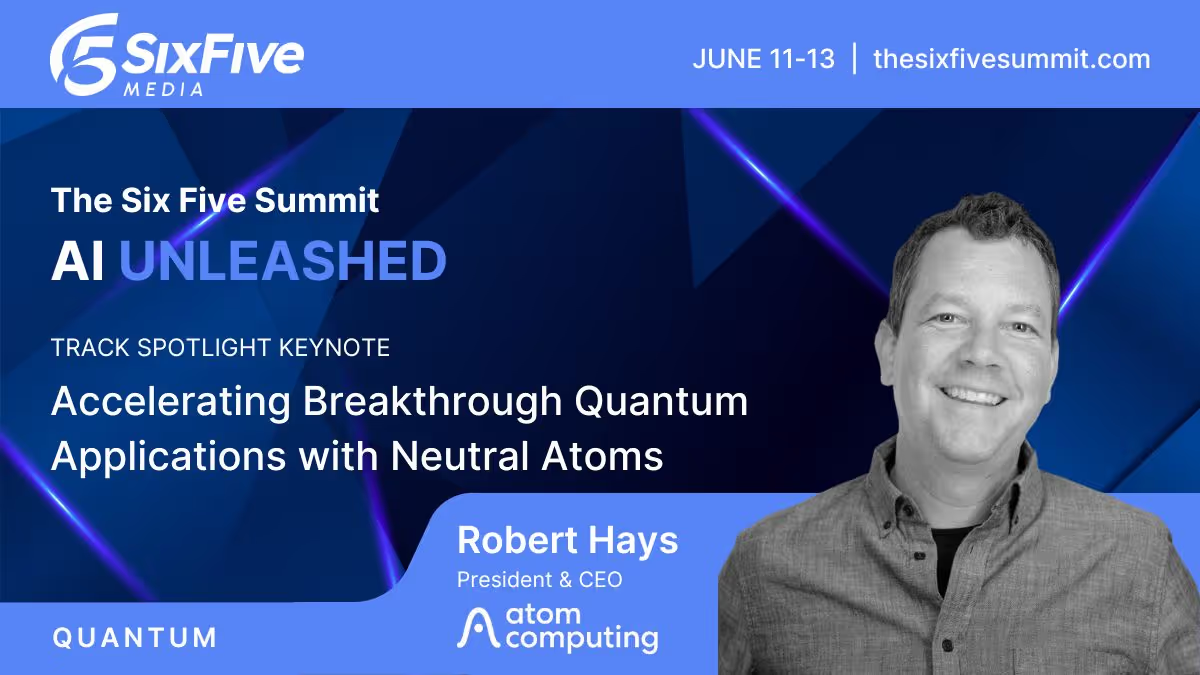
Accelerating Breakthrough Quantum Applications with Neutral Atoms
Our planet needs major breakthroughs for a more sustainable future and quantum computing promises to provide a path to new solutions in a variety of industry segments. This talk will explore what it takes for quantum computers to be able to solve these significant computational challenges, and will show that the timeline to addressing valuable applications may be sooner than previously thought.