
AI-Powered Innovation at Scale with Amazon Connect – Six Five On the Road
SHARE


Pasquale DeMaio, VP at AWS, joins the Six Five team to share insights on how Amazon Connect is driving AI-powered innovation at scale in customer service, key product advancements, and the future direction of customer engagement technology.
How is AI transforming the customer service landscape and what role does Amazon Connect play in driving this innovation?
From AWS re:Invent 2025, hosts Patrick Moorhead and Daniel Newman are joined by Amazon Web Services' Pasquale DeMaio, VP, Amazon Connect, for a conversation on AI-powered innovation at scale and the evolving role of AI-native contact center solutions. They discuss how AWS is leveraging an always-on, consumption-based model to help businesses elevate customer experience, eliminate traditional cost and complexity barriers, and meet the rapidly changing expectations of today’s end users.
Key Takeaways Include:
🔹Evolving Customer Service Vision: Amazon Connect’s role in shaping the future of automated, intelligent customer engagement.
🔹Product Evolution Milestones: Key advancements since launching Amazon Connect, including the impact and outcomes Pasquale DeMaio is most proud of.
🔹Agentic Capabilities Shared at AWS re:Invent: A deep dive into new AI features and how they enable businesses to harness automation and intelligence.
🔹Real-world AI Success: Customer stories showcasing how AI in Amazon Connect delivers measurable improvements in engagement and efficiency.
🔹Future Outlook: The emerging trajectory of customer experience technologies, and how Amazon Connect is positioned to support clients in the next wave of transformation.
Learn more at Amazon Web Services.
Watch the full video at sixfivemedia.com, and be sure to subscribe to our YouTube channel, so you never miss an episode.
Or listen to the audio here:
Disclaimer: Six Five On the Road is for information and entertainment purposes only. Over the course of this webcast, we may talk about companies that are publicly traded, and we may even reference that fact and their equity share price, but please do not take anything that we say as a recommendation about what you should do with your investment dollars. We are not investment advisors, and we ask that you do not treat us as such.
Patrick Moorhead:
The Six Five is On The Road here in Las Vegas, Nevada. We're at AWS reInvent 2025. It's been a great show so far. We knew it was going to be hardcore agentic AI lighting up enterprises in a multitude of ways with AWS's full stack offerings. And this is pretty much what we've seen so far.
Daniel Newman:
Yeah, it certainly wasn't a letdown. It was very exciting. Big keynote, lots of news. And by the way, this is kind of the histrionics of AWS. coming out, introducing a ton of stuff. And it was no different today. Now, of course, the only thing you and I, after what, three years of being on the road as professional event attenders, can say is the amount of AI-related news really took, you know, and I think that's because the AWS core business is really well understood. I think the company has that luxury and they're in this really important inflection right now where they're like, hey, We build infrastructure. Hey, we build applications. Hey, we build all the connective tissue that's required to build AI for your company, developers, whatever it is. So there was a lot of news. And I think it was like two and a half hours long.
Patrick Moorhead:
Yeah, it was. And which, by the way, I think that may have made it a short keynote for reInvent. But anyways. Like those jumbo classes in college. Oh, exactly. So hey, the great news is like every one of these big waves that we've seen, it goes from, gee whiz, this technology is amazing. We're going to go from zero to 60 in a day to the reality of enterprises asking, what is this tech doing for my business? And they've gone through the classic experimentation, POCs, deployment out there. But one of the focal areas that I've seen in my research, and I think that you've seen too, is this idea of generative AI lighting up the customer experience in a very data-driven manner. And that's what we have brought PQ from AWS here to talk about. Great to see you. Yeah, it's great to be here. Thank you so much for having me. Yeah, congratulations on all the success you've had. I think one of my analysts, I think we wrote the first announcement that you made. Wow. Yeah, yeah.
Daniel Newman:
It's a big moment. And by the way, PQ, it's great to have you on. What Pat said is really true. There's a lot of debate about how we saw over the last decade, consumerization, where things started with consumers, and land in the enterprise. Whereas before that, it might've been the other way around. But one of the areas where we're sort of having this conversation debate about where AI is really landing is customer success, customer experiences, contact center, like the application, not just for generative AI, but for agentic AI. And that's your baby here, Amazon Connect, that's what you oversee. I'm just kind of curious, let's start with that big picture. We now know that AI is going to be powering the future of customer service, contact centers in the future. How do you see that playing out as someone that lives it every day? specifically tell us a little bit about Amazon Connect and its role.
Pasquale DeMaio:
Yeah, thanks. I mean, that's a great lead into the conversation I have with so many customers all the time, which is to say, I think when we launched Amazon Connect eight years ago, we were the first contact center that was natively AI integrated. It was relatively simple back then and was like really just some automation around calls. And it was really cool for customers to be able to get that out of the box and not to do any work to get the benefits or very little work to get the benefits. Over time, we pretty quickly realized we should bring AI into more and more touch points. And when Gen AI came out a couple of years ago, we already had AI doing a lot of things like, you know, monitoring calls and actually listening to what was being said and then helping agents take action. But a lot of the work was not really thoughtful. It was very roadie, it was heavy lifting. And so it was kind of a bit of a miracle for us because we had been building this solution across all the different touch points, whether it be voice, chat, email and tasks, even things that don't involve a customer input and saying, well, we should bring AI there. Then this shows up and it's like magic. It's like manna from heaven that this comes down and you can say, okay. Now we can have something that really understands the conversations that are happening. And so from the very beginning to the very end of it, we can fundamentally change the way we think about the problem, which is instead of saying, hey, I've got this thing that's trying to deflect the conversation or get rid of a customer. Instead, I can build a concierge that's going to solve the problem for the customer if it can. And if it can't, it's going to lead this entire experience through to the agent. And it's going to support the agent as well in this thing. So instead of losing that experience and having to repeat yourself every time, Maybe you've got three problems that can solve one of them, it brings the other two to the expert who can really do it. And as those experts are thinking about how to solve that problem, it's giving them insight and offering them the information they need to do it, and even guiding them through that experience. And so that's a game changer. And once that person's done, instead of then having to type up notes and choose codes, which they're not going to do a good job of, you didn't hire these people because they're great at writing notes, at least I hope you didn't. And so at that point, what you can do is then say, OK, I can take all of them back and I'm going to do a better job. You can get back to doing what you do great, which is helping people. And that is, I think, the magic of where we are now, which is that it's really an AI teammate. And in this situation, there's three people on the team. There's the customer, there's the person, the agent doing the work, and there's the AI agentic who is also taking care of this and driving this stuff across it. And I think that's just a fundamental shift of where we're going. And we were very lucky that we had built a system that was designed to enable those touch points. So we've been able to move very quickly to bring this across the entire experience, not just individual points.
Patrick Moorhead:
So I love the way you frame that. And, you know, I do CIO roundtables, like, a lot of analysts do, and they're seeing really good results from it. In fact, when they do A-B testing, their users or their customers are happier with the AI-assisted than others, and in some ways even saying it's more human, which just blows my mind. But you're bringing a lot of new things out every show here, but Kinect is not new. It started eight years ago, and by the way, that's a good thing when it comes to enterprise software or systems out there. Can you take us a little bit through the journey? What were some of the inflection points that were most meaningful to better serve your customers?
Pasquale DeMaio:
Yeah, it's been a really interesting journey and it does even predate my involvement. I'll say the very first line of code was written in Kinect about 16 years ago by a man named John Jay. He's still on my team. He's a great engineering leader. He directly run some of the most important aspects of planning for agents. And it's just a tremendous asset to have that person who had this insight back then to say, we need to have the security and the scalability to drive Well, we wanted to be the most first, most customer centric company. And he saw that they couldn't do that with what was in the market. And he said, I think we should build this ourselves. And so he got started really with that vision. And by the time I found that team, I was actually super interested in doing AWS service and I love software. And I met them and I said, you guys have built this incredible thing that's powering all these teams inside of Amazon, Amazon customer service, Audible customer service. uh, our own help desk and even our HR team are all using it. And I'm like, we've got to bring this to the people of the world to see it. You've got to see the work you've done. And so that's when I got engaged and said, let's go do this. And it was an incredible moment for them because they were like, you know, they had done so much great work, but it was kind of, you know, they were toiling in the engine room and then we brought it out. Uh, and at the moment, everyone said we were nuts because we came out with a very, a very specific value proposition around voice AI and scalability enterprise readiness. Well, pretty quickly people said, well, that's not going to fly. It's an omni-channel. It doesn't do all the other things. It doesn't have all the bells and whistles, but we did one thing really well. And that gave us the ground floor to start building on top of that with that attitude of bringing AI everywhere. And so the next big inflection point was to start analyzing all the conversations that were happening. and then solving that problem. And about three or four years ago, we then built a tool that was going to do agent assistance. And we were using legacy AI for it. It just wasn't good enough. And so we got about a year and a half into that. And I was so disappointed. And I said to the team, I said, we might have to shut this product down. And that week, literally the week I had that conversation, OpenAI launched ChatGPT. And I saw what could be possible. And I said, guys, I think we have something. We can build something on top that's like this. We can take that and bring that to bear in a very measurable, very real way for customers. And the whole team was like, yeah, this is incredible. And at that, that was a huge inflection point for us. And because we had built all the channels to work the same way, same underlying capabilities, all the engines are the same. We were then able to apply that AI across every channel. So that email, whether that's chat, whether that's even step by step guides, you can give to both your agents or give them directly to your customers. So you can train on both sides. All these pieces just worked seamlessly with it. This has been, I think, the part, so it's sort of one of those things where, you know, the Japanese have a term Kaizan of like continuous improvement. And so ever since that day where we saw what we could do with generative AI, I feel like we've been on this Kaizan journey with a few pretty serendipitous jumps this week being a huge one for us, where we've now offered a fully agentic solution. You can go 100% agentic with no people. You can go 100% human with no AI. And in the middle of that, you can still use deterministic workflows and AI to drive the things you feel like are really important to get right every time. You don't want to take any risk with hallucinations. Most of my customers are going to pick that cross. They're going to take it from both. Very few people go fully agenting. Very few people will go all human, but the AI can bridge across all of it.
Daniel Newman:
I think you'll see over time there will be a continuum and more and more and more to AI. But I think companies are still trading. And that's kind of that whole enterprise conversation we're having is like enterprises. You know, there's a lot of what I call prosumer utilization of AI right now. It's like I use a consumer app to do some of my work. But you're seeing with a lot of things announced here, whether it's like Forge and, you know, whether it's agent core, like a lot of things you guys are trying to do is trying to make AI very democratized to the enterprise. And, you know, by the way, a lot when I'm listening to your Connect story, Very similar ethos, the Genesis story, very similar ethos to AWS as a whole, right? I mean, kind of the storage buckets, oh, we're going to use this for our, oh, we could sell this to everybody else. And then over time, sort of expanded, like what can we build here for our customers? And by the way, that tends to be great, customer zero always tends to be a great way to build great products because hopefully you're not building crappy products for yourself. You know, so you sort of teased the thing I was going to ask you about next, which is about the agent platform and what you've announced here. So can you talk a little bit about that? Like I understand you can go fully agentic, but like what did you really announce here in terms of the agent platform and how does this change the paradigm for your Connect customers?
Pasquale DeMaio:
Yeah, so we, I think, are very interested in democratization, as you said, and we are big on the idea that people should have choice. So we offer a full end-to-end AI solution. And because of the way we've priced, you don't have to do cost-based trade-offs. So you can use our AI all the way across it at one low price and use as much as you want, all you can eat. And so that game is a game changer because folks are always trying to figure out tokens and utilization and all this stuff. And it's awful. And I said, there were three things that were stopping customers from adopting. It's hard to integrate. It's hard to get things to work together because they were using all different schema platforms and weren't working together. And then the pricing was a nightmare. And I said, let's fix all three of those things with one swipe. We did that in March where we launched our Connect Now, which is just AI. And so it's an AI solution. And when you buy Connect, you get AI out of the box. You use it however you want to, as much as you want, as little as you want. But it's there, and you don't have to worry about those trade-offs. And then as you go, we also allow you to bring in, and we're adding more and more capabilities for this, integrating third party AI as well if you want to. And so with that, we give our customers a choice that very few others have, I haven't really seen anyone else doing, I won't say no one else is doing it, but I haven't seen it. And the whole idea here is we don't want to build a walled garden. We want people to have choices. We just will hopefully build the very best and then people will choose ours. And if they don't, they get great benefits from our AI working with the other AI too. I think that really the future is that no one, I don't think anyone wants to take a bet on any single vendor that there'll be the best AI solution in two years, five years, they're gonna want a choice. I think we'll do a great job, so I'm not worried about that. But I also think that the idea that you know where this business is going or this industry is gonna go. AI is going to go, I think it would be a risky thing to put all your eggs in that basket. And I also think that point solutions where you're trying to integrate things is always going to slow you down because nothing talks to each other well. And so having this ability to have it fully integrated from the very beginning, even across multiple contacts, huge win for customers and customers, huge wins for my customers who are trying to help those customers.
Patrick Moorhead:
So it's a great conversation. I want to take it from a slightly abstract to a customer level, right? I think we all agree that it's about outcomes. It's always been an outcome. I mean, it's never been about outcomes, but it is important that we go through the cycle of gee whiz, this technology is amazing and let's fall in love with the technology. But in the end, People only want to spend money on it, a lot of money on it, if it's doing something for their business, lowering costs, driving revenue, or increasing stickiness in relationships with their customers that at some point will pay off. Can you talk about some specific customer examples of how they're using the AI features inside of Connect?
Pasquale DeMaio:
Yes, in fact, up on stage with us just yesterday, we've had two customers who told great stories. Priceline has gone and driven AI through their entire experience, and it's both made a huge difference to their end customers where they're seeing much fewer transfers. They're doing much more efficiently with their agents and Centrica is another one, two very different businesses. One is traveling. The other one, Centrica is an energy company and energy in the, in, you know, in the U S we think of our energy systems a little bit different. There's not as much choice, but in Europe, folks have a big choice in how they pick out their energy provider. And so much of it's based on customer service. And so for them, they drove up their net promoter scores. I believe it was well over 10%. And that for them is like lifeblood to their business because they want you to go tell your friends to pick this energy company. That's a huge win for them. If you can get one or 2% on that, it's typically a big win for folks. And they did it very quickly with Connect because again, they don't have to do those integration points. And the thing about it is, because they don't have to make those trade-offs, they also put it all across the entire system. So it's not just, how did this one contact go? Let me see if I can solve the problem. I love the example I always say, like someone calls in and says, hey, I want to change my password. And then the agent starts doing it. But in the passage, the person says, I'm just doing this so I can cancel my service. An agent will just sit there if they're a good agent and try to change that password as fast as possible. If you're in that mode of telling people, Hey, average handle time, average handle time, that's completely the wrong mental model. Instead, you've got to be thinking about the long-term relationship with the customer. And that's going to be a super interesting conversation going forward. And that's where the conversation is going to go. We're going to get out of that world of like, hey, how do I lower my handle time? How do I deflect customers? That's the opposite of what you want to do. And I think that's where these customers are.
Daniel Newman:
All right. So let's take this all home. Clearly, AI is the center of the technological universe. And by the way, this is going to become the center of the enterprise universe. It's becoming the center of the way we all work. Just walk around the halls here. See what people are doing between their meetings and their breaks. They're on their phones, and I don't By you and I, Pat, but in the analyst world, we sure as heck have turned to these new tools quite a bit to speed up our research and insights. And I think companies expect a lot from their contact center, their customer experience tools. They're going to expect to be able to turn more customers, get better outcomes. Where does this go though? Like the next couple of years, I mean, we kind of talked about the continuum, but you know, beyond the fact that we expect people to just use more, you have to be the visionary. You have to help build this connected to whatever it becomes. So what does it become and how does it really help your customers in the future?
Pasquale DeMaio:
Yeah, it's a, it's a great question because it's, it's fundamentally what I try to spend my time thinking about and, and really Connect has been, has really allowed me to live out my dream of being able to go do things that help people. You know, I look at folks like Centrica who talked about the fact that they're actually, they're able to actually detect folks who are at risk and help them when they don't have the money to pay their heating bill and help those folks by listening to the calls and monitoring every call. It's an incredible outcome. Those things I think are, have to become the standard bearing. Yesterday when I gave my when I gave my keynote, I actually then fed it into AI and had it rate me, and I said, how did I do, where could I have done better, what was the messaging, what did you think the messaging I got, and I looked and said, is this the messaging I wanted? It was good, I was glad, I was a little worried. It had some pointers, it had some pointers, but I was glad, it was pretty good. But the thing about it was, AI and human beings as teammates is a lot more interesting to me than AI trying to do work and ending up with that work slop that everyone sort of got into this mire. My new word of the month is slop. I think it might be the word of the year, I think. And so as we do this, what we want to do is create a situation where AI and people are making a one plus one is a huge multiplier, not an adder. And we're seeing this, we're seeing, you know, 70% improvement in completions of tasks and things like that faster. Like I think it's 24%. faster completion and better and 42% improvement of the quality of the work. When we start measuring these things, these are real world results. What is going to fundamentally shift though, for customers who are trying to, you know, companies trying to do this is that a bunch of folks now are going to be working to disintermediate them. This idea of using AI to get rid of people is totally the wrong thing. Instead, what you want to do is use AI to bring people into you and build that relationship, help create that emotional and loyalty that you want with your brand. And using AI can help you do that, and using people can help you do that. So you bring this in. When we were prototyping some of this stuff, we literally had our agents volunteer and said, would you wear a heart rate monitor while we test some of our assistance capabilities? So we put a heart rate monitor on there, Austin. And then we said, OK, now handle these customer contacts like you with this new solution we have for you. And we saw their heart rates drop. Now, do you think an agent who's more calm, more relaxed, more able to focus on a person is better? I bet they are. And obviously, they're also much less likely to want to leave their job if they're feeling like their job is rewarding.
Daniel Newman:
And when you say agents, you're talking about people.
Pasquale DeMaio:
Yeah, human beings. Human beings. Yeah, yeah.
Daniel Newman:
You didn't even ask the robots to wear a heart rate monitor.
Pasquale DeMaio:
No, no. Although we do measure them the same way. We use the same tools to measure both folks and their ability to solve the problems. And so we can make each other better together. And so this world where AI and people are teammates, that I think is the future. And we're well on a path with that. That's already happening in the real world. You can start today and achieve those results with Connect.
Daniel Newman:
You're certainly one of those industries, though, that's going to be the first that has a kind of multi-persona orgs that are going to be humans and agents. And obviously, we're spending a lot of time thinking about, what does an org look like? And I mean, the customer call centers, contact centers are going to be those orgs where you're going to have people leading, and their teams are going to be
Pasquale DeMaio:
Mixed agents and it's, and it's not in the, in the, we'll do it to help the agents, but we're also doing it to help the managers. We actually, you can actually use connect right now. We have a beta out of actually managing your contact center within a person, within a teammate who's helping you understand what's happening all the time. and helping you make changes to your configuration and update your agent scheduling, all these things. It's, you know, it's a game changer. It just makes the people so much more effective. And I've never met a person who said, I wish my job was harder.
Daniel Newman:
Yeah. You may need to change the spelling to like A-G-I-N-T-S. So now it makes sense. Like agents, A-G-I-N-T-S. You know, having a little fun with that. Listen, Vicky, it was a lot of fun having you on the show. It's been terrific. I know it's a big week. You're going to be having lots of conversations, customers, and partners. Some analysts are probably worth speaking to. You got the best, the best, the best, obviously, of course. But we really appreciate it. Let's chat again soon. Look forward to watching all the continued progress with Amazon Connect and have a great rest of your AWS re-invent.
Pasquale DeMaio:
I can't wait. Thank you so much for having me. Thank you.
Daniel Newman:
And thank you everybody for being part of this six five. We're on the road here at AWS reinvent 2025 in Las Vegas. Join us for all of our coverage here of the Six Five lots more. And of course, join us and be part of our subscribers for all of the six five content. But for this episode Patrick Moorhead and myself have time to say goodbye. See you later.
MORE VIDEOS
WD's Tim Rausch: AI Storage Demand Compounds With Every GPU Cycle
Western Digital's Tim Rausch argues that AI's compounding data growth, more than GPU capacity, sets the real ceiling on infrastructure scaling. He joins Matt Kimball at AI InfraSummit 2026 to walk through how total cost of ownership, archived data reuse, and WD's capacity roadmap are reshaping enterprise plans to scale AI over the next several years.


.png)
The Main Scoop Ep. 45: Attackers Only Need to Be Right Once. AI Just Made That Easier.
Chad Rikansrud, R&D Software Security Engineer at Broadcom, explains how frontier AI models are finding decades-old mainframe vulnerabilities in seconds, collapsing the complexity advantage that once protected legacy platforms. He outlines why enterprises need faster Security Intelligence (SECINT) ingestion and disciplined human oversight to keep pace with adversaries wielding the same tools.
Fleet-Scale Deployment Is the Physical AI Benchmark
Physical AI is shifting from lab prototypes to fleets of machines operating reliably in the real world, and Ambarella's Muneyb Minhazuddin joins Six Five On The Road at AI Infra 2026 to explain what that shift demands of silicon, memory and developer workflows. Minhazuddin traces the case back to a 22-year-old chip architecture and forward to a developer cloud built to compress model porting time from months to days, and he identifies enterprise ROI proof points as the biggest hurdle left before physical AI scales into millions of deployed units.
Other Categories
CYBERSECURITY
Threat Intelligence: Insights on Cybersecurity from Secureworks
Alex Rose from Secureworks joins Shira Rubinoff on the Cybersphere to share his insights on the critical role of threat intelligence in modern cybersecurity efforts, underscoring the importance of proactive, intelligence-driven defense mechanisms.

HP Launches World’s First Business PCs to Protect Against Quantum Hacks - The Six Five On the Road
On this episode of the Six Five - On the Road, hosts Patrick Moorhead and Daniel Newman are joined by HP's Ian Pratt, Global Head of Security for Personal Systems.
What is Autonomous Endpoint Management?
Autonomous Endpoint Management is a framework designed to unify IT operations and security teams on a single platform through real-time control and visibility.
QUANTUM
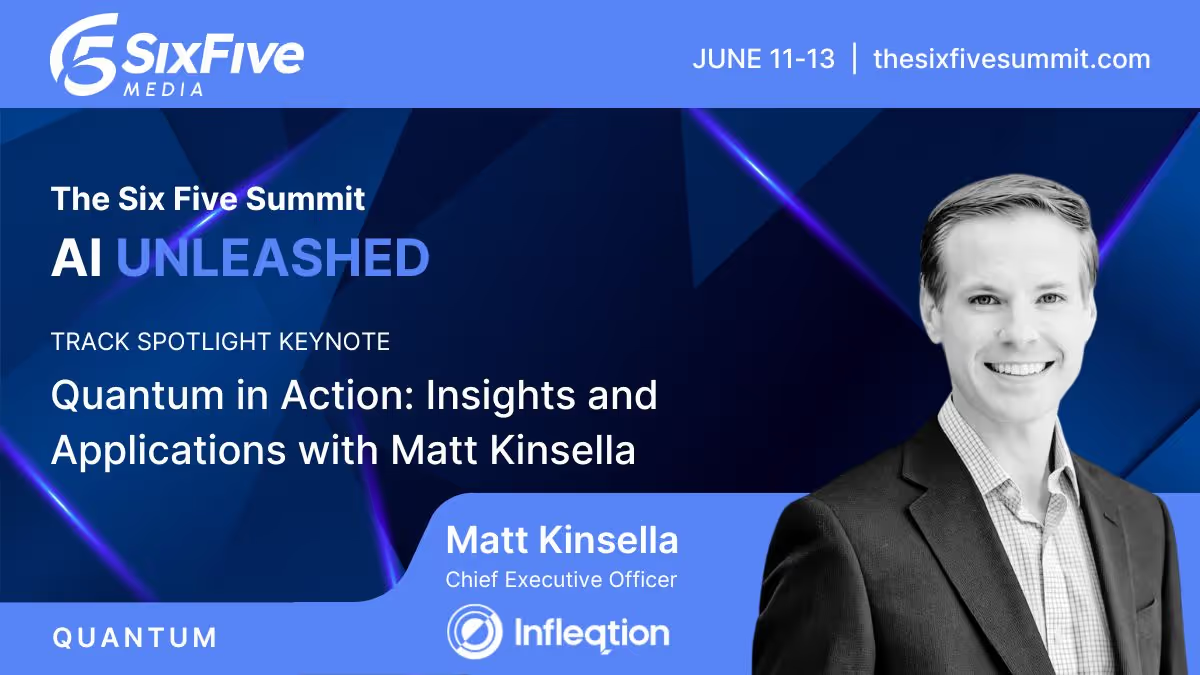
Quantum in Action: Insights and Applications with Matt Kinsella
Quantum is no longer a technology of the future; the quantum opportunity is here now. During this keynote conversation, Infleqtion CEO, Matt Kinsella will explore the latest quantum developments and how organizations can best leverage quantum to their advantage.
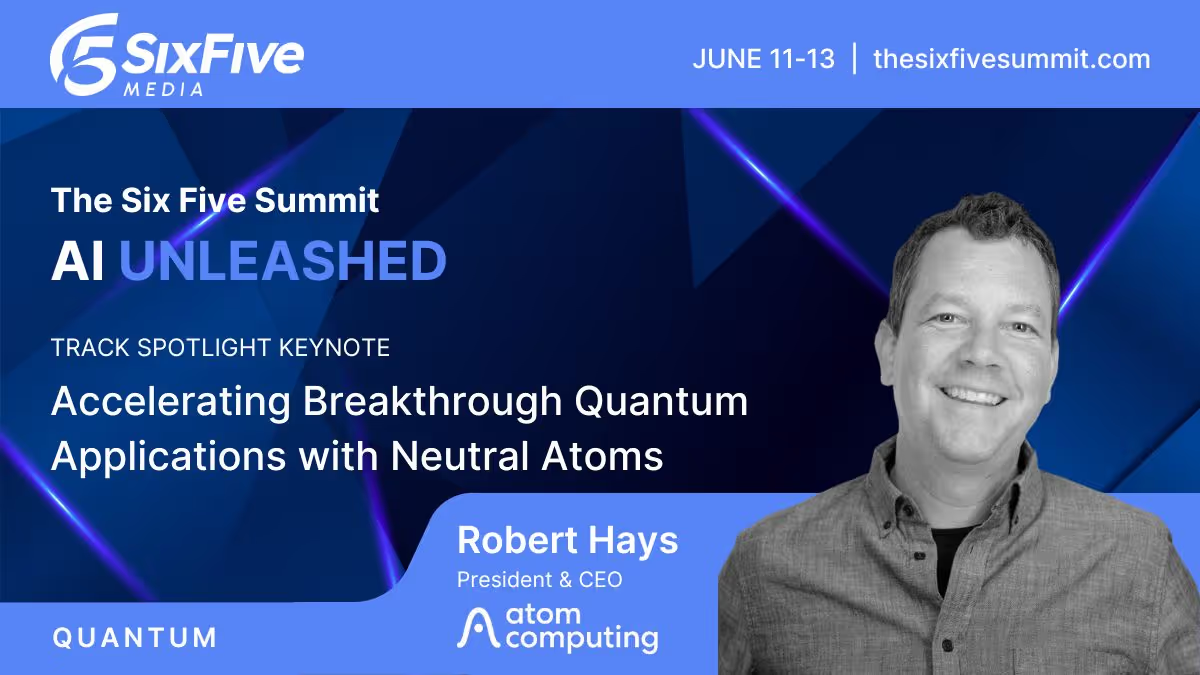
Accelerating Breakthrough Quantum Applications with Neutral Atoms
Our planet needs major breakthroughs for a more sustainable future and quantum computing promises to provide a path to new solutions in a variety of industry segments. This talk will explore what it takes for quantum computers to be able to solve these significant computational challenges, and will show that the timeline to addressing valuable applications may be sooner than previously thought.