
AWS Containers & Serverless Update from AWS re:Invent 2025 - Six Five On the Road
SHARE


Barry Cooks, VP of Compute Abstractions at AWS, joins Patrick Moorhead and Daniel Newman to discuss the latest innovations in AWS container and serverless technologies, offering valuable insights for developers and IT leaders looking to accelerate business outcomes.
How are AWS containers and serverless innovations reshaping developer experiences and cloud performance in today’s evolving tech environment?
From AWS re:Invent 2025, hosts Patrick Moorhead and Daniel Newman are joined by Amazon Web Services’ Barry Cooks, VP, Compute Abstractions, for a conversation on the latest technological innovations in AWS containers and serverless computing. They highlight how these advances are enabling developers and technologists to build cutting-edge systems faster, addressing key challenges and supercharging business agility.
Key Takeaways Include:
🔹Addressing Developer Pain Points: Insights from AWS conversations at re:Invent 2025, highlighting what IT professionals need most from cloud providers and the adoption challenges they face.
🔹Opinionated Compute Options: The rationale behind AWS offering more prescriptive solutions and how they streamline user experiences and reduce complexity.
🔹Advances in AWS Lambda and Serverless: New capabilities designed to improve performance, flexibility, and developer productivity.
🔹Evolving Containers for AI: Innovations addressing the unique demands of AI workloads and how AWS is helping customers adapt.
🔹The Future of Cloud Computing: Barry Cooks’ perspectives on trends fueling the next wave of cloud growth and innovation.
Learn more at Amazon Web Services.
Watch the full video at sixfivemedia.com, and be sure to subscribe to our YouTube channel, so you never miss an episode.
Listen to the audio here:
Disclaimer: Six Five On the Road is for information and entertainment purposes only. Over the course of this webcast, we may talk about companies that are publicly traded, and we may even reference that fact and their equity share price, but please do not take anything that we say as a recommendation about what you should do with your investment dollars. We are not investment advisors, and we ask that you do not treat us as such.
Patrick Moorhead:
The Six Five is On The Road here in Las Vegas, Nevada. We're at AWS re:Invent 2025. Unsurprisingly, the biggest themes have been around agentic AI for enterprises. Daniel, we've seen the full stack all the way from the hardcore infrastructure at the bottom or at the top, applications on top and everything in between.
Daniel Newman:
Yeah, we knew this was going to be a big year. It's been big for the AI boom, but we knew for AWS, it was a big year because it was a prove-it year for the company. It is the biggest cloud by revenue. It's got a massive customer base and it really has an AI story to tell. And Pat, you and I have covered the AI story for a long time, the SageMaker era, the building ML and applications on AI. But we are in this kind of new, I call it the GPU compute era, they may call it the Tranium compute era, but we are in this new era. And yes, we make jokes on the scenes, not all applications and not all things are AI, but gosh, you would never know it.
Patrick Moorhead:
No, it's absolutely right. And hey, one of the traditions we've had here at reInvent with the 6.5 is talking about serverless and containers. I mean, If you're building applications today and you're not leaning into these, you're probably not a developer. Sure, I mean, virtualization is cool, but serverless containers are cooler, coolest.
Daniel Newman:
Yeah, we went like big abstraction.
Patrick Moorhead:
Yes.
Daniel Newman:
By the way, that'll be funny when you introduce our guest. All the way to just straight nerdy now, which is super fun.
Patrick Moorhead:
Totally. Nothing more fun than that. So let's bring in our guest, first time guest on The Six Five, Barry Cooks, VP of Compute Abstractions. Great to see you.
Barry Cooks:
Yeah, thanks for having me on. I really appreciate it.
Daniel Newman:
So you spend a lot of your time talking to developers. So let's start there. I mean, we can get into the nitty gritty of containers and serverless, but you're trying to solve problems for developers. What are the big problems that are on the developers' minds that you're talking to right now?
Barry Cooks:
Yeah, I think for us, it's been the challenge of making it easier, consistently raising that bar on how we can get developers to find a faster, easier path onto the cloud. I think in a lot of cases, what we've observed in the past is you run into little things that you need to go figure out that slow you down. And so a lot of our effort has been, hey, can we make sure that our abstractions are clean enough to cover all those boundaries and give people a really simple experience as a developer to focus on your code and nothing else? And we'll handle the back end. And that's been a big focus for us this year.
Patrick Moorhead:
So I've heard you talk about opinionated compute options. Okay, we know you have an opinion and we know there's options for compute, but can you first of all tell our viewers what that is and what's the vision behind that?
Barry Cooks:
Yeah, so our focus has been any abstraction is an opinion, right? That's basically what it always boils down to. And sort of internally, we have sort of three pillars, right? So one is make it easy, right? If an abstraction isn't easy, it's not gonna solve the right problem and then you're just, people are gonna wander off. So you got to make it easy. You got to make it super simple for a developer to say like, okay, I'm mostly doing my code. This all works for me. I think the second thing that we've had as a big focus recently is what I call no cul-de-sacs. You don't want someone to adopt one of these abstractions of ours. like Lambda, for example, and then feel a year or so later like, you know, my workload pattern has changed, things are bigger on my side, and it doesn't feel like it's fitting anymore. They feel like they've gotten into a cul-de-sac, they've got to back out and think about their architecture again. So we really, really don't want people getting into that kind of mode. And then the last one is really about our expertise and your innovation as a customer. You want to focus on your business logic. You want to focus on your innovation. We've got 20 years of experience running at global scale. We want to expose that and let that be part of what we offer in the abstractionist. You just get our expertise for free as part of the abstraction.
Patrick Moorhead:
And I'm curious, just to follow up to that, where did price and speed factor into that?
Barry Cooks:
Well, they always factor into everything. I guess you're on a spectrum. You're making trade-offs. I think if you leverage the abstractions to the max, like in the case of Lambda is kind of our classic abstraction because it is pure developer play. You don't know about our infrastructure or anything else. So if you come in that door, you can move super fast. It is so easy to get started, so easy to build applications. But if you scale up big enough, you start wondering about some of these price trade-offs and you start wondering about performance trade-offs, right? Because you're using abstraction, which means you're getting our best view of how we can give you compute performance. So we've launched some new things this year just specifically to deal with that. So Lambda launched this year Managed Instances. And this is going to be super weird because it's kind of serverless.
Patrick Moorhead:
I was going to say it's like an abstraction of an abstraction.
Barry Cooks:
Yeah, people, there's a bunch of memes flying around internally on this now that I launched. But the funny thing about it is it actually fits our enterprise customer base super well. because most of them are already buying EC2 for some other use case they may have. For their developers, nothing changes. They're still just Lambda developers. They're still just writing code. They're still focused on business logic. But from an operations perspective, you can now select instance types, which means if you've got like an IO intensive workload, you no longer don't have a worry of like, is Lambda going to handle this well? Is it going to scale the way I expect? Like I can go pick an IO, instance from EC2 and say, go run these lambdas on that instance, and we'll go do that. You don't have to manage the instance. We're still going to manage it. We'll patch it. We'll deal with all these things that tend to be a challenge. But we're giving you this ability to say, hey, I know what I need at scale. I'm at enough scale that I really want to go focus on something specific, like Graviton as an example.
Daniel Newman:
So it's like serverless picking, but yet picking a server?
Barry Cooks:
Yeah, exactly. It's a serverful serverless. It's a weird way to put it.
Daniel Newman:
Are we going to go down this rat hole? I hope not. Oh, come on. Come on. You guys got to let me have my fun. All right, so you started kind of what I wanted to ask you. You started going down the path of what's kind of hot and new in serverless, what's hot and new with Lambda. So beyond what you just shared, what else is going on in serverless?
Barry Cooks:
Yeah, there's a host of things we've done. We've been pretty busy this year. The teams have been doing an amazing job of really focusing on execution. We really want to kind of return to our roots. and deliver for customers rapidly. See the innovation, get on top of it and deliver. So this year for Lambda in particular, we did the managed instances launch. We're super excited about that. you know, but in the classic, but wait, there's more. We did a lot of other stuff. So durable functions launched. And so this is a really good one in the agentic world. You were talking about AI a little bit and kind of where that's playing roles. And oftentimes these are, you're doing a chain of events that you're putting together. And the nice thing about durable functions, one of the things in the chain of events may be an agent calling into an LLM for an answer to something. And so you're going to have these pauses in between these things. Today, what do you end up doing? You have retry logic you have to write because you're going to make this call. And what if it fails? Am I going to retry it? And you've got to track state and all these other pieces. With Durable Functions, we're going to take care of that for you. And as a developer, it's just all code-based. So you're not scrambling around some UI and then writing code. stuck in two worlds. You're focused on writing code, laying out your steps, and then we'll make it idempotent for you. We'll go do the retries for you. We'll let you, you know, my joke earlier today with someone was like, if your VP of IT is part of your process and they need to approve something, so you go through like a manual approval process, they can be on their four week golf trip. When they get back, it'll fire right back up after they approve and the steps will continue executing. And so you can have things sitting around for a year. before they'll start to time out. And that gives you a huge amount of time to really be flexible in how you do this, and then we're only going to charge you when you're actually executing. So if you're paused, you're waiting for the guy to come back from vacation, you're just paused. You're not paying for that.
Patrick Moorhead:
So I want to shift to containers. So containers aren't new, but the innovations inside of containers, you know, it's funny, we think that, hey, we couldn't see innovation in the space and boom, a problem or a challenge comes up and AI is the next new challenge. If nothing else, it's calling new types of compute resources that need to be managed differently. So talk about some of the innovations that you're putting into containers for AI.
Barry Cooks:
Yeah, I think one of the biggest things we did this year, we actually worked in conjunction with Anthropic and said, like, how are you doing your training at scale? What are the kinds of challenges that you face? They love Kubernetes. It's one of their favorite things. They happen to be an EKS customer, so we're pretty excited on our side about that. And so we went and worked with the community and the open source world, our core development team, and Anthropic, and we changed the game with respect to scale for Kubernetes, for training workloads specifically. So we now support, I think it's 100,000 nodes in a single Kubernetes cluster. So when you're trying to train a massive AI model, you want to do it at real scale, it's the one place you can do that, and we're building Cloud with them on that cluster now. So it'll have 1.8 million traniums at max capacity. So it's a huge way to really take on the scale of what people want to be able to do with AI models.
Patrick Moorhead:
Did you have to do anything to modify your containers for performance, for latency, or things like this to get that scalability? Because it's one thing to scale. It's another thing to scale with performance as well.
Barry Cooks:
Yeah, we launched, actually, last year at reInvent, something called AutoMode, which is a managed instances, but on the container side. This year we did the same in ECS, managed instances for ECS. And part of what we're doing with those launches is we're providing additional management of the containers. So bin packing to give you the most efficiency for your container run times. We spent a lot of cycles looking at startup time, how quickly we scale up, because one of the things in these agentic worlds is you get much burstier workloads. So you want to be able to quickly scale things up and respond to the kinds of situations that customers will find themselves in that they weren't in sort of prior to all of the AI buildup.
Patrick Moorhead:
Yeah, I want to go kind of side topic here. Sure. My apologies. I know you've got questions you want to ask.
Barry Cooks:
Sure.
Patrick Moorhead:
Okay. So one product that came out this week was called Transform. There was one formerly known as Q that would take a VMware virtualization and pull it into KVM. and into a container, and I'm curious, do your worlds intersect here in this environment, or am I just making something up as an analyst or being a junior product manager?
Barry Cooks:
No, I mean, they do. Lots of customers are trying to figure out how do they get their on-prem estates moved into the cloud. And, you know, it is more challenging than anyone. You know, we talk a lot about AI and all the hype and the reality is we got lots of people still running mainframes and you would have thought they went out of style in like 1978. So these things last a long time. And what Transform is helping our customers do. is help them with an AI-based model that is built on our best practices for how to take an application and move it into AWS. You can target that at EC2. That's a pretty common target. We have other targets which include containers. We have targets that include Beanstalk. We have a host of different ways that we can land you in AWS. And we work with most of these customers to say, where are you at on a maturity scale? What are your users and your operators like? If you're coming from a VMware environment, you have point-and-click operators in many cases, because VMware's strength was its UI, where it had that, the whole vSphere UI was quite impressive. And so jumping into the cloud, it's a different model. And so we work hard to make sure that we're mapping to what the customer skill set is.
Patrick Moorhead:
So Transform can take you into your compute abstractions. Absolutely. Okay. Absolutely. Thank you.
Daniel Newman:
So as we sort of wrap up here, Barry, you have a big remit here at AWS.
Patrick Moorhead:
It's going to be four pages long.
Daniel Newman:
The title is VP of Compute Abstractions. Remind me, so you have Container, you have Serverless, you have SageMaker.
Barry Cooks:
SageMaker AI is in there. I've got our HPC business, some of our commercial apps, and then our quantum experimentation, the bracket service.
Daniel Newman:
You know, with all that, you know, in your scope, you are looking at cloud very holistically, not just, you know, we spend a lot of time on serverless, a lot of time in containers. Just like to get your sort of read, you know, where do you see kind of cloud going? What's your big vision for this business? How's it going to change over the next few years?
Barry Cooks:
I mean, it's pretty obvious. This is where AI is going to kick in. You know, we've had lots of conversations. I think when we talk about AI last year, there was a lot of hype. There was a lot of noise, but there wasn't a lot of proof points yet. And I think the thing about the AI systems these days is people are starting to use them in anger. And they're starting to see real results. They're struggling a little bit because it's not the most consumable piece of tech yet. There's a lot of expertise and experience that goes into building models or customizing them for those enterprise use cases. But it's clear that these agent-based systems, it has legs. That is going to be the way that people do things. And so a lot of our attention, we launched a bunch of MCP servers this year across my portfolio. And part of the reason we did that is we recognize agents are going to be running our systems. We need to make the systems as friendly to agents as we're trying to make them to humans. Because both of those things are going to be involved in the future, and you have to serve them both. And they have different needs.
Daniel Newman:
Yeah, I think we actually did some research. Signal, we have a performance lab too. We have 65 of the media, but we also have Signal 65, which is our performance lab. We did some testing with AgentCorp. And we actually tested kind of DIY versus AgentCorp. And some of the findings were really compelling. I think it was like 75% less time spent on infrastructure to deploy agents. I think what we've realized is there's been a ton of energy in inference and how much throughput. how many tokens, how big windows are, and we've spent a lot of time on that, but businesses are kind of like, can I automate this process? Can I make it autonomous? Can I have a human and an agent interacting, collaborating, and get a good outcome? Staying within policy frameworks and safety, and of course, doing these things at scale, and do I have a way to use the observability stuff that's in your observability business to be able to monitor this and then evaluate how well the agents are? I mean, that's where it's all heading, right?
Barry Cooks:
I mean, one of the classic things here to never lose sight of is the fundamentals and the basics matter. Having that data, like you're talking about observability, having deep, good observability data helps humans resolve problems. It's absolutely required for AI systems, right? Having that speed, having that ability to deal with bursty workloads, those are fundamental things that we worked on for many, many years. They now play an even bigger role because they're fundamental to being able to have the agents spin up on demand and do the tasks that are needed to be done. So I think in the end, It's kind of a classic one, but fundamentals matter. You never give up on the fundamentals.
Daniel Newman:
So last question just for fun. You know, the analysts got to talk to Matt for an hour today. We all asked questions. Pat asked a good one. I asked the question too. But someone asked him about quantum. And since you said that's your baby, they asked him, when's quantum going to be, you know, when's it going to really be meaningful, you know, in the market, not in research labs, not an expert. When is it commercially viable? I won't tell you what he said.
Barry Cooks:
I was going to say, you got to tell me what Matt said.
Daniel Newman:
I can't tell you what he said, because this is the way.
Barry Cooks:
You're going to get me in trouble with my boss.
Daniel Newman:
Well, we can edit this, you know.
Barry Cooks:
No, you're all good. No, we're not editing.
Daniel Newman:
We're not going to edit this.
Barry Cooks:
Yeah, so look, quantum sort of somewhat infamously has always been five years away from being five years away. Yes. That's the joke. And I think that right now we're starting to see real signals of the ability to do real work on a quantum machine. Does that mean it's going to be like fully, like these are very complicated systems, so no. But in the next couple of years, say two to four, I think you're going to see quantum systems that hold it together long enough to do real work. And that's going to be pretty game changing when that happens. Right.
Daniel Newman:
I believe Matt said he was an optimist. I think he said something like five, but- I think he gave the five years.
Barry Cooks:
Yeah.
Daniel Newman:
He did five, but he said maybe it's seven, but he said five, but he's like, I'm an optimist.
Barry Cooks:
I'm pretty optimistic on this too.
Daniel Newman:
I also think it depends on what we're considering real work and how long- That's the problem, yes. to be stable, to do the work and whatnot. But it does seem, and again, there's different systems and superconducting and that, and which one, which modality ends up winning. So it's gonna be a great touch.
Barry Cooks:
You guys don't really care in the end though, because you guys- We have a horse in the race, but the bracket service, which is my area, we are trying to help our customers try them all. We want them to be able to experiment with it while it's still experimental, get their experience. We learn from that as well. That helps us build a better abstraction layer, back to abstractions. So that when it becomes a reality, we have an easy way for you to go take advantage of whatever the winning factor is.
Daniel Newman:
Yes, that's right. And that's what I kind of meant in the end. Yes, you have your own silicon, but you're also happy if they use AMD or Intel or NVIDIA. You have bracket because whatever quantum computer they want to be able to simulate, they can do it. But of course, companies like Amazon are going to want to have their own thing too. That's how it goes. Hey, Barry, thank you so much for joining us. And thank you everybody so much for joining us here at AWS reInvent 2025 here in Las Vegas. It's been a great show. Subscribe, follow us, check out all of the Six Five coverage here on the ground at the event. Of course, be part of our Six Five community and every week you can hear from Pat and I and all of the great analysts across our firms. But for this show, this episode, it's time to say goodbye. See you all later.
MORE VIDEOS
WD's Tim Rausch: AI Storage Demand Compounds With Every GPU Cycle
Western Digital's Tim Rausch argues that AI's compounding data growth, more than GPU capacity, sets the real ceiling on infrastructure scaling. He joins Matt Kimball at AI InfraSummit 2026 to walk through how total cost of ownership, archived data reuse, and WD's capacity roadmap are reshaping enterprise plans to scale AI over the next several years.


.png)
The Main Scoop Ep. 45: Attackers Only Need to Be Right Once. AI Just Made That Easier.
Chad Rikansrud, R&D Software Security Engineer at Broadcom, explains how frontier AI models are finding decades-old mainframe vulnerabilities in seconds, collapsing the complexity advantage that once protected legacy platforms. He outlines why enterprises need faster Security Intelligence (SECINT) ingestion and disciplined human oversight to keep pace with adversaries wielding the same tools.
Fleet-Scale Deployment Is the Physical AI Benchmark
Physical AI is shifting from lab prototypes to fleets of machines operating reliably in the real world, and Ambarella's Muneyb Minhazuddin joins Six Five On The Road at AI Infra 2026 to explain what that shift demands of silicon, memory and developer workflows. Minhazuddin traces the case back to a 22-year-old chip architecture and forward to a developer cloud built to compress model porting time from months to days, and he identifies enterprise ROI proof points as the biggest hurdle left before physical AI scales into millions of deployed units.
Other Categories
CYBERSECURITY
Threat Intelligence: Insights on Cybersecurity from Secureworks
Alex Rose from Secureworks joins Shira Rubinoff on the Cybersphere to share his insights on the critical role of threat intelligence in modern cybersecurity efforts, underscoring the importance of proactive, intelligence-driven defense mechanisms.

HP Launches World’s First Business PCs to Protect Against Quantum Hacks - The Six Five On the Road
On this episode of the Six Five - On the Road, hosts Patrick Moorhead and Daniel Newman are joined by HP's Ian Pratt, Global Head of Security for Personal Systems.
What is Autonomous Endpoint Management?
Autonomous Endpoint Management is a framework designed to unify IT operations and security teams on a single platform through real-time control and visibility.
QUANTUM
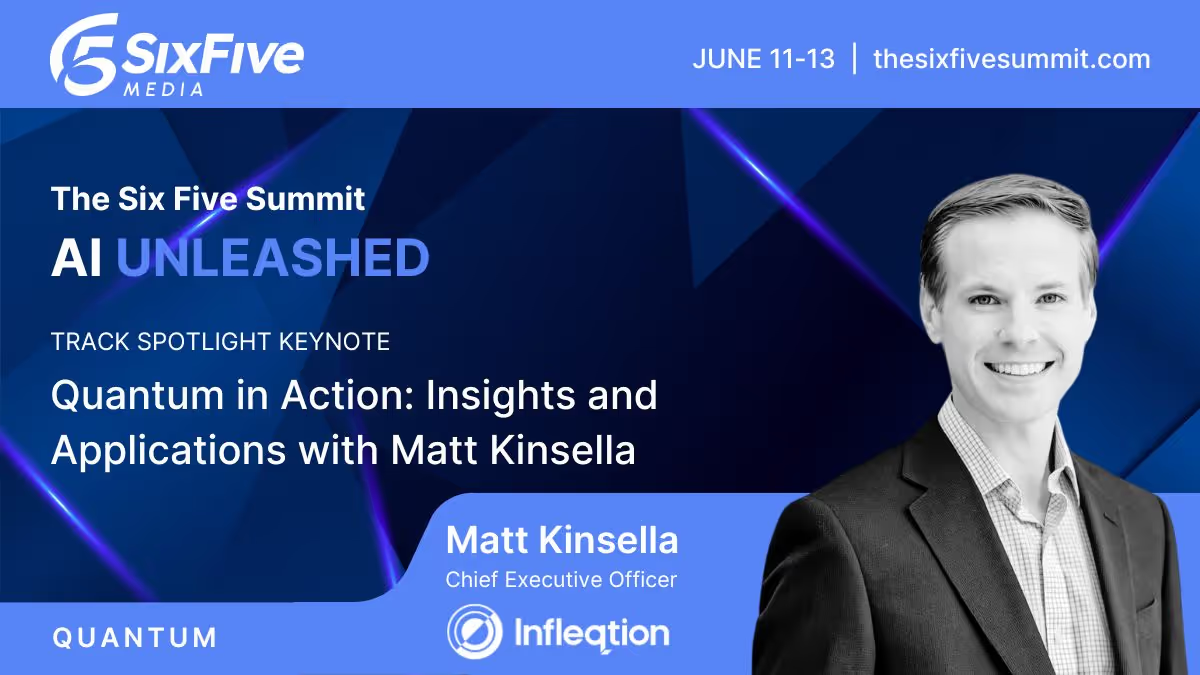
Quantum in Action: Insights and Applications with Matt Kinsella
Quantum is no longer a technology of the future; the quantum opportunity is here now. During this keynote conversation, Infleqtion CEO, Matt Kinsella will explore the latest quantum developments and how organizations can best leverage quantum to their advantage.
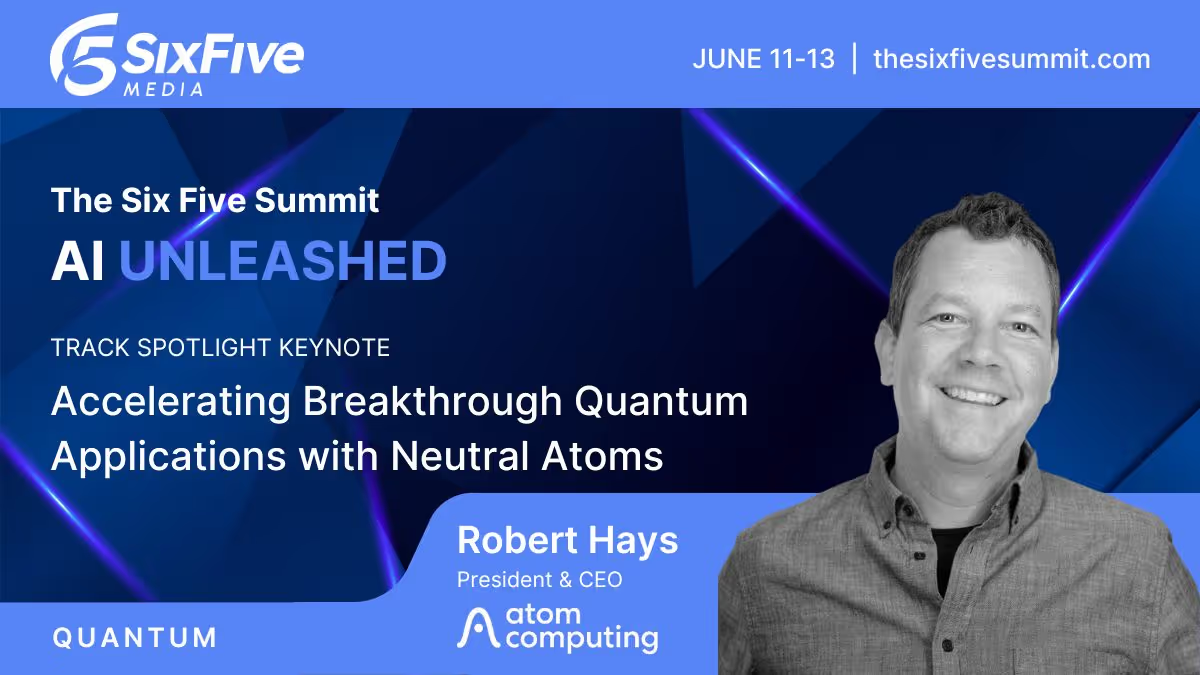
Accelerating Breakthrough Quantum Applications with Neutral Atoms
Our planet needs major breakthroughs for a more sustainable future and quantum computing promises to provide a path to new solutions in a variety of industry segments. This talk will explore what it takes for quantum computers to be able to solve these significant computational challenges, and will show that the timeline to addressing valuable applications may be sooner than previously thought.