
AWS Observability Update from AWS re:Invent 2025 - Six Five On the Road
SHARE


Nandini Ramani, VP, Cloud Operations & Search at AWS, joins Daniel Newman to discuss how AWS is advancing cloud observability through unified data lakes, integrated security analytics, and native AI-driven monitoring in CloudWatch.
How is AWS addressing modern cloud observability challenges by unifying operational telemetry and security analytics?
Host Daniel Newman is joined by Amazon Web Services' Nandini Ramani, VP, Cloud Operations & Search, for a conversation on how AWS is transforming observability in the cloud by integrating operational telemetry and security logs within a unified data lake in CloudWatch. They dig into AWS's native integration with OpenSearch, enabling powerful analytics on combined data, and new analytics experiences launched outside the AWS console, especially useful for threat detection. Nandini also addresses AWS’s approach to agentic AI in cloud operations and strategies for customers adopting AI-driven observability.
Key Takeaways Include:
🔹Modern Observability Challenges: Insights on handling the complexity of distributed cloud environments and increasing data volumes.
🔹CloudWatch Unified Data Lake: Customers can store and query operational telemetry and security logs in one place, improving situational awareness.
🔹OpenSearch Integration: Enables advanced analytics and threat detection across diverse datasets, both within and beyond the AWS console.
🔹3rd Party Log Ingestion: Out-of-the-box connectors for tools like Crowdstrike and Okta provide a comprehensive security posture.
🔹AI’s Role in Observability: Guidance and best practices for organizations of varying maturity levels in adopting AI for cloud operations.
Learn more at Amazon Web Services.
Watch the full video at sixfivemedia.com, and be sure to subscribe to our YouTube channel, so you never miss an episode.
Or listen to the audio here:
Disclaimer: Six Five On the Road is for information and entertainment purposes only. Over the course of this webcast, we may talk about companies that are publicly traded, and we may even reference that fact and their equity share price, but please do not take anything that we say as a recommendation about what you should do with your investment dollars. We are not investment advisors, and we ask that you do not treat us as such.
Daniel Newman:
Hi, everyone. The Six Five is on the road here at AWS reInvent 2025 in Las Vegas, Nevada. Been a great week here in Las Vegas at the show, as we have seen this place pack wall to wall, not just in one or two of the hotels, but really up and down the Las Vegas Strip. People are here to hear from CEO Matt Garmin and the executive leadership team and so many other of the partners that you can find throughout this great event about what is going on at AWS. It's innovation in infrastructure, it's innovation across AI, agents, developers. And another thing that the company's been focused a lot on is software data observability. And I have a great guest today that's going to join me, Nandini Ramani, not the first time on the show to talk a little bit about what's going on with observability here at AWS.
Nandini Ramani: Thanks for having me again. I really look forward to this now every year.
Daniel Newman: Yes, I got to ask before, you know, you hear me try to give the entire rundown of the show in two minutes. That's not possible. So much going on, but kind of, how's it gone for you so far?
Nandini Ramani: It's been fabulous. I mean, you mentioned Matt's keynote and I was just thinking about the layers that he walked through and the rapid fire segment with so many new innovations and features and launches. I'm really energized this year, I have to say. And I had the privilege of kicking off the re-invent this year with the very first innovation talk. And clearly, given the attendance, cloud ops is on everybody's mind. And so it's been fabulous. And by the way, the expo, for those who went there, we have so many startups on AWS. You can feel the energy.
Daniel Newman: Yeah, as an analyst, I spent a little time, you know, a lot of clients we advise and companies that we work with over in the expo, some great startups, some that were small a few years ago with big booths. So you've seen them explode, which is really exciting. And then of course, you see that next wave of companies coming up. And that was something Matt really did focus on as there is a really vibrant ecosystem of companies that are building. on AWS, and I think some of the tools, especially for agent development, Kiro, new IDEs, and everything that's going to be enabled. Because a lot of this is going to be about speed. It's going to be about the speed of being able to build and get things to market. I know we've been super focused on how fast inference and throughput, but in the end, it's like, how quick can I get an agent deployed that can do something valuable, and how do I do that most efficiently and effectively with the available infrastructure? We know there's only so much compute out there. That's definitely finite. But let's ground the conversation a little bit back into what you're super focused on. The modern observability in the stack, what are the challenges that organizations are facing right now, especially with the AI explosion and data explosion that comes with it?
Nandini Ramani: Yeah. I think that is the biggest thing. We always call it the needle in the haystack problem. but I feel like the haystack's getting bigger. There's layers of bales or whatever the vocabulary is for that. I have to think of a better analogy, but it is getting more complex. And we've seen this even before the Gen AI revolution, if you will, and it's only getting even more so. But here's what I will say. So I look at observability in layers, if you will. Matt mentioned this, and in fact, Andy Ojasi posted on LinkedIn, and it's well worth a read for your viewers. Yeah, so he talks about like our meat and potatoes, like I know you said inference, compute, storage, all of these things. We continue to evolve and innovate and lots of new features and launches related to that because that is the backbone. on which you are running these agents and leveraging Gen AI and all of those things. So we haven't forgotten that. And while agents are being deployed, there's also traditional microservices also being deployed and agents do not work in a silo. They work hand in hand with, you know, human led or agent enabled and so on and so forth. So that's thing one in observability. So the core of it still continues. Now, let's get back to your data explosion piece, because that is a key component of why observability matters and visibility into all of the data. It's still foundationally based on telemetry, based on logs, metrics, and traces, and we have lots of innovations. In fact, one of the ones was in Matt Garman's keynote with a unified data lake, and then so many other features.
Daniel Newman: So I think both of us alluded to it in my preamble and your first answer, this pivot to agentic and AI. I know you featured that prominently in your innovation talk as well. How is AWS rethinking observability because this really should change it, it should change that needle in a haystack problem. It should change the size of security teams when suddenly you have, yes, you have your SecOps people and stuff, but they have a team of agents working all the time. And this is really exciting. How are you kind of reframing that?
Nandini Ramani: Yeah, yeah. It is very exciting. So I mentioned the first layer of foundation in your earlier question. And the way we think about agents, it's twofold when it comes to cloud operations and observability. Thing one is the big announcement at Matt's keynote. How do you get agents to help you go faster, smarter, higher quality code, all of that? So we launched Frontier Agents to do that across three pillars, all three meeting developers where they are. So Kiro. the security agent, and the DevOps agent. So that's a layer of how we think about how we bring tools and agents to developers, our first most important cohort, to meet them where they are. So it has integrations into Jira, GitHub, and Slack, et cetera, which is what we all use every day. IDs are the thing. In fact, my own developers use Kiro all the time and you can see the velocity of code commits going up as we speak. And the security agent is super important because it prevents vulnerabilities from ever going to production, which is very proactive. So when it comes to observability, the key thing is, How can agents reduce your MTTR? We have classic examples of the Commonwealth Bank of Australia. They use a DevOps agent and they have found that they could resolve issues in a matter of minutes, like 15 minutes to resolve an issue relative to the hours that it would take them previously. Just think about the Freedom it gives you to continue to innovate for your customers instead of troubleshooting. So, super powerful from a agentic space. But when it comes to agents, there's also the next layer of it, which is that agents are awesome. They help you get more efficient, faster, smarter, et cetera. However, think about it, let me give you an example of a chatbot handling a billing issue for your end customer. In a matter of seconds, it goes through all kinds of data and everything and gives a response to the agent. Now, when it comes to observability, it's no longer just enough to say it ran with a latency of two seconds and a status code of 200 and whatever parameter. All of that's important, don't get me wrong. But observability when it comes to agents is taking it an additional direction because you need to understand the decision tree of what your agent is doing. How do you know which model it invoked? What every knowledge-based query that it's doing, you need to be able to track it. So one of the other innovations we've launched recently is the agent core observability in order to monitor what your agents are doing. In fact, I now call the new observability as your control plane for trust, safety, and accuracy, because when you deploy agents, it has transformed the meaning of observability. And I will take it another level and tell you agent core evals, evaluations was another announcement, that goes into how do you observe the trustfulness, helpfulness, accuracy of the agent? Like it can respond, but if it's unhelpful answers, It's not the same.
Daniel Newman: No, that actually makes a lot of sense. I think for a lot of people, we're in this space between two worlds. Some people see this almost like a panacea. We get the agents running, everything starts to become autonomous. A lot of work has to be done between here and there. Others are probably slightly more fearful. If you have very sensitive data, important security, if you have regulated industries, stuff like that, you want to deploy all these technologies. It was just like the cloud was at one time. You want this because it is probably going to create an easier, scalable approach, but you're also like, who do we blame when something goes wrong? And so things like the evaluation, things like agent core observability is pretty important, and by the way, isn't something that's been talked about a lot? All these companies are saying, deploy an agent, deploy an agent. Well, who's watching all of that?
Nandini Ramani: Exactly.
Daniel Newman: I think that's a really interesting area to keep an eye on. We've been looking a lot at one of the biggest growth areas in the market. I think we put a 50% CAGR on this over the next five years, and are going to be AI platforms that basically are the tools that enable the building of AI. We see that industry being, I mean, the bull case is like almost a trillion dollars in the next five years. Now, again, it's going to grow. It's small right now. It's like 25 billion. We think it's got a lot of growth and these are the tools, the stuff you're building.
Nandini Ramani: These are totally the tools, which is why while we launched the frontier agents, in parallel, we launched the ability for you to understand what those agents are doing, not just like go build.
Daniel Newman: So Matt talked about the unified data store. That's pretty interesting. I'd love for you to talk a little bit about why that's important.
Nandini Ramani: Yeah. So when it comes to telemetry, we just went through how agents work 24-7, autonomous, et cetera. And so they're generating a lot of telemetry. And so you need a place to store the data. Obviously, you can federate. Agents can go anywhere. But today, it's still very complicated for a lot of customers. This is going back to why the foundations matter. The unified data lake, when you think about it, whether it's a security use case, a compliance use case, or an observability use case, you're looking at the same telemetry. It's VPC flow logs, it's WAF logs, it's logs, metrics, and traces from your application and your infrastructure and so on. But the use cases are different. And so today, customers have to deal with My, you know, some data is here. The other data is stored in a different database and a third one. And then you build, you have to do a lot of DIY ETL pipelines and things to bring all the data together. This lake, we've made it super simple. All your data is in one place. You can also query the data. We use open standards. Everything is in there. And so we are super excited. We feel like this democratizes data for everyone.
Daniel Newman: Yeah, you got to democratize data, the tools we kind of hit on. And by the way, we ran some analysis in our lab of agent core versus DIY. And we actually did find that there were some pretty significant savings in terms of bringing agents that were secure and functional correctly, versus the whole DIY thing. It was pretty meaningful. And we'll put some links in the show notes. So you know, you out there, they might want to see what those stats look like. They were very impressive, like in some cases, like triple digit percentage more efficient, getting these agents.
Nandini Ramani: Totally, my God, yes. And in fact, you talked about the show floor and the expo. The reason that such a vibrant startup community is because we are simplifying how you can build trustworthy agents. Security is job zero for AWS at every layer.
Daniel Newman: Absolutely. So let's look into the future a little bit. I mean, we're sort of, I think, guiding that way. We know AI, we know agents. But like, what are you excited about that this is going to enable? Because observability has been a longtime problem, as long as data has been being developed, trying to understand the data has been a problem. But AI seems like it should be really kind of creating this immediate, this much more high value. You started with the needle in a haystack. I mean, are we there?
Nandini Ramani: We're getting there. So I always look at this continuum, right? While agents help you get more efficient, smarter, et cetera, on the flip, it helps you solve a lot of old problems. It's also creating more operational complexity. You're going to have so many agents. You have to manage those agents, which is why we do a human-in-the-loop approach. I don't know if your viewers know this, but at AWS, development teams are responsible for every part of their service. You do the troubleshooting, you respond to the pager, you know. So now when you're getting assistance from agent tech, my teams use Kiro for everything. We're using the security agent, we're using all of these tools internally, but ultimately the developer is still responsible. So the assistant will continue to grow. It's generating so much more telemetry. So we have to figure out ways, hence the lake. We want to make it easy for you to have the lake. We want to give you, not all logs are equal. How do you make sure that, you know, which is why we innovate all the way from the silicon to the application layers. And I'm super excited for what's to come. I mean, I look at last year's re-invent to now, look how far we've come. I can't wait to see where we're going to be next time I talk to you.
Daniel Newman: Yeah, I mean, year to year, you know, AWS probably for the first time really since it came to market, felt a little pressure in the transformative phase of AI, and I think that's good. I think Matt was very, I think he's been doing a very good job of acknowledging it. You're doing a lot of things. challenging yourselves to build a full stack of infrastructure. First of all, that's in itself. There are companies that just do that. And then of course, you know, you're challenging yourself to, you know, develop an entire toolkit for developers. Another thing that, you know, there's companies that just do that. And so, you know, then you go everywhere in between all the traditional things you've been doing all these years, you know, for, for hybrid and for, you know, you know, Kubernetes and like everything that you built. It's so much. And so I think you guys have really embraced and now I think this year was kind of like, you know, hey, before everybody says that, you know, AI is run by and that, you know, look at all the things we're doing.
Nandini Ramani: Yeah.
Daniel Newman: And I think that's been good. And as an analyst, that's what I wanted to see.
Nandini Ramani: Yeah, and we also take an approach of having our own Nova models. We are evolving, iterating, innovating there, but we also support all the others. We always meet the customer where, yeah, exactly, Bedrock.
Daniel Newman: Yeah, and I think that's great. And that's kind of what I said, like what you're doing with Tranium, what you're doing with Bedrock, it's kind of, because I think cloud is a little bit of a, to some of the things you were saying, it's a little bit of a choose-your-own-adventure for most companies. Some companies really want almost that whole drag-and-drop. They love to work with you guys or Cloud Code and to develop as far as they can take it. There's some people that like the lovable experience. They literally just want to type what they want. Then there's other people that are like, no. I think Matt said this in the analyst session earlier. He's like, people that already know how to use this stuff, that already know how to code, for instance, are going to do really great things.
Nandini Ramani: Even bigger and better things, exactly.
Daniel Newman: And that's the opportunity. So speaking of the opportunity, though, you know, every enterprise wants to adopt all this stuff. I've spoken to countless boards, and there's not a CEO on the planet that's not under great pressure to put AI to work, get more efficient, get more productive, and grow. But the risks that come with that, you're opening a lot of risk to data, to the exposure, to security vulnerabilities, privacy, to the governance risks that you have. And this is where observability and the stuff that you're saying is so important.
Nandini Ramani: Totally, yes.
Daniel Newman: How do you kind of guide and recommend customers to do both? Because I feel like sometimes it's like a push-pull. And security has the security part of observability, sometimes it's kind of come later. I always call it insurance. It's like, oh, I got to buy that. But it seems like it's something you really want to do together.
Nandini Ramani: It totally, and I will tell you, this is one of the things that's changed, I think, since the generative AI movement. Previously, customers would be like, I need compute, I need storage, et cetera. And by the way, just like compute storage and databases are building blocks, so is generative AI today. It's just one and the same as part of your infrastructure. But going back to that, customers that I've talked to, especially this year, previously would be like, yeah, yeah, we use some tool for observability. Now, they're demanding that we need proactive remediation, recommendations. In fact, I was talking to one of the customers who are migrating to the cloud who said, We want from the ground up, we want observability. That makes me so happy because we've been together for years, it shouldn't be an afterthought, it should be built in from the ground up. GenAI agents are certainly changing that perception and it's adding layers to observability that we didn't think about before.
Daniel Newman: So what's your one or two big pointers for all those customers out there that are watching this to get their observability strategy?
Nandini Ramani: Yeah. Please kick the tires on all our frontier agents. They're awesome. Please do that. Check out CloudWatch investigations, generative AI observability. We have so much going on. CloudTrail has aggregated events. We have MCP servers for you, so speaking of democratization, you can use the MCP server on the lake. We're making things so easy. Please kick the tires on it.
Daniel Newman: I love it. I love that you gave everyone a little pointer. It's been a lot of fun. Nandini, let's do this again next year. We'll make it an annual thing.
undefined: Yes, sounds great. Thanks for joining me.
Nandini Ramani: Of course. Thank you all for having me on.
Daniel Newman: And thank you everybody for being part of this Six Five. We are on the road here at AWS reInvent 2025 in Las Vegas. Hit subscribe, join us for all of the coverage here at reInvent and of course, all of our great content on the Six Five. For this episode though, for the show, it is time to say goodbye. See you all later.
MORE VIDEOS
WD's Tim Rausch: AI Storage Demand Compounds With Every GPU Cycle
Western Digital's Tim Rausch argues that AI's compounding data growth, more than GPU capacity, sets the real ceiling on infrastructure scaling. He joins Matt Kimball at AI InfraSummit 2026 to walk through how total cost of ownership, archived data reuse, and WD's capacity roadmap are reshaping enterprise plans to scale AI over the next several years.


.png)
The Main Scoop Ep. 45: Attackers Only Need to Be Right Once. AI Just Made That Easier.
Chad Rikansrud, R&D Software Security Engineer at Broadcom, explains how frontier AI models are finding decades-old mainframe vulnerabilities in seconds, collapsing the complexity advantage that once protected legacy platforms. He outlines why enterprises need faster Security Intelligence (SECINT) ingestion and disciplined human oversight to keep pace with adversaries wielding the same tools.
Fleet-Scale Deployment Is the Physical AI Benchmark
Physical AI is shifting from lab prototypes to fleets of machines operating reliably in the real world, and Ambarella's Muneyb Minhazuddin joins Six Five On The Road at AI Infra 2026 to explain what that shift demands of silicon, memory and developer workflows. Minhazuddin traces the case back to a 22-year-old chip architecture and forward to a developer cloud built to compress model porting time from months to days, and he identifies enterprise ROI proof points as the biggest hurdle left before physical AI scales into millions of deployed units.
Other Categories
CYBERSECURITY
Threat Intelligence: Insights on Cybersecurity from Secureworks
Alex Rose from Secureworks joins Shira Rubinoff on the Cybersphere to share his insights on the critical role of threat intelligence in modern cybersecurity efforts, underscoring the importance of proactive, intelligence-driven defense mechanisms.

HP Launches World’s First Business PCs to Protect Against Quantum Hacks - The Six Five On the Road
On this episode of the Six Five - On the Road, hosts Patrick Moorhead and Daniel Newman are joined by HP's Ian Pratt, Global Head of Security for Personal Systems.
What is Autonomous Endpoint Management?
Autonomous Endpoint Management is a framework designed to unify IT operations and security teams on a single platform through real-time control and visibility.
QUANTUM
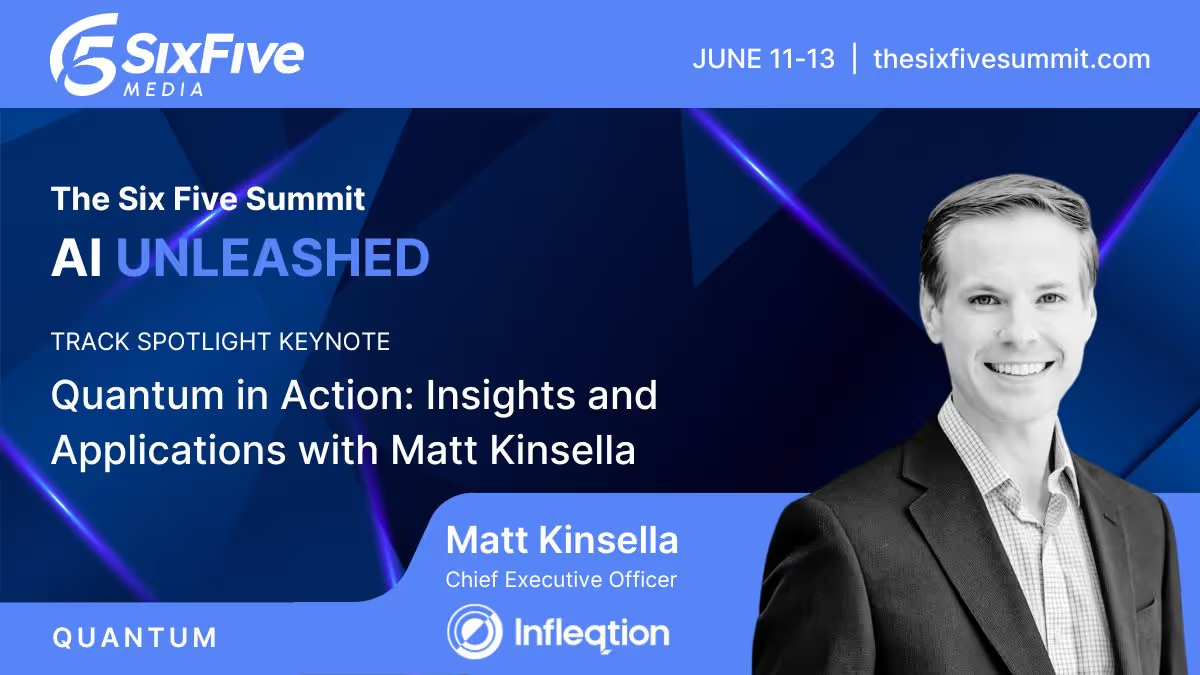
Quantum in Action: Insights and Applications with Matt Kinsella
Quantum is no longer a technology of the future; the quantum opportunity is here now. During this keynote conversation, Infleqtion CEO, Matt Kinsella will explore the latest quantum developments and how organizations can best leverage quantum to their advantage.
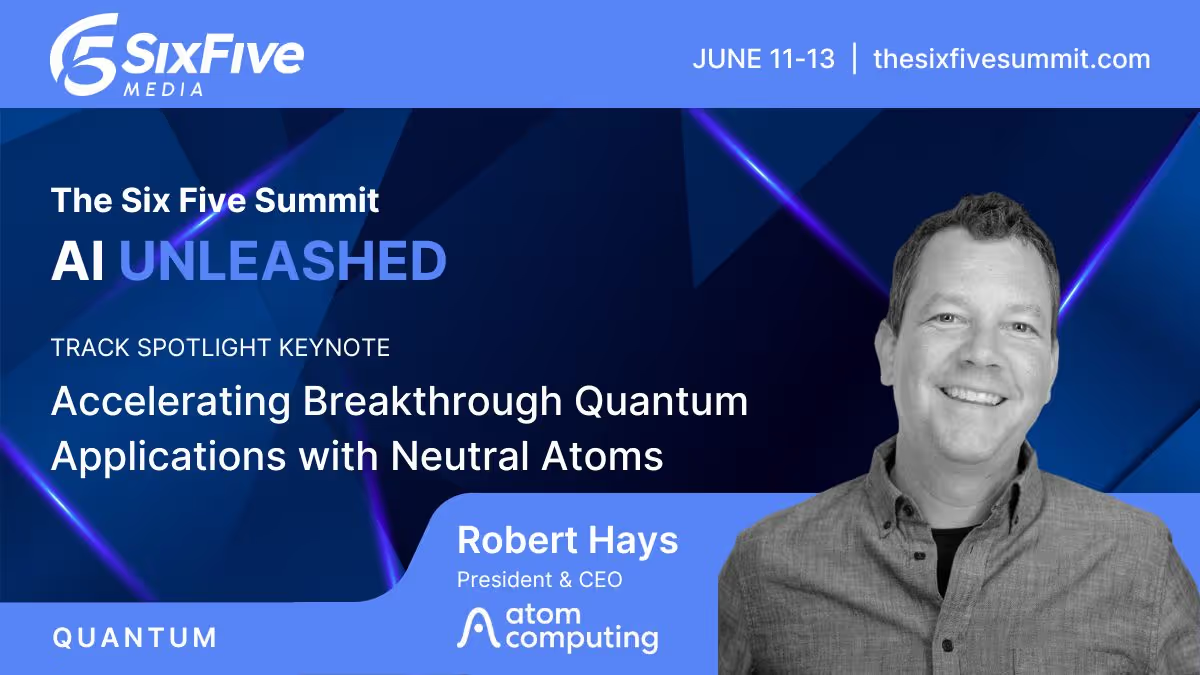
Accelerating Breakthrough Quantum Applications with Neutral Atoms
Our planet needs major breakthroughs for a more sustainable future and quantum computing promises to provide a path to new solutions in a variety of industry segments. This talk will explore what it takes for quantum computers to be able to solve these significant computational challenges, and will show that the timeline to addressing valuable applications may be sooner than previously thought.