
Cooling, Power, and Running AI in Production - Six Five On The Road
SHARE


Scott Tease of Lenovo joins Patrick Moorhead and Daniel Newman on Six Five On The Road to discuss how power, heat, and efficiency are shaping the next phase of enterprise AI.
Once AI leaves the lab, power, heat, and efficiency decide what can actually run.
From Lenovo Tech World in Las Vegas, Six Five On The Road turns its attention to what changes when AI moves from experimentation into sustained production. As compute density rises and AI workloads become persistent, the conversation shifts toward the physical demands required to support them, including power delivery, thermal management, and operational efficiency.
Patrick Moorhead and Daniel Newman are joined by Lenovo’s Scott Tease, Vice President, Product Group, ISG to examine how power availability, heat dissipation, and energy efficiency are now shaping enterprise AI deployment decisions. As higher-density systems push traditional air-cooled environments to their limits, organizations are rethinking how AI infrastructure is designed, what it costs to operate, and where it can realistically scale, with liquid cooling increasingly entering the conversation as a practical requirement rather than an edge case.
Key Takeaways Include:
🔷 Production AI introduces physical constraints: Once AI runs continuously, power availability, heat, and efficiency shape what can be deployed and sustained.
🔷 Higher density changes system design: As AI workloads concentrate more compute in less space, traditional cooling approaches face growing limitations.
🔷 Energy efficiency impacts economics: Power and cooling are now major contributors to the total cost of ownership (TCO) for AI systems in production.
🔷 Liquid cooling is becoming a practical option: What was once limited to hyperscalers is increasingly relevant to enterprises planning for long-term AI growth.
🔷 Operational planning determines scalability: Organizations that account for power and thermal requirements early are better positioned to expand AI without disruption.
Watch the full video at sixfivemedia.com, and be sure to subscribe to our Youtube channel so you never miss an episode.
Listen to the audio here:
Disclaimer: Six Five On The Road is for information and entertainment purposes only. Over the course of this webcast, we may talk about companies that are publicly traded, and we may even reference that fact and their equity share price, but please do not take anything that we say as a recommendation about what you should do with your investment dollars. We are not investment advisors, and we ask that you do not treat us as such.
Patrick Moorhead:
The Six Five is On The Road here at Lenovo Tech World in Las Vegas. We just had an incredible keynote highlighting YY at the Sphere. It was pretty incredible. All the announcements, all the luminaries and the experience was pretty amazing.
Daniel Newman:
Yeah, if you wanted to be at one thing, this was the thing to be at. It had all of the different leaders across the industry. And, you know, there was a lot of topics. We've said this a few times on the show, Pocket to Cloud and everything, but man, enterprise AI um, kicking off the year with a bang. We are not going to accept another year of AI infrastructure boom without some inference boom that yields a return of investment to all these enterprises that are spending money. You can just sense it. The industry gets it. It's time to start showing return.
Patrick Moorhead:
It is. And Part of that return is being able to build out. We've gone from three year cycles to literally one year cycles. We've gone from industry standards in racks, keep out zones in power. It's an absolute free for all right. It used to be that a rack you know racks future racks will be taking 5 to 10 times more power than they did five years ago. And two things are happening. What it does puts a strain on the ability to cool that rack, but also is driving so much power to the point that we are running out of energy and we are literally doing Manhattan style projects, at least here in North America, to to figure out how we do that. And one person that's been front and center with this doing it before it was cool with Scott tease here with Lenovo. Scott remember the day. Great to see you again.
Scott Tease:
Good to see you.
Patrick Moorhead:
Um, you know, remember when you know water cooling was looked at as a sign of weakness. Like, you either do mainframes or you messed up on your silicon and you had to. You had to water cooler. Now look at it. Now everybody's doing this. This is incredible.
Scott Tease:
It's cool. Just like me, man. It's cool.
Patrick Moorhead:
No it is. You are cool. And you look very cool in that very warm jacket. Ah, it is cool.
Daniel Newman:
Well, you know, you sort of. You sort of teased out.
Scott Tease:
Oh, man.
Patrick Moorhead:
This is getting good started.
Daniel Newman:
You started, you started teased out the topic of du jour. Yeah, I mean, look at every every part of the the energy supply chain. Like, like now you're talking about the energy supply chain. We are now going to be constrained. Um, you know, whether it's nat gas and turbines, you know, whether it's windmills, solar. Um, and so solving the problem for, for power and cooling is going to be a big part of us meeting this energy to I think it's like 120 gigawatt of projects expected to be built out by the end of the decade.
That number, by the way, those estimates go up. They keep going up. Like if you go back a year, it was like 80 and now it's like 120 and then like six more months. This is a really big thing. I mean, kind of talk a little bit about your broadly, what you're seeing in the power and cooling trends running in the industry right now.
Scott Tease:
Yeah. I mean, our the people that generate power for us are among the most conservative industry out there, right. The you know, the generation companies are really conservative. They weren't planning for this five years ago or four years ago. It takes them a long time to bring new power on board. So that's part of our issue. The other part of our issue is by 2040, we were supposed to be delivering a fully green grid, which meant a lot more solar power, a lot more wind power. So as we see all this increasing power, you know, electric cars going on the road, the data centers needs, combined with the desire to move to those greener power sources, we're just not generating enough power.
And we're not sharing enough of the green power we were hoping to generate. So it's causing real, real problems for us. So we're trying to do everything we can to make the it that we're putting out there as efficient as we possibly can. I think that's the key thing we can do right away.
Daniel Newman:
Can you help frame a little bit with real numbers, kind of the density, power and heat that is driving people to water cooling.
Scott Tease:
Yeah. You know, there really is no magic number when you have to go to water cooling. I think it's a realization that air cooling is inherently inefficient. It's just an inefficient way to do it. Moving air cost a lot of power. It costs a lot of money and a lot of power. So whenever I've got to move air, either inside the server to get it away from the CPU or the GPU or in the data center, it's costing me a lot of money. In fact, if I look at a traditional air cooled data center, I'm spending about 40% of my power budget on air movement, air handling, chiller capacity, things like that infrastructure. So imagine if you've got a megawatt, which used to be a lot of power. I mean, I'm having a megawatt data center like heck yeah.
Now megawatts, not that much power. But if you got a megawatt data center, a megawatt of IT load, you're going to be spending 400kW of that power just to do air conditioning, heat rejection, things like that. It's inefficient. We can't continue to do it as power continues to go up. That's where liquid comes in. If I can replace the air movement with liquid. Very lightweight power consumption. Easy to pump, easy to move liquid. It's far more efficient at transferring heat. And that's that's what we're focusing on with Neptune. I love it. Yeah.
Daniel Newman:
So companies are in this pilot production phase for all things kind of a some of them, it's for their build outs of their own data centers, for co-located data centers for running up their hyperscale relationships and building out and also the applications themselves. But part of it in this whole infrastructure thing is they are trying to get this cost balance right. Like, what are, you know, the sort of TCO considerations for businesses as you work with these different enterprises because they got to balance at all how much cloud load, how much on prem load, how much do they consider, you know, different thermals in access to energy and grid, if it's of course their own days or do they even have it?
Scott Tease:
Do they even have it?
Daniel Newman:
Enough energy to do this anymore? It's because it's not. It's you know, it's not trivial.
Scott Tease:
No it's not. It's power consumption. It's not trivial. And it's only going up again that those combinations of all the additional demand, as well as the desire to go green, it's going to drive up our power costs. Europe's already starting to see it. I mean, Germany and the UK saw a massive power increase over the past few years. We're going to see the same thing here. Doubling the power in the next couple of years is not an unlikely thing. So imagine how big power is is a part of your budget. Now see that kind of power cost doubling?
It's going to make for big impacts. As you do more training, it's going to drive up costs. The GPUs are not they're not going down in power. The density is not going down. They're both going up. And even when we get out to inference, you're talking about running inference 24 over seven all the time. It's like continual increase in power consumption. So there's a lot to think about with this power stuff. And on top of the cost, you've got the availability of it. Like if you've got a local data center, the chances you're going to be able to get another megawatt of power into it pretty unlikely these days. So you've got to make the most out of every what you can get, and having it go to infrastructure cooling rather than the IT or the AI or the HPC is something you don't want to see. We want to use it for the IT function, not for blowing air around the room.
Patrick Moorhead:
So I learned a lot yesterday. But one of the things was that F1 actually uses water cooling.
Scott Tease:
Yeah.
Patrick Moorhead:
That that was was pretty cool. I couldn't help but to think about all the different design changes every year that F1 has to make. And this is kind of a data center upgrade for 2026. So that's F1. But how does that translate to the larger AI opportunity? Like what learnings from this F1 experience matter to non F1 companies.
Scott Tease:
You know it's um. F1 has the same exact problem as most of our customers have right. Okay. They're looking for performance. They're looking for density. They've got to fit it into a certain power envelope that you know they're doing all this AI on the for the broadcast. They're trying to get this broadcast out in a few seconds across the entire world. So that's high performance, right? They can't trade that off. But at the same time, F1 is really focused on green and sustainability. And they do have these type power envelopes at the at the locations where it's sending these remote data centers out to.
So that combination of desiring highest performance yet needing sustainability and needing energy efficiency is where liquid cooling comes in. And companies or companies outside of that, maybe they're not race car companies, but they have the same exact problem. Okay, we're facing the same exact thing with AI. We need performance. We need density. We need to get more in there. But I've got to maintain my sustainability goals. I've got to maintain my power bill. So imagine a solution where you get you unlock the highest performance because you keep the parts as cool as possible, but you're also using the least power possible because you're not blowing a bunch of air around the room or inside the server. So that's Neptune, and that's why we're so excited about it and been for a long time.
Patrick Moorhead:
A clarifying question here for F1. Is it? Do they bring the infrastructure with them to every race or is it that this is the headquarters?
Scott Tease:
Some quarters a little bit of both. They're going to be doing both. But they do bring some out there. A lot of the edge stuff that's used for broadcast, they do bring with them and they want it in containerized data centers. So if you can do it with liquid cooling, that's a lot less stuff in that container to ship around. But they're also going to be doing back at the base data center as well to drive efficiency there. And it's pretty common. Most of our most of our installations that we see for Neptune today are actually retrofitted air cooled data centers.
That is the vast majority of them. So there may be companies out there that have been done bigger installs than we have with liquid cooling, but no one's done more like liquid air to liquid transitions. Lenovo has. We're pretty excited about it. That's to me that's the key value. What we do is that helping customers on that journey.
Patrick Moorhead:
Yeah, Jenson had mentioned on stage as well kind of your prowess in HPC.
Scott Tease:
I liked his new jacket too. I think jacket was pretty cool.
Patrick Moorhead:
He brings out a new one, right? I think it was a it was an alligator skin or something. Lizard skin.
Scott Tease:
It looked nice. It was actually very funny.
Daniel Newman:
In the investor Q&A. Someone asked him about his jacket and, you know, it was it was a funny question, but along the lines of, you know, you must be doing well. And he said something along the lines of, yeah, you know, based on the new jacket, things are going quite well.
Scott Tease:
Um, you can see it in great detail on the big screen.
Daniel Newman:
Yeah. But it was a very nice jacket. So I think no one here is going to debate AI's voracious growth. Yeah, the demand is insatiable. Um, but power cooling, thermal. These are real rate limiters. Like, what is going to be some of those key separators from the companies that are the enterprise's companies. Hyperscalers, cloud service providers that will end up being able to grow even against the limits of power and those that don't.
Scott Tease:
Yeah, I think two things to think about. And one is when you're running the big AI, you want to you want to be able to to do it as energy efficiently as you possibly can. The migration to those more energy efficient practices in the data center is a must do. Yeah. Again, imagine wasting 40% of your power going to something that's going to deliver no business value. So we've got to we've got to move those people to liquid cooling for our enterprise clients. The bigger thing we're focused on today is right sizing the AI for the model that they're going to be running. Not everything needs one of those big GPU systems or a NVL 72. A lot of it can be done in very lightweight stuff.
If I prune the model properly, it's running on my mobile phone or on my laptop or on an edge device. It's definitely running in a data center, so we're trying to do our best to deliver AI systems at our right size for both the environment but also the task at hand. And those are not power intensive. Right. Yeah, and that's real AI, just not with the power we're used to hearing about.
Daniel Newman:
I do like two and a half ton racks though.
Patrick Moorhead:
Oh, those are good. Those are fun.
Daniel Newman:
Yeah.
Patrick Moorhead:
We have more competition in the industry. Whose rack was heavier this week?
Daniel Newman:
That's that's. And who consumes the most power? Exactly. Well, but again, still driving significant generation to generation efficiency improvements. But the this is the Jevons paradox thing. It's like we're going to do so much more of it. And yeah, it might be ten x more efficient, but we have 1000 x more use. And so that's what we're up against. So we're going to have to get it right on every different you know part of the of the build out.
So Scott I want to thank you so much for joining us here.Always great. Thank you for having me. Appreciate it. Great to see you. Nice to see you. And I want to thank all of you so much for being part of the six five on the road here at Lenovo Tech World 2026. So much great content. Subscribe. Check it all out. Stay with us here. Stay with us everywhere. We appreciate you.We'll see you all later.
MORE VIDEOS
.png)
The Main Scoop Ep. 45: Attackers Only Need to Be Right Once. AI Just Made That Easier.
Chad Rikansrud, R&D Software Security Engineer at Broadcom, explains how frontier AI models are finding decades-old mainframe vulnerabilities in seconds, collapsing the complexity advantage that once protected legacy platforms. He outlines why enterprises need faster Security Intelligence (SECINT) ingestion and disciplined human oversight to keep pace with adversaries wielding the same tools.


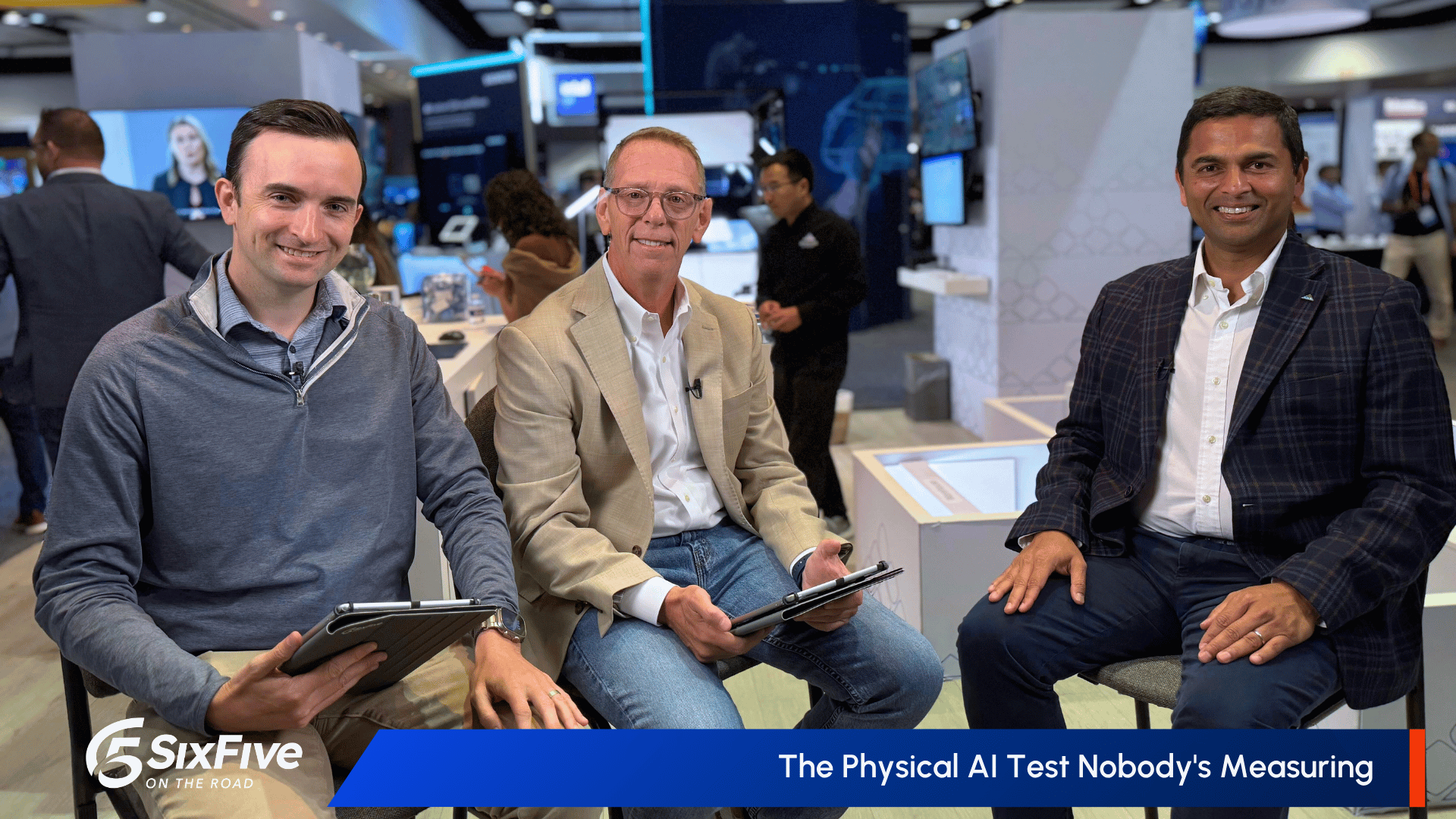
Fleet-Scale Deployment Is the Physical AI Benchmark
Physical AI is shifting from lab prototypes to fleets of machines operating reliably in the real world, and Ambarella's Muneyb Minhazuddin joins Six Five On The Road at AI Infra 2026 to explain what that shift demands of silicon, memory and developer workflows. Minhazuddin traces the case back to a 22-year-old chip architecture and forward to a developer cloud built to compress model porting time from months to days, and he identifies enterprise ROI proof points as the biggest hurdle left before physical AI scales into millions of deployed units.
.png)
AI Safety Alarms, China's Distillation Reckoning, and Qualcomm's AWS Breakthrough: A Pivotal Week for Enterprise AI
A viral AI extinction claim, a federal advisory naming six Chinese AI labs for industrial-scale distillation, and a $60 billion Qualcomm-AWS silicon pact define a week when enterprise AI risk and opportunity collided head-on. Patrick Moorhead and Daniel Newman weigh in on what's signal and what's noise across AI safety, chip supply deals, and a market rally still betting big on compute.
Other Categories
CYBERSECURITY
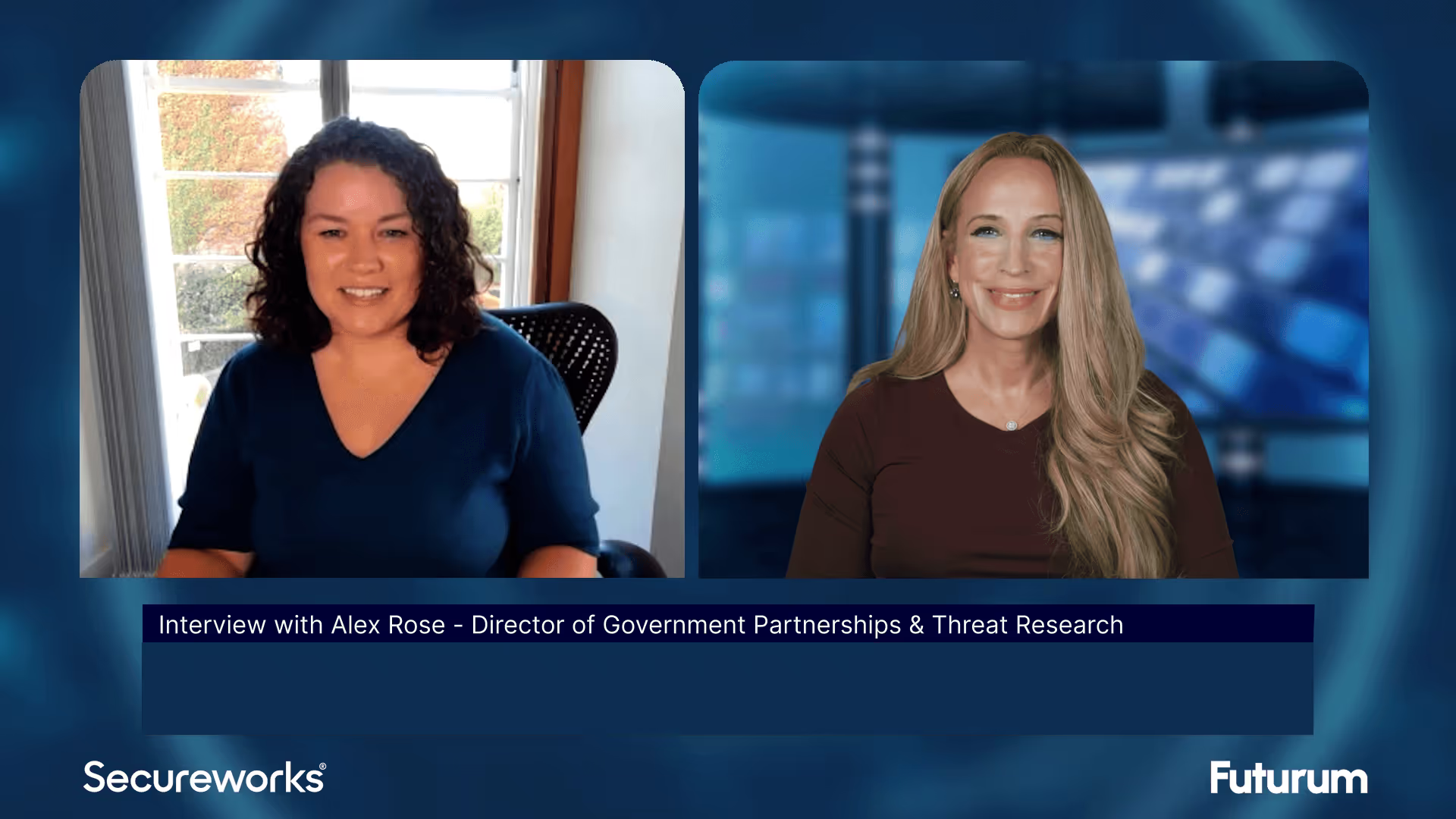
Threat Intelligence: Insights on Cybersecurity from Secureworks
Alex Rose from Secureworks joins Shira Rubinoff on the Cybersphere to share his insights on the critical role of threat intelligence in modern cybersecurity efforts, underscoring the importance of proactive, intelligence-driven defense mechanisms.

HP Launches World’s First Business PCs to Protect Against Quantum Hacks - The Six Five On the Road
On this episode of the Six Five - On the Road, hosts Patrick Moorhead and Daniel Newman are joined by HP's Ian Pratt, Global Head of Security for Personal Systems.
What is Autonomous Endpoint Management?
Autonomous Endpoint Management is a framework designed to unify IT operations and security teams on a single platform through real-time control and visibility.
QUANTUM
Quantum in Action: Insights and Applications with Matt Kinsella
Quantum is no longer a technology of the future; the quantum opportunity is here now. During this keynote conversation, Infleqtion CEO, Matt Kinsella will explore the latest quantum developments and how organizations can best leverage quantum to their advantage.
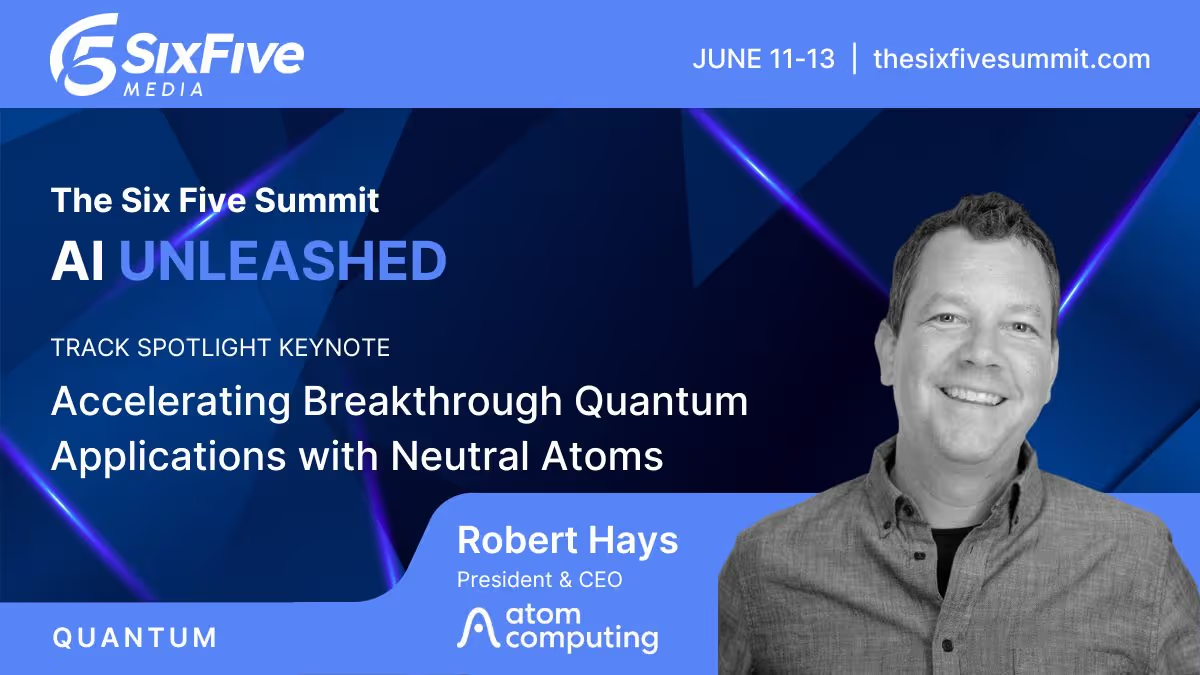
Accelerating Breakthrough Quantum Applications with Neutral Atoms
Our planet needs major breakthroughs for a more sustainable future and quantum computing promises to provide a path to new solutions in a variety of industry segments. This talk will explore what it takes for quantum computers to be able to solve these significant computational challenges, and will show that the timeline to addressing valuable applications may be sooner than previously thought.