
Digital-First Growth: A Product-Led Marketplace Journey - Six Five On The Road
SHARE


Aaron Newman, CEO at Cloud Storage Security, joins Alex Smith to discuss the company’s product-led growth strategy on AWS Marketplace, detailing how digital-first tactics have accelerated customer acquisition and created a scalable path for success.
How can startups leverage product-led growth strategies through digital marketplaces to drive rapid customer acquisition and sustainable success?
From AWS re:Invent 2025 , host Alex Smith is joined by Cloud Storage Security CEO Aaron Newman for a conversation on their experience with digital-first growth. They discuss how Cloud Storage Security’s embrace of a product-led growth (PLG) strategy on AWS Marketplace enabled the company to drive rapid customer acquisition, streamline sales processes, and build a scalable growth engine through marketplace innovation and self-service optimization. The impact? Embracing these digital channels has supported continuous product innovation.
Key Takeaways Include:
🔹Product-led Growth On AWS Marketplace: Cloud Storage Security strategically adopted PLG to minimize sales friction, enabling customers to independently discover, try, and purchase its solutions.
🔹Marketplace Innovation As A Competitive Edge: How leveraging AWS Marketplace allowed Cloud Storage Security to automate customer onboarding, accelerate time-to-value, and continually adapt its offering for marketplace consumers.
🔹Self-service At Scale: By optimizing its AWS Marketplace presence, the company created a seamless, sustainable engine for automated growth, supporting both customer discovery and ongoing product improvement.
Learn more at Cloud Storage Security.
Watch the full video at sixfivemedia.com, and be sure to subscribe to our YouTube channel, so you never miss an episode.
Or listen to the audio here:
Disclaimer: Six Five On The Road is for information and entertainment purposes only. Over the course of this webcast, we may talk about companies that are publicly traded, and we may even reference that fact and their equity share price, but please do not take anything that we say as a recommendation about what you should do with your investment dollars. We are not investment advisors, and we ask that you do not treat us as such.
Alex Smith:
Six Five On the Road here at AWS reInvent. I'm Alex Smith, an analyst with Futurum Group, and we're here to talk about marketplaces, which we see as one of the fastest growing routes to market in the software industry, and AWS Marketplace being one of the leaders of that charge. And I'm joined here by Aaron Newman, who's CEO of Cloud Storage Security, one of the ISP partners on the AWS Marketplace. Aaron, thank you so much for taking the time out of, I know, a very busy re-invent to join us and talk with us here today.
Aaron Newman:
Thanks for having us, Alex, and it truly has been a wild wind, a wild wind tour here at re-invent, as it always is. Yeah.
Alex Smith:
So first, tell us a little bit about your company for people out there that might not have heard about you.
Aaron Newman:
Yeah, so Cloud Storage Security, we are a security vendor that helps you protect the storage that you have in the cloud in AWS. And that's, you know, everything from antivirus to classifying your data to identify sensitive information. That's activity monitoring, inventory and management of what you have. So there's so much data that's accumulating in storage in the cloud. And that is the target and the goal of an attacker. And that could be an internal attacker, it could be an external attacker, but you need to protect that data. And that's what we provide is tools that help people be able to manage that and make sure it's locked down properly.
Alex Smith:
And startup, or have you been around for a number of years?
Aaron Newman:
We've been around for four or five years. And we're still in startup mode, but we're growing. And 1,400 customers in the marketplace. The marketplace has been a crucial place for us to grow. We're not a big enterprise company that has a huge sales and marketing team. So the marketplace is so powerful to allow a company, a startup company like ours to, to get into a market that doesn't exist.
Alex Smith:
So how long have you been in the AWS marketplace, like roughly?
Aaron Newman:
A little over three years in the marketplace. And so we have a product that goes in-tenant, because if you want to protect your data, you don't want it to leave your AWS account. So our product's in-tenant. So it works very well for the marketplace. Somebody can go up, can click a button, and can have it installed and use it very easily. It just makes the whole process very easy. It just greases the skids to get it out to our customers. So, you know, with a small company with a very small go-to-market team, we have over 1,400 customers.
Alex Smith:
So, what was part of your decision to actually list in the marketplace? It is just that kind of ease of use of being able to, you know, expand and, um, you reach lots of customers that you might not have had.
Aaron Newman:
I mean, the, the key to, you know, and I've, this is, I'm a serial, I'm sure this is my fifth startup and I've, I've learned, you know, not the hard way, but I've learned well that If you want to be effective in the AWS ecosystem, you have to partner well with AWS. And the best way to do that is through the marketplace. They just provide a way. And they're continuing to innovate in terms of what kind of capabilities and how do you help track what's being delivered. And they make it fairly easy to push that out there. Uh, you know, they have a search engine and they're continuing to innovate on that. So it's, you know, it's a great way to, to push it out there, particularly the way that we're implemented.
Alex Smith:
Yeah. So I know generally speaking, one of the mantras of a lot of SAS companies is product led growth, right? How can you very easily get your products and solutions into the hands of potential buyers to, you know, from a discoverability, from a trial side of things, you know, so that they can, that's always the best way to then, you know, start to familiarize yourself with the technology. So are you leaning into some kind of product-led growth strategy in your own business? And if so, does the marketplace kind of help you on that journey?
Aaron Newman:
Yeah. I mean, I'll go back with a little bit of context because, you know, at the end of the day, uh, you know, when I, 20 years ago, when you look at how software sales was done, it was big enterprise salespeople, you know, that were trying to sell million dollar deals, uh, IBM style and it was long sales process. And that changed when the cloud kind of came to market, the world changed significantly. And, you know, it was much more of a, how do I get people to start using my tool on a very limited basis? have success with it and build it. Right. And that's a much better strategy for anybody. It eliminates the risk of, you know, if I give you a million dollars, I hope the product works. I'm not going to know till a year later versus with cloud type of strategy. It's a much different sales process. It's a different market and it's way better for innovation to happen because I don't have to hire an expensive sales team to go out there and carry a multi-million dollar quota, what I just do is deliver it to a marketplace that allows people to try. And if your product works, it will get adopted. If your product doesn't work, then it's not going to get adopted. So it really lets you filter out the stuff that doesn't work. You know, because somebody can try it. They can go on there, try a free trial, or even spend a couple hundred bucks to give it a try in an environment. So it's a whole different strategy that I've seen over my lifetime doing software. And it's a much better way to do it, especially if you have good tools and good products that are useful.
Alex Smith:
Yeah. And, and especially I think in a field like cybersecurity where, you know, naturally there has to be a lot of conservatism, a lot of kind of, um, uh, risk aversion. So being able to actually experience the technology, um, before we are rolling out at a, at a, you know, widely across your organization. Right. I think it's pretty critical for a lot of your, um, potential customers and buyers out there.
Aaron Newman:
And the other side is also we, we often get drowned in these tools, right? So if you can get a marketplace that allows people to try things, see what makes sense, see what works, it's a much better strategy when you have so many different tools and all of many of the tools are valuable. Many of them are not valuable. So, you know, how do you weed through, you know, the, you, you could just. put a line down and say, I'm going to put all my money behind this company. Or you could say, I'm going to put together the best of breed for multiple places in a marketplace. And this cloud kind of strategy of small adoption and growing it is a much better strategy.
Alex Smith:
Yeah, absolutely. So you mentioned lots of tools. And I think you and I both know that the cybersecurity space is an industry that has tons of tools, tons of providers out there. Um, so how do you think about, you know, as a, as a startup and, and, you know, through a PLG kind of strategy, how do you think about, um, you know, optimizing for self, self-service discovery and, um, um, and then ultimate, ultimately purchasing hopefully as well. Are there any things you're thinking about in terms of optimizing through the Marketplace?
Aaron Newman:
Yeah, I mean, listen, you have to be, you know, there's the old classic strategies. You've got to make sure you're doing your SEO and you're putting the right search terms in there. And now we have AI, which is starting to affect that searchability and discoverability on the Marketplace. Uh, but you, you know, you have to think about growth as its momentum, right? So when I put a new product out there, I don't have to make a million, I don't have to land a million dollars, a million customers tomorrow. What I have to do is land my first 10 customers. And that creates momentum because those 10 people will talk to other people. And then you have to land your next 10 customers. So a marketplace enables that. And the AWS marketplace really gives you that ability to say, I'm going to build momentum. I'm not going to wake up one day and say, I need X. I'm going to figure out how I get my, how do I get to, how do I get to the first point? And then from there, once I get there, that momentum will drive me to the second point. Uh, second stage. So that's, that's the strategy is, you know, I, I can walk into a marketplace and say, I need to get a hundred customers in this, in this quarter, my first quarter, have it out. Let me get a hundred customers. So I don't have to boil the ocean with a marketplace. I have to just find a hundred people that are willing to give me a shot. And do that. And that momentum will then carry to another hundred or a thousand. And then you scale up from there. So it's about scaling. And it's the same concepts you'd think about with, you know, how do I scale my EC2 instances? How do I scale my databases? Right. You're scaling your, you know, when you first put out your application, you only need one EC2 instance, right. Or maybe two or three, but if you hit success, then you need a hundred, a thousand of them. So it's the same process, the same mentality with sales and going to market. How do I get one EC2 instance or one set of customers first? And then I'll grow that with momentum.
Alex Smith:
Yeah. Let's unpack that a little bit. I think you said at the beginning of the conversation, is it around 1,400 customers on the marketplace? So obviously, um, you've been able to, um, be safe, have customers identify you, find you through the marketplace. Um, and then ultimately, um, transact and become a, a subscribing, uh, customer. How has the marketplace really enabled that kind of transactional component of the sales?
Aaron Newman:
Think about it this way. We built our first product release. Our first feature we put out, there was an antivirus for S3, right? At the end of the day, would you have a laptop without antivirus on it? We all know you would not do that, right? We have tons of cloud storage out there that isn't being properly managed for antivirus, for malware, for ransomware, and people are getting hit by it, right? And that is part of, we know AWS, we have the shared security model, right? AWS gives you the tools to do it. You still have to turn the tools on. You have to implement them right. You have to put the right access controls on, all of that. But we looked at it and said, you know what? We need antivirus for the S3 environment. We built the tool very quickly, and then we rolled it out there, and people got it, right? It's a very easy solution to understand the concept of what I should have. If I have thousands of S3 buckets, I need to be just looking at those and making sure that somehow some customer does not accidentally upload some file that has a ransomware that's going to end up affecting my, my organization. So it's a very, very easy concept to understand. Once people get that, and once you start explaining it to them, it becomes a no brainer. And that's how we, you know, we, we are the number one number one solution on containers in the AWS marketplace. But it was just a simple idea that we just rolled out. And the execution's hard, because how do you scale up to the level of S3 to do scanning, malware scanning? But we have the best engineers out there, and they know how to do it. And we're just touching the tip of the iceberg right here. We have 1,400 customers. We should have 14,000 in a year or two. Because everyone needs a little bit of antivirus for their storage. And that's not just S3. What about my EFS? What about my FSX? And what about my EBS? So there's a lot of storage out there, and protecting it from ransomware is important.
Alex Smith:
Well, I think especially in the age of AI, everyone is focused on data, making sure that they've got their data lakes, that they've got their secure data lakes as well. Yeah, I guess those S3 buckets are getting bigger as well, so you have to keep scaling to meet the demand out there. Have you evolved your portfolio in the years that you've been on the marketplace and launched new solutions to kind of meet that demand?
Aaron Newman:
Absolutely. So we have a new product, Data Defender, which expands on. I have antivirus now, I need data classification across 10,000 S3 buckets, EFS files, EBS files. I don't know where my data sits anymore, right? So we help you answer that question, classify this massive amount of data. And because we have that, that pro, proximity to the data, we're so close to it and we're scanning it, we have the ability to tack on data classification to that. We have the ability to look at your access controls and make sure you've implemented those correctly. So we've just built on that suite and it's not just antivirus now, it's a complete lifecycle management of your data. Everything from classification, inventory management, secure configuration, we've built that on top of that.
Alex Smith:
Yeah. Great. So we're getting close to wrapping up, Aaron, but I think you said in the conversation you've done, you've been involved in five, five startups, I think you've said. I don't know if this is the first that you've done where you've maybe lent in quite a bit to the marketplace. But if so, like how, what are some of the learnings that you've had of, you know, kind of this, I guess, different go to market motion? What are some of the interesting insights that you've gleaned compared to some of the other
Aaron Newman:
I mean, like my last startup was a company, CloudChecker, which was very big in the AWS space. And we were a SaaS offering. So we existed on Marketplace, but this was 10 years ago when Marketplace wasn't quite as mature as it is today to deliver a SaaS through it. Now you can deliver a SaaS through the Marketplace. I mean, we see, I know some of the biggest Marketplace vendors are doing billions of dollars through there. Uh, clearly it's, it's become a much more mature platform than, than the last startup I was at. So now, uh, it's, it's definitely, you, you have to be in touch with the marketplace team to understand how to do it, how to optimize it. Um, you know, how to grow your presence there. Uh, and it is, it's, it's about working with the AWS channel. Uh, you know, going direct to market is tough in this world. Absolutely. Yeah. Right. We're riding the AWS bear, holding on, trying our best to, you know, to work with, uh, you know, and, and they shift right there. One of the most dynamic, AWS is one of the most dynamic fast-moving companies out there. And as a partner, keeping up with them can be fun, but it requires a lot of effort and innovating along with them and keeping up.
Alex Smith:
I don't doubt it, but it's good to have partners to go to market with in a very busy, crowded world. Well, Aaron, thank you so much for taking the time to share a bit about your company and also your experience with the AWS Marketplace. I know it's a very busy show here at reInvent this week, so definitely appreciate you making the time. And for those of you watching, thank you for tuning in with us. And again, this is part of our series looking at AWS Marketplace and the partners that are driving business through that platform.
MORE VIDEOS
WD's Tim Rausch: AI Storage Demand Compounds With Every GPU Cycle
Western Digital's Tim Rausch argues that AI's compounding data growth, more than GPU capacity, sets the real ceiling on infrastructure scaling. He joins Matt Kimball at AI InfraSummit 2026 to walk through how total cost of ownership, archived data reuse, and WD's capacity roadmap are reshaping enterprise plans to scale AI over the next several years.


.png)
The Main Scoop Ep. 45: Attackers Only Need to Be Right Once. AI Just Made That Easier.
Chad Rikansrud, R&D Software Security Engineer at Broadcom, explains how frontier AI models are finding decades-old mainframe vulnerabilities in seconds, collapsing the complexity advantage that once protected legacy platforms. He outlines why enterprises need faster Security Intelligence (SECINT) ingestion and disciplined human oversight to keep pace with adversaries wielding the same tools.
Fleet-Scale Deployment Is the Physical AI Benchmark
Physical AI is shifting from lab prototypes to fleets of machines operating reliably in the real world, and Ambarella's Muneyb Minhazuddin joins Six Five On The Road at AI Infra 2026 to explain what that shift demands of silicon, memory and developer workflows. Minhazuddin traces the case back to a 22-year-old chip architecture and forward to a developer cloud built to compress model porting time from months to days, and he identifies enterprise ROI proof points as the biggest hurdle left before physical AI scales into millions of deployed units.
Other Categories
CYBERSECURITY
Threat Intelligence: Insights on Cybersecurity from Secureworks
Alex Rose from Secureworks joins Shira Rubinoff on the Cybersphere to share his insights on the critical role of threat intelligence in modern cybersecurity efforts, underscoring the importance of proactive, intelligence-driven defense mechanisms.

HP Launches World’s First Business PCs to Protect Against Quantum Hacks - The Six Five On the Road
On this episode of the Six Five - On the Road, hosts Patrick Moorhead and Daniel Newman are joined by HP's Ian Pratt, Global Head of Security for Personal Systems.
What is Autonomous Endpoint Management?
Autonomous Endpoint Management is a framework designed to unify IT operations and security teams on a single platform through real-time control and visibility.
QUANTUM
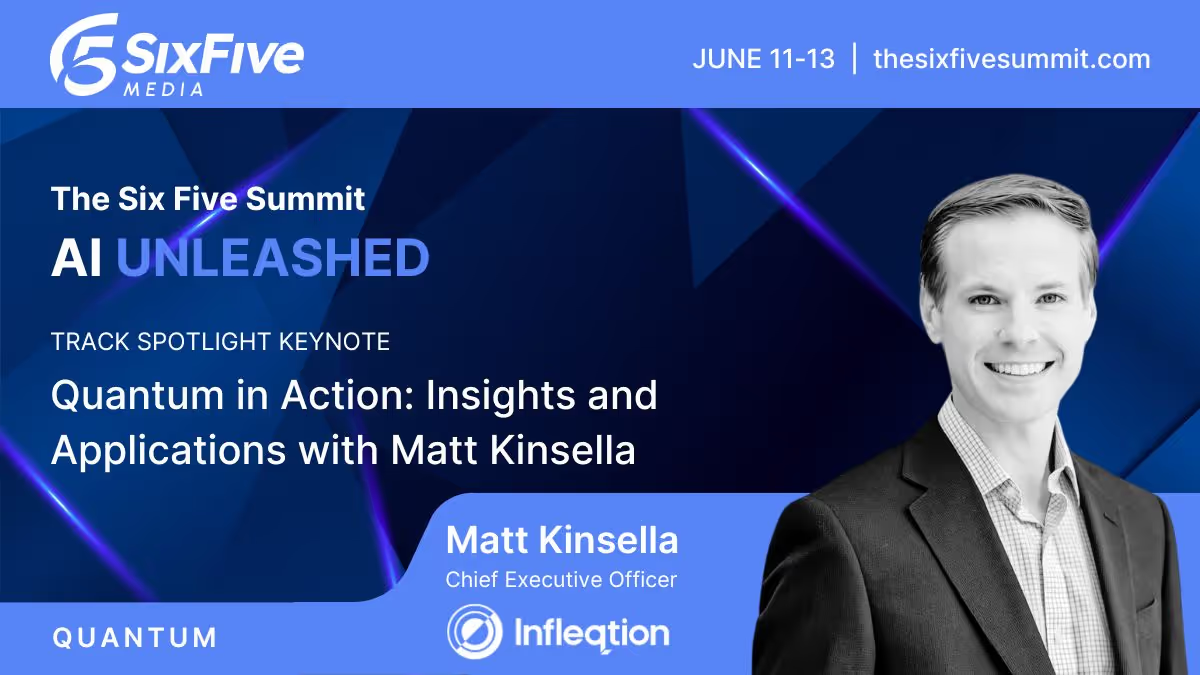
Quantum in Action: Insights and Applications with Matt Kinsella
Quantum is no longer a technology of the future; the quantum opportunity is here now. During this keynote conversation, Infleqtion CEO, Matt Kinsella will explore the latest quantum developments and how organizations can best leverage quantum to their advantage.
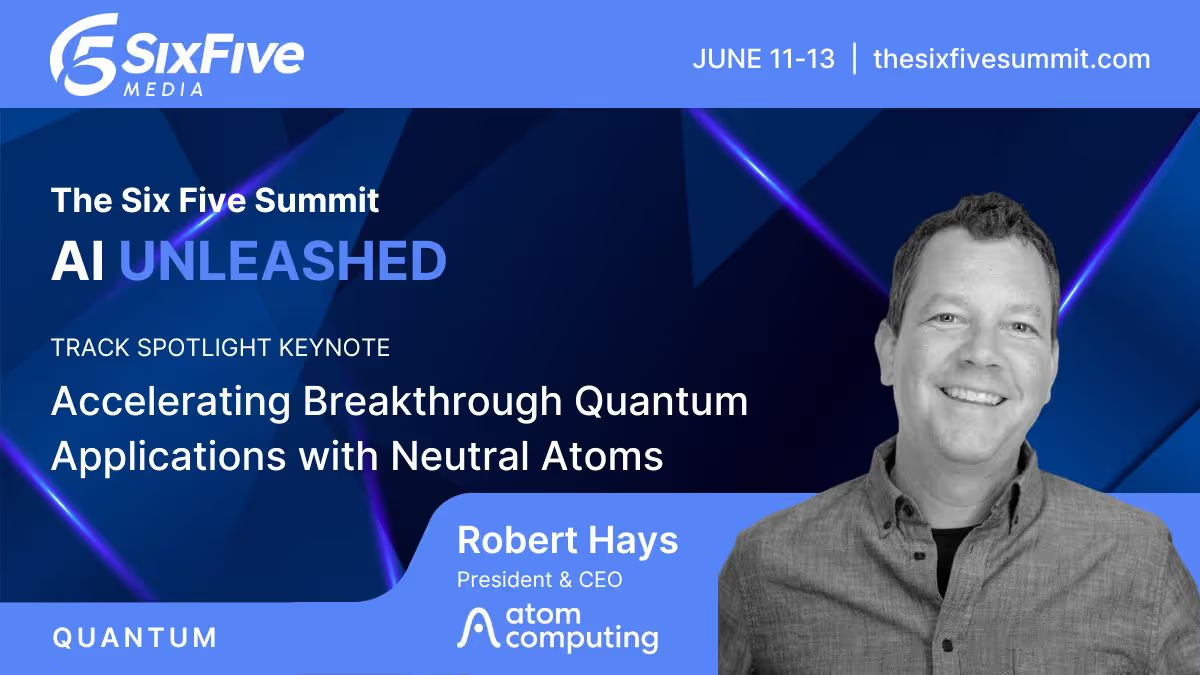
Accelerating Breakthrough Quantum Applications with Neutral Atoms
Our planet needs major breakthroughs for a more sustainable future and quantum computing promises to provide a path to new solutions in a variety of industry segments. This talk will explore what it takes for quantum computers to be able to solve these significant computational challenges, and will show that the timeline to addressing valuable applications may be sooner than previously thought.