
Driving the Future of Enterprise AI, Cloud, and Virtualization - Six Five On The Road
SHARE


Patrick Osborne, SVP of Hybrid Cloud Technology Acceleration at HPE, joins David Nicholson to share insights on how HPE is driving enterprise AI, cloud, and virtualization, with a focus on secure, compliant infrastructure and innovative data solutions.
How are enterprises reinventing their AI and cloud strategies to stay ahead in a rapidly evolving digital landscape?
From HPE Discover Barcelona 2025, host David Nicholson is joined by Hewlett Packard Enterprise SVP of Hybrid Cloud Technology Acceleration, Patrick Osborne, for a conversation on HPE’s transformation of enterprise AI, cloud, and virtualization. They explore HPE’s hybrid cloud strategy, the company’s latest data intelligence and protection solutions, and the evolving landscape of compliant, secure infrastructure for organizations with advanced AI ambitions.
Key Takeaways Include:
🔹End-to-end Hybrid Cloud: Why the company’s vision for AI factories and hybrid architectures is resonating with enterprises adapting to fast-changing technology demands.
🔹Next-Gen Storage & Data Protection: How HPE’s Alletra Storage MP X10000 Data Intelligence Nodes and StoreOnce Gen5 platforms unlock new ways to prepare, protect, and manage AI-ready data.
🔹Virtualization Beyond Legacy Stacks: The role of HPE Morpheus in overcoming current market challenges and accelerating cloud-native adoption.
🔹Data Sovereignty & Compliance: How HPE is addressing regulatory and security imperatives, especially for highly regulated industries and sovereign requirements.
🔹Future Outlook: Key trends shaping the next era of enterprise AI, networking, and hybrid cloud, with insights into HPE’s ongoing innovation and leadership.
Learn more at HPE.
Watch the full video at sixfivemedia.com, and be sure to subscribe to our YouTube channel, so you never miss an episode.
Or listen to the audio here:
Disclaimer: Six Five On The Road is for information and entertainment purposes only. Over the course of this webcast, we may talk about companies that are publicly traded, and we may even reference that fact and their equity share price, but please do not take anything that we say as a recommendation about what you should do with your investment dollars. We are not investment advisors, and we ask that you do not treat us as such.
David Nicholson:
Welcome back to HPE Discover Barcelona 2025. I'm Dave Nicholson here for Six Five On The Road, and I'm joined by a very special guest, Mr. Patrick Osborne, Senior Vice President technology acceleration for HPE Hybrid Cloud, that is a mouthful. I'm kind of proud of myself, but the fantastic thing about it is it sets up an awesome opportunity to have a conversation. I've got actually notes here, which is unusual. I usually just kind of fly blind, but let's talk about the end-to-end approach for AI factories from a hybrid cloud perspective. What's your perspective on that?
Patrick Osborne:
So first of all, thanks for coming to the show and supporting us. It's been a bang-up week, sold out, right, at capacity. So it's been good. AI's been a huge topic, right, for a lot of our customers. We sort of have three big pillars that we've been having conversations with customers around. Virtualization reset, security, and then AI, right? And so for AI, we have a number of enterprises here, right, that are implementing AI. And a couple things that we're doing is we're sort of demystifying AI for the customers, especially when it comes to the deployment, right, phase. They're going to come with their own specific use cases. We want to give them infrastructure, a runtime environment, software, everything you need to do to make that a business-critical, mission-critical service within the enterprise, as well as we've built this really cool program called Unleash AI. It's a technology partner program. Antonio talked about it yesterday in his keynote. horizontal use cases and vertical use cases with a very, very rich software partner ecosystem to basically help customers be successful. You hear these stats about failed POCs and minimal ROI, but we're really helping customers really get down to, I want to have a use case, I want to implement it, I want to be successful in a very reasonable amount of time.
David Nicholson:
So you have the, I think it was a Charlie Brown comic strip that said, sometimes the most frustrating situation or the most discouraging situation to be in is to have so much potential. And so you're in an interesting situation here because you have all of these really interesting components. that go into making up the solution that delivers the business outcome. People have the use case, and they have something that they want to achieve. Where do you draw the line in terms of calling out the specific things that are under the covers? There's been a lot talked about with Electra this year, the storage platform. So why? Because think about it. Why should people care about storage? Why does it matter?
Patrick Osborne:
So it's funny that you ask that because we've been under this shift for a few years in talking to customers about business outcomes, workloads, how to align IT to the business. But we never sort of really shed our roots, right? HPE is a great product company. They have fantastic offerings for customers. And so when you think about sort of decomposing the opportunity around AI, it's not just one app, right? It's like an ecosystem. It's a set of services and workflows. And as you implement this, one of the things that's super hard and it's really important to make the AI use cases successful is the data layer. So not only having a fit-for-purpose data layer that's going to plug into your AI architecture, that it's scalable, it's performant, aggregating multiple data sources together, because essentially people have, AI is not a greenfield opportunity, it's a brownfield opportunity. So how to store that, how to tag it, how to effectively curate all that data, and so we brought to market We actually announced it here last year, it was the Electra MP X10,000, which is meant for unstructured data. So analytics, streaming analytics, AI, machine learning, and so that has been very successful for us. And it's a layer that underpins all this kind of fancy stuff we talk about, inferencing and GPUs, like really at the end of the day it's about the data and what you can derive from it. So that's a really important step one for customers.
David Nicholson:
But worth calling out is the point, because data has a certain importance attached to it. In other words, data is the only thing that really matters, ultimately. And one of the other things that's been talked about, you mentioned it earlier, this idea of kind of the great VM reset, people reevaluating what they're going to do, how they're going to support. what we might call legacy application environments that have been virtualized. Morpheus seems to be part of that conversation. It's part of the narrative here. What's going on? What's this all about?
Patrick Osborne:
Yeah, so there's been a lot of disruption in the market, and essentially 99% of the conversations here this week have been around this topic. which is HPE, please provide me a full stack that's going to get me from point A to point B, right? And point B can be different for different customers, but essentially what they want is a full private cloud stack that's going to run these workloads with hybrid data services, right, on top. And so for us, We're not only just providing technology, right? Again, this is a brownfield opportunity for customers. You can't just put in a whole new stack and then immediately cut over, turn off the old one, right? It's a multi-year journey. And that journey ends at either cloud automation that we provide, the cloud operational model, cloud consumption model for customers. Oftentimes, it's new ways of developing and deploying services through containers, so it's a mix of virtualization and containers. And through Morpheus Enterprise and our Cloud OpStack, we can provide that for customers, which is essentially, I can help you manage what you have today, transition that, and give you a perfect path forward.
David Nicholson:
Yeah, I love the optimism when you said, the journey ends. When really, I know you've been around long enough to know that the journey ending is a bit like that vanishing point on a desert highway where the sides of the road appear to converge, but the closer you get to them... We'll talk about that next year. The closer you get to them, the further it gets away. But yeah, talking about moving into the future, what are some of the key trends that you're seeing now? I mean, look, we're in December here, so kind of end of the year, next year predictions. Where do you think we're going to go? And let me just say, a lot of the talk this week has been around this idea that we're truly moving into the execution phase. Would you agree with that? And what are you seeing in terms of trends?
Patrick Osborne:
Yeah, so I definitely agree with that. The big trends I see are, you know, I think customers are absolutely, like everybody that were in the sessions this week, you know, we always do kind of a straw man poll, like, raise your hand if you have more budget this year, right? And not a lot of people, you know, raise their hands. Maybe they're afraid someone's going to come steal their budget. But, you know, absolutely, you have to do more with less, right? And the only way you're going to be able to do that is through, like, upskilling your, you know, your staff, right, so they can focus on, like not repeatable tasks, but things that are going to change the business for you. And then automation, right? We see this over and over. I mean, we're doing this ourselves internally at HPE, but how do I use things like agentic AI to make the infrastructure easy to manage? how can I use all these tools to have a better outcome, whether it's faster product development, higher quality, et cetera. So we just continue to automate, automate, automate, which is great. We're definitely seeing a huge uptick in this great VM reset. The clock is ticking for a lot of customers, both on the technology side and economically. There's some big cliffs they're going to fall off of, and we want to be able to help them execute on that strategy. A lot of them are making that decision now and will execute that throughout FY 26. So that's a big one. And then the third one that comes up like in every conversation it has to be part of every sort of architecture is security. One of the big things we see is the backup team managed backups, DR had a separate team, endpoint intrusion, the security on the network. What we're finding is that all that stuff is getting pulled together in a common chief information security officer office type thing, where they're just taking a look at organizational risk. So, security is part of every conversation because it's becoming an issue fueled by AI, fortunately or unfortunately. It's a very powerful tool.
David Nicholson:
In the AI era, we often get distracted by the latest shiny toy that comes out. Some model vendor comes out with a new version that does video better or whatever it is. Sure. We get distracted by that. It seems like part of HPE's thought leadership in the AI space is to remind people that, you mentioned autonomous operations, that there's a lot of value that can be extracted from using these AI tools to streamline and make operations much more efficient, which then frees up capital to do those shiny object things that people want to. But what are some other areas in terms of thought leadership where you see HPE kind of staking out ground in the coming years?
Patrick Osborne:
Yeah, so definitely on the AI side, we're putting a lot of efficacy into agentic AI. And if you think about our portfolio and the strategy that Antonio laid out, we have and GPU-accelerated compute. We have certainly a very robust networking offering now. The tagline there is networking for AI, AI for networking. Everything we're doing in hybrid cloud around storage and bringing that all together, that's a huge opportunity, but it's also very complex. We've been on this road right now to embed MCP agents, provide a catalog and a set of workflows for customers to make sure that not only your network is self-driving, but your AI infrastructure, your private cloud infrastructure, your security apparatus is all working together and it becomes autonomic really at the end of the day. And so we're definitely investing quite a bit I think agentic AI is going to be very important. It's like the next step from AI ops, right?
David Nicholson:
Yeah, there's nothing worse than a bad marketing slogan and there's nothing better than a concise answer. Yes. Networking for AI and AI for networking says a lot because it's addressing both sides of that. It's like, yes, networking so that you can do these cool AI things. Absolutely. But also AI to optimize the networking on the back end. I really, really like that.
Patrick Osborne:
And it works for storage, too. If you think about it, if you think about AI for storage, storage for AI, we talked about the Electra MPX 10,000. We just announced this week that we have embedded MCP agents, data intelligence built into the storage later. So now that you can do vector databases, inferencing, data tagging, all that in service of, like, we partner with NVIDIA on very high-performance storage protocols. And so it's the same thing for storage, you know, when you think about it in context. So every layer of that infrastructure is being affected by AI, either because it's in that ecosystem or we're using AI tools to make that part of the, you know, the infrastructure layer way more efficient for customers.
David Nicholson:
Well, we had a chance to talk with an HPE partner that works in the sovereign AI space. Oh, yeah. This one in particular out of the UK. But, of course, HPE's global reach would indicate that you're going to have all sorts of partners and conversations with folks around the globe. What's your view on kind of this? The subject of sovereign AI, what does that mean to you when I say sovereign AI?
Patrick Osborne:
Yeah, so we usually hit, it's been a hot topic this week, right? Especially in Europe, in this theater. So for us, it's usually one of two things. First is, we have disconnected or sovereign in terms of, it's a specific customer or use case. you know, government, defense, financial services, critical healthcare. They have, you know, some very bespoke security requirements. And then there's the other piece of it, which is coming up more and more now, which is regulation-driven, right, at either the EU level or at the country level, where they want to have provenance over their data. in a data center that resides in that municipality, in that country, that's managed by folks that are from that country, and it's not just a technology issue, it's process, regulation, people, processes, and so we have a lot of partners that we're working with right now, whether that's MSPs, CSPs, telcos often, to give them the technology and the stack so that they can go implement that for their customers. And we've talked a lot about it. We actually had a session yesterday with one of our customers, Dan Foss, and they're doing this, right? And they've had a number of folks across Europe reach out. Even this week, doing one-on-ones, like, how do you do that? How does that compare cost-wise to the public cloud? Like, who audits that for you? So it's definitely a really hot topic.
David Nicholson:
Yeah, and maybe I'm showing my age, but there's something comforting about the idea of, say, you're with HPE and you have partners around the globe and you're working with them in these areas. There's something nice and reassuring about this idea that you're working in Italy with Italy's sovereign. environment, and kind of accentuating the differences that are there, instead of trying to have a one-size-fits-all model for things.
Patrick Osborne:
It's very important here. You think about the digitalization of cultural documents, and obviously things that are very critical infrastructure to countries, and they want providence over it, as they should, and we need to help them do that.
David Nicholson:
Yeah, I guess we can't just make them all speak English and eat McDonald's every day, can we? That would be no fun. You know, Coca-Cola, put it in your baby bottle. That's no fun. That doesn't work. Patrick Osborne, it's always a pleasure. Yes. It's absolutely a pleasure. Thank you for having me. It's really good to see you. Good to see you here in Barcelona. And for Six Five On The Road, I'm Dave Nicholson. Thanks for joining us here. Stay tuned for more compelling content from HPE Discover Barcelona 2025.
MORE VIDEOS
The Six Five Pod | EP 322: AI Writes Its Own Rules, Copilot Bills by the Task, and Memory Names Its Price
The companies racing to build frontier AI just agreed to referee themselves. Over the same week, launches, investor days, and earnings put a price on that arrangement. Microsoft is charging for finished work, NVIDIA is selling agent containment as infrastructure, and the suppliers AI can't route around, from Synopsys to Micron, are collecting the premium. Patrick Moorhead and Daniel Newman separate signal from stagecraft, then split hard on whether the White House accord actually binds these key players to anything.


The Major Decision Hiding Behind Every Hypervisor Renewal
HPE's Varma Kunaparaju talks with Patrick Moorhead and Daniel Newman about why virtualization licensing changes are forcing enterprises to confront a bigger decision than which hypervisor to choose next: what operating model sits underneath their private cloud and AI factory. He outlines how CxOs can sequence modernization in phases, extend governance across open and frontier models, and decide where automation should replace human approval in IT operations.
Bridging the Capacity Gap: Why Enterprises Are Investing in Agentic Digital Workers
IFS Loops CEO Somya Kapoor joins Keith Kirkpatrick to explain why agentic digital workers stall between pilot and production, and why governance, escalation design, and change management now shape adoption more than building agents does. Drawing on new Futurum research, she shows how enterprises can start with imperfect data and redirect reclaimed capacity toward growth.
Other Categories
CYBERSECURITY
Threat Intelligence: Insights on Cybersecurity from Secureworks
Alex Rose from Secureworks joins Shira Rubinoff on the Cybersphere to share his insights on the critical role of threat intelligence in modern cybersecurity efforts, underscoring the importance of proactive, intelligence-driven defense mechanisms.

HP Launches World’s First Business PCs to Protect Against Quantum Hacks - The Six Five On the Road
On this episode of the Six Five - On the Road, hosts Patrick Moorhead and Daniel Newman are joined by HP's Ian Pratt, Global Head of Security for Personal Systems.
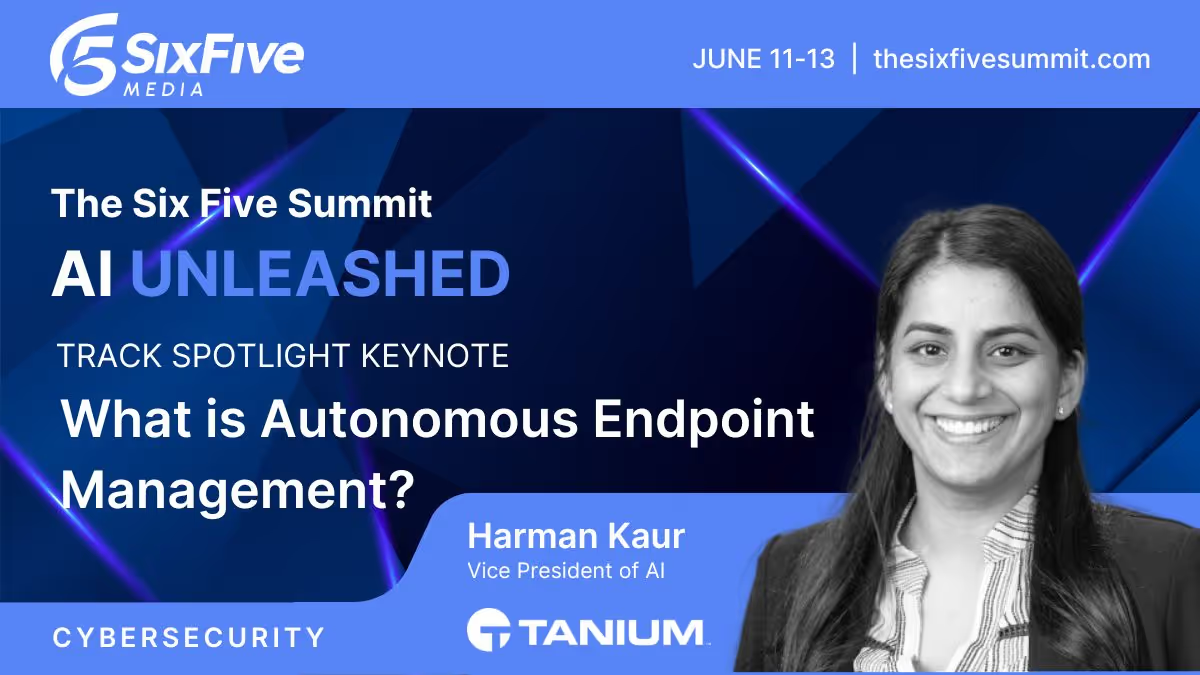
What is Autonomous Endpoint Management?
Autonomous Endpoint Management is a framework designed to unify IT operations and security teams on a single platform through real-time control and visibility.
QUANTUM
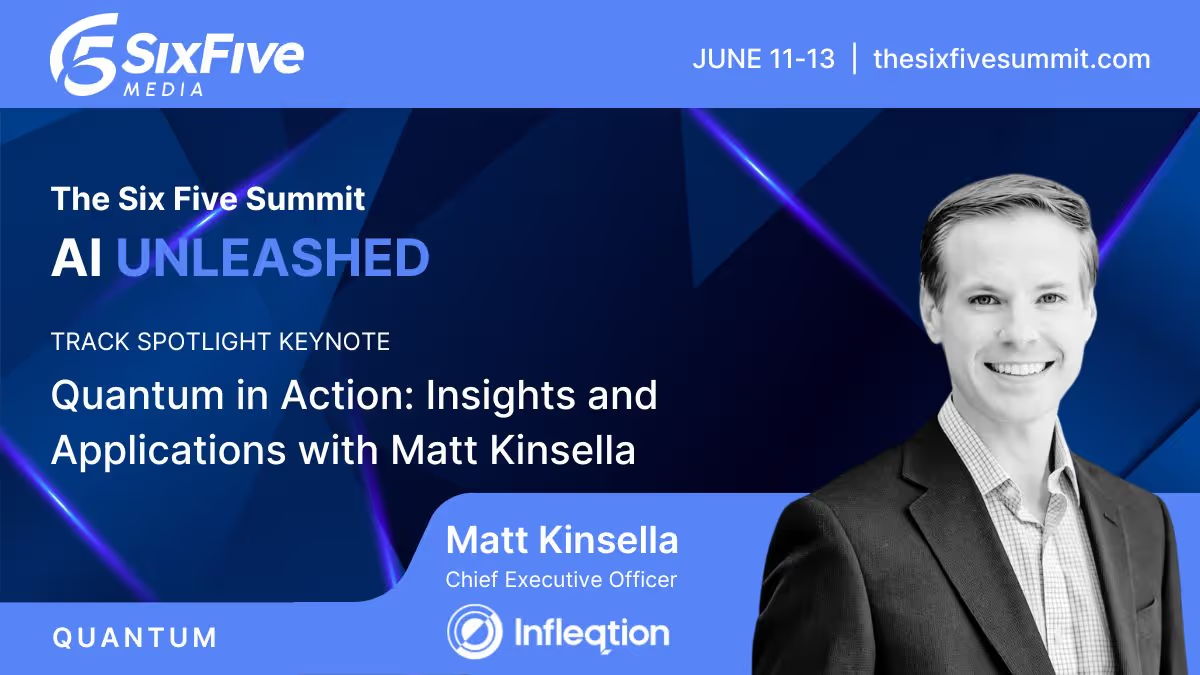
Quantum in Action: Insights and Applications with Matt Kinsella
Quantum is no longer a technology of the future; the quantum opportunity is here now. During this keynote conversation, Infleqtion CEO, Matt Kinsella will explore the latest quantum developments and how organizations can best leverage quantum to their advantage.
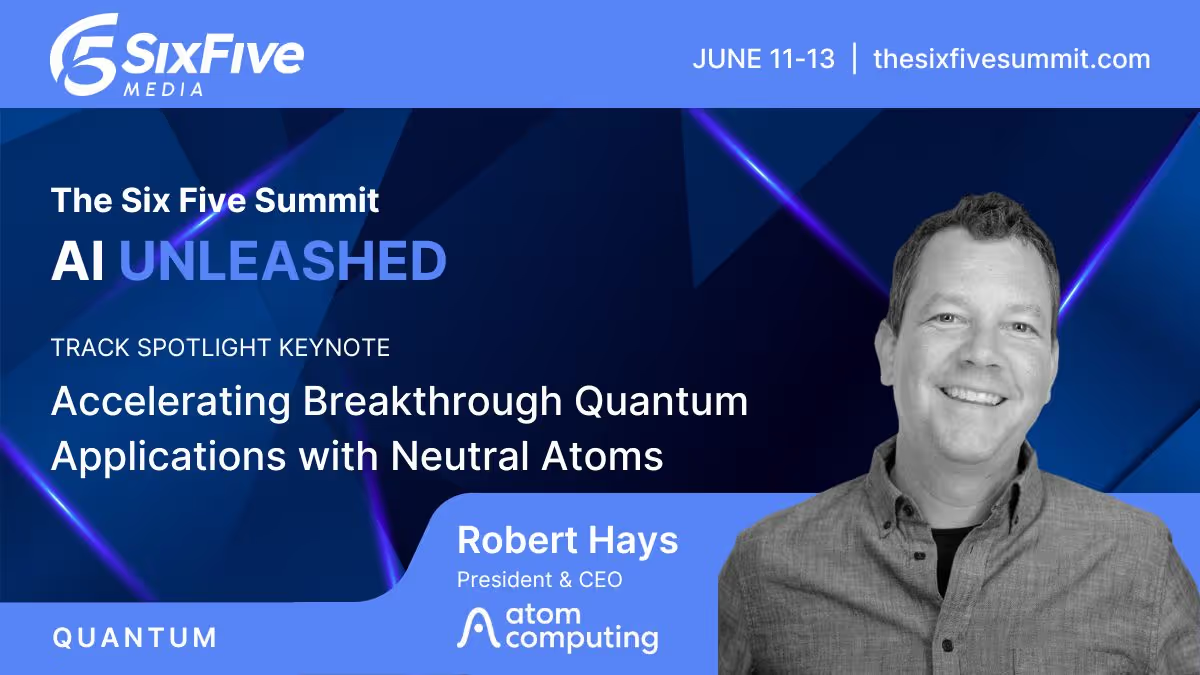
Accelerating Breakthrough Quantum Applications with Neutral Atoms
Our planet needs major breakthroughs for a more sustainable future and quantum computing promises to provide a path to new solutions in a variety of industry segments. This talk will explore what it takes for quantum computers to be able to solve these significant computational challenges, and will show that the timeline to addressing valuable applications may be sooner than previously thought.