
Modernizing Virtualization and AI Inference with HPE & Intel
SHARE


A 2.7x reduction in cost per token and a ruggedized edge device capable of running 80 billion parameter models are reshaping how enterprises think about AI infrastructure economics. Justin McGarry, VP and GM of Compute and AI Infrastructure Software at HPE, and Justin Christiansen, GM and HPE Global Sales Director at Intel, join Six Five at HPE Discover 2026 to break down how virtualization savings, workload-specific CPU and GPU architecture, and component supply pressure are shaping enterprise AI decisions right now.
A 2.7x reduction in cost per token, achieved on the same IT infrastructure, just by changing memory tiering and KV cache offload settings. That's not a roadmap promise. That's a benchmark Intel ran on an HPE system, and it's the kind of detail that gets buried under bigger headlines about AI transformation, even though it carries more weight for CIO’s trying to justify next quarter's infrastructure spend.
At HPE Discover 2026 in Las Vegas, David Nicholson and Matt Kimball sat down with Justin McGarry, VP and GM of Compute and AI Infrastructure Software at Hewlett Packard Enterprise, and Justin Christiansen, GM and HPE Global Sales Director at Intel, to get into what's actually driving enterprise infrastructure decisions right now. The conversation moves from how AI workload architecture is splitting CPU and GPU demand in ways that didn't exist a few years ago, into the virtualization cost pressure forcing IT teams to find savings they can redirect straight into AI initiatives, and lands on a hardware release most viewers won't see covered anywhere else: a ruggedized edge device built to run an 80 billion parameter model from beneath an airplane seat.
Agentic AI workloads are reshaping the ratio between CPU and GPU utilization, with orchestration, data handling, and business logic increasingly running on Xeon while the GPU sits idle for portions of the job, a shift that's changing how Intel and HPE architect solutions together. The partnership addresses the tension every IT leader is navigating right now: CEOs treating AI as priority one while virtualization costs still need controlling, and how tools like VM Essentials and Compute Ops Management are giving customers a concrete way to redirect virtualization savings into AI acceleration instead of asking for new budget. Christiansen names the elephant in the room directly: pricing pressure and supply shortages across components, and what that means for enterprises trying to execute an AI roadmap when the industry itself is oversubscribed.
Key Takeaways:
🔹 CPU and GPU roles are diverging based on workload type. Agentic AI pushes more processing onto the CPU for orchestration and business logic while the GPU handles training.
🔹 Virtualization cost savings are becoming the funding source for AI initiatives, not a separate budget conversation. Customers are using HPE VM Essentials specifically to offset virtualization costs and redirect that freed-up budget into AI acceleration, turning a cost-control exercise into an AI funding strategy.
🔹 A 2.7x reduction in cost per token came from optimizing memory tiering and KV cache offload on existing infrastructure, not new hardware.
🔹 Edge inference just got a major capability jump. The newly launched EL2000, built on Intel Xeon 6, can run models up to 80 billion parameters in a small, ruggedized form factor designed for environments like vehicles, aircraft, and retail floors.
🔹 Component pricing increases and supply shortages are now a real constraint on enterprise AI execution. Intel and HPE are managing this challenge together, changing how enterprises plan procurement timelines.
🔹 ComputeOps Management integrating with HPE Aruba Networking's data center assurance product is closing a long-standing operational gap. The classic finger-pointing between server admins and network admins when an issue surfaces is getting resolved through a single pane of glass that pinpoints where problems actually originate.
The partnership between HPE and Intel isn't just about two companies getting along well. It's about mapping customer outcomes to specific workloads, then benchmarking exactly which hardware configuration delivers them, which is a more concrete promise than most ecosystem partnerships make.
Watch the full video at sixfivemedia.com, and be sure to subscribe to our YouTube channel so you never miss an episode.
IMPORTANT: Note to Uploader: VIDEO EMBED – added by uploader.
Disclaimer: Six Five Media is for information and entertainment purposes only. Over the course of this webcast, we may talk about companies that are publicly traded, and we may even reference that fact and their equity share price, but please do not take anything that we say as a recommendation about what you should do with your investment dollars. We are not investment advisors, and we ask that you do not treat us as such.
?DAVID NICHOLSON:
Welcome to Six Five On The Road. I'm Dave Nicholson. I'm here with Matt Kimball. We're here at HPE Discover in Las Vegas, Nevada. And we decided to randomly go out and find two people with the same name. And what we came up with was Justin McGarry, Vice President and General Manager of Compute and AI Infrastructure Software at HPE. Welcome, Justin. And so we had to find another Justin. We found Justin Christensen, who just so happens to be GM and the HPE Global Sales Director at Intel. So we have Justin from Intel, Justin from HPE working together here. And we have Matt Kimball. I think we're done. Yeah. I think we're good.
MATT KIMBALL:
I'm going to go by Dave.
DAVID NICHOLSON:
I'll go by Matt. Are you gonna go by … There you go, Dave and Dave. But in all seriousness, Mr. Christensen, AI has quickly moved from experimentation to implementation, and people are looking at what's the next step in moving forward with infrastructure, kind of broad strokes against that. What are you seeing vis-a-vis your partnership between Intel and HPE?
JUSTIN CHRISTIANSEN:
Yeah, well, I mean, first of all, we have a great partnership with HPE. What's really been interesting is to watch how the dynamics have changed in terms of how people are deploying their AI infrastructure. So, you know, I think it started off, you were just using as many GPUs as you possibly could, focused on training, and what we've really seen transpire and driving a lot of the demand for CPUs and memory. Is that the different workloads are being architected somewhat differently. If you're looking at traditional AI, ML, that's going to run really well on a CPU. If you're looking at agentic AI, there's actually a lot of processing that happens on the CPU while the GPU would be idle. So you're seeing a lot better ratio from a CPU perspective to that GPU. Doing things like orchestration, data handling, and business logic. And so that's, for us, that's really not only grown the business, but changed how we're architecting solutions for our customers. It reduces the cost of driving those tokens or creating those tokens. And then we still have, you know, the training market, which is continuing to boom. So I think we see kind of different paths, different architectures, and we're really trying to find ways to make that as low cost and as low energy as possible for our customers.
DAVID NICHOLSON:
So, fit for function when it comes to processors, it's not a one-size-fits-all world. Yeah, you said it better than I did.
MATT KIMBALL:
You should patent that or trademark that. Yeah, yeah. All right, so AI is disruptive, right? I mean, there's no arguing that. But at the same time, these enterprises are struggling with AI. Virtualization has kind of come back into focus, right? And a lot of enterprises are kind of reassessing that virtualization strategy they've had and kind of go forward. Talk to me a little bit, like, what's driving all of this? I, as an IT leader, I think about modernization, I think about the path forward, I think about flexibility, cost control, right? How does an IT organization approach this without adding so much more disruption to what is already a disruptive market with AI?
JUSTIN McGARRY:
Yeah, I think in the customer conversations I'm having right now, of course, AI is the number one priority from the CEO down. And so I think what I'm seeing is these IT teams are having to react quickly to that. And they're also getting the pressure from a virtualization cost perspective at the same time. So they're having to react quickly to both of those. I think where we're helping from an HPE perspective is in kind of two areas that I see. One is with VM essentials. And in the conversations we're having with customers, it's all about, well, how can I offset some of my costs from a virtualization perspective? Working with HP, and then how can I go and apply those savings to help me accelerate my journey when it comes to AI. And so a lot of the customer conversations I'm having right now, Matt, are in that area, number one. And then the second is, the other piece from an AI pressure perspective, is around all the software and the tooling that they have in their environment. And so if you're coming into a customer conversation and you don't have a great story around your software and how it's leveraging AI, then you're dead in the water. And so we're really iterating right now, if I think about my portfolio with compute ops management, our SaaS-based cloud manageability solution for the whole server infrastructure estate, not just HPE ProLiant. We're able to actually monitor other OEM requirements as well. Love that. We are accelerating our roadmap from an AI perspective. So it started with our compute co-pilot, very conversational AI assistant that you can go and have a discussion around the environment. We're accelerating that quickly into Agentic. You look at a few years, Matt, and I think it's going to be a world where we'll have server admins. Those server admins are going to have to continue to focus on where AI is going. And so as much as we can automate the environment and secure that, leveraging Agentic, that's where we're going to head.
MATT KIMBALL:
And modernization really does start with that kind of reassessing where you are today and what that go forward looks like. It's not; we've been doing this for 15 years, and we're just gonna continue to do this over and over again. I love your agenda. Your co-workers are going to be digital here in the next few years.
JUSTIN McGARRY:
Yeah, I think the challenge that customers are going through right now with this pressure and CEO top-down priority around AI is, okay, if I'm managing and orchestrating this server infrastructure, I still want to have some control. So it's great that we're really getting this pressure around agentic, I'm okay with agents going and providing some recommendations on things like, "Hey, you need to update because of this security advisory. But I still want some guardrails to say, okay, here's the recommendation, yes, go implement that." Versus it just going and implementing without. And I think over time, we'll start to build that trust. I think with Agentic and with those agents to allow them to go do more in the infrastructure estate. But I think customers are all kind of cautiously looking at that. Yeah, we're getting this pressure, but at the same time, we want to maintain control.
MATT KIMBALL:
And everybody goes at their own pace.
DAVID NICHOLSON:
Exactly. We talk a lot about how budget can be freed up to do the really cool novel things if you optimize infrastructure. And one of the pieces of optimizing infrastructure is your Compute strategy for inference as we move forward. How do you help people with kind of a framework for figuring out how to deploy acceleration and whether to go CPU or GPU in a certain instance.
JUSTIN CHRISTIANSEN:
Yeah I think it's interesting because we kind of talked earlier about some broad strokes. whether you're doing traditional AI or whether you're doing agentic AI or training. Even when you look within those, you can actually achieve the results with a CPU, with a GPU, or in a hybrid environment or solution. So you can have that whole solution. The question is, how do you optimize for performance, for cost, and for power? And it's different for different customers, even on the same workload. Some examples I would give that I think are pretty exciting. We just recently did some benchmarking on a DL3 ADA. which has Xeon 6 processors, NVIDIA GPUs. And what we did was we changed the memory tiering and optimized the KVCache offload. And just by making those changes with the same IT infrastructure, we were able to decrease the cost per token by 2.7x. So that's one example. Another example I'd highlight that I'm really excited about, we just, well, we didn't, you did, but together we launched a product. It's called the EL2000. It is a small form factor, ruggedized device. It was built to be put in the harshest environments. It has Intel Xeon 6, so you can put that, whether it's on a car, in a backpack, you can actually put it under the seat of a plane, you can put it in a retail environment, and that Xeon processor can actually handle parameters up to 80 billion, so up to 80 billion parameter models.
DAVID NICHOLSON:
So true inference at the edge.
JUSTIN CHRISTIANSEN:
True inference at the edge, but you can also put NVIDIA GPUs
in that system, get over 100 billion, and then use the CPU for other workloads, and you can leverage the AMX accelerator within the CPU. So you can kind of see it, you know, different sizes, different form factors, and it's just really exciting to see how we can actually optimize within the portfolio we have to deliver better outcomes for our customers.
MATT KIMBALL:
Yeah, it's funny you mention AMX. This is one of the things I loved a few years back when you introduced it. I loved how Intel stayed ahead of the curve on kind of like what does tomorrow look like in building those discrete acceleration engines to kind of be ready for those workloads. It was a great stroke of innovation on your side.
JUSTIN CHRISTIANSEN:
Yeah, I mean, I think, I don't know exactly how many years it's been. I think it's been about seven years. But we still see AMX driving performance that's incredible. And we have a tool called OpenVINO. And so ISVs can use OpenVINO to take their already trained model and deploy it onto an Intel CPU and leverage that AMX acceleration for really great performance.
MATT KIMBALL:
All right, so Justin and then Justin, I've got a question and then I'll come back to you guys. So you're out there talking to enterprise customers, they're modernizing, they're updating their virtualization strategy, they're starting on this AI journey. When you chat with CIOs or IT DMs, IT decision makers, what are they holding up as this is how we measure success and this is what we're seeing through HPE powered by Intel?
JUSTIN McGARRY:
I think I'll comment first. I think it goes back to earlier in my career, the virtualization days, and how did that organization go and really drive the conversation with customers. It was, hey, you have all these servers in your data center. Guess what? We can really bring that down quite a bit, and you'll have a lot of cost savings as a result. I think at the CIO level right now, with all the pressure from an AI perspective, again, back to my point on The CEO number one priority is AI. They're looking at costs across the board and saying where can we reallocate those costs effectively in order to go and apply that to these business critical priorities around AI. So where we can help them is give them simple tooling to say this is how you can go down that path. I look back to Some of the things that we're doing with VM essentials and showing some of those models I look at what we're doing with compute ops management we have a ROI calculator out there very simple for questions. Answer these and I was just in a conversation with one of our digital sellers a few weeks ago and he said to me just things like you wouldn't imagine couldn't believe like we're in this conversation with a customer. And what won them over is they saw all the cost impact and savings from a ComputeOps management perspective. CIO said, yep, that's reputable. It's from a reputable organization as far as who built that tooling for HPE. I'm signing off on this. And that's the type of quick wins that I think IT is wanting to have with the CIO level right now and the board level. Because again, they just can't keep up. They can't move fast enough. They don't want to be thinking about having to keep the lights on. They want to go and apply those resources to go really push on AI.
MATT KIMBALL:
It all lines up to that AI North Star. Exactly.
JUSTIN CHRISTIANSEN:
Well, I think one of the things we're really excited about, we've worked with HP to understand what are the outcomes they're trying to drive. We've mapped that back to the workloads they need to run to drive the outcome. And then we're doing that benchmarking on the HP systems to understand where do you best run that workload. So we've really tied the customer outcome we're trying to drive into the solution that we're bringing to market or that we already have in market and guiding people to. And then I think the other thing, maybe it's the elephant in the room, but prices are increasing, supply is a challenge. It's across many different components. So the other thing we are constantly dealing with is we want to drive these outcomes. We've got a path to do that, but now the industry is facing challenges around pricing or supply shortages. And so it's also managing how do we best match supply, match products to meet a need when we thought we had one way, but we need to find another.
DAVID NICHOLSON:
So give me some other reasons why people should care that Intel and HPE get along so well. You know, from the outside looking in, it's like, oh, OK, two big tech companies, they get along. I can see what's in it for them, but what's in it for me in the enterprise? You gave some examples of collaboration.
JUSTIN CHRISTIANSEN:
Yeah, and it's not just because our parents named us the same name.
DAVID NICHOLSON:
I was going to start there.
JUSTIN McGARRY:
It's Justin and Justin, and that's why it works well. Simple as that.
JUSTIN CHRISTIANSEN:
Yeah. HP and Intel have a longer history than the Justins. You know, I think it all starts on technology innovation. So the partnership around technology innovation is great. We work really hard to make sure we're looking at the IP that each of us bring to the table and what can we bring to market together. I also think that like there's similar cultures in terms of that customer obsession and driving customer outcomes, which is really great. So you kind of bring that technical depth and background and you pair it with a customer focused initiative and for us I think it works really well.
JUSTIN McGARRY:
Well I think back to a lot of the things that we did at Discover Barcelona together and Justin and team lined up all of these ISVs and going back to talking about the workload conversation a moment ago, like really going and partnering with those ISVs. From my perspective, when we're working together, Intel gets software. And I think that's really helped with my business and how we're partnering together because we see that joint opportunity. It's not just about the hardware at the end of the day. It's how you manage, you secure, you automate that infrastructure. I think Intel gets that just as much as we do. So I think that really helps with the partnership as well.
DAVID NICHOLSON:
So two final points. The first one is a hypothetical, because you mentioned sort of the dawn of virtualization. Are we going to live long enough to see ghost town data centers ever again? Is something going to come along that all of a sudden empties out data centers? I mean, it's sort of a yes or no, or shake your head, like Justin is doing.
JUSTIN McGARRY:
Yeah, I mean, I can't imagine that world at this stage.
DAVID NICHOLSON:
Not in the next 24 months?
JUSTIN McGARRY:
No, and I even think about, you know, every customer conversation I'm having right now is pushing us around autonomous, around agentic, back to what I was talking about earlier around the software. I think that's just going to continue to accelerate. I think when folks are seeing some of the advantages and benefits and they're able to go and apply those resources elsewhere, I just see that continuing to accelerate. So yeah, I don't see that world, Dave. I don't, not anytime soon.
DAVID NICHOLSON:
Okay, so that blends into the final question, which is looking out over the next 24 months, I think we've established that people are not going to be saying, you know, I need to move a lot of this hardware out of the environment that I'm using for compute now. I have too much space. Not gonna happen. What do you think is ahead. What's ahead over the next 24 months. What should people really be paying attention to.
JUSTIN CHRISTIANSEN:
I mean we continue to see just strong demand driven by A.I.. I would say like what are we trying to do over the next. It's not even that long 20 24 months. Yes. But we've got to move faster. Yeah. It's really around I think enabling that software ecosystem. Yeah. So we've already partnered with thousands of ISVs who have optimized their applications on OpenVINO to be able to run inferencing better on a CPU or a solution with a GPU. Right now with the memory constraints, a lot of it's around how do you optimize the memory footprint. So we focused early on how do you minimize the cost and footprint of expensive GPUs. Now we're looking at how can you do it with less memory. There's a really cool demo actually in the Intel booth here with a company called Multiverse. It's doing just that and I think those are the types of trends. It's probably how do we enable the software ecosystem to better perform on less infrastructure because You know, we're oversubscribed in the number of people who want to buy the infrastructure versus what we can supply.
JUSTIN McGARRY:
Yeah.
JUSTIN CHRISTIANSEN:
What do you think, other Justin?
JUSTIN McGARRY:
I mean, I think from my perspective, you'll see us continue to integrate more and more of the software stack. So I think about even this week, some of the announcements that we have around what we're doing with ComputeOps management for the underlying ProLiant infrastructure. How do we go and make sure that we solve the challenge? I know I've been in the industry for many years now. The big challenge has been, hey, an issue happens in the environment. The server admin points a finger to the network admin. The network admin points a finger to the server admin. But no one's really kind of solving that. I think we're starting to solve that. So we're integrating ComputeOps management with the HP Mist networking data center assurance product and giving customers that single pane of glass, if you will, that we've always been talking about to help them go and figure out, OK, quickly, where are those issues happening in the environment so we can solve those quickly? I think you'll just continue to see us head down that path where we're stitching these things more closely together because, candidly, that's what our customers are asking us to go and do.
MATT KIMBALL:
Well, I'll tell you what, either way, Enterprise AI, we're just on the beginning of that journey, and it's going to be a fun 24, 36, 48, what's after 60? 60, right? 60 months. It's going to be a fun few years to watch. You're looking to finance a car, Matt? What are you? That explosion is coming, and what y'all are doing today is going to have lasting impact tomorrow. Thank you for joining us. This is a great conversation. Justin McGarry, Justin Christensen, Dave and Dave, otherwise known as Matt. And for those at home, thanks for tuning in to another episode of Six Five On The Road at HP Discover 2026. Please don't forget, subscribe, follow, like, and make sure you go to Six FIve Media to see really good content that continues from my great co-host, David Nicholson. And we'll see you next time.
MORE VIDEOS
Industry Veteran and Google’s Satish Thomas on Replacing One-Size-Fits-All Enterprise AI With Industry-Specific Agents
Google is moving enterprise AI beyond general-purpose tools and into industry-specific workflows built for regulated sectors such as legal and financial services. Satish Thomas, Vice President, Business and Industry Solutions at Google, joins Six Five to explain how Gemini Enterprise for Industries combines purpose-built skills, ready-to-deploy agents, model choice, and an open partner ecosystem to bring AI into the workflows enterprises already run.


AMD Instinct MI355X vs NVIDIA HGX B200 GPU platforms AMD vs NVIDIA: A Three-Level Inference Infrastructure Evaluation
Signal65 President Ryan Shrout and Senior Performance Analyst Mitch Lewis review a new three-level inference infrastructure evaluation of AMD's Instinct MI355X against NVIDIA's HGX B200 with AMD's Andrew Dieckmann and Anush Elangovan. The MI355X's memory bandwidth advantage compounds as context and concurrency scale, delivering up to 2.25x throughput gains and roughly 40 percent lower cost per GPU hour.
.png)
Anthropic’s AI Slowdown, OpenAI’s $1.2T Valuation & Salesforce’s AI Bet
Anthropic's "Pace the Frontier" essay set off a week in which nearly every major AI leader, and two heads of state, weighed in on whether the frontier should slow down. Patrick Moorhead and Daniel Newman read the incident as something larger than a safety debate. Whoever sets the pace of the frontier also sets the pace for open-weight models, enterprise custom models, and the trillion-dollar valuations riding on top of them. That contest, not the essay itself, is the through-line of Episode 320 of The Six Five Pod.
Other Categories
CYBERSECURITY
Threat Intelligence: Insights on Cybersecurity from Secureworks
Alex Rose from Secureworks joins Shira Rubinoff on the Cybersphere to share his insights on the critical role of threat intelligence in modern cybersecurity efforts, underscoring the importance of proactive, intelligence-driven defense mechanisms.

HP Launches World’s First Business PCs to Protect Against Quantum Hacks - The Six Five On the Road
On this episode of the Six Five - On the Road, hosts Patrick Moorhead and Daniel Newman are joined by HP's Ian Pratt, Global Head of Security for Personal Systems.
What is Autonomous Endpoint Management?
Autonomous Endpoint Management is a framework designed to unify IT operations and security teams on a single platform through real-time control and visibility.
QUANTUM
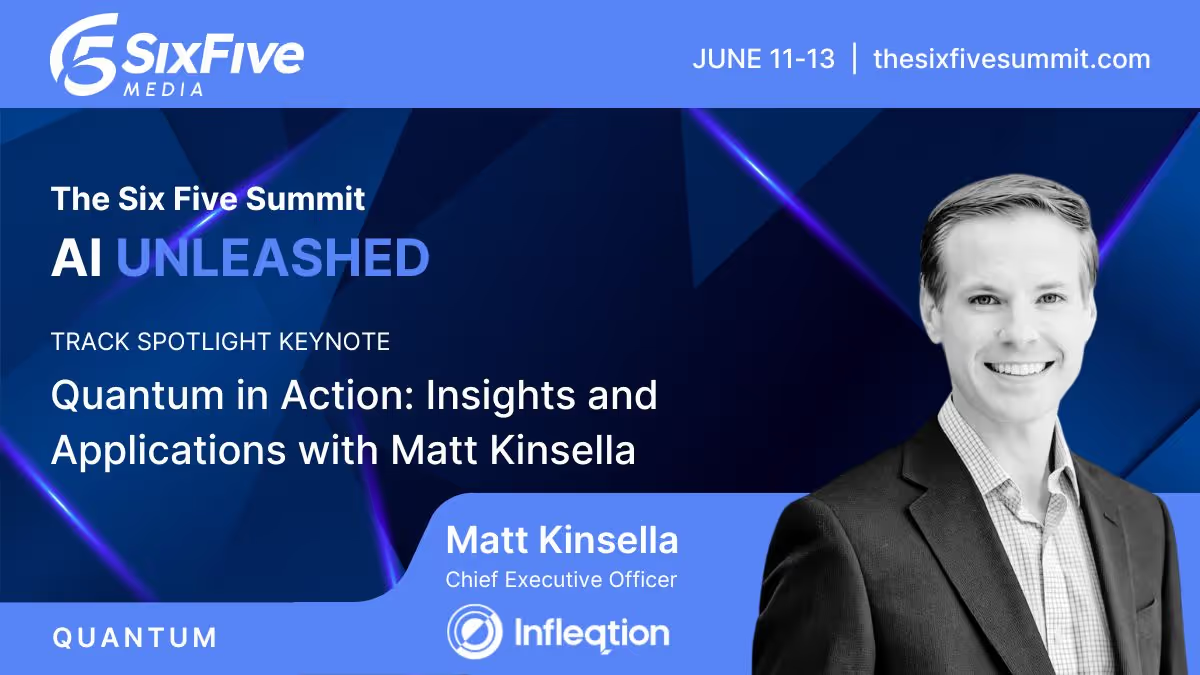
Quantum in Action: Insights and Applications with Matt Kinsella
Quantum is no longer a technology of the future; the quantum opportunity is here now. During this keynote conversation, Infleqtion CEO, Matt Kinsella will explore the latest quantum developments and how organizations can best leverage quantum to their advantage.
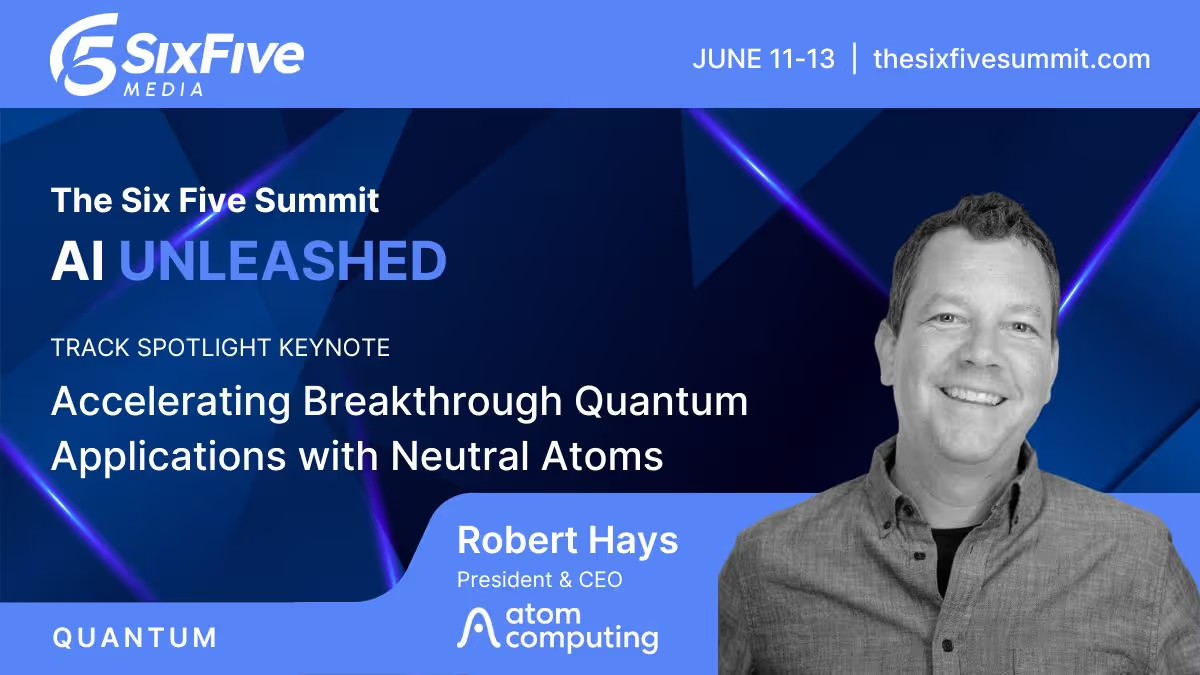
Accelerating Breakthrough Quantum Applications with Neutral Atoms
Our planet needs major breakthroughs for a more sustainable future and quantum computing promises to provide a path to new solutions in a variety of industry segments. This talk will explore what it takes for quantum computers to be able to solve these significant computational challenges, and will show that the timeline to addressing valuable applications may be sooner than previously thought.