
Six Five Pod Ep. 314: TerraFab, Memory's Comeback, and the Custom Silicon Debate
SHARE


Patrick Moorhead and Daniel Newman cover Tesla and SpaceX's $16.8 billion TerraFab chip factory, Samsung's zHBM debut at FMS 2026, a week of frontier model launches, and a simulated debate for “The Flip” over whether custom silicon will capture the majority of AI workload dollars by 2028. The episode closes with earnings from SpaceX, Palantir, AMD, Astera Labs, IonQ, and Lattice Semiconductor.
The handpicked topics for this week are:
1. TerraFab Breaks Ground in Grimes County, Texas: Moorhead and Newman dig into Tesla and SpaceX's approved $16.8 billion TerraFab chip factory near Texas A&M, where Intel is confirmed as a digital foundry partner despite minimal SEC disclosure so far. Moorhead raises the open question of who handles the analog side of production that Intel doesn't cover, and Newman points to Musk's track record of hitting ambitious goals years behind his original stated timelines. Both hosts frame the investment as a genuine step toward expanding domestic chip manufacturing. (The Decode)
2. Samsung's zHBM Headlines a Blockbuster Memory Show at FMS 2026: The hosts cover the Future of Memory and Storage show in Santa Clara, where Samsung's BVNAND and zHBM concepts headlined alongside new announcements from Kioxia, SanDisk, and SK Group's high-bandwidth flash spec through OCP. Pat traces the industry's swing from oversupply and negative margins to today's memory shortage, driven by AI demand that has grown 5-10x faster than expected. Daniel adds that stacking memory directly on the accelerator, as zHBM proposes still needs to solve for the physical constraints of heat before it becomes production-ready.
(The Decode)
3. Three Frontier Model Launches Land in a Single Week: Alibaba shipped Qwen 3.8 Max, DeepSeek released V4 Flash at 14 cents per million tokens, and Meta debuted its first coding agent, prompting a discussion on how fast the frontier is moving. Newman argues every company will need a new benchmark built around operational workloads and real-world token efficiency. He points out that Chinese model usage and frontier lab revenue are both climbing simultaneously, and makes the case that healthy frontier labs are essential to funding the open source models built in their wake.
(The Decode)
4. Anthropic and AMD Both Make Moves on Custom Silicon: Anthropic confirmed it’s developing custom AI chips, reportedly with Samsung and reportedly Broadcom. AMD announced its acquisition of Taalas, a company that etches model weights directly into silicon for major inference speed gains. Patrick traces his own multi-year prediction that heterogeneous computing would become standard, pointing to Google's TPU program as proof it can work at scale. Daniel frames both moves as evidence that AI companies are racing to control total cost of ownership (TCO) as memory and compute costs keep climbing. (The Decode)
5. The Flip: Will Custom Silicon Capture the Majority of AI Workload Dollars by 2028? Patrick argues every frontier lab is now pursuing vertical integration, citing Anthropic's new chip program, AMD's acquisition of Taalas, and NVIDIA's $20 billion license of Grok's inference technology as evidence the shift toward specialized silicon has become a step function. Daniel counters that every lab building custom silicon is simultaneously signing record contracts with NVIDIA and AMD, arguing that compute itself functions as the real moat regardless of chip architecture. (The Flip)
6. SpaceX Posts 92% Growth in Its First Public Earnings Report: SpaceX's debut public earnings showed 92% growth, narrowing losses, and rapidly expanding AI compute revenue layered on top of its launch and satellite businesses. Daniel flags new AI deals with Google and Anthropic as driving much of that growth, while Pat highlights that the company's stated $100 billion run rate target depends heavily on December performance and questions how soon TerraFab-related capex will hit the income statement. (Bulls and Bears)
7. Palantir Delivers Its Fastest Revenue Growth in Company History: Palantir posted 93% year-over-year growth and record commercial revenue, with CEO Alex Karp highlighting that no company at Palantir's scale has grown this fast before. Patrick points to the company's sovereign AI positioning as being well-timed given growing enterprise distrust of frontier model providers, and Daniel adds that 150% commercial growth is far outpacing other enterprise software peers. (Bulls and Bears)
8. AMD Posts Record Growth as Investors Expect Even More: AMD delivered record revenue and growth. Investors had priced in results closer to NVIDIA's historic beats, and capex nearly quadrupled without much detail on where the spending is going. Moorhead traces the increase to AMD building out Helios rack-scale systems ahead of shipping, and both hosts note the timing of Elon Musk's public NVIDIA endorsement landed awkwardly on AMD's earnings day. (Bulls and Bears)
9. Astera Labs Beats on Revenue and EPS as the Market Shrugs: Astera Labs beat on both top line and EPS, posting record growth off a still small base. Pat points out new CXL innovations unveiled at FMS as evidence of the company's position building connectivity infrastructure alongside Broadcom and Marvell. (Bulls and Bears)
10. IonQ Raises Guidance and Closes Its $1.8 Billion Skywater Acquisition: IonQ raised its FY26 guidance from $280 to $290 million and closed its Skywater acquisition, positioning the company as a vertically integrated quantum player across networking, sensing, and compute. Daniel notes IonQ is approaching a billion-dollar annual run rate once Skywater is included, and highlights a new Anduril partnership as a notable expansion into defense. Patrick adds nuance to the "only quantum pure play with foundry assets" framing, noting other quantum companies maintain foundry relationships of their own. (Bulls and Bears)
11. Lattice Semiconductor Beats Across Revenue, EPS, and Guidance: Lattice beat on revenue, EPS, and guidance, growing 62% and closing its $1.65 billion AMI acquisition. Newman points to the company's data center AI segment growing 83% as FPGA content keeps expanding inside rack-scale systems, and both hosts frame Lattice as approaching a billion dollars in annual revenue. (Bulls and Bears)
Watch the full video at sixfivemedia.com, and be sure to subscribe to our YouTube channel so you never miss an episode.
Disclaimer: Six Five Media is for information and entertainment purposes only. Over the course of this video, we may discuss companies that are publicly traded, and we may reference their equity share prices. Nothing discussed during this webcast should be considered investment advice or a recommendation to buy or sell any security. We are not investment advisors, and you should not rely on this content as financial advice. Six Five Media collaborates with technology companies and industry leaders to produce research-driven interviews and multimedia programming for enterprise technology audiences.
Daniel Newman:
We absolutely know what we're talking about. Welcome back to Six Five Pod. It's great to see everybody. And I am Patrick Moorhead, and this is Daniel Newman. You may have missed half of his video last week. We apologize. He was going through driver updates, I believe, but Dan is back. Don't worry. He is on camera. How are you doing? What was up with that, man? What was up with that crap? You know, what happens to me sometimes is you do a Windows update or a driver update. You haven't rebooted. And you have to reboot to get the cobwebs out. That's the technical explanation.
Daniel Newman:
I got a new XPS this week. Pretty excited about it. Nice. Nice. Set it up this weekend, and I'm all grown up now.
Daniel Newman: Yeah, I'm pretty excited about that. I got an X, an upgraded XPS 14, uh, 64 gigs of memory and two terabytes of memory just running your favorite models and Kimmy models on it. Pretty run pretty much run in, uh, everything but those on it.
Patrick Moorhead:
I know you're one of those China bulls, big time China guy.
Patrick Moorhead:
No, it is great.
Daniel Newman:
And we're going to have a lot of fun that you put something out like please send our best EUV. I mean, because we have no advantage.
Patrick Moorhead:
I am. I'm also in Washington, D.C., platforming for NVIDIA, right, saying send the latest and greatest directly to the PLA headquarters.
Daniel Newman:
So, oh, my God, that's great. I appreciate you doing that. Yes, I think I'm going to change sides.
Patrick Moorhead:
You know, I might too. And just I might just do an auction for, you know, who can who can pay me the most. And we'll see where that goes.
Daniel Newman:
So there are some people that might think that's how we already do things. I don't know.
Patrick Moorhead:
Well, they would be mistaken. And I wouldn't do, you know, I'd have a it's funny. The funniest dream that you bought a Gulfstream like a G5 nice and you picked me up in it so See, I told you I'd still let you ride I'm so once Daniel once we see Daniel cruising around in his G5, you know, he has picked a side No, listen, it's all fun and games until somebody gets hurt and we we do not do that I have a reputation to uphold Daniel and I know, I know, but it's fun because, you know. Which is largely positive, I think.
Daniel Newman:
The great thing about, you know, doing video is people can cut things completely out of context. It's kind of like our simulated flip debates. Like, we tell everyone they're simulated, we put the little banner that they're simulated, but there's inevitably always someone that still gets pissed off thinking that we're seriously making whatever argument we're making. And really, we're just trying to show the world how good we are at arguing nonsense. We can literally find a way to convince people of complete nonsense because that's the way things are. Everything's nuanced. Everything in what we do is nuanced.
Patrick Moorhead:
We are doing a tech podcast, and I'm really excited about the topics we have. First of all, We've got TerraFab landing in Grimes County, Texas. By the way, for those of you who don't know exactly where that is, that's right near Texas A&M, southeast of here. Huge investment there, but not a whole lot of details, folks. FMS 2026, this is the biggest memory conference. I have, I have, I have been once. This would be the year to go because memory is hot. And we're going to talk about all the big memory vendors, innovations coming out of that. And, you know, the frontier model launch conversation just keeps on keeps on going here. And whether it's just trying to copy IP to security, to tokenomics, a lot of good stuff coming out here. We're going to hit bulls and bears. We've got SpaceX, we've got AMD, Astera Labs, INQ, Lattice. Big week, Daniel. Big week. Tons going on. I just don't know if there's ever not a big week anymore. You know, we do keep saying that, and we need to, you know, we need to have a bigger, a bigly, biggestly week in tech, maybe to separate that too. But it does seem like complete pand, literally pandemonium every week, uh, which I fricking love it. You know, I mean, I got so bored in my corporate job. Um, that was part of the reason I left a big tech, but the pace is, is, is wonderful.
Daniel Newman:
You're doing a lot of context shifting, which in the ADD era is a great thing, right? You can bounce between different industries, different technologies, different platforms, different companies, different vendors. It keeps us on our toes, and it keeps our attention deficit fully locked in, which is great. What are we even doing here? I'm forgetting. Why am I here? What's going on? I'm here for a podcast.
Patrick Moorhead:
Thank you. Decode, we try to separate the news items and what's being said noise from the reality of what's going on. So let's jump in. All right, TerraFab lands in Grimes County. There were rumors before, but it is approved. We've got 16.8 billion out of hundreds of billions investment. And Daniel, like, talk about the significance of this. I mean, is this just one of another Elon's pipe dreams? You know, Intel is supposedly the the partner, but they've done almost no SEC filings for anything.
Daniel Newman:
Only one filing, I believe, where they mentioned their expected involvement in the program. I mean, I think Elon is going for it. This is what Elon does. Former trillionaire Elon Musk, no longer. What a loser. I know. I don't even know what you do. Like, what happens when you're like a couple hundred billion dollars less valuable? Are you like, I'm not going to? What would you not do that you were going to do before? I don't think it changes anything. But look, it's a 16.8 billion, and it's in Texas. And, you know, I think this week, Texas has made a bit of a news. We are going to cover it deeply because it's not exactly related. But, you know, there's been some structure around what's going to happen in terms of data center build-outs here. Governor Abbott, you know, people are conflating it with him doing a moratorium; that's inaccurate. But anyways, we're building here in Texas. And so I still see that. I still see that occasional post where the Congress lady in California said, fuck Elon Musk. You might want to beat that out, producers. But, you know, she said that and he says message received. Well, here's 16.8 billion dollars of additional investment, probably at minimum. Let's be candid, like 16.8 is probably the starting price. It's probably going to end up being more expensive than that. And it's going, like you said, right outside Houston, kind of in between Houston and where Texas A&M is. And this is massive. I mean, he's talking about this being the largest and most valuable building on Earth. He believes, he said in his earnings, we'll talk about SpaceX later, that it's on a path to a trillion. But you've got it manufacturing robotics, you've got it manufacturing autonomy, and you've got it manufacturing chips for XAI. And so, you know, he's he's targeting a terawatt per year in the two different chip families: full self-driving optimists, XAI compute. And then, of course, is one family. And then his other is compute for orbital deployments. Data centers in space. Hold on one second here, got something weird going on. Okay. And so this is, you know, this is pretty massive. It's a big take. I mean, here's where I get Elon Musk does everything he says he's gonna do, but his timeline versus what he tells the world is like so skewed. Like, I think he's saying, like, we're gonna have orbital data centers next year. I always go back to what is it? Was it 2016 when he said he was gonna do the first self-driving? And when did that actually happen? 24, 25?
Patrick Moorhead:
-About eight years later.
Daniel Newman:
Eight years later. So the question is never like, is he gonna do what he says? The question is, is he gonna do what he says in the timeline of which he says? This is a- People cannot overestimate how hard this is, how hard this is going to be. Now the videos and the AI-created promo videos of the future of TerraFab looks awesome. It looks epic. It's going to solve a lot of problems. It's going to solve capacity problems here. It's going to solve not just the data center build-out, but the entire edge, compute, robotics, autonomy build-out. He's going to kind of own that. It's such a big thing, Pat. I don't believe we're going to get there before the end of the decade. I just don't see a situation in which this thing's operational and creating even close to what he says in terms of terawatt capacity in the next four or five years. So that's where I'm held up. I believe he's going to do it. I love that it's in Texas. I think the ambition is great. I think he's addressing current and future states, meaning current demand for compute. And then he's going into kind of physical AI and the future of compute. Then he's going into the orbital. Orbital and data centers in space, but I also just think the timeline is probably complete crap.
Patrick Moorhead:
Yeah, you really nailed the timeline piece. And you know, uh, there are leaders who take different approaches to, um, putting goals out there. And, uh, one of those is let's put a, a goal and a timeframe out there that absolutely looks unattainable. Based on the view that you will always miss your goals. So if you're always going to miss your goals by a certain extent, put a goal out there that is so big that you just hit a reasonable goal. Daniel Newman might actually run his revenue in sales like that, but I wouldn't know. Um, but no, there's different ways to do this. And, you know, I, I worked for some GMs that, you know, they put that out the impossible dream, uh, and then you would feel pressure and, and then you would, you would go off, uh, and, uh, and do this. So, um, and. The other comment I want to make is on specificity. So Intel did do an initial very ambiguous SEC filing. And then so far, we haven't seen anything out of Intel. And ntel is the chosen partner, at least for the digital side, of what the business model would look like, what increased CapEx that Intel might need. Right now, it kind of looks like an Intel foundry funded by Elon. I have a lot of people telling me I'm wrong on that, but I might stick to my guns. The other part is on the analog side. So Intel clearly has a roadmap in the digital world, but what about the analog world? Right. Are they going to cut a deal with Global Foundry's TI or somebody like somebody like Tower out there? I do. I do do not know. The funny part about the groundbreaking, too, as it was called, is there were no groundbreaking photos, which, you know, maybe this is, you know, Elon trying to be different or unique. Or something. So, you know, fabs aren't real when the governor shows up. It's real when companies like Applied and ASML caches the actual check. And final comment is I am bullish on this. I want this to succeed. We need more manufacturing here in the United States. A lot of U.S. companies are ponying up, and Taiwanese and Korean companies. But doing more here is better. All right, let's go to the next topic here. FMS, the Future of Memory and Storage Show, was in Santa Clara this week. We saw Samsung's BVNAND and ZHBM headlining the show. You had Kioxia, you had SanDisk, plus SK publishing a new first high-bandwidth flash spec through the OCP spec. OCP organization, so let's go. Yeah, yeah. Bigger picture. Memory wasn't cool until it was. And you have companies like Micron going from negative 32% gross margin to high, high 80s. There was a while there that there was so much oversupply and not enough demand. There just wasn't enough money to invest into CapEx to build facilities. And, you know, it takes a good three to four years from shovel to high-volume manufacturing. And you need to make these early, and they didn't have the money to do that, so they didn't. So not only are we in a supply constraint environment, we're in this absolutely not based on just some reasonable demand. We've 5x, 8x, 10x'd the demand for this memory. And it's interesting: some of these technologies out there that were brought out are interesting ways to, you know, you've heard of the storage and memory hierarchy, right? Kind of a pyramid that shows fastest, which is SRAM, and the slowest, which is spinning disk, and everything in between, including KB cache and stuff like that. There were new architectures that were proposed out there that put a layer between HBM and DRAM. So that, I guess, is good news, but the challenge there is it might not show up. Uh, for four or five years, uh, you know, Samsung, um, brought out, you know, a cool, a cool technology, uh, but there were no dates, dates on it. Uh, but I also think it was probably the most consequential; it's called Z H B M, where memory is vertically stacked on top of the accelerator. And that's different today, where it's sitting outside of it. And you can already be asking the questions of, well, wait a second, how? We can't even keep- you know, one of the biggest challenges with HBM is it's stacked, and we can't keep it cool. How the heck are we gonna put that on top of a, you know, 600-watt accelerator or something like that? So interesting stuff. You know, we saw, you know, HBM4 or HBM5 stuff come out there, which is very, you know, a lot nearer term than, let's say, a Z HBM or something like that. But it is good to see the industry innovating because, you know, quite frankly, all of the accelerator and GPU companies are finding ways to limit the amount of memory that is used. So this is the memory industry continuing to innovate. And you would think with this new amount of money, that with valuations reaching astronomical highs, they will have the money to do this.
Daniel Newman:
lyIt's interesting. Everything's back in play now. All the memory architectures and memory types, how they can be applied- flash, NAND, CXL, you know, was dead and now it's back. Stacking, you know, and then of course the network becomes a binding constraint. So you start to see a lot of people talking about like, long light, short memory, like basically that they're gonna, we're gonna break this somehow by optics. Moving data faster and not trying to solve necessarily for a memory wall or solving it the way we're thinking about solving it. Of course, you've mentioned a few times on the show what Qualcomm's trying to do. You just mentioned, you know, stacking, taking off the 2.5D interposer. You've, you know, and of course, high bandwidth flash, which is, you know, you got HBC, HBM, HBF. H, B, B, S, U, F, my life, making that last one up in case anyone thought I was being serious. But I mean, look, I think, you know, I said something the other day; there was like a really stupid post by Zero Hedge, but I saw a bunch of different people shared it. And it was along the lines of like, NVIDIA is trying to do Reuben with less memory. It was like everybody's trying to do less memory right now because it's like the most expensive input right now in the stack. And it's meaningfully constrained. Right. So it's like, of course, if you can find a way to you know, and this is where, by the way, China's really good. in terms of their sort of, you know, like they're stealing all the data, but they're actually doing some really interesting things in terms of how they're using the compute architectures to make inference more efficient. But look, I mean, I think you said this to me in private, and this is not any sort of MMPI, but like every company right now is trying to break the memory wall. Like, look, the only thing I'll also argue, though, is even if you break the memory wall, Pat, we're still going to end up seeing exponential more use, right? We break the memory wall, we're going to bring the cost of compute down, we're going to bring the cost of inference down, and we're going to see that Jevons paradox spike of terms of model utilization at much, much greater scale. So I don't know that memory suddenly becomes more commoditized again; I think it still remains pretty darn strategic. I just think breaking the wall will actually enable us to go faster in terms of build-outs. It takes a constraint out of the supply chain. And of course, FMS is where we're hearing about at least whatever innovations are currently ready to talk about to the market.
Patrick Moorhead:
Yeah, Dan, I agree. Every time, you know, again, I think any type of these innovations, first of all, turns it into a Franken architecture. Because the more hops that you have, the uglier it gets. And, you know, we see this today with the, you know, million-million GPU or million-accelerator rollouts that are pulled together by high-speed networking, right? Like it's where you hit a wall. I mean, we used to not put air, sorry, water cooling on GPUs and now we do because we hit another wall. So at some point it slows down, but yeah, this might alleviate some of the challeges, but it's not, you know, thinking that it has an impact on the investment is completely ludicrous. Maybe you're looking at five years or something. But yeah, Jevin's paradox just means we're going to hit even more. Good conversation. So, three major frontier announcements every week. It gets even better. We've got Alibaba shipping Quen 3.8 Max. We've got DeepSeek promoting V4 Flash, which, by the way, you can run on two Nvidia Sparks at 14 cents per million tokens. And Meta, who has been counted out, money whipped, a tremendous amount of high-quality people brings out its first coding agent. Dan, is this the wheel turns or any unique observations out there?
Daniel Newman:
Look, I mean, my read is everybody's going to need a new benchmark. Signal 65 should be the one to create it. And what we're going to do is start really just focusing on the operational workloads that a business runs on, and then figuring out which architecture across which model, across which infrastructure delivers the most efficient token on which model. I mean, that's it. Like, it's, it's, that's the world. I mean, it's almost getting to the point, Pat, where I like these topics, but I'm almost like dread them when I see them on our, on our prod sheet, because like, every week, there's new models now. Every week, China is going to come up with the next model. And by the way, I mean, there's like this really interesting bifurcation right now, but Chinese models are being used more, and actually the frontier models are taking more and more of the revenue. It's actually bifurcating. People are like, oh, China's taking over. It's like, not the money. It's actually, you know, I mean, what did I hear? Andropix might be close to $85 billion of ARR now, despite the fact that we have GLM 5.2, and we have Kimi K3, and now we have Quen 3.8 Max. I just saw a tweet, because I was multitasking in my ADD world, that there's a $10 trillion parameter ByteDance model approaching the size of Fable that's going to ship now. I'm sure that $10 trillion were all the parameters of Fable. joking. Come on. Go with me here. I laughed inside. OK, thanks. I I've been told I'm not funny, but I think I'm funny. And that's really all that matters is you got to laugh at your own jokes. But but look, I mean, what we do have is we have the innovation around intelligence is just happening incredibly fast. My read is China continues to be at the forefront. We can argue why and how China remains at the forefront. And you heard me say before, I am a China hawk, but like you did hear me say, they are doing some very interesting things. They spend their time and resources to figure out how to make models work better. We spend our time training models. We need U.S. labs, Meta, NVIDIA, to wake up and start putting in some of that work to give Western open source a chance. But look, I mean, I think it's great. I think it's great that we're pushing the boundaries. I think it's great that we're trying to bring the cost of intelligence as close to zero as possible. I think it's going to create it. And what I do believe is in the long run, it just it creates great upstream value. Because I always say, Pat, I get asked all the time, like, what's the upstream AI, like ROI thing? And it's like, when Pfizer is making more money because of the utilization of models in its business, and we create more economic value of manufacturing companies and rocket-building companies and banks, because of the intelligence that they're getting access to at low input output costs. That's when we've actually seen proliferation and adoption hit scale. I also just say, and I know this isn't really the topic, but I feel like I got to put it on the record, is like, we do not want OpenAI and Entropiq to fail. I do believe demand is fungible. I do believe FrontierLab, but I believe it's incredibly important if open source is going to be successful, that the FrontierLabs, the ones making all the big investments and taking all the risk to build these first level models, feel that there's enough economic value to keep leaning it and to keep spending bigly. Because the open source, you know, we can argue all the parameters again, but like, I don't think we build Kimi K3s, Quen 3.8 maxes, or DeepSeek v4 flashes if we don't have Frontier Labs to emulate.
Patrick Moorhead:
Great, great commentary. Did you have this same conversation on a broadcast show this week?
Daniel Newman:
I didn't. I mean, I'm just I'm feeling the feels right now.
Patrick Moorhead: I mean, I might have had like an advisory where we talked a lot about this, though. Normally, you know, sometimes a show up at 8 a.m. and I've got sad Dan, which is just. It's hard to be around. Wait, there's sad.
Daniel Newman:
I'd like to say that I juiced up on TRT or something today, but I still haven't started taking TRT yet.
Patrick Moorhead:
Sad Dan and miserable Pat.
Daniel Newman:
Right. Pat gets me, you know, for everyone out there that wants to get the most out of it. Pat gets an occasional hour of miserable Dan. I had two years of miserable Pat. The Pat getting healthy Pat. Yeah. Before he became a much more enjoyable version. Yeah.
Patrick Moorhead: Calorie deficits and bombing your gut. or at the same time, I do not recommend folks. So literally, yeah, I killed all the microbiome in my gut and I started over and that's- Taking out mercuries and metals and gut biomes and- Well, I literally wiped out all the bacteria, good and bad. quit drinking completely and then basically eat. You know, that's part of miserable Pat, too, like at least with miserable Pat, plus a few drinks here or there, like, you know, there there was some, you know, fun or fun, Pat, because God knows Pat gets a few Tito's and he must be cutting deals all day long.
Daniel Newman: I do like that guy. We're going to do a we're going to do like a reunion 50 year 60th birthday, right? Yeah. Sixtieth birthday. Oh, Your birthday, it's on your Twitter account, so I'm not giving any real private info there. Pat looks 50 or 45, but he is actually an old freaking dude.
Patrick Moorhead:
The reason why I put my age on there is just to make people my age sad that are not in shape and get the wow factor. Go boy.
Daniel Newman:
All right, anything to add on my model stuff or did I kill that entire topic?
Patrick Moorhead:
No, listen, you absolutely crushed that topic. Competition is good. The things that nobody is really internalizing based on Chinese, not just Chinese models, but Chinese hosted models is, you're not going to get much business out of the United States. So, and, you know, good luck getting enough inference capacity to run all of that. You saw both, you know, all the three big China model labs talk about, you know, raising prices considerably. Surprise, this stuff's not free. But you did need to show it off for free. I get hooked on the sauce first. No, exactly. Exactly. It's like a drug. Anyways, it also kicks the frontier guys in the butt to hurry the heck up. All right, folks, let's jump into the final decode topic. We're talking heterogeneous compute here. Two major announcements came out, one that was kind of a surprise and one that really wasn't. First of all, Anthropic confirms custom AI chips, looks like with Samsung and I believe Broadcom. We will see. Broadcom doesn't run a lot through Samsung, although they have run some silicon through them. I think the Samsung decision is primarily primarily has to do with the capacity, the fact that they got two nanometer kind of up and running, which is a sign. And, you know, I'll take a victory lap on this when people thought I was crazy for talking about any competent silicon coming out that could do something better than a GPU, people scoffed. TPU came out, did all their training on Gemini on that when it was rocking. I think that was Gemini, maybe it was 3.1. They are having their challenges and maybe we discuss that next week. I don't know where that topic went. But no surprises here. Getting your first chip out and having it really good is a challenge. I think looking at Microsoft is a good example. Well, first of all, it took Amazon 11 years into this journey. And and and google is about is about ten microsoft has growing pains with the first my accelerator second one is considerably considerably better and we will see what this does all about the. the need to reduce the total cost of ownership. The equation is an interesting one here because you have to spend many more of these pieces of custom silicon to keep up with the future. But if you know what you're going to build two years out, it's probably a good play. And then you can do what google does which is they don't just stop using your old accelerators they pin them to a workflow. And and optimize the heck out of fully depreciated and paid for silicon and you measure that against the flexibility of a gpu and how many. How much life cycle can get you out of it and you know it might be a higher. higher cost per token for acquisition, but if you're layering that across multiple years with new software updates, so it's a very simple, not simple equation, but you can see why people might take the bet here. Okay, the second announcement that was a little bit of a surprise was when we bought a company called Telos and they etched the model weights directly into the silicon. It takes one or two of the metal layers and it burns the weights directly into that piece of silicon, which can be up to, you know, a hundred times faster than a GPU. And the way that I look at this is, If you're going for extreme inference efficiencies paired with GPU flexibility, this is the way to go. And then if I look at the different ways that they could pull this together, actually, I digress. There's two ways that I think AMD is going to use this. So first of all, They're going to integrate the technology into their GPU in one way, shape, or form. And a gentleman on X called Cubidium got me through this. He said, AMD doesn't even need to run the full model. Instinct does the dense, fat modules and multiplexes each to last to handle the smaller, more sub-partitions. I can't tell you exactly, down to a gnat's ass, exactly what that means, but it essentially means the ability to come up with a heterogeneous workflow. The second way that I think AMD will use this, and I'll just read it right out of their press release, is AMD plans to develop system level solutions with AMD Instinct GPUs. I read that as a standalone Telos accelerator plus a GPU in the same future rack or kind of like NVIDIA did with GROK having a full rack with TELOS sitting in there. TELOS isn't just IP and some RTL, they actually built an accelerator with LAMA and you can check out my X to see some of the performance numbers that they put out. Again, probably 10x faster than Cerebris, 20x faster than Samanova, and about 40x faster on tokens per second per user than Grok. So pretty amazing stuff at about 100x, but I don't know, close to that versus an H200. They got B200 in there. So check it out. I've always, I was always wondering and challenging the AMD team. And this was even publicly, you know, three years ago, I asked Mark, hey, Mark Papermaster, their CTO at a public forum. Hey, how are you going to deal with all of this? inference efficiency solutions coming up. You know, you're not doing anything here. Nothing wrong with the GPUs, but a lot of your customers are moving towards peak efficiency. So good stuff, man. I can't wait to see how this works out.
Daniel Newman:
Yeah, that was pretty good. Not a lot to add. As I said on Twitter, Axe, this is the AMD skating toward the heterogeneous AI compute puck. You and I have talked a lot on the show, the era of heterogeneous is here, single architecture is gone. Every company is trying to find a way to deliver the optimal compute throughput and capacity for the workload. And we know inference is the workload right now and AMD needed an answer. I mean, AMD is doing great because they've addressed memory pretty aggressively in their next generation chips. We've seen some good performance. Of course, you know, it's got to be lab verified at signal 65 to be 100% sure that it's right. But like, you know, whether it was the Grok move, whether it's the partnerships with Cerebris, whether it's like different, you know, everyone's trying to address. So that 17,000 token per second is the number here. The question is, does that kind of scale? Because right now, trust me, if it was doing this at scale, this company would have been worth probably 10 times more than what Lisa probably paid for it. But Lisa believes, I'm guessing that she with her expertise can make this production scale ready. And so that's the bet.
Patrick Moorhead:
Yeah, their big issue is they didn't have the capital cause you've got to do one or two layer metal spin for every model that has different weights. So, um, now they have capital, you know, exactly. They were a company designed to be acquired. And by the way, uh, these are the X tense Torrance, uh, CEO and a couple of X AMD guys out of, out of Toronto.
Daniel Newman:
They did raise what did I read? I read that somewhere in here. They've, they raised a lot of money though. It was a 219 and they already raised 219 million. which again is a lot, but nowadays feels small. I got only 219 million. That's it.
Patrick Moorhead:
Can you believe that? That's all you got? I mean, if it doesn't start with a T, I'm not even interested.
Daniel Newman:
I can't get out of bed unless it has a T. So I said, I mean, now that Elon's not a trillionaire, I don't even know whether the TerraFab is a real thing. You got to call it with a B because he's no longer a T. That's good. That's good. Very, very good.
Patrick Moorhead:
All right, folks, let's jump into the flip where we are going to dive a little bit deeper into this argument here. So by 2028, lab owned plus specialized inference silicon will capture the majority of net new AI training and inference workload dollars. Merchant silicon vendors are already seeding in the marginal workload to vertical integrators and model specific.
Daniel Newman:
So let's see, let's use for it. But remember, everyone, this is simulated. So yeah, we're not really taking sides.
Patrick Moorhead:
All right, let's jump in. Well, look at that. I am for surprise. So first of all, I want to lay out my prior positions here and do a little victory lap. I said four years ago. that this would happen, heterogeneous computing. We would hit. People said I was crazy. I was a loser. I didn't fully appreciate the architecture of the GPU. But it was simple economics and physics, and also looking over the rearview mirror of what Google had done so well. So I think every frontier lab is on the vertical integration path. And the merchant leaders themselves are buying specialized silicon. And the pattern really is a step function this week. And quite frankly, the last holdout fell this week, right? You got Anthropic. We talked about this in the decode confirmation, meaning OpenAI. Jalapeno with Broadcom, Meta, Amazon with Tranium, Microsoft with their own, Google with TPU, Anthropic, and even Tesla and SpaceX AI Terrify programs all have captive silicon efforts here. So essentially, every frontier workload owner is economically motivated to co-design the hardware with its own models for cost per training and inference latency. So the merchant vendors like NVIDIA and AMD aren't conceding that GPUs are not the whole answer either. NVIDIA, quote unquote, licensed Grox technology for $20 billion, shipped the Grox 3LPU, AMD just bought TELOS, Qualcomm bought Modular. So when both dominant merchant vendors, AMD and NVIDIA, buy specialized inference silicon, that's the market pricing architectural, call it, plurality. I think the growth math already favors custom, right? Shipments are tracking to 40, 45% growth in 26 versus 16% for general purpose GPUs. I think Amazon's chip business says that they're able to convert this to revenue at scale, right? They said, Amazon said recently that they're on a $25 billion annualized run rate. and their gross margins expanded even in the environment of rising memory costs. And I think the final thing I'll end on this to loss is model-specific silicon, it changes the inference economics by an order of magnitude where it fits. Now, It's debatable on that. And in our decode segment, I talked about it, it all boils down to how you do the TCO equation. But, you know, Telas' first silicon out served LAMA 3.1, may you rest in peace. at 16,000 tokens per second on a meagerly six nanometer process here. So we're looking at, you know, even 100x cheaper per than training on a frontier model. So, you know, we will we will see.
Daniel Newman:
Yeah, that's just nonsense, all of it. Look, you know, the same labs announcing captive silicon are also signing record merchant checks in the same quarter, right? You know, the merchant tape, it's compounding faster than any captive program can absorb and pricing power isn't moved. So this is, as I like to say, and I've said many times, this is not a indictment on NVIDIA. This is not the end. It's an augmentation, OK? And again, we just said literally two weeks ago before announcing their own chip team, what did Anthropic do? It signed a two gigawatt deal with AMD. Who else did that? OpenAI did that. Meta did that. They're all using it. What did Elon Musk say on his earning call this week? He literally said, I'm only using NVIDIA because it's the best AI computer in the world. So basically what we have here is that every company is hedging, every company is building a heterogeneous multi-chip strategy because their intention is to try to build out as much AI compute because what else is it that I like to always say with a rocket ship and a hand clap is I like to say Compute, not the model, is the moat. And by the way, if you want any more reasons to not believe that these lab-grown, it's like a lab-grown diamond. Who wants that crap? Maybe the kids do, but the people that know what they're talking about, they want the real thing. And look, NVIDIA's Q on print was 81.6 billion, blowing out consensus, 85% growth. You know, the numbers of the merchant silicon for AI, they're not going down. And by the way, the margins aren't going down either. So people were concerned. Oh, you know, there's more competition. It's going to hurt their margins. Hasn't hurt their margins. Clearly, they can't build enough because the demand is insatiable. And what we are is we're in a hedging era where everyone out there says we need to be able to build as much compute as possible. And maybe at some point in the future, by having our own silicon, we will control more of our stack and control more of our destiny. But that is a TBD into the future. Only one that's even come close to that, by the way, is Google with its multi generation now, you know, seven plus eight plus generations of it. And let's be you know, let's be very clear, that has taken a long time. And by the way, they don't build them themselves. They're built with Broadcom. And they right at this point, they still don't actually do it. So it's still in its own sense, a merchant silicon. What about AWS? Well, AWS does it too. But oh, doesn't Marvell touch that? Yeah, they're not building their entire chip stack top to bottom either. So overall, You know, the TLDR is sure there is more growth. There is demand around these custom inference chips. There's certainly demand for heterogeneous compute, and there is certainly a need to find the most optimal way to deliver inference using heterogeneous GPU, CPU, XPUs, different networking techniques, different memory. But having said that, this is just a augmentation. It's a hedge. NVIDIA, AMD, massive growth in the future. Nothing's going to change that, certainly not.
Patrick Moorhead:
That's a pretty good job, Daniel. In fact, I'll even give you the W on that. This is a very nuanced type of conversation, but I think we both agree that heterogeneous computing is the way and both GPUs and specialized silicon will keep innovating to make this stick. Everybody was always questioning the business model and investment of TPU and of Tranium. I think for the most part, those are put to bed. So Daniel, any other comments?
Daniel Newman: No, it's always fun, but you didn't have a lot to work with there. So I thought you made a good argument for something that's tough to argue.
Patrick Moorhead: I took the harder one. Definitely the harder side. But sometimes you do.
Daniel Newman:
There are a lot of people out there that genuinely do believe, like they cannot see it. They only see zero sum. like Meta is gonna create a chip for the 74th time. They're doing an inference chip and oh, it means NVIDIA is gone or like, they're not gonna do the AMD. It's like, FFS people like, God.
Patrick Moorhead:
I am souring a bit on on X and the conversations going on there because some of it is so much nonsense. The only reason you would be pushing it is to push disinformation. If you if your book is is tied up in that. Right. Yeah.
Daniel Newman:
I mean, yeah, we said we saw that work. I mean, how much did how much did Citadel make in a week, like six billion dollars in profit in a week?
Patrick Moorhead:
Yeah, I mean, on a percentage basis, right, they buy at a 10% discount, and then, you know, they wake up and their book's up 15%. So I know it's not straight math of 25% investment, 25% on 40 billion, right? That's why they say, you know, it takes money to make money. If you have enough, you can go quick. Exactly. I like to take my money and put it into zero interest bearing accounts, so.
Daniel Newman:
loss making investments, right? You and Kathy Wood are both trying to show tax losses to your investors.
Patrick Moorhead:
Exactly. There we go. That's how I feel better. Hey, let's jump into bulls and bears. A lot of cool earnings, a lot of good earnings. Let's go in. All right, we are here in Bulls and Bears. We've got a lot of great prints. We had SpaceX, we had Palantir, we had Astera Labs, we had AMD, IonQ, and Lattice. But the most important question when I ask you, Daniel, is what in the hell are you drinking your drink out of this morning? Is that a pink? It's a purple Stanley Cup. Oh, I was like, I'm in touch with my feelings, Pat. I do appreciate that. OK, now that we know it's purple and not pink, this is good. But is it pink?
Daniel Newman:
Would pink have changed how you react to that?
Patrick Moorhead:
I could go to a pinkish hue, if that makes you feel good. I don't know. I'd have to contact Lisa and let her know you're taking her cups.
Daniel Newman:
Yeah, well, these are her cups.
null: 100%.
Daniel Newman: Okay, there we go. All right.
Patrick Moorhead:
All right. Let's jump in SpaceX, Daniel. First public ever earnings. This was like an action there.
Daniel Newman:
Yeah, this was a kind of an interesting and tricky one because there's just so much going on around this company, right? It came out and had this massive run up, multi trillion dollar valuation, very small float in the onset. So it was trading thinly, but very well. People were rushing into it. There was kind of a to school. This is a company that's going to the moon, literally, or this is a company that, you know, maybe is way overvalued and the market's going to sort of sort that out. And so far it's kind of gone to the ladder. The market sort of sorted this one out. And I mean, I think it was down like 50% close to from its very highs and it's up today. So, but everything's up a little bit today. But, you know, I think over time proof is in the pudding. So it comes down to this, the earnings, right? And so, you know, it, 92% growth, That's a pretty darn good terminal growth rate. You know, it's narrowing its losses. It's increasing its capex, as we know. And what did Musk say? They're going to get to a trillion dollars in long term revenue. Going back to our early conversation on TerraFab, Pat, is when are you going to be a trillion dollars in revenue? There's some time there. But again, this is a business that sort of breaks up into three different buckets, right? It's got its launch business, it's got its satellite business, and now it has its AI business. And frankly, where a lot of its revenue growth is coming from is its AI business. It's You know, it's growing incredibly fast. I believe there was multiple billions of additional run rate revenue that was sitting on top of deals that had recently made with with Google. And I believe Anthropic, there was a deal there too. And then I think they had another deal that was a little bit smaller, not remembering off the top of my head. But I mean, it's run rate business now is moving incredibly fast into its AI business, which is interesting because now they are basically a premium compute business for AI, which As we were heading into the IPO, it was like a little sideshow of their business. And within a matter of time, it became the show. And as I mentioned before, it looks like they're going to be spending big on CapEx expanding. And Elon Musk gave a full, unadulterated blessing that he is all in with just NVIDIA. And by the way, rotten timing on the day of AMD's earnings for him to come out and say that. Not that it hurt AMD's growth, but just given the fact the market was already disappointed in AMD's forward look, which we know Lisa's conservative. We'll talk about that later. But overall, Pat, I mean, look, this business is growing very fast, very profitably on its AI. People want to see more growth from its satellite business. And that, of course, is super interesting because you also heard in there that they're going to get into mobile phones. So by next year, they're basically saying they're going to start taking T-Mobile market share and other AT&T and others. So it's kind of a all-in corp to take over orbital compute, AI compute, satellite compute, satellite connectivity, launching. Hey, dude, I see your gut. It snuck out. OK.
Patrick Moorhead:
It's not one of the things I'm proud of, so.
Daniel Newman:
No, it's all good. It's just a bad angle. So I think it's okay. I mean, look, the unlocks that are coming, Pat, that's the big thing I worry about is, you know, this thing has fallen a lot and the float is just starting to open up, but there's a lot of reasons to be excited. 92% growth, there's nothing to sneeze at.
Patrick Moorhead:
This one's interesting. That $100 billion run rate is based on what they think they're going to do in December times 10. I think the good news is that December isn't too far away from August. But these guys need to make some absolutely major moves. And I guess it's the contracts that they've signed across the model makers that should make that happen. The other interesting point, I'd be really interested to understand profitability moving forward. Like when you're going to spend this much in CapEx on TerraFab, which ultimately does hit the income statement, I'm super interested to see. The one thing to keep in mind is the big investments of a foundry are the equipment. The shell is expensive, don't get me wrong, but the equipment is the big loader, and that likely won't hit until 2028, right? The guy get the shell up; that could take one to two years. You and I had the opportunity to go through Applied Materials Epic. And while that isn't a high-volume foundry, a lot of the basis of how it was set up is exactly like like a foundry is. And maybe it'll take shorter in Texas than in California. But still, we're we're we're years we are years away here. Yeah, the timing of Elon and him talking about him going, you know, exclusively, one person might say, boy, there was a setup and, and really shitty timing, but AMD and SpaceX for the same day. So, you know, but but I can imagine that. Elon got a good pricing and some locked-in availability for him to go out on a limb. The repricings didn't change a lot on the sell side. Maybe a few dollars; you had some raised, you had some lowered, but all in the 200s probably with the exception of Piper Sandler. And I think Bank of America is in the 800s on that, which, if you're If you're looking at, you know, three to three to five years, that that might make sense. But outside that it's it's it seems low. I do want to comment on the lockout. Right. The first lockout period expired, and the shares, the first first trades went down a bit, but then it got it came up and ended the day. A lot higher. And I don't know what you think, Daniel, but was there somebody behind the scenes buying that stock with the intent of making sure that it didn't have a lockout period doldrums?
Daniel Newman:
I don't know. I mean, I'm sure there's, you know, large institutions that are committed to growing, sizing up their positions for sure. And obviously it's at a discount from where it was. The alternative is, while people were suspicious that everyone that unlocked would want to sell, you don't know that. I mean, look, if these people were part of building it and they own tons of stock in this thing and they've been working, maybe they believe that the company is intrinsically worth more. Yeah. Then, you know, if he's convinced them, maybe they're not trying to go to cash so quickly, you know? And so, but yeah, I mean, look, there's no question with all the index buying and stuff with them quickly entering the indices and everything that, you know, they're going to have a lot of buying support in the market. And of course, there's going to be tons of funds that are going to want to get sizable positions built of this company.
Patrick Moorhead:
-This makes sense. Sorry, I'm slowing things down here. Let's jump into Palantir. I loved Carp's otherworldly view. What a colorful guy. I mean, he had basically beat on everything, kind of crushed it out there. Fastest revenue growth in company history at a scale where growth was supposed to slow 93% year on year. On a nearly $8 billion annualized run rate. And I love Karp, that he, you know, love or hate him. You know, he said, hey, forget consensus. To my knowledge, no business at our scale has even grown half that much, which is actually true. So U.S. Commercial is the largest software business in earnings. And I think that's consequential because they had originally been looked at as a U.S. government a company- CIA and defense and NSA and folks like that, but pharmaceutical companies, banks are using their technology. I think what I'll leave on is their sovereign AI thesis; I think is perfect timing. CARP had been talking about this forever, but now that you have the lack of trust with the frontier models, I think that his take of being able to control your AI is very welcome to boards of directors, not just enterprise, not, not just enterprise IT.
Daniel Newman:
Yeah, look, this was a, another- what's the word I'm looking for? Kind of a, hold my beer moment, you know, it was another slamming the door shut on the SAS apocalypse end of enterprise software. It's just not real. And that's what we're finding increasingly is just these kind of. Hyperboles of market-ending moments that are driven by Anthropic's newest model is just not, it's not security. It's not happening in the enterprise. And I mean, Carp was pretty fast to dig on that. Like, you know, basically, do you want to protect the data, the quote unquote, he calls alpha of your business, or do you want to give it all away to a model company? And I think, you know, more importantly, is it showing up in the numbers? And so I also thought that that commercial number was really important. And you called that out. But like, there's a lot of people that sort of look at Palantir as a government, a war machine for the government. And of course, there's always dollars in that. But is your software actually powering enterprises? And 150% growth is, you know, somewhere like five to six times faster growth than the next hottest enterprise software company. And it's beginning to get to the scale of those other companies. So it's no longer just because it's growing on a small base. You know, so it's execution is really, really good. So you've got to like that. And like I said, Karp, otherworldly, he's just who he is. He's always going to be that way. I appreciate that about him. I enjoy his I enjoy his style, you know, calling short sellers coke heads on the air, and everything else he does is like, look, you know, we need a little more honesty in this world.
Patrick Moorhead:
That's good. Good. Good at her, Daniel. I'm going to try to start calling you Daniel. It's hard.
Daniel Newman:
Well, he bounced between my trouble or am I in trouble?
Patrick Moorhead:
It's just your name, you know? All right. Let's jump into AMD. Huge, huge growth number. Stock fell. What's the story there?
Daniel Newman:
Um, well, I mean, look, this is one where they're just it's coming to absolutely run into earnings. You know, it's trading at two to three times. NVIDIA is multiple right now. They're getting a lot of credit in the market for what they're doing. But I also think when you're getting that kind of credit, you're trading at those kinds of premiums. The expectation is not the expectation is otherworldly car like beats, not modest beats. Despite records and despite this, this is a company that's about to inflect into its first offering, its Helios RackScale solutions, and with these new offerings, I think people are just expecting Lisa to get on and just talk about just massive numbers. I mean, I think people are waiting for those 2023 sort of NVIDIA beats, you know, that first wave when it was like beating by a 20 billion and it was like, that's just not what they're getting here. And so, you know, you couple that with a couple of other small items, free cash flow dropped in the quarter, a big, big CapEx number for the company, right? It's not big in this world of hundred billion dollars a year, but I think their CapEx went from like, like up like four X, which was a, you know, a big number. And by the way, they didn't give much details as to exactly why CapEx went up so much, which, you know, you could sort of infer has to do with, you know, the investments in building out these next generation systems. But I think when people see that, you know, I call them the free cash flow mafia, they get really frustrated. You know, what they want here is a, balance sheet and income statement that looks like NVIDIA three years ago. And, you know, we're not quite seeing that yet. Having said that, though, look, this is a company that's operating and executing in all cylinders. Their growth is tremendous. They're hitting record numbers, record growth. They have a really big slate of new products and solutions that are coming to market. And I think I think the company is going to keep performing. I just think it's valuated very fairly. And so anything less than a smash out of the park is going to get this kind of scrutiny.
Patrick Moorhead:
Yeah, Daniel, I think you nailed it on this. In the run up to this, I said, hey, if there's not something big in the guide, or at least, AMD doesn't do annual updates in the quarter, but they could have, so what they got was a guide for the next quarter. which there's going to be very, very little of their highest run products in there. So I think people who looked at that and thought it would be bigger were wrong. Now, You know, the buy side guys are usually more in tune to this than the sell side guys. And the whisper number was higher for AMD on the on the Q3 guide. And I think that was directly related to CPUs as opposed to how much Helios would drive. So, you know, if you think about it, it was a, you know, it was an MI-355 quarter, right, on there, plus all the CPUs that they could get TSMC to make for them. I also think there are a lot of questions on CapEx. Last quarter, AMD didn't float out potential increase in CapEx, and it went from around $300 million to $800 million. I drilled down on that, talked to the company, and they were really clear that there's kind of the party line of their investment investing in the backend capacity and equipment spend to support the data center growth this year and next. And my brain first went to backend packaging, but that was wrong. This is all about, I think these are servers, they're standing up, Helios is that they're standing up to reduce the cycle time between shipping and actually having the systems ready. So they bought a ton of racks from their ODMs and that's what that increase of almost $500 million was. And, you know, the the Musk thing was, you know, I'm sad for AMD. I'm happy for for NVIDIA on this. But the timing, the timing just, you know, just sucked. And, you know, we'll have to look at at the future. You know, the NVIDIA read through around August 27th is going to be is going to be a biggie. I'm sure you're going to be lighting up, lighting up everything there. All right, let's move to- Yes, we will. Yes, we will. Yeah, yeah. So Estera Labs, a beat on the top line, a beat on EPS. The market shrugged though, based on its forecast. So, well, interestingly enough, they came out and they lost during after hours, but they were up, it looks like up 5%. Anyways, ignore me here. I'm going to cut to the chase here. Not a lot of post reratings, but I think Astera Labs, I mean, look at their valuation. It's amazing. And if you look at NVIDIA and AMD building the engines, Astera Labs builds the highways along with Broadcom. and Marvell, they're very much a force. And at FMS this week, they came out with some of their latest CXL innovations that are notable.
Daniel Newman:
Yeah, I didn't track this one super closely, but I mean, this is one of those where, you know, people are just completely dialed into this company having parabolic growth every single quarter because, you know, we talk so much about the connectivity layer. So, but it looks like, I mean, again, you know, record growth, still a pretty small base, but, you know, it did okay. And your point about like, I think it was that day, everything was selling in the after hours. Bloody, even Beats were selling off. And then some of them the next day rebounded. So it was kind of hard to tell sometimes what is actually moving these things. If you and I only knew, we could play some bigger bets, but we don't. All right, we have a couple.
Patrick Moorhead:
Yeah. All right. Let's hit quantum. We got to get I on cue. Raise their FY 26 guidance 280 to 90 million. Close the $1.8 billion Skywater acquisition.
Daniel Newman:
Yeah, I mean, look, we talked about the close last week, which is huge. I mean, they're going to be the only fully vertically integrated quantum company across network sensing and compute. But I think probably the big thing here is just the blowout revenue growth. I mean, their earnings on EPS, people will criticize, but remember, these are still loss-making companies in a technological battle that's being fought over the next half decade. it's still very, very early. So if you look at IonQ, it's absolutely running away revenue wise compared to the Regatties and the D-Waves. I mean, it's, you know, Pat, it's no longer a number to sneeze at. You're talking about nearly a $300 million run rate, and that's not including SkyWater. So when you add the Fab into the business, now the IonQ family, Congratulations to our friend, Niccolo DeMossi, is getting darn close to going to have a run rate business to a billion dollars a year of run rate revenue. You know, I think they're the first company outside of IBM, because IBM, I think, says they attribute about a billion dollars a year of revenue to quantum. They're the first one outside of IBM that's kind of gone from science lab experiment to real revenue. And, you know, they're showing that it's fundable. And I think there's a couple of little interesting things. You know, in that there's like an Anduril partnership that was announced, which is super cool. I mean, you know, getting in on the defense battle. And I think there's further support coming from DARPA. So there's some other things in there. But yeah, I think the Anduril thing was one of the coolest announcements. And so, you know, like I said, it's a trajectory now that it's showing to be a very, very serious business with real growth. And this is all happening ahead of what I think most people would agree of any real inflection, because you've got the encryption inflection, you know, you've got the computing inflection. And of course, you know, none of these things have really started to ramp even close to the expected scale long term.
Patrick Moorhead:
Yeah, I think I can safely say that INQ has the most complete end to end stack. I look at the 14 companies. I went through this on the last pod. People should be careful calling INQ the only quantum pure play with Foundry assets. I know you didn't say that, but QCI has advanced packaging and photonic foundry ops. Google and Rigetti operate a dedicated quantum chip fab. IBM uses New York Creates and its building is separate from merchant foundry efforts. So it's the I think the cleaner claim is that INQ is the only listed quantum focused company that combines commercial-scale front-end merchant foundry with own businesses in computing, networking, sensing, and quantum security. There you go, Niccolo. I gave you the talking points there. Just kidding, my friend. I'm really excited about this company as well. And I do have some shares in this company, which I have to let people know about as I say this. All right, folks, let's move to Lattice Semiconductor. We had a beat on revenue, a beat on EPS, and a beat on guidance. I think the biggest story here is they closed on the AMI deal, $1.65 billion, and they grew 62%, raised the guide. And, you know, I think their timing had to do with the sell-off. I think it was a very similar, same message as AMD sent out an hour earlier, right? You can do great, but the sell-off might have nothing to do with your fundamentals. I always love the charts. I think there are two or three year charts that Lattice shares with everybody that shows either revenue, gross margin, EPS. And this company is on the absolute upswing, even without AMI. And I do love the end to end story of the BIOS, turning on the physical hardware to adding all the security capability. And I think that's a strong vertical integration play in the future. Mid-range, Silicon is moving forward. But as we know, the time from design win to revenue is excessive. just based on the design cycles of these companies could be three years. So I think the best is yet to come from Lattice.
Daniel Newman:
Yeah. I mean, only a couple of adders like you remember that really great wave they had prior to the 2023 bust. Yeah. They're now back and passing that wave. So for Tamer and Issam and the team there are doing really well. You're talking about a company that's actually also about to break a billion dollars of revenue, diversifying the business. The data center AI part of their business is growing 83%, as you talked about. And by the way, more and more FPGA content is being baked into these RackScale systems. You know, when I watch the numbers and I look at everything and I'm talking to them on earnings, I'm like, that is the highlight, guys. That is the highlight is like these systems keep getting more complex and it just opens the door for more FPGA content. And this company has been executing incredibly well. And I'm not going to say that, you know, Altera or Xilinx within AMD is asleep, but those companies are so distracted and focused on other things that this is a company that's just been you know, maniacally focused on doing what they do well. And it's showing up in the numbers. Great ads on AMI. You know, that was a really interesting strategic bet that makes Lattice more important to more customers. And it just brings them closer. And like I said, helps them cross into that at a billion dollar a year annual revenue rate. So very good quarter. Very good show, Pat. Yeah.
Patrick Moorhead:
Good show. I think I talk too much. Who knows? We will see. But at least it wasn't at half speed this time. I'm all caffed up. I want to thank everybody for tuning in for this this segment. Check out the invitations. The Six Five Summit. Get out there. Sign in. We've got some amazing speakers. Be part of our community. Hit that subscribe button right now. Take care, have a great week.
MORE VIDEOS
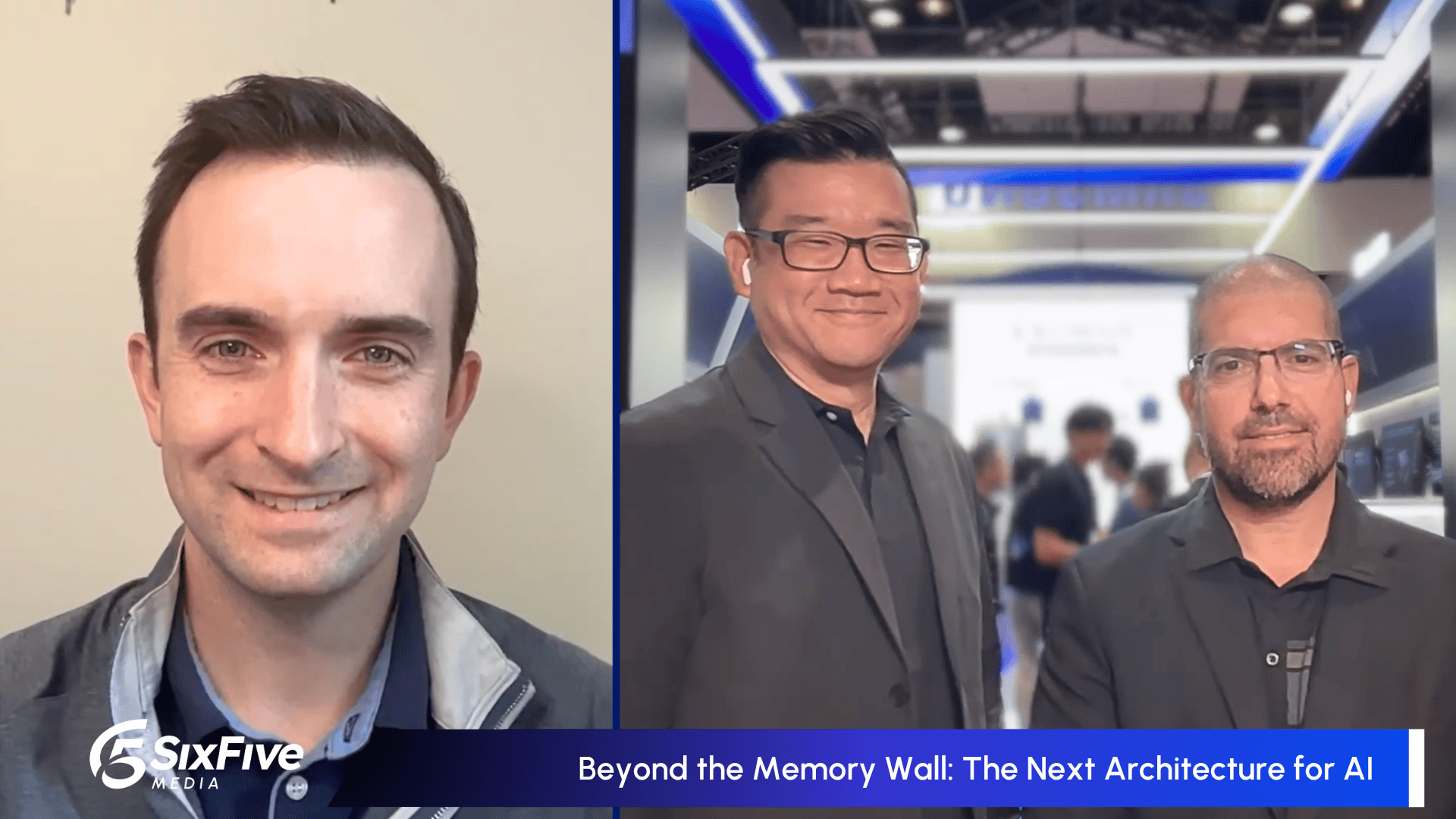
Samsung Unveils zHBM and V10-BV to Target AI's Memory Bottleneck
AI infrastructure is running into a physical wall, and Samsung's answer is architectural. At FMS 2026, Samsung Semiconductor's Donovan Hwang and Eyal Pnini join Six Five to unveil zHBM and V10-BV, concept architectures designed to close the physical distance between memory and logic and keep pace with AI's growing demands.


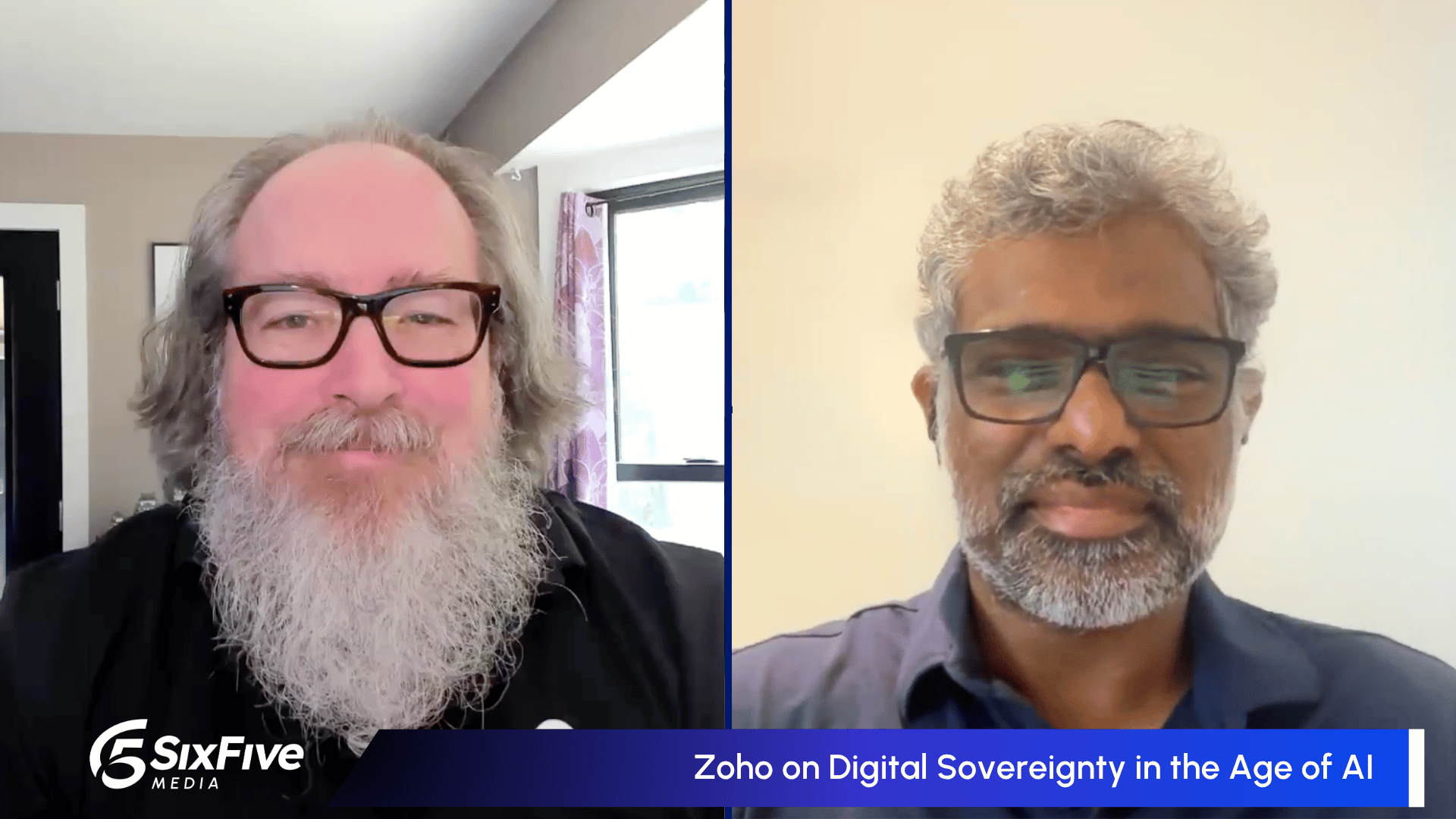
Zoho on Why AI Sovereignty Means Owning the Intelligence, Not Just the Data
As AI adoption accelerates, Zoho's Raju Vegesna argues enterprises must rethink sovereignty beyond data residency to include who owns the models processing that data. Vegesna joins Six Five to explain why retaining AI intelligence, not just information, determines whether a company remains a customer or becomes a hostage to its technology provider.

The Orchestrators Ep. 1: Why Enterprise AI Needs a Conductor
Mohamad Ali, SVP and Head of IBM Consulting, joins Daniel Newman to discuss how AI is transforming enterprise workflows, why consulting is becoming software, and what it takes to operationalize agentic AI at scale.
Other Categories
CYBERSECURITY
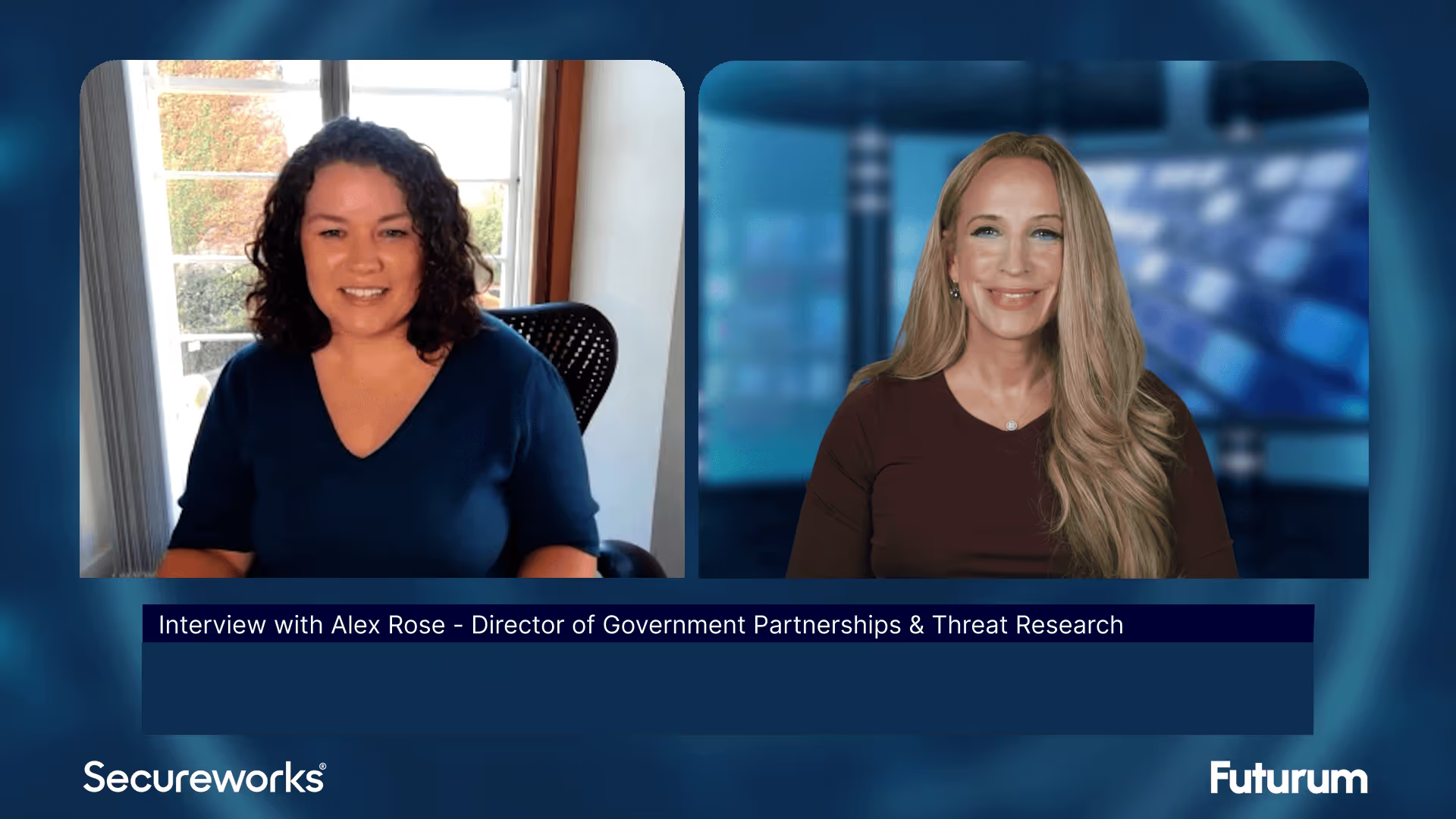
Threat Intelligence: Insights on Cybersecurity from Secureworks
Alex Rose from Secureworks joins Shira Rubinoff on the Cybersphere to share his insights on the critical role of threat intelligence in modern cybersecurity efforts, underscoring the importance of proactive, intelligence-driven defense mechanisms.

HP Launches World’s First Business PCs to Protect Against Quantum Hacks - The Six Five On the Road
On this episode of the Six Five - On the Road, hosts Patrick Moorhead and Daniel Newman are joined by HP's Ian Pratt, Global Head of Security for Personal Systems.
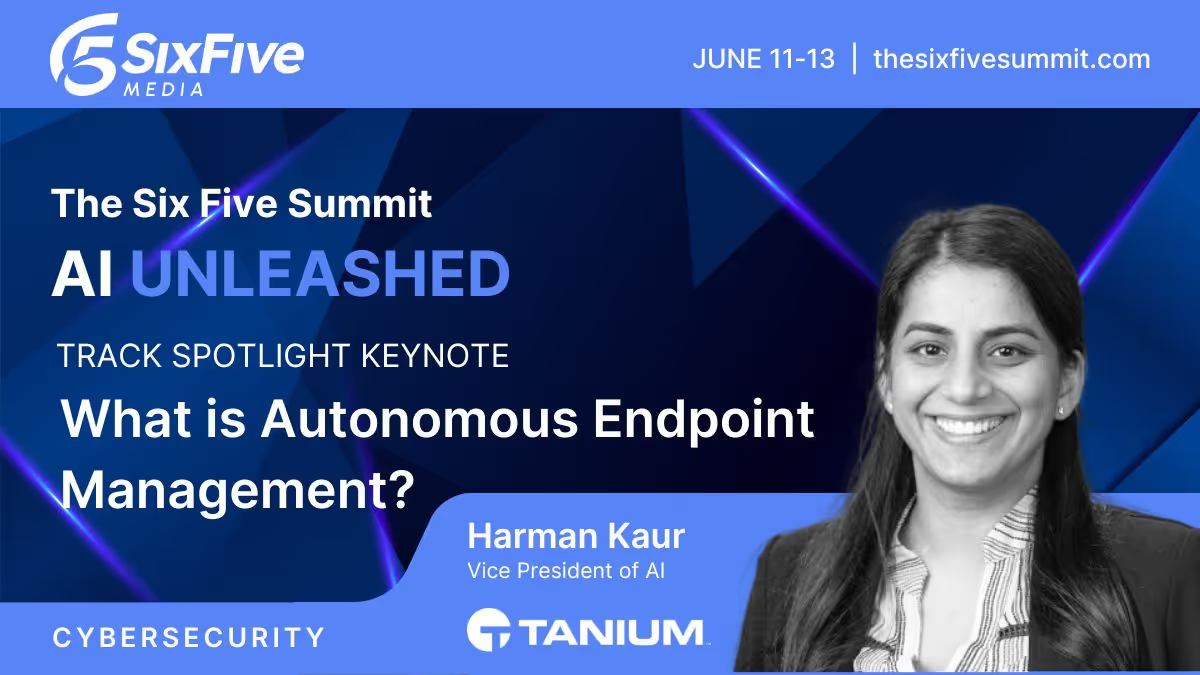
What is Autonomous Endpoint Management?
Autonomous Endpoint Management is a framework designed to unify IT operations and security teams on a single platform through real-time control and visibility.
QUANTUM
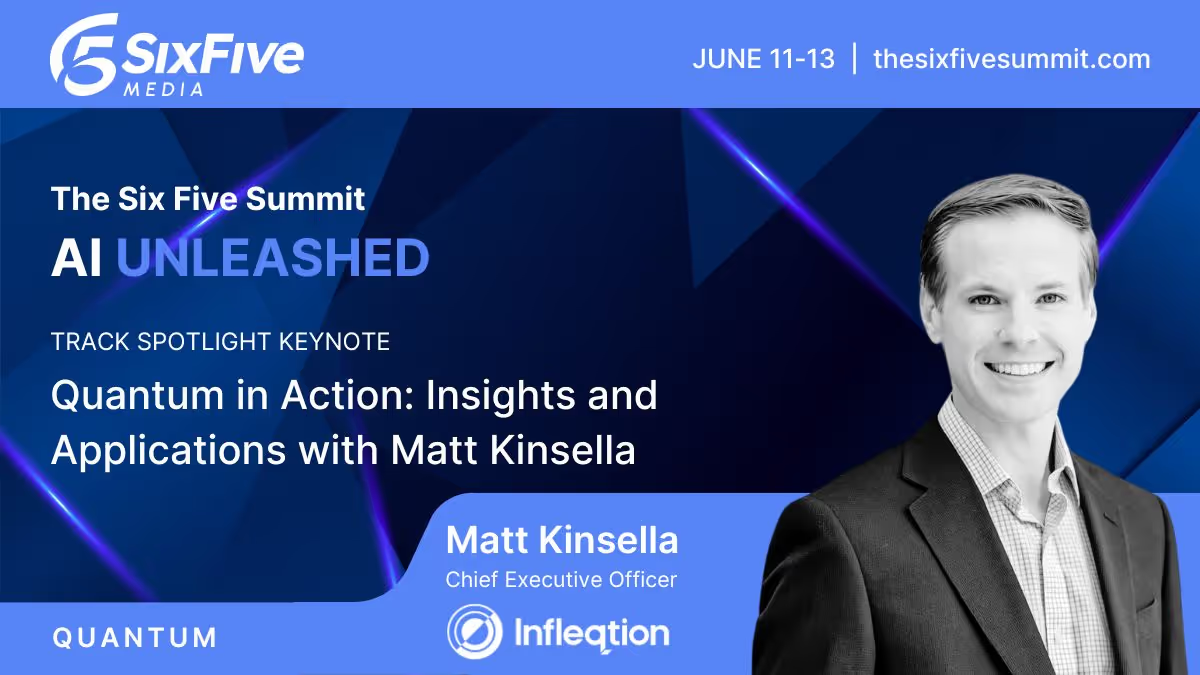
Quantum in Action: Insights and Applications with Matt Kinsella
Quantum is no longer a technology of the future; the quantum opportunity is here now. During this keynote conversation, Infleqtion CEO, Matt Kinsella will explore the latest quantum developments and how organizations can best leverage quantum to their advantage.
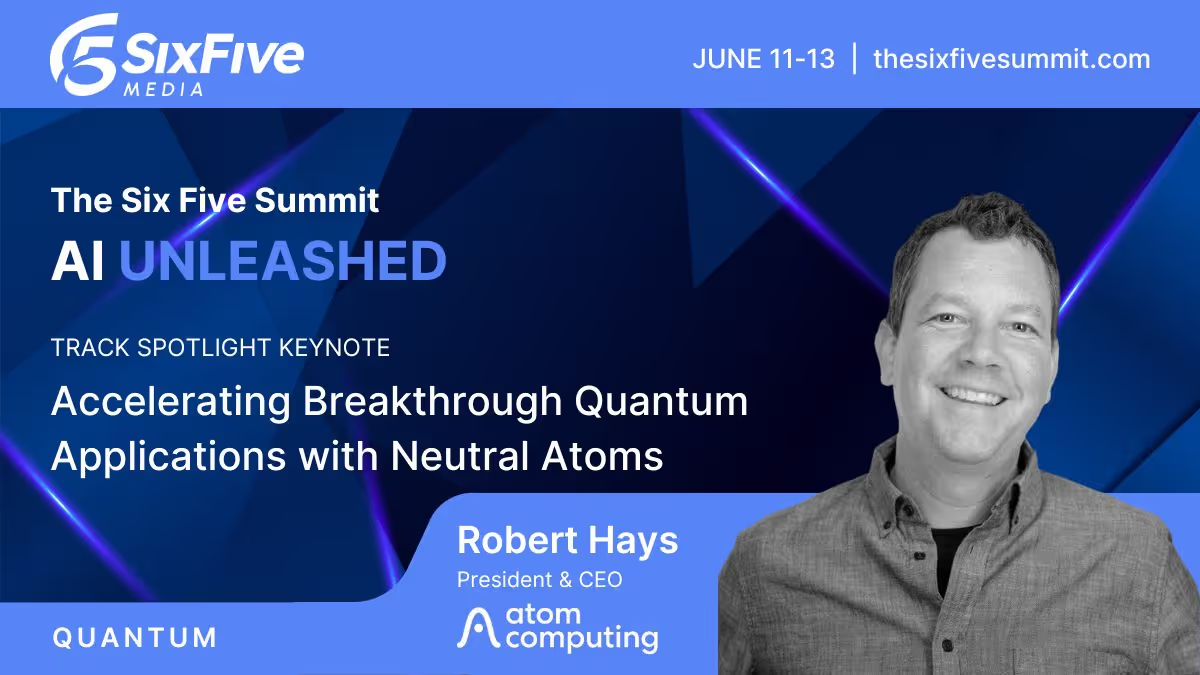
Accelerating Breakthrough Quantum Applications with Neutral Atoms
Our planet needs major breakthroughs for a more sustainable future and quantum computing promises to provide a path to new solutions in a variety of industry segments. This talk will explore what it takes for quantum computers to be able to solve these significant computational challenges, and will show that the timeline to addressing valuable applications may be sooner than previously thought.