
From AI Strategy to Execution: How Forward Deployed Engineering Is Closing the Enterprise Gap
SHARE


Accenture and ServiceNow launched the Forward Deployed Engineering program at Knowledge 2026 to address the delivery gap that keeps 88% of enterprise AI initiatives from reaching scale production. David Kanter, Senior Managing Director and Global Head of the ServiceNow Business Alliance at Accenture, and Miku Jha, GVP of Applied AI and Forward Deployed Engineering at ServiceNow, outline how embedding co-engineering teams inside customer environments from day one, backed by 300+ agentic AI workflows and a governance-first architecture, changes what enterprise AI deployment actually produces.
Enterprise AI investment is accelerating, but sustained, enterprise-wide impact remains the exception. Accenture's own research puts the share of leaders reporting that outcome at 32%. The forward-deployed engineering program ServiceNow and Accenture announced at Knowledge 2026 addresses the delivery layer directly: ServiceNow product and platform engineers and #Accenture FDEs embed inside customer environments from day one, co-building #AgenticAI workflows in production on the platform where enterprise work already runs.
Melody Brue sat down with David Kanter, Lead - Accenture ServiceNow Business Group, Global, at Accenture, and Miku Jha, GVP of Applied AI and Forward Deployed Engineering at ServiceNow, to unpack what the program changes about how AI gets built, governed, and scaled inside the enterprise.
The conversation covers why the gap between AI strategy and measurable outcomes is a delivery problem, not a technology problem, and how embedding engineering teams inside customer environments resolves integration challenges, data quality issues, and governance requirements that external implementation models cannot surface. Kanter and Jha also address the 0-to-1, 1-to-N delivery model, where #ServiceNow FDE teams drive initial production deployment, and Accenture's global organization scales it across the enterprise, without a knowledge transfer gap between phases.
Key Takeaways:
🔹 The delivery gap, not the technology gap, explains why 88% of enterprise AI initiatives never reach scale production. Vendors layered AI onto disconnected processes. The models could reason, but they could not execute across enterprise systems with governance, context, and accountability in place.
🔹 Forward-deployed engineering embeds ServiceNow and Accenture teams inside customer environments from day one. Joint customers access 300+ AI agent skills and agentic workflows, co-built natively on the ServiceNow AI Platform, with value demonstrated in production before enterprise rollout.
🔹 Trust has moved from a feature consideration to an architectural requirement. For a CIO, CFO, or CTO to authorize enterprise-wide agent deployment, the governance layer must be built into the foundation. The AI Control Tower is the governed execution environment that makes agentic AI operable at scale.
🔹 Accenture operates ServiceNow at approximately 800,000-employee scale, advancing toward a zero-touch service desk. That operational experience converts client conversations from theory into practice. When a customer asks whether something works, Accenture answers from live deployment, not reference architecture.
🔹 The 0-to-1, 1-to-N delivery model eliminates the handover gap that stalls enterprise AI programs. ServiceNow FDE drives initial production build. Accenture scales it across the enterprise. Both phases run as a single motion, with no knowledge transfer break between them.
Enterprises that build the right operational foundations now compound the advantage over the next decade. The FDE program is how that foundation gets built at speed, with engineering embedded alongside the customer rather than handed off to them.
The Six Five Media team makes no guarantee, warranty, or representation as to the accuracy or completeness of the information presented. This content is produced independently and is not sponsored, endorsed, or reviewed for accuracy by any company mentioned. All trademarks and company names referenced are the property of their respective owners. This is not investment advice.
MIKU JHA:
There's no way I can take it and deploy it across my entire enterprise or risk my external customer base with them. So trust is not even a feature anymore. It is the architecture that needs to happen.
DAVID KANTER:
Yeah, well said. Well said.
MELODY BRUE:
Hello, welcome to Six Five On The Road. I'm Melody Brue. Today, I'm going to be diving into how organizations are moving AI from concept into real innovation. And I'm here with David Kanter and Miku Jha. We're going to get talking about, you guys had a big announcement today. You want to share a little bit about the big news, a lot of excitement.
DAVID KANTER:
Miku and I are very excited about our announcement just hours earlier. It's something that Miku and I, and our teams have been working on for many months. And you think the time is perfect right now. This is the moment. I mean, one of the things we're finding in all of our conversations right now is all of our joint customers will go so far beyond talking about automation, with the latest technology, but really getting the impact at scale across their enterprise. And to do that, we believe that we need to reinvent the underlying work. To reinvent the underlying work, you need to think about going that differently. So our announcement today was our joint Forward Deployed Engineering program that is bringing together experts, AI-native, platform-native on ServiceNow at FDE's with Accenture industry for deployed engineers to go reshape that underlying work. And that's why this mole is the biggest solo core and why we're so energized to be here and talk to you about it.
MELODY BRUE:
This is great. So tell me though, why is it now? Now, we're kind of forward in AI deployment and how people are thinking about AI, so why is this the moment?
MIKU JHA:
I think it's really, if you look at the data, then it's kind of interesting because enterprises are investors in autonomous agents. They are getting into the core workflows, but at the same time, 88% of those initiatives don't make it into scale production deployment. Or said other way, only 12% make it. So there is still this glaring gap of 88 to 12. And how do we get enterprises to kind of start getting the outcomes? Which is why this motion is so powerful. Because yes, I founded this FTE team eight months back. We are able to take solutions into production in less than 10 weeks. But the question is that once it is in production, now there is change management. Now it is about how do you get it adopted in the deployments from 200, how do you get to 20,000 users? And all of that is outside of just the pure tech and LLM. That's where this partnership becomes so powerful, because you need industry expertise, you need to have the knowledge to do the change management, and you need to take it to enterprise scale. which we can do together for our joint customers in a very differentiated way.
MELODY BRUE:
One of the big challenges has been around mindset. Now there's a mindset about AI and whether people are ready for it and that change management. So how do you kind of think about sort of…you can't just create mindset, right? But you can sort of reverse engineer it. So how is this partnership helping to create and build on that mindset in the enterprise so that people really are ready for what's next that they have?
DAVID KANTER:
I think a couple of things that we're doing together, we talked about that mindset. One of this mindset is not just automation, but reinventing the work melody. So when Miku and our team started formulating about what to make this different, it may be impactful to the mindset is that we found to get the return on this investment, on the tokens, on the assist, we need to look at the value chain. Think about it as a major process area. If we look at it that way, we can start delivering that there's going to be a change in experience, a real business outcome we're going to drive towards. And we found that that's the important shift on the mindset. We have to tackle something that's specific to that value chain for the customer in their industry, in their environment, because they're using lots of different AI technology. And that's why we think this is so important.
MIKU JHA:
So what they were saying, right, there is also some sort of fatigue of doing all the experimentations for enterprises. So the way the resistance comes from not yet seeing, touching and feeling that valley, from your investments. So now when we take on the projects where we can partner really well is also how do we show them the potential value? What is the business outcome? Why are you even building it? And I think that needs to be more of a science as opposed to an art. Today it's an art because you say, OK, I'm going to go build these five agents. Why? Right? Like, where is that method to say, this is what it is going to deliver me. This is what—it is going to save me $5 million because I'm able to avoid the issues which I couldn't avoid before. So that value anchor is a data-driven way in which the mindset can change, right? Which is not happening as much as it should.
MELODY BRUE:
Yeah. So you're really reorganizing around value. And that takes several different steps to get there. So first you have to align on what is the value. And then it is a bit of an organizational reconstruct, right? So how do you help? How do you jointly help customers get there?
DAVID KANTER:
Yeah. And what's great is about this, this announcement today is that it's beyond an idea. So me and our teams, like we are already out of customers together. We were eventually, we've been working together since January, building upon our long history. I mean, we announced our original work, uh, around Source.ai platform back in July, 2023, believe it or not, like two and a half years ago. So a couple of things we can do is one, you've worked so closely together at the product level, now at this industry level. And we're proud to be ServiceNow's number one partner globally, and in every region around the world. And what that allows us to do is bring our scale, both globally, but also locally to this, to like, feed all of our knowledge into our clients, along with Miku's teams, not in parallel, but together. And we're finding that's what our customers want, is you showing up together from the beginning. I would add to that, I would just also call out that we also go and show up as customers because as Accenture, we're an early adopter of ServiceNow's technology. We use that power, our organization. But I think that really helps the conversation of how we show up together.
MIKU JHA:
And one thing I really want to kind of emphasize here, right, that now the term FTE is kind of used as, you know, a branding or marketing, but it's not actually about the labor. It's actually about how do you approach that bill and what is the operating principle. It's really important, this is where this partnership helps so much, because from ServiceNow, we are building best of the best AI native engineering talent, and we are embedding in customers' environment, in their world, in their workflows, in their messy data, right? We are working with them, we are going into their board meetings to say, okay, what is your board imperative, right? So we embrace that into it, and then kind of roll up our sleeves to say, We are not here to give you best practices, templates. We are here with you to actually take your solutions where you start seeing the outcomes, right? So that's a very different approach in how we are bringing the FDE motion for our mutual enterprise customers. It's not just as a top, it is really leaning in 360 with the customers to get them over the finish line.
MELODY BRUE:
And as you help customers deploy thousands of agents across their enterprise, how do you then help them to understand the governance and the security and risk that comes with that?
MIKU JHA:
That's a very powerful question because I was reading the data that the number one blocker for AI solutions not to be adopted is the consistency. But the number one blocker for it to not scale at enterprise level is trust. Because if I don't trust it as a CIO, as a CFO, as a CTO, as a decision maker, there's no way I can take it and deploy it across my entire enterprise or risk my external customer base with that. So trust is not even a feature anymore. It is the architecture that needs to happen.
DAVID KANTER:
Yeah, well said, well said.
MELODY BRUE:
Yeah. And as you start to architect this, actually, as you start to build it out and you continue on this code about development path, what does that look like for you? And what are you looking at towards, you know, what's the next phase of this and what does success look like for you in this?
DAVID KANTER:
Yeah, it's a great question. We're at Knowledge 2027 now and we're having this conversation again.
MELODY BRUE:
So next year, a year from now.
DAVID KANTER:
A year we're going to be from now. Our teams are driven by this, really this vision, by making it real, like we're going to re-embed work, industry by industry. And this combination of our skills is unmatched. And that's why it gives us the confidence, like where we're going to be in a year and even beyond, is we're truly going to re-embed the work, industry by industry.
MIKU JHA:
I'm not even going to 27 like now, right? Now, the way we want to work is that as we get into our mutual customers, right? We lead from our AI native teams. We do all that we need to do correctly to get it to the build phase. And then we kind of have no gap in anything called knowledge transfer. Our teams work together. We're bringing the expertise from industry. Accenture takes it to scale. So it's from zero to one, one to N, and it's done in one motion. 0 to 1, we will take it on. 1 to N, Accenture FD does it, and then enterprises are successful.
MELODY BRUE:
As we talk about AI in the enterprise, there's always the discussion of what does this do to jobs? How do people sort of address not just working now with their co-worker, their human co-workers, but their agent co-workers? Accenture has always led with human at the lead, not human in the loop. So for this project, and as you move forward, what does that look like to you? What's the importance of that?
DAVID KANTER:
Yeah, I mean, I think that's going to be your point of your question here. That's going to continue to be our operating mindset, too, is that we need to have humans in the lead. So now we're talking about putting AI to work for people. That is how we think about this. The work is we're thinking about that value chain and rethinking about that. It still requires very specialized people to resolve certain types of issues. We want to free up some of the administrative work so that we can have the humans that are driving this spending their time on the most important issues affecting a customer at Elko. So I think that's just going to be inherent in everything.
MIKU JHA:
Yeah, and a lot of it is, the way we say it is more that you have autonomous actors in your equation for core workflows. You will have more human on the loop as opposed to in the loop. But that time that gets freed up is for more complicated tasks. So it's always a mapping, but it is like the things which the autonomous system can do, it still needs to be supervised. It still needs to be that somebody overseeing that fleet of agents, for example. So I think it's about what are the right handover points in the context of a given workflow between the agent and the human. That's what we need to decide correctly for workflows to become efficient.
MELODY BRUE:
Well, this will be exciting to watch. Anything else you want to share before we wrap up?
DAVID KANTER:
We're, we're so excited to get going nowadays. We talked about, we have this in plate to a couple of customers and we're looking forward now with the announcements out there is bring this Ravni around the world.
MELODY BRUE:
Yeah. Thank you. Well, Dave, Miku, thank you so much for joining us for this episode of Six Five On The Road. Please check out all of our other videos on Six Five .com. Like and subscribe, and we will see you next time.
MORE VIDEOS
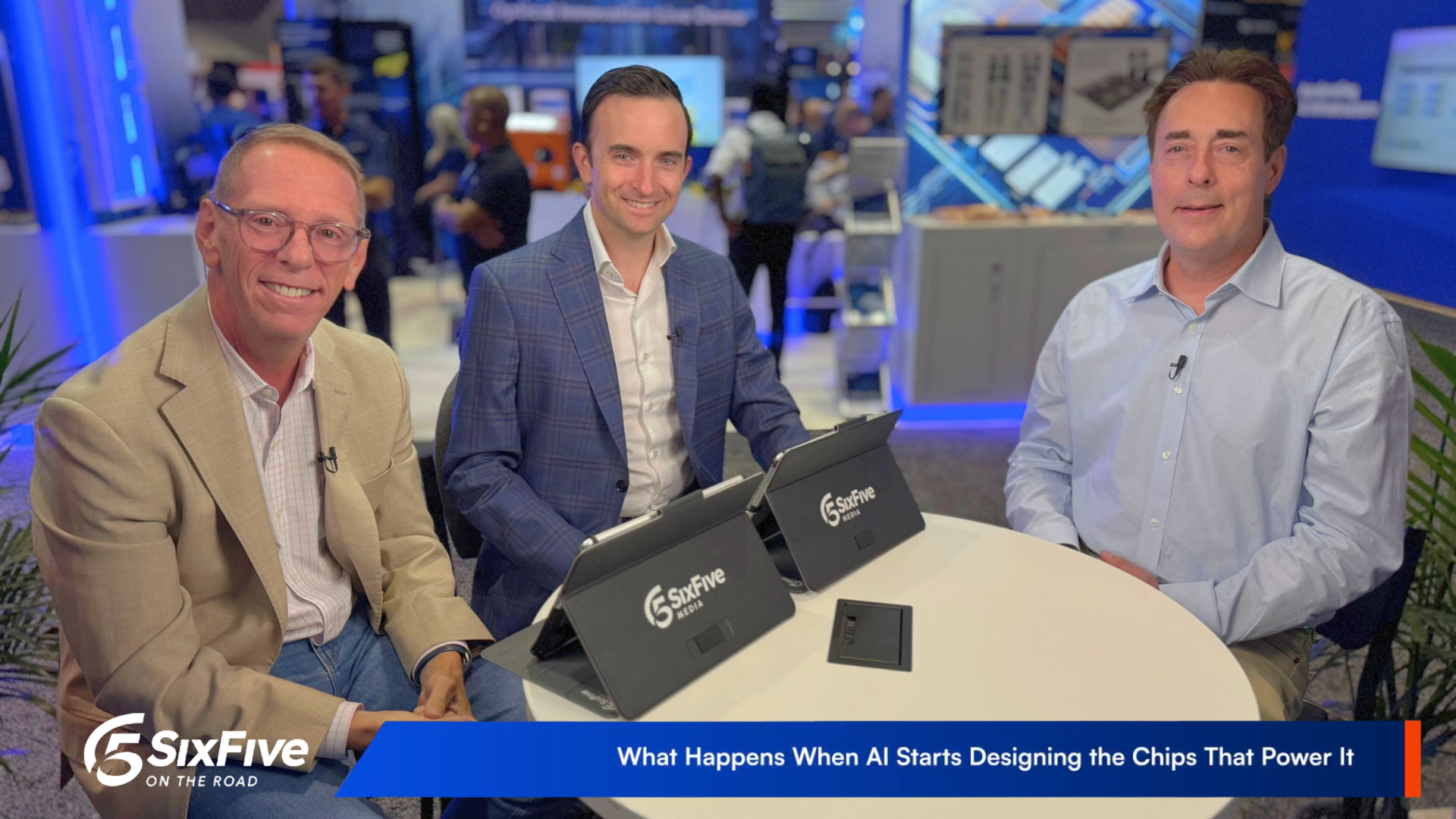
What Happens When AI Starts Designing the Chips That Power It | Synopsys at AI Infra Summit
At AI Infra Summit 2026, Synopsys' Thomas Andersen joins Brendan Burke and Matt Kimball to explain how chip design is moving from AI copilots that suggest to agentic systems that execute tool orchestration, timing fixes, and verification from a written spec. For enterprises, that shift compresses spec-to-tapeout timelines and lowers the resource barrier to custom silicon.


The Six Five Pod | EP 322: AI Writes Its Own Rules, Copilot Bills by the Task, and Memory Names Its Price
The companies racing to build frontier AI just agreed to referee themselves. Over the same week, launches, investor days, and earnings put a price on that arrangement. Microsoft is charging for finished work, NVIDIA is selling agent containment as infrastructure, and the suppliers AI can't route around, from Synopsys to Micron, are collecting the premium. Patrick Moorhead and Daniel Newman separate signal from stagecraft, then split hard on whether the White House accord actually binds these key players to anything.
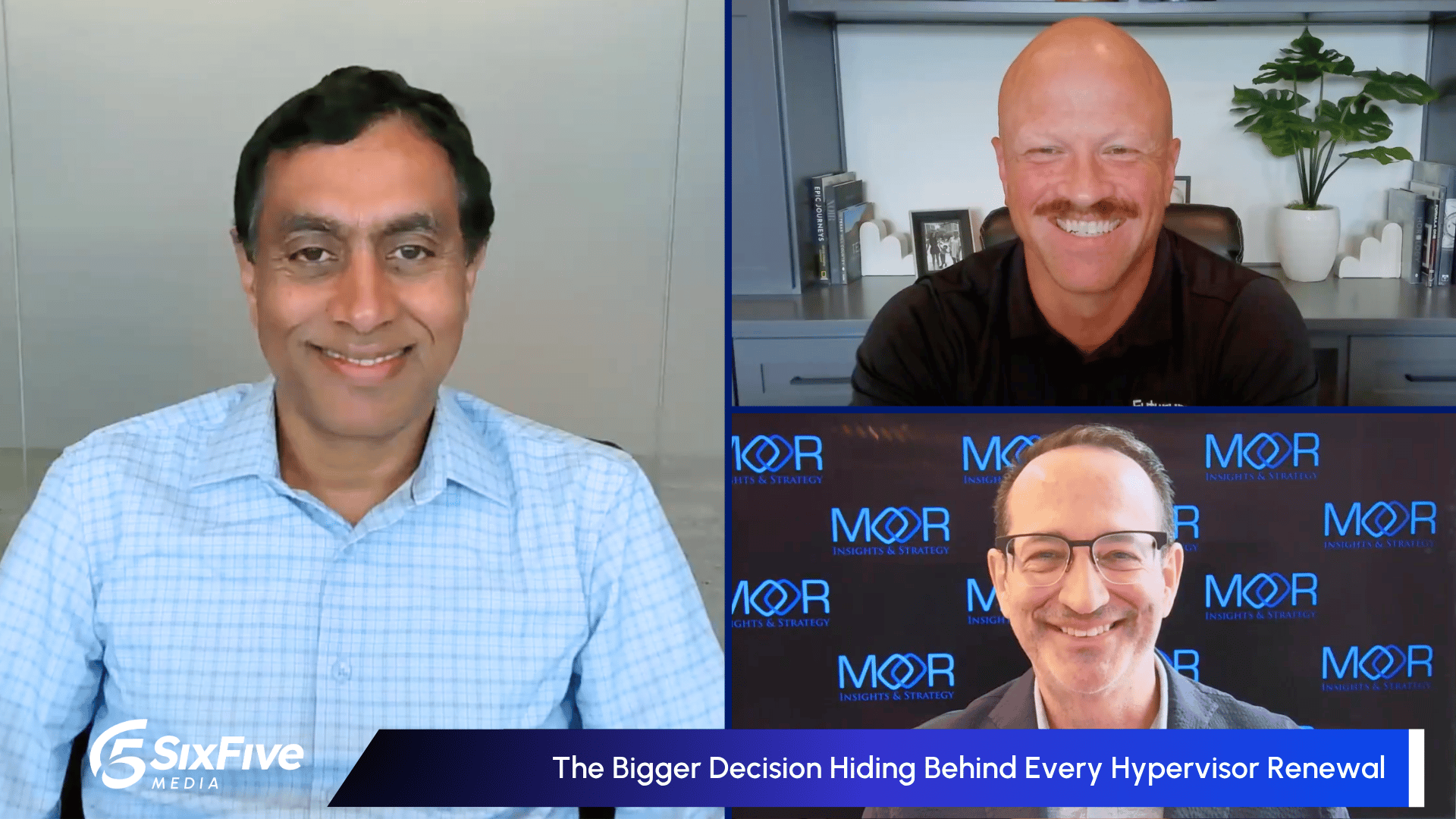
The Major Decision Hiding Behind Every Hypervisor Renewal
HPE's Varma Kunaparaju talks with Patrick Moorhead and Daniel Newman about why virtualization licensing changes are forcing enterprises to confront a bigger decision than which hypervisor to choose next: what operating model sits underneath their private cloud and AI factory. He outlines how CxOs can sequence modernization in phases, extend governance across open and frontier models, and decide where automation should replace human approval in IT operations.
Other Categories
CYBERSECURITY
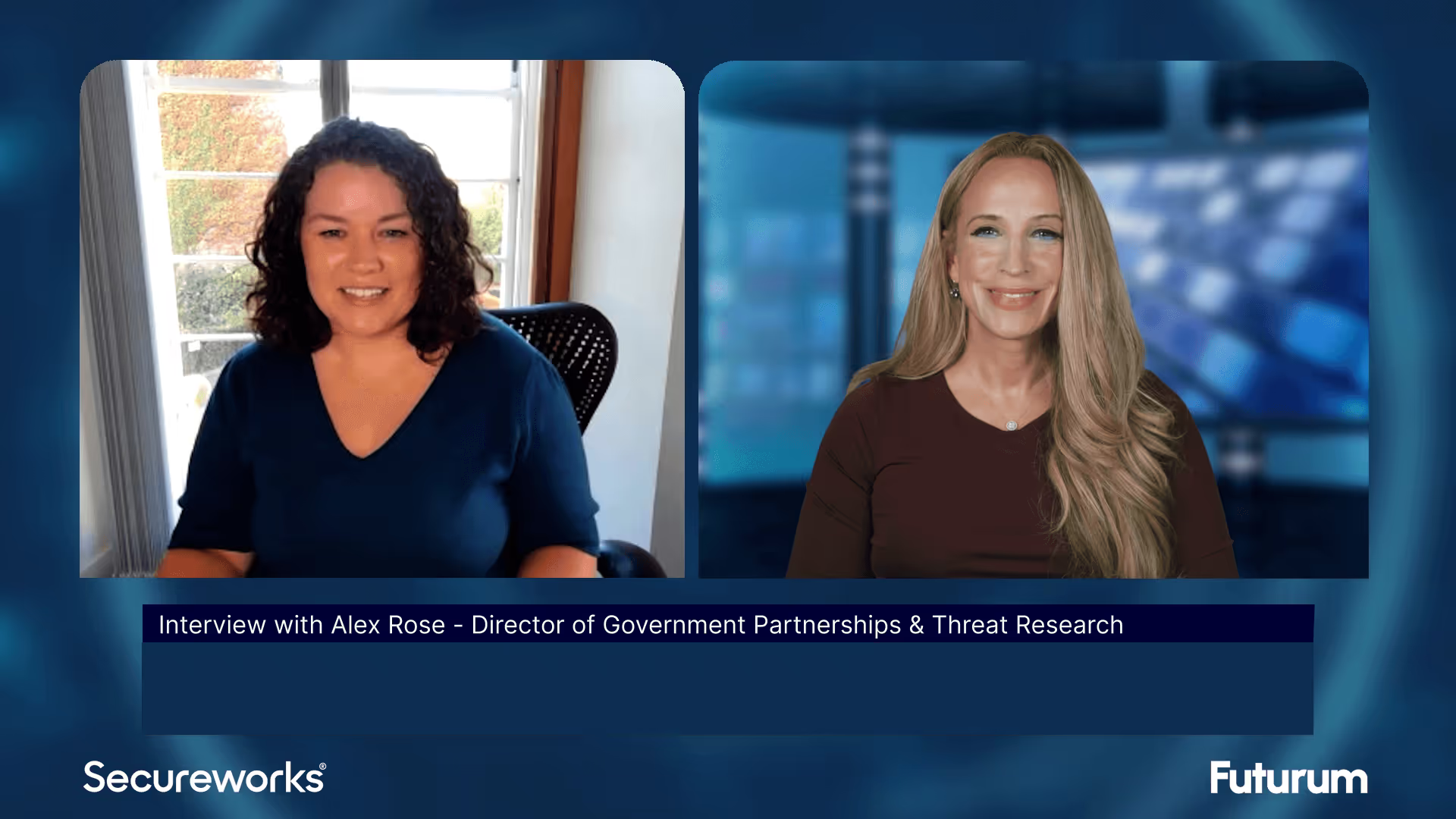
Threat Intelligence: Insights on Cybersecurity from Secureworks
Alex Rose from Secureworks joins Shira Rubinoff on the Cybersphere to share his insights on the critical role of threat intelligence in modern cybersecurity efforts, underscoring the importance of proactive, intelligence-driven defense mechanisms.

HP Launches World’s First Business PCs to Protect Against Quantum Hacks - The Six Five On the Road
On this episode of the Six Five - On the Road, hosts Patrick Moorhead and Daniel Newman are joined by HP's Ian Pratt, Global Head of Security for Personal Systems.
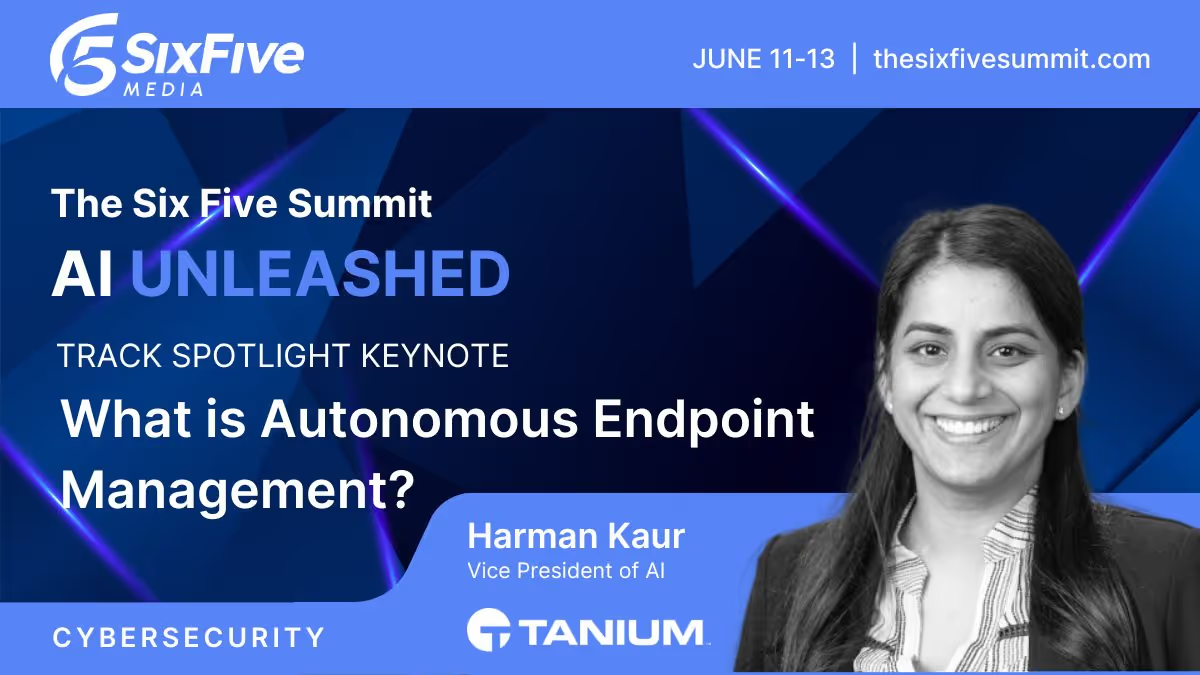
What is Autonomous Endpoint Management?
Autonomous Endpoint Management is a framework designed to unify IT operations and security teams on a single platform through real-time control and visibility.
QUANTUM
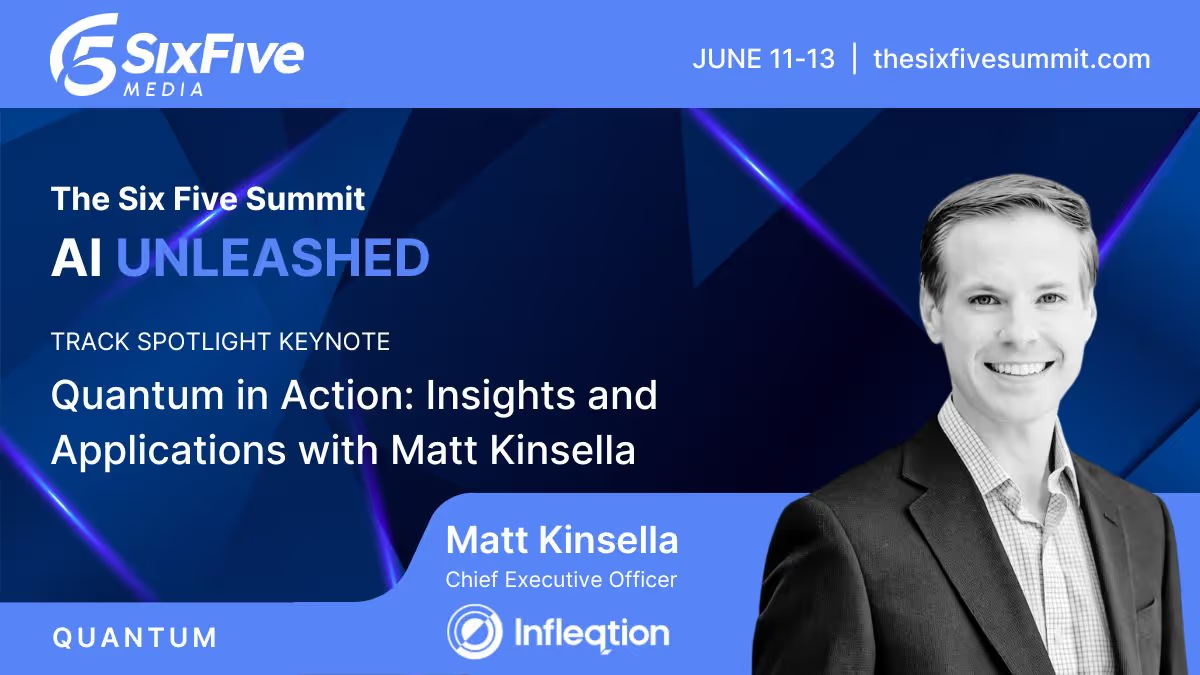
Quantum in Action: Insights and Applications with Matt Kinsella
Quantum is no longer a technology of the future; the quantum opportunity is here now. During this keynote conversation, Infleqtion CEO, Matt Kinsella will explore the latest quantum developments and how organizations can best leverage quantum to their advantage.
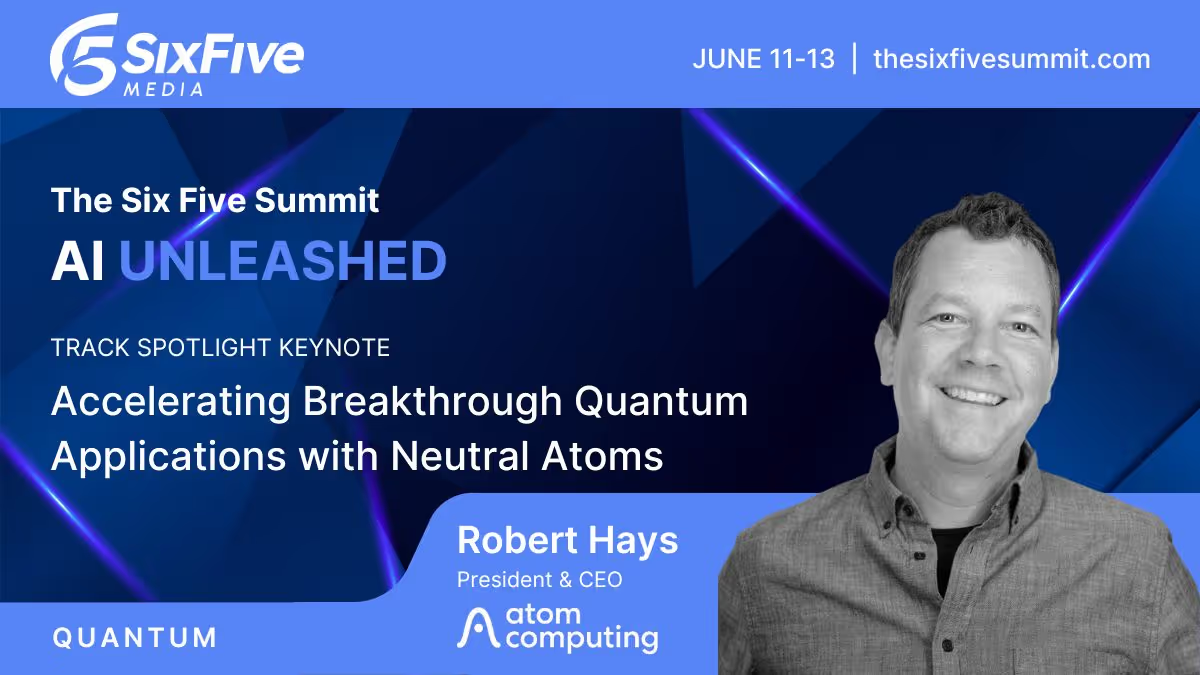
Accelerating Breakthrough Quantum Applications with Neutral Atoms
Our planet needs major breakthroughs for a more sustainable future and quantum computing promises to provide a path to new solutions in a variety of industry segments. This talk will explore what it takes for quantum computers to be able to solve these significant computational challenges, and will show that the timeline to addressing valuable applications may be sooner than previously thought.