Home

From Data Platform to AI Control Plane: Snowflake CEO Sridhar Ramaswamy on Agentic Enterprise Architecture
From Data Platform to AI Control Plane: Snowflake CEO Sridhar Ramaswamy on Agentic Enterprise Architecture
SHARE


The enterprise data bottleneck in the agentic AI era is not storage capacity. It is making the data that matters visible and accessible to AI models at the moment of decision. In this Six Five Virtual Webcast, Snowflake CEO Sridhar Ramaswamy joins Patrick Moorhead and Daniel Newman to examine how coding agents are becoming the foundational infrastructure of the agentic enterprise, why architectural flexibility across models, formats, and cloud providers is a competitive requirement, and what enterprise data leaders must prioritize to build a compounding advantage in the next 12 months.
Enterprises have spent years consolidating data, but a majority of them still can’t answer their most important business questions in real-time. The bottleneck is no longer storage or compute. It’s making the right data visible, accessible, and actionable for AI, the moment it’s needed.
Patrick Moorhead and Daniel Newman sit down with Sridhar Ramaswamy, CEO of Snowflake, to examine what the agentic enterprise era actually demands from data infrastructure. The conversation covers how coding agents are becoming the foundational layer of enterprise AI, why architectural flexibility is a competitive requirement, and what enterprise leaders should be doing over the next 12 months to stay ahead without constantly chasing the trend cycle.
Sridhar also breaks down Snowflake's vision for intelligence as the control plane, the role of open formats like Iceberg and Polaris in enabling true data interoperability, and how MCP connectors are changing what is possible when work context and data context come together in the same environment.
Key Takeaways:
🔹 Coding agents are the foundation of the agentic enterprise. Sridhar reframes the coding agent as an abstraction agent. Providing enterprise context, model access, and application connectivity is where the real productivity unlock happens, not in the code generation itself.
🔹 Data accessibility matters more than data completeness. Getting the data that the business actually relies on daily into a state where AI models can see and act on it delivers faster ROI than waiting for a full data estate overhaul.
🔹 Architectural flexibility is not optional. Snowflake supports interoperability at every layer from MCP endpoints to Iceberg to raw SQL because monocultures fail, and enterprise buyers cannot afford platform lock-in as the AI landscape continues to shift.
🔹 AI is the new integration layer. Cortex can query Databricks sources, manage Glue and Airflow systems, and stitch data across heterogeneous environments. The data platform is becoming the orchestration layer, not just the storage layer.
🔹 Short planning cycles outperform long roadmaps. Sridhar's operating principle: prove progress every week, not every quarter. With AI capability compounding at 15 to 20 percent per week, two-year plans are obsolete before they are approved.
The enterprise data leaders who win the next phase of AI adoption will be those who make the right data visible, connect it to their working context, and iterate fast enough to compound their advantage.
Watch the full conversation at sixfivemedia.com and subscribe to our YouTube channel so you never miss an episode.
Disclaimer: Six Five Media is for information and entertainment purposes only. Over the course of this webcast, we may talk about companies that are publicly traded, and we may even reference that fact and their equity share price, but please do not take anything that we say as a recommendation about what you should do with your investment dollars. We are not investment advisors, and we ask that you do not treat us as such.
SRIDHAR RAMASWAMY:
Not all pieces of data are that important. Having the data that you really care about on a day-to-day basis such that they are visible to AI models and accessible with products like Snowflake Intelligence itself is a very big deal.
PATRICK MOORHEAD:
Welcome back to the six five. This is a six five virtual webcast. I'm joined here with my bestie, Daniel Newman, and we are talking about our favorite topic. And that is AI. You know, it's crazy, Daniel, how far we have come from that initial chat GPT moment.
DANIEL NEWMAN:
Yeah, it's been an incredible couple of years, hasn't it, Pat? I keep thinking you and I are probably some of the most tech forward, tech optimist. We are also now engineers, vibe coders, full stack, in fact, engineers we have now become. But at every stage of this, I genuinely reflected on the fact that as optimistic as I am, I think I've underestimated how exciting the times and how exponential times we are in right now.
PATRICK MOORHEAD:
Yeah, Daniel, having a ton of conversations about, you know, moving from, you know, I'll call it experimentation, to pilots to truly scaling, agentic AI. And one of the companies really in the center of all of this, this whole big data conversation is Snowflake. And Last time we discussed this with Snowflake, we were in Davos, but I'd love to bring in the CEO of Snowflake, Sridhar Ramaswamy. Great to see you again.
SRIDHAR RAMASWAMY:
Hey guys, great to see you. Yes, how much has changed? Gosh, in like three months, it's wild.
PATRICK MOORHEAD:
Yeah, it's amazing.
DANIEL NEWMAN:
It really, really is. And I couldn't think of a better person to be speaking with, because you are in the middle of this right now. You are on the forefront of some of the most important innovation, which we know is around making data accessible to all of your applications. That's what Snowflake came to market. That's why it was one of the most anticipated IPOs in history. That's why it's been one of the most exciting growth companies. But it's definitely changed. Even in our conversation in Davos, it's changed how you think about product and innovation. I remember you saying something to us about how you kind of, with your team, building product, looking out, I think it was beyond a year or two, you kind of said like, you don't really go for that. You kind of said, because you just genuinely don't believe. And I think you were really kind of even proven more right. Because anybody that's sort of gone along the way these last couple of years, and they've tried to build to the trends, by the time you've built anything, You were already run over and passed by. So so let's let's start there. I mean over the last couple of years enterprises there they are experimenting a lot with generative AI. Now a dick AI. But I think part of it's the chasing part of it's all the unknowns. Part of it was they didn't have their data in good shape before AI. And now they certainly aren't ready. ready now, but like, you know, companies want ROI, they want to get returns on their investment, they're not in the business of making software, writing it or managing it. But what is the sort of, you know, as we enter this agentic enterprise era, how do companies get through this difficult phase? And how do they get from that kind of recommendation to to really actioning their AI?
SRIDHAR RAMASWAMY:
Yeah, it's a great question. I think just the pace of change, as you find out, Pat and Daniel, has been quite incredible. Just to do like just a super rapid fire of 2020 through to 2026, what happened was first came the chatbots. This is the chat GPTs of the world. They enthralled us because they could apparently answer anything. but they were not that great at answering lots of real questions about the enterprise, but they were super creative. We fell in love with them. Then came the rack-based systems, which made them more reliable for just having conversations about, I don't know, how to repair a particular device, for example. They were interesting, not that interesting. And then came along systems that could do things like talk to structured data. And people in data have been wanting to do this literally for decades. That was also an interesting addition. But I think this latest round is particularly profound because of the rise of coding agents. What we call an agentic enterprise has as its foundation this thing called a coding agent. A coding agent is actually, in a weird way, it's a misnomer because it's actually an abstraction agent. That's where all of the power within the enterprise is coming from. If you take something like a cloud code or a cortex code or their work variations and give them access to things like enterprise context, give them a great model, give them rules about what they should and should not do, and attach them to applications that you and I use, let's say Slack or Drive, real magic happens. That's the thing that is enthralling people, because it means that you can do things that you simply could not imagine doing before. Just over this weekend, for example, I wanted to write a chronology of all of the different features and launches we have had for Cortex code and Snowflake intelligence. This is not putting together stuff that's sitting in 100 different documents, 100 different Slack channels. But using our coding agent, I could actually assemble a deep research report without literally anyone's help. Those are the kinds of things that are possible today. That's the reason you see the excitement. But you needed to apply it in situations where you can show clear ROI. We have done that in support. We have done that with our SREs, the people that maintain Snowflake. So we'll talk more about that. But it's the rise of coding agents. and this now unfolding view that you can sit inside them and just get work done, that I think is a profound new idea.
PATRICK MOORHEAD:
There's two schools of thought now related to what I will call AI architecture, right? One school of thought says, hey, let's go fully integrated. Let's go compute, storage, data management, and even I'll throw networking in there. From the start, Snowflake has been designed around optionality, right? You separate compute, data management, and storage. Can you talk about why architectural flexibility matters? in this age of agentic AI and doing it, I'll call it responsibly and also quite frankly, getting the results that you need to get.
SRIDHAR RAMASWAMY:
The choice part is super important. I'll almost answer that flippantly. Why do all dictatorships fail? That's good.
PATRICK MOORHEAD:
I might take that line from you and not give you any credit for it.
SRIDHAR RAMASWAMY:
Look, any kind of monoculture has a bad ending. We don't know how, but it will be a bad ending. And with perfectly good intentions, that's sort of how things unfold. So I think it's important to have choice when it comes to CSPs. We run on all of them. They're wonderful partners. They're great for customers. But for example, regulators will say, you know, we don't want you to be all in on one because in case there is a downtime with it, we need you to still be up. It's very similar with models that are great companies, OpenAI, Anthropic. We partner very closely with both of them. but our product runs on both of them. We do the work to make sure that it is high quality on the best models from these and also, by the way, on open source models because those are catching up and they can be at a dramatically different price point compared to others. That's the reason why I think choice will continue to be important. By the way, it drives an enormous amount of innovation. in the ecosystem. I've been trying the work products, Cloud Core and Cortex. In addition to Cortex code, there's lots of good ideas. I was telling my team over the weekend, hey, like just look at the innovation that's coming from these companies. That's what creates great products for all of us and creates value for enterprises.
DANIEL NEWMAN:
Yeah, I know Pat and I I jokingly said when we were talking in the green room, Sridhar, that, you know, we're now full stack engineers, but, you know, in the, with the advent of Codex and Cloud Code and Perplexity, and to your point though, you know, both of us really enjoy Perplexity Computer because of that idea of sort of an agnostic model approach, you know. That's right, that's right. You know, all the models do well, and you can definitely do a lot in Codex and a lot in Cloud Code, and you can do a lot in Cortex, you know, but like when you had that, flexibility to work across the model landscape, it does a nice job of sort of selecting when a certain model does a certain thing well. And we know that's the case. And I love the point you made about open source, because one of the things we're not probably having enough of a conversation is about what happens when the subsidies on all these models sort of play out a lot of things. And I'm sure you feel very passionately about this. whole enterprise software debate that's gone on like people are basically using these heavily subsidized open models, the frontier models at incredible prices that will never be sustainable when they're doing enterprise work. And so you guys are going to see this when when companies really start to try to get ROI. they're going to turn to companies like Snowflake. It's not going to be entropic instead of it's going to be entropic with Snowflake. And that's absolutely what we're seeing. So, you know, I guess I'd love to ask you about that. And more broadly, like we're coordinating models. We are trying to manage a crazy enterprise data environment. We are trying to determine how to handle governance, compliance and all those different rails of business. all at the same time. And you guys, you know, obviously believe in every company wants things sort of centralized on their platform, or it can be, but that's hard. So how are you guys sort of thinking about Snowflake Intelligence, Cortex code, and sort of decentralizing this, but also really allowing businesses and developers to operationalize across the AI landscape? This is a pretty unique moment.
SRIDHAR RAMASWAMY:
Because obviously we love AI, because we can do things in natural language, complicated, you know, complicated things. The other unheralded side of AI is its ability to act as glue. What I mean by that is it can take data. from one system and stitch it together with data from another system. And so Cortex-Go not only supports, for example, being able to query snowflake sources, but you can actually query Databricks sources as well. You can manage Databricks systems or Glue systems or Airflow. I think that's, again, the power of coding agents. Absolutely. We deliver a lot with Snowflake. It's that ability to govern. It is that ability to audit. It's that ability to make sure that you have all of the clearances that you need in order to be able to act on your data. But we also understand inherently That is a pretty heterogeneous world out there. And so increasingly you're seeing AI as the way in which data from different systems can be brought together to achieve a business outcome. It might still be the case that you might want to migrate some data into snowflake because you want that flexibility. You want that scalability and high performance. But I think we are much more comfortable with saying both the options are perfectly reasonable. It's Snowflake Intelligence. You can create agents on all open data, not just the data that we write. That's the magic of things like Iceberg and Polaris because we can actually read data from any Iceberg catalog and then be able to run queries on it. And again, in the spirit of our customers, these companies don't want to rely solely on Snowflake either. You know, what's good for the goose is good for the gander. And so we have to lean into that interoperability. And plenty of people are storing data in iceberg format using Snowflake for a large set of jobs, but also using other systems if they want to do something specialized or if they simply want to have insurance in case they want to do that in the future. I think this embrace combined with AI's ability to stitch together different systems, different data, I think that's going to be the big story six months from now.
PATRICK MOORHEAD:
Yeah, let's dig a little deeper into into openness and, you know, just like the prior question I asked you, you know, age, age old right aggregator architecture disaggregator architecture closed system open system and by the way everybody's got a different. definition of what open means. So first of all, I'd like to ask you what your version, Snowflake's version of openness is, and maybe talk about how it's being delivered, right? Is it MCP, which by the way, I love. Is it open models? Is it interoperability with SaaS applications? What does that look like?
SRIDHAR RAMASWAMY:
Yeah, these are great questions. Roughly the way Snowflake has been architected is that we offer interoperability at every layer. Obviously, I have a preference for our customers to use us at the top, at the control plane. I want every business user to be pulling out Snowflake Intelligence if they want to answer any questions about their business. That's my aspiration. But having said that, we are perfectly happy to expose Snowflake Intelligence Agents as you described, MCP endpoints. Model Control Protocol is just a way for people to be able to make calls into a Snowflake Intelligence Agent. If they don't want to do that, they can use the next layer below that, which is our semantic view format. They can use that to come up with a definition of an agent. They don't want to do that, they can write raw SQL. Plenty of people are connecting to a Snowflake database and using another coding agent and sending us SQL queries. We definitely let people do that. Next level down, we write and support Iceberg as a full-fledged first-class format within Snowflake where our query performance is on par or better with any other engine that is out there. They can make us write Iceberg and read it from a different engine. Hopefully, this gives you an idea of working down the stack when it comes to interoperability. I do want Snowflake to be a thriving, future-proof business. And so I'm always going to lean into creating functionality that lets Snowflake be the control plane for the enterprise. That's what we aspire to. But people are going to be doing all kinds of things, just like with the model providers, for example. Of course, Anthropic wants everyone to use Cloud Code. But if you want to use Cloud API and access their models, they provide support for that as well. It's going to be the case with pretty much every company that's out there.
DANIEL NEWMAN:
It's interesting, Sridhar. We've entered the era of abundance, I call it. It's never or, it's always and. Right now, you know, we talk about, Pat and I talk constantly on our pod about heterogeneous compute. You know, people are always like, oh, new AI chip. This is going to take out NVIDIA. And Pat and I are always like, no, it's not. It's like, we're going to use both. And I think your point, though, is with, you know, some people will want the API. Some people will want to use, you know, use MCP. Some people will want to come in and use your platform directly. And I think the companies that are sort of building for the abundance era, the and era, they're giving the optionality. I think it was like, you know, more than a decade ago, we sort of said, you know, you know, consumer experience will sort of drive the market. And so whether you want to go to the web, you want to do it on the app, you know, right, it's like you have choice. So right now, I think AI has really driven an era of choice.
SRIDHAR RAMASWAMY:
Just our ability to do many, many different things. At this point, I can create deep research reports in Cloud or in Chad GPT or in Cortex code or Snowflake Intelligence. Sometimes I end up doing a couple and sort of pitting them against each other and asking another model to judge the quality. In fact, our head of comms showed me a report that she had written about a topic that had this kind of critiquing. It's actually turning out to be a really good technique or getting a varied point of view about how things should work. That also has become a technique, which is you do work with AI by getting other AI agents to validate your work. That's what makes it more robust. A good shout out there to Stella Lowe.
DANIEL NEWMAN: You know, by the way, I just think that's a, you know, you just made a really important point, you know, by the way, a lot of token consumption in that in that strategy, right, right, Pat, you know, and we're critiquing, we're using an agent to then critique our agent, which then use another model to then check the agent then comes back. But that's how we get to write. That's how we get to accuracy. That's how we get to ROI. Let's let's end on a question, though, because, you know, so many and you're probably When we're in Davos, I mean, CEOs, CIOs, leaders of government, they're all trying to kind of get this right. And we already talked about the fact that it's hard to keep up with the trends. You're going to be constantly chasing it. So what is the recommendation that you would give to the leaders of businesses, the technological leaders, and those that are responsible for their enterprises' data? What should they prioritize in the next year or so to try to stay ahead of this? There are lots of no-regret moves.
SRIDHAR RAMASWAMY:
Getting pieces of your data estate in order so that you can answer your most important questions. Not all pieces of data are that important. But having the data that you really care about on a day-to-day basis. such that they are visible to AI models and accessible with products like Snowflake Intelligence itself is a very big deal. Bringing your work and data together. This is where things like MCP is a big deal. We now have MCP connectors for Google Enterprise, for Salesforce, but also for Slack. It is a true game changer to have an environment like that without coming up with complicated new products for what to do. Just that ability to synthesize and making it available to people is a big, big deal. I am not a fan of, you know, get your data estate completely in gear for the next 12 months before you do anything. I tell people I want proof every week. By the way, this is the standard demand that I have of my team. So much progress can be made in one week that we should have shorter planning cycles. And to your point, I don't make two year plans because if things are getting better, take your pick 15, 20% every week. 20% compounded for a year is like an unimaginable number. It's like 1.2 multiplied by itself 50 times. It's a very large number. That's part of the reason why I think that it is okay to be incremental because there are so many gains to be had. This is one of those rare moments in history where being greedy but somewhat thoughtful about which way you proceed actually is going to give you a lot of value. And you can do this in a way that does not foreclose future opportunities. Do not bet on weird new formats or weird things that people are doing. Going with the mainstream, you're going to get a lot of benefits.
DANIEL NEWMAN:
I love that you say that. It's fascinating. If you basically try to chase, you will fall behind. But then at the same time, if you do nothing, you probably fall even further behind. So it's get after it. And I think this does always go back to something that I know Pat and I talk a lot about, and that's picking the right partners. Yeah, of course.
SRIDHAR RAMASWAMY:
Seeing my partners drafting the way of what is possible today, that is going to be quite a revelation for most companies. I think we all tend to overcomplicate things. I'll leave with the final thing. My infrastructure teams were writing multiple 20, 30 page docs trying to figure out strategy. We argued about it for a while and we agreed on we'll just iterate every week. The amount of progress that they've made in the last two months is just wild because they embrace this. We just don't know if we're going to do stuff and we will trust that we'll be fine.
DANIEL NEWMAN:
Just build. I love it. Sridhar, I want to thank you so much for joining us here on The Six Five for this virtual webcast. Love to have you back again soon. I know it's only been like four or five months, and it feels like there's been a decade of innovation. So I can't even begin to imagine what might come up the next time we chat, but thanks for joining us. Absolutely. Excited for the next chat. Thank you, Pat. Thank you, Daniel. Thank you. And thank you, everybody, for being part of this 6.5 virtual webcast. That was a sea of snowflake. That was a really interesting conversation. We are moving incredibly quickly. So much ground for everyone out there. Hope all of you that listened enjoyed it. Subscribe. Be part of our community. Check out all of our Six Five content. But for this episode, for this particular show, it's time to say goodbye. See you all later.
MORE VIDEOS
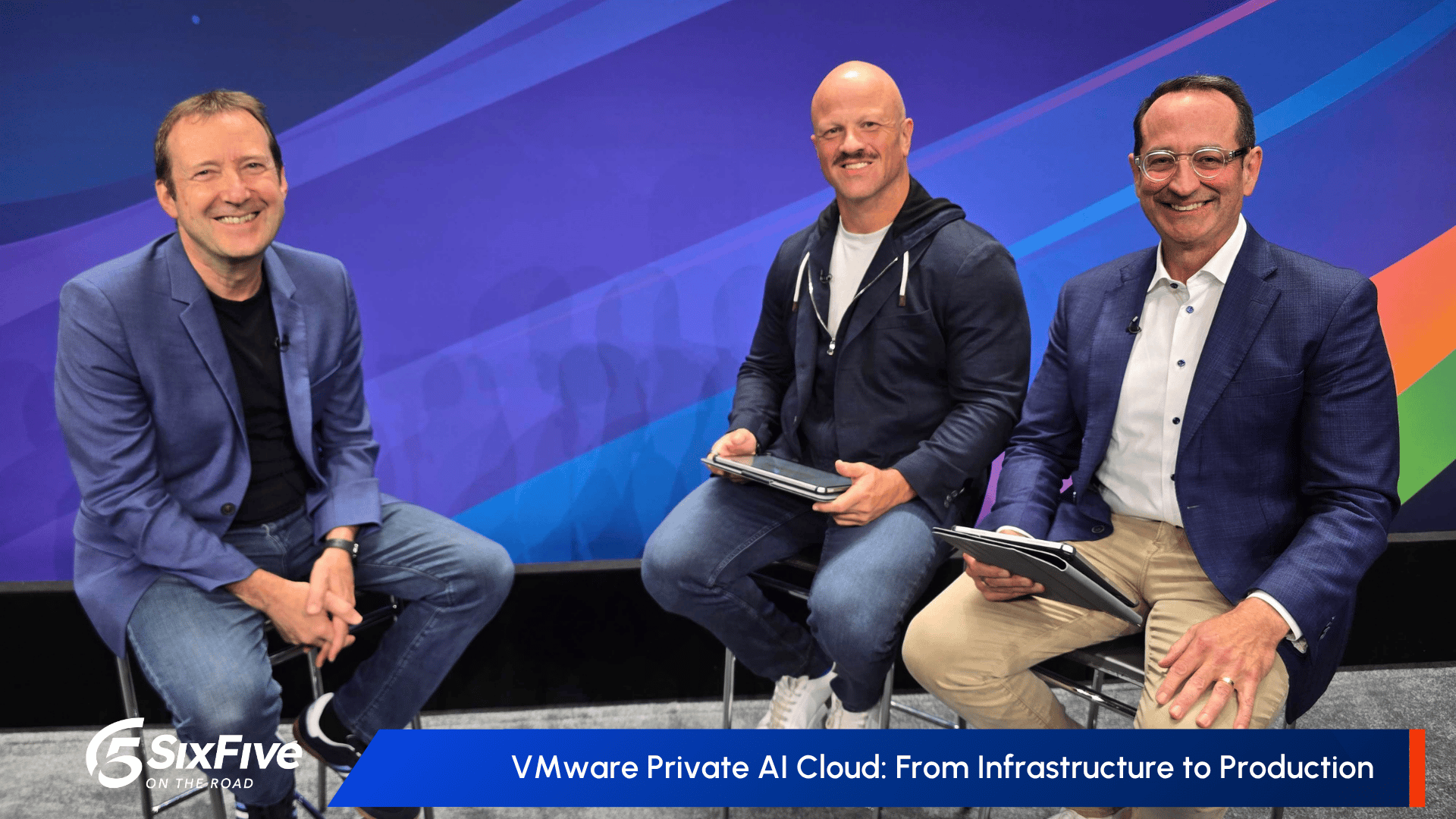
The 15-Cent AI Query: Broadcom's Paul Turner on Rebuilding Enterprise AI Economics
A Six Five study found an eight-to-one cost gap between running an AI agent through a leading frontier model and running it on modest on-prem hardware. Paul Turner, Chief Product Officer of the VMware Cloud Foundation Division at Broadcom, joins Daniel Newman and Patrick Moorhead at VMware Explore 2026 to explain how VMware's AI Factory turns GPU provisioning, model management, and security into a repeatable path from infrastructure to production AI.


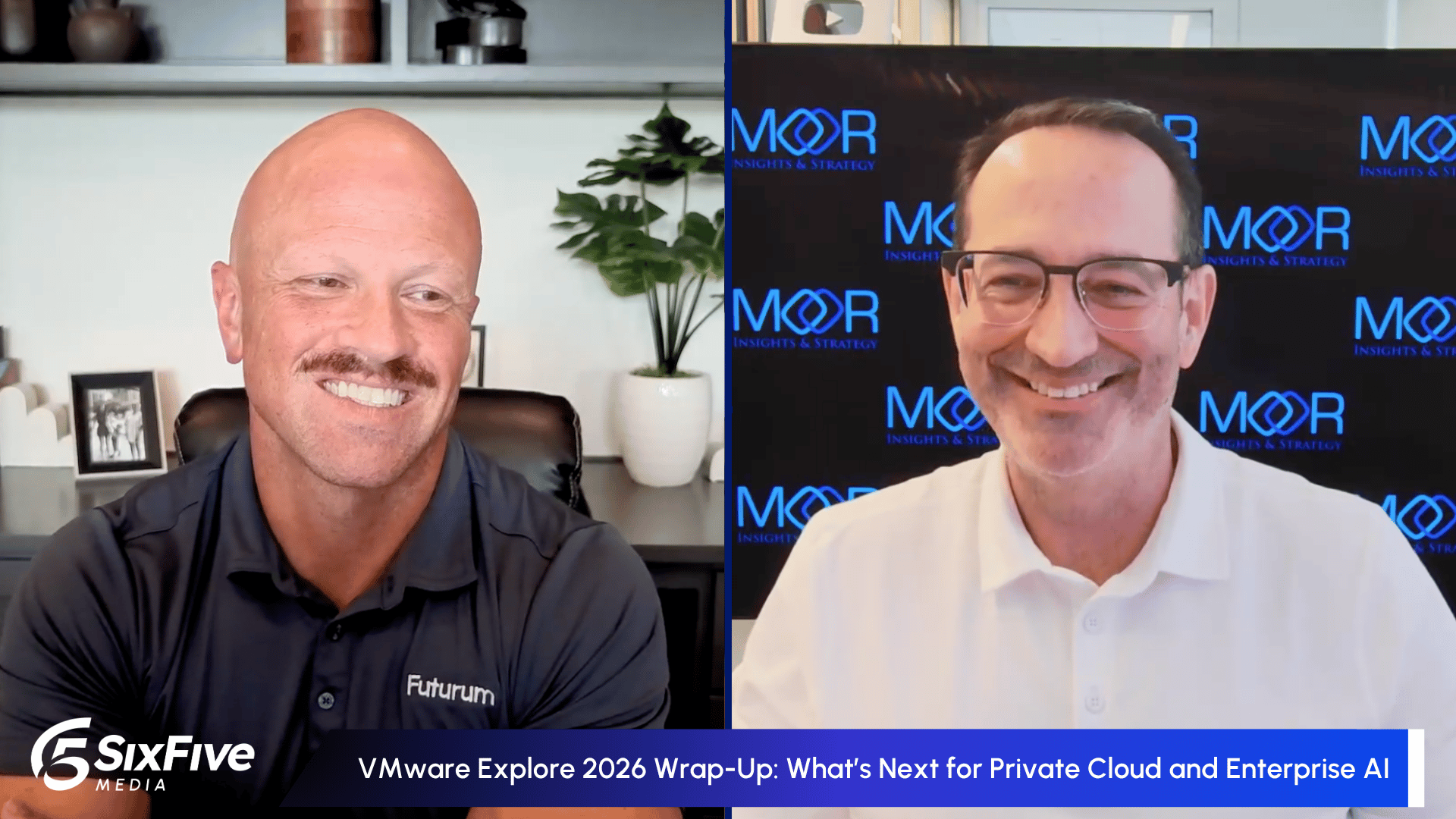
VMware Explore 2026 Wrap-Up: What’s Next for Private Cloud and Enterprise AI
What infrastructure model makes the most sense when AI workloads move from experimentation into production?
In this analyst recap of VMware Explore 2026, Patrick Moorhead and Daniel Newman examine this central question facing enterprise technology leaders and how Broadcom and VMware are positioning private cloud as a critical foundation for bringing enterprise AI into production.
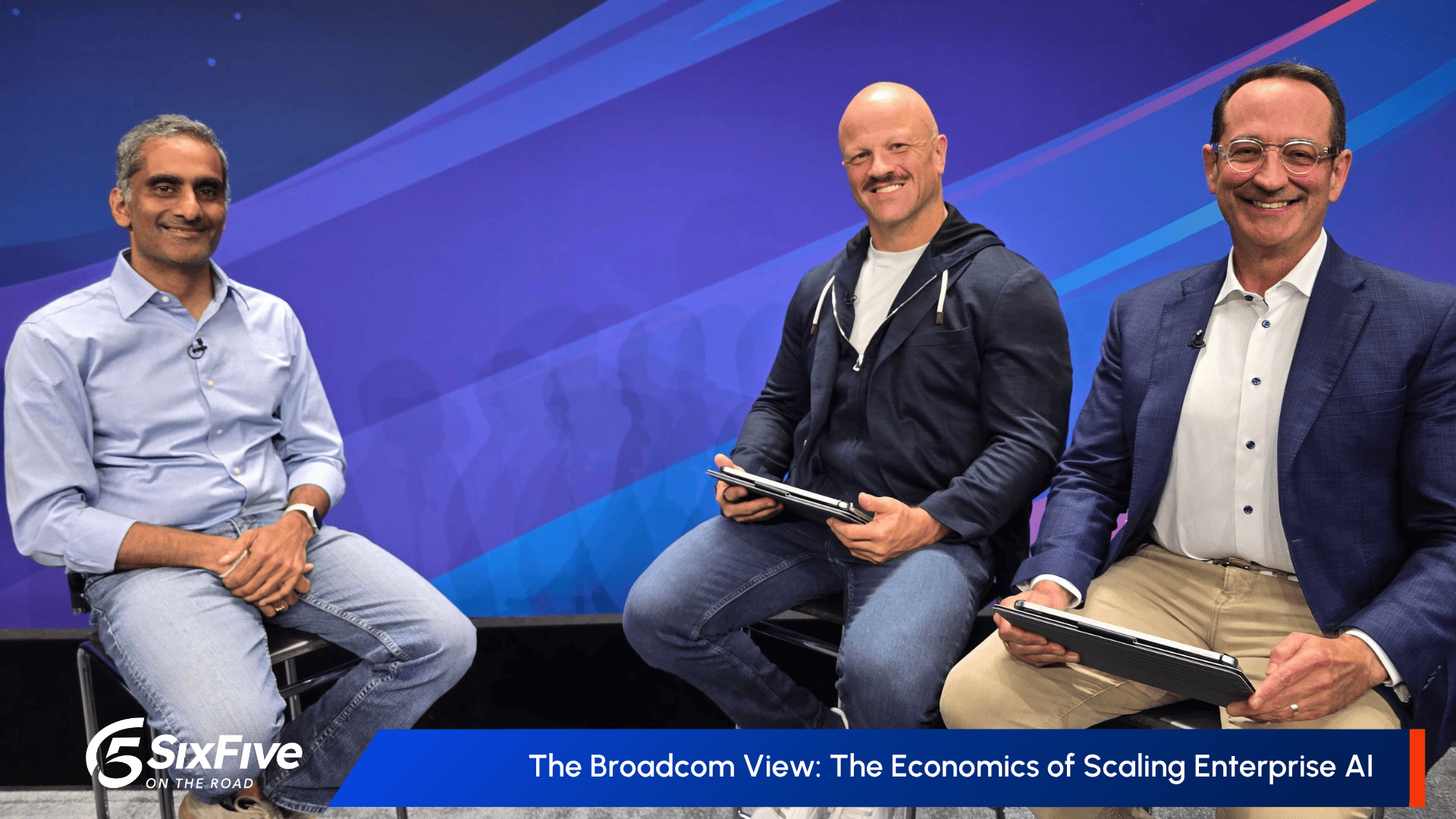
Broadcom's Ram Velaga on the AI Economics Pulling Enterprise Workloads Back On-Prem
Enterprise AI economics are pulling workloads back toward on-premises infrastructure, with control over data as the primary driver. Ram Velaga, President of Broadcom's Infrastructure Software Group, joins Patrick Moorhead and Daniel Newman at VMware Explore 2026 to detail how Broadcom is helping customers route AI workloads, govern agents, and rebuild VMware's role underneath the AI buildout.
Other Categories
CYBERSECURITY
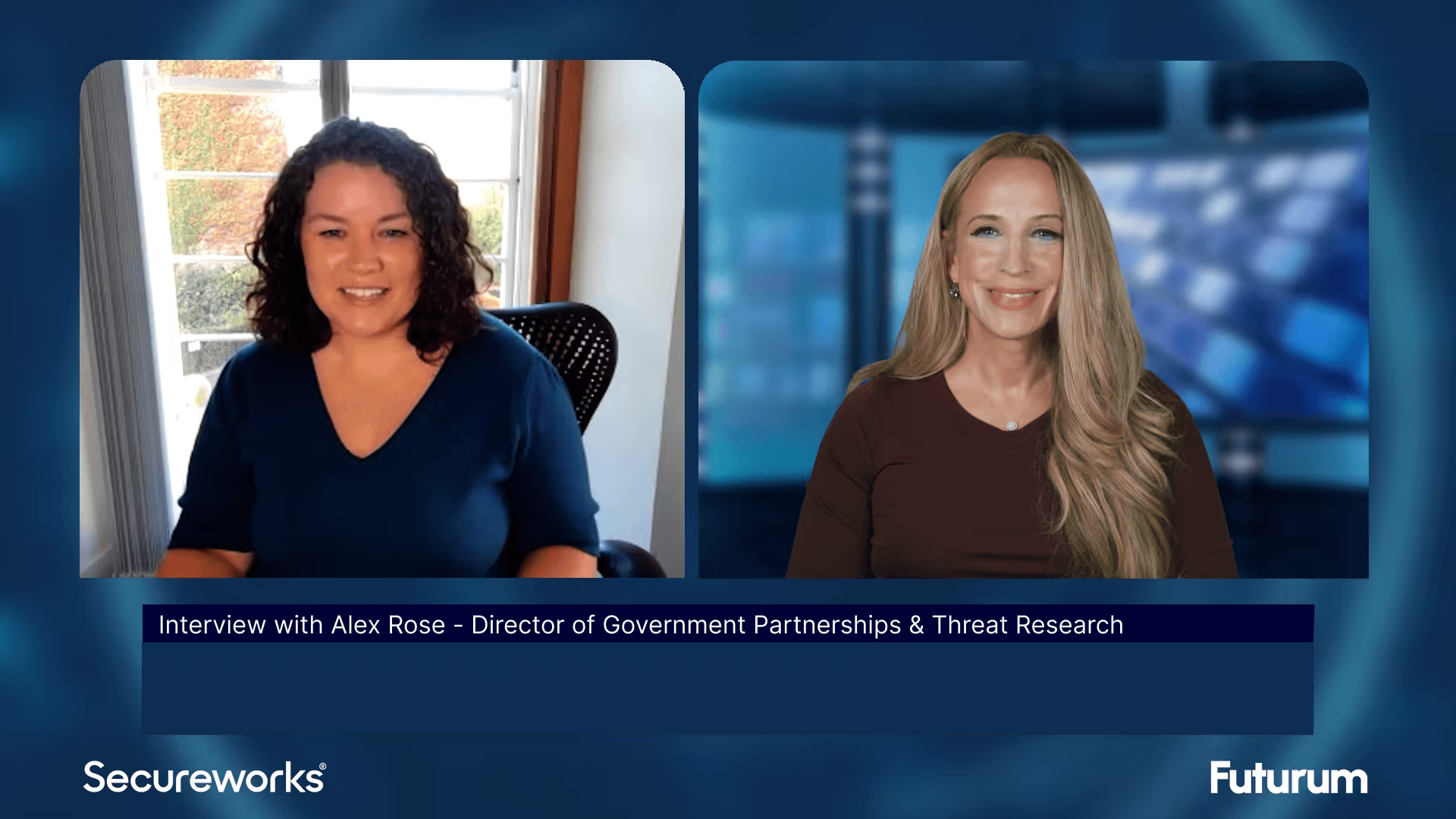
Threat Intelligence: Insights on Cybersecurity from Secureworks
Alex Rose from Secureworks joins Shira Rubinoff on the Cybersphere to share his insights on the critical role of threat intelligence in modern cybersecurity efforts, underscoring the importance of proactive, intelligence-driven defense mechanisms.

HP Launches World’s First Business PCs to Protect Against Quantum Hacks - The Six Five On the Road
On this episode of the Six Five - On the Road, hosts Patrick Moorhead and Daniel Newman are joined by HP's Ian Pratt, Global Head of Security for Personal Systems.
What is Autonomous Endpoint Management?
Autonomous Endpoint Management is a framework designed to unify IT operations and security teams on a single platform through real-time control and visibility.
QUANTUM
Quantum in Action: Insights and Applications with Matt Kinsella
Quantum is no longer a technology of the future; the quantum opportunity is here now. During this keynote conversation, Infleqtion CEO, Matt Kinsella will explore the latest quantum developments and how organizations can best leverage quantum to their advantage.
Accelerating Breakthrough Quantum Applications with Neutral Atoms
Our planet needs major breakthroughs for a more sustainable future and quantum computing promises to provide a path to new solutions in a variety of industry segments. This talk will explore what it takes for quantum computers to be able to solve these significant computational challenges, and will show that the timeline to addressing valuable applications may be sooner than previously thought.