
From Pilot to Production: How Lenovo XIQ Is Bringing Agentic AI to Retail at Scale
SHARE


Ryan Shrout and Mitch Lewis of Signal65 walk through their independent validation of the Lenovo xIQ platform and Lenovo Super Agent for Retail with Paige Grady, Director of AI Solutions at Lenovo SSG. The conversation covers what stalls retail AI at the pilot stage, how full-stack integration addresses the operational challenges that custom builds cannot, and what Signal65 found across deployment time, agent accuracy improvement, and lifecycle management in testing.
Over 93% of retail organizations are evaluating AI deployments, but most of them are still stuck in pilots. The gap between a working model and a production-ready agent is where the majority of enterprise AI projects stall, and it’s not a model problem, it’s an operational one.
Ryan Shrout, President of Signal65, and Mitch Lewis, Senior Performance Analyst at Signal65, sit down with Paige Grady, Director of AI Solutions, SSG at Lenovo, to walk through Signal65's independent validation of the Lenovo xIQ platform and the Lenovo Super Agent for Retail. The conversation covers what actually holds retail organizations back from scaling agentic AI, why full-stack integration matters more than model selection, and what Signal65's testing found across deployment time, agent accuracy, and ongoing lifecycle management.
Key Takeaways Include:
- Enterprise AI adoption is primarily an operational challenge, not a model challenge. The majority of deployment effort is spent on data integration, governance, monitoring, and lifecycle management. Lenovo xIQ addresses all of these in a single platform rather than requiring enterprises to stitch together fragmented solutions.
- Signal65 testing found that Lenovo xIQ can be deployed and operational in approximately one week. Custom agent builds from scratch run six months or more on the low end. That compression in time-to-value changes the calculus for retail organizations evaluating build versus buy.
- AI performance improved fast — without rebuilding the system. During Signal65’s evaluation, agent accuracy increased from 75% to more than 90% without code changes or specialized technical expertise. Model swaps, glossary updates, and data ingestion adjustments were all handled directly within the platform in a relatively short timeframe.
- Retail AI works best when it connects the store to the digital experience. The Retail Floor Assistant brings real-time inventory lookup, store navigation, and personalized support directly onto the sales floor. Combined with autonomous handling of routine service inquiries, it gives store associates more time for higher-value customer interactions while creating a more seamless omni-channel experience.
For retail CIOs weighing platform adoption versus building in-house, Paige Grady makes a practical point: custom builds can introduce months of complexity without guaranteeing the governance, scalability, or drift detection enterprises need. Platforms like xIQ come with those capabilities already built in, helping teams move into production faster and with less operational risk.
For the full Signal65 validation report, visit https://bit.ly/3PKrcph.
Check out the Signal65 ‘Lenovo Super Agent for Retail’ infographic at http://bit.ly/4fhmt7h.
Watch the full conversation at sixfivemedia.com and subscribe to our YouTube channel so you never miss an episode.
Disclaimer: Six Five Media is for information and entertainment purposes only. Over the course of this webcast, we may talk about companies that are publicly traded, and we may even reference that fact and their equity share price, but please do not take anything that we say as a recommendation about what you should do with your investment dollars. We are not investment advisors, and we ask that you do not treat us as such.
RYAN SHROUT:
Hi, everybody. Welcome to another Signal 65 video insights. I'm your host, Ryan Shrout, president at Signal 65. I'm joined by Mitch Lewis, one of our lead engineering and testing guys on the team here. Mitch, good to see you again.
MITCH LEWIS:
Yeah, always good to be here, Ryan.
RYAN SHROUT:
And we are joined by our guest today, Paige Grady, who is the director at Lenovo of SSG AI Solutions. Paige, thanks for joining us today.
PAIGE GRADY:
Thanks for having me, Ryan.
RYAN SHROUT:
Now we are here to talk about, we're going to talk about agents and AI and how they integrate around retail, but also some of the larger discussions around what kind of Lenovo strategy is around these AI deployments. Now recently at Signal 65, we published a report, you know, really looking at and validating the Lenovo XIQ AI platform. and the super agent specifically targeting the retail vertical. We're going to go through kind of what that is and why that matters in a second. If you haven't checked out that report, please go to Signal65.com and look at all of Mitch's amazing work that he dove into there. I want to start the conversation by setting some context around what this opportunity really is, both for Lenovo and for kind of the industry at large, right? Futurum Research, one of our sister organizations, found that over 93% of retail organizations are considering AI deployments. But the vast majority of them are still, you know, they're kind of stuck in these pilot phases, if you will, of how those are going to work. So Paige, in your view, what's holding them back from scaling agentic AI today in this particular field?
PAIGE GRADY:
Yes. The retail operations are still very repetitive, yet context-dependent interaction. We're very right to use AI to enhance that environment and provide solutions to some of the challenges they have. We need to underestimate taking that GEOC into production-ready. Due to enterprise-grade requirements like latency, reliability, and maintainability, moving beyond these pilots requires far more than a working model. It requires some real-time inference, performance, continuous data ingestion. A lot of these are multi-agent orchestration, and also, in addition, the lifecycle management. And then on top of that, it's the people aspect of AI. Skills gaps, as well as difficulty, provide difficulty in demonstrating ROI at scale across their retail enterprise.
RYAN SHROUT:
Yeah, that skills gap is something that's really interesting. Most people think of, hey, we're gonna implement AI, everything's going to be easier out of the gate, when in reality, there is still, there's a level of familiarity that is missing and some training and capabilities to really understand that. And I know a lot of the Lenovo benefits and capabilities is kind of bringing down that level of required knowledge to really get up and running and deploying new agents and tweaking things and perfecting things. You know, one of the unique aspects of the XIQ platform, Lenovo XIQ platform, is around its combination of infrastructure, you know, the ThinkSystem servers and NVIDIA GPUs, the data pipelines, the agent lifecycle tools themselves. How important is that full stack implementation for these types of enterprise adoptions?
PAIGE GRADY:
It's incredibly important. Full stack integration becomes very essential because enterprise AI adoption is primarily an operational challenge, not just a model challenge. you know, a lot of the research and that which you have done as well, show that a majority of the effort in deploying agents lies in the data integration, governance, monitoring, and lifecycle management, not just in the development of the agent itself. So by combining an integrated stack, it removes the need to stitch together these fragmented solutions. So if we have our think system and our GPUs, the data pipeline, the model execution, and the lifecycle management all in a single platform with XIQ. This eliminates that complexity that typically delays or derails a lot of the enterprise AI projects companies are deploying today. So we really become a full end-to-end solution that reduces that complexity.
RYAN SHROUT:
Interesting. Mitch, I want to bring you in here because, you know, Signal 65, we evaluated this platform across several different aspects, such as deployment time and ease of use, and even really something that people don't often think about, kind of the ongoing agent management. What, in your view, were some of the key findings that you came across that really showcased some of the advantages that the Lenovo solution could bring?
MITCH LEWIS:
Yeah, I think there are a lot of advantages that we've found kind of across, you know, We're really showcasing that it is a full stack solution. So, you know, from the beginning, just the initial deployment time, you know, this is something that you can realistically get deployed and up and running in around a week is what we found. Comparatively, you know, if you're building something from scratch, you're looking at six months, maybe more just to get something working. The next point, you know, kind of what we've been talking about, okay, now you have, you know, maybe an agent, but how are you going to manage that? How are you going to scale that, right? So maybe you spent six months on something, but you're still in that pilot stage. Like we found, you know, so many retail organizations are, let me, let me maybe kind of start over. Okay. That's fine. Do you want to take the question again?
RYAN SHROUT:
I can absolutely do the question again. There we go. So I want to bring in Mitch now and really talk about the performance that we were able to look at. Signal 65, you know, we evaluated the platform across key aspects like the deployment time, ease of use, and even something that I think a lot of us don't think about is this long-term agent management that you have to do. What were some of the key findings that you came across in kind of evaluating the Lenovo solution?
MITCH LEWIS:
Yes, we looked at the solution. I think we found, you know, a lot of big advantages really showcasing that this is a, you know, a full stack solution that gets you not just from the initial deployment, but really through all that ongoing management and ongoing, you know, the scalability that you need for something like this. So the first thing we found that's really big is this is a solution that can be set up in around a week compared to, you know, building a custom agent from scratch is going to take, you know, kind of six months on the low end, maybe even longer. So right off the bat, that's an improvement. But moving on from there, it's how do you, how do you manage your agents? How do you scale, you know, a retail solution, maybe you have, you know, a new store, maybe you want to scale from, in store to online do with the Lenovo XIQ solution, new agents can be created in as little as five minutes, switch models, ingest new data, and actually monitor how your solution is holding up.
RYAN SHROUT:
Those aren't insubstantial advantages, right? Going from something like a six month deployment time to a one week deployment time means that, you know, customers of this solution can kind of get that time to value metric really low, which is super important for them as they deploy. There was also a number in here that I really liked. It was a 21% improvement in agent accuracy. Can you tell me what that number was about?
MITCH LEWIS:
Yeah, so that was an experiment that we ran. We made our own agent, put in our own data. And, you know, we just picked kind of a basic model. And I think we started off with, you know, 75% accuracy based off of the, you know, 100 something questions we're asking. And so from there, it's like, okay, that's 75%. That's, that's okay. That's probably not what you want to put into production, right? So it was, what can we do on the platform to boost that number up? That included, you know, changing the model, which is something that, you know, on this platform we could do really quickly. And then also adding in, you know, glossary definitions, things that we can add into our environment that teach the AI make understand our terms that are in our data, things like that. So I think we went from around 75% to a little over 80 to over 90%. And that was all done relatively quickly, no code, no real complexity. And there's certainly more you could do depending on how much data you have, what your data is, different models, all sorts of things. But I think the key thing there is you can get really big increase in accuracy without a ton of complexity, without being an expert or anything like that.
RYAN SHROUT:
That's very cool. Paige, I want to ask you, like, there's often an underestimation of the operational side of AI, right, from the data ingestion to the monitoring and this idea of drift detection, which is something that was kind of new to me as well at the beginning of this project. Why is it or is it your view that that's where a lot of the real effort kind of lives that this Lenovo solution helps lift and make easier?
PAIGE GRADY:
Yes, so we designed the XIQ platform to take into consideration the challenges around AI and AI deployment of agents. The majority of effort does lie beyond the model and data integration and operation, like Mitch provided an example of how minor changes are able to increase improvement in the accuracy. with using XIQ. Retail and specifically retail use cases require that real-time continuous updated data pipelines in order to materially improve conversion satisfaction and ultimately brand trust. So the ongoing monitoring and governance really is very important to delivering ROI with something like a retail agent. So with XIQ, we're able to provide that ongoing monitoring and governance already built in. It continuously evaluates for that drift in accuracy, and you're able to make those changes relatively easily and in real time to improve the reliability of the agent. Without automated monitoring, this becomes very manual, opaque, and often difficult to scale. minimizing that ROI that you could see using AI in retail.
RYAN SHROUT:
Interesting. Now, I want to ask a couple of specific retail questions, right? So knowing that these are targeted, there's one called the Retail Floor Assistant that you have that's particularly interesting to me. It brings AI into the physical stores themselves. What does that unlock that kind of online-only solutions can't really do? And how can that be combined with other agents?
PAIGE GRADY:
Yes, so in retail, you want to have an equally as good experience online as you do in the store, as many people are starting to come back to going into the store, and maybe not necessarily for shopping, but you see an uplift in returns in store, even pickups, doing real-time pickups. So with the retail floor assistant, it brings that real-time AI-driven intelligence into the physical store. and closes that gap between the digital experience and the in-store experience. With the floor assistant, we've enabled live inventory lookup, store navigation, also personalized assistance, but directly on the shop floor. It really does combine that traditional online only solution with an in-store presence to have a more seamless experience in person.
RYAN SHROUT:
And one of the other things,
PAIGE GRADY:
I was also going to say, it really does enable a true omni-channel continuity from that digital and physical journey. So it brings it all together in a seamless orchestration layer with the floor system.
RYAN SHROUT:
It's actually what I was gonna ask about, right? One of the other things that we saw in the paper was this modeling of significant labor savings as well with that efficiency gain. How does this, you know, how do the Lenovo platform and these agents translate into that kind of realistic, you know, not just modeled, but real ROI?
PAIGE GRADY: Yeah, for example, handling a portion of the in-store customer service, inquiries autonomously can free up thousands of staff hours and significantly reduce those operational costs. It also allows for upskilling of staff and into other more strategic areas of the store or in the retail operations. With AI powered recommendations and upselling, it improves that customer engagement and shown to increase conversion and sales opportunities. So these small savings across the store operations really does start to show a very tangible ROI. From a people perspective, we do recognize that in retail there are small margins. There's also labor constraints and also like even with staffing with an odd hours becomes very challenging. So having AI in the retail industry and in stores does allow for significant savings and efficiencies across the whole operation. Interesting.
RYAN SHROUT:
As we kind of look forward and we kind of have evaluated this article and this report that we've posted, I'm curious from a retail CIO perspective, if you're evaluating AI today, what in your view, Paige, is the strongest argument for choosing a platform approach, like the one we've been describing the benefits of, versus something that some people may think is going to be better if it's customized and building something internally?
PAIGE GRADY:
Well, building internally introduces significant costs, complexity, oftentimes delays. Custom agent development often takes months and requires stitching together infrastructure, various data pipelines, and also creating models and monitoring, which is very much a heavy burden to most internal teams. Platforms like XIQ can dramatically accelerate that time to value and also reduce the risks. Having a partner like Lenovo can provide a full integrated solution across the hardware, software, and services that will allow for from deployment production to ready agents in just as little as a week compared to months of custom builds. Enabling that faster time to realize value and and deliver on business outcomes. Also, platform provides that scalability, built-in governance and also ongoing optimization, seamlessly built in to allow those minor tweaks to build that accuracy in the model and also be able to deliver a better outcome versus maintaining in-house can become very challenging for most enterprises.
RYAN SHROUT:
Definitely. You know, we have quite a few other projects that we're working on with our partners at Lenovo, in terms of demonstrating these different types of applicable AI deployments and agentic use cases. And this is just one of the first ones that we've touched on. And I find it really interesting to see all the different areas and places that AI can embed itself into a retail environment. If you haven't gone to Signal65.com yet, check out that full report that Mitch worked on. I highly recommend you go do it. Paige, thank you very much for joining us. I appreciate you coming on.
PAIGE GRADY:
Thank you, Brian. It's been a pleasure.
RYAN SHROUT:
And Mitch, you as well. For everybody else that's watching, thanks for joining us and make sure you check back soon for our next Signal65 Video Insights.
MORE VIDEOS
AI’s Next Scaling Test Is Connectivity, From Rack to Region
Marvell’s Sandeep Bharathi, Xi Wang, and Russ Esmacher explain why connectivity has become AI’s next rate limiter, from the copper wall inside the rack to scale-across links between AI clusters. For hyperscalers, the connectivity bets made today must hold up across multiple bandwidth generations.



Why Unified Orchestration Is Becoming Its Own Category
On the Six Five Virtual Webcast, Kestra's Kai Waehner explains how AI agents acting across fragmented automation are moving governance out of individual tools and into a unified orchestration layer. Enterprises that define accountability, access control, and sovereignty requirements in that layer first can scale agents without losing end-to-end control.
Windows Goes Hybrid, Marvell’s $90B Target, and the AI Routing Race | The Six Five Pod Ep. 323
On Episode 323 of The Six Five Pod, Patrick Moorhead and Daniel Newman unpack the biggest stories from the week, including Microsoft and NVIDIA’s hybrid intelligence push for Windows, Marvell’s Investor Day, new models from Anthropic, Mistral, and Reflection, the AI labs’ accountability hearings in New York and Australia, Google’s model-neutral Gemini agent, and whether temporary construction jobs justify AI data centers. Plus, Bulls & Bears covers Thursday’s chip-led pullback, NVIDIA’s run past $240, and Samsung’s record Q3 guidance.
Other Categories
CYBERSECURITY
Threat Intelligence: Insights on Cybersecurity from Secureworks
Alex Rose from Secureworks joins Shira Rubinoff on the Cybersphere to share his insights on the critical role of threat intelligence in modern cybersecurity efforts, underscoring the importance of proactive, intelligence-driven defense mechanisms.

HP Launches World’s First Business PCs to Protect Against Quantum Hacks - The Six Five On the Road
On this episode of the Six Five - On the Road, hosts Patrick Moorhead and Daniel Newman are joined by HP's Ian Pratt, Global Head of Security for Personal Systems.
What is Autonomous Endpoint Management?
Autonomous Endpoint Management is a framework designed to unify IT operations and security teams on a single platform through real-time control and visibility.
QUANTUM
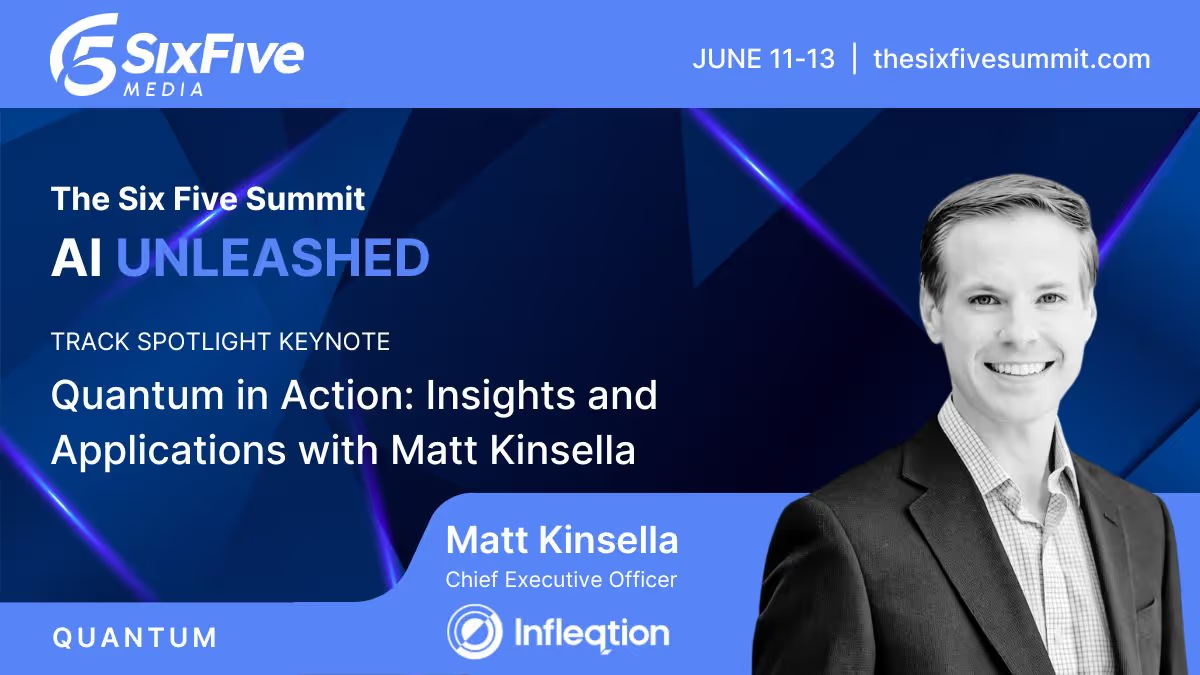
Quantum in Action: Insights and Applications with Matt Kinsella
Quantum is no longer a technology of the future; the quantum opportunity is here now. During this keynote conversation, Infleqtion CEO, Matt Kinsella will explore the latest quantum developments and how organizations can best leverage quantum to their advantage.
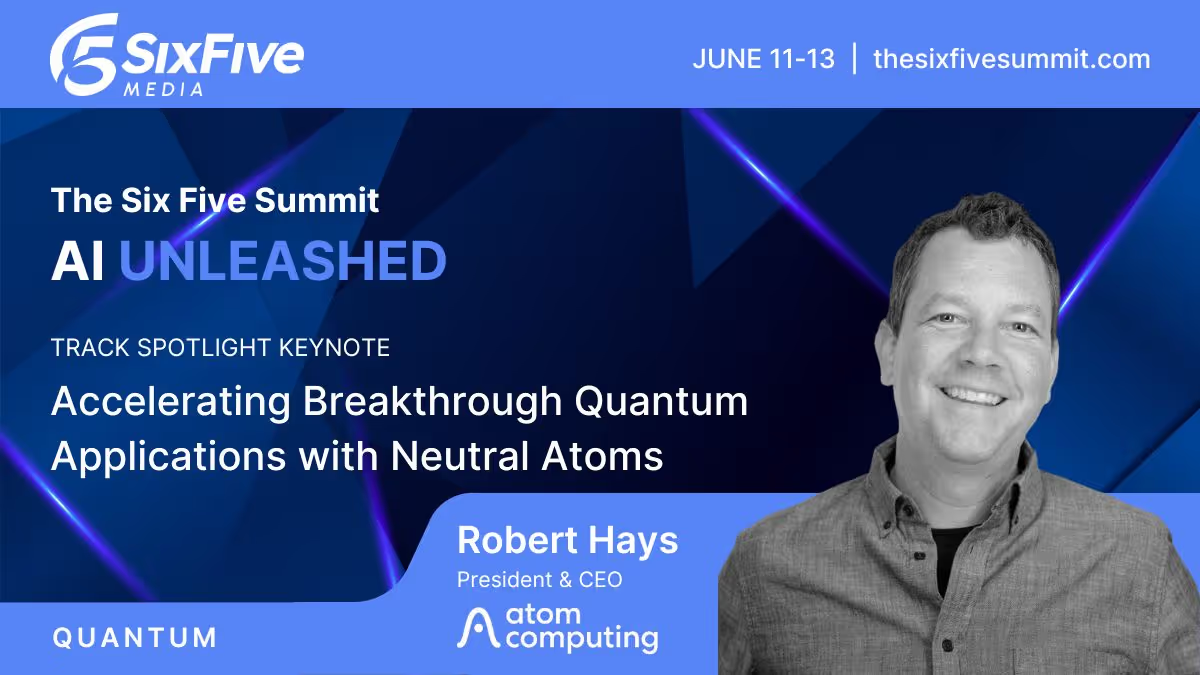
Accelerating Breakthrough Quantum Applications with Neutral Atoms
Our planet needs major breakthroughs for a more sustainable future and quantum computing promises to provide a path to new solutions in a variety of industry segments. This talk will explore what it takes for quantum computers to be able to solve these significant computational challenges, and will show that the timeline to addressing valuable applications may be sooner than previously thought.