Home

Tae-won (Tony) Chey on the 15-Year Bet Behind SK hynix’s Nasdaq Listing and the Future of AI Infrastructure
Tae-won (Tony) Chey on the 15-Year Bet Behind SK hynix’s Nasdaq Listing and the Future of AI Infrastructure
SHARE


Tae-won (Tony) Chey, Chairman of SK Group, joins Daniel Newman at Nasdaq in New York following SK hynix’s ADR listing to trace the strategic decisions, from the 2012 Hynix Semiconductor Inc. acquisition to the 2019 push into AI, that positioned SK Group at the center of today's AI memory market.
SK hynix marked its Nasdaq ADR listing on Friday, July 10, 2026, a milestone that was nearly 15 years in the making for SK Group Chairman Tae-won (Tony) Chey.
When he first took the helm, SK hynix was in Chapter 11 bankruptcy. The acquisition many questioned has since become one of the defining bets of the AI era, placing SK hynix at the center of the AI memory market.
Daniel Newman met directly with Chey in New York on the day of the company’s listing to trace the decisions behind it: why he moved on a distressed semiconductor business in 2012 when capital intensity made it look like the wrong call, why he pushed SK Group toward AI in 2019, three years before ChatGPT existed, and what he's watching now that memory has gone from commodity to bottleneck.
Chey also lays out where SK Group is putting its capital next, with nearly $1 trillion planned for AI data centers aimed at cutting the cost of a token, more than $35 billion already invested in the U.S., and an expanding HBM packaging build-out in Indiana. He addresses the risks he sees over the next five years as the AI buildout collides with financing constraints and geopolitics.
Key Takeaways Include:
🔹 The bet on Hynix Semiconductor Inc. was a fifteen-year conviction, not a quick win. Chey took over a company while it was in Chapter 11, when the memory business looked purely cyclical. He bet that society's growing digital and data footprint would eventually make memory a strategic play rather than a commodity.
🔹 HBM's complexity is the moat. HBM's complexity is the moat. Chey highlights the immense complexity of HBM technology as a key reason the market is difficult to enter and the technology is hard to replicate at scale.
🔹 SK Group moved on AI three years ahead of mainstream LLMs. Chey pushed the organization into AI starting in 2019, building an internal LLM and application that set the technical and organizational groundwork for what came next.
🔹Token economics, not capacity, is the goal. Chey explains that SK Group's nearly $1 trillion AI data center investment strategy isn't simply about building more infrastructure. It's about driving down the cost of generating AI tokens at scale.
🔹 The five-year risk window is financing and geopolitics, not technology. Chey names capital availability and geopolitical shocks on energy prices as bigger near-term threats to AI's buildout than the maturity of the technology itself.
Watch the full conversation at sixfivemedia.com, and be sure to subscribe to our YouTube channel so you never miss an episode.
IMPORTANT: Note to Uploader: VIDEO EMBED – added by uploader.
Disclaimer: Six Five Media is for information and entertainment purposes only. Over the course of this webcast, we may talk about companies that are publicly traded, and we may even reference that fact and their equity share price, but please do not take anything that we say as a recommendation about what you should do with your investment dollars. We are not investment advisors, and we ask that you do not treat us as such.
Daniel Newman:
Hello, the Six Five is on the road. We are here in New York City at the NASDAQ for an incredibly special day. SK Hynix had its U.S. listing today. Actually, it's going on right now as we speak. You may be getting this just a little bit later, but I could not be more excited to sit down today with Chairman Chey. who's led SK Group through a tremendous set of innovation and transformation over the past many years. And we're going to talk today about that transformation that has led us here to today at this listing here at the NASDAQ in New York City. Chairman Chey. Thank you so much for being here today. You know, let's just first and talk about the day you are here. You know, this is the beginning, I say the beginning, of a revolution that is AI. SK has been transforming the Korean market. We've been watching that take place. It's been transforming the memory market. And of course, now you've brought this here and made it available to U.S. investors. Just talk a little bit about the day, the moment, and how you're feeling right now, because I think everybody would like to know that.
Tae-won (Tony) Chey:
Well, before I say some things, please call me Tony.
Daniel Newman:
From here on out, I'm going to say Mr. Chairman, I'm going to say Tony.
Tae-won (Tony) Chey:
Yes. Well, this is a great day and a great moment. We've been waiting for almost 15 years. SK just took over Hynix, so we are entering into that semiconductor business. So we've been doing these things in the 15 years, and they are one of our milestones. And someday we're going to actually connect with the global capital market, especially in the New York side. So here we are. So I actually achieved that really really the biggest milestone. Also, it's a kind of celebration and accessing the global market is, well, there is probably three different types of things I can actually say to you, that number one is, well, we have a lot of options, especially the financial play. We are not just stock trading in Korea, but trading in the U.S., we could actually invite the new talent, and through that, well, there's the new stocks, Also, well, second thing is, well, we have the new shareholder. The new shareholder, especially the U.S. shareholders, and we have actually reconstructed the governance system, too. So it's not just the Korean company. We could become the global company. So we may actually create the new system for the governance. And third one is, the investment. Using this stock momentum, we could actually create a lot of investment opportunities. We're going to make the US-based R&Ds and access a lot of AI startups and also other investment, not only just the high-end memory side, and we could actually extend our investment in the AI and energy side. We have a lot of options, and I'm happy to be here.
Daniel Newman:
Yeah, there's a lot of excitement. I've been fielding calls for days, weeks now, from media. The over-subscription and the demand that was here, and of course, right above us there, you can see tick by tick. You don't want to watch every second, right? But by the way, I mean, clearly, there's just the embrace of the United States of the American markets has been tremendous. I don't know if you saw the JP Morgan building last night with the Korea flag. But yeah, the excitement has been there and people are realizing, you know, just how critical this technology is for this next build out of this fourth industrial revolution. I did want to talk a little bit about what you saw that was different, though, because, you know. SK has positioned itself incredibly well in this moment. Partnerships with the likes of NVIDIA becoming the premier partner. You had to make some really tough decisions, though, when you came into the role and see things differently throughout these years. What were some of those big decisions that you had to make that was just really critical for you guys to be where you are now?
Tae-won (Tony) Chey:
Well, I don't know. I've been doing this job almost 30 years. So there's a lot of ups and downs. But one of the main key momentum issues is back to 15 years ago. So when we took over the Hynix, at that time, the Hynix is a Chapter 11 company. So they've been doing that Chapter 11 almost 10 years. What that means is that nobody really wants this kind of business. The semiconductor manufacturing business is a really risky business because there is an uncontrollable cyclical business. But that business also required the constant capex. But it's cyclical. So no guarantee for making money. But I see that the world is at a different angle. The first thing is the memory. And 15 years ago, I see that we're going to live in the digital world. All that digital society created a lot of information, data, and people's experience. All those data has to store somewhere. So that mean is that the memory things. So time goes by. Then, well, the demand of the memory will increase. That's actually I am betting. And second thing is that The memory chip manufacturing businesses are the most sophisticated and complicated manufacturing things. Among any kind of manufacturing, this is much more sophisticated. Because of the small chip, just one chip, it's called the HBM. So it's like a little small chip and contains that much transistors. That's the technology. So if I can solve this kind of challenge and the problems, I can solve anything. So this is a kind of, wow, real, challengeable, the task. So I decided, wow, let's just go ahead. So.
Daniel Newman:
You saw the market growth and the opportunity in AI or in compute across the board, but you also seem to understand the complexity, that if you could solve the complexity, this isn't something, I know people love to say memory is commodity, but we are finding out now that it is definitely strategic. And if you could solve something like HBM, It's very difficult to enter. There's very few companies that could do it and it would give you a sustained market advantage. I do have to ask you because you pointed out that you've been in the role for 30 years. It's a long time. You don't look, you look much younger, Tony. But, and I think 37 was when you said.
Tae-won (Tony) Chey:
Yeah, I was 37 when I became the chairman.
Daniel Newman:
So when you took that role, though, you must have had some principled judgment, something you did from the day you set foot into that role that you still sort of carries through how you've gotten the company to where it is today.
Tae-won (Tony) Chey:
Well, when I was young, especially the situation was that the Asian currency, the crisis. So it's not the normal business the days. So it's one of the world's darkest moment for the Korean business. So actually, when you get up and you see that the news and some of the business go bankrupt, and probably there is a next days, and there is a bunch of candidate, and nobody has at the world that much credit. And I have to learning that my whole group, and well, That's not my choice. And certainly, the former chairman, late my father, died by cancer. So I have to step up. The business environment is not really good. But I dare to challenge it, and I manage it. So now I actually do well.
Daniel Newman:
But they often say, if you build during the hard times, during adversity, the companies that come out during those times are the ones that tend to do very, very well.
Tae-won (Tony) Chey:
So my father always taught me the one single principle. You may face a lot of the crisis, adversity. But when you face those things, you actually challenge it. And you actually transform that adversity into your advantage. That's his lesson. So I know. I don't like that risk, but once I believe that I have to challenge it, I challenge it. So all those time, I just enjoy that. Let's just do it, and let's just challenge these things. And I'm not just at the one or two years. We've been doing that almost 15 years, challenging that memory business, the commodity business, and manufacturing business become, well, some strategic business now.
Daniel Newman:
Yeah, you fought through many adverse cycles only to position yourself very well with some of those decisions that we just talked about. I've sat in with some of your peers, some of the other luminaries of the industry. Jensen Huang sat with us here on The Six Five. Hock Tan, you have It used to be the semiconductor industry goes through Taiwan. And Taiwan's still very important. But now the semiconductor industry stops in Taiwan and then goes to Korea. You've had many sit-downs. These are great partners of yours. Just very interested in what are you learning working with other leaders like these during this time when we are seeing so much transformation and so much collaboration?
Tae-won (Tony) Chey:
Right. Well, when I see my partners, well, The Jensen and the C.C. Wei in TSMC, well, I always learn from those guys. So especially the Jensen. Jensen always emphasize the speed. and achievement, and the knowledge, and the depth of the knowledge is enormous. When you enter in AI era, then I don't do the management. And I actually create the opportunity. Let's just lead and do really quickly and faster. So I just learn from him. And yeah, those kind of spirits. And when I become the chairman, always the chairman is kind of, well, I'm the last guy who made some decisions. And the front line is somebody else. But now I'm changing that. Yeah, well, I have to actually in the front line, and I'm going there. So I meet the partners to discuss together, and let's just create some options. And if there is some trouble, and I have to actually doing some troubleshooting together. Even the C.C. Wei is a little different type of the program. his leadership. It's not like Jensen, but he's really calm. But his knowledge of what he's doing is something else. So I also learned from that Microsoft, and the Googles, and Meta. Even AMDs. I learned from all those men.
Daniel Newman:
And I know part of your strategy and these strategic partnerships have been not just focused on the supply and pricing, which has historically been a lot of the long term agreements. You've also been very focused on innovation partnerships. I know with NVIDIA, there was a deep innovation in your long-term partnership that talks about building the most important next generation memory. We all know getting more tokens requires more memory. I think I heard you in another interview basically trying to talk about how extraordinary the demand is and people want to kind of you know, mute it, but it doesn't matter even as we develop more efficient ways to generate tokens. I think Satya Nadella called it, you know, called out Jevons paradox, the idea that yes, we will get more efficient, semiconductors have always gotten more efficient, but the demand will grow exponentially and the amount of memory and compute required will continue to rise precipitously. And so one thing I just, I think everyone out there would love to know, and I'd love to know, is you kind of talked about this a little bit, Tony, but during that 15 years, there were some real bad cycles. I've heard some of your peers in the industry talk about how they weren't even able to invest, or they had to cease most of their meaningful investments, which actually got them off to maybe a slower start during this AI transition. You jumped ahead because you didn't back down. What was the… What made you believe and not slow down, even when the numbers started to look, I mean, in your seat, you're reporting to the street, to your shareholders. Sometimes you gotta answer to them, and slowing down has often been what maybe some other companies would have done.
Tae-won (Tony) Chey:
Yeah, well, my job is a little different, because I have to see that there's some long-term approach. Yep. And so our member companies, the CEO, he has his own short-term assignment. He has to actually focus on the year-by-year, and at least, at best, actually, three years' plan is kind of maximum. Well, as a chairman, I have to actually see that much more the longer time. And if we bring some new opportunity, new business, then I have to actually pioneering other things. One of the susceptibility is the AI side. That was actually, well, it's about 2019. So I decided that, well, we have to pursue these AI things. At that time, it was not a memory business. The memory chip and AI were too far apart. But the company called SK Telecom. And that telephony, it just stopped there, the telephony business. But I knew that there was something better, a new business for the telecom. And I actually picked the AI side. So, well, we have to make it. There was some big organization for just making our own AI. I guess that three years later, so ChatGPT came out, and actually ChatGPT beat us at everything, but we really understand that the environment and the technology itself.
Daniel Newman: No, I mean, interesting, because that that's kind of my job, you know, to sort of see the future. It's what we do is research and analyze. And it's hard. It's very hard to see what's coming a year ahead, let alone. So you were three years ahead of chat GPT. And that was the inflection that drove. massive CapEx transformation, business transformation, but you, three years before ChatGBT hit, said, we're going to lean into AI, even though it wasn't core necessarily to those businesses, you created SK Group. What was the catalyst? What was the thing that gave you the confidence that AI was going to be the next big inflection?
Tae-won (Tony) Chey:
What I really believe, and when I acquired the memory things, in a digital society, you need a lot of memory. and the datas. You have to store some datas. But I see it at the different angle. So AI, actually not just storing the datas, and they created intelligence. That's a way different thing. And that intelligence is actually the base on the datas. That mean is the memory. So it's a kind of natural thing. that actually ignited our spirit. And yeah, time just come. And whoever makes this AI application, well, Then there's some memory time. Yeah.
Daniel Newman:
Well, in the first iterations, it wasn't immediately obvious how much the memory scale was going to be required. We immediately saw the compute constraint. And then people started to see network constraint. And then memory and power. Power became a really big. Everyone got really focused on power. And then, by the way, we revisited the CPU. Because nobody talked about the CPU for a while. And then agents happened.
Tae-won (Tony) Chey:
And then the CPU.
Daniel Newman:
Yeah, it is now back. And then, of course, throughout all this, though, memory remains. If you want AI to work well, to be able to truly, you know, act as intelligence, you need a lot of data very close to compute and memory solves a lot of that. But We can argue they're all constraints, right? Power's gonna be a constraint, memory's a constraint, compute's a constraint. You said five plus years, you don't see, you said you're gonna double your capacity for memory and you still won't have enough, is how you see it. So what over these next five years, what are you concerned about? What do you think the biggest risks are over these next five years?
Tae-won (Tony) Chey:
Well, one thing is a kind of geopolitics. It's a kind of black swan type. So nobody knows what's going on. But it just come out, and it actually ignited the energy price and also geopolitical risk. So like that, and even though this is a kind of doing that the path of the AI evolution, so this is something came up. We may lost it even in the short period of time that we lost our own momentum. But it could happen that way. That's one risk. But I cannot tell what specific risk we can actually worry about. But totally, it's a geopolitics risk. The second thing is the money. Well, AI requires the huge money. You said that the chips and the energies, well, there's a lot of bottleneck. That bottleneck means that it requires lots of money, money to invest. So, if there's a fail to actually pumping the money into the AI society, it's going to be kind of, we lost that big momentum. That's probably, I'm worried about next five years. The reason why it's five years is I see that still AI is imperfect. So within five years later, we see that the little baby is going to grow up and probably we can use it as a much more reliable AI. That actually means that we had a lot of increase in our own productivity. Then people started using the AI much more than things and that actually generated a lot of income. So there is a really good cycle going to begin. But within five years, we still struggle with some imperfect and, well, with a little baby, well, we have to worry about.
Daniel Newman:
AI is very, very young. A lot of people think we're halfway through. We're at the halftime of the World Cup game of AI. I like to say we're still in the pregame. It's very, very early. And some of the things you suggested about how long the cycle lasts and then, Tony, there's There's physical AI, there's humanoids, there's the next generation of autonomy, and then there's, as you just said, there's much better working AI. We're really only a few months into what I'd say models that are really valuable for enterprise use. All this happens, how long do you think this cycle can last?
Tae-won (Tony) Chey:
Well, it's not the cycle that matters. This is the evolution of the industry. So we have to maintain this cycle until we see some perfect AI. So we have to pump in. So even though economy doesn't actually back it up, and the financial world cannot actually support those things, but well, there is another thing. It's a kind of geopolitics competition. So you don't want to lose those kind of competition. That's a security matter. I think that even government has to come out and keep pumping those money until somehow that AGI era. Otherwise, you may have to worry about some even the national security things.
Daniel Newman:
We see $10 trillion to $12 trillion of capex between now and 2030. The companies supporting it, unlike historic bubbles and such that have broken, are companies that can't afford it or have the ability to raise the capital because they have the businesses that underlie. But as you said, maybe cycle's not the word because it almost becomes permanent. AI intelligence becomes permanent. And then it augments the economy, the society, and the growth. I want to bring it back to something a little bit more for all the investors out there, a little heartier. What do you want the investors here in the United States that are watching this right now to know about SK Group as they're thinking about where do they allocate capital and why they should? They're not looking at trading. You want people to invest. You want people to see what you're doing. You want them to put dollars into SK Group, SK Hynix, and invest. What do you want to tell them?
Tae-won (Tony) Chey:
Well, our target is, well, with U.S. investors and the U.S. company partners together, I'm trying to create the AI society. Number one, my target is the token cost. Well, right now, AI cost is too high. Too high. Let's just get together and find some technological breakthroughs. So we have to actually cut down the cost-wise. That's one thing I'm really focused on. So every partner, I'm going mad. And well, what is your strategy? And how can I actually support it? Because what I believe is memory is one of the AI infrastructures. infrastructure for the AI, in other words. So what I really want to do is, well, how can I actually support you? But I know that right now, the price of chip is so high, it's one of the burden, and not enough supplies. So right now, I cannot help it, because I need some lead time to expand the supply capacity. But in the meantime, why don't we focus on the new technology and how to actually save these bottleneck problems with them? And also, I'm heavily invested. I'm announcing almost a $1 trillion investment plan for the AI data centers. So I'm trying to focus on making new AI data centers which can actually head at a much lower cost and generate much more efficient tokens. That's the kind of target and I'm looking for that and I'm talking with all the partners. This is kind of my new plan and I never actually expected when I say that I created the $1 trillion investment plan. AI makes that happen, actually. AI is so expensive. And when you had it, there was certain type of amount of the AI data centers.
Daniel Newman:
Well, it's existential. I say these companies making these large CapEx investments understand that if they don't make them, They won't you know short-term maybe more more more cash flow, but long-term It's existential to their to their you know survival and market position while you're talking about you know to the u.s. audience and SK has done some investing. It's I think in Indiana you know four four billion dollar investment some R&D Do you have? meaningful plans to do more, to engage more, to invest more here in the USA?
Tae-won (Tony) Chey:
Yes. Not much people know that we already invested more than $35 billion in the U.S. Well, we have much more to plan, and a much bigger size. I'm looking for that in the future, that investment in the AI data center type, and the AI ventures, and the R&D centers, expanding that, well, Indiana FAPS. So.
Daniel Newman:
Build HBM in the US?
Tae-won (Tony) Chey:
Yeah, well, Indiana going to create the HBM. That's actually advanced packaging. They're going to create it. Put it together. HBM side, so it's the most advanced technology. Right now, people just see that the one biggest matter is the front line of the memory chip side. Well, I know that that's a huge investment, but technology-wise, this HBM is a much more important matter.
Daniel Newman:
So let's finish here. We talked about 30 years in the role. You've been doing this since you were very young, 37. You've led the company through a significant transformation, leading to a day like today here, listing in the United States, many years coming. When the world looks back, Korea and now the entire world, looks back at the Chey, Chairman Chey era, What one decision do you want to be remembered for?
Tae-won (Tony) Chey:
Not the person. Following the person's character is not really worth it. But the philosophy. SK, we have our own philosophy for our own business. To make short, short of the long story, our goal is to make the stakeholder happy. That that's the one biggest target. Even though as a shareholder, we have to actually make them happy. So we have to create the… Well, the… I'm hearing it's every quarter in the United States. It's every quarter, but it's kind of challenging. And my customer wants lowering the price and more quantity of our product. way and we have to actually break through that our business model is not just that the memory manufacturers so we are become a wants to become a much more sophisticated business model rather than just manufacturing some things and also based on the manufacturing so we could actually bring that much more the business model like well like I said at the memory as a service type. So that kind of new approach and the new breakthrough, actually, without those kind of innovation, there is no way I can make all the stakeholders happy. So that actually brings more investment to the US side. Well, I had a responsibility if I had the listing in the ADL in here, then one of my responsibilities is keeping the value and long-term growth for the ADL. our shareholders and the U.S. society.
Daniel Newman:
Well, let's absolutely hope that whenever that time comes, you know, that those returns continue, the AI boom has continued, and that, of course, the story of SK carries on for a very long time. And congratulations on all the success, Tony. And thank you, everybody, for being part of this Six Five special edition. We are on the road here at the NASDAQ market site in New York City. Please subscribe, share, check out all of our Six Five content here.
MORE VIDEOS
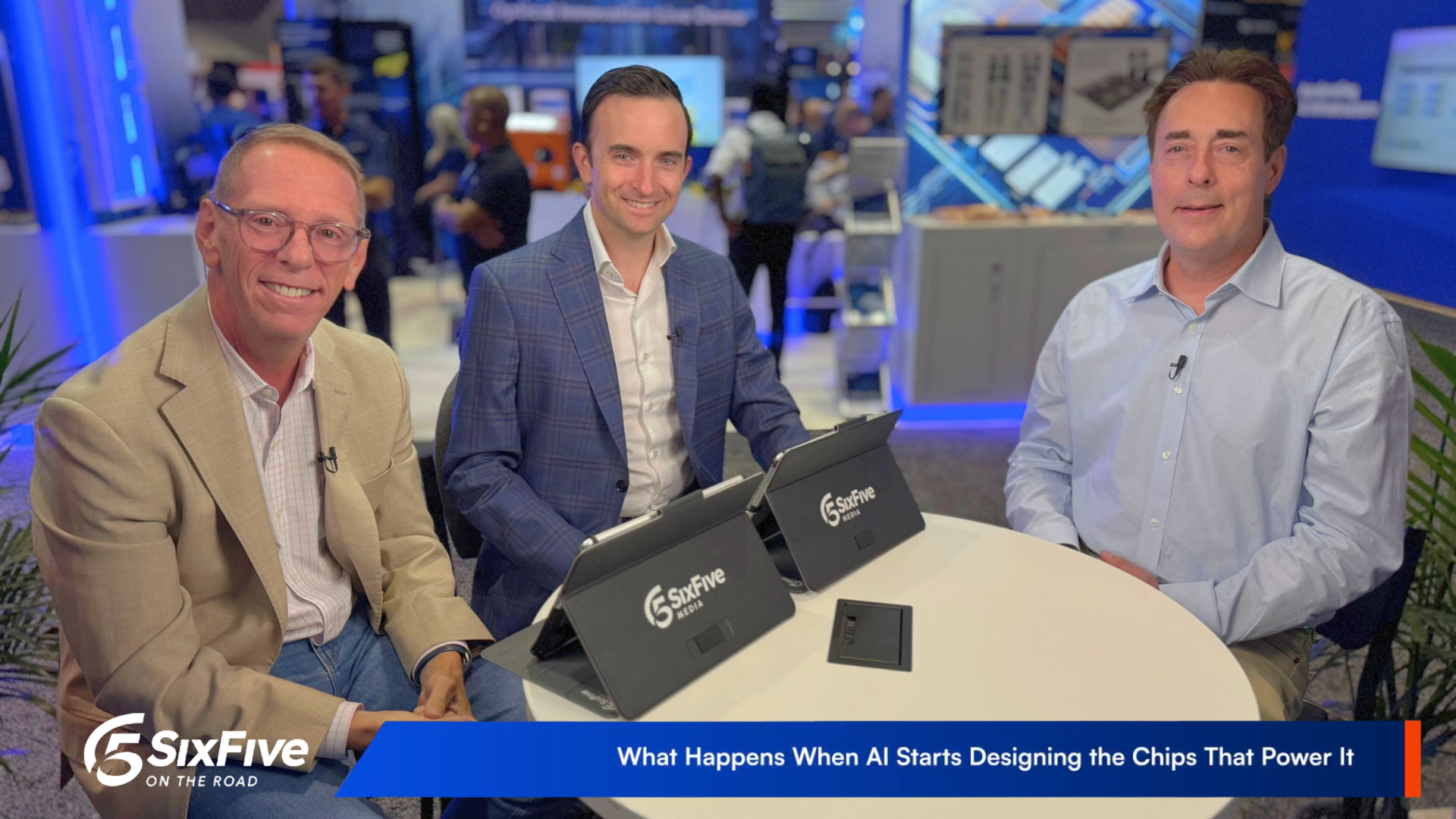
What Happens When AI Starts Designing the Chips That Power It | Synopsys at AI Infra Summit
At AI Infra Summit 2026, Synopsys' Thomas Andersen joins Brendan Burke and Matt Kimball to explain how chip design is moving from AI copilots that suggest to agentic systems that execute tool orchestration, timing fixes, and verification from a written spec. For enterprises, that shift compresses spec-to-tapeout timelines and lowers the resource barrier to custom silicon.


The Six Five Pod | EP 322: AI Writes Its Own Rules, Copilot Bills by the Task, and Memory Names Its Price
The companies racing to build frontier AI just agreed to referee themselves. Over the same week, launches, investor days, and earnings put a price on that arrangement. Microsoft is charging for finished work, NVIDIA is selling agent containment as infrastructure, and the suppliers AI can't route around, from Synopsys to Micron, are collecting the premium. Patrick Moorhead and Daniel Newman separate signal from stagecraft, then split hard on whether the White House accord actually binds these key players to anything.
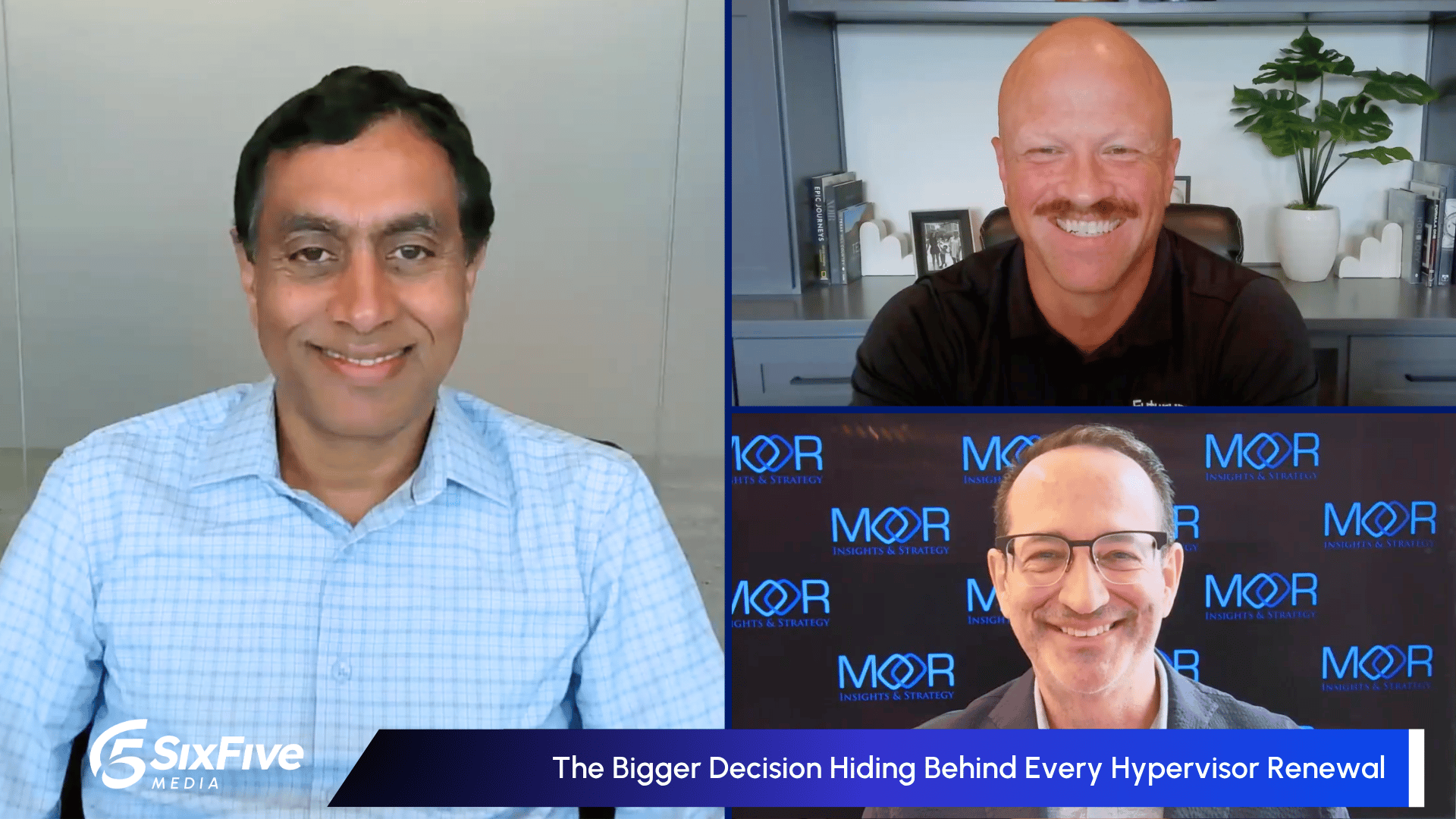
The Major Decision Hiding Behind Every Hypervisor Renewal
HPE's Varma Kunaparaju talks with Patrick Moorhead and Daniel Newman about why virtualization licensing changes are forcing enterprises to confront a bigger decision than which hypervisor to choose next: what operating model sits underneath their private cloud and AI factory. He outlines how CxOs can sequence modernization in phases, extend governance across open and frontier models, and decide where automation should replace human approval in IT operations.
Other Categories
CYBERSECURITY
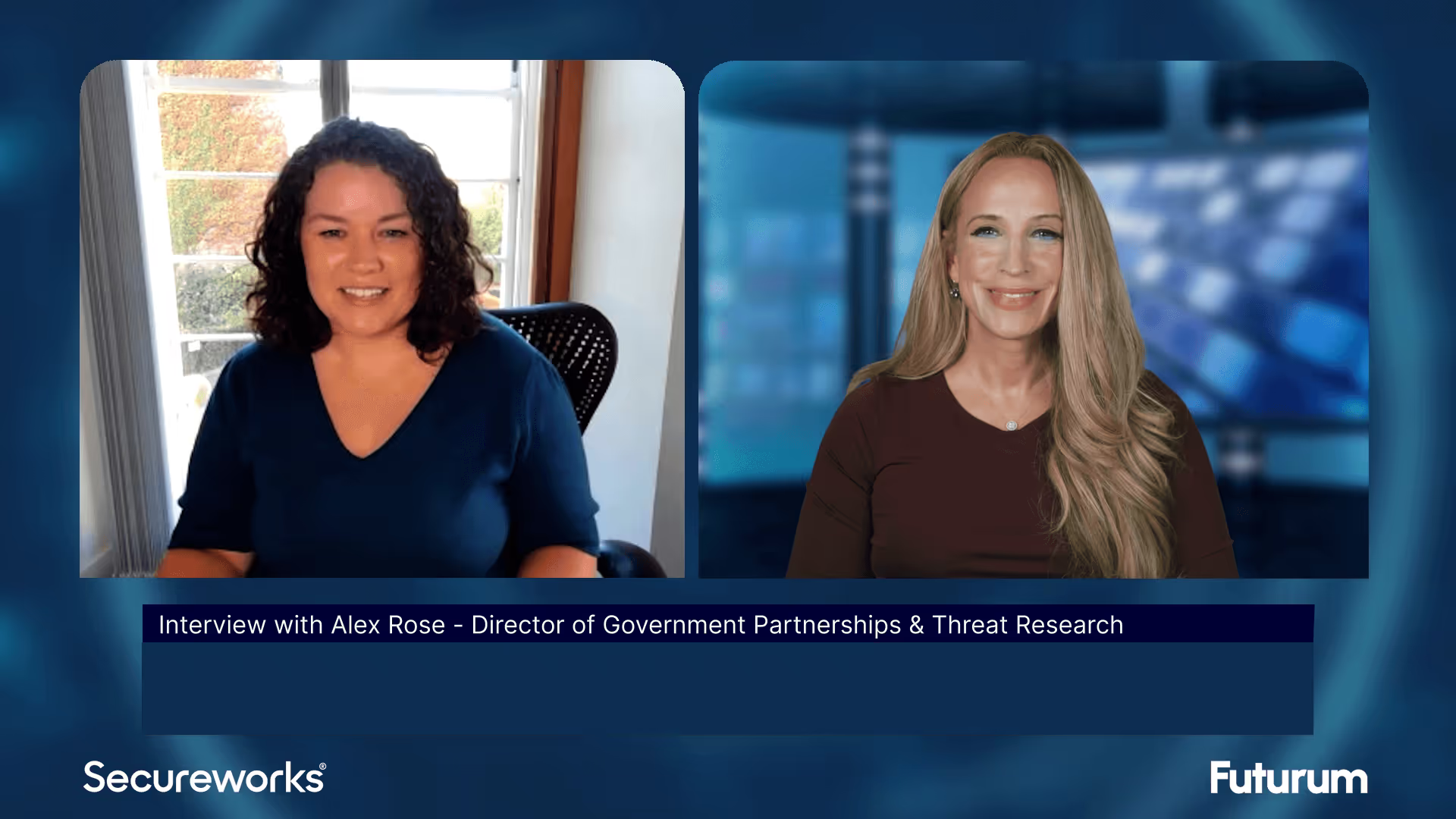
Threat Intelligence: Insights on Cybersecurity from Secureworks
Alex Rose from Secureworks joins Shira Rubinoff on the Cybersphere to share his insights on the critical role of threat intelligence in modern cybersecurity efforts, underscoring the importance of proactive, intelligence-driven defense mechanisms.

HP Launches World’s First Business PCs to Protect Against Quantum Hacks - The Six Five On the Road
On this episode of the Six Five - On the Road, hosts Patrick Moorhead and Daniel Newman are joined by HP's Ian Pratt, Global Head of Security for Personal Systems.
What is Autonomous Endpoint Management?
Autonomous Endpoint Management is a framework designed to unify IT operations and security teams on a single platform through real-time control and visibility.
QUANTUM
Quantum in Action: Insights and Applications with Matt Kinsella
Quantum is no longer a technology of the future; the quantum opportunity is here now. During this keynote conversation, Infleqtion CEO, Matt Kinsella will explore the latest quantum developments and how organizations can best leverage quantum to their advantage.
Accelerating Breakthrough Quantum Applications with Neutral Atoms
Our planet needs major breakthroughs for a more sustainable future and quantum computing promises to provide a path to new solutions in a variety of industry segments. This talk will explore what it takes for quantum computers to be able to solve these significant computational challenges, and will show that the timeline to addressing valuable applications may be sooner than previously thought.