
How a Research Institute Got a 100x Speedup Moving Biology Sims to TPUs
SHARE


At the Google Public Sector Summit, Caltech’s Matt Thomson explains how virtual tissue models running on Google Cloud TPUs are turning biology into a compute problem, with a 100-fold speedup in therapeutic simulations. Pairing that infrastructure with clean data could compress the path from research insight to new therapies.
Biology can now generate hundreds of terabytes of molecular data about a single organ, and modeling how millions of cells respond to a therapy has become a high-performance computing problem on a scale comparable to running a frontier AI model. Many research HPC systems were never built for that load. When predictive cell models start working, use cases pile up faster than on-campus infrastructure can support.
At the Google Public Sector Summit in Washington, D.C., Patrick Moorhead sits down with Matt Thomson, Principal Investigator at the Heritage Medical Research Institute at Caltech, to discuss his lab’s work with Google Public Sector. Thomson explains how his team builds virtual tissue models, in which each cell is modeled individually, and thousands of those models communicate to simulate how human tissue responds to treatment. He also describes why the lab moved that work onto Google Cloud TPUs.
For research institutions, the deployment lesson is to fit the architecture to the workload. Running thousands of inference passes in parallel on TPUs gave Thomson's lab a 100-fold speedup in therapeutic simulations, while Gemini serves as an agentic interface for running models and analyzing petabytes of output. Combined with clean data, including Parkinson's disease data from the Michael J. Fox Foundation, the infrastructure turns therapeutic discovery into a much faster loop of idea, simulation, and experiment.
Key Takeaways:
🔹 Cells behave like small computers. Cells take in information from their environment and make decisions, and the body has millions of them. Modeling them at scale quickly becomes an HPC problem not unlike serving a large AI model.
🔹 Virtual tissue models simulate how treatments land. Thomson's lab uses graph neural networks where each cell is its own model, similar to being a single copy of a model like Gemini. Thousands communicate to mimic how tissue, such as a Parkinsonian brain, responds to a therapy.
🔹 TPUs fit the parallel inference workload. The lab outgrew Caltech's on-campus HPC as use cases poured in. TPUs load model weights once and run thousands of inference passes in parallel, delivering a 100-fold speedup in therapeutic simulations.
🔹 Clean data is the driver. Biology can now capture molecular data across entire organs. Pairing those datasets, including Parkinson's data from the Michael J. Fox Foundation, with virtual tissue models lets the lab predict how diseased tissue will respond to different interventions.
🔹 Discovery starts to work like programming. Researchers can test large numbers of ideas in parallel on the computer, get rapid feedback, and send only promising candidates to the wet lab. Thomson sees cancer immunotherapy, autoimmune disease, and neurodegeneration as frontier problems this approach could move forward.
Research institutions that pair the right infrastructure with high-quality data will compress the path from scientific insight to therapies that reach patients.
Watch the full video at sixfivemedia.com, and subscribe to our YouTube channel so you never miss an episode.
Learn more about Google Public Sector at publicsector.google.
Disclaimer: Six Five Media is for information and entertainment purposes only. Over the course of this video, we may discuss companies that are publicly traded, and we may reference their equity share prices. Nothing discussed during this webcast should be considered investment advice or a recommendation to buy or sell any security. We are not investment advisors, and you should not rely on this content as financial advice. Six Five Media collaborates with technology companies and industry leaders to produce research-driven interviews and multimedia programming for enterprise technology audiences.
Matt Thomson:
Therapeutic discovery is going to become like programming, like computer programming, where you can actually get these really rapid feedbacks, where you get an idea, you test the idea, you get, at least on the computer, some indications that it might work, and then you push it out ultimately to experiments.
Patrick Moorhead:
Hey, everybody. Six Five is On The Road here in Washington, D.C. I am at Google Cloud's Public Sector Summit 2026. It's been a great show so far. The theme has been all about mission to moonshot, which is super important, especially in this environment. You know, it's interesting. Some of the most popular videos on the Six Five are all about the application of technology, and we've got a great one for you right now. So, biology is still very important in the lab, but more and more, it's a compute problem, and it's becoming a bigger compute problem every single year, every single year, even back when I was involved with high-performance computing. And here to talk about what that means and the changes is Matt Thomson from Caltech. So Matt, welcome to The Six Five.
Matt Thomson:
Thanks, Patrick, great to be here.
Patrick Moorhead:
Yeah, so hey, maybe a great place to start is talk about your relationship, co-development with Google Cloud.
Matt Thomson:
Yeah, great. So I have a lab at Caltech, and our focus is on leveraging computation to build predictive models of cells and tissues to drive forward the next generation of therapeutic development. And so we had a really exciting breakthrough over the last five years in our ability to model biology from the ground up. And we worked with Google to scale that and deliver the impact to the world.
Patrick Moorhead:
Yeah, it was funny. I'm not a biologist. I don't pretend to be one on camera either. But as I was reading through some of this, there was this discussion of how cells process information and make decisions. The make decisions part made a lot of sense, but I didn't know that cells actually process information, too. So it was interesting, and I'm curious, how has Google's, kind of their AI platform, how has it shifted what's computationally possible for the lab when modeling these systems?
Matt Thomson:
Yeah, so it's interesting. So you can think of cells as little computers. They surveil their environment, take in information, and make decisions. Things like our immune system: they detect intruders and then invade a tissue, get the intruders, and kill them, like when you're sick. And so we've been trying to model these computers at scale for years. And one of the challenges is our body has millions of cells. And so it really quickly becomes a high-performance computing problem that's not that different than running something like Gemini at scale.
Patrick Moorhead:
No, that makes sense. So it's not only about the compute, which it's funny, that's where I've got most of my experience over the past 35 years is in the compute part. But data, it's funny, even my first programming class in 1986, it was garbage in, garbage out. I think it'd be doing BASIC. But data is paramount. In fact, the size of the data eclipses almost any other industry out there. And this goes all the way back from DNA sequencing, and just the amount of sheer data. So you've collaborated with Google to get access to their first-party data sets. Can you talk a little bit about that? And what does it mean for the outcome in your research? How does it make it better, to make it faster? Is it more precise?
Matt Thomson:
Yeah, so data is the driver. And so biology has had this incredible advance over the last 10 years in the ability to collect data on the human body at the molecular scale. Like you said, we can now collect hundreds and hundreds of terabytes of data about your brain, your lung, your liver, and how the mRNA and protein molecules in those cells are behaving. And then we, so we need clean data, which we get either through measurements at Caltech or through partnerships. So with Google, we worked with the Michael J. Fox Foundation, who's collected data on Parkinson's disease, human brains. And then what my group does is we merge that data with models that are a lot like large language models, but are built to model the cells in your body. And we use those models and train them on the data to then predict how, with Google, something like the Parkinsonian brain will respond to different therapeutic interventions.
Patrick Moorhead:
That's amazing. A large cellular model? Yeah. This is what we call it?
Matt Thomson:
We call it a virtual tissue model.
Patrick Moorhead:
Okay.
Matt Thomson:
It's built on cell models, but the really cool thing is each cell is modeled as an individual model that you can imagine as being like one copy of something like Gemini.
Patrick Moorhead:
Yeah.
Matt Thomson:
And then we have thousands of these models communicating, and that computational system, we hope, mimics how something like the brain will respond to a new therapy.
Patrick Moorhead:
Oh, that's exciting. So the other thing that's been true for the eternity of computing, like garbage in, garbage out, is the fact that, and I call it the law of ands, which means a new technology comes out, it's not that another one goes away. You add to it. And I'm sure if you look at your data center, you look at your compute and your software, it's literally building years and years of different capabilities on top of each other. How did you work with Google to pull all this new capability in and not have to integrate with all the other capabilities that you had? I doubt you pushed everything out the door and just started over.
Matt Thomson:
No, it's interesting. So it actually turns out that our model is not a language model. It's different. It's called a graph neural network, and it's designed to model cell behavior. But it turns out a lot of the architectural features are very similar to things that Google had been developing to serve AI technologies generally, including large language models, out to the public. The lucky thing was that it turned out that Google's TPUs were perfectly suited to doing huge numbers of simulation runs on our virtual tissue model. And then it turns out that the agentic systems that Google's building, like Gemini, serve as a really natural interface into our models, so that we can make drug discovery like computer programming, and also to perform data analysis at scale. Our models generate huge amounts of data, petabytes of data, and so it's beyond what humans can look at. And so we built upon these stacks, hardware stacks that allow inference, and then software stacks that allow analysis and interface.
Patrick Moorhead:
Was there a lot of disruption to your ongoing HPC work bringing this in, or was it relatively smooth?
Matt Thomson:
Yeah, I mean, we blew past the capabilities of our current HPC system really quickly. So we'd hit upon this architecture, this virtual tissue model architecture, a couple of years ago. We realized that for the first time we could make predictions about how the human body behaves when it responds to a cancer therapeutic.
Patrick Moorhead:
Right.
Matt Thomson:
The use cases started pouring in, and we just couldn't deliver on those use cases using our high-performance computing infrastructure at Caltech. It's a totally different scale and scope. And so we kind of had to replace it and move to this TPU paradigm, where we're running on Google Cloud with our models, and then using the existing agentic infrastructure that Google's building out to do runs and also data analysis on top of that.
Patrick Moorhead:
Yeah, that's impressive. You know, we've been researching Google TPU since, I think, version 2 when they actually talked about it. They didn't talk about version 1, right? And they're on version 8 at this point and have the training version and the inference version. So, super exciting, and it's impressive that you were able to optimize for the TPU because there are choices out there.
Matt Thomson:
Right. Yeah, so it turned out it works really well because the challenge we were facing is that we're modeling many cells communicating, and each cell is one model. And so what we needed to do is have a way to do thousands and thousands of inference passes in parallel. And it turned out that the TPU is a perfect architecture for that, because you load in the model weights, and then you can do many inference passes in parallel at the same time. And that really solved our core problem. We got 100-fold speedup in our ability to run therapeutic simulations of the human body.
Patrick Moorhead:
That's impressive. How long has the relationship been going on? Maybe I should have asked you about that at first, but you seem to be doing a lot of work and a lot of deep work that I didn't know, particularly on the TPU that's going on.
Matt Thomson:
Yeah, so. I mean, we started conversations with Google some years ago, but then the work as of early this year, the work was in a perfect place where we'd shown in the context of cancer that our models could work. We'd pushed therapeutic ideas from the models into the wet lab and showed that they could work. And then we kind of united around this unmet need and grand challenge of Parkinson's disease, where Parkinson's disease is a really terrible neurodegenerative disease for a variety of reasons that are really hard to treat. And so we came to Google in this past spring with the Michael J. Fox Foundation around this idea: could we do something for PD? And then things moved really quickly. There's a Google team that worked with us to port the models to TPU. We did a huge number of inference runs over the last six months, and we showed both speed-up, but also the ability to deliver new therapeutic ideas into downstream researchers.
Patrick Moorhead:
Now, that's super exciting, and you know, it's interesting. I don't know, you know, I am not working on humanity's deepest scientific questions, okay? But you are. And so there's a lot of responsibility that goes along with that. And, you know, I don't know if you wake up every morning and think through that, but it is pretty awesome at what you're trying to figure out. And it's super impressive. And I'm curious, though, how is this new technology that you brought in with Google, with your new methodologies, how is it going to shape the next generation of Caltech scientists and how they approach discovery? Because the way we approach things has significantly changed. Yes.
Matt Thomson:
Yeah, I mean, the thing we wake up and think about every day is really trying to deliver for the public on our science, because the public funds science, allows us to explore and learn new things. I'm really passionate about making sure the things we learn can get converted into public benefit, therapeutics, new technologies that actually move humanity forward. The thing that's been really exciting about this new era is that one of the frustrating things in biology is that it can be slow because, as you said, things have to get tested in the world. New therapeutics have to be tested just so that they're going to work, that they can be safe, and that can bog the process down. So the new era of virtual biology or agentic biology, whatever we call it, is going to allow researchers, PhD students, postdocs, researchers out in the industry to try out huge numbers of ideas in parallel on the computer before you put things into the wet lab, and we hope that that will increase the probability of success. We're also seeing that because of the things like the TPU, we can do predictions in real time, and so I like to think that therapeutic discovery is gonna become like programming, like computer programming, where you can actually get these really rapid feedbacks, where you get an idea, you test the idea, you get, at least on the computer, some indications that it might work, and then you push it out, ultimately, to experiments. So I think it's just, it's really gonna change the experience, and it's honestly, for my students, it makes it hugely pleasurable to just be able to go so quickly.
Patrick Moorhead:
Well, so theoretically, and again, I'm an observer, you're in the middle of it, but is it safe to say that we will increase the rate at cures or therapeutics or something to help a malady, and we will be able to do it not only quicker, but also more of them as a unit.
Matt Thomson:
Yeah, I mean, if we do our job right, we should. We're always worried about over-promising because the public hears over and over there's going to be a new era, a new era, a new era. But the thing I will say is for the first time in my career, we can now make good predictions in the context of an in vivo human tissue. That's new. Things are going much faster. And I think there's also this ability to now start automating experiments. And so we can just try out a lot more things in parallel and at scale. And if we execute, that should change how drugs are developed and tested and applied to patients in the clinic. So I think everything about the process should change and get faster if we just keep leveraging the technology and keep following it where it's leading.
Patrick Moorhead:
So, I don't want you to break news on the Six Five here, but is there any area, any disease, any malady that, you know, looks within reach at this point?
Matt Thomson:
Yeah, I mean, I think my passion started with cancer. I lost my dad to pancreatic cancer when I was young, and I knew that this was a really important challenge. It's a terrible disease. The major insight in the last 10, 20 years has been that we can use the immune system to kill tumors. That works in blood cancers and skin cancers, and when it works, it's incredible. People with a stage four melanoma can go into remission. The problem is it doesn't work on everybody, and it doesn't work on all tumor types, but it can work. And I think that's where we need to be able to compute over many, many more people. We need data from all samples from lots of different tumor types that are resistant. And I think that is one that, if we collect the right data, we compute correctly, we automate experiments, you could imagine a world like, you know, our kids won't, will be able to, that disease will be treatable. And the same thing I think is true for things like autoimmune disease. It's another disease of the immune system. With Google, we worked on neurodegeneration, which is increasingly a challenge in the world as we have an aging population and is very, very difficult. That's maybe on the horizon, but also why we need to sort of point at it as a frontier problem.
Patrick Moorhead:
Yeah, Matt, super interesting. Glad people like you, your students, your college is working on solving these really big questions with ultimately, you know, hopefully it will lead to people leading better lives, maybe longer lives. And it's really the dream of all this technology that you're actually doing. So I really appreciate you sharing all of that and coming on The Six Five.
Matt Thomson:
Awesome. Thank you so much, Patrick.
Patrick Moorhead:
Thank you.
Matt Thomson:
Pleasure.
Patrick Moorhead: And thank you for tuning into Six Five here. Hit that subscribe button. Check all of the Google Cloud content on the Six Five. Take care.
MORE VIDEOS
Three Industry Firsts: How HPE ProLiant Gen13 Sets a New Server Standard
HPE’s Krista Satterthwaite joins Daniel Newman and Patrick Moorhead to discuss how ProLiant Gen13 automates security with iLO 8 and centralizes management as denser AI servers raise the cost of every failure. For enterprises, protection that works without manual steps and reliability tested at scale reduce the operational risk of running AI in the data center.


For What’s Next for Enterprise Compute: Inside the HPE and AMD Partnership
HPE’s Krista Satterthwaite and AMD’s Dan McNamara join Patrick Moorhead and Daniel Newman to explain how the shift from training to agentic inference is changing enterprise server buying, and why four new ProLiant Gen13 models target performance per watt. For enterprises, matching compute to each workload sets how quickly modernization and AI adoption can move.
The Midterms Hit AI: Data Center Pushback, a Market Whipsaw, and Earnings That Tell a Different Story
A midterm election that put data centers on the ballot, followed by one of the sharpest two-day market swings in recent memory, changed the AI conversation this week, even as earnings from AMD, Arm, Lattice, and Coherent pointed to demand that hasn't slowed. Patrick Moorhead and Daniel Newman unpack what the election results could mean for the AI buildout, why the market reacted the way it did, and what the week's earnings actually showed.
Other Categories
CYBERSECURITY

Threat Intelligence: Insights on Cybersecurity from Secureworks
Alex Rose from Secureworks joins Shira Rubinoff on the Cybersphere to share his insights on the critical role of threat intelligence in modern cybersecurity efforts, underscoring the importance of proactive, intelligence-driven defense mechanisms.

HP Launches World’s First Business PCs to Protect Against Quantum Hacks - The Six Five On the Road
On this episode of the Six Five - On the Road, hosts Patrick Moorhead and Daniel Newman are joined by HP's Ian Pratt, Global Head of Security for Personal Systems.

What is Autonomous Endpoint Management?
Autonomous Endpoint Management is a framework designed to unify IT operations and security teams on a single platform through real-time control and visibility.
QUANTUM
Quantum in Action: Insights and Applications with Matt Kinsella
Quantum is no longer a technology of the future; the quantum opportunity is here now. During this keynote conversation, Infleqtion CEO, Matt Kinsella will explore the latest quantum developments and how organizations can best leverage quantum to their advantage.
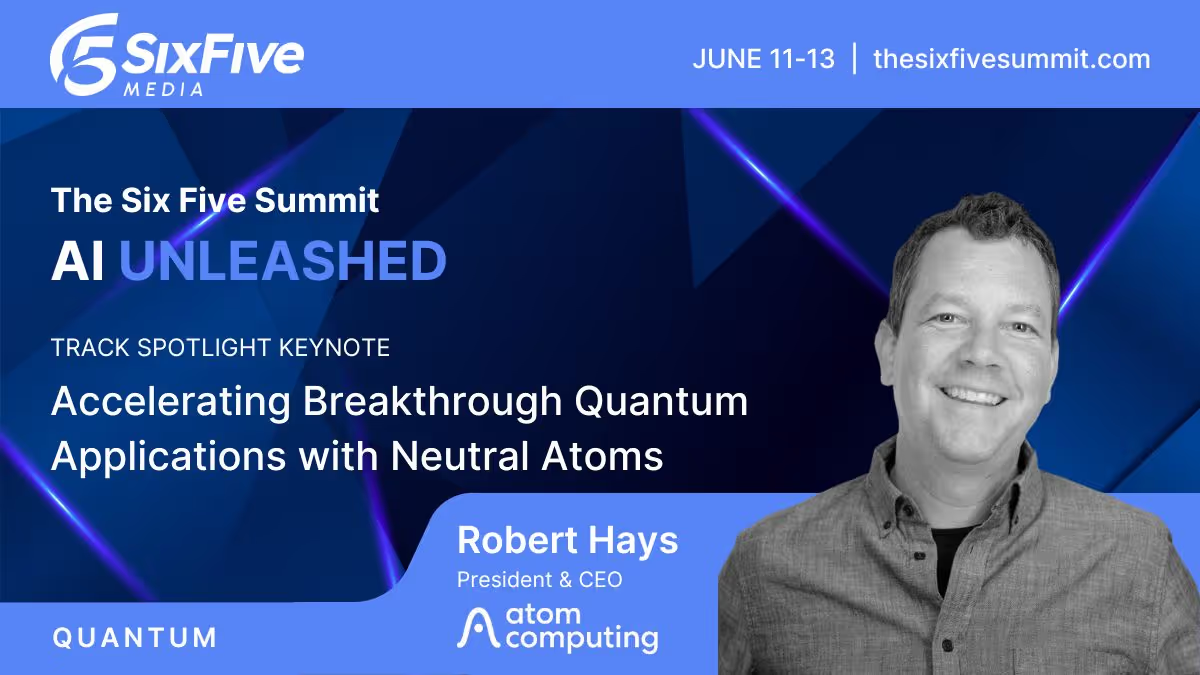
Accelerating Breakthrough Quantum Applications with Neutral Atoms
Our planet needs major breakthroughs for a more sustainable future and quantum computing promises to provide a path to new solutions in a variety of industry segments. This talk will explore what it takes for quantum computers to be able to solve these significant computational challenges, and will show that the timeline to addressing valuable applications may be sooner than previously thought.