
HPE ProLiant Compute Gen12, powered by Intel Xeon 6 - Six Five On The Road
SHARE


Justin Christiansen, General Manager at HPE, and John Carter, VP of Server Product at Intel, join Six Five hosts to share insights on HPE ProLiant Compute Gen12 and Intel Xeon 6—advancements driving AI workload acceleration, stronger security, and more resilient operations.
How are next-generation compute and processor innovations reshaping efficiency, security, and performance for modern data center workloads?
From HPE Discover Barcelona 2025, hosts Will Townsend and Ryan Shrout are joined by Hewlett Packard Enterprise General Manager & Global Sales Director, Justin Christiansen, and Intel Corporation VP of Server Product, John Carter, for a conversation on how HPE ProLiant Compute Gen12 powered by Intel Xeon 6 is accelerating AI and data-intensive workloads while delivering enhanced security and operational efficiency, with a keyphrase focus on HPE ProLiant Compute Gen12.
Key Takeaways Include:
🔹Next-gen Performance: HPE ProLiant Gen12 Compute systems feature higher core densities and faster memory, significantly boosting performance for demanding workloads.
🔹Security & Manageability: Enhanced protections like iLO7 and silicon-root-of-trust, continuous firmware validation, along with simplified fleet management to improve operational resilience.
🔹AI and Data Workloads: Dedicated AI accelerators provide meaningful advancements in inferencing capabilities for accelerated machine learning and analytics.
🔹Data Center Transformation: The combination of HPE hardware and Intel Xeon 6 platforms reduces operational costs and risk, enabling seamless, impactful infrastructure refreshes.
Learn more at HPE.
Watch the full video at sixfivemedia.com, and be sure to subscribe to our YouTube channel so you never miss an episode.
Or listen to the audio here:
Disclaimer: Six Five On The Road is for information and entertainment purposes only. Over the course of this webcast, we may talk about companies that are publicly traded, and we may even reference that fact and their equity share price, but please do not take anything that we say as a recommendation about what you should do with your investment dollars. We are not investment advisors, and we ask that you do not treat us as such.
David Nicholson:
Hi, this is Six Five Media on the road. We're at HPE Discover Barcelona 2025, and we're having a conversation with Intel and HPE. I'm joined by my partner in crime, Ryan, and let's kick things off. And John, I'd love to start with you. Now, I know HPE launched the ProLiant Gen12 compute platform in March of this year. What's really unique about that solution?
John Carter:
You know, a lot of things that we've done differently this time around, and we always try to come out with a few key points so that our customers can kind of distill this down. For us in Gen 12, it was about three things. It was about security, which we believe we've got some very unique value propositions versus others in the industry. It was about performance optimization, obviously, and partners like Intel really helped to drive that with us. And then it's really about simplicity of management and automation, bringing in more AI features and that type of value to our customers through the cloud as we move forward. Awesome.
Ryan Shrout:
Justin, the Xeon 6 processor platform kind of powers the majority of that ProLiant Gen12 platform. I'm curious, what are the key features of it that help HPE deliver on those three key promises? Is it about performance? Is it about security? Is it core count? What stands out to you?
Justin Christiansen:
Yeah, I mean a lot of the benefits that John highlighted in the ProLiant Gen12 servers are features that have been enabled within the silicon. And the latest Xeon processors have been optimized for the best head node when you're running AI training or large-scale inferencing. So we've optimized the performance of the cores, the number of the cores, the IOs, so that we have the best performing CPU when you're running it with a GPU. We've also built some of those enhancements into the silicon itself. So when you're buying an Intel Xeon 6 processor, you're getting accelerators for security. You're getting accelerators for AI inference. And here at the show, we've got some of the ISV partners who have taken advantage of those features and are showcasing how you can actually encrypt your data in new ways because they're able to take advantage of those features available in the Gen12 servers.
David Nicholson:
So Justin, you touched on AI accelerators for inferencing. How do customers benefit from that?
Justin Christiansen:
This is one of the things that personally I'm most excited about. We've worked really closely with the ISV ecosystem that develops applications. A lot of times they're training their models on GPU and for large deployments still doing the inferencing on GPU. But with the combination of the AI accelerators in the Xeon 6 processors, as well as tools like OpenVINO, we've really enabled a lot of those workloads to run on a processor. There's a lot of reasons people would want to do this. Cost is a big reason. And power, right? Power, reliability, form factor considerations if you're putting it on a retail shelf, for example. So there's a lot of reasons people do this. And with a Xeon processor, you can actually have an up to 70 billion parameter model running inferencing on that CPU. And we've enabled that to run on core processors inside of your PC, as well as ARM.
Ryan Shrout:
I do think there are a lot of instances where customers are finding that they can run the AI inference they need to run on the Xeon platforms on these HPE servers without the need for kind of massive GPU deployments and still be very effective on it. I wanted to ask you about the Gen 12 security features, kind of what the focuses are there. We've done a lot of work at Signal 65, kind of looking at ILO 7 and some of the ops management side of things. Give me your input on kind of what makes the Gen 12 iteration different or improved.
John Carter:
favorite topics to talk about actually. I really like talking through the security architecture because most people don't get the difference. They hear things like hardware root of trust and you've probably heard that from every vendor that makes a server out there at this point, right? Every ASIC you see has some sort of secure root of trust, hardware root of trust, but what does that really mean for customers? It's kind of gotten muddied over the years and we were the first ones in the market six, seven years ago to launch that concept, and we still do it uniquely versus other vendors out there because we're actually the only server manufacturer today that designs and manufactures their own BMC. So when you are creating that ASIC design yourself to partner with your server, you can do some unique things. So every year if you go to any of the security conferences around the world, Black Hat, those type of things, you tend to hear issues with things like bootloader vulnerabilities. But we don't suffer from those because we can actually guarantee security as soon as power touches that board because we've integrated those two components together. Now while there's a lot of great features coming from off-the-shelf BMCs and they can do a lot of other things very well, they can't do that because they're not built to integrate specifically together. So from that foundational layer, if your root of trust is really meant to be that foundation that you chain from as you go up, If you can't secure that first step, then what's the point? So that's the big thing that I like to start with. We move beyond that with iLO 7 with a couple of cool new things. So we've introduced something called a secure enclave. And think of this almost as a vault inside of iLO itself, where we secure things like passwords, encryption keys, all those secrets that you don't want anybody to get. And this technology has actually allowed us to go and pursue the requirements needed for the U.S. government's FIPS 140-3 Level 3 requirement, which is a very, very stringent physical requirement. And if you think about, you know, you hear customers talk about things like chip clip attacks, where somebody can buy a $20 part off of Amazon and all of a sudden they can pull passwords out of your system. Well, a lot of people say nobody's getting into my data center to do that, right? Nobody's breaking into my secure facility. It's not really the threat. The threat is buying a server completely legitimately, right? Buying it from a distributor, from us, whatever it may be, and then taking those passwords out and using those passwords to attack a customer. So with the Secure Enclave, that's no longer possible. That is physically protected from the outside, that there's no ability to pull those passwords out. So a couple of very cool new things. We're also the first in the industry to present quantum-resistant firmware, TQC. So a lot of government standards all over the world starting to require that. And we know that not only are people buying servers now, that of course they'll still be using in five years, right? But also bad actors out there are collecting credentials today to decrypt later. So this is a threat today. So we've already started to put those protections in place for customers. A lot of cool things.
Ryan Shrout:
I also wanted to ask about the ops management side. One of the things we found in looking at the software is the simplicity of scaling from one, two, three servers up to hundreds and thousands of devices. And that works extremely well in our evaluations. And also, there's some unique capabilities like carbon tracking and looking at things from a more eco-friendly standpoint too.
John Carter:
Yeah, yeah. So ComputeOps Management is our cloud-based SaaS management tool. We launched three or four years ago. It works with all of our ProLiant servers. Even more than that, you can now manage and monitor many third-party servers from our competitors. So customers out there typically don't buy just us. They've got multiple vendors, and we give them that visibility. But you're right. We offer a number of features on there, whether it's just firmware upgrading, which we dramatically simplify, or things like security dashboards and policies that can now be managed directly from the cloud across your environment all over the world. We've got secure workflow tracking so you can make sure that the right people are signing off on the right tasks. And then things for sustainability, carbon footprint tracking, power predictability, all of those type of tools that really allow our customers to hit some of the goals that they have with their corporate offices and make sure that they're following all the compliance rules that they need to.
David Nicholson:
Great. Well, as we wrap the conversation up, Justin, I'd like to get your perspective on the partnership with HPE and how is that transforming data center refresh cycles?
Justin Christiansen:
Well, first of all, we have an amazing partnership, decades-long partnership. We engineer some of the best technology in the world together. We also partner in how we bring that to market. I think John did an excellent job highlighting some of the foundational benefits around security, manageability. These are critical considerations when you're purchasing. We often talk about performance. And with Gen12 and Xeon 6, we're talking about the best performance in the market. But I also think we're talking about some of the best total cost of ownership. You know, there's a great story that HP likes to tell around server consolidation. It's taking your Gen 10 servers and 6 or 7 to 1 consolidation, even more if you look back further. Not only does that reduce your upfront cost relative to purchasing that equipment, but the energy consumption of running that, of managing it, securing it.
David Nicholson:
The OpEx savings are huge, right?
Justin Christiansen:
Yeah, and I think the sustainability story is one that we don't talk about enough because not only is it less raw materials, but that lower energy consumption, especially, you know, in today's environment is really important. So we're really excited, not just about the partnership, but I think about Gen 12 and the launch. It really provides customers with something that, you know, from a value perspective, I think is generational. So we're excited.
David Nicholson:
Yeah.
John Carter:
Anything else to add there, John? No, I mean, the partnership with Intel has always been great. We really get to work quite a bit with Justin's team to make sure that we're doing everything we can for our joint customers. It's been a great ride here with Gen12, so really excited to keep working with you guys.
David Nicholson:
Yeah, and the best is yet to come, I'm sure, right? And we'll keep doing it. Well, hey guys, thanks for taking the time to speak with Ryan and I. It's been really enlightening. And I just want to thank our viewers for tuning in. This is Six Five Media on the road at HPE Discover Barcelona 2025. Stay tuned for more great content.
MORE VIDEOS
The Six Five Pod | EP 322: AI Writes Its Own Rules, Copilot Bills by the Task, and Memory Names Its Price
The companies racing to build frontier AI just agreed to referee themselves. Over the same week, launches, investor days, and earnings put a price on that arrangement. Microsoft is charging for finished work, NVIDIA is selling agent containment as infrastructure, and the suppliers AI can't route around, from Synopsys to Micron, are collecting the premium. Patrick Moorhead and Daniel Newman separate signal from stagecraft, then split hard on whether the White House accord actually binds these key players to anything.


The Major Decision Hiding Behind Every Hypervisor Renewal
HPE's Varma Kunaparaju talks with Patrick Moorhead and Daniel Newman about why virtualization licensing changes are forcing enterprises to confront a bigger decision than which hypervisor to choose next: what operating model sits underneath their private cloud and AI factory. He outlines how CxOs can sequence modernization in phases, extend governance across open and frontier models, and decide where automation should replace human approval in IT operations.
Bridging the Capacity Gap: Why Enterprises Are Investing in Agentic Digital Workers
IFS Loops CEO Somya Kapoor joins Keith Kirkpatrick to explain why agentic digital workers stall between pilot and production, and why governance, escalation design, and change management now shape adoption more than building agents does. Drawing on new Futurum research, she shows how enterprises can start with imperfect data and redirect reclaimed capacity toward growth.
Other Categories
CYBERSECURITY
Threat Intelligence: Insights on Cybersecurity from Secureworks
Alex Rose from Secureworks joins Shira Rubinoff on the Cybersphere to share his insights on the critical role of threat intelligence in modern cybersecurity efforts, underscoring the importance of proactive, intelligence-driven defense mechanisms.

HP Launches World’s First Business PCs to Protect Against Quantum Hacks - The Six Five On the Road
On this episode of the Six Five - On the Road, hosts Patrick Moorhead and Daniel Newman are joined by HP's Ian Pratt, Global Head of Security for Personal Systems.
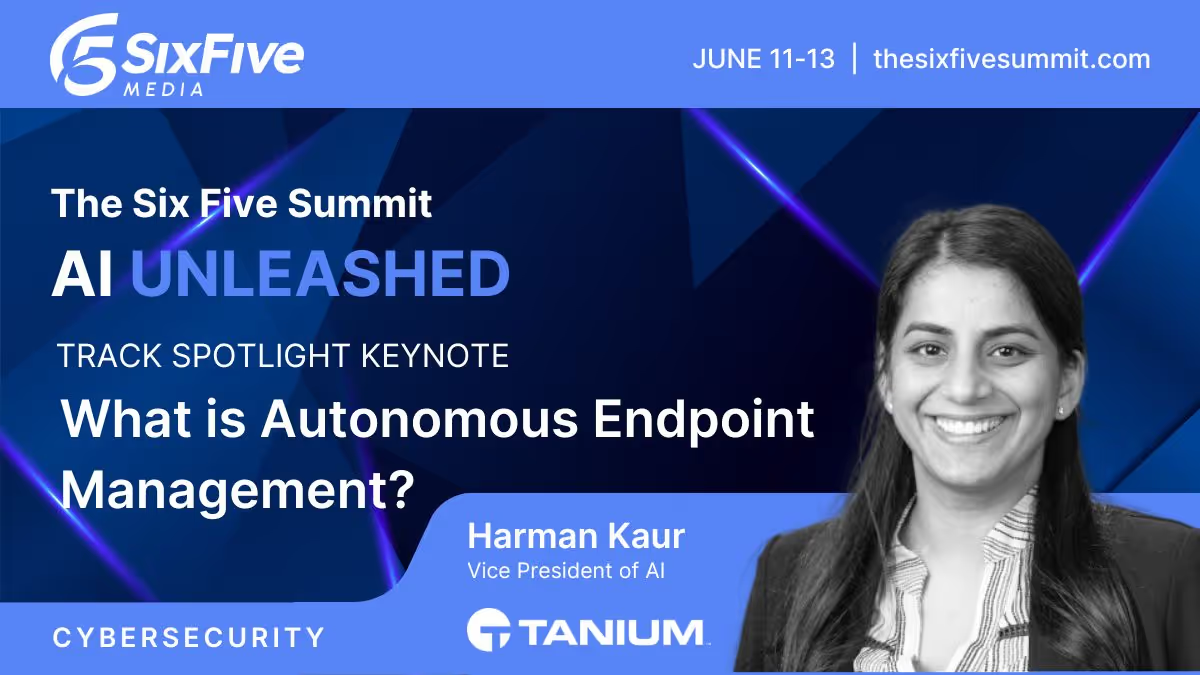
What is Autonomous Endpoint Management?
Autonomous Endpoint Management is a framework designed to unify IT operations and security teams on a single platform through real-time control and visibility.
QUANTUM
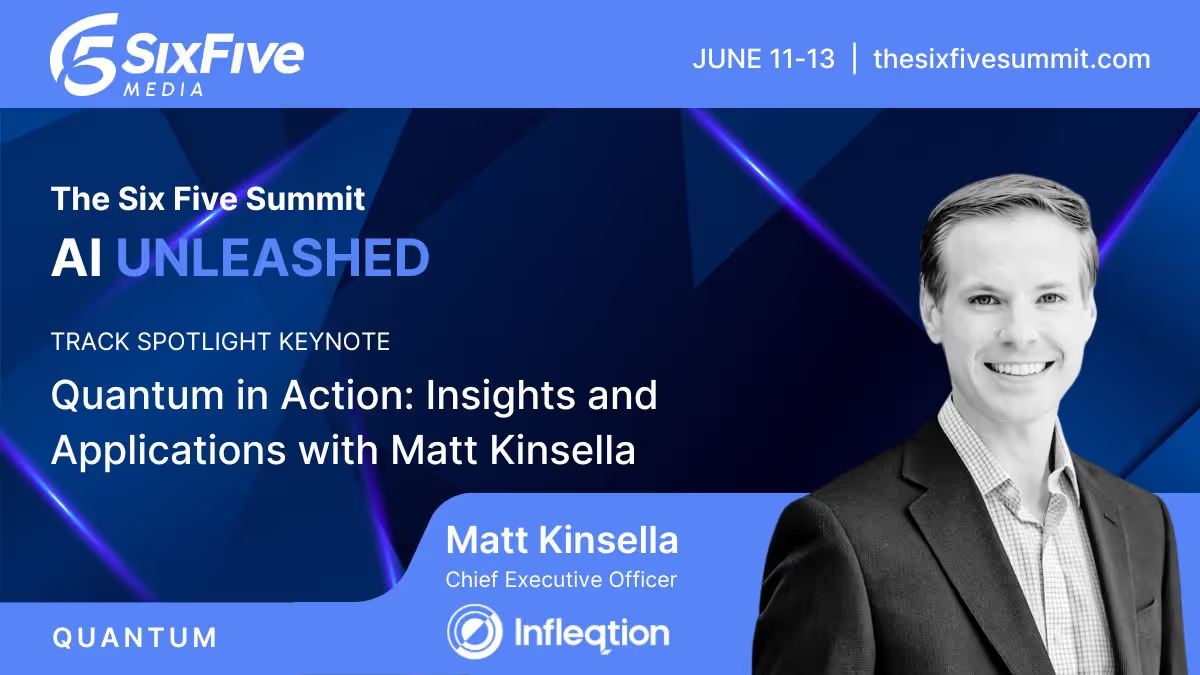
Quantum in Action: Insights and Applications with Matt Kinsella
Quantum is no longer a technology of the future; the quantum opportunity is here now. During this keynote conversation, Infleqtion CEO, Matt Kinsella will explore the latest quantum developments and how organizations can best leverage quantum to their advantage.
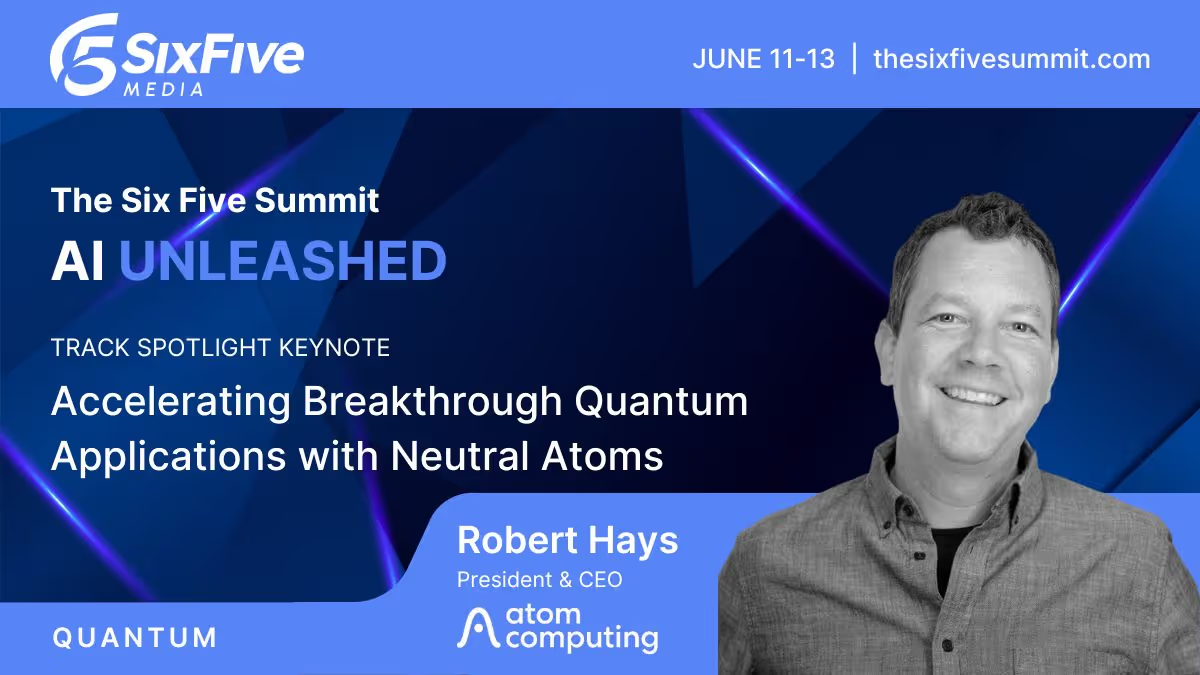
Accelerating Breakthrough Quantum Applications with Neutral Atoms
Our planet needs major breakthroughs for a more sustainable future and quantum computing promises to provide a path to new solutions in a variety of industry segments. This talk will explore what it takes for quantum computers to be able to solve these significant computational challenges, and will show that the timeline to addressing valuable applications may be sooner than previously thought.