
HPE's Chief Architect: The Tech That Will Define Enterprise Computing by 2030
SHARE


.png)
As organizations race to operationalize AI, quantum computing, intelligent systems, and next-generation infrastructure are already converging to redefine what becomes possible by 2030. Kirk Bresniker, HPE Fellow, Vice President, and Chief Architect at HPE, joins Six Five at HPE Discover 2026 to examine how research, ecosystem collaboration, and hybrid computing architectures are unlocking the breakthroughs enterprises will need to compete over the next decade.
Most organizations are still solving today's problems with today's tools, which makes sense until the technologies arriving over the next decade render those tools obsolete faster than anyone planned. Quantum computing, intelligent systems, and next-generation infrastructure are converging well before most enterprises have fully operationalized the AI initiatives already on their roadmaps.
At HPE Discover 2026 in Las Vegas, David Nicholson sat down with Kirk Bresniker, Hewlett Packard Enterprise Fellow, Vice President, and Chief Architect at HPE, to look past this week's AI headlines and into what's actually shaping enterprise computing toward the end of the decade.
Bresniker identifies the technology shifts he believes will have the greatest impact on how enterprises operate and compete by 2030, starting with what the newly launched Quantum Scaling Alliance is actually trying to solve and why ecosystem collaboration matters this much at this stage. He breaks down how AI, HPC, and quantum computing are converging despite having previously been viewed as separate domains, and points to where meaningful business value is likely to emerge first.
Kirk also walks through the specific signals HPE Labs is watching to gauge how close quantum utility actually is, and closes by weighing concepts such as the agentic enterprise, proof before trust, AI beyond the large language model era, and which of these will most reshape enterprises over the next ten years.
Key Takeaways:
🔹 The technologies most likely to reshape enterprise competitiveness by 2030 extend well beyond today's AI headlines. Bresniker breaks down the developments he believes will have the greatest long-term impact on how organizations operate, innovate, and compete.
🔹 The next phase of quantum computing will be defined by ecosystem collaboration rather than isolated breakthroughs. Bresniker explains the challenge the Quantum Scaling Alliance is designed to solve and why industry-wide coordination is becoming essential to progress.
🔹 The boundaries between AI, HPC, and quantum computing are beginning to disappear. Bresniker explores where these domains are converging, how that convergence is changing enterprise strategy, and where meaningful business value is likely to emerge first.
🔹 The ultimate competition isn't quantum versus classical computing—it's simulation versus experimentation. Bresniker argues that AI, HPC, and quantum computing will work together to simulate increasingly complex physical systems, reducing the need for costly real-world experimentation.
🔹 The enterprise of 2030 may look fundamentally different than today's enterprise. Organizations built in the era of agentic AI will operate differently, attract talent differently, and compete differently than enterprises designed before AI became foundational
🔹 Planning around today's AI roadmap alone risks missing the next major computing shift. Bresniker outlines how technology leaders can begin positioning their organizations for what's coming next while the opportunity to build an advantage still exists.
Watch the full video at sixfivemedia.com, and be sure to subscribe to our YouTube channel so you never miss an episode.
IMPORTANT: Note to Uploader: VIDEO EMBED – added by uploader.
Disclaimer: Six Five Media is for information and entertainment purposes only. Over the course of this webcast, we may talk about companies that are publicly traded, and we may even reference that fact and their equity share price, but please do not take anything that we say as a recommendation about what you should do with your investment dollars. We are not investment advisors, and we ask that you do not treat us as such.
David Nicholson:
The competition isn't between classical computing, CPU and GPU, and quantum computing. It's between simulation that includes not only Galileo and Newton, but Schrodinger and Dirac, versus laboratory experimentation, which is what we have to do today.
Kirk Bresniker:
Welcome to Six Five In The Booth. I'm Dave Nicholson and we are here at HPE Discover 2026 in Las Vegas. And I am extremely excited about this because I have Kirk here from HPE. Kirk, please introduce yourself and tell us what you do here.
David Nicholson:
I'm Kirk Resnicker. I am the chief architect at HPE labs and a short way of saying my day job is we have researchers who are looking at 5 10 15 or 20 years in the future. We have development teams that are thinking about the next discover. How do you get teams that have such a different timeline of innovation to work together. especially when working together innovation is no longer an HPE only activity. It is a global set of partnerships. So my job is sit on the uncomfortable middle space between research and development and pull everyone together.
Kirk Bresniker:
So one thing that. I mean, if you're in this industry, people know that Hewlett-Packard, HP, HPE, for a long time has been involved with serious research. Serious research. Quick anecdote, I was working for a company called EMC. We'd have these executive briefings. People had just rolled through your facility, and they'd come in and they'd tell us, these guys are doing material science. What are you doing here? We're like, nothing. So you guys have legitimate street cred in this space. So when I ask you where are we now versus 2030. What are you thinking. What are you thinking about what's happening over the next decade or so. What direction are we headed.
David Nicholson:
Yeah so I think you know I think I've done my job right as the chief architect when HP when one of our executives comes as hey here's a new technology. I think it's going to be important to our business and I say that's right. That's why three years ago we started a research collaboration. Here's the best academic teams. Here's the best potential startups. Here's IP so you can understand and you can have freedom of action on how you want to evolve HPE's business. So when we think about 2030 I think about five I'm calling five navigational aid. So as you're piloting our company into this future I want you to think about the agentic enterprise. I don't just mean the adoption of genetic technology by today's enterprise. What is that enterprise going to be when its founders used A.I. throughout their whole careers when you're creating an enterprise that could not have existed except for the presence of agenda. How do you become one of these companies. How do you attract talent that will demand to work at one of these companies. The second thing we think about is beyond the grid. You know we think about a century ago at Westinghouse versus Edison A.C. versus D.C. How are we going to harness this new power for good. And now we're seeing exactly the same discussions today but where all the units are huge. hundreds of thousands of amperes gigawatts of power intense demand also intensely distributed supply as we learn to live within the means of sustainable energy but also need to accomplish so much more. So that grid that model that was established back then is not what will see us forward especially when we're talking about equitable and sustainable access to these technologies. The third thing we think about is proof before trust. You know, when will I be able to have from the CCD that captures an impedance to the LED that displays it on my phone at test station, at scale, every device, every firmware, every hardware, every software transformation of all this information proven, not trusting, but proven to be factually correct, proven that the adversary has not gotten into the supply chain. The fourth thing we think about is quantum utility. In 2030, we think about someone. Maybe we'll be here at Discover 2030, and we'll be talking about, did you see the breakthrough? Quantum mechanics now being brought into the simulation portfolio, the same ease at which we do finite element analysis, computational fluid dynamics, nonlinear circuits. Now we're doing quantum mechanical simulation, just that easy and just as well integrated into the supercomputer. and the last thing we think about, we think about all the power that we're unleashing with today's LLMs, but the LLM will not be the last of the AI faculties we add into the artificial intelligence portfolio. How do we add more deductive reasoning? How do we bring world models, energy-based models? How will we complement the creative power of the LLM and get to efficient, deep reasoning for the enterprise as well?
Kirk Bresniker:
Okay, so we're in a very interesting point in history. I wouldn't even call it a
crossroads but it's sort of a convergence. You think about the history we're coming off of in the traditional high performance computing supercomputing realm where you look at correct me if I'm wrong but I'll copy time. You familiar with it. I love it. A little bit. A little bit. CPUs right. CPUs and GPO. But I'm saying previous iteration. Oh yes. Primarily CPU. Yes. Right. And in fact you know a few years ago we were concerned about floating point sixty four going away because I was sucking the oxygen.
David Nicholson: Gracious appetite for millimeters on die and wafers.
Kirk Bresniker:
And now we're moving in the direction of yes more GPU and in what will become the traditional supercomputing space. We have a I which is Not, I mean, yes, it's all artificial intelligence, but when we talk about AI today, generative AIs in particular, supercomputing kind of different, but there's this convergence happening, and then quantum is on the horizon. Yes. 2030, which isn't as far away as it should be in my mind. Are we going to see all of these things operating still, or is there going to be a convergence into one methodology? I mean, isn't quantum and supercomputing and traditional legacy computing with CPU, GPU, fill-in-the-blank PU, aren't all those things going to still be around?
David Nicholson:
Oh certainly. As a matter of fact in order for us to realize the potential of what quantum will offer us there is a necessity at every layer in the stack to bring in A.I. and bring in HPC in designing that next generation to bit. massive qubit quantum processing units RF radio frequency design power design super cool to Miller Kelvin's as intense EDA challenge. How will we design a wafer scale quantum processing unit. That is going to be simulation a design of an unparalleled level. HPC and I will be in the tools and will be. utilized by the tools in order to affect that design. Above that the manufacturing new manufacturing technologies that will enable us to get better and better cubits again. A.I. HPC. Above that the control of these of these quantum processing units. Again A.I. and HPC to do the microsecond by microsecond calibration and measurements care and feeding of these incredibly interesting and intricate and delicate physical operations for physical computation of quantum mechanical results. All that is again HPC AI. And then we get into the applications, how we take a problem, break it apart, decide which pieces go into the CPU, which pieces go into the GPU, which pieces go into the QPU. Again, that's both a machine learning and a quantum machine learning problem. all the way back up to the top to the scientists or engineer who want to just run a simulation. We'll see APC A.I. and quantum computing necessarily coming together.
Kirk Bresniker:
OK well we shouldn't think of from a. computational perspective it's not that quantum computing in 2030 will have replaced all need for GPU CPU TPU whatever.
David Nicholson:
No matter if it will induce even more demand for traditional computing in order to realize the promise and potential because The competition isn't between classical computing CPU and GPU and quantum computing is between simulation that includes not only Galileo Newton but Schrodinger and Dirac versus laboratory experimentation which is what we have to do today.
Kirk Bresniker:
OK. And so are all of these things that you referenced. Are they going to happen? And then are they also not going to happen? Little Schrodinger's cat humor there.
David Nicholson:
So we are, yes, a superposition of hype and reality. Maybe that's the other way to say that. And that's really what we want to understand is how do we make this real? Right. And you know there's probably never been an endeavor that we as a species have undertaken that matches the number of disciplines which must come together to make this true. Here we are saying what at the heart of a quantum computer. We're saying I'm going to create a tiny little universe. I'm going to populate it with a quantum mechanical system and I want all the knobs and buttons to be under my control. That's already a pretty audacious statement. But now to say that I will then utilize this to simulate the way that the world actually works, the world according to quantum mechanical principles. Again, so much there, so much physics, so much material science, so much engineering, computer science, everyone is there inside of that QPU. And again, it won't just be traditional computation it will be massive AI that enables us to work together and to realize this incredible advancement that we will have as a people.
Kirk Bresniker:
OK. So while we keep in mind that yes AI moving forward yes GPU TPU CPU all of it working together. I want to dive a little more closely into the quantum realm.
David Nicholson:
Absolutely.
Kirk Bresniker:
So let's go on a little tour, because I'd like you to show us what we're looking at in 2030 and beyond.
David Nicholson:
I'm excited to do that.
Kirk Bresniker:
All right, Kirk, what is this? Where are we?
David Nicholson:
We're in a data center of the future. Now, most of the data center of the future will look like what you expect it to, row after row of cabinets all filled with CPUs, GPUs, storage, all connected with high-performance networking. But then you're going to see this object, and this is going to be different. And you'll probably see tens or even hundreds of these. This is a quantum processing unit. This is from our partner IQM. In the center, immersed in liquid helium, is the quantum processor itself with all of the qubits. Around it is the cooling apparatus that keeps it at a couple of tens of millikelvin above absolute zero. And remember, space is much hotter than that. So this is millikelvin as opposed to four or five kelvin, the temperature of deep space. So colder than space, isolated, controlled, a quantum environment that we create and then bring into the supercomputing data center.
Kirk Bresniker:
OK, and so these would be working in concert with what we think of as more traditional architecture, including CPUs, GPUs, likely all liquid cooled in some way or another. Different liquid, though.
David Nicholson:
Different liquid. Here we have liquid helium. And then what we have in the rest of the equipment is water cool, direct liquid cools for ultra high efficiency. The other thing that we'll say about these data centers that might be different than traditional ones, they'll be silent because of all that high performance.
Kirk Bresniker: I'll believe that when I hear it. With practical hearing damage from the fans of data centers over all of these years, cumulative anyway. Why does it have to be so cold?
David Nicholson:
Because we need to create a quantum mechanical system, that's the heart of the quantum processor unit. Create a quantum mechanical system, manipulate it ourselves, and one of the ways that we keep the rest of the universe out is by cooling it to those millikelvins. This is also a superconducting qubit. There's many ways that we can create a quantum mechanical system and harness it to do quantum processing. A superconducting quantum system needs superconductivity, and that's why it's millikelvin, in order to get that superconducting operation ready to become a quantum processor.
Kirk Bresniker:
OK, if we were in your garage, and this wasn't an EV, let's stipulate that, I'd ask you to open up the hood.
David Nicholson:
Yes.
Kirk Bresniker:
So can we kind of? Open up the hood and take a closer look.
David Nicholson:
Yeah, we have a model over here that'll show you what's inside that beautiful silver cylinder.
Kirk Bresniker:
Alright, let's go take a look. Let's take a look over here. Oh, here we go. Okay, I've seen something like this before on Doctor Who.
David Nicholson:
Yeah, that's right. It's the middle of the Tardis and it's going up and down when we're traveling through time and space, right?
Kirk Bresniker:
So, what are we looking at here?
David Nicholson:
So, this is what we have inside of that cylinder. So, this is what's going to be cooled. to the 10 millikelvin above absolute zero. Here you can see the processor down below, and it looks like a lot of chips we might see. That processor is installed inside of this vessel, and that's what's actually cooled to the millikelvins. Now you see all the silver lines, each one of those is a coaxial microwave waveguide. The way that we manipulate the quantum system inside of the quantum processor is by engineering a specific microwave pulse. Attack, duration, decay, repetition, and period are all things that we engineer to enter quantum information into the quantum system, to manipulate the quantum system, and then to get the information back out again. So into the quantum domain, out of the quantum day, by specifically engineered microwave pulses.
Kirk Bresniker:
And so this all would be immersed in liquid helium?
David Nicholson:
All coming down and cooled, yes, by liquid helium.
Kirk Bresniker:
Immersed or it's cooled with it? Cooled with it. OK, OK, OK. And explain the difference between physical qubits, logical qubits, and what constitutes a stable qubit. Right. And how many of those are we kind of looking at here?
David Nicholson:
So this is approximately 56 qubits, so 66 of these superconducting devices.
Kirk Bresniker:
Physical qubits? Is that how you would describe it?
David Nicholson:
Physical qubits, so 56 physical qubits. And when we're assembling quantum devices, we think about three things that are the superpowers of the qubit. One, they are in superposition, so they can be both a probability of being a 1 or a 0 simultaneously, and those are actually complex numbers. If you remember trig class A plus BI, so a lot of information can be stored in the probability of a qubit, a 1 or a 0. The second thing that they have is entanglement. I can take two qubits, I can entangle them together, and now the state is determined by their behavior as a whole. So if it took a certain amount of information to describe that quantum system, I add a second qubit, it takes twice as much. I add a third qubit, it takes twice as much again. So two to the end. So that ability for these complex systems to grow exponentially in their interactions is why we want to use a quantum system, because that's how nature works. If I have a molecule with one electron, it takes a certain amount of simulation power to simulate that on our supercomputer. I add a second electron, the problem gets twice as hard. I add a third electron, the problem gets twice as hard. And that's why we soon run out of capacity, even our most advanced supercomputers, to handle simulation of quantum systems big enough that they mean something to society. So that's why we want to harness this quantum system. The last superpower is interference, is that the probability of each of those qubits of being both a 1 and a 0 simultaneously as they're working together in entanglement, they also can tug and pull and adjust each other, and that's actually how the quantum circuit evolves. We can manipulate it by sending those microwave pulses, that's how we step through each step in the quantum algorithm, and then we let it evolve, and then we measure it out, we get the quantum data out, what is the state of the quantum system as it evolves, that's how we run a quantum application.
Kirk Bresniker:
Okay, so I'm going to show you how smart I actually am. I am not going to go like this at most of that because you start talking about superposition and the only thing I can do is go. because I can't possibly understand. My non-quantum brain can't fully capture it. Let me go. Let me try for a go. No, no, no, it's not. I'm saying, no, no, no, no, no. I'm saying that the people who all go, oh, yes, I get it, I get it. No, nobody gets it. Nobody completely gets it. But you explained it very well.
David Nicholson:
But let me try this. We're in Las Vegas and it's all about the odds, right? So, let's say we had a coin. And I show you the coin and it's heads up, tails down. And I flip it. When the coin is spinning in the air, is it heads or tails?
Kirk Bresniker:
Yeah, it could be either. It could be either. It's both. It's yes.
David Nicholson:
So, we don't know until I grab it out of the air and then I show you. So, that is supervision. While it's rotating, while it's spinning around, it's heads or tails.
Kirk Bresniker: No, that's easy. But how do you predict weather with that? Well when you said 56 and when you were talking to physical cubits logical and logical cubits.
David Nicholson: So that's a physical cubit. Now as we said this is in liquid helium. It's at 10 millikelvin to protect it from the rest of the universe because anything that comes in and jiggles it could have set those odds. Because what we're doing when we're manipulating the qubits is that we're adjusting those odds, the probability we'll get a one or a zero. And then when I measure at the end, I get one classical bit of information from every qubit. And that's how I solve my quantum computing problem. So when we're talking about that, we have to think, well, how fragile are these? And the truth is that some qubit technologies, they can last Milliseconds some tens of milliseconds some might be seconds but if I have a calculation that has to run for days or weeks or months then I need something that protects that state and that is where we have quantum error correction. Now we always think we think of like oh it's not like parody and D ram I have 8 bits I had an extra bit I can tell if any of the bits got flipped the challenge we have with quantum. is, to your earlier joke about Schrodinger and their cat, you can't peak. Because if you peak, you destroy all the wave functions and your quantum circuit evaporates. So I had to figure out a way to encode all of the quantum information and the error correction in a way that can progress without me doing any observations. Now, what that practically means is, if we think of parity as one bit per taxate, in quantum we flip the numbers. If we're to get one logical, really robust qubit that we can count on for the duration of an algorithm, we might need 1 to 10,000. physical qubits.
Kirk Bresniker:
So as we stand here in 2026 there is sort of a number a max that people have been able to reach. Where do you think we'll be by 2030.
David Nicholson:
So that is sort of the open question and we'll be different on the different ways. Now this is a superconducting qubit. That's about one of about a half a dozen different ways I can use mechanical quantum mechanical systems in order to construct a quantum superconducting qubit. supercomputer. Some of those will scale more readily, some of them last longer, some of them are speedier, some of them have advantage in how they can intercommunicate between the qubits. They all have pluses, they all have minuses. Now the count that we're talking about, you know, can we get to something that's in the 10 or 100,000 range in the next several years? I think that's certainly what we would aspire to, but the devil is in the details and that's why we formed a research community to write down all those details. Here we're at tens of qubits. We have line of sight to hundreds of qubits, but we do need to get to at least hundreds of thousands of qubits, and then still, we'll still have a distributed computational problem, and we'll need to understand how we distribute problem across hundreds, perhaps, of QPUs to tackle one problem of sufficient interest.
Kirk Bresniker:
And even at that stage of the game, the work to solve a problem is going to be split between the stuff that's working in the quantum realm and stuff that's working in kind of more traditional HBC supercomputing a CPU GP.
David Nicholson:
I don't want to use a cubit to do arithmetic got it right. That's why I have the CPU for the GPU. So when we're taking a problem we care about, the first question is going to be, do I need a quantum processor? If I don't, if I have a great approximation, knock yourself up. That's what the supercomputer is for. That's what the CPUs and GPUs are for. But then when I get to the necessarily quantum piece of that problem, I want to understand, okay, given the quantum problem, And given the QPUs I actually have, what's the best way to partition that problem? Because when I partition a quantum problem, I will eventually have to reconstruct what I cut apart. And that costs me a lot of high-performance computing cycles to stitch all that data back together. And what we've seen from our simulations and research, if I do that intelligently, if I understand the nature of the problem I'm trying to split apart, There might be a reduction of a factor of a thousand in what I have to do to stitch all those answers back together. So intelligent partitioning adaptive circuit is what we're calling it of a problem into where the QP use are actually going to behave is going to be a vitally important piece of that scaling equation.
Kirk Bresniker:
OK. We you know we sort of started the conversation reminding people that HPE is famous for research and you've been involved in this space. for your whole career. It's amazing. It's amazing. Remind me what version of cubit ism we're using here. Superconducting superconducting. So an alternative method would be trapped ion and there are others and others. HPE is involved in research. IQM is a partner of HPE. Yes they are. So have you. So does that mean that HPE has is sort of doubling down on this type of technology or are you are you open to others with the HPE environment likely include various quantum methodologies.
David Nicholson:
Oh, absolutely. As a matter of fact, this week here at Discover, we announced partnerships not only with IQM on superconducting, but also Rigetti Computing with their superconducting technology.
Kirk Bresniker:
Got it. Okay, okay.
David Nicholson:
With Quantinium and their Trapped Ion, with Querer and their Neutral Atom, and with Intel and their SpinQubit technology.
Kirk Bresniker:
Okay, okay, okay. Very interesting. Very interesting. Well, this is absolutely amazing. Folks, you don't have to pretend to completely understand when you start getting into superposition and things like that. It's a fascinating rabbit hole to go down. Suffices to say that this technology is not going to completely replace what we're doing from a legacy compute perspective today. And I think the main thing for guys like us is that 2030 seems like it should be 50 years into the future.
David Nicholson:
The years are advancing 50 years. All the exponentials about advancement. They're all coming to play because it's HBC and A.I. and quantum all coming together. Each one of those layers that diversity of disciplines coming together. It's going to be a fantastic ride.
Kirk Bresniker:
Well, for Kirk, I want to thank you for joining us on Kirk and Dave's Excellent Adventure into 2030. Dave Nicholson with Six Five In The Booth at HPE Discover 2026. Stay tuned for more interesting content. Although I can't promise it'll be more interesting than Kirk and what he shared with us.
MORE VIDEOS
Industry Veteran and Google’s Satish Thomas on Replacing One-Size-Fits-All Enterprise AI With Industry-Specific Agents
Google is moving enterprise AI beyond general-purpose tools and into industry-specific workflows built for regulated sectors such as legal and financial services. Satish Thomas, Vice President, Business and Industry Solutions at Google, joins Six Five to explain how Gemini Enterprise for Industries combines purpose-built skills, ready-to-deploy agents, model choice, and an open partner ecosystem to bring AI into the workflows enterprises already run.


AMD Instinct MI355X vs NVIDIA HGX B200 GPU platforms AMD vs NVIDIA: A Three-Level Inference Infrastructure Evaluation
Signal65 President Ryan Shrout and Senior Performance Analyst Mitch Lewis review a new three-level inference infrastructure evaluation of AMD's Instinct MI355X against NVIDIA's HGX B200 with AMD's Andrew Dieckmann and Anush Elangovan. The MI355X's memory bandwidth advantage compounds as context and concurrency scale, delivering up to 2.25x throughput gains and roughly 40 percent lower cost per GPU hour.
.png)
Anthropic’s AI Slowdown, OpenAI’s $1.2T Valuation & Salesforce’s AI Bet
Anthropic's "Pace the Frontier" essay set off a week in which nearly every major AI leader, and two heads of state, weighed in on whether the frontier should slow down. Patrick Moorhead and Daniel Newman read the incident as something larger than a safety debate. Whoever sets the pace of the frontier also sets the pace for open-weight models, enterprise custom models, and the trillion-dollar valuations riding on top of them. That contest, not the essay itself, is the through-line of Episode 320 of The Six Five Pod.
Other Categories
CYBERSECURITY
Threat Intelligence: Insights on Cybersecurity from Secureworks
Alex Rose from Secureworks joins Shira Rubinoff on the Cybersphere to share his insights on the critical role of threat intelligence in modern cybersecurity efforts, underscoring the importance of proactive, intelligence-driven defense mechanisms.

HP Launches World’s First Business PCs to Protect Against Quantum Hacks - The Six Five On the Road
On this episode of the Six Five - On the Road, hosts Patrick Moorhead and Daniel Newman are joined by HP's Ian Pratt, Global Head of Security for Personal Systems.
What is Autonomous Endpoint Management?
Autonomous Endpoint Management is a framework designed to unify IT operations and security teams on a single platform through real-time control and visibility.
QUANTUM
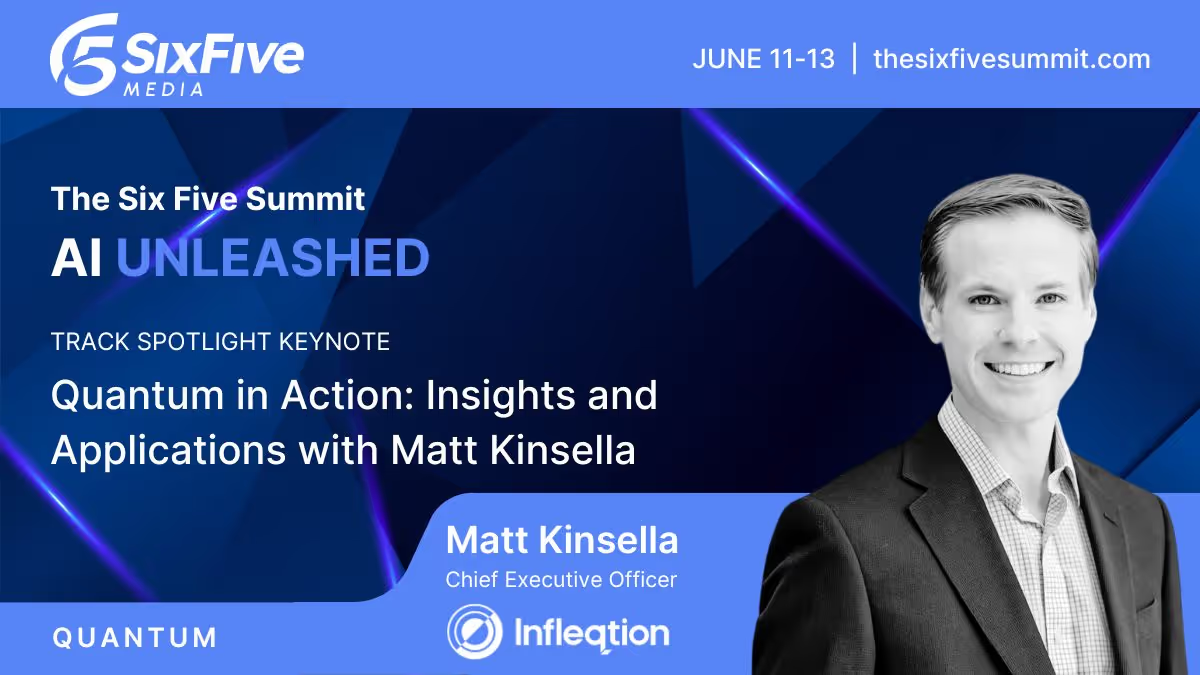
Quantum in Action: Insights and Applications with Matt Kinsella
Quantum is no longer a technology of the future; the quantum opportunity is here now. During this keynote conversation, Infleqtion CEO, Matt Kinsella will explore the latest quantum developments and how organizations can best leverage quantum to their advantage.
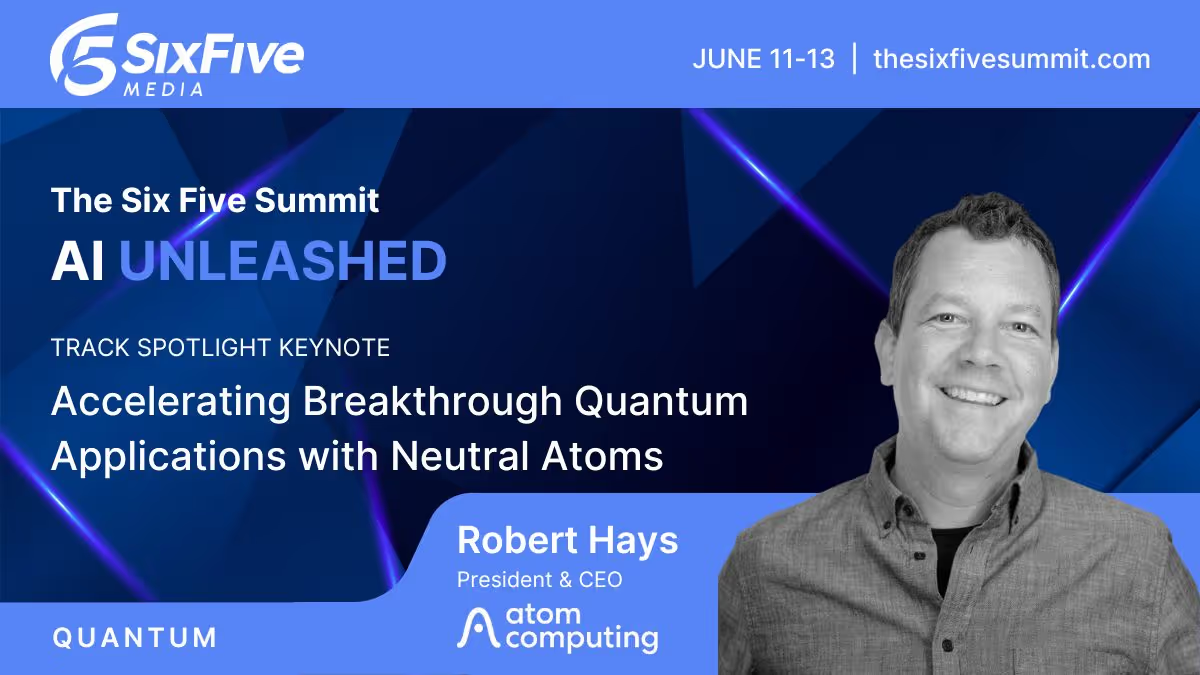
Accelerating Breakthrough Quantum Applications with Neutral Atoms
Our planet needs major breakthroughs for a more sustainable future and quantum computing promises to provide a path to new solutions in a variety of industry segments. This talk will explore what it takes for quantum computers to be able to solve these significant computational challenges, and will show that the timeline to addressing valuable applications may be sooner than previously thought.