Home

Industry Veteran and Google’s Satish Thomas on Replacing One-Size-Fits-All Enterprise AI With Industry-Specific Agents
Industry Veteran and Google’s Satish Thomas on Replacing One-Size-Fits-All Enterprise AI With Industry-Specific Agents
SHARE


Google is moving enterprise AI beyond general-purpose tools and into industry-specific workflows built for regulated sectors such as legal and financial services. Satish Thomas, Vice President, Business and Industry Solutions at Google, joins Six Five to explain how Gemini Enterprise for Industries combines purpose-built skills, ready-to-deploy agents, model choice, and an open partner ecosystem to bring AI into the workflows enterprises already run.
General-purpose AI has taken enterprises further than many expected. Now, the constraints of industry-specific workflows are exposing where it falls short.
Legal teams need confidentiality boundaries and ethical walls that generic tools may not respect. Financial services organizations cannot tolerate hallucinated figures or opaque reasoning in compliance-sensitive, multimillion-dollar transactions. That gap is what Google is targeting with Gemini Enterprise for Industries.
Analyst Tiffani Bova, Chief Strategy and Research Officer at The Futurum Group, spoke with Satish Thomas, Vice President, Business and Industry Solutions at Google, about how enterprise AI is moving beyond general-purpose tooling and into workflows designed for the operating requirements of specific industries.
Thomas outlined the three pillars behind Gemini Enterprise for Industries: purpose-built skills developed alongside industry experts, ready-to-deploy agents from Google and its partner ecosystem, and model choice that allows organizations to select among frontier models, specialized scientific models, third-party models, and open source options based on the task.
He grounded that framework in two highly regulated verticals: legal and financial services, and explained how Google’s partner ecosystem and support for open standards such as the Model Context Protocol can help enterprises connect agents to systems they already use without rebuilding their technology stack or increasing vendor lock-in.
Key Takeaways:
🔹 General-purpose AI is reaching its ceiling in specialized workflows. Thomas commented, “The era of one size fits all enterprise AI is essentially over.” Gemini Enterprise for Industries addresses that gap with purpose-built skills, ready-to-deploy agents, and model choice designed around specific workflows rather than general use.
🔹 Legal workflows expose where generic AI breaks down. Contract audits, citation verification, and invoice review require strict confidentiality and ethical boundaries. Google’s approach includes skills such as an M&A virtual data room auditor designed to identify liabilities and change-of-control clauses, alongside integrations with legal ISVs including Harvey, NetDocuments, Everlaw, and CourtListener.
🔹 Financial services has little tolerance for AI error. Financial professionals can’t afford hallucinations or black-box reasoning when handling compliance requirements and multimillion-dollar transactions. Google’s financial research agent includes more than 50 specialized skills for extracting data from earnings transcripts and working with complex spreadsheets, supported by connections to sources including the London Stock Exchange, PitchBook, FactSet, Moody’s, and Dun & Bradstreet.
🔹 The partner ecosystem is central to scaling deployment. Google has launched hundreds of partner-built agents backed by global systems integrators, AI-native partners, and boutique firms. Support for MCP helps those agents connect to existing systems of record and engagement without forcing customers into a closed architecture.
🔹 AI value depends on improving human performance. Thomas framed these tools as a way to give employees “superpowers” by helping them perform critical tasks faster, more efficiently, and with greater depth. The enterprise case is not limited to replacing work; it is about improving how work gets done.
🔹 Adoption, not model release velocity, is the real success metric. The next phase of enterprise AI will be measured by end-user adoption across industries and regions. Google’s Proof Engine program supports that objective by developing case studies and documenting measurable customer ROI as deployments move into production.
Watch the full video at sixfivemedia.com, and be sure to subscribe to our YouTube channel so you never miss an episode.
Read the research behind it: From Pilots to Production: Why Agentic AI Runs Through the Ecosystem — Futurum's report on what it actually takes to move agentic AI from pilot to production through the partner ecosystem.
IMPORTANT: Note to Uploader: VIDEO EMBED – added by uploader.
Disclaimer: Six Five Media is for information and entertainment purposes only. Over the course of this video, we may discuss companies that are publicly traded, and we may reference their equity share prices. Nothing discussed during this webcast should be considered investment advice or a recommendation to buy or sell any security. We are not investment advisors, and you should not rely on this content as financial advice. Six Five Media collaborates with technology companies and industry leaders to produce research-driven interviews and multimedia programming for enterprise technology audiences.
Satish Thomas:
The era of one-size-fits-all enterprise AI is essentially over.
Tiffani Bova:
Hello, and welcome to another Six Five Virtual Webcast. I'm Tiffani Bova, Chief Strategy and Research Officer at the Futurum Group. Today, we're exploring how enterprise AI is evolving beyond general purpose tools towards industry-specific solutions that can deliver meaningful business outcomes. I'm thrilled to have joining me here today, Satish Thomas, Vice President, Business and Industry Solutions from Google. Satish, welcome to the Six Five.
Satish Thomas:
Thank you. Thanks, Tiffani.
Tiffani Bova:
I'm super excited about this conversation for all kinds of reasons. But before we jump in there, I'd love for you to just talk a little bit about your role at Google and your mission to help businesses, as they're tackling AI, really think about vertical in new ways.
Satish Thomas:
No I think so. First of all you know I'm a vice president on the Google Cloud team working alongside some amazing people on business and industry agents. And I joined and the broader platform ecosystem as well. And I joined Google earlier this year after a short 20-year stint at Microsoft working on business applications as well. And if you look at the role here, currently the mandate is how do we bring Google's cutting-edge AI directly into industry-specific value chains, helping enterprise customers transform their core business models, operational workflows, and how do we enable the broader partner ecosystem to light up all of that as well on behalf of our joint customers.
Tiffani Bova:
Well you know there's no shortage. So after you said you know your brief stint for 20 years it's like let's have another conversation about A.I. right. It's like we are in the thick of it at this point. It is it is all we seem to be focusing on. But enterprises are in this getting value seeing the return. in the general purpose, right? General purpose AI. But many are also discovering that it has its limits, like that we're reaching maybe some of what was possible if you're just using it in a general way. And I think this is really why industry-specific solutions is so key. And so why don't we start there? Because it is this next frontier. It is where everyone is starting to talk about. And you could say, well, how far into a particular industry is AI going to go? And I think you're just the perfect person to round that out for us.
Satish Thomas:
Yeah. You know, my goodness, things are moving so fast, right? But I think the era of one size fits all enterprise AI is essentially over. And we're seeing it too. We're seeing many enterprise applications being embedded with purpose-built agents. And we're finding that organizations are finding that generic AI tools hit the wall sooner rather than later. And this is where I think when we talk to our customers, we are finding out that we need to do more to empower organizations across every region and industry to truly bring their workflows into the AI age. And some of the things that we're doing around this is what we're calling our Gemini Enterprise for Industries effort. And there's three things that accrue to that effort. One is purpose-built skills. So think of these as designed alongside industry experts around specific workflows. And we offer skills to help you automate common tasks while conforming to deterministic business rules. And you can imagine, in addition to skills, there's also, secondly, ready-to-deploy agents. And some of these agents might be from Google, but many of them are from our partner ecosystem. So think of these as included in the platform are pre-built agents designed by Google and leading ISVs that can be deployed out of the box. So right from within Gemini Enterprise, you can discover, deploy, and use those agents as well. And it's not just obviously using the agents, you can connect them to your existing systems via the connectors that we have out of the box using the MCP connected protocol and more. And the third thing which I think is super important is model choice, both from the ability of being able to use the frontier models, and also the open model so it's easy for folks to switch between first party Gemini models that we provide or specialized scientific models as an example. Be it alpha fold or alpha genome, third party models and even open source models out there as well. So whatever works for your unique workflow, you can use that and you can concentrate on choosing the best model for the job. And of course, as you scale, you also want to make sure it's optimized for cost performance ratios, et cetera. So lots going on, but I think to sum it all up, the one size fits all, has given way to more purpose built A.I. that we can enable for customers and partners via tools such as German enterprise and the broader Google cloud.
Tiffani Bova:
Well, I think as always, when you have new technology that enters into your point, right? The speed in which AI is entering the enterprise is really unprecedented because you could argue that in other transformations and other transitions, technically, it might've started in the small business or medium business or consumer and kind of got to enterprise last. And this is all hit simultaneously, which has been unique, you know, for those of us who have been doing this for 20 plus years. And so I'd say that, One question I often get is the vertical go-to-market, if you will, and solution set across those three pillars that you just mentioned is super important to being able to become more sticky and to land and to add value. Was there something that you did in order to identify which verticals you were going to start with? Because with high regulations and industry workflows and things like that that are so different in so many industries, what was the sort of catalyst for you to choose those that you have?
Satish Thomas:
So I think first of all, it's very much grounded in what customers are asking us for and where we're seeing the demand, right? So that's been a big part of it. But let me actually walk through a few examples of what this might look like in reality. So for example, be it financial services, legal or life sciences, et cetera. So let's pick legal, for example, right? If you look at typically lawyers drown in manual contract audits. So think about like citation verification and invoice reviews, et cetera. So generic AI typically fails because it doesn't respect strict confidentiality or ethical walls. So some of the things that we've done alongside many of these experts that we work alongside with is you know, for example, from a skills perspective, take for example, you know, M&A virtual data room auditor. So what does that do? It essentially scours thousands of VDR documents to automatically flag liabilities and change of control clauses, etc. So you've got skills such as that in the context of an industry like legal. And then, of course, on top of that, you've got ecosystem. solutions as well. So we've got out-of-the-box integrations with ISVs that are leveraged a lot in that industry, such as Harvey, NetDocuments, Everlaw, CourtListener, and you can access these via the MCP connectors that we have out-of-the-box as well. So and then all of this is in the context of the customers that we work alongside with to bring these to life. So you can imagine that there's a lot of some of the leading legal firms that we're working with to make sure all of this is grounded in what helps them do their job better and move their firms and business forward. Another example, maybe financial services is another good one just to make this, just to ground this a little bit is, you know, if you think about financial professionals, you know, you just cannot afford hallucinations or black box reasoning when it comes to dealing with compliance and multimillion dollar transactions or more. So if you think about some of the skills that are available as part of that industry and the work we're doing there is, you know, think of a financial research agent. This is one actually that we will build from Google where it's equipped with over 50 plus specialized financial skills allowing analysts to extract data from deep earnings transcripts structure complex spreadsheets and more. Another another high value skill there is you know fraud and ML. narrative agent. That's again one that scans complex transaction logs to identify anomalies and patterns and automatically draft technical suspicious activity. But again that's skills. But of course just like every other industry we have a strong ecosystem halo around all of this which is you know providing direct secure data connections with premium financial terminals. So Think of the likes of London Stock Exchange, PitchBook, FactSet, Moody's Credit, and the D&B Commercial Graph. So it's essentially skills, connectors, and the broader ecosystem that all come together in the context of Gemini Enterprise and the broader Google Cloud to make that use case in that industry for that customer come into the AI age and just work a lot better.
Tiffani Bova:
Well, and I think that there's so much in what you just said that should reassure those listening that this is not about replacing the human. This is really focused on what are those tasks. Having been a paralegal a gazillion years ago, long before the internet, I had to manually do all that legal research and hand bait stamp. That had changed, obviously when when things went online, but even more so now research and the ability to turn things very quickly. To your point a couple of times that this is really about customers so you know a law firm or financial services client. what they're looking for from their providers is they want things faster and more comprehensive. And so this is a way for them to do that. So when you hear that pushback potentially from those you speak to, especially as you're pitching this to organizations of whether it's law firms or financial services, do they still say that? Is this a replacement of human or are they starting to really understand the value of the human and technology?
Satish Thomas:
Correct. I think, you know, at the limit, you know, we want to make sure everybody feels like they're getting superpowers to do their job even better, right? More efficiently, et cetera. So, you know, and if you look at a lot of these use cases, these are very critical workflows in folks' day-to-day jobs. And if you can do it faster, if you can do it better, then it truly becomes, you know, really that feeling of having superpowers to do your existing job really, really well. Again, this is where it's a constant learning journey as well. So this work is never done. So assume that we'll always have a constant drumbeat of more skills, better skills, more agents, better agents, and more connectors, et cetera, as we learn and move forward here. And again, the key thing is this is a very customer-centric approach because we work very closely alongside customers. And it's also a very partner-centric approach because none of this comes to life without the context of that broader partner ecosystem, be it ISVs or systems integrators?
Tiffani Bova:
Yeah, and that was going to be my next comment, right? And I think, you know, look, I'm very bullish on the channel and the role that it will play in AI adoption and also bringing it to vertical solutions and really orchestrating because one provider of AI is one provider of AI, and it's going to be a multi-model solution, again, from a customer's decision, right? Their needs, their wants, whatever that may be, and all these connectors from Partners may be the actual channel partners, but partners in other vendors, like you mentioned, that the MCP connections, so that you're bringing that all together. And so I believe it brings huge competitive advantage. If you have an ecosystem like Google's, that is already very engaged, you know, with solutions that have been cloud-based since the beginning of time, you know, the ISV, the SI, right? It isn't so much around resale, it really is around those solutions and customization that organizations are looking for. So how can or how is I guess Google really working to empower and enable that ecosystem collectively to be capable to deliver these solutions that are now more vertically based.
Satish Thomas:
Yeah, I think it's a really, really good point. And I think one of the things, you know, ultimately I think of ourselves as both a platform and a partner company, right? And one of the things around that is, you know, our vision is an open interconnected AI ecosystem where Google can be helpful and play a role as an intelligent orchestrate in many ways, right? but all in the furtherance of customers meeting their business process needs, right? And I think it's customer at the center for all of these things. Now, from a partner perspective, we also spend a lot of time with partners to enable them to leverage the platform more effectively so they can build amazing use cases on behalf of customers. So for example, we have this effort that we call partner agent factory where we do workshops alongside partners so that we can build amazing agents, partner agents that really showcases all the things we have in the platform. But again, ultimately to meet those customer use case needs the best we can with both technology and that ultimate industry and business process knowledge. And A big part of how we empower these enterprises is take the existing tech investments they have while seamlessly integrating frontier AI into these specialized workflows without the risk of vendor lock-in. So part of that is also our support for open standards. So if you think about Things like the model context protocol, the MCP standard, we're leveraging that, of course, in terms of making it trivial for partners and clients to construct connectors or use connectors out of the box to any system of record engagement that they might be already using in the context of their workflows. But again, one of the things that gets me super, super excited with all of this is just the partner momentum. We've launched hundreds of partner built agents and these are backed by deep delivery support from leading global integrators and AI native partners and boutique firms as well. And ultimately that's where rubber meets the road or rubber meets the sky in terms of how that use case becomes real in production for those customers. So tons of obviously momentum, but I think that partner ecosystem is a big part of how all of this becomes successful at scale.
Tiffani Bova:
And then you have something–proof engine, I think is what it's called, right? On just making sure that you've got those proof points with those partners, because to the point where we started this whole conversation on getting the return on investment, making sure that clients and customers feel like they're getting something back, it goes a long way if you're gonna put some sort of proof behind the effort, especially as you're co-developing, co-delivering, co-building. It is a joint effort between you, the customer, and the partner in the mix.
Satish Thomas:
100%. And I think the proof engine program and building those case studies, et cetera, the ROIs that customers get from this is ultimately where all of this comes together. So yes, that's a big part of it. But again, like I said, the constant drumbeat of progress around all of this is super exciting. And at least for the time I've spent in the industry, my goodness, it's never been so exciting. And we're excited to be part of all of this and helping our customers and partners along the journey.
Tiffani Bova:
All right, well, I'm gonna ask you for the crystal ball. So what do you think will define the next chapter? Like we're in the thick of this one and to the point we're turning the pages so fast that that next chapter might be next week, next month, next quarter, not next year or next decade, right? But for enterprise and AI and how does in this case, right, Gemini Enterprise for industries really meet that vision of where you think it's going?
Satish Thomas:
You know, obviously, again, like I said, super exciting time. But for me, you know, my background is engineering. And I think ultimately the success of all of this is going to be measured by adoption among end users across every industry, region, et cetera. So yes, there's always going to be better ways to do it, you know, new models coming out, et cetera. But I think staying grounded in that adoption curve and you know, if I had a crystal ball, I think there's going to be a lot more of that. And I cannot wait to be, you know, working alongside our customers and partners as they go through those adoption journeys and ultimately, you know, have everybody feel like they're having superpowers in their jobs, turbocharged by a lot of the work that we're doing around AI and the broader platform.
Tiffani Bova:
Well, Satish, thank you so much for sharing your insights.
Satish Thomas:
Cool, thanks for the opportunity.
Tiffani Bova:
And to all you viewers, thanks for joining us for another virtual webcast. Be sure to subscribe, follow us on social, and visit sixfivemedia.com for more conversations with the leaders shaping the future of technology. Thanks for watching, and we'll see you again next time.
MORE VIDEOS
AMD Instinct MI355X vs NVIDIA HGX B200 GPU platforms AMD vs NVIDIA: A Three-Level Inference Infrastructure Evaluation
Signal65 President Ryan Shrout and Senior Performance Analyst Mitch Lewis review a new three-level inference infrastructure evaluation of AMD's Instinct MI355X against NVIDIA's HGX B200 with AMD's Andrew Dieckmann and Anush Elangovan. The MI355X's memory bandwidth advantage compounds as context and concurrency scale, delivering up to 2.25x throughput gains and roughly 40 percent lower cost per GPU hour.


.png)
Anthropic’s AI Slowdown, OpenAI’s $1.2T Valuation & Salesforce’s AI Bet
Anthropic's "Pace the Frontier" essay set off a week in which nearly every major AI leader, and two heads of state, weighed in on whether the frontier should slow down. Patrick Moorhead and Daniel Newman read the incident as something larger than a safety debate. Whoever sets the pace of the frontier also sets the pace for open-weight models, enterprise custom models, and the trillion-dollar valuations riding on top of them. That contest, not the essay itself, is the through-line of Episode 320 of The Six Five Pod.
WD's Tim Rausch: AI Storage Demand Compounds With Every GPU Cycle
Western Digital's Tim Rausch argues that AI's compounding data growth, more than GPU capacity, sets the real ceiling on infrastructure scaling. He joins Matt Kimball at AI InfraSummit 2026 to walk through how total cost of ownership, archived data reuse, and WD's capacity roadmap are reshaping enterprise plans to scale AI over the next several years.
Other Categories
CYBERSECURITY
Threat Intelligence: Insights on Cybersecurity from Secureworks
Alex Rose from Secureworks joins Shira Rubinoff on the Cybersphere to share his insights on the critical role of threat intelligence in modern cybersecurity efforts, underscoring the importance of proactive, intelligence-driven defense mechanisms.

HP Launches World’s First Business PCs to Protect Against Quantum Hacks - The Six Five On the Road
On this episode of the Six Five - On the Road, hosts Patrick Moorhead and Daniel Newman are joined by HP's Ian Pratt, Global Head of Security for Personal Systems.
What is Autonomous Endpoint Management?
Autonomous Endpoint Management is a framework designed to unify IT operations and security teams on a single platform through real-time control and visibility.
QUANTUM
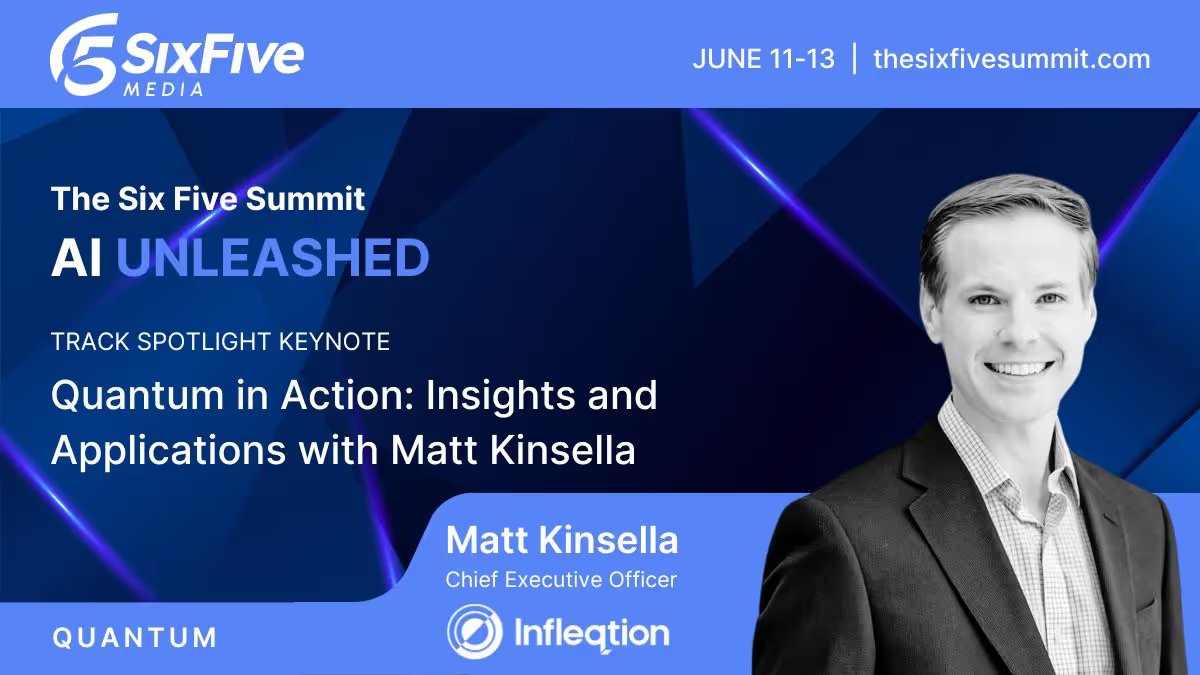
Quantum in Action: Insights and Applications with Matt Kinsella
Quantum is no longer a technology of the future; the quantum opportunity is here now. During this keynote conversation, Infleqtion CEO, Matt Kinsella will explore the latest quantum developments and how organizations can best leverage quantum to their advantage.
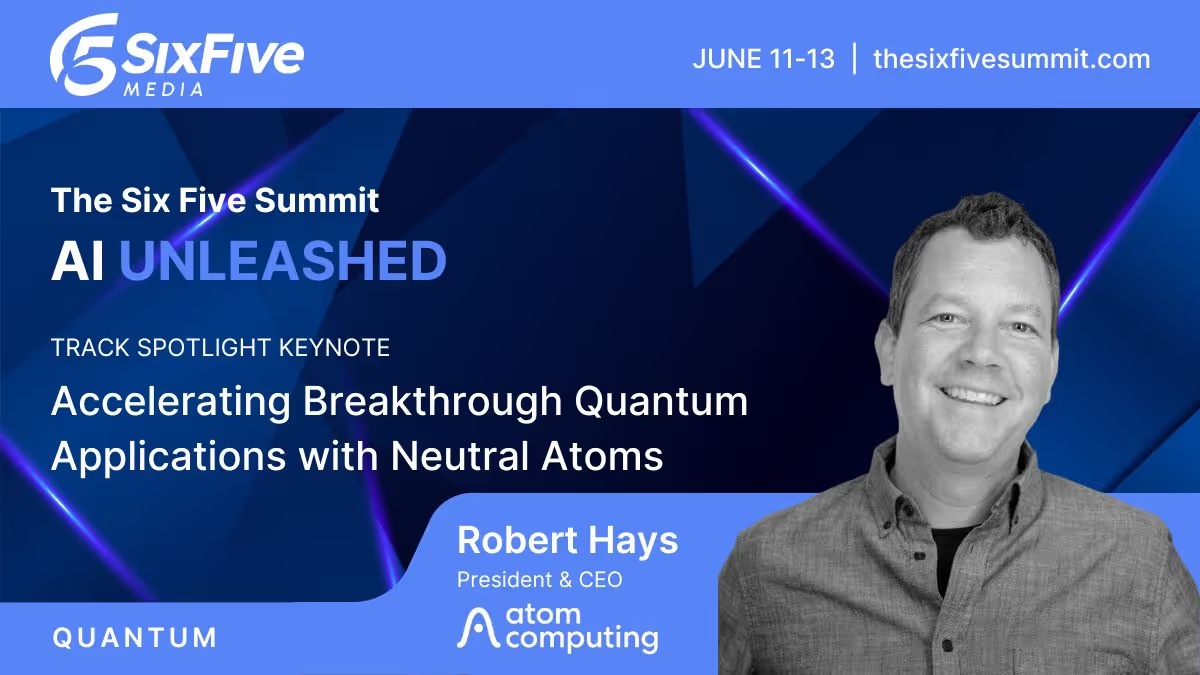
Accelerating Breakthrough Quantum Applications with Neutral Atoms
Our planet needs major breakthroughs for a more sustainable future and quantum computing promises to provide a path to new solutions in a variety of industry segments. This talk will explore what it takes for quantum computers to be able to solve these significant computational challenges, and will show that the timeline to addressing valuable applications may be sooner than previously thought.