Home

Infrastructure for the AI Era: From Experimentation to Execution - Six Five On The Road at Lenovo Tech World
Infrastructure for the AI Era: From Experimentation to Execution - Six Five On The Road at Lenovo Tech World
SHARE


Lenovo’s Vlad Rozanovich joins Patrick Moorhead and Daniel Newman to discuss why infrastructure, not ambition, is the key to moving AI from experimentation to execution at scale.
AI doesn’t fail because of weak models. It fails when the infrastructure decisions underneath them weren’t built for scale.
As AI investment accelerates, many organizations are discovering that ambition alone does not translate into results. The real challenge is infrastructure, and the growing gap between experimentation and execution is forcing IT leaders to rethink architecture, deployment models, and long-term strategy.
In this episode of Six Five On The Road, hosts Patrick Moorhead and Daniel Newman are joined by Vlad Rozanovich, SVP, ISG Sales, ISO at Lenovo, to examine why so many AI initiatives stall between pilots and production, and what it actually takes to build infrastructure that can support AI at scale.
Key Takeaways Include:
🔹 From Pilots to Production: Many AI initiatives fail not because of models, but because the underlying infrastructure cannot support reliable, day-to-day execution.
🔹 Infrastructure as a Differentiator: Data flow, connectivity, and system architecture are becoming competitive advantages, not back-office concerns.
🔹 Hybrid by Necessity: AI workloads are increasingly distributed across cloud, data center, and edge, making architectural flexibility essential.
🔹 Avoiding Lock-In: Early infrastructure decisions can either enable long-term scale or introduce complexity that limits future options.
🔹 Execution Over Experimentation: Organizations that align infrastructure strategy with business outcomes are more likely to turn AI into a durable advantage.
Learn more at Lenovo.
Watch the full video at sixfivemedia.com, and be sure to subscribe to the Six Five Media YouTube channel so you never miss an episode.
Listen to the audio here:
Disclaimer: Six Five On The Road is for information and entertainment purposes only. Over the course of this webcast, we may talk about companies that are publicly traded, and we may even reference that fact and their equity share price, but please do not take anything that we say as a recommendation about what you should do with your investment dollars. We are not investment advisors, and we ask that you do not treat us as such.
Patrick Moorhead:
The six five is on the road here at Lenovo Tech World in Las Vegas. It is day two right after the YY keynote in the sphere. It was quite the experience. A lot of big announcements, but the strategic vision and luminaries really capped off the night.
Daniel Newman:
Yeah, that night was in the stratosphere. Exactly. It was fantastic. We were out there. It was wonderful.
Patrick Moorhead:
It was a good experience.
Daniel Newman:
Yeah. Yeah, yeah. You like that?
Vlad Rozanovich:
You know what I loved about the event, actually, last night is. And it kind of came out there. The sphere operates on Lenovo servers. Hundreds of them
Patrick Moorhead:
No. I literally learned that yesterday as I was interviewing Dana.Yeah. Yeah, yeah. Who is, you know, behind that?
Vlad Roxanovich:
Yeah. And I love the fact that some of our competitors have had events in the sphere, you know, talking about infrastructure. And in the back of my mind, all I'm doing is laughing, saying if they ever asked the question of what powers the Lenovo sphere, it would be.
Patrick Moorhead:
I'm not allowed to laugh about those things, but I will laugh for you.
Vlad Roxanovich:
Thank you.
Daniel Newman:
You know, you know, we typically have like this really regular routine on the six five, but I kind of like that. I just bring the guest in without, you know, having to do our whole preamble. And it's not a guest that really needs introduction. He's been on the show, what, like 40 times?
Patrick Moorhead:
Exactly. You know, it's great. He's a definitely A Six Five favorite here.
Vlad Rozanovich:
Oh, thanks.
Daniel Newman:
Hopefully nobody else reads this.
Vlad Rozanovich:
Does this mean I'm going to get a chair next to you guys? And it's going to be three of us?
Daniel Newman:
I mean, I've actually been trying to get out.
Patrick Moorhead:
I've been trying to get AI to completely redo me. So, you know, you never had never have to show up. So we're definitely not there yet. But I think we should talk about AI. I mean, essentially, we've been all AI nonstop for the last three and a half years. And, you know, it really did start in the big cloud with OpenAI and Microsoft, but it really hasn't fully made its way to the enterprise.
Doesn't mean that enterprises aren't using it, right? They're using ChatGPT. They've gone from experimentation to POCs. Some applications have, in fact, scaled right in a in a hybrid manner. But but for the most part, we're really just going. I mean, dare I say that, you know, 98% of enterprise applications are still non AI?
Uh, maybe there's a little bit more on the edge when it comes to things like security cameras, uh, you know, shopper counters, things like this. Uh, but it really hasn't a hit yet. So good news, bad news. The good news is, if you pick the right architecture today, that doesn't lock you in, that meets your needs, that in the end you get those measurable improvements.
And whether it's reducing costs, increasing revenue, improving stickiness, uh, inside of the organization. Um, then, you know, you know, you make the right decisions now, you're not going to pay for it later.
Vlad Rozanovich:
Yeah. You know, and one of the things I've seen is that, you know, decisions that were made on how AI architecture looks like today could not have been determined two, three, four years ago.
Sure. The market has moved so much. The techniques have moved so much. Uh, it's not just a soft. AI is not just a software initiative. It is a complete architectural initiative within most of these enterprises. And it's so new. You know, today we're seeing a lot of things that are targeted, that are keyed as AI, that are not new.
You know, you look at things like machine vision that's been happening. It's accelerating now. It's accelerating. You have more opportunities for sensors and cameras and more processing power. But that's something that's actually been done. You know, even Lenovo, if you look at kind of looking
Patrick Moorhead:
Back at the old days of machine learning on the edge.
Vlad Rozanovich:
Like that's right. Years ago. Exactly.
Patrick Moorhead:
Chat bots too.
Vlad Rozanovich:
Yeah.
Daniel Newman:
I also think there's a lot of it's going to be about threading things together. Right. So you had a number of different things that we're machine learning, but like we're an agent can actually have a workflow completely handled from end to end rather than just kind of like the vision spewing a bunch of data back and it going, ooh, that rubber ducky coming off the line looks wrong.
Stop the line. Like the whole flow of that could could, you know, everything from getting the repair ordered, getting new materials brought in, like that's where AI in a general workflow has become really powerful.
But what you're saying is basically the problem is companies. And we've done tons of research on this. CEOs, uh, CIOs over the last few years. There's been tons of downward pressure. Do AI we joke about it here a lot, but also show returns? Yeah, and that's where we're at right now. But at the same time you go talk to these people like, yeah, we're doing a lot of things.
We're doing a lot of AI. How's it going? Yeah, and I'm not saying it's all bad. Like I think a lot of people are now starting to have things like this is really cooking, but there's a lot of things out there like, am I? Why am I not father? Like what? What are you what are you seeing there?
Vlad Rozanovich:
Well, I think it's a few things, right? And like you said, it's not. AI is not new in many, in some, in some areas of business outcome. If you look to things like maybe, um, you know, smart retail theft detection, you know, these are things that have been working with machine vision and analysis, but now it's just happening at a faster pace, which means you can have more throughput, which means you can actually have a better business outcome because you can react faster than the malicious activity.
And so for me, seeing the speed of AI is something that actually is a good business outcome. However, one of the things you brought up Dan there that I kind of wanted to go back to is when I, when I look at, you know, oh, we want to do AI across our enterprise. And there's this assumption that, you know, your AI has access to all your data.
Well, if you don't set up the permissions the right way, if you don't set up the architecture the right way, if you don't look at where that data is and what you're trying to act on, you're basically going to really kind of create operations that are going to run in circles, where you're not going to get to the true information you're trying to act on.
And so for us, from a Lenovo perspective, we look at it as this is a complete architecture, a re-engineering of what traditional it looks like, which means you probably cannot use what you've used before, which means that when you start doing your experimentation outside of SaaS or cloud based workloads, um, you know, now you have to start thinking, what is this AI journey going to look like from a compute GPU CPU ratio, from a security, from a network infrastructure, from a storage pipeline, from a data architecture standpoint, from a cloud to edge, uh, framework.
All of those are questions that people need to start rethinking on how they're going to architect. And it doesn't mean that they don't have the imagination to rethink what it's going to look like. It's do I have the right people to figure how to do this? Which is going to create that new architecture?
Daniel Newman:
Are you seeing big, big talent bets, though, too? I mean, talent companies that have a lot of dollars, but it's happening all the way down. Like, yeah, getting very talented is not it's not trivial either.
Vlad Rozanovich:
No question. You look at the traditional, you know, global service. You know, integrators. They are making big bets around this right now because they want to have the talent.
But then smart corporations are looking at how do I get the right talent. And so this there is definitely going to be a talent war. You know, from a Lenovo perspective, we're making sure we have the right data scientists and architecture managers that can help people along their journey to say, hey, we can we can kind of be involved here from the creation to the business outcome to the result.
Daniel Newman:
So what smart analysts.
Patrick Newman:
There we go.
Vlad Rozanovich:
Yeah, that's true too.
Patrick Moorhead:
That's what we call ourselves.
Patrick Moorhead:
Um, so what is it that breaks between these POCs and, you know, real business outcomes. And maybe you can talk about the real business outcomes. Be specific.
Vlad Rozanovich:
Yeah. Here's a real business outcome. Was meeting with a manufacturing company yesterday here at CES.
And they started off with an AI pilot. And the AI pilot was actually to detect in their manufacturing environments potential hazardous conditions. And what's interesting is in their AI pilot that they ran, uh, they actually said, okay, well, we got a decent type of result, right. And the result led to 98% accuracy when we started bringing it up to scale.
Well guess what? In a hazardous condition environment, 90% is not. 98% is not good enough.
Patrick Moorhead:
It's like days without an accident. Yeah, right. One is too many.
Vlad Rozanovich:
And the problem is, is that the POC couldn't scale because the cost was too prohibitive. Right. But by the time they did the POC and they said, hey, we're, you know, with a subset of one, we accomplished what we wanted.
And then when you added 1000, they did not accomplish what they wanted. And they said, you know what, we need to go back to the drawing board. And so part of this is how do you actually architect at scale or test at scale, so that when you implement at mega scale or real time scale, you know, you actually have what you're trying to accomplish.
Daniel Newman:
So models are such a focus to like build your own open source off the shelf, use a frontier. Um, and that's that's a big deal. I mean, any workflow. And by the way, it models a lot of people out there think a lot about them just through language. But I mean, there's there's video models, uh, there's image models.
There's models that can create music. There's but there's also like industrial models, like models for like autonomous driving is a model like like Tesla is a giant model at this point. There's models for healthcare for discovery and diagnosis. There's and and so if you want to be like a frontier company.
You've got to kind of have a model. Like you've got to do something. But like when you think about the day to day enterprise, you've got data flow, you've got connectivity, you've got to have the right systems design. Like should those be more front and center focuses? Because like I said, I just think everyone's talking about what model do we have to run on.
And that seems like almost a like a high class problem.
Vlad Rozanovich:
Well, you know, models are great to create kind of a, you know, a baseline of, of information and, you know, an all encompassing view of how do I act on it? You know, what's not good is you don't. If you're a pharmaceutical drug discovery firm, you don't want to take a baseline model that has no expertise in drug discovery, because you're probably going to come out with some outcomes that are completely irrelevant for that organization.
And so using models, the next step is how do we get to verticalized, focused models that are more streamlined, that are more targeted at what that business outcome of an enterprise is looking for. And I think that's what we're going to see over the next couple of years. I think you're going to see more specific models I see.
I think you're going to see, you know, Nvidia's call them kind of their rag models. You know, there's even more specificity to those models that many enterprises are going to look for. And they may come to consultants and organizations to help them on their journey. You know, companies like Lenovo can say, hey, here's where I, you know, I view the traditional models fitting.
Here's where I look at more specific vertical sized industry models fitting, but then even taking it to the next level to say, hey, here's a software provider that we may be able to bring in for you to kind of utilize through our AI innovators program and say, here's a very specific use case. Maybe it's credit card fraud monitoring.
Monitoring, you know, in in micro slice time, like we see out in Asia where you see, you know, so many people trying to get credit for cell phones, right. And, you know, if you don't have a application based off of a model that's very specific to credit monitoring for that type of. You're basically going to be spending way too much time and way too much money until you get to the point where, like, hey, that's the solution I want to get to.
Patrick Moorhead:
So as we bring this awesome conversation to wrap, I want to I want to try to simplify here, which is what is the one thing that separates organizations that have effectively scaled AI? They're seeing real business returns versus those who are just stuck in in pilot mode.
Vlad Rozanovich:
Yeah, yeah. Don't underestimate the requirements of what that business outcome is. Number one. Number two, make sure that when you are looking at implementation, you know, don't skimp on the POC. Uh, you know, utilize resources to ensure that, hey, if we need to scale out, if we need to drive something as a POC in the cloud just for, you know, for the time being versus putting it on prem, don't skimp on what the you know, the POC is going to be because you're going to need to re architect so much of your solution anyway.
You know, your storage, your networking, your compute, your GPU, your in some cases, your security. Make sure you're really kind of taking it, but also don't do anything too big, right? Don't try to take on the world. Have one successful project, one successful program, and then build on it. That's going to what's going to build the most credibility within CXO organizations.
Daniel Newman:
Well, that's great chatting you about this. This is a topic that is probably going to see some progress in 2026, but I think we're going to still be fighting these, you know, fighting these demons for a period of time. It's it's just hard. And we saw decades of this with big data, with analytics, uh, with cloud one.
Now we've got AI cloud. But it's also a great opportunity for Lenovo because you guys are going to be there side by side with all these enterprises. And of course, Pat and I are going to be there to analyze whether you're doing a good job. Well, thanks.
Vlad Rozanovich:
And honestly, I'll keep watching you guys because I learn from you.
Patrick Moorhead:
Right? You know, that is how it works.
Vlad Rozanovich:
This conversation about it is how do we move the industry forward. And you guys do a great job of asking those questions. When I talk to CIOs and CTOs, I hear the questions as well. And it's a great place to collaborate. You know, not to give out any industry secrets of or competitive information, but for the industry to progress and get more efficient and better at this. So we remain in a sustainable operational way instead of wasting time, money and energy. This is a great
Daniel Newman:
There needs to be a lot of alignment on that. Just like like cybersecurity. Yeah. All right. Well, Vlad, let's have you back again soon.
Vlad Rozanovich:
Awesome, great.
Daniel Newman:
And we hope to have you all back again soon. This has been great. I appreciate having all of you as part of our Lenovo Tech World 2026 coverage. Subscribe to the six five and check out all of the other episodes here at Lenovo Tech World. And of course, all the great content on the six five. But for this episode. Time to say goodbye. See you later.
MORE VIDEOS
WD's Tim Rausch: AI Storage Demand Compounds With Every GPU Cycle
Western Digital's Tim Rausch argues that AI's compounding data growth, more than GPU capacity, sets the real ceiling on infrastructure scaling. He joins Matt Kimball at AI InfraSummit 2026 to walk through how total cost of ownership, archived data reuse, and WD's capacity roadmap are reshaping enterprise plans to scale AI over the next several years.


.png)
The Main Scoop Ep. 45: Attackers Only Need to Be Right Once. AI Just Made That Easier.
Chad Rikansrud, R&D Software Security Engineer at Broadcom, explains how frontier AI models are finding decades-old mainframe vulnerabilities in seconds, collapsing the complexity advantage that once protected legacy platforms. He outlines why enterprises need faster Security Intelligence (SECINT) ingestion and disciplined human oversight to keep pace with adversaries wielding the same tools.
Fleet-Scale Deployment Is the Physical AI Benchmark
Physical AI is shifting from lab prototypes to fleets of machines operating reliably in the real world, and Ambarella's Muneyb Minhazuddin joins Six Five On The Road at AI Infra 2026 to explain what that shift demands of silicon, memory and developer workflows. Minhazuddin traces the case back to a 22-year-old chip architecture and forward to a developer cloud built to compress model porting time from months to days, and he identifies enterprise ROI proof points as the biggest hurdle left before physical AI scales into millions of deployed units.
Other Categories
CYBERSECURITY
Threat Intelligence: Insights on Cybersecurity from Secureworks
Alex Rose from Secureworks joins Shira Rubinoff on the Cybersphere to share his insights on the critical role of threat intelligence in modern cybersecurity efforts, underscoring the importance of proactive, intelligence-driven defense mechanisms.

HP Launches World’s First Business PCs to Protect Against Quantum Hacks - The Six Five On the Road
On this episode of the Six Five - On the Road, hosts Patrick Moorhead and Daniel Newman are joined by HP's Ian Pratt, Global Head of Security for Personal Systems.
What is Autonomous Endpoint Management?
Autonomous Endpoint Management is a framework designed to unify IT operations and security teams on a single platform through real-time control and visibility.
QUANTUM
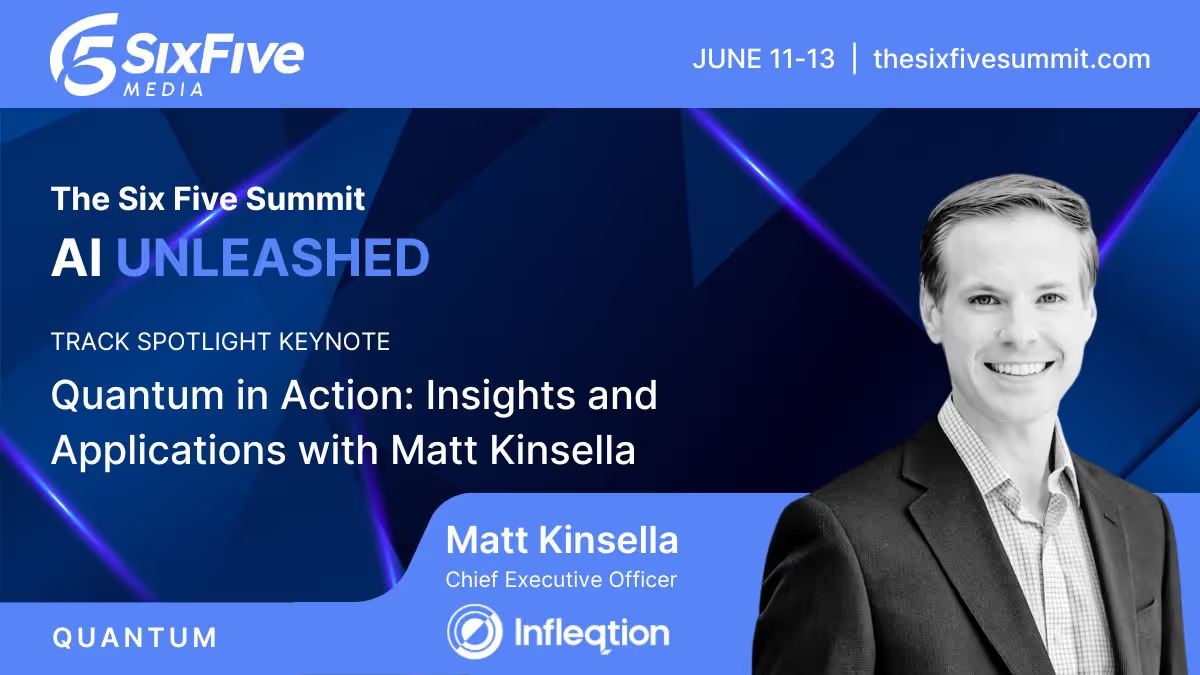
Quantum in Action: Insights and Applications with Matt Kinsella
Quantum is no longer a technology of the future; the quantum opportunity is here now. During this keynote conversation, Infleqtion CEO, Matt Kinsella will explore the latest quantum developments and how organizations can best leverage quantum to their advantage.
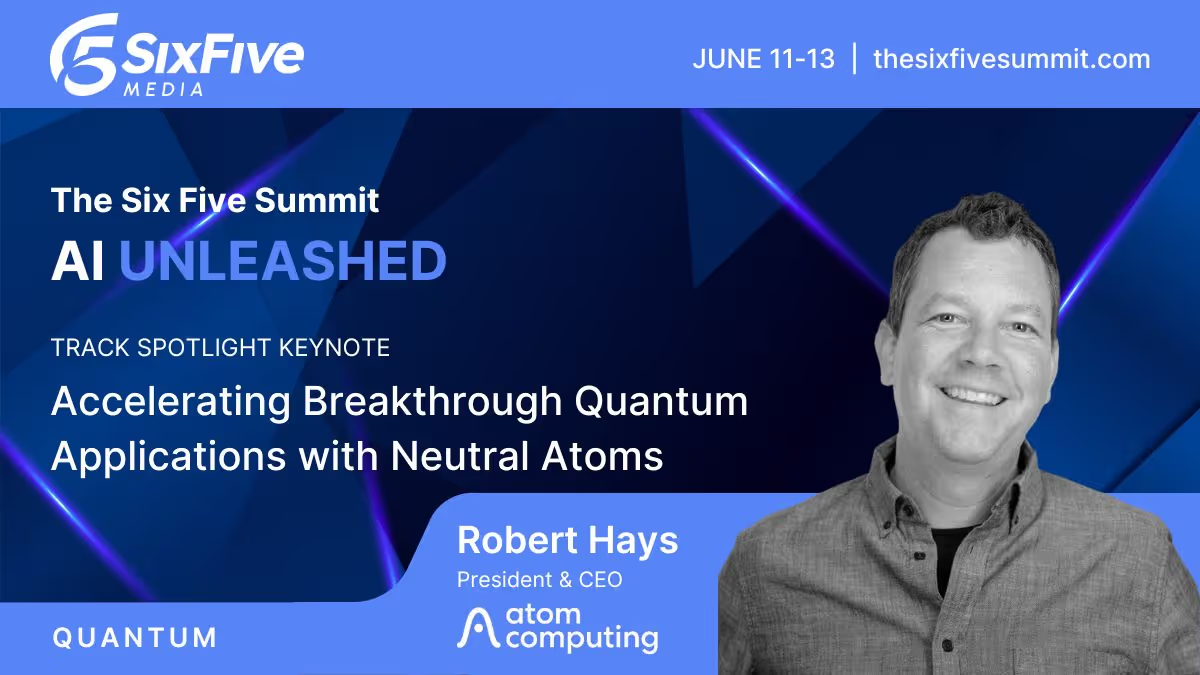
Accelerating Breakthrough Quantum Applications with Neutral Atoms
Our planet needs major breakthroughs for a more sustainable future and quantum computing promises to provide a path to new solutions in a variety of industry segments. This talk will explore what it takes for quantum computers to be able to solve these significant computational challenges, and will show that the timeline to addressing valuable applications may be sooner than previously thought.