
Lights, Camera, Compute: More Performance From the Same Power Budget
SHARE


Kate Swanborg, SVP at DreamWorks Animation, and Flynn Maloy, CMO of Lenovo’s Infrastructure Solutions Group, join Daniel Newman at SC26 on how Lenovo Neptune warm-water cooling modernized DreamWorks’ 30-year-old data center. The studio now runs significantly more compute on less power and cooling, work recognized with HPCwire’s Top Energy-Efficient HPC/AI Achievement award.
DreamWorks Animation's Kate Swanborg says the studio is not generating images with AI. It is using AI for agentic operational workflows, which she says it could only consider after updating its legacy data center with Lenovo.
Daniel Newman, CEO of The Futurum Group, talks with Kate Swanborg, SVP, Technology Communications and Strategic Alliances at DreamWorks Animation, and Flynn Maloy, CMO, Infrastructure Solutions Group at Lenovo, at SC26 in Chicago.
A few years ago, DreamWorks' 30-year-old data center ran out of space and power. Building new, moving to the cloud, and colocation all cost too much. Artists' interactive workflows need data and compute close by. Lenovo Neptune warm-water-cooled servers let the studio grow compute within the same footprint.
Key Takeaways:
🔹 Every frame is computed. A DreamWorks film takes 3-4 years and 300-400 artists, and typically consumes more than 300 million computational hours.
🔹 Liquid cooling bought speed. Swanborg says Neptune servers ran 20% faster than any air-cooled server in the data center because they could run at full clock.
🔹 More compute, less power. DreamWorks now uses less power and cooling than it did 8-9 years ago while running significantly more compute. Its entire render farm is on Neptune, with empty racks to spare.
🔹 The air conditioners are going off. The studio has started switching off its CRAC units because it needs less air conditioning, cutting its power and cooling costs.
🔹 Moving air is the hidden cost. Maloy says about 50% of the energy in the average data center goes to moving air. Neptune uses a closed water loop, and its 45°C outlet water can be reused by facilities.
The work earned HPCwire's Top Energy-Efficient HPC/AI Achievement award, and Swanborg says the lesson carries beyond film: when it comes to high-performance compute, “we're all more alike than we are different.”
Watch the full video at sixfivemedia.com, and subscribe to our YouTube channel so you never miss an episode.
Disclaimer: Six Five Media is for information and entertainment purposes only. Over the course of this video, we may discuss companies that are publicly traded, and we may reference their equity share prices. Nothing discussed during this webcast should be considered investment advice or a recommendation to buy or sell any security. We are not investment advisors, and you should not rely on this content as financial advice. Six Five Media collaborates with technology companies and industry leaders to produce research-driven interviews and multimedia programming for enterprise technology audiences.
Daniel Newman:
Hey everyone, the Six Five is on the road here at Supercomputing 2026. We are in Chicago, my hometown, actually, for those that don’t know it. And yes, I do live in Texas now, but I spent my first 40 years here in this lovely city. And we are here for the large, growing, ever-present AI industry and HPC industry showing up here. For supercomputing, and it took me a while to get in the door because it is busy here. But I’m excited for the conversation today. We are going to be talking with our friends at Lenovo, once again. We got Flynn Maloy, the CMO of the Infrastructure Group, the rapidly growing Infrastructure Group. Congratulations on that last quarter.
Flynn Maloy:
Thank you, thank you.
Daniel Newman:
And then we got Kate Swanborg.
Kate Swanborg:
Hi there.
Daniel Newman:
And Kate is an SVP at DreamWorks.
Kate Swanborg:
Absolutely.
Daniel Newman:
DreamWorks makes Shrek. People tell me often I look like Shrek. She said I’m a better-looking Shrek, but we’ll get to that later. That’s not good. Thanks, both, for joining me; it’s so good to have you here. Absolutely, thrilled to be here. Thanks for coming. Yeah, so Flynn, I’m gonna start with the nerdy stuff, and then we’re gonna talk about the cool stuff. Is that fair?
Flynn Maloy:
Yes.
Daniel Newman:
Okay, because the nerdy stuff enables the cool stuff.
Flynn Maloy:
It does, it does.
Daniel Newman:
But like, you know, you and I, I think we’ve been like three or four years now; we’ve actually had a sit-down of some sort at Supercomputing.
Flynn Maloy:
Yep.
Daniel Newman:
And I think each year, it’s gotten a little crazier, a little crazier, a little crazier, and it’s all gone straight alongside this amazing AI boom. But you’re seeing AI reshaping industries like crazy. Like, what are you seeing, you know, as the tech itself continues to proliferate, but how are you seeing it sort of find its way into the changes that are happening across the industries consuming it?
Flynn Maloy:
Well, so thank you for coming.
Daniel Newman:
Of course.
Flynn Maloy:
Yeah, let’s start with the nerdy stuff, which is, this show used to be the king nerdy show, right? It was all the HPC folks that would get together, talk about their kind of niche tech. It was a lot smaller. It was a lot smaller, and it was very insular, in a good way for them at the time. But since AI has crossed the chasm, like this show, it turns into a rock concert now. There’s so many people. That are coming, the enterprises here; all the top vendors in the industry are showing up, and why is that? That’s because the entire world is looking to this community of the HPC leaders: how do we deal with power? How do we deal with cooling? How do we deal with scale? How do we deal with this level of compute? And that’s where we often talk, and you hear it in the press all around this show, that the convergence of HPI, HPC, and AI are coming together because the requirements of the tech at this extreme level require a different way to think about infrastructure, a different way to think about how you architect the applications and ecosystem on top of it. So there is a convergence coming, and this is the community that’s really leading the way.
Daniel Newman:
Yeah, it’s pretty fascinating to watch it, though. I mean, how many of these have you been to, Kate?
Kate Swanborg:
I’ve been to several supercomputers. I gotta say, this is the most vibrant one I have ever, ever been to.
Daniel Newman:
It was amazing. I think it was St. Louis last year? Yeah. I just remember getting to St. Louis and thinking, this show is too big for the city now. And it’s no knock on St. Louis. That’s where I met my wife. She lived there. Great city. But they needed McCormick Place. And soon, I’m worried it’s going to find its way to Las Vegas, because it’s going to be the only city that’s going to be big enough. The animated, you know, film industry, I mean, it’s an incredibly compute-intensive business, right? For those of us that just watch it and don’t think about all the bits and bytes, we may not fully appreciate it. But all the people here understand, I mean, with so much compute intensity, like, how are you seeing and what are you sort of, you know, investing in doing to make animation and bring it to life? And how does compute play a role in all of that?
Kate Swanborg:
DreamWorks Animation is focused really on one core thing, and that is brilliant storytelling. But brilliant storytelling needs amazing visual imagery to create worlds that no one has ever seen before and characters no one’s ever seen before. And that’s where high-performance computing starts to play a huge role. Every single thing that you see on screen in one of our movies is designed with intention and built from the ground up. Typically takes us three to four years to make a film, and 300 to 400 of the best artists in the entire world, everything you see on screen is digitally crafted. So by the time that we’re done making one movie, we’ve typically consumed over 300 million computational hours. High-performance computing is absolutely critical to give the artists what they need so that they can work at the speed of their imaginations.
Daniel Newman:
It’s really interesting because, I wanted you can tell I’m in a good mood. I’m making jokes, but I wanted to kind of crack a joke. You mean you can’t just vibe code the next Shrek movie?
Kate Swanborg:
It turns out you can’t. And it’s funny because as we’re sitting here amidst this massive AI world and, frankly, democratization, one of the questions we often get is what kind of role is that going to play at DreamWorks? And it’s interesting because I can say unequivocally, we are not generating images with AI. We have the best artists in the world to do that. But we absolutely are looking at AI for agentic operational workflows under the hood. And honestly, we would not be able to even consider that if we had not updated our legacy data center with Lenovo solution a few years ago.
Daniel Newman:
Yeah, there’s no doubt it shows up. And by the way, you know, I have a 10-year-old son. I have old daughters, too. I’ve been raising kids for like three decades now. But, like, my 10-year-old watches tons of movies; loves, loves it. The stuff you do. And obviously, a lot of the animated stuff out there. And it’s just even just watching back. Only seeing the changes over the last five and ten [years] and going back. And so you go back and watch something that maybe me, you know, me, you know, being a young man, I am that I would have watched as a kid, and then seeing animations somewhere in between. And then, like when my 20-something-year-old daughters and then the animations now, I mean, you guys have made incredible progress in terms of taking animation, bringing it to life, making it it’s so lifelike now. Yes. And yet at the same time, still has all the great effects of being animated and that, you know, the joy
Kate Swanborg:
Deeply designed and immersively rich. We want people to be able to fall in love with these worlds.
Daniel Newman:
I love that. So deeply designed.
Kate Swanborg:
And immersively rich.
Daniel Newman:
Immersively rich. You know, personalization at the next level. Absolutely. So, so from both of you, though, like, how are you thinking about the demand then? Cause you know, you need more compute, you need more power, you need all that stuff. Like in your role, that’s part of your gig, right? You’re thinking about how are you planning for all that demand and all the intense resources that are coming your way.
Kate Swanborg:
Well, that’s how, actually, that’s how we came about choosing Lenovo. We were, if you look back seven or eight years, the data center that we use at DreamWorks Animation, it was built over 30 years ago. And so it’s a legacy data center, and at the time that we built it, we were doing hand-drawn animation, so it was perfect. But fast forward to a couple of years ago, we were out of space and out of power. And all of the options for us were incredibly expensive. Build a new data center, go to the cloud, use colos- all of that felt really untenable from a budget standpoint. And the other thing about our workflows is they’re incredibly interactive. So having the data and the compute and the artists all near one another really allows us to move in a low-latency way. That’s where Lenovo came in. They said, you’ve got to consider our Neptune warm-water-cooled servers. And they showed us that this server technology, which was so mature, but game-changing, could actually update our legacy data center. We use less power and cooling today than we did eight or nine years ago, and we’ve increased our compute significantly.
Daniel Newman:
It’s an order of magnitude more. It’s huge. It’s wild. But I think it’s a double click there is worth pointing out. There were options for you. You could have, you know, obviously built new, you could have gone to the public cloud, you could have co-located, and you sort of weighed all those options. And in the end, I’m guessing combination of, you know, compute performance and companies are in the business of making money and being profitable. I’m guessing the financials.
Kate Swanborg:
Absolutely. We have to look. We when we’re spending money on making these films, we want that money to go to the creative side. We we want the technology to be as high performance as possible, but also invisible and wildly stable. The Neptune servers, that’s what they were. We brought them in, and automatically they were 20 percent faster than any other air-cooled server we had in the data center because we could run them at full clock.
Daniel Newman:
Yeah, Flynn, this must make for a great case study.
Flynn Maloy:
Oh, it is.
Daniel Newman:
I think about the analyst conferences I attend, and me, I’m always raising my hand, being like, tell me about the- where’s the ROI? Give me the measurements. And I’m nice on camera, but I’m really tough behind the scenes. But I’ve hit them up, and it sounds to me like this is one of those cases where, in the end, because it’s really, tokens are really what you’re sort of measuring by, right? You know, we talk a lot about megawatts and gigawatts, but companies are generating tokens, and you’re trying to get value from tokens. And it sounds like she found Lenovo to be the optimal token generator for the DreamWorks.
Flynn Maloy:
Well, it’s a fantastic story that starts with a, you know, a build-out test. That’s what we love about DreamWorks is let’s test it. And wow, look at that performance. Let’s go. And now the data center, you walk into it. It’s perfectly silent. Everything is all liquid-cooled. And it’s in the same footprint that it was 30 years ago, like on the DreamWorks campus. And now it’s all liquid cool with the most cutting-edge stuff that we have and seeing fantastic performance increases. So it’s a consolidation and a performance increase and getting the power down all at once. Like you can’t beat that story.
Kate Swanborg:
Our entire render farm now is Neptune, and we have empty racks because we don’t need them. We’ve actually started turning off CRAC units because we don’t need as much air conditioning. So the ROI goes beyond the performance that our artists are getting, which is always significant. We’re actually spending less money on power and coolant.
Daniel Newman:
And you can walk in the data center; you can hear yourself.
Kate Swanborg:
Absolutely.
Daniel Newman:
Can you hear yourself think?
Kate Swanborg:
Yeah.
Daniel Newman:
I mean, anyone that’s spent any time in a data center knows that that’s, especially the traditional, you know, fan-cooled, it’s money and that.
Flynn Maloy:
You’re humming. 50% of the energy used by the average data center is just moving air. Like, it’s an amazing amount of energy that’s just spent doing that. And, you know, especially one other thing to kind of talk about is the sustainability around water usage. So I think there’s a lot of FUD out there about data centers consume water. Modern data centers, it’s all closed-loop. And with, you know, so it’s just recycling the same water. And with Neptune liquid cooling, we use warm water cooling. When we say warm, that just means there isn’t a chiller before the rack. Wasting more electricity to cool the water before it goes in so the water that comes out the back is like 45 degrees C Which has enough heat energy to be used by the facilities or other things in order to recycle it So it just it’s a giant energy footprint that is reduced.
Daniel Newman:
That’s all another episode. We will spare Kate, but we need to sit down and talk about all the data center fear, uncertainty, and doubt that’s being created. That, realistically, a lot of companies like yours are solving, right? Yeah, and so and so speaking of green and energy efficiency and stuff like that, it’s worth pointing out, by the way, Kate, I’ll probably bring this to you, even though Lenovo was awarded, HPCwire awarded you, I want to get this right, Top Energy-Efficient HPC/AI Achievement Award. Yes, the HPCwire award. Just wanted to make sure I got that right. And that’s Basically, the award, though, was enabled by the work that you do.
Flynn Maloy:
It’s a case study. Yeah, we brought forward the case study and submitted it as an HPCwire award because it’s just such a perfect example of using energy efficiency to drive performance gains.
Kate Swanborg:
We’re incredibly proud to be associated with this. We’re proud to be partnered with Lenovo. This is just another example of where Lenovo solutions are so rock solid, and the case study is so good. The power savings, the cooling savings, and it’s been going on for years. It’s not just one installation. It’s the entire way we run the data center. We’re thrilled that Lenovo’s been recognized with this.
Daniel Newman:
Well, Flynn, you have to offset the Mustang. I do. Because that thing probably… It’s not driven that much, so… I know. I mean, this is how you can give back. You know, when you take that thing out, emissions go up. When you partner up with companies like DreamWorks, the emissions go back down. There we go. Right?
Flynn Maloy:
Yes.
Daniel Newman:
So, Flynn, he’s not sure if I should be saying this, but… No. We know, Flynn likes muscle cars, and I’ve always been very enamored by vehicles myself, but it’s great to see putting technology to work, delivering incredible computational capabilities, all the while delivering, going back to what we were talking about with the uncertainty and doubts created around data center efficiency. There’s a lot of work that can be done to make data centers get a lot done, and they don’t have to be taking enormous amounts of power. It’s these kinds of collaborations that bring it there. So let’s kind of wrap up a little bit on the learnings here and the advices that you can maybe give. As a big, large organization that has a big global footprint that people pay a lot of attention to, what do you kind of think you could pass on from the approach that you’ve learned about performance and capacity and efficiency? What can you pass on to other businesses making the same considerations about building their own technological futures?
Kate Swanborg:
So it’s one of the things: when I look at DreamWorks, we’ve got a world-class engineering organization. I mean, we’ve got really brilliant engineers, but the future is moving so fast. The level of change out in the technological industry is rapidly, rapidly evolving. And so I think that the best decision that we make is in partnering with Lenovo. It’s no one Lenovo solution. Obviously, the Neptune servers are brilliant, but it’s really the people at Lenovo. They act as an extension of our world. They’re problem-solving for our business when we’re not thinking about things. They’ll call us up, and they’re like, oh my gosh, we had a thought- could we come and talk about this solution? We think it might actually help you. And I feel like when you find a company like that, that is fundamentally focused on our business outcomes and our success, like that’s the most you can ask for.
Daniel Newman:
Yeah, and Flynn, obviously, partnerships matter. You know, these relationships matter. I think helping, one of the biggest things I just, I continue to pound on as an industry analyst is that bringing these technologies to the businesses that are in the business of these technologies, right? How are you changing media and filmmaking? How are you changing manufacturing and design? How are you, you know, and so this just makes such a great case study? I imagine, Flynn, you have so many more of these in the works.
Flynn Maloy:
Well, we do. And one of the learnings, just thinking about your last answer to that question, one of the learnings for us, too, is the breadth of where you can bring forward different solutions together with a partner. So, for example, we work with workstations across the campus. We work with our experts in services, TruScale, and other solutions, and looking for what can we do next, next, next, to try to push the envelope all the way across everything you do. And that’s the same thing for retail, for finance, for any industry, and that’s what you got to keep doing.
Kate Swanborg:
How can you work… When it comes to high-performance compute, we’re all more alike than we are different?
Daniel Newman:
Aww. And Kate, on the way out, what is the next exciting DreamWorks thing that all the people out there watching this need to get out and see?
Kate Swanborg:
Well, you are going to be particularly excited because this summer, Shrek 5. Shrek 5. Look at that. I’m so excited.
Daniel Newman:
And like I said, they say we look alike. Kate, Flynn, thanks so much for being here with me.
Kate Swanborg:
Thank you so much. Really appreciate it.
Daniel Newman:
And thank you, everybody, for being part of the Six Five On The Road. We’re here at Supercomputing 2026 in Chicago, Illinois, here at McCormick Place. Place is jammed. It is busy. AI, HPC, still on fire. Great examples here from DreamWorks and Lenovo. Stick with us for all our coverage. We’ll see you all later.
MORE VIDEOS
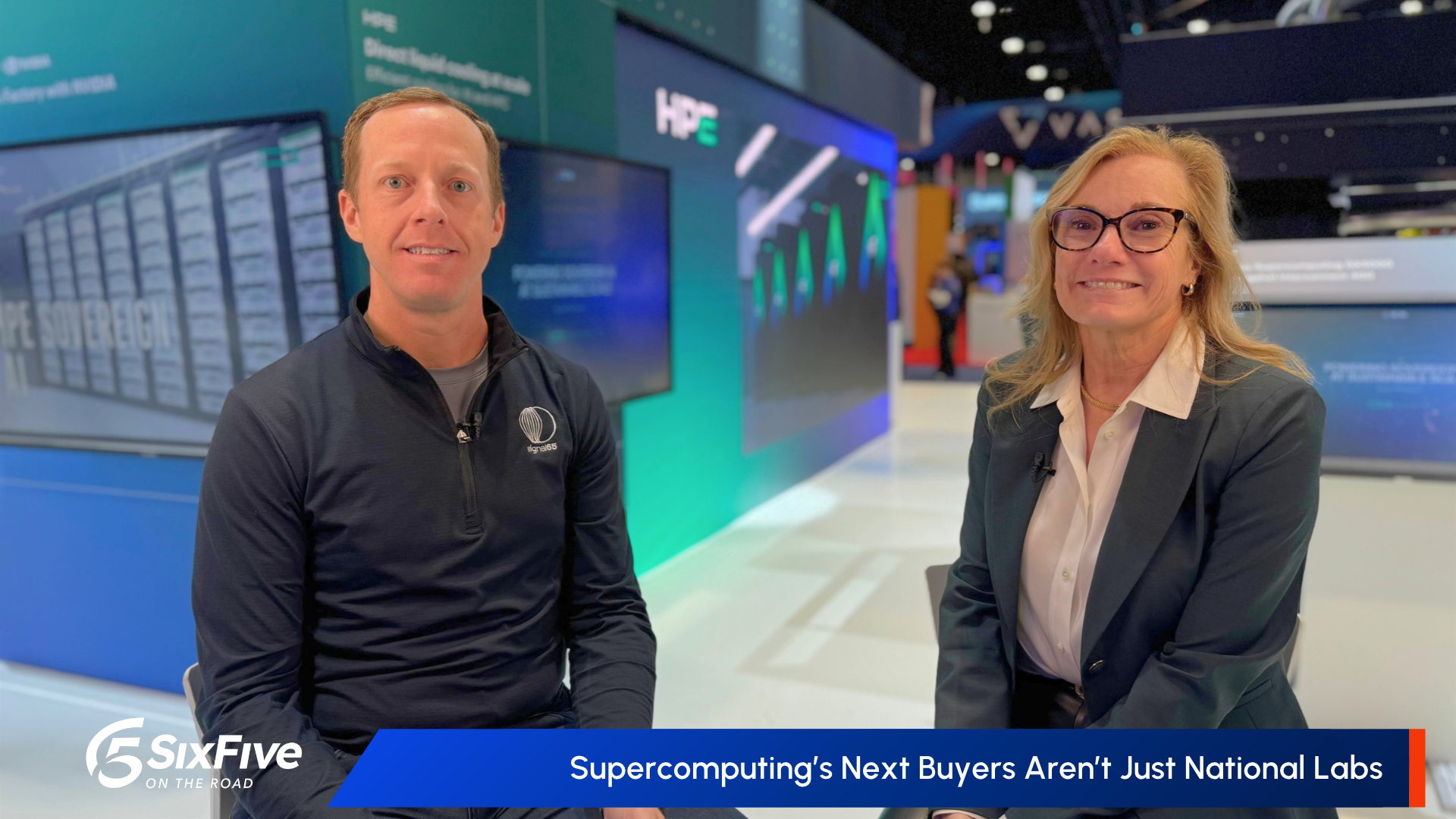
Supercomputing’s Next Buyers Aren’t Just National Labs
Trish Damkroger, SVP and GM of HPC and AI Infrastructure Solutions at HPE, joins Ryan Shrout at SC26 on how the convergence of HPC and AI is changing supercomputing. Customers now define a balanced system as FP4 to FP64, while rack-scale AI increasingly needs the density, liquid cooling and tight coupling of traditional supercomputers.


When the Token Math Starts to Favor On-Prem AI
Justin Christiansen of Intel and John Carter of HPE join Brad Shimmin ahead of HPE Discover Barcelona 2026 on how on-prem AI economics are shifting. From CXL memory and HPE VM Essentials to KV cache offload on ProLiant Gen12, they show how enterprises can lower AI infrastructure costs on hardware they already run.
Why Most AI Agents Never Make It Past the Demo (MongoDB)
MongoDB Principal Technologist Devin Dickerson joins Jason Andersen to explain why AI agents fail on the path from demo to production, as data moving across disconnected systems adds latency, drift, and cost. For enterprise platform leaders, collapsing operational data, retrieval, and memory into fewer systems creates the trust and cost predictability that production agents require.
Other Categories
CYBERSECURITY
Threat Intelligence: Insights on Cybersecurity from Secureworks
Alex Rose from Secureworks joins Shira Rubinoff on the Cybersphere to share his insights on the critical role of threat intelligence in modern cybersecurity efforts, underscoring the importance of proactive, intelligence-driven defense mechanisms.

HP Launches World’s First Business PCs to Protect Against Quantum Hacks - The Six Five On the Road
On this episode of the Six Five - On the Road, hosts Patrick Moorhead and Daniel Newman are joined by HP's Ian Pratt, Global Head of Security for Personal Systems.
What is Autonomous Endpoint Management?
Autonomous Endpoint Management is a framework designed to unify IT operations and security teams on a single platform through real-time control and visibility.
QUANTUM
Quantum in Action: Insights and Applications with Matt Kinsella
Quantum is no longer a technology of the future; the quantum opportunity is here now. During this keynote conversation, Infleqtion CEO, Matt Kinsella will explore the latest quantum developments and how organizations can best leverage quantum to their advantage.
Accelerating Breakthrough Quantum Applications with Neutral Atoms
Our planet needs major breakthroughs for a more sustainable future and quantum computing promises to provide a path to new solutions in a variety of industry segments. This talk will explore what it takes for quantum computers to be able to solve these significant computational challenges, and will show that the timeline to addressing valuable applications may be sooner than previously thought.