
Making Your Agents Pay: The Future of Agentic-Native Commerce - Six Five On The Road
SHARE


Allison Farris and Danny Smith from Stripe join Jason Andersen to explore how the Agentic Commerce Protocol (ACP) enables autonomous digital agents to securely complete transactions, and what’s next for agentic commerce.
How will agentic commerce, powered by AI and protocols like ACP, change how consumers and businesses interact and transact online?
From AWS re:Invent 2025, host Jason Andersen is joined by Stripe’s Developer Advocate, Allison Farris, and Global Solutions Architect Lead, Agentic Commerce, Danny Smith, for a conversation on the evolving landscape of agentic commerce, the foundational role of the Agentic Commerce Protocol (ACP), and how developers can prepare for a future where digital agents conduct purchases.
Key Takeaways Include:
🔹The Rise of Agentic Commerce: AI-powered agents are moving from providing information to autonomously executing transactions, making agentic commerce a timely topic for developers and businesses alike.
🔹Understanding ACP: The Agentic Commerce Protocol (ACP) is designed to enable secure, interoperable transactions carried out by autonomous agents, providing a framework for agent-driven purchases.
🔹Developer Enablement: ACP empowers developers to build and deploy commerce experiences where agents can discover, coordinate, and pay for goods and services on behalf of users.
🔹Building for the Future: A look at upcoming advancements for ACP, and how Stripe is encouraging developers to get involved as the ecosystem evolves.
Learn more at Stripe.
Watch the full video at sixfivemedia.com, and be sure to subscribe to our YouTube channel, so you never miss an episode.
Or listen to the audio here:
Disclaimer: Six Five On The Road is for information and entertainment purposes only. Over the course of this webcast, we may talk about companies that are publicly traded, and we may even reference that fact and their equity share price, but please do not take anything that we say as a recommendation about what you should do with your investment dollars. We are not investment advisors, and we ask that you do not treat us as such.
Jason Andersen:
Hi, this is Jason Anderson with Moor Insights and Strategy, and I'm here with another installment of Six Five On The Road at AWS reInvent 2025. Today we're going to do a little bit of a different topic. Agents have been a hot topic, but today we're going to talk with Stripe about agentic commerce. And I'm really excited to be here with Allison Farris and Danny Smith, who are going to guide us through a little bit about this exciting new standard you put out, open source as a matter of fact, right? So cool. Why don't you just both give us a little intro on yourselves before we dive in. Allison.
Allison Farris:
Yeah, thanks. Absolutely. It's so great to be here today. So I'm Allison Farris. I'm a Stripe developer advocate. So I work on really engaging the Stripe developer community and helping them really build on Stripe and learn about our products.
Danny Smith:
Hi, Danny Smith. I'm a global solution architect lead for agency commerce at Stripe. So my job is to work with our customers and help bring these visions to life.
Jason Andersen:
Great, perfect. So here at reInvent, topic agents has been a huge topic, but I think you folks are bringing something a little different to the table. So let's talk a little bit about agentic commerce and why it matters now.
Danny Smith:
Hmm. I'll start. Okay. A little bit of an origin story. We always love to talk about where these things came from. So Stripe traditionally has worked with a lot of the AI companies. We power the payments for roughly 70 to 80% of the AI companies out there, including companies like Perplexity and OpenAI. Okay. And Perplexity came to us actually late last year with this use case of People using our chat surfaces to shop, to actually get hyper personalized recommendations. And we have no way to really make that like a curated experience. You know, right now it's something that it's very, you're getting different results each time. There's no way to complete the transaction. People are having to leave the chat surface in order to do that. So they came with us with a pretty complex use case of like, how can we facilitate this in-chat commerce experience and make it an experience that is safe, secure, and with built-in fraud prevention and things of that nature. So they turned to us, since they have worked with us to do their own payments, saying like, hey, we're not an e-commerce company. We're an AI company, and we don't necessarily want to be an e-commerce company. So we're going to turn to our experts and figure out how we can build this and make this something that's secure. Fast forward, we evolved, the same use case working with OpenAI, came to us with the same problem set as, hey, people are using our agents to shop for things. So how can we make this a safe, fast, reliable experience? Um, and, and so why it matters today at Genetic Commerce is basically it's, it's, it's a very interesting use case of people are turning away from searching through product catalogs and like, and, and, and using like Google searches and things of that nature and using these AI surfaces to find these recommendations and want to complete the purchase. So it's just a natural evolution. of where the market is going. Okay. Great. I would love your perspective as well. Anything to add?
Allison Farris:
Yeah, absolutely. And I think when we think about the normal way to pay through an e-commerce website, now we're seeing a lot more trends through no longer searching for items, but prompting through AI agents for finding kind of information. And then, as Dan mentioned, actually completing, how do we next take it to the next step of actually completing the actual payment successfully, safely, and securely?
Jason Andersen:
So like so many things in the payments world from the past, standards are a great way to go, right? So I think that led you to develop the agentic commerce protocol, right? And you open sourced it. So can you tell us a little about ACP, what it is and any background on it?
Allison Farris:
Yeah, so ACP stands for the Agented Commerce Protocol, and we're very excited about launching and co-developing this with OpenAI. And so essentially what ACP is, is an open standard that connects buyers through their AI agents and sellers to seamlessly complete checkout and payment transactions. And so this helps to standardize essentially how agents can communicate with sellers and their underlying payment service providers. So it's a very exciting space that we're looking to really open source and leverage the developer kind of focus and influence to making sure that we're shaping it in a right, in a very exciting way, in an open way, and making sure that we're providing best practices and making sure that we're innovating in a safe and controlled environment.
Jason Andersen:
Okay. That's probably the most important thing, right? Safe and controlled. Danny, have you been working with developers? How are they actually starting to use this in practice? I mean, you have a couple interesting case studies with these AI vendors.
Danny Smith:
Yeah, yeah, absolutely. Developers at the end of the day, they're looking for composable building blocks to help really tackle real world problems. And that's what ACP brings to the table. And a key part of ACP is something that we're calling the shared payment token. Okay. And so I think of it as, I almost like to use the analogy of like a Russian doll. There's many layers built into being able to facilitate e-commerce in general. When you're just buying something on a website, you have to worry about things like PCI compliance. So you have to have vaulted card credentials. We cannot forward people's personal credit card information over the internet. So we've always had to worry about making sure that that was a vaulted experience. In this new world of agentic commerce, there's a whole different challenge, right? Because you're basically shifting from using an AI agent to like to discover things and the right content for you to actually being autonomously given a task. So I like to think of agentic commerce, people think of agent as the root word. I like to say it's really agency, which is giving someone autonomy to go perform an action on your behalf. So that's what's changing in the industry. But agents are very good at certain things and very bad at other things. When we first launched last year, we were using more browser automation. So basically giving a credit card, a virtual debit card, if you will, to an agent and basically having it go try to figure out a human readable checkout. Oh, okay. And basically, you know, purchase the item that you're searching for in that manner. And what we found out is that agents are very probabilistic in nature, the way they solve problems. And we were seeing everything from like five seconds to sometimes 10 minutes to have an agent figure out a human readable checkout. The protocol basically allows us to make this a more deterministic outcome because agents are very good at hitting an API, making a direct call, and completing a task. So this is what developers like to hear. We live in a world of APIs. We live in a world of webhooks, serverless architecture. So we're basically giving these agents the ability to act as a developer would in making human-readable checkouts machine-readable. Okay, all right. And so that's what the protocol was designed to accomplish, is let's not use browser automation and web scraping, and let's give these agents tasks that they're not good at. Let's refactor the experience to make sure that the agents are given tasks in a more deterministic fashion that they are good at.
Jason Andersen:
Yeah, so Danny, the shared payment token technology is really interesting. Can we double-click on it a little bit? For example, I'd like to know, does it work with multiple payment providers, for instance?
Danny Smith:
Yeah, that was a key part of what we wanted to launch. We wanted to contribute to the overall problem, right? And so we wanted to make ACP in general, an open protocol and share payment tokens, while it is Stripe technology, it's open to be used by any third-party PSP.
Allison Farris:
Okay.
Danny Smith:
So we do pass the fraud signals, we do pass everything I mentioned earlier, like the budgeted amount. So there is a lot of information encased inside the token, but it can be unwrapped as long as you have an ACP-compliant endpoint to basically unwrap the token. It can be handed off to a third-party payment processor. It's easier if you're using Stripe. It's basically like one line of code-ish to make that transition. But we're definitely open to working with third-party PSPs. We want to make this an open experience where we're contributing overall.
Jason Andersen:
That's great. I think it's just such an excellent point around agents in general. I've been researching it now for a year and a half plus. And what we're finding is that, to your point about determinism, agents are so good at being non-deterministic, but they tend to have trouble with determinism. So we are definitely seeing a marketplace where people are starting to connect that bridge, right? Find ways to connect that bridge through tools or through APIs because otherwise it just doesn't go as well as intended. It really is the combination of the two to make it work right.
Danny Smith:
And so to kind of complete that thought on the shared payment token, this is the tool that we've given developers. The fact that you can now create this token that has built in what we call guardrails. So To give an agent full autonomy, you're basically saying, here's this credit card, go shop for whatever it is. If I'm shopping for a model airplane, you want to make sure it doesn't hallucinate and try to buy a real airplane and drain your bank account. And so you have to have built-in guardrails inside of this shared payment token. Things like budgeted amounts. We also send fraud signals using Stripe Radar. Expiry, there's built-in expiry. So developers love having tools like this that solve problems that they can use. in a very composable fashion. And that solves the issue of an agent possibly hallucinating or doing something unpredictable. And when it comes to payments, you want everything to be very predictable, very safe, secure, and compliant.
Jason Andersen:
So why don't we just shift gears for half a second? Because you're onto this idea where you're talking about in terms of the developer experience. If we kind of zoom out from that a little and talk about the community overall, Danny, right? By open sourcing this and kind of giving this out, what's the intention on the community level? What do you think they're going to get in this kind of exchange?
Allison Farris:
Yeah, absolutely. I think, as Danny mentioned, we're starting to see a lot of, I think, with the launch of the GenTech Commerce Protocol, we're now allowing developers to be able to really drive AI-native commerce flows and build innovation across multiple types of business models. Today, the V0 version of ACP really supports, foundationally, an e-commerce flow, a one-time payment, and purchasing one item. But with the ACP and really the drive for open source and really building off of the community element aspect is allowing developers to have the standards to be able to innovate and build to really solve for the business cases that they're looking at. We're starting to see a lot of developers experimenting with things like autonomous marketplaces, AI driven storefronts. And so allowing them to be able to build on top of the ACP compatible endpoints will help them really future proof their integrations to enable simple, kind of innovative payment flows today through agentic commerce and then allowing them to really grow and adapt when it comes to the changing AI landscape.
Jason Andersen:
You could also see some real openings in kind of more business-to-business payments or buying commodities in bulk, right, where that could speed things up or even really change how procurement departments work in companies today, right?
Allison Farris:
Absolutely, yes. Because right now, today, what we're doing with the Shared Payment Token is allowing really secure, basic capabilities for allowing an agent to make a transaction on behalf of a seller and a buyer very seamlessly. And so really allowing the open source community to really shape the future of the protocol in the way that they see kind of the demand and their customer requirements and needs.
Jason Andersen:
That's great. So last question in terms of, both of you can take a stab at it, in terms of how do you see this playing out? Like, what's the future of ACP? And also, how can people get started now, right? So, two-part question for you.
Danny Smith:
Yeah, so as Allison mentioned, like, we're evolving. So, like ACP, it was the initial launch. We launched initially with Etsy. We have some other major merchants that are onboarding very soon. It began as a six-month journey of building this basically as a bespoke integration that we decided, hey, we can help contribute to the overall community and let's make this a protocol. Let's save everyone else the six-month journey of building all these different services that are involved in hosting ACPM points to listen for these shared payment tokens that we're talking about. So let's publish it as a protocol. Let's put it out there. It's co-authored with us in OpenAI, but we're very much understanding that it's an evolving spectrum. So we want developers. There's a GitHub repo. You can go to agenticcommerce.dev. You can see all the specs. So there's a product feed spec, as you can imagine. The very interesting thing about the protocol is that it is open, and so it's open to anyone as a merchant to participate, but anyone as an AI agent also to participate. So we see this emerging ecosystem of AI agents, and we've mentioned OpenAI and Perplexity already, but we've got things like Microsoft Copilot, Google Gemini, X. There's this huge landscape of AI agents, these chat services that people are gonna be using to shop for different items. We want to make this an open protocol that anyone can use as an AI agent and then anyone can use as a back-end merchant. Stripe, again, will work with you as far as that journey, but we're looking to the overall developer community to really help us evolve this. Go into the GitHub repo. We've got demos. We've got a developer community, YouTube. videos that we've released recently that really do a deep dive into the protocol and how to build things on it. So we definitely want that overall adoption and participation from the community.
Jason Andersen:
We're very open to that. And you license it as Apache 2.0, which is a very permissive, developer-friendly license, which will definitely help accelerate that.
Allison Farris:
Yeah, and I think another angle of really having an open standard is the interoperability that is really essential when interacting across agents, multiple different types of PSPs, payment service providers, and sellers, right? And so kind of the next iteration of ACP is really to help enable and just drive broader adoption so that we have this open standard so that as we're starting to innovate, we're not slowing down innovation, we're able to really drive kind of the network effect of adoption through both AI platforms who are ACP endpoint compatible, as well as developers getting their seller workshops and storefronts ACP compatible. Yeah, exactly.
Danny Smith:
In full transparency, there are many use cases we have not solved for yet. Sure. So we at Stripe, we always say we haven't won yet. Like, you know, we're constantly, you know, working on innovation. There's things you can go out and experiment with today. You can go on Instant Checkout with Chat2BT, and buy things on Etsy. But you'll notice that it's like a single item checkout. There's many use cases. There's loyalty programs. There's all kinds of use cases that we really want to turn to the developer community to help us solve.
Jason Andersen:
Okay.
Danny Smith:
And that's both like partners that are out there in the ecosystem, but any, any developer who wants to jump in and help us solve these evolving use cases, because there's so many use cases that we need to tackle in the future.
Jason Andersen:
That sounds great. Allison, Danny, thank you for your time. I really appreciate hearing about that. It's exciting stuff. And for all of you, thanks for joining us. Six Five On The Road and we were here with Stripe. Have a good one.
MORE VIDEOS
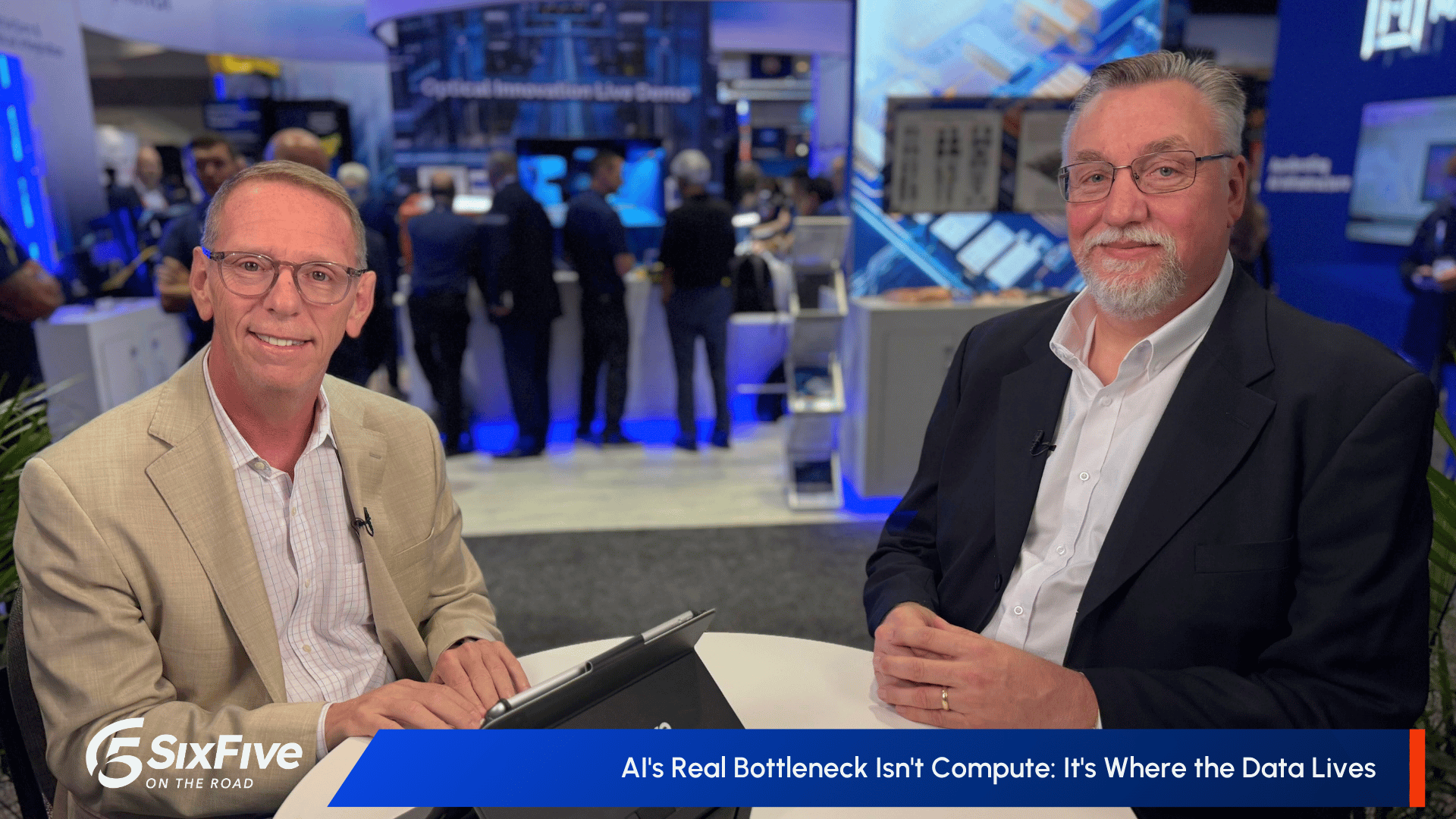
WD's Tim Rausch: AI Storage Demand Compounds With Every GPU Cycle
Western Digital's Tim Rausch argues that AI's compounding data growth, more than GPU capacity, sets the real ceiling on infrastructure scaling. He joins Matt Kimball at AI InfraSummit 2026 to walk through how total cost of ownership, archived data reuse, and WD's capacity roadmap are reshaping enterprise plans to scale AI over the next several years.


.png)
The Main Scoop Ep. 45: Attackers Only Need to Be Right Once. AI Just Made That Easier.
Chad Rikansrud, R&D Software Security Engineer at Broadcom, explains how frontier AI models are finding decades-old mainframe vulnerabilities in seconds, collapsing the complexity advantage that once protected legacy platforms. He outlines why enterprises need faster Security Intelligence (SECINT) ingestion and disciplined human oversight to keep pace with adversaries wielding the same tools.
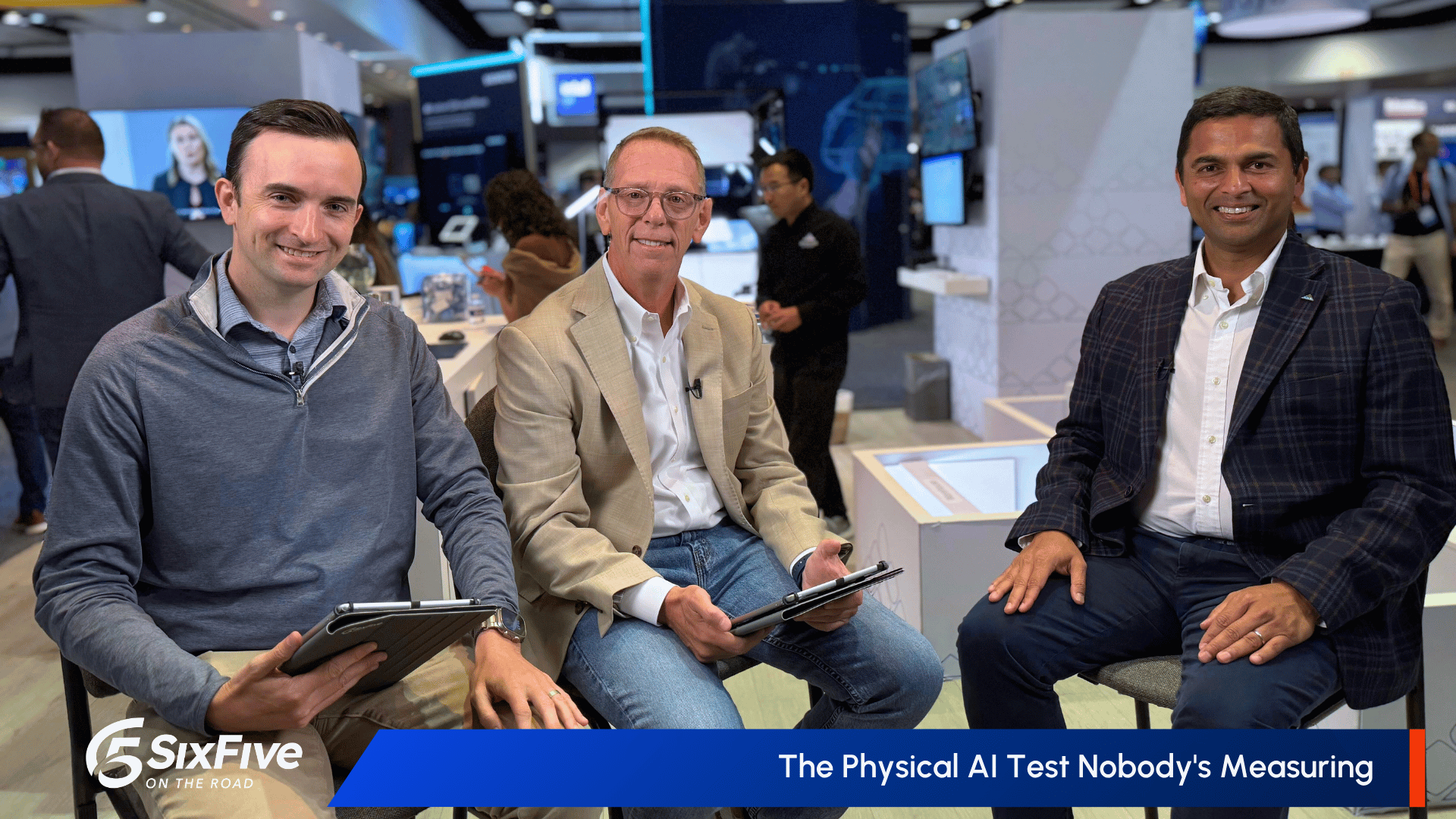
Fleet-Scale Deployment Is the Physical AI Benchmark
Physical AI is shifting from lab prototypes to fleets of machines operating reliably in the real world, and Ambarella's Muneyb Minhazuddin joins Six Five On The Road at AI Infra 2026 to explain what that shift demands of silicon, memory and developer workflows. Minhazuddin traces the case back to a 22-year-old chip architecture and forward to a developer cloud built to compress model porting time from months to days, and he identifies enterprise ROI proof points as the biggest hurdle left before physical AI scales into millions of deployed units.
Other Categories
CYBERSECURITY
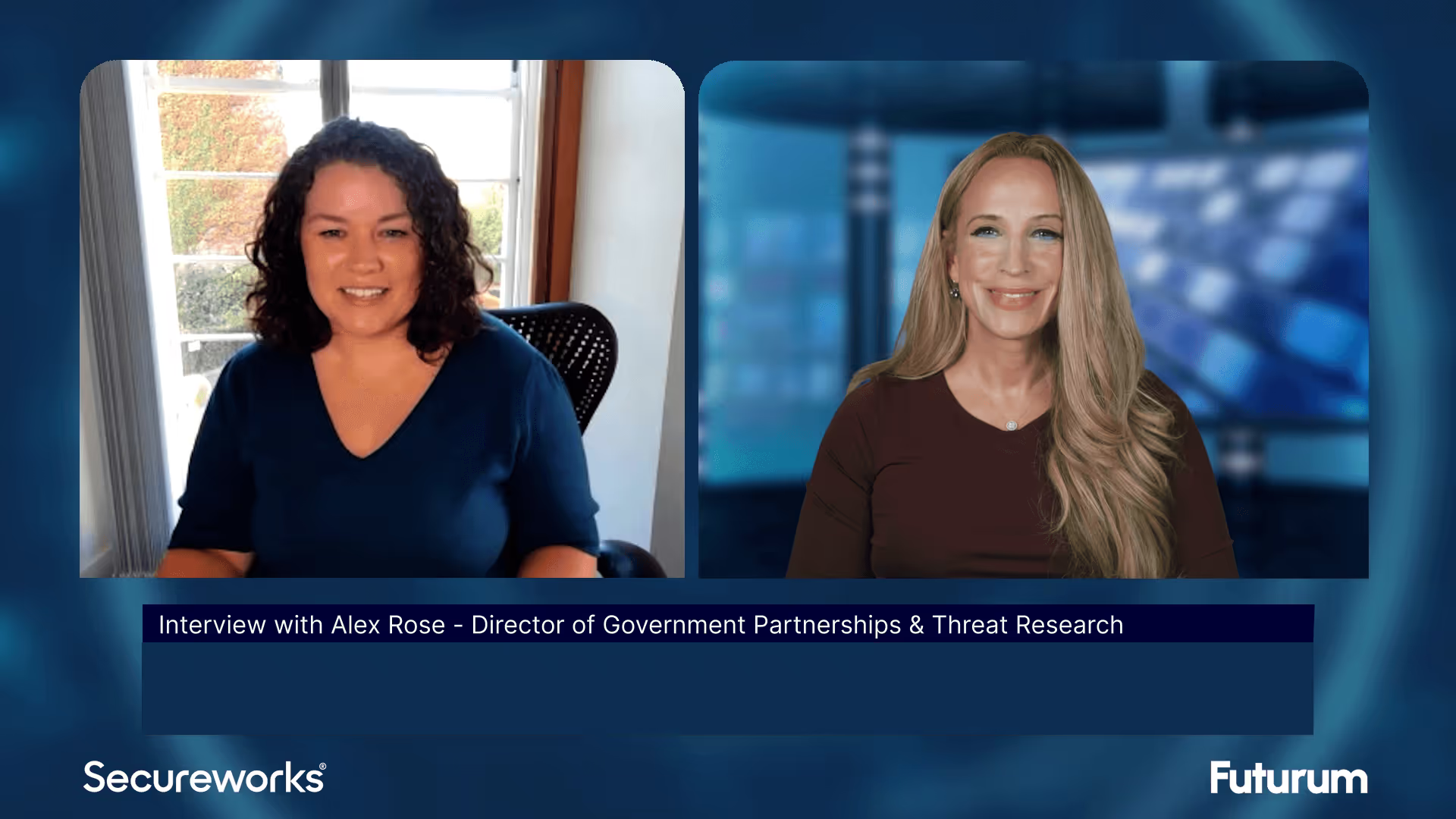
Threat Intelligence: Insights on Cybersecurity from Secureworks
Alex Rose from Secureworks joins Shira Rubinoff on the Cybersphere to share his insights on the critical role of threat intelligence in modern cybersecurity efforts, underscoring the importance of proactive, intelligence-driven defense mechanisms.

HP Launches World’s First Business PCs to Protect Against Quantum Hacks - The Six Five On the Road
On this episode of the Six Five - On the Road, hosts Patrick Moorhead and Daniel Newman are joined by HP's Ian Pratt, Global Head of Security for Personal Systems.
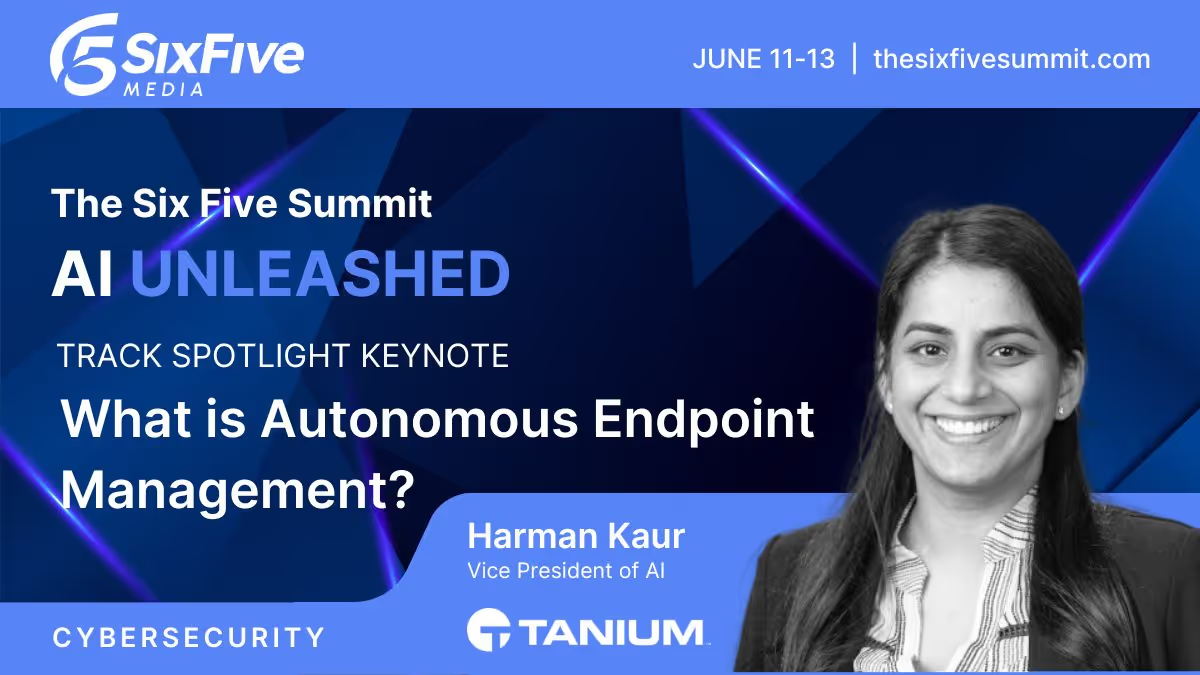
What is Autonomous Endpoint Management?
Autonomous Endpoint Management is a framework designed to unify IT operations and security teams on a single platform through real-time control and visibility.
QUANTUM
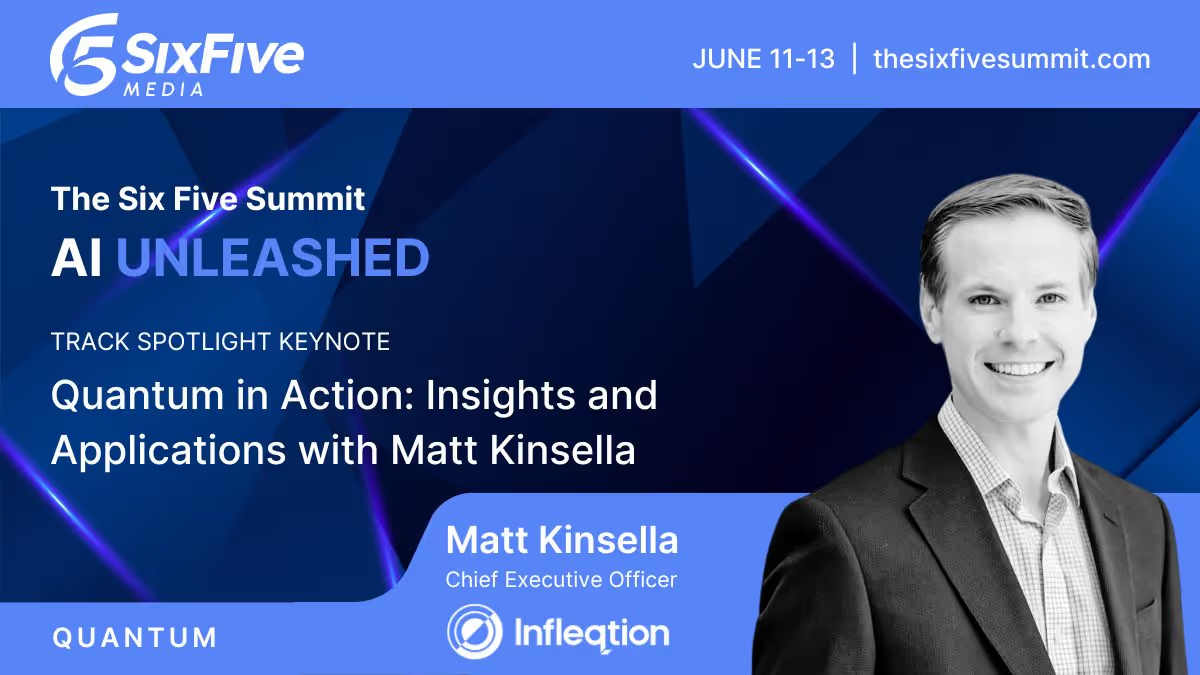
Quantum in Action: Insights and Applications with Matt Kinsella
Quantum is no longer a technology of the future; the quantum opportunity is here now. During this keynote conversation, Infleqtion CEO, Matt Kinsella will explore the latest quantum developments and how organizations can best leverage quantum to their advantage.
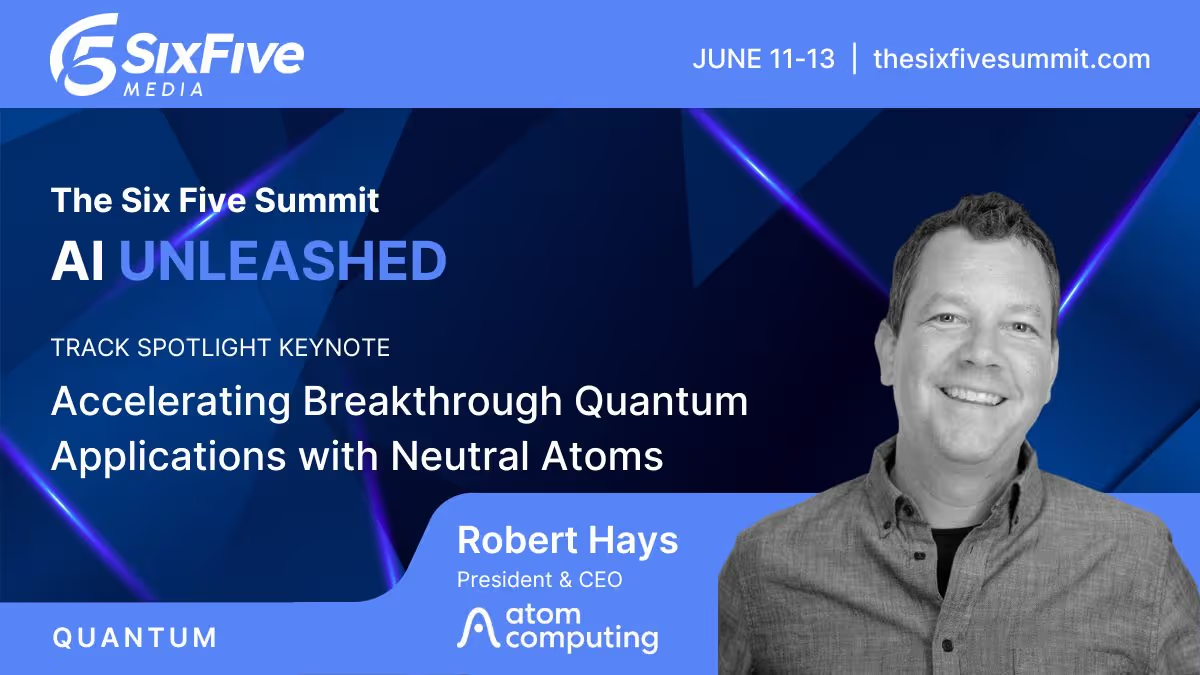
Accelerating Breakthrough Quantum Applications with Neutral Atoms
Our planet needs major breakthroughs for a more sustainable future and quantum computing promises to provide a path to new solutions in a variety of industry segments. This talk will explore what it takes for quantum computers to be able to solve these significant computational challenges, and will show that the timeline to addressing valuable applications may be sooner than previously thought.