
Megawatt Racks Need a New Power Architecture: Inside the Shift to 800 VDC
SHARE


At OCP Global Summit 2026, LITEON, NVIDIA, and QCT explain why megawatt-scale AI racks are driving a shift from 54-volt to 800 VDC power architecture. For data center operators, the transition depends on a shared specification, retrofit paths for existing sites, and liquid-cooled power innovation.
AI racks are moving from roughly 120 kilowatts toward a megawatt, and traditional 54-volt power distribution can't keep pace. Delivering that much power at low voltage pushes current, copper, and conversion losses to physical limits. That is pushing the industry toward 800 volts of direct current, from the grid all the way to the chip.
At the OCP Global Summit 2026, David Nicholson, Chief Technology Advisor at The Futurum Group, is joined by Harry Petty, Technical Marketing for HPC and AI Edge Applications at NVIDIA, Jack Luoh, Head of Product Marketing at QCT & Quanta Computer, and Simon Ong, President of LITEON U.S.A. at LITEON Technology to look at the 800 VDC shift from three angles: accelerated computing, system integration, and new power technology.
The consensus is that no single company can make the move alone. The 800 VDC transition depends on a shared specification, retrofit paths for existing facilities, and new power innovation coordinated across the full ecosystem.
Key Takeaways:
🔷 Higher voltage is the path to denser AI racks. Petty says agentic AI demands roughly 100 times the compute of generative AI, pushing NVIDIA to pack more GPUs closer together than 54-volt bus bars can efficiently power. NVIDIA and its partners co-designed an 800 VDC specification, published at OCP APAC, to give the supply chain and site builders an early signal.
🔷 Rack power is heading past a megawatt. Luoh traces rack power from 10 to 30 kilowatts a few years ago to about 120 kilowatts with GB200 and roughly 235 kilowatts with Vera Rubin, with 500 kilowatts to 1 megawatt ahead. Moving to 800 volts also means rebuilding labs, test procedures, safety guardrails, and manufacturing lines.
🔷 Power rack sidecars bridge existing facilities. Liquid-to-air sidecars brought liquid-cooled systems into air-cooled data centers, and power rack sidecars can now do the same for 800 VDC in AC sites. Petty outlines three upgrade paths: a power rack beside dense racks, end-of-row conversion for a scalable unit, and greenfield halls distributing 800 volts throughout.
🔷 Liquid-cooled power racks are the next frontier. Ong says the step after liquid-cooled AI racks is liquid-cooled power racks, which requires repackaged power supplies, new semiconductors, and integrated magnetics. LITEON has supported NVIDIA since the A100 and now develops three product generations at once.
🔷 800 VDC extends today’s 48-volt systems. Data centers will stay mixed, Luoh says, because CPU workloads draw far less power than GPUs approaching 2 kilowatts each. Ong adds that converting 800 volts down to 48 volts lets the new architecture coexist with current-generation systems.
🔷 DSX gives the ecosystem a shared blueprint. Petty describes NVIDIA’s DSX reference design and digital twin for planning AI factories from energy to applications, including intelligent power smoothing that lets GPUs and power supplies coordinate to manage grid transients. Ong and Luoh say it lets partners co-define specifications one to two generations ahead and align stakeholders from design through operations.
Operators that plan their power architecture with the full ecosystem now will be able to deploy megawatt-scale racks as each new GPU generation arrives, without starting from a blank slate.
Watch the full video at sixfivemedia.com, and subscribe to our YouTube channel so you never miss an episode.
Learn more about LITEON, NVIDIA, and QCT below:
Disclaimer: Six Five Media is for information and entertainment purposes only. Over the course of this video, we may discuss companies that are publicly traded, and we may reference their equity share prices. Nothing discussed during this webcast should be considered investment advice or a recommendation to buy or sell any security. We are not investment advisors, and you should not rely on this content as financial advice. Six Five Media collaborates with technology companies and industry leaders to produce research-driven interviews and multimedia programming for enterprise technology audiences.
Simon Ong:
So with now the AI rack fully liquid-cooled, the next step, of course, is for the power rack to be fully liquid-cooled. There's a full set of new innovation required within the power supply itself. It's a lot more than the industry can imagine for us to achieve that.
David Nicholson:
Hello and welcome to Six Five On The Road. I'm Dave Nicholson and we are here at OCP Global Summit 2026. I've got a distinguished panel assembled here to talk about 800 VDC. What is that, you ask? We're talking about 800 volts of direct current power and The move to that architecture is changing the way that AI infrastructure is designed and deployed in data centers. On the panel, we are joined by Harry Petty, who is Technical Marketing Chief for High-Performance Computing and AI and Edge Applications at NVIDIA. Welcome. Thank you. We're also joined by Jack Luo, Head of Product Marketing at QCT, and Simon Ong, President of Light On USA. Welcome to Six Five, gentlemen. Thank you. Thanks a lot. Harry, I'm going to start with you. As we scale AI compute, How are next generation platforms reshaping infrastructure requirements? And where does this transition to 800 VDC, as we'll call it from this point forward? How does that affect the deployment of platforms moving forward?
Harry Petty:
As you know, we were speaking a little earlier about the growth of AI and agentic AI in particular. So to keep up with the demands for compute, it's like 100 times more than generative AI. We need to scale up the platforms. We need to scale up their capability. And the way that's done is by essentially bringing more compute together. We scale up the networking in that rack, that supercomputer rack. Today we put 72 of them together. And the power footprint goes up. And every generation that we increase the compute capabilities of the GPUs themselves, the power may go up. But we'd like to put 144 together or 576 together and have them close together, share memory, and therefore be able to support the needs of, let's say, a genetic AI, physical AI, deep research, reasoning. So to accomplish that, We need to integrate the cooling, the networking, the power, all of those specs together in this design, holistic design, full stack. No one company can do it all, you know, so we work with partners to agree on the spec in the industry. But the architecture for computing is going to evolve and provide denser computing, which means denser power. We want to be, because power is a limiting factor for these knowledge factories, these AI factories, We want to be very efficient performance per watt. So all of that is kind of a collective effort. And so the evolution of these systems is we look at what we could do with 54 volt power. We need more power. And physics says that we can accomplish this by raising the voltage. And therefore, we can deliver more power, more current, without having huge physical limitations on bus bars and everything else. So we needed to agree on a spec as an industry. At OCP APAC, we published a spec that was worked on, co-designed with our partners, that said we agree on this 800-volt DC, VDC specification, for the power distribution, power architecture of the entire data center. This is something that we need some innovation to go from the grid to the chip. And so collectively with the partners, you know, setting our sights for when that generation of, let's say, megawatt scale kind of compute is delivered, the entire ecosystem supply chain will be ready. And we also want to give a signal to the site builders that it's coming, so they can plan ahead.
David Nicholson:
Yeah. So speaking of partners, Jack, being part of this ecosystem, tell me how the move to 800 VDC changes considerations when you're integrating things in a system.
Jack Luoh:
Yeah. So very much aligned with your message. And what we're seeing right now is the rack power growth significantly. In the past, we are looking at 10, 20, 30 kilowatts. Consider it's pretty much a lot for the computer rack. Starting from GP200, we are looking at 120 kilowatts. This year, we are shooting via Rubin. We are looking at 235 kilowatts. I believe that soon, with NVIDIA's leadership, we are looking at 500 kilowatts, maybe 1 megawatt soon. Because, again, we want to collect as much GPU as closely together as possible. So we can have a much bigger L1 domain for very high demanding AI models. With that, higher voltage really have an advantage to lower the power loss. reduce the, increase the power efficiency, right? So that's key to us. But again, it takes a whole ecosystem to work together. We had a similar experience just in the recent years from liquid cooling side, right? When all the data center is focusing on air cooling, Liquid cooling GPU system, how can we install them in the data center that is designed for air cool? We have a sidecar, liquid to air, right? That can help to push the liquid cooling system inside air cooling data center. We are looking at something similar here with the transition into 800 volts DC. We will need Li-ion as our partner to provide a product like Power Rack Sidecar to help to ease the pain during this transition in time. So we can put 800 volt DC system with Power Rack inside not so ready data center. When the technology evolves, data center is more ready, SSE infrastructure is ready, we can feed about 800 volts bus way into the rack, then a much simpler rack architecture will be there. We clean up more room for more GPUs, and that is good for everybody. But from our side, we see a lot of challenges for sure. For example, Our labs need to be renovated, right? The new SOP, new standard, no testing procedures, no safety guardrail need to be there, right? Our manufacturing also need to be ready, right? Just like a data center, we need to have 800 volts through it. So, it takes a whole ecosystem to work together. At Quanta, we have been working with Hyperscaler on their transition to 54V a few years back. And we are not strangers to this kind of transition. So, we believe that by working together, we can deliver much better products, a much better AIDC to our end customers.
David Nicholson:
So, I'd like to dive in on a little subject here. We nod our heads when we talk about going from 20 kilowatts to 125 to 250, you know, megawatt. Oh, yes. A lot of people can't wrap their heads around that. in terms of just how much power that is. If you think about an average home, you're talking about an ongoing consumption of 2, 3, 4, 5, 6 kilowatts, maybe. That's a bunch of air conditioners, all sorts of stuff going on, pool pumps cranking away. We're talking about hundreds of homes worth of power in the not-too-distant future. in the space of what people can think of as a tall, dark, and handsome refrigerator. And so that density is absolutely crazy. It sounds like you have a plan working together to ease people into it from a data center perspective. They don't have to wipe the slate clean and start with the proverbial green field, which we never get to do in this market. Where does Light On fit into this mix? I mean, you're making sure that this You know, the power supplies and distribution actually works. Talk to me about that.
Simon Ong:
In light of that, we have the privilege to support NVIDIA since A100, as well as, of course, our great partners, QCT. And we lived through the entire transition from what Jack said earlier, you know, 20, 30 kilowatt, up to 130 kilowatt. Now, you know, it's excessive of 200 kilowatt and very near future, more than one megawatt. Over the last few years, we have been accustomed to working with NVIDIA to collaborate together on the development of our system for not just one or two, but three generations of product together. So this is, for us, it's not a surprise because, again, we see that coming, having the privilege to work on three generation products simultaneously. And 800 volt DC, which what we say is the natural outcome of this entire process of evolution in the AI, because of the density that's required to support the computing configuration, what Harry and Jack just mentioned earlier. Again, higher density to get within the cluster together so that they can achieve the computing effect that they want. So, right on, when we work on a 100-volt architecture, there's a lot of challenges and innovation which is required to support that architecture.
David Nicholson:
So you didn't just turn a dial from 480 to 800? We hope we can do this instead. Was that the extent of the innovation? Just turn it up to 800?
Simon Ong:
Well, unfortunately, the actual vote don't happen that way. For us to support 800-vote transmission within the data center is a whole new bargain for us. Even though high voltage transmission is not new to the industry, we do high voltage transmission over, I mean, high power cable cross-country, but within the AI data center, it's a whole new ballgame. What we are talking about here is, again, how do we deal with the safety concern, as Jack mentioned earlier, and how do we deal with the regulatory requirement to support all those requirements, this new standard. And most of all, NVIDIA has taken a bold step forward to make this entire architecture liquid-cooled. Two generations ago, I think Jensen has made all GPU liquid-cooled. Two generations later, now power supply. I think it's a natural step that we are taking because right now, in order for us to be, again, more efficient in the data center, we want to have maybe less power wasted on cooling the data center itself. So, with now the AI rack fully liquid-cooled, the next step, of course, is for the power rack to be fully liquid-cooled. And in order for us to achieve that, there's a full set of new innovation required within the power supply itself. We have to repackage the power supply in such a way that it allows us to liquid-cool it. and also the different sets of semiconductors required to support that new packaging requirement. And so for a magnetic component, same thing, everything has to be integrated so that it allows us to be able to cool them more effectively. So all in all, I would say there's a lot more than the industry can imagine for us to achieve that.
David Nicholson:
So, in order to deliver more power, that generates more heat. You need to cool that so you can deliver more power, so you can generate more heat, which then needs to be cooled. It's a never-ending cycle. You mentioned that there was a mention of A-100s just a minute ago. And what's interesting is looking at how relevant A-100s are still, although in this accelerated space, people are concerned about the future-proofing an environment, when we talk about 800 VDC, how far does that take us into the future? When will light on be under pressure to go to something beyond, which we can't even conceive of from an engineering perspective yet, in terms of density and cooling, and no one's even pretending to talk about five megawatt racks today, right? But what about the kind of future-proofing of it? How far does this take us into the future, do you think?
Simon Ong: levels of AI, as we know today, and I believe that for some of the applications, we'll move forward to the 800-vote architecture, and for the others, we'll remain where we are on the 48-vote architecture. Again, like I say, depending on the density of the application, we will come up with the most efficient and effective solution for the application itself. 800 volt architecture do require a brand new architectural on an infrastructure level. So in order for us to support that kind of new architecture to be deployed, So, you do need to have that infrastructure ready in order for us to be able to deploy the new solution.
David Nicholson:
So, when I think about 800 volts direct current, is it right to, is my understanding correct that it's coming in at what, sort of the aisle level and then it's distributed to a rack? It's split then into what, 54 volts?
Simon Ong:
Is that right? So what happened is the AC current is going to come in, the AC voltage is going to come in to the power rack, the 800 volt power rack. And then the 800 volt power rack will distribute 800 volt to the IT rack. And it will get further stepped down to the lower DC voltage to be used within the IT rack itself. This is how it works.
Harry Petty:
And actually, for the upgrade path for people who have sites, as you mentioned, a lot of AC sites are being built, right? And if they want to put in this dense compute solution, Power Rack would do that conversion adjacent to the high-density racks. So you would have an aisle, and you'd take three positions to place those racks, and you could deploy that. The other model would be sort of move it a little upstream, end of the row, let's do the cluster. And there you could have redundant remote power, that 800 volt conversion done there and service like a scalable unit, a whole bunch of racks. And then the last scenario kind of upgrade path would be like a green field data hall. We do it outside and basically everything in the hall is distributed at 800 volts. And so they're deploying all those kind of elements to design this backbone. But you as the operator with your AC site have choices. on how you're going to deploy it. And that kind of depends on the maturity, you know, in the cycle, in the industry as we deploy 800 volt.
David Nicholson:
So, if a data center is being built today, you know, we hear about these gigascale data centers being built. That's likely to include a lot of 800-volt DC if it is specifically a mega data center specifically designed for AI training, as an example. Is that a fair assessment, or is it always a mix?
Jack Luoh:
I believe it's always a mix, right? So not all the workloads require such high compute power from GPU or any accelerator. We still have, for example, urgent air workload related to a lot of reasoning, right? Agents. Those workloads require CPU to do it, right? CPU we are still looking at. 350 watts, 400 watts, 500 watts, or even 600 watts. It's far less than GPU. Now we are looking at two kilowatt, sooner or before. Per GPU. Per GPU, yes. Yes, yes. Per GPU. And we have 72 of them together. Right. So it will be very diversified. And back to Simon's just mentioned earlier, we will need to make sure the infrastructure can be delivering different kind of power source to different kind of needs on different kind of rack architecture. So NVIDIA, we have like five racks, different kind of specialized rack. Although they are now all focusing on 54 volts, soon will be 800 volts for GPU. But the others may just take advantage of that journey to also be more efficient. And 800 volts is what we're focusing on right now. A couple of days ago on the OCP keynotes, they talk about 1500 volts. That's a little bit far in the future, but we need to be prepared for that. Who knows where AI is going to take us to, right?
Simon Ong:
I think the beauty of the architecture itself today, if you look at the existing system that's running on B300, it's pretty much distributing across using 48 volts. And today, the 800-volt architecture, even though if we distribute 800 volts, we do have a downstream solution that converts 800 down to 48, that allows us to retrofit the entire architecture into the previous generation products. So I would say the 800-vote architecture is not going to replace what we have today. The 800-vote is going to accommodate more generation of more different layers of application in the AI data centers.
David Nicholson:
So it's great when we talk about partnerships, ecosystems, but it's often very, very helpful to have something that that ecosystem and those partners rally around, like an agreed upon spec, something like DSX. Harry, tell me about DSX.
Harry Petty:
So, DSX is a reference design or blueprint on how you build the five-layer cake of an AI factory, from energy up to models and applications. So, we work with the industry, our partners, co-designing what's the electrical definition, what is the thermal requirement, and we codify that in a reference design. So, there's a Vera Rubin reference design, a DSX design for AI factories. And so we share that with all the partners on how we build it. We also render that in digital form as a digital twin. So now you can, what if, so this gigascale AI factory, it may be laid out a certain way, and you can customize your rack placements, your rows, kind of plan modularly how you're going to build this out. Architecture and engineering firms use that as well to design those facilities. And that's very important to model the thermal characteristics and plan the cooling. We can include the liquid cooling of the power racks themselves, model all that inside the facility. So DSX, that's something that is going to help us, you know, do multiple generations. of these AI factory designs. So if somebody has a facility that lasts 20 years, longer, they can plan ahead. Of course, this is the first time we're doing this. So we have the version out. It's going to keep evolving and include successive generations of GPUs, as well as innovations around power and cooling.
David Nicholson:
Now, is that the result of the collaboration? Because I'm going to ask Simon. Does something like DSX leave light on room for innovation, or do you feel constrained by it?
Simon Ong:
Is it a net positive? It's definitely a positive thing for us. If you look at the five-layer kicks, Lion is working on the energy and power, as well as the second-layer infrastructure. And for us, in order to be able to really support the application, we are working very closely with NVIDIA to co-define the product specification so that we can move one bounce ahead or two bounce ahead to get those future requirements ready in both the energy as well as the infrastructure space. And as Henry mentioned earlier, with this initiative, we built a closed ecosystem around the DFS requirement so that we can, as an industry and partner to NVIDIA, we got all those solutions ready one bounce to two bounce ahead of the future architecture.
Harry Petty:
kind of an example of the way we're collaborating, I might give is, so within DSX, we have a thing called intelligent power smoothing. And they implement that and use, you know, electrolytic capacitors to help us smooth out the power transients of synchronous workloads, like big training jobs, and protect the grid. And so, essentially, the compute, the GPU, and the power supply, they talk. we understand the state of charge. And so we can work together. So that's just kind of one example of an innovation. And then we've got to carry that forward as we go to 800 volt.
David Nicholson:
So Jack, from a QCT perspective, is it a constraint or does it help you with the integration effort?
Jack Luoh:
Yeah, it's very helpful, especially from a deployment perspective. So traditionally, when we look at it, normally it's a brownfield or greenfield. Let's take a greenfield as an example. So from the design to construction to deployments, each of the stage have a lot of different stakeholders. Sometimes they don't meet each other until the very end, and sometimes when they meet each other, there's something goes wrong. With the DSS as a platform, we can start to talk with each other in the same platform to make sure in the digital environments with SIM-ready assets, everything is in place in the digital world. Then we make sure everything is right in digital environments. Then we go to construction. Then we go to deployments. After deployments, the virtual world and the real world still remain syncing. Then the operation can be optimized. Power is an ugly example. We understand how the power distribution is working in the virtual world, and we also understand how it works in the real world, under the same platform again. So we can optimize the power distribution to where it needs. to not only save the power, but also making the power to be used wisely. So this kind of collaborations, actually growing the whole ecosystem even larger, not just the traditional IT world, but also the construction sites, different equipments, vendors, different partners, everybody can work together. The ultimate goal is to have the most optimized AI data center. We are having more and more growing on the token generations. I think a couple of months ago, I saw the stats saying that there are 300 trillion tokens being generated every single day. And I believe it's more now, right? So power, we are not growing significantly overnight, right? How we use the power more wisely, a hundredfold is a very good example. DSX is another good example. Make sure everything is smooth, everything is normal scale in the middle, and also the most optimized and most efficient. So, again, DSX is a great approach to make sure that we have the most optimized AI-DS in there.
David Nicholson:
Very interesting. What I'm taking away from this is just how important an ecosystem is and how important partnerships are. This has been a fascinating conversation, gentlemen. Simon, thank you. Harry, Jack, thanks for being with us for 6.5 On The Road at OCP Global Summit 2026. I'm Dave Nicholson. Stay tuned for our continuing coverage.
MORE VIDEOS

Google Is Putting AI Agents Inside the Pentagon’s Systems. Here’s How They Keep Them in Line.
At the Google Public Sector Summit, Field CTO Chris Hein explains how agencies can scale AI agents safely, from TPU capacity and smart model routing to zero trust for the agentic workforce. Agencies that get those foundations right can deliver government services that beat everyday consumer experiences.


Government Workers Built 500,000 AI Agents in One Department. None of Them Wrote Code.
At the Google Public Sector Summit, Katharyn White explains how agencies are turning moonshot AI goals into daily operations, from Gemini for Government Services to more than 500,000 user-built agents in a single deployment. Agencies that prioritize steady progress and real behavior change can deliver mission impact from day one.
Altera on Why Physical AI Needs More Than GPUs
Altera President and CEO Raghib Hussain explains why FPGAs now operate as programmable companions to CPUs, GPUs, and custom ASICs as AI model churn outpaces silicon design cycles. For infrastructure and physical AI teams, programmable data movement and sensor processing determine how quickly systems adapt after deployment.
Other Categories
CYBERSECURITY
Threat Intelligence: Insights on Cybersecurity from Secureworks
Alex Rose from Secureworks joins Shira Rubinoff on the Cybersphere to share his insights on the critical role of threat intelligence in modern cybersecurity efforts, underscoring the importance of proactive, intelligence-driven defense mechanisms.

HP Launches World’s First Business PCs to Protect Against Quantum Hacks - The Six Five On the Road
On this episode of the Six Five - On the Road, hosts Patrick Moorhead and Daniel Newman are joined by HP's Ian Pratt, Global Head of Security for Personal Systems.
What is Autonomous Endpoint Management?
Autonomous Endpoint Management is a framework designed to unify IT operations and security teams on a single platform through real-time control and visibility.
QUANTUM
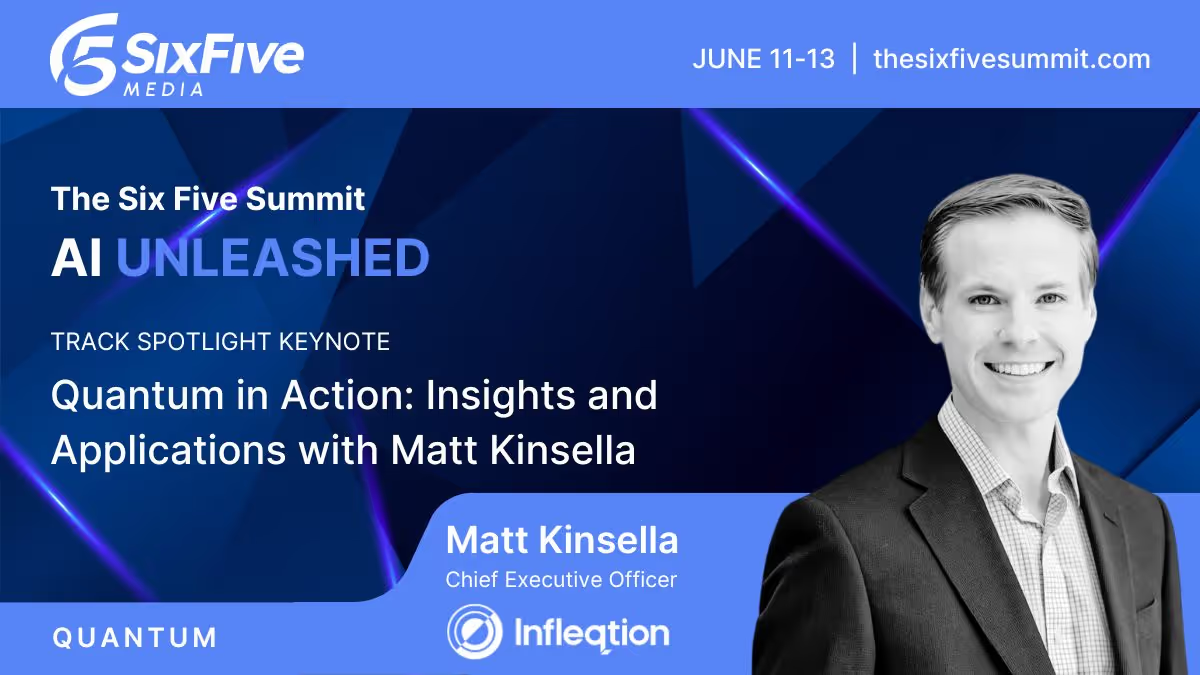
Quantum in Action: Insights and Applications with Matt Kinsella
Quantum is no longer a technology of the future; the quantum opportunity is here now. During this keynote conversation, Infleqtion CEO, Matt Kinsella will explore the latest quantum developments and how organizations can best leverage quantum to their advantage.
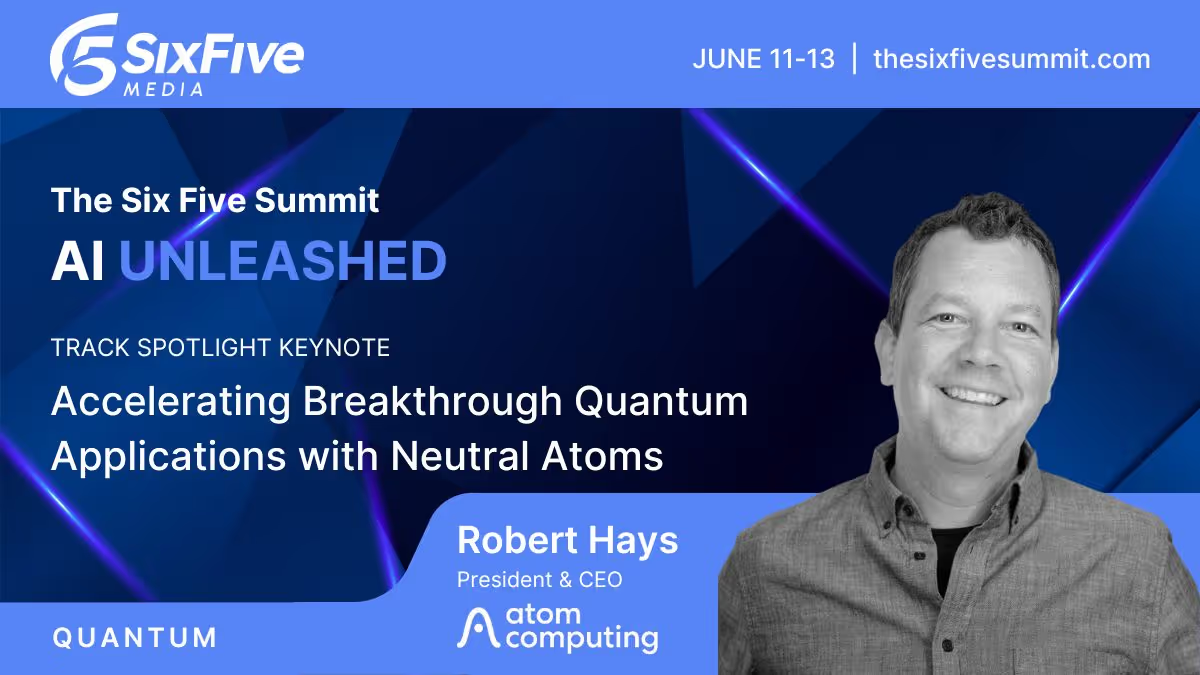
Accelerating Breakthrough Quantum Applications with Neutral Atoms
Our planet needs major breakthroughs for a more sustainable future and quantum computing promises to provide a path to new solutions in a variety of industry segments. This talk will explore what it takes for quantum computers to be able to solve these significant computational challenges, and will show that the timeline to addressing valuable applications may be sooner than previously thought.