Home

Microsoft Declares Independence, Alphabet Raises $80 Billion, and the Multi-Silicon Era Arrives | The Six Five Pod Ep. 307
Microsoft Declares Independence, Alphabet Raises $80 Billion, and the Multi-Silicon Era Arrives | The Six Five Pod Ep. 307
SHARE


Microsoft Build 2026 announced an end-to-end agentic AI stack. COMPUTEX Taipei confirmed heterogeneous AI infrastructure across ARM, Marvell, Intel, Qualcomm, and NVIDIA. Alphabet raised $80 billion. Cisco Live repositioned the network as the AI platform. Patrick Moorhead and Daniel Newman break it all down alongside earnings from Broadcom, HPE, Palo Alto Networks, and CrowdStrike, plus the token cost conversation, the edge AI push, and what Palantir and Oracle are saying about proprietary data as the real AI moat.
The handpicked topics for this week are:
- Microsoft Build 2026 Announced an End-to-End Agentic AI Stack: Microsoft shipped MAI-Thinking-1, its first homegrown thinking model, alongside Scout, Microsoft IQ, Project Solara, and a Majorana 2 quantum update targeting a 2029 commercial timeline with claims of a 1,000x reliability gain. Pat describes MAI-Thinking-1 as likely better than Sonnet 4.6 in blind testing and delivering close to GPT 5.5 quality at a far lower cost. Scout is Microsoft's first autopilot agent, anchoring the M365 Agent Suite with Office Pilot Agent Mode and Agent 365. Microsoft IQ serves as the context layer, integrating M365, business data, boundary IQ, and web IQ with GitHub Copilot, Foundry, and Copilot Studio. Project Solara is a new Android-based platform built for agent-first devices across transportation, retail, and hospital settings. Microsoft also added 83 Unix commands to the Windows stack. Dan frames Microsoft's real play as distribution, not frontier model development, noting that the open model ecosystem being pulled into the platform will matter more to CFOs managing token costs at scale. (The Decode)
- The AI Stack Goes Multi-Silicon — COMPUTEX Taipei 2026 Confirms Heterogeneous AI Infrastructure: ARM's AGI CPU is in production with Google moving its TPU head node to ARM, and adding Oracle and ByteDance as new customers. ARM also introduced a new switch, the TT100, and put the 51T CPO switch on stage. Marvell received a trillion-dollar company endorsement from Jensen Huang, adding $90 billion in market cap on the comment alone. Intel announced disaggregated inference details and Xeon 6+ Clearwater Forest, its first 18A data center processor. Vista Equity and Cambium Capital announced a NeoCloud called Vector Core Compute, with Xeon 6 handling orchestration, Salmonova RUs handling decode, and Blackwell GPUs handling pre-fill. Qualcomm's Cristiano Amon announced the Dragonfly data center brand with Snapdragon C details coming at their June investor day. The WSTS raised the 2026 semiconductor TAM forecast by 90% to $1.51 trillion, with Pat noting the market could hit a trillion dollars if memory is excluded entirely. (The Decode)
- NVIDIA RTX Spark and the Edge AI Push: NVIDIA coordinated with ARM and Microsoft around the RTX Spark at COMPUTEX, with the shared message being that the future of Windows is here. Signal65’s Ryan Shrout asked Jensen directly why NVIDIA wants to be in the PC business, given low margins and diminishing returns. Dan frames the answer in the context of devices increasingly becoming mobile data centers, capable of running models at much greater efficiency than cloud delivery. The edge AI conversation is also directly tied to token cost economics: as intelligence delivery moves closer to the device, the cost per token drops significantly. The jury is still out on whether NVIDIA will meaningfully disrupt the PC market, but its influence over OEMs like Lenovo and Dell that depend on it for data center gives it real leverage over SKUs. (The Decode)
- Token Economics and Frontier Model Cost Pressure: Dan and Pat discuss a substantive shift in how enterprises are thinking about AI consumption costs. Dan argues that “token maxing,” the practice of defaulting to the most powerful frontier model for every task, has now effectively peaked, as bills have come due at scale. Companies paying for tokens in volume are starting to question whether they can afford the prices that frontier models actually cost to deliver. Pat pushes back, saying the dynamic is still present, but both analysts agree that the market is moving toward a model where token selection is matched to the job, with Microsoft's MOE approach and thinking models positioned to help CFOs manage that economics story. (The Decode)
- Continuum Goes Public at Highest Valuation for an AI Platform: Dan notes that Continuum, the Honeywell-spawned quantum company, went public this week at what he calls the highest valuation for an AI platform to date. He flags that IonQ will likely contest that characterization. The broader context is Microsoft entering the quantum conversation with Majorana 2 at Build, a name that has largely been absent from the quantum race, while IBM has received most of the attention. (The Decode)
- AI CapEx Has Outgrown Cash Flow — Alphabet's $80 Billion Equity Raise: On June 1, Alphabet announced an $80 billion equity capital raise, upsized to $85 billion, structured as $40 billion ATM, $30 billion underwritten, and a $10 billion private placement with Berkshire Hathaway anchoring. Pat frames the questions over CapEx returns as entirely dependent on whether you are an AI boomer or a doomer: if the payback comes, the raise is the right move. If it does not, the math doesn’t close. Dan argues the investment is existential, drawing parallels to how infrastructure-first companies have always spent ahead of monetization, and notes that Google's equity is being used as a capital engine that may be more efficient than the debt markets right now. Both analysts flag the downstream implications for Broadcom, MediaTek, and Marvell given the TPU connection. (The Decode)
- The Network Becomes the AI Platform: Cisco Live 2026: Cisco launched Silicon One P200, the Secure AI Factory with NVIDIA and Spectrum X, AgenticOps, MCP-native automation, Cisco IQ, LiveProtect, and folded Astrix Security and Galileo into Splunk under one control plane. Pat identifies Cisco Cloud Control as the biggest announcement of the entire show, pulling together Catalyst, Meraki, Nexus, Firewall, and WebEx under agentic ops that run natively through MCP, with code running directly on smart switches that have x86 processors. Pat also credits Cisco for establishing Silicon One as a credible chip alternative for hyperscalers capable of taking on Tomahawk and Jericho. Dan frames the long-term opportunity as campus and branch enablement when industrial AI and robotics deployments accelerate, arguing that the numerator of AI's economic impact has barely started, as edge deployment spending has not yet begun. (The Decode)
- The Flip: Did Microsoft Build 2026 Effectively End the OpenAI Partnership? Pat argues the divorce decree has been filed. MAI-Thinking-1 was built with zero distillation from third-party models offering clean enterprise data lineage, with Maia 200 in production plus Anthropic chip supply, which signals vendor hedging. OpenAI is going all-in on AWS, which means you cannot be married to two people, and the full Build stack covering model, OS containment via MXC, agents via Scout and Agent 365, and context via Microsoft IQ removes every architectural dependency on OpenAI. Dan counters that Microsoft is hedging rather than leaving and predicts the partnership will run through the decade. Enterprise Copilot customers are explicitly showing in data that they demand GPT 5.5, internal benchmarks have not been independently validated, and Microsoft stands to make meaningful money from the OpenAI IPO. (The Flip)
- Broadcom Q2 FY26 Earnings: Broadcom posted revenue of $22.19 billion, a narrow miss depending on which consensus data set is used, with EPS of $2.44 beating estimates and AI semis at $10.8 billion. Hock Tan declined to raise the $100 billion full-year AI chip target, and the stock dropped 13% in premarket trading. Q3 guide came in at $29.4 billion. Pat calls the miss a timing issue driven by Google's multi-sourcing across Marvell, MediaTek, and Broadcom rather than a fundamental problem. Dan flags that Hock Tan opened the earnings call by accidentally reading from the 2025 print, calling it “not the best moment.” Sell-side re-ratings held in the 500s across Jefferies, Mizuho, and Deutsche Bank despite the drop, with Futurum Equities having it at 600. (Bulls and Bears)
- Hewlett Packard Enterprise Q2 FY26 Earnings: HPE delivered revenue of $10.68 billion, up 40% year over year, and EPS of $0.79, up 100%. Juniper integration and AI servers both outperformed, and all FY26 guides were raised. The stock jumped 19% after hours before settling into a roughly 15% gain, with HPE up 68% over the last month. Pat frames HPE as a value play rather than a volume play, methodically targeting enterprise and sovereign cloud deals where it can maintain profitability, rather than competing for massive NeoCloud volume. Antonio Neri was clear on the call that the profitability pull-forward is a one-shot deal. Pat and Dan will both be at HPE Discover the week after next to interview Neri and the C-suite. (Bulls and Bears)
- Palo Alto Networks Q3 FY26 Earnings: Palo Alto posted revenue of $3.0 billion, up 31% year over year, beating the $2.94 billion estimate, with non-GAAP EPS of $0.85, beating the $0.79 to $0.81 range. NGS ARR reached $8.1 billion, up 60% year over year, including $1.6 billion from CyberArk and Chronosphere. RPO hit $18.4 billion, up 36%. Both FY26 revenue and EPS guides were raised. Adjusted FCF margin came in at 38.5% TTM, up 430 basis points. The stock jumped 11% immediately after hours, then drifted lower. Pat points to 2,200 platformized customers and 120% net retention as the most important metrics. Dan notes the SaaSpocalypse thesis continues to be wrong. (Bulls and Bears)
- CrowdStrike Q1 FY27 Earnings and the Proprietary Data Moat Argument: CrowdStrike posted revenue of $1.39 billion with EPS of $1.10 and ARR of $5.51 billion. Net new ARR of $255.8 million set a Q1 record, up 32% year over year. FY27 net new ARR guide was raised by $52 million to a $1.29 billion midpoint, and FY27 revenue was raised to $5.915 to $5.959 billion. A 4-for-1 stock split was announced effective July 2nd. The stock dropped 11% despite the beat after a 64% year-to-date run into earnings. Dan uses the results to make a broader argument against the software disruption thesis, referencing Palantir CEO Alex Karp daring customers to build without him using Anthropic or OpenAI, and Larry Ellison's argument that the real AI value unlock sits in proprietary enterprise data that is not accessible to frontier models. Enterprises with governed, secure, proprietary data will continue to need platforms like CrowdStrike regardless of what frontier models can do. (Bulls and Bears)
Six Five Summit is coming. Salesforce CEO Mark Benioff will kick off the event. Register and stay current at sixfivemedia.com/summit.
Watch the full video at sixfivemedia.com, and be sure to subscribe to our YouTube channel so you never miss an episode.
Disclaimer: Six Five Media is for information and entertainment purposes only. Over the course of this webcast, we may talk about companies that are publicly traded, and we may even reference that fact and their equity share price, but please do not take anything that we say as a recommendation about what you should do with your investment dollars. We are not investment advisors, and we ask that you do not treat us as such.
DANIEL NEWMAN:
Hey, everybody.
PATRICK MOORHEAD: Welcome back …
DANIEL NEWMAN:
Oh, it's me, man. It's me, man. We should do that again. When the person is supposed to speak first doesn't know who they are.
PATRICK MOOREHEAD:
Or both of us. I was confused. Am I the operator? Or am I the host? Like, well, like I am an operator, a smooth operator. Use a smooth operator.
DANIEL NEWMAN:
All right, push the slide forward, Mr. Operator. Hey, everyone, we are back. It is episode 307 of The Six Five, and buddy, we have had a week in technology. There are no down times anymore. It doesn't matter, summer, winter, spring, fall. There's no space for vacations, no way we can ever get ourselves off the grid for any meaningful period of time because we've got to cover this stuff because we love all of you. I mean, we're here for our community. I mean, you guys wouldn't even know, there's not even like a tool out there that you could use to get an update on tech and you need the 6.5. And so I'm just glad, Pat, that we're here to help out all of these wonderful people. But I do hope someday it'd be a really great idea to build something where you could just ask like, hey, create for me a rundown of all the really important things that I care about that happened in tech this week. Don't ever build that because then what would happen to the six file?
PATRICK MOOREHEAD:
Dan, there are no moss grows on our backs these days in the age of AI. We're always doing stuff. Although, and maybe it's a calendar defect, I look at the amount of events that I have to attend in June and July and it's sparse. I'm not too sad about that either.
DANIEL NEWMAN:
No, you need some downtime. You need some downtime. You've worked really hard this year.
PATRICK MOOREHEAD:
I want that for you. Well, I need to increase my HRV. My HRV, by the way, it's slowly raising. It was in an all-time low three weeks ago, but I had some other stuff going on at the same time. And I just think I just need more peptides. I don't know.
DANIEL NEWMAN:
I saw a post yesterday that said nobody using peptides has made any progress.
PATRICK MOOREHEAD:
I saw that and my wife shared with me the peptide and cancer connection as well. I get that about once a month.
DANIEL NEWMAN:
Is it the one related to the growth hormone related Secretigods?
PATRICK MOOREHEAD:
Well, BPC-157, so.
DANIEL NEWMAN:
BPC, interesting. That one I haven't read. I've read the one about the, like, the cermoralin and epimoralins. Yeah. And it's because, obviously, if you have something growing already and you accelerate the growth hormone, you know, there's obviously not founded in research yet, but there's suggestion in research that that could, you know, do that. I don't know. BPC is like a miracle. miracle peptide that I like.
PATRICK MOOREHEAD:
Yeah, for for for regeneration and soreness and gut health and you tap that up with TB 500. And, you know, I jacked that in my shoulder about 10 times.
DANIEL NEWMAN:
Hey, yeah. And I know this isn't the the health and peptide Cooperman hour, so I will get us back on track here. But I'm glad to see you're going to get a little rest, get that HRV up. But yeah, you're looking pretty jacked, buddy, and that's important because you're a better podcaster when you're feeling fit. When you're a fat pig, you know, you suck. You were terrible. The first 200 episodes were crap, but now they were. They were really terrible. Have you ever gone back, by the way, and listened to our old episodes? I can't do it. Were we any good back then? We thought we were good. I thought we were good, but I wonder sometimes. I have, and I'll get us to the show, but I've watched back some of my early TV appearances. And I was really fucking terrible. I was terrible. You watch back and it's like, oh my God. can't believe like, because I used to get on I was so literal, like they would ask me a question, I would literally answer the exact question like, was like I was on trial, like I was in a court, you know what I'm saying? And now you know, you know, the thing is, you answer the question they want you to ask. You want to ask anyways. Alright, so we got a busy week this week. Microsoft Build took place this week, we're heading into Apple Worldwide Developer Conference. Is this the a swan song moment for Tim Apple. Is he going to get his AI? And then there's a whole bunch of earnings. Computex happened this week. In Taipei as well, like NVIDIA did their own thing while they were there. You know, so Too much to cover. We're going to have to move really fast. Dan started the pod late today because he had personal things going on that were a priority over the podcast. But Pat, let's just get right into the decode so we can try to cover everything for our people. All right, Pat, you're going to answer this now and you're going to have to answer this again later, perhaps in the flip. But Microsoft Build, they declared independence, 26 ships, and then AI stack, and so much more. What happened this week at Build?
PATRICK MOOREHEAD:
So much stuff going on. So I think probably the biggest thing is Microsoft rolled out a thinking model, and it is very, very good and likely better than Claude's SONNET 4.6 in blind testing. and at roughly GPT 5.5 quality, but a far lower cost. So I think that this is a big thing. And I know some people might say, well, it's not as good on certain reasoning as Opus 4.7 or 4.8. This is their first swing at a thinking model. So I think that's pretty amazing. Scout is this first autopilot agent. We can say going from LLM to a true agent, multi-step work, I think this is a good step. What it does is it really anchors M365 Agent Suite with Office Pilot Agent Mode and Agent 365, pulling those together. Microsoft IQ, I think this could be the ultimate node. Essentially, it's the context layer. And you have to be living under a rock if you can't make the connection between the best enterprise objective outcomes and having the right data involved here. And it pulls together M365, business data, boundary IQ, web IQ, it pulls it all together. Also, GitHub Copilot, Foundry, and Copilot Studio. So, pulls all that data together. Got a demo of it, was super impressive. I think even I could figure this out. Solara, a brand new platform based on Mdep, which is Android-based. But the headline here is, I call it agent first devices, whether it's a pin, a desktop assistant next to you, a hack, even a desktop replacement, it could be integrated into a badge. And I saw some pretty, pretty interesting things. Essentially, it goes, you know, this is cloud to client. directly and I'll call that a mini-client. I think the most interesting thing will be Vertical. implementations and stuff like transportation, stuff on the edge and in retail, hospital settings, I'm kind of open loop on whether this is a productivity, you know, standard horizontal productivity play, because, you know, it's instantly going to get compared to the smartphone, the tablet, and the PC and history says that consolidation is preferred. there. So I think, you know, Windows is back, baby. I mean, if you look at all the stuff that they brought in there, the reason a lot of developers use Mac OS versus Windows is because of all the Unix commands that are in there. Microsoft added 83 Unix commands to the Windows stack. But it's not just developers, it's really a full stack comeback, right? M365 turning into an agent suite, model independence from OpenAI with MAI and Microsoft IQ being the big moat. And then, you know, RTX, which we're going to talk about when we get to NVIDIA. and Computex. And then, you know, the final thing is they reset the quantum timeline with Majorana to essentially a 2029 target. their claims a 1000 times reliability gain on that. So I wouldn't say you know, it's a credible direction, not a not a settled result on on hope I saying this correct my major Rana. I just want to say my, my, my, your honor,
DANIEL NEWMAN:
Majorana, Majorana.
PATRICK MOOREHEAD:
Major Tom, you know, whatever. No, this was a huge one. It was too bad that I wasn't able to attend. We've got Jason Anderson from my team attending on our behalf.
DANIEL NEWMAN:
Yeah, I just got off of Fox Business. I was talking about what I think Microsoft appreciated actually said that. I think people are just missing what really is going on in the enterprise. Last week, people appreciated you letting me talk about our ETR acquisition. you know, 10,000 buyers, $2 trillion in spend, and there's actually just nothing in the data that suggests people are going to move away from Microsoft. They're going to move away from ServiceNow, from Snowflake. So I think Microsoft has a chance to continue to build, but I think their platform's… You know, I don't know that calling out a big win that you're beating Sonic 4 or 6 at this point. I don't know about you Pat, but I never used it at this point. I wouldn't even consider it. But I do think what they're showing is Microsoft needs to be the MOE winner, not the frontier model builder winner. And I think they've acknowledged that. They're moving away. But what they need to do, and they've done, and I don't think it's fully appreciated, is how they're bringing the open model ecosystem into their platform. You can use the enterprise application that's offered every day on Microsoft, but then you can have access to Whether it's their thinking models or it's going to be the most important models. And as we know, everything's going to be moving into more of this economics story where companies won't need Opus 48 for everything they do. They're going to have to sort of be able to shift to be able to get tokens right for the job they're doing. And so if Microsoft can use things like MOE and what they're doing with thinking models to deliver that to customers, they're going to make CFOs happy. And that's going to be one of the things that's going to continue to be a conversation as the token maxing thing kind of came and went, didn't it?
PATRICK MOOREHEAD:
I don't think it went yet. Still there.
DANIEL NEWMAN:
Well, I think when the bills came due, the companies that are actually paying for tokens at scale are starting to ask questions about whether they can afford to pay the price that they actually cost to deliver. Let's just say that. So that's it. I mean, You know, the quantum thing, you know, continues to be a few years into the future. Cool to hear. Cool to see. I think we're going to need to hear a lot more. But Microsoft's kind of been a name no one's mentioned in the quantum race. You know, IBM's got a lot of attention. This week, Continuum, the Honeywell spawn, went public at a pretty, I think, the highest valuation for an NAI platform. I'm sure INQ's going to contest that, you know. It's interesting because Microsoft isn't a name that gets mentioned in quantum a lot, but they clearly are here to play. Let's talk a little bit about Computex. Thankfully you and I avoided the trip to sweaty Taipei, but our teams were there. I think you had folks there, I had folks there, we had folks there, his hers and ours, you know single 65 was on the ground. You know, this was a big, I don't know, there's two things, right? I think there was a clear multi-silicon connectivity memory theme that continues as we, you know, debate how much CapEx is actually gonna get spent. And then there was a big edge component this year. You know, NVIDIA, there was this coordinates, right? The coordinates went out like on every account, you know, ARM and Microsoft and NVIDIA. I believe they were the coordinates for Taipei. Is that right what that was? And it was basically the future of Windows is here. And that's going to be the RTX Spark from NVIDIA. This is an interesting one because our very own Ron Shroud asked a question of Jensen. about, you know, why get into this? Like, why do you want to be in the PC business? It's low margin, it's diminishing returns, it's, you know, it feels like no one cares about it right now. But I think if you think, if you look back, like, our recent conversations about Dell and You know, what we're seeing now is intelligence being delivered across the stack from small devices, and we saw a little bit with Open Claw and Minimax, and we're seeing now these kind of workstations that can go into an office that are now as powerful as a full data center system from two years ago. So these devices are increasingly becoming like mobile data centers, intelligence on demand, wherever you are, where it can run models at, by the way, much greater efficiency. Going back to what I talked about, token costs, like there's a new conversation about where tokens are delivered and at what cost. I thought that was a big, interesting part. I think the verdict is out on whether or not, the jury's out, I guess you could say, on whether or not NVIDIA is going to come and just meaningfully disrupt, but they certainly have permission and they certainly have a strong influence over OEMs that are, you know, using their, especially the Lenovo's and Dell's, those that are very dependent on them on data center, that they're going to be able to surely influence SKUs. Otherwise, you know, Pat, I thought it was interesting. You know, there was a lot of debate about whether or not the semiconductor market could hit a trillion dollars this year. It looks like that number has been pushed to 1.5 trillion dollars this year. And it's going to now hit potentially a trillion without even memory into that number. Think about that. Like, we know input costs have gone up, but just wild. I mean, there were people that were debating if this would happen before the end of the decade. This has happened incredibly fast. So that's a really interesting thing, too. And obviously I'm scattering around, but we'll talk a little bit more about some results and earnings. But Jensen gave the godfather blessing to Marvell, Matt Murphy, who will be one of our opening speakers at Six Five Summit this year, said they'd be a trillion dollar company. And he added 90 billion dollars in market cap for the company with that comment. I wish I could make a comment on this podcast and add 100 million to something, just really quickly. So incredible times, exponential, Pat, but oh, and Intel entered the AIA SIC business. I'll let you maybe hit on that one too.
PATRICK MOOREHEAD:
So much.
DANIEL NEWMAN:
Yeah, too much for one topic. This could be like …
PATRICK MOOREHEAD:
I can't believe this. But But listen, so maybe we'll, you know, start in a random order here. And on the arm side, it's funny, I didn't even know arm was gonna have a keynote there until I saw people who started talking about it. It was great to see Renee. And Jensen Hug, you know, there had been discussion about, you know, hey, what kind of relationship did they have kind of after the kind of failed acquisition? But it was good to see the two of them up here. So two main topics, AGI CPU is in production. Google moves TPU head node to ARM and also two new customers, Oracle and ByteDance. Oracle, not a surprise because of Ampere. and Ampere Lineage. But, you know, the second one was, I think, a big deal. Yeah, the Marvell trillion dollar company was a big deal. And, you know, I think the biggest introduction was a new switch called the T T100 and they also put the 51T CPO switch on stage. I would say, you know, showing that this stuff is actually real. I think the two things for Intel, a little bit more detail on disaggregated inference, I'm sorry, disaggregated inference. And there was also an announcement of a Vista Equity and Cambium Capital announced essentially a Neo cloud called Vector Core Compute, VC2. And, you know, Xeon 6 does the orchestration, Salmonova RUs do the decode, and the Blackwells handle the pre-fill. This isn't a new concept. This was discussed last year in October, Sachin Keddy. The Google thing is actually not new for ASIC. They've been doing IPUs for Google a long time. It's so funny how it got billed as something new when it actually wasn't. But literally everybody said it was new. But this is not a new relationship. This is not a new win. In fact, they're in production today. The only thing I could take away was that this is a follow on or something like that. I believe the Erickson was brand new. The other thing on the Intel front, Xeon 6 Plus, called Clearwater Forest, is supposed to be Intel's first 18A data center part. It's so funny, I thought it was going to be 18AP, but it is absolutely 18A. Christiane Oman from Qualcomm was on stage. He announced the Dragonfly data center brand and also gave a little bit more details on Snapdragon C for these 300 plus entry windows. Chris, it was clear when he got on stage, hey, we're not, this is not going to be a lot of data center details. But that is going to be in June in Qualcomm's investor day. And I can't wait, cannot wait to learn more on that.
DANIEL NEWMAN:
Yeah, there's a lot there. Yeah, I mean, Pat, this is like seven decode topics in one. Uh, and by the way, we're going to kind of bang on this just a little bit more here, but, uh, you know, the, I don't know how many press calls you've probably done, but I've done on quite a few on this whole and alphabet $80 billion raise. All the companies are going cashflow negative. Um, you know, is this sustainable? I mean, are we, what's going on here?
PATRICK MOOREHEAD:
So first of all, here's what this is, right? On June 1st, they announced an $80 billion equity capital raise, and they upsized to $85 billion. One of the largest single equity raises in US corporate history. As we all know, there's two or three ways to raise capital. You can get it via debt, you can float more shares and do an equity raise, or it's just cash in a Birkin bag, which I prefer. So the structure here is 40 billion ATM and 30 billion underwritten and a $10 billion private placement. By the way, the third is actually in reality, not a Birkin bag, but it's private equity. Which, you know, take that and you'll be locked in forever. So, you know, it's funny how everybody's going to look at this is going to depend on how you look at the AI glass. Is it half full or is it half empty? Are you a doomer or are you an AI boomer? Right. And I think that's the only way you're going to convince people, because at the end, it all comes down to a spreadsheet which says, hey, at the end of all this capital and all this money gets spent, what is the incremental payback going to be? Right. And if you're a boomer, if you're a boomer, then you can afford it. And this is the right move. If you're a doomer, then it makes no sense because you're not going to be able to make profit on those on that token generation at the end of the day. So, you know, I was it is kind of surprising that the cash flow, you know, we call them the cash flow God. Maybe that's Microsoft has to go out and get and get more money. Downstream stuff I can't help but to think about is what does this mean for folks like Broadcom and MediaTek and even Marvell is on the game for the TPU as well.
DANIEL NEWMAN:
Yeah, I mean, this is a macro and a micro conversation. And, you know, Google has had an incredible run up in its valuation over the last year after some of the concerns on antitrust, some of its concerns about its kind of failed early entrees, the cloud growth, the profitability engine that it has, cash flow it can create. You know, I think it more than doubled its market cap. And to some extent, you know, it's using its equity as an engine right now to raise capital better than the debt markets potentially. And look, this is still a race for capacity. If what we're buying is intelligence, the more you have to offer, the more you can sell. People are just sort of missing. you know, I think it's weird, Pat, but like, if you think about like in a revolution, like historically, right, people had to build factories to build cars, like people had to, you know, like, like people look at the internet infrastructure, and then this is why they get all bubbly is because like, it took a long time for adoption, like it took a long time you know, but this is not taking that long. But like, when does ROI expected, you know, is three years, four years, five years unreasonable? Is it okay for a company like Google or Amazon to spend money? I mean, they've done it forever in their e-commerce business, they barely create cash in that business. And people never really talked about that, like they talk about it for this, you know, because they were continuing to innovate, take share, grow, you know, like, These companies, it's existential. If they do not make this kind of investment, they will not survive. They will literally, just like every major revolution of the past, be companies that get left behind for new companies that come in. And those new companies that the market is looking at is the likes of SpaceX and OpenAI and Anthropic. And none of these companies wanna, in 10 years, say, we fell behind during the AI revolution because we underspent. All right, let's keep moving. Cisco had an event this week. You were there, right, for three days?
PATRICK MOOREHEAD:
Three and a half days. Three and a half days.
DANIEL NEWMAN:
Did you say fuh?
PATRICK MOOREHEAD:
No. I swear. Play that back. I didn't. It was long.
DANIEL NEWMAN:
It's kind of like you said. I say that sometimes.
PATRICK MOOREHEAD:
I think this was the longest I attended any event for the entire year. I mean, I don't count vendor event. I don't count Davos.
DANIEL NEWMAN:
Yeah, you were there for a while. I was like, move there? I mean, what's going on, man? You know, you don't usually stay that long. Look, I'll hit this a little bit here because it fall on me, but you were there. So I'm going to give you a little more weight here to talk about it. But like, look, you know, this was, I would say, one of its most significant repositionings. You know, the leadership, Chuck Robbins, G2, Liz, you know, were really, really focused. on AI data centers, future-proofing the workplace and operational resilience and specifically like really Cisco and its security portfolio. You know, they did have a, I think a pretty good story around Silicon One. I know you put some tweets out and talked a little bit about that. So maybe you can dig a little deeper into that, but they've got this new cross-domain scale-up network architecture, you know, which is their P200 routing platform and 800G coherent optics. You have the Secure AI Factory. We all know that, you know, with Cisco Silicon One, NVIDIA Spectrum X, you know, that basically you give a, they have a reference architecture now that can basically improve the security of AI. And that's been something G2 has really beat on a lot over his last several keynotes, you know, talking a lot about, you know, prompt injection risk and, you know, how enterprises need to think about security in the AI era. So Cisco continues to have a chance to really lean in there and differentiate itself. They launched Cloud Control, Agentic Ops, MCP Native Automation, Cisco IQ, LiveProtect. This is really the coming together of it's Asterix Security, Galileo, and then it's folding that all into Splunk. And so, you know, you put all these things together and it goes back to what I said about Microsoft and the enterprise story for software. There's also the enterprise story for hardware and infrastructure. And as we see companies like Dell exploding with its sales of AI, all this other infrastructure is going to need to advance alongside these systems. And Cisco has a unique opportunity. And I think that's part of why it's starting to get recognized, why it's hit all time highs recently is because, you know, the network and the security is going to follow the compute.
PATRICK MOOREHEAD:
Yeah, it's amazing. Two years ago, Cisco wasn't even in the enterprise AI conversation, and here they are at all-time highs. I credit them. It's so funny what you and I were talking about two years ago. A lot of companies were whining about not being included in that. It's like, well, you kind of got to break out your Cisco, sorry, your AI revenue and profits, and Cisco, to their credit, did that. I think one of the biggest things was the realization that Cisco is a chip provider to the hyperscalers with Silicon One. And I think that's a huge deal. I do think the company can be doing a lot more to market and talk about this. I don't know why they're not at this point. It's funny, I brought this up last year on our breakdown of the show. In fact, I talked to people and they're very, very convinced that this can take on Tomahawk and Jericho. Right? And, you know, people are looking for Silicon diversity and Cisco has the Silicon and the capacity to deliver that. I think the biggest thing though of the entire show was something called Cisco Cloud Control, right? And essentially, agentic ops and the smart switches are all being pulled together, everything under one house. Cisco had talked a lot about Cisco One. I think this is the best embodiment of it, whether it's Catalyst, Meraki, Nexus, Firewall, WebEx, agentic ops, all running natively through MCP and putting smart switches and programmable platforms, actually putting code on these switches. Some people don't know, but these actually have x86 processors inside of them. I think your framing on why Cisco is relevant, and you nailed it, And, you know, essentially they're bringing, you know, compute storage, networking, security, observability, and even I think the start of a data platform. I think It's funny, everybody focuses on the data center, but I really think the home run hit for Cisco will ultimately be campus and branch enablement. I know we keep looking at our watches for this big industrial AI and robotics revolution to hit. I'm not very good on timing. I thought it would The gear would lock in a little bit more this year. It hasn't. But I still am a huge believer in the future of it. So this company is very strategic. This company is very trusted and I think long term it will do really well. I think both Chuck and G2 did a great job sort of characterizing where the industry's been, where it is now, and the conditions for success for agentic ops in the future.
DANIEL NEWMAN:
That's a lot. I don't know what my watch exactly is going to tell me about the robotics trend here, but I do agree that it's funny. We've gotten so obsessed with the, you know, I use the phrase in a recent interview where I basically said, we're so obsessed with the denominator. like the impact of all the spending on GDP and something that's fixed. And I said, we just continually forget the numerator. And in the numerator, one of the biggest expansions still is that we barely have an impact of where when AI hits the edge, whether it's the RTX spark conversation, whether it's robots, whether it's autonomy, whether it's factories, like that spending has barely even started as we build the data centers up first. And so when that number goes up, it's like, Well, is the capex spending a lot of the economy's twenty five trillion dollars bigger? Is it still a problem? And, you know, because that's the numerator, guys, like anyways, that's that part's been missed a lot. All right. I think. Um, I think we've covered it, uh, on decode. There were a few other things that, you know, but we've got, we've got to have a debate, dude. Like you and I, you know, we disagree on most things we barely get along. And, you know, so …
PATRICK MOOREHEAD:
It's always cash versus equity. Yeah.
DANIEL NEWMAN:
Um, coach muscle versus skinny being Jack versus being skinny, having hair, not having hair. Yeah. You know, carbs versus protein. You know, you're a big carb guy. I'm a big protein guy.
PATRICK MOOREHEAD:
I'm not. I'm more of a soy guy.
DANIEL NEWMAN:
Yeah. Stop it. Shirts versus skins. I don't like to wear clothes very much when I don't have to. That was weird. Shirts. I wear other clothes. Anyways, you know, it's important the community gets to know us, right? It's important to really get to know us.
PATRICK MOOREHEAD:
I mean, at least, I mean, it's not all about us, but
DANIEL NEWMAN:
But I mean, it's mostly about us. But we want to know about you too. So make sure you send all your negative thoughts to Pat. All right, so today I think we're going to talk about Microsoft. Let's debate this. Did Microsoft Build 2026 effectively end the OpenAI partnership? So let's go to the flip and let's see who says yes, Build ended the OpenAI partnership. Well, Pat, you're saying they did, and clearly they didn't, but let's see how you're gonna try to debate this.
PATRICK MOOREHEAD:
Yeah, so first and foremost, there was a mini breakup, let's call it a separation. They were still living in the same house, but not sleeping in the same bedroom. And that happened about three months ago. But Microsoft brought out, for the first time, a model called Maya Thinking One. And I want you to put the focus on one. This isn't Maya thinking 4.7 or 5.5. It's one. And their first shot at that, they come out with something that is better than Sonnet 4.6 and matches Opus 4.6 on coding. with zero distillation from third party models, which offers a clean enterprise data lineage. So I think first and foremost, this is the absolute divorce decree. We're still living in the same house. Divorce has been, divorce has definitely been filed and that would make sense. They separated, you know, they kind of wanted to see if they would get along and they just decided, okay, we're done here. I think the second one is, you know, Maya 200 in production plus Anthropic and Maya coming together clearly signals vendor hedging. When Maya 200, and by the way, keep your eye on Maya 200, there will be a special Six Five podcast coming out in a couple days. Um, so, you know, essentially the, the, the open stack and, you know, I think this is a huge thing, by the way, you know, divorce goes two ways. Remember open AI going, going all AWS, uh, as well. And you, you know, you can't be married to two people and therefore, you know, it's, it's over. So the other thing I'll put in there is Microsoft is treating Frontier Labs as customers and not exclusive suppliers, right? Microsoft canceled Anthropex internal software licenses over billings, then pivoted to a chip supply, and then reframed really the labs as infrastructure customers as to these fully integrated pieces of the framework. And the final thing is let's just, you know, Maya's one thing, but literally Microsoft built a full stack to remove the last open AI dependency point, right? Microsoft owns the model, the OS containment, which is MXC, agents with scouting agent 365 and the context. which is Microsoft IQ. So the architectural reliance, not just the model reliance, has completely gone. So I would say the final point is, you know, cost efficiency was the forcing function, right? Microsoft claiming parity at a fraction of the cost, a 10X less cost on internal tasks. I would say that that means every quarter of MAI maturity makes OpenAI's premium a lot harder to justify just based on pure economics.
DANIEL NEWMAN:
All right. That wasn't bad. You've done a lot worse most of the time. So it's a pretty good effort, pretty good effort now. But listen, Microsoft may be domiciled in Washington state, but they can also have a heart of Utah and they can have more than one marriage and they can sleep with multiples in the same bed. In my opinion, they didn't get anywhere here. I mean, Microsoft still desperately needs open AI. It's their frontier anchor. They've really You know, look, if they'd had Signal 65 or artificial analysis or some third party or even have heard from Anthropic that they've actually tested these internal benchmarks and seen anything that actually matches what Microsoft is saying, then sure, maybe I'd buy into it. But, you know, We live in the world, Pat, where we know that we have to validate every claim that comes out because companies are notoriously good at finding ways to tweak the benchmark in such a way that it shows a really good response on one particular workload on the right hardware because it's 93 degrees that day, it's sunny outside, and you had a lunch that was better than the one you had yesterday. But in the real world, we have to see how these things work. And I just don't necessarily believe yet that people are ready to move away because Because basically the enterprise copilot customers, they're explicitly showing in data that they demand GPT 5.5. So until the internal benchmarks are validated and people actually start to say this is what they want, they can build anything, they can tell you any story, but that doesn't make it a reality. And also, this is a partnership, and the reason I said that they can have more than one marriage is because this partnership goes through the decade. Microsoft can have a certain degree of independence, but it doesn't mean they're really walking away or running away. What they're going to do is it's going to be and in both. Microsoft stands to make meaningful money from Microsoft's, from OpenAI's IPO, which is likely coming. And the last thing they want to do is completely deprecate or harm a company where they have significant investment in, where they have a lot to gain from that. So what Microsoft is doing is hedging. Microsoft isn't saying we're moving away. They're not going another direction. They're just hedging right now. And that's the smartest thing that they can actually do. Microsoft's win is not in their ability to develop the best models. Although I am optimistic that they're getting better and what they showed with MAI is definitely encouraging. Microsoft is about distribution. It's the stickiness of the enterprise, the difficult to actually fully move away from the Microsoft environment to any of these net new solutions. So what they're going to do is say, we are going to give the customer choice. We got a model that is very efficient. You want to use it? That's great. You want to use Opus? You can use that. That's great. You want to use GPT? That's great too. They're going to create that environment. They're going to run it on their market leading deployments of NVIDIA and other infrastructure. They're going to hedge this the way they're hedging chips, the way they're hedging everything else. And by the way, that's the right thing for Microsoft to do. Microsoft Enterprise is a distribution play, not a leading technology play. The sooner the market realizes that, the sooner they can appropriately evaluate Microsoft and the sooner they're going to realize that this is not an official breakup. It's just a hedge. Let's go, all right, that was fun.
PATRICK MOOREHEAD:
My man, you're the host, I'm the operator.
DANIEL NEWMAN:
I know, but I was waiting to see if you had anything to say about that. I made that up on the fly, by the way, I'm pretty proud of that response. By the way, producers had some decent notes in there. Gave me a good starting point. I'm not gonna lie. I don't know if I could have done that well without some cues.
PATRICK MOOREHEAD:
My producers, my model council.
DANIEL NEWMAN:
But I will say, you know, just, I do think Microsoft is hedging as far away to the point where if they're not fully divorcing, they're getting darn close.
PATRICK MOOREHEAD:
Yeah, listen, so many enterprises are baked into OpenAI that they'll never, I mean, you can't divorce. It's like, you know, you get divorced and have kids, like there's visitation, you know.
DANIEL NEWMAN:
This is with children. This is the mom-in-law loves the wife better than you. Your mom loves your wife more than you. So that's here. Hey, we got a lot of market madness this week. No, no slowdown in earnings. Gosh, you know, the earning seasons are now like three months long. You know, it used to be like a week. Remember that we really had to focus on. It's like it's it just goes and goes. Let's go to bulls and bears. All right. Bulls and bears. The market, by the way, it's absolutely tanking as we record this right now. Awesome. I guess the market. Did you invest yesterday? Did you put?
PATRICK MOOREHEAD:
Yeah, I did.
DANIEL NEWMAN:
Yeah. That's that's notorious for right into the right into each of the drawdowns. So there's a lot going on this week. We got a bunch of earnings to hit. Let's just go right into it. I think the big one that everyone was waiting on this week, probably the biggest was Broadcom.
PATRICK MOOREHEAD:
Yeah, this was definitely my pick of the week. I was looking at the chops, right? All these, you had Apollo, you had Blackstone, you had fricking Berkshire buying into Google, that meant TPU goodness. So I just thought, this is gonna be an absolute landslide. It wasn't, but let me be real clear. It's funny, revenue, I got challenged on. I said it was a beat, I was using fact set numbers, LSEG meant it was a miss. They beat on EPS, they beat on guidance, but here was the challenge, right? There's this new element of by side numbers, I think, aka the whisper number. You can correct me on that if I'm wrong. And that's one of the bigger things that was missed. It was a semiconductor miss on the actuals versus consensus, but software made up for a lot of the miss. These are just a bunch of details. This is not a fundamental problem. Right. It was it's just a it's likely a timing issue. But I think people took it as a, oh, my gosh, they're losing all of this market share to MediaTek, which, you know, the training version of the current chip is MediaTek. But it's been very clear that Google has been going multi-source into the future across Marvell, MediaTek, and Broadcom. So I think this is just a minimal blip, but the reality is that custom ASICs are going to continue. Broadcom has some big ones in the pipe. like OpenAI, I believe Apple and others, but their core competency, which is connectivity, that's not slowing down. whether it's scale up, scale out, scale across, that is not going to slow down anytime soon. Now, this $100 billion forecast versus 120, it's funny and some of the callbacks and you saw that you saw this through some of the sell side reports. they said, hey, after we did the callbacks, we think we think the number is going to be more around 118. Sorry, 118%. So which, by the way, is a huge spread between 100%. And but not but very close at 120. So in the end, Daniel, I wish that they would have
DANIEL NEWMAN:
Do you mean 118 billion just to be clear?
PATRICK MOOREHEAD:
Yeah, yeah. Sorry, AI growth. I'm so sorry. Yeah, 100% AI growth. They said the street wanted 120% AI growth. But in callbacks, it was like 118%, at least for Morgan Stanley. And then, you know, a final thing is look at the re-ratings, right? Right now stocks trading at foreign change and you've got Jefferies that went from 500 to 550, Mizuho up to 530, Deutsche Bank 515. Despite the drop, pretty much everybody re-rated it or kept it in the 500s. There was maybe one person who didn't.
DANIEL NEWMAN:
Future of Equities, Rolf Bulk has it at 600. We just don't see it the same way as the street. You hit it really well with the media tech thing. Again, another example of denominator focus rather than numerator. You know, multi-sourcing and vendoring is going to be normal. Nobody's going to maintain 100% shares. NVIDIA's market share is going to go down, too. You know, but right now there just seems to be a lot of punitive sort of market perception on anyone that's seeding any market share, even though the market's getting so much larger. You know, the overall print was pretty good. The fact that he started off reading the 25 print was weird. I don't know if you caught that.
PATRICK MOOREHEAD:
I just when people pointed it out to me.
DANIEL NEWMAN:
Not the best moment. I can't imagine someone doesn't work there anymore.
PATRICK MOOREHEAD:
I saw your tweet on that.
DANIEL NEWMAN:
Yeah, that's one of my better tweets of the day. I only usually have like one smart comment per day. But yeah, I mean, look, there's not a lot more to say there. I mean, this company is, again, not only XPUs either. It's just, it's the whole connectivity portfolio. And, you know, it's just, it's a bit of an overreaction, but at the same time, like we need these moments in the market. Like we need some cooling. It can't just be up and right all the time. So these pullbacks are opportunities. And also, you know, there is a bit of humbling that goes on and, you know, we need that just to keep things from completely blowing off the top. Let's talk a little bit about HPE, Pat. They had an absolute smoking hot banger. Big growth, you know, cleaning up its balance sheet, hitting big numbers, being able to forecast into 2027, you know, seeing its free cash flow going up, raising guidance across the board. Clearly, it's Juniper deal is a winner. And there was really clear sentiment in the business that it's kind of network and security led approach to selling compute is doing quite well. We kind of have seen Dell has absolutely taken off in terms of winning the volume in the supply chain game, managing the cash flow. HPE and Unix spoke to CEO Antonio Neri. They've taken a different approach. They've been very methodical about the deals that they're going after. They're seeing a big growth in backlog around AI compute, but they're not trying to fight for those massive NeoCloud deals the same way. They're really focused on enterprise and sovereign cloud, deals where they can win and maintain profitability, which saw their server profitability grow significantly. And of course, HP has a huge CPU data center business. And that has been and kind of was an unexpected beneficiary of all these OEMs to be able to really grow that part of their business. Um, you know, strong Greenlake demand growth, um, you know, in a stock pack, it was a 30% reaction. I mean, that's, that's unheard of for HP. HP is the kind of stock that on a 5% market day moves 1% up or down. So, um, you know, Dell has had this sort of mean tailwind. And the other stocks in this field are, I think, I think HPE is finally getting recognition here. And I think if they can execute networking and execute security, a little bit like Cisco, kind of how we talked about Cisco, you know, a little bit more like that strategy. I think they're going to get pulled along campus branch, small, very, very small sort of cloud, sovereign clouds. And I mean, good, there's going to be a lot of that kind of business for them to go win.
PATRICK MOOREHEAD:
Yeah, they absolutely crushed it. Essentially what they did is they, they pulled in their profitability by two years. Okay. Not bad. Yeah, gee, not bad, right? And I liked your characterization compared to Cisco. And what I always like to talk about is there's value and there's volume, right? Value is higher margin, lower units, and value is lower margin, higher volume. And we can debate whether it's net free cash flow that you're going after and how that does it. But it also leads to what your core competencies are and where you put your investment. So HP is clearly in the value play here and I would say a juggernaut on the networking side. And obviously their lineage is on the compute side, but they also have a very capable full stack for AI and they offer optionality. You know, Daniel, you talked about the big jump, you know, it's settled down a little bit, you know, about a 15% gain, but but the last month, they're up 68%. Okay, so, and they got a lot of the nice, nice, nice lift, you know, with Dell, and Lenovo, even their lot, not, you know, direct competitors in every shape or form. So listen, I'm, I'm, I'm willing, you know, I think the probably the next thing to look at would be profits for networking on the call. Antonio was very clear. This is kind of a kind of a one shot, a one shot deal. Um, but hey, if you had to find some blemish somewhere or something to pick on, uh, that, that was probably the one. Uh, so Daniel and myself and the six, five, we are going to be at HPE discover, uh, the week after next. And, you know, we're doing the big show. We're going to be interviewing, uh, Antonio and a lot of the C suite there.
DANIEL NEWMAN:
Rock and roll. It's exciting. It's exciting. Let's go. All right, Pat, a couple more, a couple more. Palo Alto, we had the securities this week, the big security names, Palo Alto.
PATRICK MOOREHEAD:
Yeah, so first off, AI means security risk and a lot of the, most of the security players, whether it's CrowdStrike or Palo are up there. So, you know, a triple B, B down to revenue, EPS and guidance, which I thought was, you know, was pretty amazing. I think the platformization metric is probably the one that is the best. And it's compounding, right? Palo is all about the security platform. And I think that this is important, particularly if you look at what customers are looking for, but also reframing of the competition. And they said 2,200 platformized customers and 120% net retention, right, is the biggest deal here. CyberArk, right, landed in there and de-risks the M&A and where the puck is going, you know, about $380 million of revenue and $1.6 billion of ARR and $1.8 billion of RPO. By the way, that's not just a revenue ad. I think that's also kind of strategic logic when you look at extending the platform into the fragmented areas and categories thatogenic AI is is created. So net net beat raised. And yeah, it's sold off anyways, I think because of the of the guide. But, you know, I think the whole security aisle, like I said, you know, is priced for a standing ovation. And, you know, maybe a great quarter just gets polite applause.
DANIEL NEWMAN:
Yeah. I mean, not a lot to add there. You know, organic is the number I think everyone wants because this company has been so acquisitive. Like, where's growth coming from? And, you know, organic growth still looks pretty good. You know, you know, the RPO is growing nicely. The, you know, Overall, SaaSpocalypse call on this company and other companies continues to be wrong. So, you know, I think that security only becomes more important with the proliferation of AI. And I think it's going to be an and, not an or. And I think we're seeing that continue to show up in the numbers of Palo. And we're also, of course, seeing it show up in the numbers of CrowdStrike. which we can talk about next. And by the way, these companies both ran up extremely far into earnings. So when you see them selling, I kind of get a little, you know, like sell the news is just the thing. Like we anticipate, and then there's always some, you know, degenerate that wants to bet that after a 65% run up into earnings, it's gonna go up another 65% on a mediocre beat. It's like-
PATRICK MOOREHEAD:
That's usually where I buy.
DANIEL NEWMAN:
Yeah. stock picker Pat, we should have a little segment stock picker Pat.
PATRICK MOOREHEAD:
Well, remember, that was going to be the thesis of bulls and bears where we pick stocks. I'm like, No, I'm not doing that. Nah.
DANIEL NEWMAN:
You're like someone might actually track the performance and I'll be done like it. But CrowdStory got 1.39 billion, 26% year-on-year subscription growth. It had a record net new ARR, 256 million in the quarter, 32% up year-on-year, bringing its ARR to 5.51 billion. It beat on non-GAAP EPS, it had record operating cash flow, it raised guidance, and then it still went down like 10%. This was another case though, where they'd had a huge run straight into earnings. I'm trying to pull the exact number. I think it was 64% year to date up. So, these are kind of like, they did great, but maybe not great enough. But look, if the proof to my point isn't clear in these numbers, that there is no attrition yet. Now, again, I am not brave enough to emphatically say that there's no condition in which AI could ever disrupt software. But what I'm saying is you heard Palantir CEO Alex Karp this week talk about how he wins deals. He basically dares the customers to build this stuff with with entropic or open AI without him. You know, we heard Larry Ellison come out and basically talk about the real value that you're going to be able to unlock with AI. It truly sits in whatever proprietary data that you have that is not accessible by these models. This is what these software companies have. They have data that your enterprise, it's critical to your enterprise that is not easily accessible and available in a safe and secure governed environment. You know, unless you're gonna take all that data and drop it into a CSV and present it to Claude and hope for the best, you're gonna need these kinds of environments to run your, that's like I did that. You did that, didn't you? But in serious, like when you're talking about like large scale enterprises that have real like, you know, MMPI or that have real PP, you know, PPI, what do they call that? No, is that right? Is that right? Personal data, PII, PII, I gave it too many P's. Personal data, you're gonna still need systems to govern all this. And these are, you know, govern and secure all this, this disruption just, it's been overblown. And buddy, that's actually it. I thought there might be one more topic, but there's not. So we did it. Another week in the books, 6-5. Summit's coming up. Everybody out there, you know, we got Mark Benioff. We got Marvel CEO Matt Murphy. Lots more surprises coming. Going to be our biggest banger yet ever. Strap in everybody. Make sure you check it out and register. I'm going to ask the producers to put it into the show notes so we don't forget. You on the road next week or are you home?
PATRICK MOOREHEAD:
I'm home, baby.
DANIEL NEWMAN:
I'm up in my second home in New York next week.
PATRICK MOOREHEAD:
Oh my gosh. How about that?
DANIEL NEWMAN:
Yeah. Yeah. I'm meeting with bankers about a Birkin bag. I can't tell you much more than that, but there's a banker and a Birkin bag meeting next week.
PATRICK MOOREHEAD:
I'll be, I'll be rooting for you. Okay.
DANIEL NEWMAN:
In this case, Routing would be appropriate. Not in all cases, but in this particular case, it would be appropriate. Appreciate everybody tuning in. We do know you have many choices when it comes to what podcasts to listen to. The 100,000 plus of you subscribers and those that tune in each and every week and those that give us feed, we really do appreciate. It means the world to us. We do this one from the bottom, love in our hearts. Do we make any money from this? I don't want to talk about that.
PATRICK MOOREHEAD:
I don't know. All I know is I sat here and I pretty much lost like 75 grand. Did you look at your account? I did. I opened it up. By the way, I only opened up one. I'm down like 75 already. So
DANIEL NEWMAN:
Well, the only news I can hope is that it means the account's fairly large because if you're down like 5% and you're down 75, it means you got at least a mil in that account. Anyways, I'm not gonna quick Matthew, but I'm just gonna say this dude is loaded. So subscribe to hear more from this loaded guy with big guns that has great investment advice. Just kidding, never investment advice. Tune in soon. We appreciate y'all being part of the Six Five. We're out of here.
MORE VIDEOS
When Sovereign AI Becomes an Enterprise Problem, Not Just a Policy One
NetApp’s Adam Gale explains why sovereign AI now depends on moving complete services quickly while preserving control and security. For enterprises facing regulatory and geopolitical shifts, portability has to be built into the data platform before a crisis forces the move.


Meta and Google Rejoin the Frontier, Microsoft’s Maia 300, and the AI Credit Scare | The Six Five Pod Ep. 324
On Episode 324 of The Six Five Pod, Patrick Moorhead and Daniel Newman unpack the biggest stories from the week, including new agent models from Meta, Google, and NVIDIA, Microsoft's Maia 300, Applied Materials' EPIC Center, AMD, NVIDIA, and Cisco at OCP Global Summit 2026, and the Apple-Meta Muse Spark Open partnership, plus a Flip debate on whether AI leaderboards serve vendors more than enterprise buyers. Plus, Bulls & Bears covers the CPI and PPI shock that rattled the AI trade, Anthropic's investor event, ASML's record quarter, and TSMC's earnings results.
What It Takes for AI Agents to Earn the Right to Act
Snowflake’s Pavan Pothukuchi explains why enterprise AI agents still struggle to act on systems of record, and how governed data platforms, semantic layers, and scoped agent identity close the gap. For enterprise leaders, agent autonomy has become a data architecture decision.
Other Categories
CYBERSECURITY
Threat Intelligence: Insights on Cybersecurity from Secureworks
Alex Rose from Secureworks joins Shira Rubinoff on the Cybersphere to share his insights on the critical role of threat intelligence in modern cybersecurity efforts, underscoring the importance of proactive, intelligence-driven defense mechanisms.

HP Launches World’s First Business PCs to Protect Against Quantum Hacks - The Six Five On the Road
On this episode of the Six Five - On the Road, hosts Patrick Moorhead and Daniel Newman are joined by HP's Ian Pratt, Global Head of Security for Personal Systems.
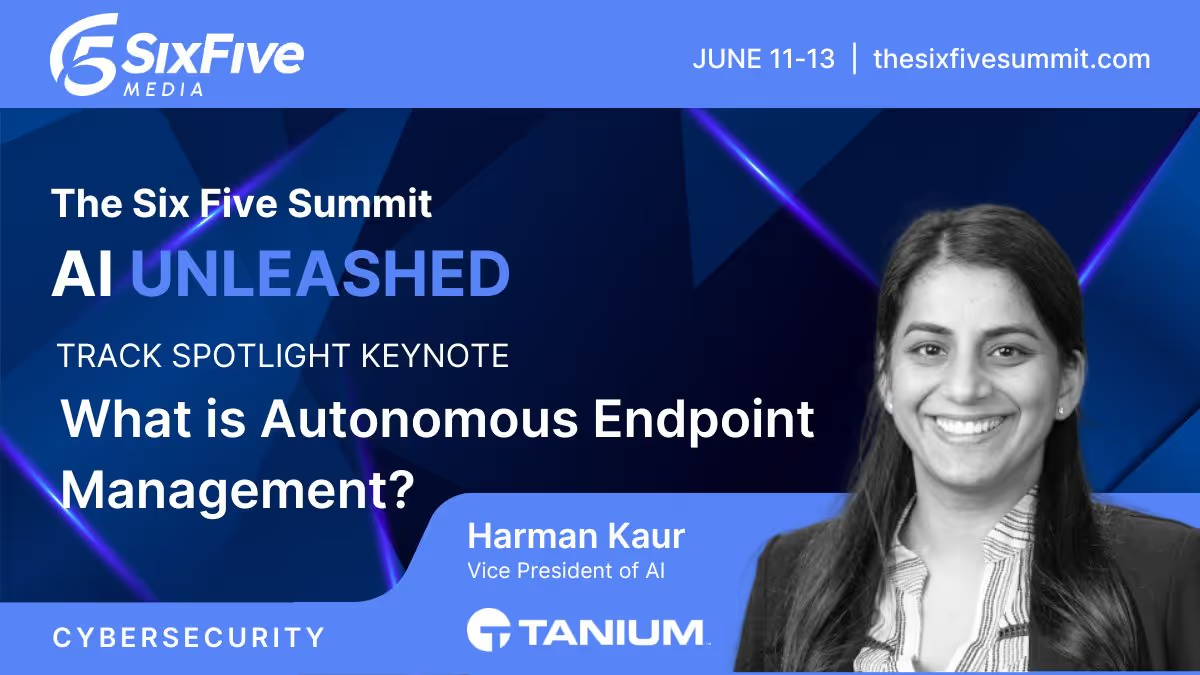
What is Autonomous Endpoint Management?
Autonomous Endpoint Management is a framework designed to unify IT operations and security teams on a single platform through real-time control and visibility.
QUANTUM
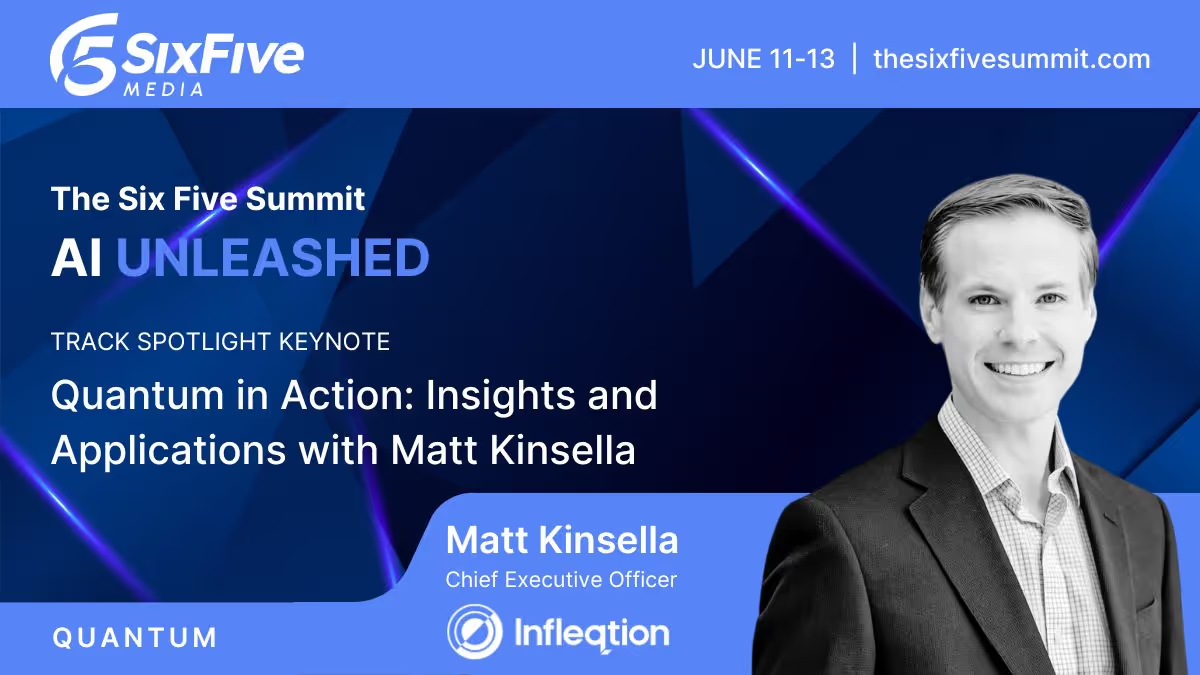
Quantum in Action: Insights and Applications with Matt Kinsella
Quantum is no longer a technology of the future; the quantum opportunity is here now. During this keynote conversation, Infleqtion CEO, Matt Kinsella will explore the latest quantum developments and how organizations can best leverage quantum to their advantage.
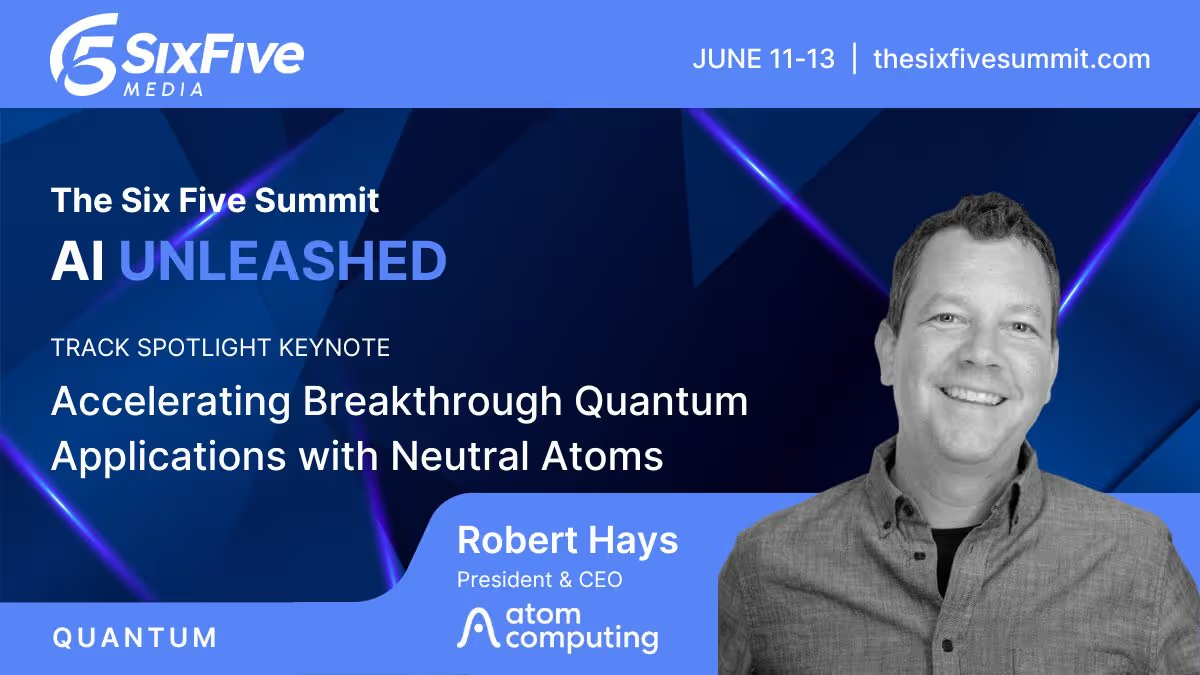
Accelerating Breakthrough Quantum Applications with Neutral Atoms
Our planet needs major breakthroughs for a more sustainable future and quantum computing promises to provide a path to new solutions in a variety of industry segments. This talk will explore what it takes for quantum computers to be able to solve these significant computational challenges, and will show that the timeline to addressing valuable applications may be sooner than previously thought.