Home

Scaling AI Infrastructure: Lessons from the Lenovo and Nscale Partnership - Six Five On The Road
Scaling AI Infrastructure: Lessons from the Lenovo and Nscale Partnership - Six Five On The Road
SHARE


Patrick Moorhead and Daniel Newman are joined by Lenovo’s Conor Malone and NSCALE’s Stu Pann to discuss the real-world challenges of scaling AI infrastructure from pilot projects into production environments.
As AI systems move out of pilot mode, infrastructure challenges become operational realities.
Patrick Moorhead and Daniel Newman sit down with Conor Malone VP, CSP, ISG of Lenovo and Stu Pann Senior Advisor at Nscale to break down what it actually takes to deploy and operate production-grade AI infrastructure. They focus on the gap between early experimentation and real-world execution, where systems grow denser, power demands rise, and deployment complexity accelerates.
Drawing on lessons from the Lenovo–NSCALE partnership, their discussion highlights how close collaboration between infrastructure providers and CSPs can reduce deployment risk, shorten timelines, and improve operational stability. As these advanced computing environments continue to scale, our guests underscore why architectures, processes, and partnerships must evolve continuously to keep pace with rising performance and efficiency demands.
Key Takeaways Include:
🔹 Scaling AI infrastructure is harder than early pilots suggest: Moving from experimentation into production exposes gaps in power availability, cooling capacity, deployment processes, and operational maturity that pilots rarely reveal.
🔹 Execution discipline matters as much as platform choice: Successful deployments depend on coordinated delivery, repeatable processes, and operational rigor, not just hardware specifications.
🔹 Power and cooling are defining constraints at scale: High-density AI systems force organizations to rethink data center design, energy access, and thermal management strategies.
🔹 Platform partnerships reduce deployment risk: Collaboration between infrastructure providers and CSPs helps manage complexity across design, delivery, and ongoing operations.
🔹 Production AI requires continuous evolution:As systems become denser and more demanding, architectures and operating models must adapt to support long-term scalability and stability.
Learn more at Lenovo.
Watch the full video at sixfivemedia.com, and be sure to subscribe to our YouTube channel, so you never miss an episode.
Listen to the audio here:
Disclaimer: Six Five On The Road is for information and entertainment purposes only. Over the course of this webcast, we may talk about companies that are publicly traded, and we may even reference that fact and their equity share price, but please do not take anything that we say as a recommendation about what you should do with your investment dollars. We are not investment advisors, and we ask that you do not treat us as such.
Patrick Moorhead:
The Six Five is On The Road here at Lenovo Tech World in Las Vegas at the iconic sphere. The crowds are coming in right now. Hopefully you can see all the action. Daniel, I'm excited for the big show.
Daniel Newman:
Yeah, it's buzzing right here. We're an hour before. I mean, lines were wrapped around the building. The icons is not the iconic is not just the sphere.
That's the icons of the industry. The titans of the industry are going to be rolling through here over the next few hours. And frankly, we're at an inflection point where there's a lot to be said. And I mean, it's going to be, of course, uh, covering the whole gamut of all things AI. But I'm getting I'm starting to get goosebumps a little bit. I'm excited to hear what's going to be said today.
Patrick Moorhead:
Yeah. I mean, listen, uh, we might be here in Las Vegas at a specific consumer show, but there's an incredible amount of infrastructure that's being discussed. And, Daniel, I remember people 2 or 3 years ago were saying, hey, infrastructure is dead. Infrastructure is a commodity.
Now look at us in the age of AI. It's absolutely banging. And whether it's the hyperscalers and NIO clouds and everything in between. This is absolutely rocking. The complexity of the installs, getting these systems up and running. There are only a few people who can actually do this reliably. Things like, you know, GPUs burning up, networking, being misconfigured. And now you have.
Daniel Newman:
Melting pot burning.
Patrick Moorhead:
And now you have two and a half ton racks that can barely even sit on a stage. Here in Las Vegas, we saw two of those today. One of the companies that is absolutely crushing it out there as a neo cloud is Nscale. And they have partnered with Lenovo on this. And I'm really pleased to introduce Conor with Lenovo and Stu an advisor to end scale.
Stu. It's great to see you again. Again. I've known Stu for 25. Well, no. Since 95, I guess. Yeah. This is our 30th anniversary. 30th anniversary? How about that? Anyways, good to see you. Great to see you. Great to be with you guys today. Thanks for being here. Thanks for having us. Absolutely.
Daniel Newman:
Well, it's good to have you back. Stu, it's been been a minute. Um, look, this stuff is hard. I mean, operationalizing this stuff is very hard. So I want you to have you share a little bit about how how NCL doing that. But before you do that, why don't you just give everybody just a quick. You know, there's a lot of neo clouds popping up. If you haven't heard of any scale, give them like the, you know, the 38 second elevator pitch too.
Stu Pann:
Well, I think, you know, Nscale, you know, is first and foremost a European company. And so we've built our business, you know, starting in Europe, starting with, you know, great power capability in Norway and then expanding in the US and to expand around the world. But our start was there. We had the most successful B round in European history, followed by a series C safe round the very next day.
So made, over the course of a couple of days. We raised a Billion and a half dollars. And I think Europe is excited about having a, you know, a European based champion to go ramp this stuff at scale. And that's part of our name is scale. So think of us as, you know, a highly motive, very nimble neo cloud provider based in Europe, but with ambitions to go around the world with our capability.
Daniel Newman:
All right. So given the background and Nscale, doing this, like what's the role you're playing in kind of operationalizing AI at scale and like I know I you know, why is this not as easy as everyone kind of
Patrick Moorhead:
Just rack them and stack them.
Daniel Newman:
We're not we're not just wrapping up data centers. I mean, there's there's a lot of work here.
Stu Pann:
I mean, this is not the PC business. It's not Xeon. It is. You know, the unit of compute is a scalable unit as defined by Nvidia, you know, 16 rack configuration with network racks, storage racks and thousands upon thousands of components, miles and miles of cable. And they all have to show up on time to go energized.
And if you're missing one thing, you don't energize. And because there's so much capital tied up here, you can't miss an hour of being getting to energizing. So what we're working on with partners like Leno was, how do we deliver this brand new unit at the multi ton complexity. Right. You have you have 16 of these two and a half ton racks.
Exactly. You know, how do you sequence it with construction, with logistics, with upstream providers, with you know from time to TSMC starts away for the time it gets energized in a rack. How do you minimize that time?
Daniel Newman:
Yeah, time to token, time to token.
Stu Pann:
But from wafer start to energizing A rack . And that's what we as an industry have to figure out how to do, because we're drawing down immense amount of capital and we have to pay that capital back really quickly. And that's really the work that I'm doing with a number of partners, is how do we take time out of this?
Patrick Moorhead:
Yeah, it makes sense. So, Conner, I'm going to ask you a question and I'm going to see if he, you know, nods here. Um, obviously, um, you know, in scales on stage here, uh, you guys are partners. But I'm curious what came into.
What were the characteristics? Why were you embraced as a solution provider here for them? Because there's a lot of options out there. Yeah, I obviously know, you know, I've been engaged with you guys since you were a legend, so I get it. But but you are doing a ton out there, particularly with the hyperscalers as well.
Conor Malone:
Yeah. So it's interesting, like a lot of the criteria over the years hasn't changed with some of the focuses have. So obviously key and paramount is scale. Lenovo brings scale global manufacturing footprint in region where these things need to be deployed to. And then Stu mentioned this earlier. The other is execution okay.
You have to have a consistent, reliable delivery. Uh, there's lots of other variables that are not any less important. But like it's it's funny how the criteria changed. And the old days of doing hyperscale stuff was all about engineering and custom design work and. Yeah, and pulling costs out of things and that's the thing.
And and still have a great engineering team. That's still a critical part of the puzzle, but it's, uh, it's changed. The the variables have changed in terms of what's most important.
Daniel Newman:
So Stuart you is this.
Stu Pann:
It's absolutely true. I mean it's supply chain. You know doing this kind of supply chain work is unprecedented in this industry.
There's never been a delivery of this amount of volume. You think about Zion started with really with Compaq in the in the late 90s when you and I were working together. Right. Think about that high standard, high volume server model now extrapolated to a scalable unit. Yes. And who would have thought that's the delivery vehicle and without supply chain visibility.
And we're working on this with Lenovo and other partners. How do we get this all linked together and not by spreadsheets. These a lot of these data centers are built by spreadsheets right. You can't do that.
Patrick Moorhead:
That's right, that's right. And then by the way, one thing is new architecture every year by multiple vendors as well.
So in I don't know if there's any standards anymore. Like they're like what's a standard rack. What is standard networking. It's like it's all custom and its churning every year must be a huge challenge.
Stu Pann:
Well, this is where the scalable unit concept is so important. Yes, because it becomes our ramp vehicle.
And, you know, we're perfectly fine with Nvidia doing this work because it's the only way we can manage all the complexity around the installs. Right. But you and I have gone through roadmap transitions. Sure. We never used to do PCs every 3 or 4 months
Patrick Moorhead:
Exactly, and that was really cutting edge.
Stu Pann:
That was now imagine doing something the complexity of a scalable unit once a year. Right. You know, it's it's daunting. But I think with the help of good partnerships, yes, we can figure it out.
Daniel Newman:
Presuming you can actually get your hands on the equipment. Right. Because we know how backed up in difficult supply chain is not it could be memory, it could be turbines, it could be concrete.
Everything right. Everything is constrained. But like in your opinion, it's like where are the the biggest AI infrastructure challenges? Because we hear, um, cooling power and cooling is a challenge. You hear timelines like is this project on time? Like even if you have everything, is it running on time?
Um, orchestrating like, right scale up, scale out, scale across. Um. And then of course, these systems just keeping them stable, right? Keeping them running all hard. Like, what's your order of operations? What's the biggest problem? Clearly, I think in all of them. Right. I mean,
Stu Pann:
But memory is clearly an issue for the industry right now.
Memory is probably the biggest constraint. You know, Dram followed by SSD and then, you know, but we're always competing, which is the toughest constraints, you know, and as we go through this GB 300 and you know to Rubin VR 200, that Ram profile and Ram guidance that we get from Nvidia becomes critical because we can't afford to not match this thing up.
You know, there are differences between the, you know, the two product sets. So we have to make sure our supply chains ramp up, ramp down with good visibility. So we don't have stall inventory. So we worry about everything. Yeah. But you have to worry about the most expensive stuff. And the most expensive stuff is really, you know, the racks.
Right. But we were about construction, right? Getting the folks in West Texas to go build a data center. If they don't show up, we lose the day for two days. So everything matters.
Daniel Newman:
Time to toke it right. I mean, every day that these things. Right? I mean, they're being financed their debt back. I mean, this is where all the bubble stuff comes up, is like, people are going to use this stuff. It's just, can we get it all energized? Can we get it running? Can we get tokens created? Can we get like there is a lot of unknown.
Stu Pan:
But so the company that chose most operational excellence will be the ones that are manageable.
Conor Malone:
Yeah. One interesting wrinkle on that too is and Stu knows as well. But it's not everybody in the out in the audience might.
But it's people talk about the size gigawatt facilities and these massive AI factories. But what's feeding into those factories. So people like us at Lenovo will have to have similar capacity to match. Yes, obviously we're turning racks. We're testing racks. We don't they don't stay with us for quite as long. But it's it's a massive uptick in capacity required to get the amount of racks they need out deployed.
Daniel Newman:
For sure. So once you do get systems implemented, you know, flips on how are you measuring what is the metric or what are the metrics of success after that? Is it? Uh, you know, cost per token divided by reliability. Like what? Is there some special metric that you're looking at right now?
Stun Pann:
We look at a lot. Clearly, you know, the contracts we write are, you know, really per our kind of contracts. So for us, we have to satisfy the likes of Microsoft and other hyperscalers. So that's a certain level of reliability hitting our contracted commit dates because they're building their pals and us being able to energize as they introduce new models.
Right. If they don't have the capacity online they can reduce. So getting the reliability up, getting commissioning done, getting done first token, all those things really, really matter. And we look at all of them. They're about you know, we've got, you know, maybe 30 metrics that we're developing right now between myself and OS Morales of how do we measure success. But it's really that energizing the rack. That's where it all starts. And that's where revenue comes from.
Conor Malone:
Yeah, it's it's interesting because time to time the first token is a is an endpoint for some parts, but a beginning part for others, and then you. Then you have to look at meantime to failure. Right.
And so that's where the kind of test process, test capability and the test capacity I was talking about earlier comes into play, is that we want to shake all that out so it doesn't hurt them. Those racks stay up as long as they're still.
Patrick Moorhead:
By the way, I didn't even say congratulations on the Microsoft deal. I probably should have. You want to brag a little bit about that?
Stu Pann:
You know, we have said publicly we have 200,000 GPUs under contract. Okay. Uh, I the deals that we've done with Microsoft are equally they're fair, they're aggressive.
We're very clear on what we have to do with each other. We know when we have to deploy. We know how much we have to deploy. So they have been superb partners plus their investment grade. Yes. Plus Microsoft. And in fact, we just recently hired Nitty Chappell, who was the person that ran infrastructure at Microsoft who manages a fleet roughly 2 million GPUs.
Right. So she knows how to do this right at scale, right? In terms of, you know, operations. And so between knitting myself and a bunch of us who are coming on board, we feel like we've got the right team to go figure this out. But the relationship with Microsoft is integral to our success.
Patrick Moorhead:
That's great.
Daniel Newman:
Well, Connor, it's not this isn't the end. This is like the beginning, right? These partnerships, the need for these data centers, the next five years, we've seen some of the estimates. They're incredible. And it's not going to end in five years either. It's just our ability to predict beyond that is just not that good. But I mean, having said this, how does a partnership like this evolve?
I mean, Lenovo's got to be looking to be building many of these. How are you going to continue to evolve and make these partnerships more meaningful?
Conor Malone:
Well, yeah, it's it's it's a lot different than a traditional like supplier, you know, customer relationship. We we kind of have to look off into the future, figure out where they're going to deploy.
And our other customers obviously. And we have to be proactive about bringing capacity up online because of that roadmap cycle and churn we talked about earlier, this moves, moves, moves, moves and power density goes up. Right. Cooling densities going up. And so you have to do the capacity planning way ahead of that. So where in the world is it going? How much.
Stu Pann:
Well you have to capacity plan at building at pod at rack at tray and at CPU. All those things simultaneously have to be capacity planning and the art of this. The people will be successful who figure out how to do that. Interlock across those five layers.
Daniel Newman:
You would think they build a model to actually do that.
Stu Pann:
And maybe they are.
Daniel Newman:
You know, somebody. I think maybe we'll hear about it from one of the great speakers here today at Lenovo Tech World. Conor, Stu, want to thank you both so much. Thank you. It's going to be a great show. Look forward to chatting more. Congratulations on all the progress. Thank you for your time today.
Conor Malone:
Appreciate it. Thanks for having us.
Daniel Newman:
Thanks folks and thanks everyone for tuning in to this session. We are here pre gaming at Lenovo Tech World. Stay with us for more content. We'll be back really soon.
MORE VIDEOS
.png)
The Main Scoop Ep. 45: Attackers Only Need to Be Right Once. AI Just Made That Easier.
Chad Rikansrud, R&D Software Security Engineer at Broadcom, explains how frontier AI models are finding decades-old mainframe vulnerabilities in seconds, collapsing the complexity advantage that once protected legacy platforms. He outlines why enterprises need faster Security Intelligence (SECINT) ingestion and disciplined human oversight to keep pace with adversaries wielding the same tools.


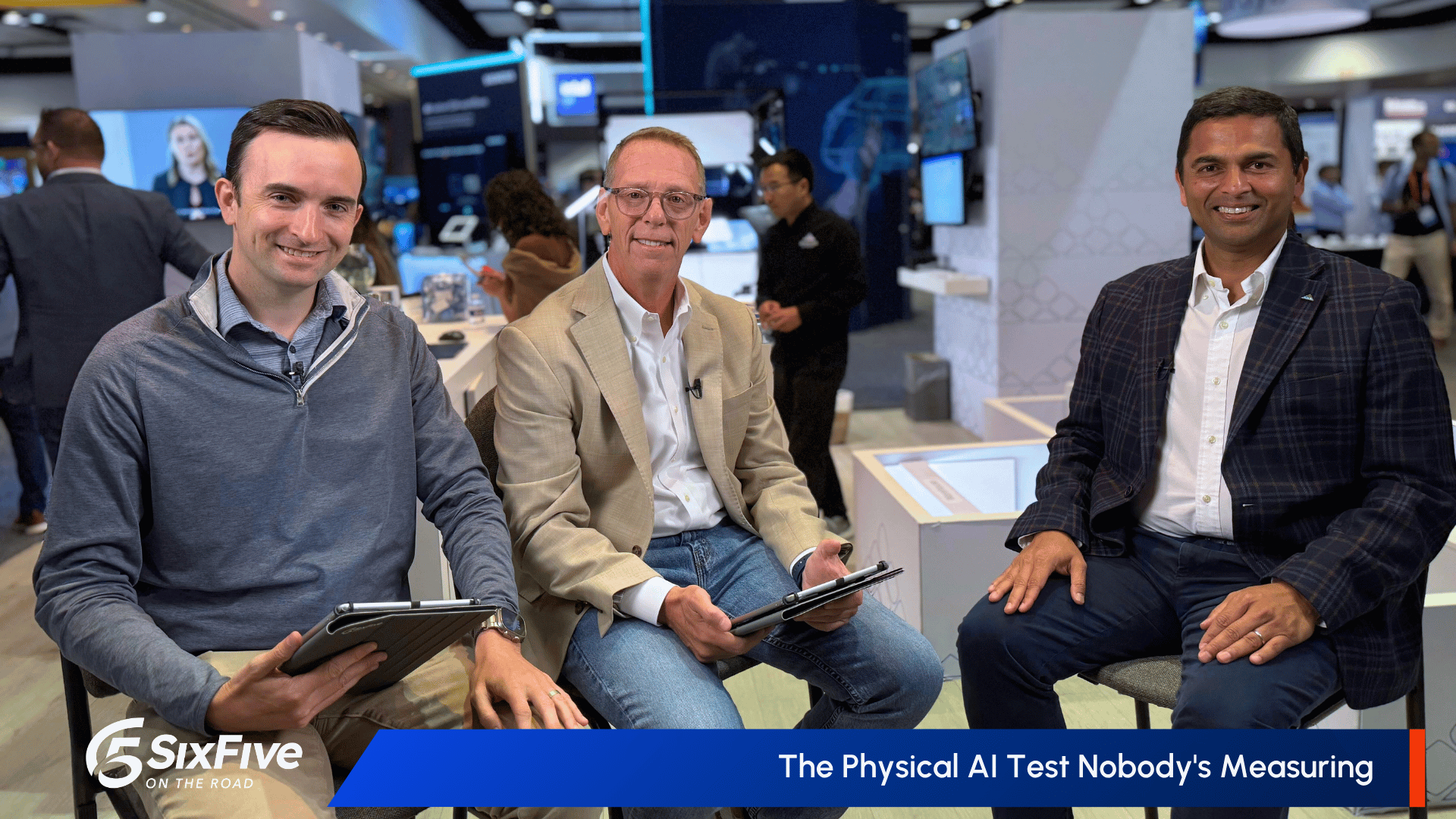
Fleet-Scale Deployment Is the Physical AI Benchmark
Physical AI is shifting from lab prototypes to fleets of machines operating reliably in the real world, and Ambarella's Muneyb Minhazuddin joins Six Five On The Road at AI Infra 2026 to explain what that shift demands of silicon, memory and developer workflows. Minhazuddin traces the case back to a 22-year-old chip architecture and forward to a developer cloud built to compress model porting time from months to days, and he identifies enterprise ROI proof points as the biggest hurdle left before physical AI scales into millions of deployed units.
.png)
AI Safety Alarms, China's Distillation Reckoning, and Qualcomm's AWS Breakthrough: A Pivotal Week for Enterprise AI
A viral AI extinction claim, a federal advisory naming six Chinese AI labs for industrial-scale distillation, and a $60 billion Qualcomm-AWS silicon pact define a week when enterprise AI risk and opportunity collided head-on. Patrick Moorhead and Daniel Newman weigh in on what's signal and what's noise across AI safety, chip supply deals, and a market rally still betting big on compute.
Other Categories
CYBERSECURITY
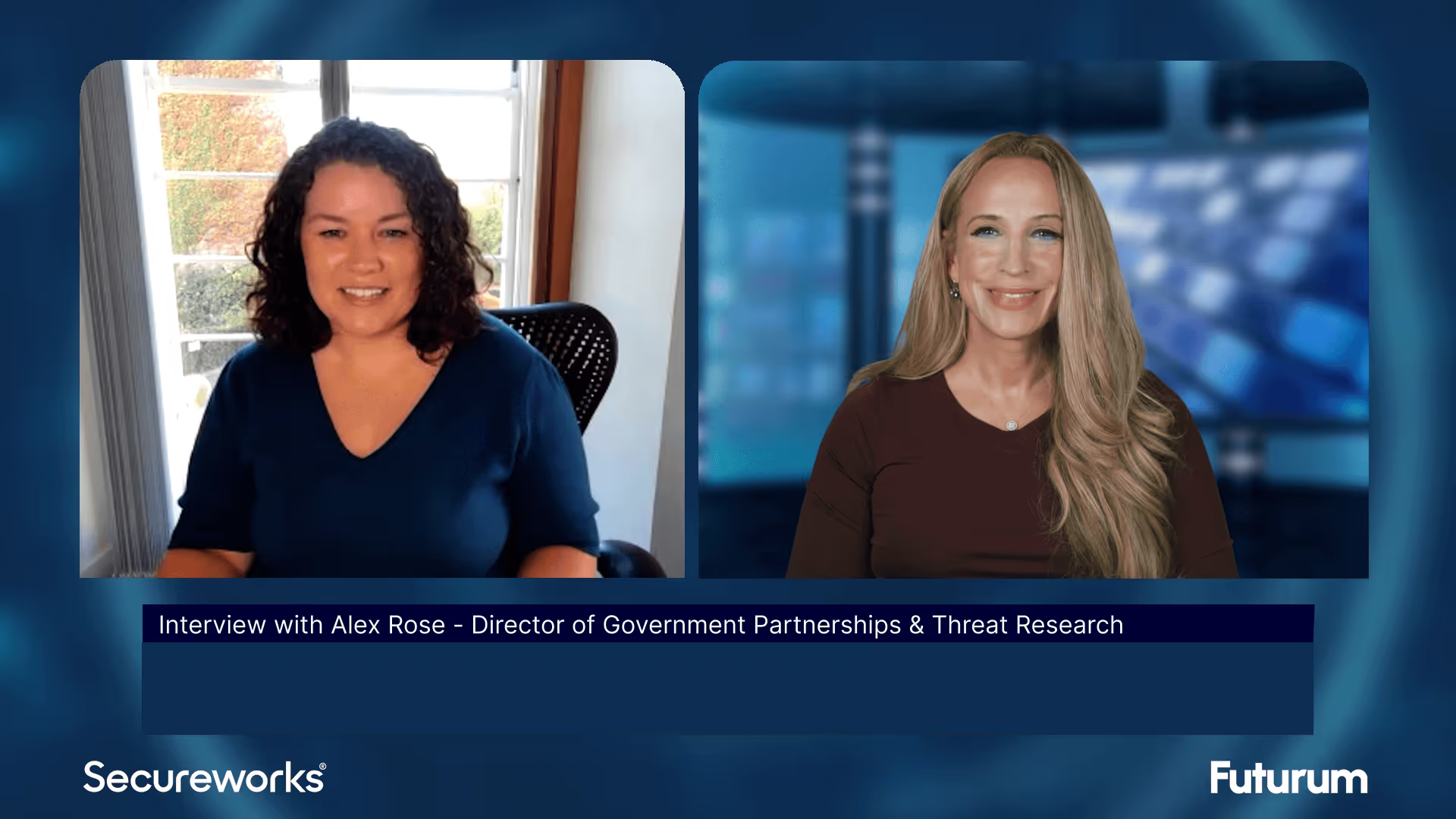
Threat Intelligence: Insights on Cybersecurity from Secureworks
Alex Rose from Secureworks joins Shira Rubinoff on the Cybersphere to share his insights on the critical role of threat intelligence in modern cybersecurity efforts, underscoring the importance of proactive, intelligence-driven defense mechanisms.

HP Launches World’s First Business PCs to Protect Against Quantum Hacks - The Six Five On the Road
On this episode of the Six Five - On the Road, hosts Patrick Moorhead and Daniel Newman are joined by HP's Ian Pratt, Global Head of Security for Personal Systems.
What is Autonomous Endpoint Management?
Autonomous Endpoint Management is a framework designed to unify IT operations and security teams on a single platform through real-time control and visibility.
QUANTUM
Quantum in Action: Insights and Applications with Matt Kinsella
Quantum is no longer a technology of the future; the quantum opportunity is here now. During this keynote conversation, Infleqtion CEO, Matt Kinsella will explore the latest quantum developments and how organizations can best leverage quantum to their advantage.
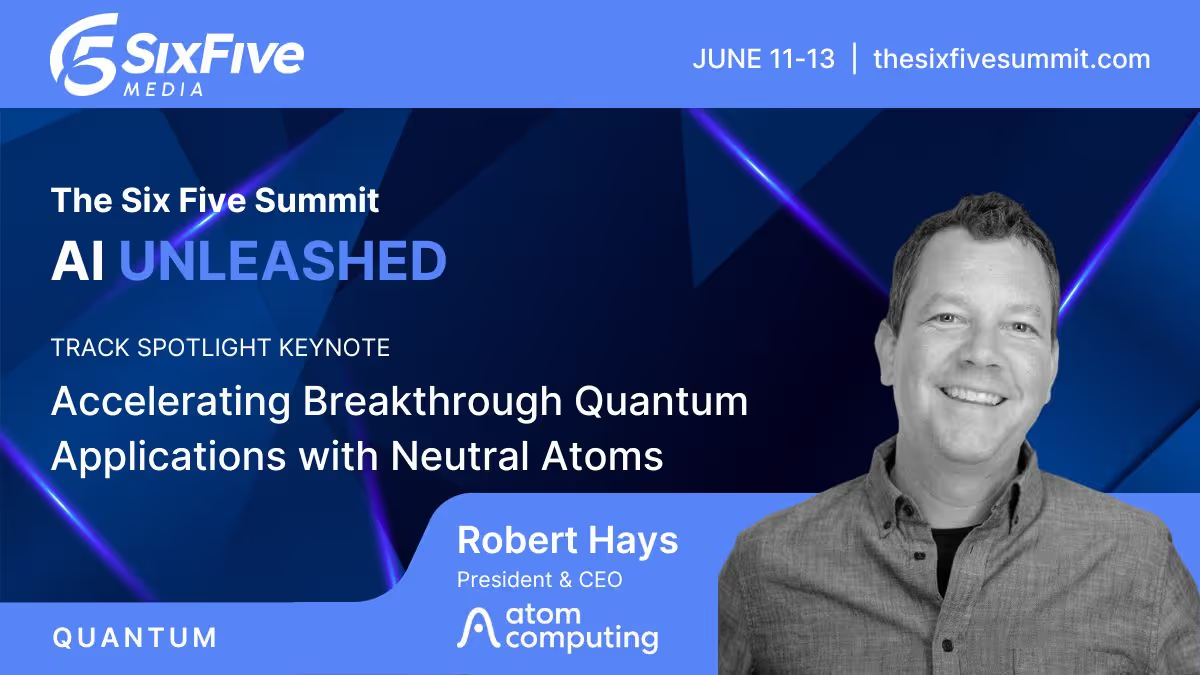
Accelerating Breakthrough Quantum Applications with Neutral Atoms
Our planet needs major breakthroughs for a more sustainable future and quantum computing promises to provide a path to new solutions in a variety of industry segments. This talk will explore what it takes for quantum computers to be able to solve these significant computational challenges, and will show that the timeline to addressing valuable applications may be sooner than previously thought.