Home

The Main Scoop Episode 38: From Mainframes to Modern Al: Lessons Shaping the Next Wave of Innovation
The Main Scoop Episode 38: From Mainframes to Modern Al: Lessons Shaping the Next Wave of Innovation
SHARE


Ellen Rubin, Operating Partner at Glasswing Ventures, joins Daniel Newman and Greg Lotko to share her insights into how early-stage innovations and investor strategies are redefining enterprise AI—touching on lessons from cloud, navigating AI hype, and building resilient partnerships for the future.
How are today's early-stage investors influencing the evolution of AI in enterprise IT, and what lessons are they using from earlier shifts in tech?
On this episode of The Main Scoop, hosts Daniel Newman (The Futurum Group) and Greg Lotko (Broadcom), are joined by Glasswing Ventures' Ellen Rubin, Operating Partner, for a conversation on Funding the Future: Where Enterprise AI Is Headed (and Who’s Backing It). They unpack the effects of early-stage AI innovation on enterprise IT, the sustainability of AI investments, and the proven strategies that drive long-term technology adoption.
Key Takeaways Include:
🔹Infrastructure Lessons for AI: Insights from past transformations in cloud technology and their relevance to modernizing enterprise IT for AI workloads.
🔹Filtering AI Hype from Value: What strategies investors can use to discern meaningful enterprise AI solutions from short-term trends?
🔹Collaboration Trends: How partnerships between startups and established enterprises are enabling innovation in mission-critical environments.
🔹Building for Resilience: The challenges and priorities involved in scaling technology for today’s complex, high-stakes enterprise settings.
Watch the full video at sixfivemedia.com, and be sure to subscribe to our YouTube channel, so you never miss an episode.
Or listen to the audio here:
Disclaimer: The Main Scoop is for information and entertainment purposes only. Over the course of this webcast, we may talk about companies that are publicly traded, and we may even reference that fact and their equity share price, but please do not take anything that we say as a recommendation about what you should do with your investment dollars. We are not investment advisors, and we ask that you do not treat us as such.
Greg Lotko:
Hey everybody, welcome to our next episode of The Main Scoop. Good to see you again, Daniel. It's been a while.
Daniel Newman:
It is good. It's great to be back here. Both of us probably on the road like crazy because you know we love to do these every chance we get when we're together. I think we're going to get together again in the near future. We are, but we mix it up. Also good to be at my desk for once. It's been a crazy, the speed of innovation right now, the new cycle with AI. I'm telling you, Greg, I have never seen the world move as fast as it moves every single day right now. It feels like there's some big thing that breaks. And when I say break, I'm not talking about outages in the cloud, those are only occasional. I'm talking about break like some new $50 billion, $100 billion investment, some new trillion dollar market number comes out. But it's been great. I mean, heck, every day I wake up excited right now.
Greg Lotko:
Well, I think that's one of the really fun things about the whole IT landscape, right? There's always something new and different going on because we always want to be more effective and efficient and drive greater value to the organizations that we work with. I think what we're going to do this time is kind of broaden it out a bit more. We've talked about a lot of different things. We've talked about new innovations in IT from machine learning to AI and much, much more. But I don't think we've ever focused on what can we learn from where we've been, right? I mean, we've gone through these cycles. The technologies have been different. We've figured out how to work with them, get the most out of them, how to connect them to other things. But I don't think we've talked about that specifically as a topic. And, you know, I think that'll be a fun conversation.
Daniel Newman:
Yeah, and maybe even a little bit of how, where we've been is sort of creating this where we're going and then what parts of where we've been, which is something we do talk about a lot, continue to be critical to where we're going. And then of course, what did we learn like what have we learned in these innovation cycles, I mean, hey, heck. They say that this cycle, this AI cycle, is something like seven times faster than the internet. Seven times is one of the numbers being thrown around. I tell you by how I feel waking up every day, it feels like 70 times faster. But it's moving really quick, and I think we have a great guest today.
Greg Lotko:
We do for sure. You know, our guest today has an extensive career in understanding infrastructure challenges. She's been in the space for years, can apply lessons learned from past innovations to today's new wave of IT trends. So let's pull in Ellen here. Ellen, can you share a bit about your work and what drew you to kind of this side of looking at innovation in the ecosystem?
Ellen Rubin:
For sure. All right. Hi guys. Thank you very much for inviting me. And I'm always up for talking about infrastructure, especially when my kids aren't here to roll their eyes and be like, oh my God, it's so boring. And I'm like, no, no, it's so exciting. And now it's even more exciting.
Greg Lotko:
Our kids don't always think what we think is exciting is exciting, but I think there's a little bit of a vice versa there too.
Daniel Newman:
Well, and you know, six years ago, I was talking to a media outlet that told me they no longer want to really write about semiconductors. because it's not interesting anymore. Just telling you like how fast things can change.
Ellen Rubin:
So I'll be brief about myself and then I know we want to kind of get right into it. So I am a three-time founder CEO. I've been in entrepreneurship and innovation for my whole career. And I've spent pretty much all of it in the enterprise infrastructure spaces. There's an older story we can get to in terms of how did that happen and why did I end up there? But long story short, I feel like I started my meaningful career at a company in the data warehousing space called Netiza. And this was pre-cloud. And that was all about huge data management issues and being able to do analytics faster and with greater cost efficiency and just dealing with all sorts of issues that were big data problems. And then from there, I went off and I started my own companies and I've been doing that ever since. Initially in the very beginning of cloud computing and dealing with hybrid cloud and so cloud infrastructure as it was just getting started really when it was like it was Amazon and it was Amazon, you know, and like before the other clouds really took off. And so I can tell you more about that if that's interesting. That company was acquired by Verizon. So I got to be in like the networking world. And then after that, I got all excited about latency as a problem. So I was dealing with hybrid cloud storage at the edge and dealing with issues of kind of dealing with the cloud together with more of an on-prem environment. So that was all going on. That company was acquired by AWS. I worked for AWS for a while in their hybrid cloud storage services and saw what life is like inside the big tech machine. And You know, more recently, about a year ago, I switched to the venture side. So I have that perspective as well. So I am an operating partner at Glasswing Ventures, which is a seed stage venture firm in the Boston area. We just announced our Fund 3, a $200 million fund. And we invest only, and I've only ever invested in AI and cyber. So I kind of get my fix on things that are a little more infrastructure-y on the cyber side. And then on the AI side, a lot of it is more business-specific, more at the application layer, although we deal with data pipeline issues and other stuff as well. So it's a really great mix, and I kind of get to see now this latest generation. So let me pause there. Happy to answer questions.
Greg Lotko:
I think it's a remarkable path. And I was looking at your background, and obviously I didn't look back far enough. I didn't realize we had the overlap with NetEase. I started my career in information management largely around applications and then went into software. And I was in the division at IBM when we acquired NetEase. Oh my goodness.
Ellen Rubin:
Oh my goodness. I should have looked at your LinkedIn more carefully.
Greg Lotko:
That's pretty funny. So I think we can have a lot of fun. And I love I love hearing your background of looking at the whole IT space from a bunch of different perspectives. And I think that's what gives us clarity.
Daniel Newman:
So I got to ask you before we dig in any further. You founded companies, you exited to some very well-known companies. Was it you kind of felt like you hit that point in your career where maybe not time to launch and operate and maybe take a step back and take all that you've learned operating? Because like I've always said, I meet a lot of people that are in venture and PE that that haven't ever operated. And it's really interesting when they come into your boardroom or in your meetings and try to tell you what to do, but you've got this really unique perspective. Cause you're like, I've done this, I've been through this, whether it's raising, whether it's building, whether it's scaling, you know? I mean, was it just kind of, you're at this point where you're like, I've got a lot to teach, a lot to pass on. And maybe, cause it's also like you age, like I've been founder operator for, you know, about the last- I'm right there with you, sir.
Greg Lotko:
I had hair.
Daniel Newman:
at one time.
Greg Lotko:
I was scared where you were going there.
Daniel Newman:
No, I just meant like, you know, I think it's a quick way to lose your hair. I mean, operating is a lot of fun, but also there's a lot to probably pass on at this point.
Ellen Rubin:
Right. So it's always a debate in my head, which is, in my soul, I am a founder builder, right? That's what I do. I love the operator side of things. And I've done it now several times, and I have been through an IPO and two acquisitions, right? So I've definitely seen a lot of things, good, bad, very bad, ugly, wonderful. I've seen the full range. And so I love that journey. Along the way, just because you do, I got very involved in the Boston tech community and in particular working with other women founders and women operators. And so I've spent a lot of time now for, it's more than a decade. I think it's maybe closer to two decades where I've done like advisory and I've been an investor and I had gotten involved in some of the early stage venture firms here, including Glasswing. Like I kind of had been doing that in the background, I've been on boards. So like, Part of me is like, I love that because that's such a, it feels like, you know, interesting and engaging and giving back and, you know, building the community here and all that kind of stuff. But then there's the other side of it, of course, where you say like, no, no, no, but I, you know, I want to go do that next thing. And you never know, right? I mean, you never know where things will head, but I definitely had reached the point where I was starting to feel like it was a good time to start to shift the balance more towards that side of it.
Daniel Newman:
Yeah, well you wake up every day is kind of a new problem, you know, not to say that when you're in a founding role you don't have that but it's kind of different because you're not only same problems, your same company different problems I got many companies many problems many things to work on so We focus a lot here on infrastructure. We talk a lot about the mainframe here. And so I do want to get your take, having the history you have. You have to have a bit of an outlook. Infrastructure is changing. IT innovation is happening at breakneck pace. But the mainframe is still very important, fundamentally, to so many different workloads, applications, and the industry as a whole. What's your sort of take on that role of the mainframe in this shifting infrastructure landscape?
Ellen Rubin:
So I had to laugh when you guys invited me and I saw some of the prep questions, because the first thing I thought was, oh, the mainframe. OK, here we go. And my feeling about it a little bit was, what's that quote? It's like, the rumors of the mainframe's demise are premature or something like that. Every time there's a major technology trend, people say, okay, that's the end of the mainframe. We're done with that. How are those things still even running and stuff like that? But I deal with enterprises. My whole career has been with medium up to large and huge enterprises. They got mainframes and they are not giving them up. We used to joke that it was like, out of my cold, dead hands, will you get my mainframe? There's that level of intensity. importance, right? System of records and, you know, like just, and frankly, how well they have performed and held up for so many decades. So, you know, like when we went to the cloud, there was all this discussion about, you know, cloud migration from the mainframes and how was that going to work and whether people were going to do it and were they going to lift and shift and were they going to, you know, modernize their workloads and stuff like that. And I think to some extent, you know, you guys may disagree with me, it a little got walled off where it was like we got all these greenfield things and we have other things that are a little more like virtualized and cloud ready that we're ready to go and let's go do those things and all of our net new applications and we're going to keep some of these other systems and you know i lived in hybrid cloud my whole career so it's kind of like it's okay to have things in different environments based on what's appropriate but there was some aspect of that Now fast forward to AI, where there's like, okay, we want the mainframe still as a platform, but we need it to be available to AI workloads. And we need it to be integrated in with other things that we're doing that could be living, that are certainly living in the cloud, most of them, but also could be living in other types of environments given how difficult it is to put your AI workloads in the right place at the right cost with the right performance. There are all these issues that I'm sure we'll talk more about. So what I've been seeing is that there are both big companies, which you guys probably know a lot about, and also startups that come pitch me and the Glasswing team about COBOL migration, modernization of mainframe environments to enable the workloads to either run in place or to be able to now actually move into the cloud and to be able to span across multiple environments and being able to automate it, but also being able to enable a lot of the provability that the workloads will run appropriately once they have been either modernized and or migrated. And so that's a lot of the stuff that I'm seeing. And I think that those are things that are clearly underway and people are believing is going to take place, which is great because basically that allows kind of this whole next generation of technology. So I'm sure you guys have other things you want to add about that, but that's what I'm seeing. Like ironically, I see people pitching me not just about apps and all sorts of other stuff, but they're also doing this specific type of mainframe related workload because it's just so critical to a lot of the businesses.
Greg Lotko:
And I love the way you said that. You started with talking about connected, but the word I picked up the most on was the idea of integrated, right? Because it's not just about connecting to access, pulling data from here or there or wherever, mainframe or somewhere else. It is about the integration of these technologies where I think that's where the biggest magic happens when you're using the strengths of each of these things orchestrated or coordinated together versus little silos or repositories or pulling from here and aggregating somewhere else. And I think that was the challenge. I agree with you. Initially, when people were talking about the cloud error, it was one or the other. It was a lift and a shift. And then it was a, how do I connect and get what I need, but do everything else here or there or somewhere else. And it's absolutely evolved into an integration. So I'm curious, if you look at the infrastructure space today and you look at the, you talked a little bit about a journey, the journey to cloud, but what do you think are kind of the biggest challenges today and how are they evolving? Or are we just kind of really learning the same lessons over and over and having to figure out how to integrate things?
Ellen Rubin:
Right, like sometimes when I'm as old as Daniel, you and I both are, I feel that like it's like the same movie again and again, except that it's not exactly the same movie, right? We know this. So of course, today we have massive data center power and growth, supply demand issues that are just overwhelming. And then of course, there's access to GPUs and all the chip issues. So we've got that going on. And those are, I don't want to say unprecedented, because of course we had times before where there were these surges of growth, but at like seven times the speed of a previous innovation wave, this is more like a tsunami, right? So like everyone's just scrambling and running around. So we'll just put that to the side. That's one whole, I'm sure, longer discussion we could have. But then when I think about what the other problems are and what I see in terms of the companies that are building new technology that are more infrastructure related, there really takes on the old things. So what are the things that have always been problems, right? scalability, performance, there's latency, there's cost, right? There's optimization of cost performance, right? We got all of those types of issues. And then you've got the whole security and compliance side of things, which now has a whole new range of opportunities of scary malicious things that can happen that are not out of our wildest imagination, but they're beyond the things that we have already instrumented. We've got all of those things going on. Those are all old things. Those are things that we've had to deal with before. It's the pace of the innovation that's happening and how fast enterprises are adopting these technologies and going full speed ahead. They've moved through that whole cycle that I've lived through now a couple of times of like, Oh, we're going to have a little team that's just going to work on something and they're like the skunk works team and they're going to go do things and to it starts to spread across the organization. And then, you know, the CIO gets crazed and everybody's screaming about, you know, all the risks and all that kind of stuff like that collapsed into like a year. Right. And then we're already into the business units are running these. operations, some of them are still in pilots, but a lot of them are actually building their own AI agents and thinking about how they're going to run things in more of an autonomous way. And they're doing it relying, again, on the infrastructure to be available to them and to support them. And so that's a huge pressure. And inevitably, I'm always engaged with the CIO and the engineering and IT teams. That's very frequently where I've spent my time and my efforts building my companies. And you got to have some, I want to say, empathy with them in terms of the pressure that they're under to ship code faster, to speed up, to with fewer people, let's go, all that kind of stuff. But without creating risk to the business, that could be quite substantial. So I'll pause there in case that's not the direction you guys wanted to head in. But to me, that's where it looks. And I like things that solve very, very pragmatic and seriously day-to-day business problems. And so the infrastructure issues are back, front, and center, in my opinion.
Daniel Newman:
Well, there's a lot of similarities that you can map to each generation of infrastructure. And then there's obviously a lot of differences. And of course, you sort of use the word tsunami. You know, I've talked to countless, you know, both enterprises and CEOs and investors right now. And most of them, you know, continue to talk about, you know, they use the word insatiable demand. You know, we've got this word that gets thrown around a lot about a bubble. You know, I've never seen it really be a bubble when you have constrained supply and unlimited demand. Now, at some point, could we build too much? Could we have too much? Yes, that is absolutely possible. But I think when you literally can't get a turbine right now to build a data center for five years, I think we've got a window of time where we're going to build this stuff. But besides that sort of breakneck pace, is there anything from those sort of earlier generations that you're seeing that we can learn from? you know, how do we avoid sort of underestimating the complexity and getting ourselves too modern at this pace? Because that's the one thing, like, I think where AI seems to do much better than us as humans. Like, we tend to stick our, you know, claws in with how it's always been, Ellen. We don't want to change. I see it a lot, like, with the, I call it the cult of I'm a something, a certified something, meaning I am a certified on one platform and we will, you know, I will resist. Claude code, or I will resist, you know, like, how do we make sure we don't do that? Cause that's what I think the biggest risk to enterprise is right now.
Ellen Rubin:
Yeah. I do see that as well. Like there's the. you know, like on the engineering side, there are the developers who have spent a lot of time, and this is true, equally true on the IT side as well, but there's a lot of like, I've built my career on understanding certain platforms, certain processes, I've built those processes, I know they work. And now you're asking me essentially to learn a whole bunch of new skills and also throw out a lot of the stuff that I built before because it's too manual and requires too many people to maintain and manage it versus things that we might be able to do in the future. And that's a lot. Again, I have empathy with that issue. But on the other hand, it's kind of like, but that's where we are. So we got to move forward. When I think about the, like, what do I see the companies having learned, right, you know, in terms of this new wave of adoption, like there are all these potential roadblocks or things that might be, you know, slow down or whatever. But in terms of the things that I'm seeing that are different this time, one is that the people who are building and adopting AI native technology are very sensitive to this issue of integration, Greg, that you were talking about, and the fact that a lot of them got really hosed where they built all of these siloed systems. And then they found out that they're, you know, people used to say to me, like, I have copies of my data all over the place, like 10 different environments, because every time we need to do stuff, we know we don't want to move the data around, right? Better not to move the data around. but like on the other hand, what are we supposed to do? And all these big data lake projects that got done and stuff like that. So people are very sensitive to that now. And they're thinking right up front about where are we? We have to train these models. Where are we going to train them? Where is that data going to come from? How are we going to protect it and make sure that we're not making anything available just generally out to the internet or to other customers and stuff like that? What do we do about that? And so they're being more, I would say, mindful of that right up front. And then they're also, I think, trying to come up with Metrics of Success. for some of the pilots and the testing that they're doing. Because as you may recall, back in earlier waves of technology, it was just like, throw it against the wall, see what sticks. 10 different people were doing stuff they didn't even know about it. We used to talk about shadow IT. We used to talk about all of these people gone rogue and stuff like that. And that was part of the adoption, but it also was part of the resistance, right? Like, oh my God, we've created a mess here. A lot of the regulated industry companies that I talk to who are adopting AI, they are adopting AI and they're doing it under a lot of urgency that they feel that they need to do it. But they're saying, we know that there's a chance that AI could actually break our compliance and we might not even be aware of it, right? Like we had processes that would try to make sure that we stayed in compliance because we knew what those processes were. But now there are all these like, who even knows? So they're trying to think about a lot of those risks and security things up front. And I feel like there's a lot of mindfulness to it. And, you know, will there be mistakes? Yes, there will be mistakes. Will we hear stories that become the big stories and everybody's yelling and screaming about them? Yes, that will happen. But I think that, you know, the trend has already gained enough momentum that those won't pause us. Right. They'll pause us, but they won't stop us is maybe the right word.
Greg Lotko:
I want to make sure I've I've I've heard what you're what you've been saying, because I I very much believe it if we're if we're kind of on the same page here. You were talking about how much faster everything's coming at us, but fundamentally, the things that we need to care about in IT haven't changed. Resiliency, security, and stuff like that. So I think about that as, you know, you look at our educational system or you look at what we learned when we were in school versus what our kids learned. The subjects haven't changed. You still do math, you still do social studies, you know, English, grammar, all this kind of stuff. But you're learning in elementary school, but what we maybe learned in middle school or in high school. And there's more to learn. You know, there's more history. There's what we've lived in the last 40, 50 years, which is now history. The subjects stay the same, but the intensity, the amount of information, how fast it's flowing at you and your ability to apply it and integrate it with other things, that's what continues to expand. And I think that ties in nicely with what Daniel was talking about relative to certifications. Because everything is always changing, because technology tends to be additive, I think that's why Daniel and I both viscerally react to somebody who just says, I'm a certified X, Y, or Z. The organizations and the people that are successful are the ones that have fundamental core technological skill that don't trap themselves in a technology for a technology's sake, but they actually use the various technologies out there and can learn and know, hey, it may be a different language. It may be a different platform. I may have to interact or connect this differently, but I know the things I want to get done. Then I hear the new things and the new capabilities. And when we When we reinvent our processes around technology and the power of it versus just redoing what we've done, that's when it all unleashes. And so I think that's kind of what you've been talking about and adding in, Daniel, with the certification, right?
Daniel Newman:
Yeah, I mean, my read on it was that right now, you know, there was people that for a decade or more, I mean, you kind of had the Cisco era, you had the VMware era, you had the AWS era where people were like, this is who I am. This defines me because this is at that moment what infrastructure was sort of seen as.
Greg Lotko:
Right, I'm on this program or a cloud architect.
Daniel Newman:
Yeah, same thing now with developers. And, you know, now basically we're seeing that, you know, and I've had a number of developers, by the way, Ellen, you probably see some of the companies you're investing in, they come to me and they said, I am more productive than I've ever been. You know, and like, because there's like only two, I find it's everything now. This is just how our society is. We're always, it's A or B. We've become incredibly binary in our thinking. And it's probably driven by some of the political fury that we have in the world, but it's like either I'm a programmer and AI is never going to replace me. There's that school. And then there's the I'm a programmer and I've become like 20 times more effective using AI. And I think those are the ones that are going to be most successful. And I think it's that kind of digging in or in basically embracing the future of technology. I don't know if you're seeing your stars. I imagine the ones you're investing in are the ones that are saying we're 20 times
Ellen Rubin:
For sure, for sure. I feel like I keep hearing an 8x, like four times the productivity with half the number of people needed to build and ship and keep rolling out new features and stuff. And, you know, look, we'll see. But the things that are causing the productivity are good, solid, basic things that will become part of our basic hygiene, right? About prototyping and debugging and taking the product requirements and getting them into a format that then they can actually move the whole flow through more quickly. I mean, those are just like real things, right? The whole software development lifecycle has sped up. is that inherently good and right? Who knows? Because still, you have to build things that actually solve problems for customers. The fundamentals of like, are you solving a real problem for real customers will never go away, and I think faster isn't always better in that case. However, when you know what it is that you want to build and you're in a competitive environment where people are building lots of new functionality, you want to be fast and you don't want to have to say, You know, I remember the days when we used to, at Netezza, we would do like a couple of major releases a year. Of course, we had hardware and firmware, so that was even more challenging. And like, you know, the customers could... maybe handle one a year. So they take one, like one major release and that was it. That was the pace we were on, right? And so, you know, you compare that to now, like when I was at AWS, we did like 20 something releases in a year. So, you know, it was just every couple of weeks we were rolling things out, right? It was how it felt.
Greg Lotko:
Well, and for sure, whether you're building the right thing or the wrong thing, you don't want to take that long to figure it out, right?
Ellen Rubin:
Right, worse is you roll it out and it was the wrong thing, right? And it took you six months, right? Yeah, that's right. So I don't know if that's the direction you guys are going in. But just the cultural issues, you know, like you were talking about, like, like, even for companies that are not big, you know, large enterprise, the kinds of companies, even for smaller companies, you have people who got trained and are certified and have the things that they do. And in many cases, in a smaller organization, they built the platform engineering and they built the release cycles and how they deal with it and how they support the application guys and all that kind of stuff they're doing all those things and they deal now within terms of like where's our infrastructure gonna run and what which cloud or multiple clouds likely are we using all that kind of stuff so there are these people who are handling all of those issues and. there is resistance, right? There is some resistance. But I think what you're seeing is that some of them, like what I heard from, we had a gathering of our portfolio companies and all of their, you know, kind of technology leadership. And they were talking about the fact that sometimes somebody younger would come in and they would start to just do something and show like, oh, this, I was able to do this project and I did it myself in like, you know, a couple of minutes, hours, whatever it is, you know, some ridiculous amount of time. And right. And the rest of the team was like, huh. OK. All right, I'm in. Maybe I won't use it for everything, but I'm going to start using some of this new technology right away. Because to your point, I have to. To be excellent in my field, I have to do this.
Daniel Newman:
Yeah, I feel like we're back to the era, though, where it kind of used to be you could do something well or you could do something fast, but it was rarely both. And I still get that from some of, in the organization, you sort of have people that are on the front edge of like, how do we do well and fast at the same time? And then you've got the people that kind of still, like I said, there's so much cultural here that's going on. But I do want to ask you, I was going through your portfolio companies. It looks like the kind of companies that you're investing in and, you know, being early stage, founder-led, that seems to be your sort of ethos and thesis in your investment strategy. It looks like there's companies that are kind of doing a lot of vertical things. Maybe it's pharmaceutical work. Maybe it is FP&A building tools that help companies improve FP&A. I'm super interested because when you get the resistance right now, everybody kind of likens AI to a chatbot. Okay, that's like, okay, so how many people are using chat GPT and willing to pay for and that's supposedly the value of AI. And when you look at it, it's like, first of all, the enterprises have been using AI for decades, in different ways, like machine learning, algorithms, analytics, things that AI have been helping with, of course, now, you've got a lot more autonomy, you've got a lot more you know, ability to generate, whether it's code, generate text, generate outputs, assets, insights. But like, where are you sort of seeing translation? Because, you know, in all these different fields, this is where enterprise AI gets real. Like, hey, we're doing drug discovery. Hey, you know, we've been able to company to, you know, eliminate 80% of cost of finance or get their financials out within 10 days instead of 30 days or things like that. Like, is it happening? And are people paying? Like, are you seeing this turn to revenue?
Ellen Rubin:
Yeah. Okay. So this is part of what's a little fun for me and also different from previous lives. So first, let me kind of just agree with some of the things that you said already in terms of the portfolio. So the founders of Glasswing make the joke that AI is the revolution 80 years in the making. Right? Because if you think about AI, like it was already happening back, you know, kind of World War II, right? You know, like 1950s, there was all sorts of stuff going on. There was another big heyday in the 80s. I'm sure you guys remember. And then, you know, like there's another one. So it's been multiple, at least three multiple, maybe more multiple waves of this technology.
Greg Lotko:
And when I... Systems in the 80s, right? Remember expert systems, knowledge systems, all that. That was AI of the day.
Ellen Rubin:
And it was I mean there was a lot of value in some of those things, it was more that it didn't catch the world's imagination in any meaningful way the way this wave hats right this is like a totally different experience. So, I guess I would say that the things that we're seeing. are very much to your point around, they are very clear, specific business problems that need to be solved, sometimes for specific industries. They can be more horizontal, but they often have a particular set of verticals that are most relevant for them. So you mentioned pharmacy. So our company, Assephfa, we've all been to the pharmacy, right? So we know what it is to go stand in line and they have the wrong thing. And then the pharmacists are overwhelmed and running around with their hair on fire. And you're like, it's not a happy experience many times. So the founder there. who is herself trained as a pharmacist, created a business that is totally based on the AI data that's relevant and necessary here for this particular industry. And essentially, it's for pharmacy chains where the back office operational stuff, all the way through serving the customers, customer experience, but through billing and making sure that the right medications are where they're supposed to be and all that kind of stuff, that's all streamlined and automated and much more accurate and relieves the pressure on some of the teams that are so overworked in these locations. So when I look at that, that's like a good example to me of more of a verticalized type of an approach. And also the fact that what happens in that situation is the customers who are the prospective customers of these startups, selling into enterprise, I've spent my whole career selling into enterprise. And there are things that are difficult to just become an approved vendor, to get through their security reviews. be in their procurement system, and then to just push the whole thing through the whole cycle, even when somebody is like a champion and has budget and all that kind of stuff. Here, what we're seeing for a lot of the companies that we're investing in at this early, early stage is they have revenue right away. They're already hundreds of thousands of dollars of ARR up into low millions of ARR. That was not true in the previous waves of companies. Certainly back in the internet, there was a lot of whatever craziness that happened where companies really just were They weren't really solving real problems necessarily, or even if they were, they were like very sort of short-lived problems. These are hard and solvable problems that the cloud and all of the automation that has been put in place and all the SaaS products that are out there have not solved. And so AI is now coming in and saying, now we're actually going to solve this properly. And so we do see that. Now, obviously, there's a lot of technology chasing a lot of customers. So I'm sure we will see turnover in terms of how many vendors could be solving some of these same problems. But the more specific you can get, the better, both in terms of your data sources and in terms of actual value and impact to the business within even days of the customer using the product.
Daniel Newman:
I'd like to kind of pull this all together from it. You've got three massive successes. Well, maybe not massive. I don't know the exact numbers, but they would sound like they were really big successes. Like I said, I want to hear more about the IPO at some point, but we'll save that one here because I'm always interested in kind of that life, taking something public. But, you know, you've exited to the world's, you know, some of the world's most respected companies in their fields. At the time, it sounds like you went to Verizon. That was the rage, right? That was the time when it was all about mobile and networks. And then you went to AWS when it was all about cloud. And, you know, now you're building things. You know, how do you sort of see this pace accelerating? And how do you sort of see us being able to as a society, because this is probably the one thing, and this is a little big for our show, Greg. I'm going to be candid. We like to get nerdy here, and this is a little more, I guess you call it philosophical. But I think all three of us have agreed on this show, we've never seen anything like it. We've never seen a pace like this of change. But we also agree that there is a lot to be learned from each generation that has come before it. Like, what do you sort of recommend out there to the people in technology, whether they're the people that are still, you know, building and making sure these mainframes run every transaction that, you know, every one of these transactions that we basically do every day is probably touching a mainframe. All the way to the other end of it, to building these future-proof, AI-powered, autonomous, self-healing applications that revolutionize industries. Like, how do you kind of help the founders, help the builders, help the technologists, what kind of advice do you give to them today to be successful in the future?
Ellen Rubin:
I think because the technology is changing so fast at every level, right? You know, at the core infrastructure level and, you know, all of the models, you know, foundational models are changing. And then the, you know, the way in which people are trying to use these things are so different. Like it's like you're trying to build the the plane while you're in the air and you're trying to change the engine out. It feels like that sometimes, I think. The feeling for the startup founders is that, first of all, they have to build in a way that is as agnostic as possible, that the business value that they have, that they know they can solve some of these problems that we were talking about for companies and for their meaningful business issues that they're trying to resolve. If you stay focused on that, But then think about how you're building your company in a way that you haven't bet too much on any one platform and you haven't bet too much on any one source of data, because you just don't know for sure how things are going to change. And be alive and very fast thinking around the fact that you will have to pull in other sources of data and other teams and other usage patterns very, very quickly and that you need to be able to handle that. And so who you hire and like, you know, back to your point about like, if it's someone who's like, well, I'm here because I'm the, you know, X technology guy, you know, as, as part of the team, that's probably not as useful as I tried 20 new tools this past week. And I found this one was really helpful to me. And this one is like a newer thing. And I'm going to switch to that now, you know, and it's kind of like a willingness. It's like a, an intellectual curiosity. That's part of this conversation and hiring for that. And so, you know, like it, It's not to say that only young people can do that. It's a personal trait in terms of how you feel about learning and how you feel about being exposed to things and stuff like that. But in the end, whatever the AI is doing, someone still has to say, why is this company and product going to have something of value in five years? and hopefully 10 years. And if you've lost sight of that and you're just kind of spinning so that people can get ACWA hired for $100 million in salary, well, congratulations is how I feel.
Daniel Newman:
Yeah, there's only a few of those opportunities out there, I think. Me, thanks. There's only a few. Mark did not call me. I would consider that. I'm not sure.
Ellen Rubin:
You're like, I wouldn't rule it out.
Daniel Newman:
But, you know, Mark, if you're out there, you know, give me a call. I've got a lot of ideas. Just one last touching point before I do bring this show to sort of a wrap is because you got me thinking about the Sam Altman comment of the billion dollar one person company. So the billion dollar one person companies because of AI and then kind of the large enterprises sort of, like you said, according aqua hiring, acquiring, building the skill itself. Do you think there'll be a revolution of small companies getting really big because of, I mean, obviously Glasswing, that's got to be part of your thesis of it, but also you guys always need exits. So is it going to be the big companies buying them? Some will go IPO, but like, will companies ever be as big? Like, it just feels like there's this kind of like, does it need to be?
Ellen Rubin:
Right. I mean, OK, I think that unfortunately with some of these things, the hype gets ahead of the reality in terms of like the one guy building a billion dollars. OK. And there will be a couple of those examples where everybody will go like, oh, my God. cursor, you know, like everyone's wandering around and sharing those stories. So you have to pay attention to them a little bit. But I would say that as a company gets to market and gets to revenue and has some early things that look like there's some product market fit, which can be done with a very, very small number of people, maybe just by the founders and one or two people beyond that, you can do that now, right? Because the technology enables it and everything is so accelerated. And then you actually have to build a meaningful customer experience and an ongoing set of processes. Do you need as many people as you used to need? Probably you don't. On the other hand, if you're growing and thriving and succeeding, you still need to engage in the whole lifecycle of customer acquisition all the way through satisfaction, retention, good experiences, hopefully till you build a company that's really a meaningful standalone company. Whether that gets acquired or... Right now, M&A is hot, hot, hot because all of the big tech companies and other companies that are trying to be AI native are like, oh my God, we don't have the talent. The focus is actually much more on the people than it necessarily is on just what do they know at this moment. There's a lot of that going on. That will start to... Inevitably, that starts to settle down. Then you're still building a company that has to actually have products and customers. and still has to manage in a global marketplace with the challenges that that brings. So I think that it's possible that the overall numbers will be smaller, but I don't think it will be like, oh, we can do this. Like 10 people now can basically be a multi-billion dollar company and we can just stay at that size. No, I do not think that. And I guess if you see examples, we can come back and do another session and debate how that happened. But that's my take.
Greg Lotko:
I think this has been a fabulous conversation. I took a lot away from it. I got to tell you, what I heard was, don't build isolated islands. You want a framework or a network. Generalize what you're doing. until you're driving to a specific value. So you need to be open, you need to be flexible, but always focus on what is the value you're delivering, because building technology for technology's sake doesn't get you there. So I do think there's a lot of lessons that we can learn from where we've been, and it is all about interconnectivity and integration.
Daniel Newman:
Yeah, I want us to say thanks so much. I mean, this was this was a lot. You covered a lot of ground and clearly have expertise sort of through generations kind of remind me of one of those, you know, when you go through the music history from your childhood to youth and they show you kind of phasing through your life of the different things that you listen to. I mean, you've gone through kind of each phase. And it seems like a really nice way to put everything together, Ellen, to be able to put it together with that kind of deep history and understanding of where we've come from. And then, of course, being able to change. And I'd like, if I kind of have one big takeaway, it's the same thing I often say to our teams. There's a lot to learn from what's happened in the past, but there's also a lot of risk at over-indexing what's happened in the past when you're kind of trying to decide how to go forward. It sounds like for the builders, the technologists, the founders, everyone that's out there, there's so much to learn and gain and accelerate what you're doing right now with this AI, with all the tools that are going on. But of course, so much of that core infrastructure really still does look the same with maybe slightly different iterations of compute connectivity. Data centers are still data centers. They're a little different now. But at the same time, the kind of purpose, the build, all those things. There's a lot of commonality. But yeah, it'd be great to have you come back and keep talking about this at some point. I just want to thank you so much for the time. And of course, for putting up with Greg and I.
Greg Lotko:
Thanks a lot, Ellen.
Ellen Rubin:
That's awesome. It's totally fun. All right, guys. Great to talk. And I love getting to hang out with people about infrastructure. So thank you for inviting me.
Daniel Newman:
but we covered it all. So, and thank you everybody out there for being part of this episode of The Main Scoop. Hit subscribe, join us for all of our other episodes. We're always having a lot of fun here and we hope you are too. For this episode though, gotta say goodbye. We'll see you all later.
MORE VIDEOS
The Six Five Pod | EP 322: AI Writes Its Own Rules, Copilot Bills by the Task, and Memory Names Its Price
The companies racing to build frontier AI just agreed to referee themselves. Over the same week, launches, investor days, and earnings put a price on that arrangement. Microsoft is charging for finished work, NVIDIA is selling agent containment as infrastructure, and the suppliers AI can't route around, from Synopsys to Micron, are collecting the premium. Patrick Moorhead and Daniel Newman separate signal from stagecraft, then split hard on whether the White House accord actually binds these key players to anything.


The Major Decision Hiding Behind Every Hypervisor Renewal
HPE's Varma Kunaparaju talks with Patrick Moorhead and Daniel Newman about why virtualization licensing changes are forcing enterprises to confront a bigger decision than which hypervisor to choose next: what operating model sits underneath their private cloud and AI factory. He outlines how CxOs can sequence modernization in phases, extend governance across open and frontier models, and decide where automation should replace human approval in IT operations.
Bridging the Capacity Gap: Why Enterprises Are Investing in Agentic Digital Workers
IFS Loops CEO Somya Kapoor joins Keith Kirkpatrick to explain why agentic digital workers stall between pilot and production, and why governance, escalation design, and change management now shape adoption more than building agents does. Drawing on new Futurum research, she shows how enterprises can start with imperfect data and redirect reclaimed capacity toward growth.
Other Categories
CYBERSECURITY
Threat Intelligence: Insights on Cybersecurity from Secureworks
Alex Rose from Secureworks joins Shira Rubinoff on the Cybersphere to share his insights on the critical role of threat intelligence in modern cybersecurity efforts, underscoring the importance of proactive, intelligence-driven defense mechanisms.

HP Launches World’s First Business PCs to Protect Against Quantum Hacks - The Six Five On the Road
On this episode of the Six Five - On the Road, hosts Patrick Moorhead and Daniel Newman are joined by HP's Ian Pratt, Global Head of Security for Personal Systems.
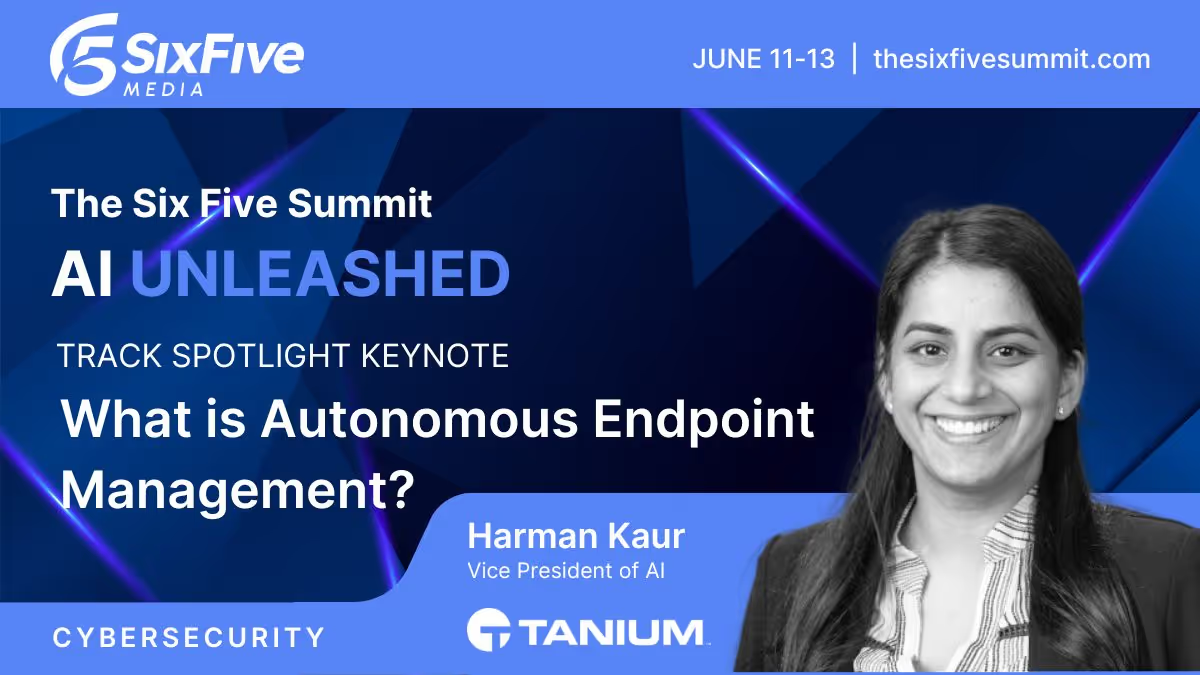
What is Autonomous Endpoint Management?
Autonomous Endpoint Management is a framework designed to unify IT operations and security teams on a single platform through real-time control and visibility.
QUANTUM
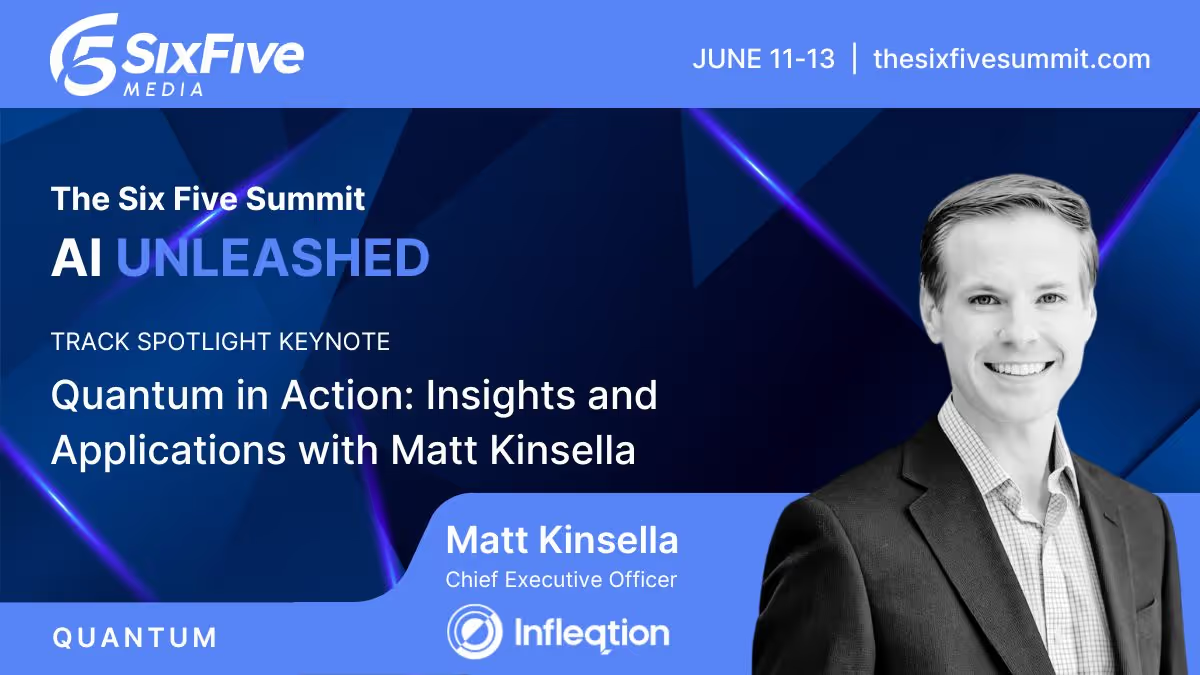
Quantum in Action: Insights and Applications with Matt Kinsella
Quantum is no longer a technology of the future; the quantum opportunity is here now. During this keynote conversation, Infleqtion CEO, Matt Kinsella will explore the latest quantum developments and how organizations can best leverage quantum to their advantage.
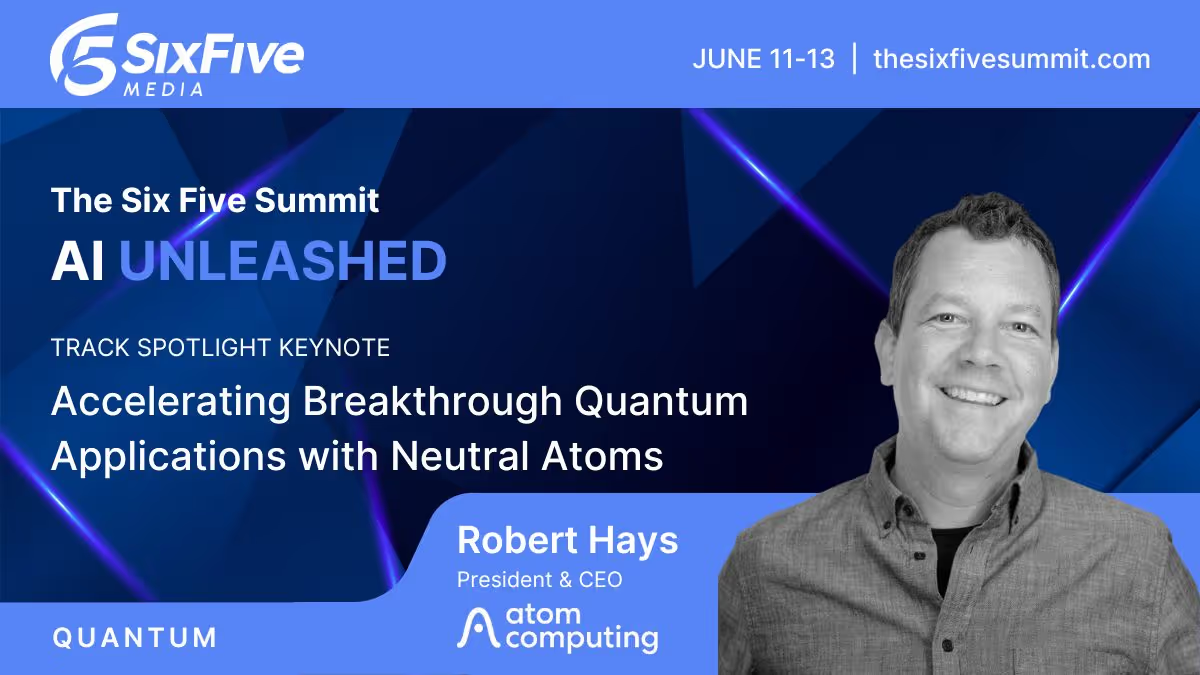
Accelerating Breakthrough Quantum Applications with Neutral Atoms
Our planet needs major breakthroughs for a more sustainable future and quantum computing promises to provide a path to new solutions in a variety of industry segments. This talk will explore what it takes for quantum computers to be able to solve these significant computational challenges, and will show that the timeline to addressing valuable applications may be sooner than previously thought.